R E S E A R C H A R T I C L E
Open Access
The impact of a school-based
tooth-brushing program on dental caries: a
cross-sectional study
Yuri Tashiro
1, Keiko Nakamura
1*, Kaoruko Seino
1, Shiro Ochi
1, Hiroshi Ishii
2, Masaru Hasegawa
2,
Yoshimichi Kawauchi
2and Mitsuyuki Chiba
3Abstract
Background:Promotion of oral health in children is recognized as one of the components of health-promoting schools (HPSs). However, few studies have addressed supportive school environments for children’s oral health. This study aimed to evaluate the status of dental caries in school children at HPSs, with the objective of examining the impact of a supportive school environment for oral health, considering the lifestyles of individual children and the socioeconomic characteristics of their communities.
Methods:Data of 2043 5th-grade students in 21 elementary schools in Ichikawa city between 2008 and 2013 were analyzed. Children’s oral health status was evaluated using the decayed, missing, and filled permanent teeth (DMFT) index. A self-reported lifestyle questionnaire, a survey of the school environment promoting tooth-brushing, and community socioeconomic characteristics derived from the National Census data were included in the analyses. Bivariate analyses were conducted to evaluate the children’s DMFT status, and zero-inflated negative binominal (ZINB) regression was used to assess the relationships between DMFT and other variables.
Results:Prevalence of dental caries in the permanent teeth of 5th-grade children (aged 10–11 years) was 33.3%, with a mean DMFT score (± SD) of 0.83 ± 1.50. According to multilevel ZINB regression analysis, children from schools with after-lunch tooth-brushing time showed a higher odds ratio (OR) for excess zero DMFT (OR = 1.47, 95% CI = 1.00–2.15,P= 0.049) as compared to those from schools without it. Neither bivariate analysis nor ZINB model analysis revealed any significant influence of children’s gender or use of a toothpaste with fluoride. Conclusions:The school-based environment supportive of oral health was significantly associated with a zero DMFT status in children. School-based efforts considering the socioeconomic characteristics of the area warrant attention even with declining prevalence of dental caries.
Keywords:Dental caries, School children, DMFT index, School environment, Zero-inflated negative binominal regression, Cross-sectional study
Background
Poor oral health status in children is a growing public health concern worldwide, as it has been reported to correlate not only with the physical well-being of chil-dren as they grow into adults but also with their socio-economic status (SES) [1, 2], and therefore, promotion
of oral health, especially prevention of dental caries, from an early stage in life needs considerable attention.
Schools are known to be important avenues for chil-dren to acquire knowledge about health [3,4]. A healthy school, or a health-promoting school (HPS), is a com-prehensive school-based concept aimed at developing healthy lifestyle habits, preventing diseases and injuries, and promoting the health of children engaged in school activities through a multisectoral approach [3,5,6]. Pro-motion of oral health in children is recognized as one of the components of HPSs and the relevant frameworks
© The Author(s). 2019Open AccessThis article is distributed under the terms of the Creative Commons Attribution 4.0 International License (http://creativecommons.org/licenses/by/4.0/), which permits unrestricted use, distribution, and reproduction in any medium, provided you give appropriate credit to the original author(s) and the source, provide a link to the Creative Commons license, and indicate if changes were made. The Creative Commons Public Domain Dedication waiver (http://creativecommons.org/publicdomain/zero/1.0/) applies to the data made available in this article, unless otherwise stated. * Correspondence:[email protected]
1Department of Global Health Entrepreneurship, Division of Public Health, Graduate School of Medical and Dental Sciences, Tokyo Medical and Dental University, Yushima 1-5-45, Bunkyo-ku, Tokyo 113-8519, Japan
have been applied worldwide [2,4]. Although not many HPS programs focus on oral health, there are some school-based interventions for reducing dental caries of children [1,2,5,7,8].
Guidelines for HPSs of the World Health Organization (WHO) address the importance of developing a support-ive environment in schools for promoting children’s health [2, 5, 9]. For the promotion of children’s health, individual factors influencing children’s oral health, such as their lifestyles and caretaker’s attitude, also need at-tention [10, 11]. Efforts have been oriented toward es-tablishing policies for safe environments in schools to prevent injuries and secure safe water [5, 9]. However, few practices have yet addressed supportive school envi-ronments for promoting children’s oral health.
Besides these school-based programs, previous studies have explored the SES in children’s communities and their status of dental caries [12–16], indicating the im-portance of considering the socioeconomic characteris-tics of living areas for promoting oral health of children. However, only a few studies have analyzed the independ-ent relationships between status of dindepend-ental caries of Japanese children and school-based programs and socio-economic characteristics of living areas.
This study aimed to evaluate the status of dental caries in school children at HPSs, with the objective of examin-ing the impact of a supportive school environment for oral health, considering the lifestyles of individual chil-dren and the socioeconomic characteristics of their communities.
Methods
Health database
Ichikawa city, located in a suburb of Tokyo with a popu-lation of 490,000 as of 2017 [17], is characterized by communities with a diverse socioeconomic profile. The city launched its own healthy school program in 2005 including oral health programs [18]. As part of the HPSs in Ichikawa city, oral health checkups and questionnaire surveys among 5th-grade students in elementary public schools had been conducted in the selected 5–8 schools annually since 2008.
The program focuses on evaluating the status of dental caries in the permanent teeth of 5th-grade children (aged 10–11 years), which is in the late mixed dentition period for children getting permanent teeth. Children of 5th grade were expected to show greater participation rates than those of 6th grade, the final year of elemen-tary school. Data from oral health checkups conducted from 2008 to 2013 and those from 21 schools were com-piled. A questionnaire survey on the lifestyles of children was conducted in the same schools where oral health checkups were conducted. Clinical dentists delegated by the Ichikawa Dental Association examined children in
each school. Dentists included in this study participated in a training using standardized visual materials before they conducted the dental examination of children. The status of dental caries was assessed through visual exam-ination and probing, and recorded using the decayed, missing, and filled permanent teeth (DMFT) index. Decayed teeth were detected through untreated carious lesions with obvious cavitation, and missing teeth were counted if they were missing due to caries [19].
Oral health-related questions were selected from the children’s lifestyle questionnaire and answers to multiple-choice questions were dichotomized in the ana-lysis. The answer to the first question on breakfast habit was categorized based on whether they eat breakfast or not (“eat alone” or “eat with family” as“Yes” and“often skip breakfast”or“usually do not eat breakfast”as“No”), and other questions were categorized based on the me-dian value of answers to the questions: “Do you eat breakfast on every school day?” (Yes/No), “Do you al-ways eat green and yellow vegetables?” (Yes/No), “How often do you eat sweet snacks (candy, chocolate, chew-ing gum, ice cream, etc.) in a week?”(≤2 days/≥3 days),
“How often do you drink sweetened drinks (juice, liquid yogurt, sports drink, etc.) in a week?” (≤ 2 days/≥ 3 days), and “Do you use toothpaste containing fluoride for brushing?”(Yes/No or Not Sure).
Among 2573 eligible children, 2489 (96.7%) partici-pated in the program and those with missing values were excluded from the analysis. Complete data of 2043 5th-grade children (79.4% of eligible children) were obtained with the cooperation of the Ichikawa Dental Association and used for the analysis.
School environment survey
A questionnaire survey of elementary schools was con-ducted to determine the status of water supply facilities for their classrooms and whether they allocated tooth-brushing time in the school. Since public elementary schools in Japan offer school lunch to their students ac-cording to National law [20] and children usually spend their lunch time together in their classrooms, the exist-ence of school-based after-lunch tooth-brushing time at the time of oral health checkups was used to assess the school environment for tooth-brushing. The results of the school survey were analyzed with the individual chil-dren’s database.
Community characteristics based on the census data
and university graduates was evaluated as the “ commu-nity characteristics” in this study. These data were ob-tained from the National Census of 2010 [24, 25]. The rate of households with school-age (aged 6–18 years) child/children and a single-parent relative to the total number of households of school-age child/children was calculated as the “percentage of single-parent families in the community,” and the rate of people who had graduated from university/graduate schools per total number of people with any academic background among persons aged 15 years or older was calculated as the“percentage of university graduates in the commu-nity.”The census data were obtained at each street level and classified as per districts of the schools. These allo-cated school district-level data were then divided into quartiles (Q1–Q4) based on 21 school areas and in-cluded in the analysis so that the most deprived group (highest rate of single-parent families and lowest rate of university graduates) was included in the last quartile (Q4). Data of quartiles were compared with data of children from schools.
Data analysis
Chi-square test was used to test the associations among the lifestyle questionnaire, community characteristics, and school environment pertaining to after-lunch tooth-brushing by children’s gender and presence of caries. As DMFT scores were not normally distributed (Shapiro– Wilk test: P < 0.001), mean DMFT scores were com-pared using Mann–Whitney U test and Kruskal–Wallis
H test. Considering the skewed distribution of DMFT scores, Poisson, zero-inflated Poisson (ZIP), negative bi-nominal, and zero-inflated negative binominal (ZINB) regressions were employed for modeling the count data of DMFT. Although Poisson and negative binominal re-gressions do not require the assumption of the normality of data, negative binominal regression is preferred over Poisson regression model, as negative binominal model can handle over-dispersed data whose variance scores largely exceed the mean score. Furthermore, zero-inflated models (i.e., ZIP and ZINB) account for data with excess zeros [26–28], and to choose the model with a better fit for the study, a likelihood-ratio test was adopted to compare ZINB and ZIP models, as ZIP model is nested in ZINB [27]. Moreover, Vuong’s test was conducted for a non-nested comparison of ZIP with Poisson and ZINB with a standard negative binominal model [28]. In addition, comparison of Akaike informa-tion criterion (AIC) followed as a measure of goodness-of-fit of the models with the preference for the lowest value. Finally, the ZINB regression model was adopted to assess the effects of independent variables on DMFT scores. The same independent variables were included in all the analyses, and children with missing data were
excluded from the study. As children are nested within schools and their lifestyles may vary according to the schools that they attend, multilevel ZINB regression was also considered to identify whether the association be-tween DMFT scores and other variables still exists after accounting for the differences between schools, with the school used as a grouping factor and use of a random intercept model. Data were analyzed using RStudio ver-sion 1.1.463 (RStudio Inc., Boston, MA, USA) and IBM SPSS Statistics for Windows, version 23.0. (SPSS Inc., Chicago, IL, USA), with the significance level set at 0.05.
Results
Among the 2043 children aged 10–11 analyzed, the per-centage of male children was 53.1%. The prevalence of dental caries in the permanent teeth was 33.3% (n = 680). DMFT scores ranged from 0 to 12, with a median score (10th percentile, 90th percentile) of 0 (0, 3) and a mean score (± SD) of 0.83 ± 1.50.
Table 1 presents distribution of lifestyles of the dren classified by gender. The percentage of female chil-dren who reported a higher frequency of eating sweet snacks (≥ 3 days/week) was higher than that of male children (P = 0.025), and the percentage of female chil-dren who reported a higher frequency of drinking sugar-sweetened drinks (≥3 days/week) was lower than that of male children (P= 0.011). All the schools were equipped with water supply facilities (water taps) in their class-rooms, which the children could use for brushing their teeth. Seven schools reported having allocated a specific time after-lunch tooth-brushing time for the children. Integration of the results of the school environment sur-vey with the individual children’s database showed that 27.8% children attended schools that had allocated a specific time for after-lunch tooth-brushing (Table 1). The percentage of single-parent families by school areas ranged from 7.54 to 16.17% and the percentage of uni-versity graduates ranged from 12.83 to 38.48%, in 21 school areas, respectively.
Figure 1 shows the skewed distribution of DMFT scores according to whether the school had allocated after-lunch tooth-brushing time. The percentage of zero DMFT children among those who attended schools that were and were not allocated after-lunch tooth-brushing time was 72.4% and 64.5%, respectively.
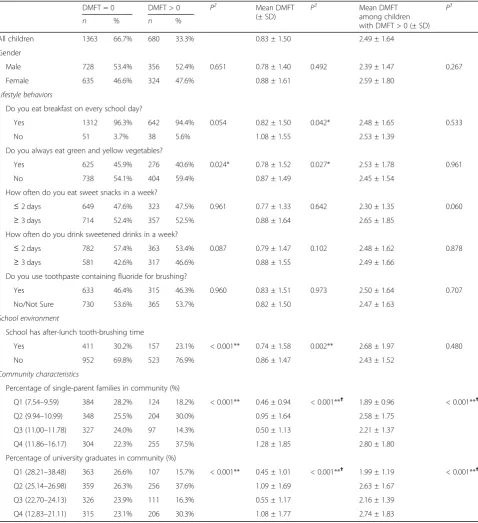
after-lunch tooth-brushing time (0.74 ± 1.58) was lower than that in children attending schools without it (0.86 ± 1.47) (P= 0.002).
Table 3 shows model fit statistics of the four re-gression models. According to the results of likelihood-ratio test (ZINB vs. ZIP, P < 0.0001), Vuong’s test (ZIP vs. Poisson, P < 0.0001 and ZINB vs. negative binominal, P < 0.0001), and comparison
of AIC, a better goodness-of-fit was suggested for ZINB in this study.
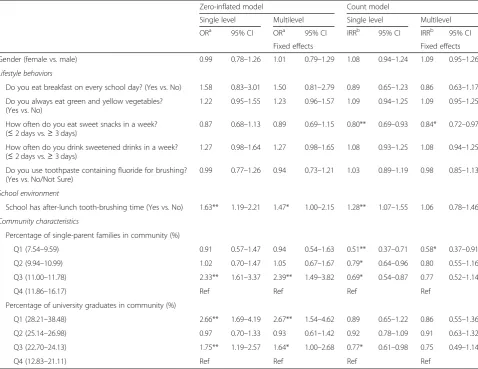
Table 4 summarizes the results of adjusted odds ratio (OR) and incidence rate ratio (IRR) obtained using the ZINB regression model. The ZINB regres-sion combined the model of subjects with zero count into the logit model and subjects with over zero count into the count (negative binominal) model, which enabled the estimation of the risk of caries prevalence (DMFT = 0 or not) in OR and caries se-verity (increase in mean DMFT score) in IRR simul-taneously [26–28]. For the multilevel ZINB model, intercept variances of the random effects of the zero-inflated model and count model part were 0.036 and 0.056, respectively. Children attending schools that had allocated time for after-lunch tooth-brushing showed higher odds of an excess zero DMFT status (OR = 1.63, 95% CI = 1.19–2.21, P = 0.002 in the single-level model and OR = 1.47, 95% CI = 1.00–2.15, P = 0.049 in the multilevel model). The school environment showed an inverse associ-ation with DMFT score in the single-level count model, which was not seen in the multilevel model. In the count model part, a lower consumption of sweet snacks per week (≤ 2 days) was associated with a decreased mean DMFT score (IRR = 0.80, 95% CI = 0.69–0.93, P = 0.004 in the single-level model and IRR = 0.84, 95% CI = 0.72–0.97, P = 0.019 in the multilevel model) as compared to a higher frequency of consumption of sweet snacks (≥ 3 days). With re-gard to the community characteristics, Q3 for single-parent family quartiles and Q1 and Q3 for university graduate quartiles showed higher odds of an excess Table 1Lifestyle behaviors, school environment for after-lunch
tooth-brushing, and community characteristics of children, 2008–2013 (n= 2043)
Total Male Female P1
n % n % n %
All Children 2043 100% 1084 53.1% 959 46.9% Lifestyle behaviors
Do you eat breakfast on every school day?
Yes 1954 95.6% 1033 95.3% 921 96.0% 0.412
No 89 4.4% 51 4.7% 38 4.0%
Do you always eat green and yellow vegetables?
Yes 901 44.1% 462 42.6% 439 45.8% 0.151 No 1142 55.9% 622 57.4% 520 54.2% How often do you eat sweet snacks in a week?
≤2 days 972 47.6% 541 49.9% 431 44.9% 0.025*
≥3 days 1071 52.4% 543 50.1% 528 55.1% How often do you drink sweetened drinks in a week?
≤2 days 1145 56.0% 579 53.4% 566 59.0% 0.011*
≥3 days 898 44.0% 505 46.6% 393 41.0% Do you use toothpaste containing fluoride for brushing?
Yes 948 46.4% 497 45.8% 451 47.0% 0.594 No/Not Sure 1095 53.6% 587 54.2% 508 53.0% School environment
School has after-lunch tooth-brushing time
Yes 568 27.8% 301 27.8% 267 27.8% 0.970 No 1475 72.2% 783 72.2% 692 72.2% Community characteristics
Percentage of single-parent families in community (%)
Q1 (7.54–9.59) 508 24.9% 274 25.3% 234 24.4% 0.692 Q2 (9.94–10.99) 552 27.0% 283 26.1% 269 28.1% Q3 (11.00–11.78) 424 20.8% 222 20.5% 202 21.1% Q4 (11.86–16.17) 559 27.4% 305 28.1% 254 26.5% Percentage of university graduates in community (%)
Q1 (28.21–38.48) 470 23.0% 259 23.9% 211 22.0% 0.515 Q2 (25.14–26.98) 615 30.1% 312 28.8% 303 31.6% Q3 (22.70–24.13) 437 21.4% 232 21.4% 205 21.4% Q4 (12.83–21.11) 521 25.5% 281 25.9% 240 25.0% Qquartile
1
Chi-square test by gender *P< 0.05 (two-tailed)
zero DMFT status both in single-level and multilevel models. Conversely, Q1, Q2, and Q3 for both single-parent family and university graduate quartiles showed decreased mean DMFT scores in the count model as compared to the
reference group, although the results were not statistically significant in all cases. Children’s gender and use of a tooth-paste with fluoride had no significant influence, as analyzed using either bivariate analysis or the ZINB model.
Table 2DMFT status in children, 2008–2013 (n= 2043)
DMFT = 0 DMFT > 0 P2 Mean DMFT
(± SD) P
3 Mean DMFT
among children with DMFT > 0 (± SD)
P3
n % n %
All children 1363 66.7% 680 33.3% 0.83 ± 1.50 2.49 ± 1.64
Gender
Male 728 53.4% 356 52.4% 0.651 0.78 ± 1.40 0.492 2.39 ± 1.47 0.267
Female 635 46.6% 324 47.6% 0.88 ± 1.61 2.59 ± 1.80
Lifestyle behaviors
Do you eat breakfast on every school day?
Yes 1312 96.3% 642 94.4% 0.054 0.82 ± 1.50 0.042* 2.48 ± 1.65 0.533
No 51 3.7% 38 5.6% 1.08 ± 1.55 2.53 ± 1.39
Do you always eat green and yellow vegetables?
Yes 625 45.9% 276 40.6% 0.024* 0.78 ± 1.52 0.027* 2.53 ± 1.78 0.961
No 738 54.1% 404 59.4% 0.87 ± 1.49 2.45 ± 1.54
How often do you eat sweet snacks in a week?
≤2 days 649 47.6% 323 47.5% 0.961 0.77 ± 1.33 0.642 2.30 ± 1.35 0.060
≥3 days 714 52.4% 357 52.5% 0.88 ± 1.64 2.65 ± 1.85
How often do you drink sweetened drinks in a week?
≤2 days 782 57.4% 363 53.4% 0.087 0.79 ± 1.47 0.102 2.48 ± 1.62 0.878
≥3 days 581 42.6% 317 46.6% 0.88 ± 1.55 2.49 ± 1.66
Do you use toothpaste containing fluoride for brushing?
Yes 633 46.4% 315 46.3% 0.960 0.83 ± 1.51 0.973 2.50 ± 1.64 0.707
No/Not Sure 730 53.6% 365 53.7% 0.82 ± 1.50 2.47 ± 1.63
School environment
School has after-lunch tooth-brushing time
Yes 411 30.2% 157 23.1% < 0.001** 0.74 ± 1.58 0.002** 2.68 ± 1.97 0.480
No 952 69.8% 523 76.9% 0.86 ± 1.47 2.43 ± 1.52
Community characteristics
Percentage of single-parent families in community (%)
Q1 (7.54–9.59) 384 28.2% 124 18.2% < 0.001** 0.46 ± 0.94 < 0.001**✝ 1.89 ± 0.96 < 0.001**✝ Q2 (9.94–10.99) 348 25.5% 204 30.0% 0.95 ± 1.64 2.58 ± 1.75
Q3 (11.00–11.78) 327 24.0% 97 14.3% 0.50 ± 1.13 2.21 ± 1.37 Q4 (11.86–16.17) 304 22.3% 255 37.5% 1.28 ± 1.85 2.80 ± 1.80 Percentage of university graduates in community (%)
Q1 (28.21–38.48) 363 26.6% 107 15.7% < 0.001** 0.45 ± 1.01 < 0.001**✝ 1.99 ± 1.19 < 0.001**✝ Q2 (25.14–26.98) 359 26.3% 256 37.6% 1.09 ± 1.69 2.63 ± 1.67
Q3 (22.70–24.13) 326 23.9% 111 16.3% 0.55 ± 1.17 2.16 ± 1.39 Q4 (12.83–21.11) 315 23.1% 206 30.3% 1.08 ± 1.77 2.74 ± 1.83 DMFTdecayed, missing, and filled permanent teeth,Qquartile,SDstandard deviation
2
Chi-square test by DMFT existence
3
Mann–WhitneyUtest for mean DMFT score by gender and questionnaire answer patterns ✝Kruskal–WallisHtest for mean DMFT scores by community characteristics quartiles *P< 0.05 (two-tailed)
Discussion
This study described the status of dental caries in the permanent teeth of 5th-grade students attending HPSs and analyzed its relationships with their lifestyle be-haviors, supportive school environments, and commu-nity characteristics. Some lifestyle behaviors showed a relationship with the status of dental caries, and school-based environment for tooth-brushing after lunch was associated with a higher OR of children with zero DMFT.
The school environment survey revealed that all the schools had water taps in each of their classrooms, and this study focused on Japanese schools that aimed to im-prove their environmental hygiene as one of their healthy school strategies. A physical environment (water taps in every classroom) is an important component as a tangible aspect of the HPS program. This study investi-gated both the tangible (water taps) and intangible (tooth-brushing time) aspects of HPSs and showed their relationship with the status of dental caries in children. Even in some schools that had not allocated school-wide brushing time, they had other programs such as school-wide mouth rinsing or classroom-based tooth-brushing after lunch. A positive attitude toward oral health pro-motion is already quite well established among schools in Ichikawa city, and this study adds further evidence of the school-based environment to encourage brushing to improve children’s oral health status.
The associations between the status of dental caries in children and the community-level SES were addressed in this study. Associations between SES characteristics and prevalence of dental caries at the prefectural level have already been reported in Japan [29,30]. However, dental caries by school- or local district-level SES had been scarcely addressed in Japan. This study aimed to enable stakeholders of schools or local municipalities to con-sider more focused implementation of children’s oral health programs according to each school’s background and their areal socioeconomic environment.
No significant influence of children’s gender on DMFT status was identified in any of the analyses, which is con-sistent with previous reports [31,32]. In addition, no sig-nificant influence was identified in the use of a toothpaste with fluoride. A previous review showed that the use of a fluoride toothpaste for caries prevention was
only significant for toothpastes carrying maximum or higher fluoride concentrations than those approved in Japan at the time of the study [33]. Few Japanese studies have shown an association between topical fluoride ap-plication and caries status in children [10,34]; however, artificial tap water fluoridation and mass topical fluoride application were not implemented in Ichikawa city at the time of the study.
The national average of caries prevalence of school children in Japan has been declining since the last 30 years [35, 36], and in particular, in 5th-grade children (i.e., from 64.1 to 53.9% between 2008 and 2013) [37]. Caries prevalence in the children in this study might have decreased irrespective of the tooth-brushing pro-gram in elementary schools. However, the children in this study had a lower caries prevalence than that re-ported in other studies in Japan [38–40].
This study showed higher mean DMFT scores among children with DMFT > 0 in schools that had after-lunch tooth-brushing time than in those without it; single-level ZINB regression predicted a higher IRR of mean DMFT scores among children in schools with after-lunch tooth-brushing time than those in schools without it. There were only 10 children with DMFT scores over 7 (includ-ing 6 children from schools with after-lunch tooth-brushing time and 4 children from schools with no such allocation) between 2008 and 2013 (Fig. 1). Some schools might have implemented the tooth-brushing program based on the high prevalence or severity of dental caries in children in their school. When a longitu-dinal study to evaluate influence of school-based envir-onment and programs is conducted, adjustment by the status of dental caries at the baseline or standardizing by the prevalence of dental caries by school at baseline is required.
There are several strengths in this study. The study ex-amined the permanent teeth of children in the 5th grade, which is in late mixed dentition period. This allowed the construction of a discussion on the relationship between school environment or programs and the status of dental caries, because permanent teeth generally appear from the age of 6 years, which is the age that children begin to attend school. The association between the status of dental caries of permanent teeth and school environ-ment exposed by the children is worthy for discussion. Table 3Model fit statistics of regression models
Log likelihood AIC
Poisson −2865.93 5759.86
ZIP −2339.21 4734.42
Negative binominal −2398.00 4826.00
ZINB −2326.18 4710.35
Data were collected from multiple sources and com-bined them for a comprehensive analysis, based on long-term experience of HPSs with activities for promotion of oral health. The findings of this study serve as useful in-formation for other communities focused on the promo-tion of children’s oral health. Another strength of this study is the use of the ZINB regression. When modeling count data with many zeros such as DMFT, a zero-inflated model should be considered to avoid the estima-tion parameters [27, 28]. The ZINB regression was shown to be the best fit for this study to obtain inform-ative outcomes with regard to the children’s oral health status.
There are some limitations in this study and the re-sults should be interpreted carefully. The number of per-manent teeth among the subjects who were aged 10–11 is smaller than that of older age children; therefore, the
prevalence of dental caries of permanent teeth presented in this study is age specific. The results of DMFT status should be interpreted carefully to generalize to children of all ages. The analysis is a cross-sectional design, al-though data derives over 6 years; therefore, the results are not able to address causal relationships. To clearly address the effectiveness of school-based oral health pro-grams, a longitudinal design is recommended. Oral health checkups and lifestyle questionnaire surveys were conducted in randomly selected schools every year, and therefore, systematic chronological analysis of data by schools was not possible. Data on community character-istics were obtained from the National Census and allo-cated to school district-level to represent socioeconomic characteristics by school areas; therefore, socioeconomic indicators in this analysis represent characteristics by school areas but not by individual child.
Table 4ZINB regression models of associations between independent variables and children’s DMFT status (n= 2043)
Zero-inflated model Count model
Single level Multilevel Single level Multilevel ORa 95% CI ORa 95% CI IRRb 95% CI IRRb 95% CI
Fixed effects Fixed effects
Gender (female vs. male) 0.99 0.78–1.26 1.01 0.79–1.29 1.08 0.94–1.24 1.09 0.95–1.26 Lifestyle behaviors
Do you eat breakfast on every school day? (Yes vs. No) 1.58 0.83–3.01 1.50 0.81–2.79 0.89 0.65–1.23 0.86 0.63–1.17 Do you always eat green and yellow vegetables?
(Yes vs. No)
1.22 0.95–1.55 1.23 0.96–1.57 1.09 0.94–1.25 1.09 0.95–1.25
How often do you eat sweet snacks in a week? (≤2 days vs.≥3 days)
0.87 0.68–1.13 0.89 0.69–1.15 0.80** 0.69–0.93 0.84* 0.72–0.97
How often do you drink sweetened drinks in a week? (≤2 days vs.≥3 days)
1.27 0.98–1.64 1.27 0.98–1.65 1.08 0.93–1.25 1.08 0.94–1.25
Do you use toothpaste containing fluoride for brushing? (Yes vs. No/Not Sure)
0.99 0.77–1.26 0.94 0.73–1.21 1.03 0.89–1.19 0.98 0.85–1.13
School environment
School has after-lunch tooth-brushing time (Yes vs. No) 1.63** 1.19–2.21 1.47* 1.00–2.15 1.28** 1.07–1.55 1.06 0.78–1.46 Community characteristics
Percentage of single-parent families in community (%)
Q1 (7.54–9.59) 0.91 0.57–1.47 0.94 0.54–1.63 0.51** 0.37–0.71 0.58* 0.37–0.91 Q2 (9.94–10.99) 1.02 0.70–1.47 1.05 0.67–1.67 0.79* 0.64–0.96 0.80 0.55–1.16 Q3 (11.00–11.78) 2.33** 1.61–3.37 2.39** 1.49–3.82 0.69* 0.54–0.87 0.77 0.52–1.14
Q4 (11.86–16.17) Ref Ref Ref Ref
Percentage of university graduates in community (%)
Q1 (28.21–38.48) 2.66** 1.69–4.19 2.67** 1.54–4.62 0.89 0.65–1.22 0.86 0.55–1.36 Q2 (25.14–26.98) 0.97 0.70–1.33 0.93 0.61–1.42 0.92 0.78–1.09 0.91 0.63–1.32 Q3 (22.70–24.13) 1.75** 1.19–2.57 1.64* 1.00–2.68 0.77* 0.61–0.98 0.75 0.49–1.14
Q4 (12.83–21.11) Ref Ref Ref Ref
ZINBzero-inflated negative binominal,DMFTdecayed, missing, and filled permanent teeth,CIconfidence interval,Qquartile
a
Odds ratio for being an excess zero DMFT (0 or≥1) of the group in interest against reference group, holding other variables constant
b
Incidence rate ratio for change in mean DMFT (≥1) of the group in interest against reference group, holding other variables constant *P< 0.05
This study highlighted the existence of children with severe DMFT scores, as a previous study from Japan raised this concern [38]. In addition, this study revealed the relationship between lifestyle behaviors, such as skip-ping of breakfast, and the status of caries in children, al-though no significant association was shown in the regression analysis. As a severe status of caries and life-styles at home often reflect other social aspects or family environment [41, 42], further studies considering the overall lifestyles of children and attitudes of caretakers [11] are required.
Conclusion
The findings of this study indicated that even among children in Japan, where the prevalence of dental caries has already declined, the school-based environment sup-portive of tooth-brushing was associated with a zero DMFT status in children. Higher SES of the communi-ties, where the school is located, were also associated with a zero DMFT status in children. Further school-based efforts considering the socioeconomic characteris-tics of the area warrant attention for promoting chil-dren’s oral health.
Abbreviations
AIC:Akaike information criterion; CI: Confidence interval; DMFT: Decayed, missing, and filled permanent teeth; HPS: Health-promoting school; IRR: Incidence rate ratio; OR: Odds ratio; SD: Standard deviation; SE: Standard error; SES: Socioeconomic status; WHO: World Health Organization; ZINB: Zero-inflated negative binominal; ZIP: Zero-inflated Poisson
Acknowledgements
The authors would like to thank the Ichikawa Dental Association, Ichikawa city Municipal Board of Education, and all the public school teachers in Ichikawa city for their cooperation and support for the study.
Authors’contributions
YT and KN conceptualized the research framework, designed the study, and conducted the school environment survey. HI, MH, YK, and MC conducted school surveys and compiled children’s data. YT, KN, KS, and SO developed the database and merged it with school-based statistics. YT, KN, and SO de-veloped sociodemographic indicators by school areas according to the cen-sus data. YT, KN, and YK designed and conducted a school survey. YT, KN, and SO analyzed data and interpreted statistical and geographical data. YT prepared the manuscript. KN and KS reviewed and provided conceptual ad-vice for the manuscript. All authors read and approved the final manuscript.
Funding
This study was supported by The Tojuro Iijima Foundation for Food Science and Technology.
Availability of data and materials
The dataset of children subjected in the present study is not publicly available due to ethical restrictions. The datasets derived from the National Census, statistics report from Ichikawa city, and reports from the Ministry of Education, Culture, Sports, Science, and Technology are available from respective sources.
Ethics approval and consent to participate
For participation in the healthy school physical checkups and oral health checkups including the lifestyle questionnaire survey, children’s caregivers were sent an Informed Consent letter by the schools through their children, and the checkups and self-report lifestyle questionnaire were conducted with children whose caregivers and the children themselves provided
consent. Data acquisition and analyses of children’s physical checkups, oral health checkups, and lifestyle questionnaire were approved by the Ethics Committee, Ichikawa Dental Association (No. IDA2015-0001). Data analysis protocol was reviewed and approved by the Institutional Review Board, Tokyo Medical and Dental University (No. M2000-2060).
Consent for publication
Not applicable.
Competing interests
The authors declare that they have no competing interest.
Author details 1
Department of Global Health Entrepreneurship, Division of Public Health, Graduate School of Medical and Dental Sciences, Tokyo Medical and Dental University, Yushima 1-5-45, Bunkyo-ku, Tokyo 113-8519, Japan.2Ichikawa Dental Association, Chiba, Japan.3NGO Healthy City Support Organization, Tokyo, Japan.
Received: 16 July 2019 Accepted: 14 November 2019
References
1. Edasseri A, Barnett TA, Ka K, Henderson M, Nicolau B. Oral health-promoting school environments and dental caries in Quebec children. Am J Prev Med. 2017;53(5):697–704.https://doi.org/10.1016/j.amepre.2017.07.005. 2. Kwan SYL, Petersen PE, Pine CM, Borutta A. Health-promoting schools: an
opportunity for oral health promotion. Bull World Health Organ. 2005;83(9): 677–85.
3. World Health Organization. Health promoting school: an effective approach for early action on NCD risk factors. World Health Organization (2017). Accessed 22 Apr 2019.https://www.who.int/healthpromotion/publications/ health-promotion-school/en/
4. Moyses ST, Moyses SJ, Watt RG, Sheiham A. Associations between health promoting schools’policies and indicators of oral health in Brazil. Health Promot Int. 2003;18(3):209–18.https://doi.org/10.1093/heapro/dag016. 5. World Health Organization. Oral health promotion: an essential element of a
health-promoting school. WHO information series on school health– Document eleven. Geneva: World Health Organization, 2003. Accessed 22 Apr 2019.https://apps.who.int/iris/bitstream/handle/10665/70207/WHO_ NMH_NPH_ORH_School_03.3_eng.pdf.
6. World Health Organization. What is a health promoting school? World Health Organization. Accessed 22 Apr 2019.https://www.who.int/school_ youth_health/gshi/hps/en/.
7. Macpherson LMD, Anopa Y, Conway DI, McMahon AD. National supervised toothbrushing program and dental decay in Scotland. J Dent Res. 2013; 92(2):109–13https://doi.org/10.1177/0022034512470690.
8. Wolff MS, Hill R, Wilson-Genderson M, Hirsch S, Dasanayake AP. Nationwide 2.5-year school-based public health intervention program designed to reduce the incidence of caries in children of Grenada. Caries Res. 2016; 50(suppl 1):68–77https://doi.org/10.1159/000439058.
9. Stokes E, Pine CM, Harris RV. The promotion of oral health within the healthy school context in England: a qualitative research study. BMC Oral Health. 2009;9:3.https://doi.org/10.1186/1472-6831-9-3.
10. Mitoh S. Lifestyle factors affecting prevalence of dental caries in infants in Onomichi-city. J Dent Hlth. 2006;56(5):688–708.
11. Nishide R, Mizutani M, Tanimura S, Kudo N, Nishii T, Hatashita H. Homecare protective and risk factors for early childhood caries in Japan. Environ Health Prev Med. 2018;23(1):57.https://doi.org/10.1186/s12199-018-0746-8. 12. Levin KA, Jones CM, Wight C, Valentine C, Topping GVA, Naysmith R.
Fluoride rinsing and dental health inequalities in 11-year-old children: an evaluation of a supervised school-based fluoride rinsing programme in Edinburgh. Community Dent Oral Epidemiol. 2009;37(1):19–26.https://doi. org/10.1111/j.1600-0528.2008.00445.x.
13. Da Rosa P, Nicolau B, Brodeur J-M, Benigeri M, Bedos C, Rousseau M-C. Associations between school deprivation indices and oral health status. Community Dent Oral Epidemiol. 2011;39(3):213–20.https://doi.org/10.1111/ j.1600-0528.2010.00592.x.
Ireland. Community Dent Oral Epidemiol. 2018;00:1–9https://doi.org/10. 1111/cdoe.12390.
15. Skeie MS, Klock KS. Dental caries prevention strategies among children and adolescents with immigrant- or low socioeconomic backgrounds- do they work? A systematic review. BMC Oral Health. 2018;18:20https://doi.org/10. 1186/s12903-018-0478-6.
16. Caker T, Harrison-Barry L, Pukallus ML, Kazoullis S, Seow WK. Caries experience of children in primary schools with long-term tooth brushing programs: a pilot Australian study. Int J Dent Hyg. 2018;16(2):233–40.
https://doi.org/10.1111/idh.12275.
17. Ichikawa city, department of general affairs. Population of the city from the statistical yearbook. Ichikawa city. Accessed 22 Apr 2019.http://www.city. ichikawa.lg.jp/common/000305394.pdf. (in Japanese)
18. Ichikawa-city Municipal Board of Education. Healthy school in Ichikawa. Ichikawa city. Accessed 22 Apr 2019.http://www.city.ichikawa.lg.jp/ edu08/1111000009.html. (in Japanese)
19. World Health Organization. Oral health surveys: basic methods. 5th ed. World Health Organization, Geneva; 2013.
20. Ministry of Education, Culture, Sports, Science and Technology; MEXT, Japan. School lunch act. Accessed 22 Apr 2019.http://elaws.e-gov.go.jp/ search/elawsSearch/elaws_search/lsg0500/detail?lawId=329AC0000000160. (in Japanese)
21. Kato H, Tanaka K, Shimizu K, Nagata C, Furukawa S, Arakawa M, Miyake Y. Parental occupations, educational levels, and income and prevalence of dental caries in 3-year-old Japanese children. Environ Health Prev Med. 2017;22(1):80.https://doi.org/10.1186/s12199-017-0688-6.
22. Kimura M. Social capital, its introduction in public health, and subsequent controversies in Western countries. J. Natl. Inst. Public Health. 2008;57(3): 252–65.
23. Saito M, Kondo N, Aida J, Kawachi I, Koyama S, Ojima T, Kondo K. Development of an instrument for community-level health related social capital among Japanese older people: the JAGES Project. Journal of Epidemiology. 2017;27(5):221–7https://doi.org/10.1016/j.je.2016.06.005. 24. Statistics Bureau, Ministry of International Affairs and Communications, Japan.
Population and households. 2010 Population Census. Accessed 22 Apr 2019.
https://www.e-stat.go.jp/stat-search/files?page= 1&layout = datalist&toukei = 00200521&tstat = 000001039448&cycle = 0&tclass1 = 000001047504&tclass2 = 000001047983&second = 1&second2 = 2. (in Japanese)
25. Statistics Bureau, Ministry of International Affairs and Communications, Japan. Education status of the population. 2010 Population Census. Accessed 22 Apr 2019.https://www.e-stat.go.jp/stat-search/files?page= 1&layout = datalist&toukei = 00200521&tstat = 000001039448&cycle = 0&tclass1 = 000001047504&tclass2 = 000001047983&stat_infid = 000013161812&second = 1&second2 = 2. (in Japanese)
26. Lewsey JD, Thomson WM. The utility of the inflated Poisson and zero-inflated negative binomial models: a case study of cross-sectional and longitudinal DMF data examining the effect of socio-economic status. Community Dent Oral Epidemiol. 2004;32(3):183–9.https://doi.org/10.1111/j. 1600-0528.2004.00155.x.
27. Slymen DJ, Ayala GX, Arredondo EM, Elder JP. A demonstration of modeling count data with an application to physical activity. Epidemiol Perspect Innov. 2006;3:3.https://doi.org/10.1186/1742-5573-3-3.
28. Solinas G, Campus G, Maida C, Sotgiu G, Cagetti MG, Lesaffre E, Castiglia P. What statistical method should be used to evaluate risk factors associated with dmfs index? Evidence from National Pathfinder Survey of 4-year-old Italian Children. Community Dent Oral Epidemiol. 2009;37(6):539–46.https:// doi.org/10.1111/j.1600-0528.2009.00500.x.
29. Liu A, Furuta M, Takeuchi K, Yamashita Y. Dental caries and community socioeconomic status in Japanese and Chinese children: an ecological study. J Dent Hlth. 2016;66(1):32–8https://doi.org/10.5834/jdh.66.1_32. 30. Miyake T, Uene M, Jin K, Tanaka H, Park YD, Kambara M. Relationship
between socioeconomic status and dental caries prevalence in 3-year-old Japanese children. J Osaka Dent Univ. 2010;44(1):87–92https://doi.org/10. 18905/jodu.44.1_87.
31. Chen KJ, Gao SS, Duangthip D, Li SKY, Lo ECM, Chu CH. Dental caries status and its associated factors among 5-year-old Hong Kong children: a cross-sectional study. BMC Oral Health. 2017;17(1):121.https://doi.org/10.1186/ s12903-017-0413-2.
32. Tramini P, Molinari N, Tentscher M, Demattei C, Schulte AG. Association between caries experience and body mass index in 12-year-old French children. Caries Res. 2009;43(6):468–73.https://doi.org/10.1159/000264684.
33. Walsh T, Worthington HV, Glenny AM, Appelbe P, Marinho VC, Shi X. Fluoride toothpastes of different concentrations for preventing dental caries in children and adolescents. Cochrane Database Syst Rev. 2010;1:CD007868.
https://doi.org/10.1002/14651858.CD007868.pub2.
34. Sasahara H, Kawamura M. Relationship between mother’s knowledge, attitudes and behavior towards application of fluoride and caries experience of their 3-year-old children. J Dent Hlth. 2000;50(3):398–406https://doi.org/ 10.5834/jdh.50.3_398.
35. Ministry of Education, Culture, Sports, Science and Technology; MEXT, Japan. Annual report of school health statistics research (2013). Accessed 14 May 2019.http://www.mext.go.jp/component/b_menu/other/__icsFiles/ afieldfile/2014/04/04/1314157_3.pdf. (in Japanese)
36. Matsuyama Y, Aida J, Taura K, Kimoto K, Ando Y, Aoyama H, Morita M, Ito K, Koyama S, Hase A, Tsuboya T, Osaka K. School-based fluoride mouth-rinse program dissemination associated with decreasing dental caries inequalities between Japanese prefectures: an ecological study. J Epidemiol. 2016;26(11): 563–71.https://doi.org/10.2188/jea.JE20150255.
37. Ministry of Education, Culture, Sports, Science and Technology; MEXT, Japan. Annual report of school health statistics research. Accessed 22 Apr 2019.https://www.e-stat.go.jp/stat-search/files?page= 1&toukei = 00400002&tstat = 000001011648. (in Japanese)
38. Kitada K. HinoY, Hamada S, Hamada Y, Oho T. The validity of caries risk tests in dental examinations for elementary schoolchildren. J Dent Hlth. 2006; 56(5):673–80https://doi.org/10.5834/jdh.56.5_673.
39. Yoshioka M, Honnna T, Fukui M, Yokoyama M, Tanabe S, Tamatani K, Yokoyama N, Masuda K, Hinode D, Nakamura R. The effects of supervised fluoride mouth rinsing on dental caries development - analyses of caries development by tooth type and of the relationship between deciduous tooth caries and permanent tooth caries -. J Dent Hlth. 2005;55(5):552-558.
https://doi.org/10.5834/jdh.55.5_552.
40. Igarashi M. Improvement of caries prevalence rate through school dental health activities--activities and results in Sakata and Akumi district--. J Health Care Dent. 2000;(2):34-42.
41. Valencia-Rojas N, Lawrence HP, Goodman D. Prevalence of early childhood caries in a population of children with history of maltreatment. J Public Health Dent. 2008;68(2):94–101https://doi.org/10.1111/j.1752-7325.2007. 00077.x.
42. Goto Y, Wada K, Konishi K, Uji T, Koda S, Mizuta F, Yamakawa M, Watanabe K, Ando K, Ueyama J, Kondo T, Nakata C. Association between exposure to household smoking and dental caries in preschool children: a cross-sectional study. Environ Health Prev Med. 2019;24(1):9.https://doi.org/10. 1186/s12199-019-0764-1.
Publisher’s Note