A Monthly Double-Blind Peer Reviewed (Refereed/Juried) Open Access International e-Journal - Included in the International Serial Directories
Indexed & Listed at:
VOLUME NO.2(2012),ISSUE NO.10(OCTOBER) ISSN 2231-5756
INTERNATIONAL JOURNAL OF RESEARCH IN COMMERCE, IT & MANAGEMENT
CONTENTS
CONTENTS
CONTENTS
CONTENTS
Sr.
No.
TITLE & NAME OF THE AUTHOR (S)
Page No.
1. EFFICIENCY AND PERFORMANCE OF e-LEARNING PROJECTS IN INDIA
SANGITA RAWAL, DR. SEEMA SHARMA & DR. U. S. PANDEY
1
2. AN ADAPTIVE DECISION SUPPORT SYSTEM FOR PRODUCTION PLANNING: A CASE OF CD REPLICATOR
SIMA SEDIGHADELI & REZA KACHOUIE
5
3. CONSTRUCT THE TOURISM INTENTION MODEL OF CHINA TRAVELERS IN TAIWAN
WEN-GOANG, YANG, CHIN-HSIANG, TSAI, JUI-YING HUNG, SU-SHIANG, LEE & HUI-HUI, LEE
9
4. FINANCIAL PLANNING CHALLENGES AFFECTING IMPLEMENTATION OF THE ECONOMIC STIMULUS PROGRAMME IN EMBU COUNTY, KENYA
PAUL NJOROGE THIGA, JUSTO MASINDE SIMIYU, ADOLPHUS WAGALA, NEBAT GALO MUGENDA & LEWIS KINYUA KATHUNI
15
5. IMPACT OF ELECTRONIC COMMERCE PRACTICES ON CUSTOMER E-LOYALTY: A CASE STUDY OF PAKISTAN
TAUSIF M. & RIAZ AHMAD
22
6. SOCIAL NETWORKING IN VIRTUAL COMMUNITY CENTRES: USES AND PERCEPTION AMONG SELECTED NIGERIAN STUDENTS
DR. SULEIMAN SALAU & NATHANIEL OGUCHE EMMANUEL
26
7. EXPOSURE TO CLIMATE CHANGE RISKS: CROP INSURANCE
DR. VENKATESH. J, DR. SEKAR. S, AARTHY.C & BALASUBRAMANIAN. M
32
8. SCENARIO OF ENTERPRISE RESOURCE PLANNING IMPLEMENTATION IN SMALL AND MEDIUM SCALE ENTERPRISES
DR. G. PANDURANGAN, R. MAGENDIRAN, L.S. SRIDHAR & R. RAJKOKILA
35
9. BRAIN TUMOR SEGMENTATION USING ALGORITHMIC AND NON ALGORITHMIC APPROACH
K.SELVANAYAKI & DR. P. KALUGASALAM
39
10. EMERGING TRENDS AND OPPORTUNITIES OF GREEN MARKETING AMONG THE CORPORATE WORLD
DR. MOHAN KUMAR. R, INITHA RINA.R & PREETHA LEENA .R
45
11. DIFFUSION OF INNOVATIONS IN THE COLOUR TELEVISION INDUSTRY: A CASE STUDY OF LG INDIA
DR. R. SATISH KUMAR, MIHIR DAS & DR. SAMIK SOME
51
12. TOOLS OF CUSTOMER RELATIONSHIP MANAGEMENT – A GENERAL IDEA
T. JOGA CHARY & CH. KARUNAKER
56
13. LOGISTIC REGRESSION MODEL FOR PREDICTION OF BANKRUPTCY
ISMAIL B & ASHWINI KUMARI
58
14. INCLUSIVE GROWTH: REALTY OR MYTH IN INDIA
DR. KALE RACHNA RAMESH
65
15. A PRACTICAL TOKENIZER FOR PART-OF SPEECH TAGGING OF ENGLISH TEXT
BHAIRAB SARMA & BIPUL SHYAM PURKAYASTHA
69
16. KEY ANTECEDENTS OF FEMALE CONSUMER BUYING BEHAVIOR WITH SPECIAL REFERENCE TO COSMETICS PRODUCT
DR. RAJAN
72
17. MANAGING HUMAN ENCOUNTERS AT CLASSROOMS - A STUDY WITH SPECIAL REFERENCE TO ENGINEERING PROGRAMME, CHENNAI
DR. B. PERCY BOSE
77
18. THE IMPACT OF E-BANKING ON PERFORMANCE – A STUDY OF INDIAN NATIONALISED BANKS
MOHD. SALEEM & MINAKSHI GARG
80
19. UTILIZING FRACTAL STRUCTURES FOR THE INFORMATION ENCRYPTING PROCESS
UDAI BHAN TRIVEDI & R C BHARTI
85
20. IMPACT OF LIBERALISATION ON PRACTICES OF PUBLIC SECTOR BANKS IN INDIA
DR. R. K. MOTWANI & SAURABH JAIN
89
21. THE EFFECTIVENESS OF PERFORMANCE APPRAISAL ON ITES INDUSTRY AND ITS OUTCOME
DR. V. SHANTHI & V. AGALYA
92
22. CUSTOMERS ARE THE KING OF THE MARKET: A PRICING APPROACH BASED ON THEIR OPINION - TARGET COSTING
SUSANTA KANRAR & DR. ASHISH KUMAR SANA
97
23. WHAT DRIVE BSE AND NSE?
MOCHI PANKAJKUMAR KANTILAL & DILIP R. VAHONIYA
101
24. A CASE APPROACH TOWARDS VERTICAL INTEGRATION: DEVELOPING BUYER-SELLER RELATIONSHIPS
SWATI GOYAL, SONU DUA & GURPREET KAUR
108
25. ANALYSIS OF SOURCES OF FRUIT WASTAGES IN COLD STORAGE UNITS IN TAMILNADU
ARIVAZHAGAN.R & GEETHA.P
113
26. A NOVEL CONTRAST ENHANCEMENT METHOD BY ARBITRARILY SHAPED WAVELET TRANSFORM THROUGH HISTOGRAM EQUALIZATION
SIBIMOL J
119
27. SCOURGE OF THE INNOCENTS
A. LINDA PRIMLYN
124
28. BUILDING & TESTING MODEL IN MEASUREMENT OF INTERNAL SERVICE QUALITY IN TANCEM – A GAP ANALYSIS APPROACH
DR. S. RAJARAM, V. P. SRIRAM & SHENBAGASURIYAN.R
128
29. ORGANIZATIONAL CREATIVITY FOR COMPETITIVE EXCELLENCE
REKHA K.A
133
30. A STUDY OF STUDENT’S PERCEPTION FOR SELECTION OF ENGINEERING COLLEGE: A FACTOR ANALYSIS APPROACH
SHWETA PANDIT & ASHIMA JOSHI
138
CHIEF PATRON
CHIEF PATRON
CHIEF PATRON
CHIEF PATRON
PROF. K. K. AGGARWAL
Chancellor, Lingaya’s University, Delhi
Founder Vice-Chancellor, Guru Gobind Singh Indraprastha University, Delhi
Ex. Pro Vice-Chancellor, Guru Jambheshwar University, Hisar
FOUNDER
FOUNDER
FOUNDER
FOUNDER PATRON
PATRON
PATRON
PATRON
LATE SH. RAM BHAJAN AGGARWAL
Former State Minister for Home & Tourism, Government of Haryana
Former Vice-President, Dadri Education Society, Charkhi Dadri
Former President, Chinar Syntex Ltd. (Textile Mills), Bhiwani
CO
CO
CO
CO----ORDINATOR
ORDINATOR
ORDINATOR
ORDINATOR
AMITA
Faculty, Government M. S., Mohali
ADVISORS
ADVISORS
ADVISORS
ADVISORS
DR. PRIYA RANJAN TRIVEDI
Chancellor, The Global Open University, Nagaland
PROF. M. S. SENAM RAJU
Director A. C. D., School of Management Studies, I.G.N.O.U., New Delhi
PROF. M. N. SHARMA
Chairman, M.B.A., Haryana College of Technology & Management, Kaithal
PROF. S. L. MAHANDRU
Principal (Retd.), Maharaja Agrasen College, Jagadhri
EDITOR
EDITOR
EDITOR
EDITOR
PROF. R. K. SHARMA
Professor, Bharti Vidyapeeth University Institute of Management & Research, New Delhi
CO
CO
CO
CO----EDITOR
EDITOR
EDITOR
EDITOR
DR. BHAVET
Faculty, M. M. Institute of Management, Maharishi Markandeshwar University, Mullana, Ambala, Haryana
EDITORIAL ADVISORY BOARD
EDITORIAL ADVISORY BOARD
EDITORIAL ADVISORY BOARD
EDITORIAL ADVISORY BOARD
DR. RAJESH MODI
Faculty, Yanbu Industrial College, Kingdom of Saudi Arabia
PROF. SANJIV MITTAL
University School of Management Studies, Guru Gobind Singh I. P. University, Delhi
PROF. ANIL K. SAINI
Chairperson (CRC), Guru Gobind Singh I. P. University, Delhi
DR. SAMBHAVNA
Faculty, I.I.T.M., Delhi
DR. MOHENDER KUMAR GUPTA
VOLUME NO.2(2012),ISSUE NO.10(OCTOBER) ISSN 2231-5756
INTERNATIONAL JOURNAL OF RESEARCH IN COMMERCE, IT & MANAGEMENT
DR. SHIVAKUMAR DEENE
Asst. Professor, Dept. of Commerce, School of Business Studies, Central University of Karnataka, Gulbarga
DR. MOHITA
Faculty, Yamuna Institute of Engineering & Technology, Village Gadholi, P. O. Gadhola, Yamunanagar
ASSOCIATE EDITORS
ASSOCIATE EDITORS
ASSOCIATE EDITORS
ASSOCIATE EDITORS
PROF. NAWAB ALI KHAN
Department of Commerce, Aligarh Muslim University, Aligarh, U.P.
PROF. ABHAY BANSAL
Head, Department of Information Technology, Amity School of Engineering & Technology, Amity University, Noida
PROF. A. SURYANARAYANA
Department of Business Management, Osmania University, Hyderabad
DR. SAMBHAV GARG
Faculty, M. M. Institute of Management, Maharishi Markandeshwar University, Mullana, Ambala, Haryana
PROF. V. SELVAM
SSL, VIT University, Vellore
DR. PARDEEP AHLAWAT
Associate Professor, Institute of Management Studies & Research, Maharshi Dayanand University, Rohtak
DR. S. TABASSUM SULTANA
Associate Professor, Department of Business Management, Matrusri Institute of P.G. Studies, Hyderabad
SURJEET SINGH
Asst. Professor, Department of Computer Science, G. M. N. (P.G.) College, Ambala Cantt.
TECHNICAL ADVISOR
TECHNICAL ADVISOR
TECHNICAL ADVISOR
TECHNICAL ADVISOR
AMITA
Faculty, Government H. S., Mohali
DR. MOHITA
Faculty, Yamuna Institute of Engineering & Technology, Village Gadholi, P. O. Gadhola, Yamunanagar
FINANCIAL ADVISORS
FINANCIAL ADVISORS
FINANCIAL ADVISORS
FINANCIAL ADVISORS
DICKIN GOYAL
Advocate & Tax Adviser, Panchkula
NEENA
Investment Consultant, Chambaghat, Solan, Himachal Pradesh
LEGAL ADVISORS
LEGAL ADVISORS
LEGAL ADVISORS
LEGAL ADVISORS
JITENDER S. CHAHAL
Advocate, Punjab & Haryana High Court, Chandigarh U.T.
CHANDER BHUSHAN SHARMA
Advocate & Consultant, District Courts, Yamunanagar at Jagadhri
SUPERINTENDENT
SUPERINTENDENT
SUPERINTENDENT
SUPERINTENDENT
SURENDER KUMAR POONIA
CALL FOR MANUSCRIPTS
CALL FOR MANUSCRIPTS
CALL FOR MANUSCRIPTS
CALL FOR MANUSCRIPTS
Weinvite unpublished novel, original, empirical and high quality research work pertaining to recent developments & practices in the area of Computer, Business, Finance, Marketing, Human Resource Management, General Management, Banking, Insurance, Corporate Governance and emerging paradigms in allied subjects like Accounting Education; Accounting Information Systems; Accounting Theory & Practice; Auditing; Behavioral Accounting; Behavioral Economics; Corporate Finance; Cost Accounting; Econometrics; Economic Development; Economic History; Financial Institutions & Markets; Financial Services; Fiscal Policy; Government & Non Profit Accounting; Industrial Organization; International Economics & Trade; International Finance; Macro Economics; Micro Economics; Monetary Policy; Portfolio & Security Analysis; Public Policy Economics; Real Estate; Regional Economics; Tax Accounting; Advertising & Promotion Management; Business Education; Management Information Systems (MIS); Business Law, Public Responsibility & Ethics; Communication; Direct Marketing; E-Commerce; Global Business; Health Care Administration; Labor Relations & Human Resource Management; Marketing Research; Marketing Theory & Applications; Non-Profit Organizations; Office Administration/Management; Operations Research/Statistics; Organizational Behavior & Theory; Organizational Development; Production/Operations; Public Administration; Purchasing/Materials Management; Retailing; Sales/Selling; Services; Small Business Entrepreneurship; Strategic Management Policy; Technology/Innovation; Tourism, Hospitality & Leisure; Transportation/Physical Distribution; Algorithms; Artificial Intelligence; Compilers & Translation; Computer Aided Design (CAD); Computer Aided Manufacturing; Computer Graphics; Computer Organization & Architecture; Database Structures & Systems; Digital Logic; Discrete Structures; Internet; Management Information Systems; Modeling & Simulation; Multimedia; Neural Systems/Neural Networks; Numerical Analysis/Scientific Computing; Object Oriented Programming; Operating Systems; Programming Languages; Robotics; Symbolic & Formal Logic and Web Design. The above mentioned tracks are only indicative, and not exhaustive.
Anybody can submit the soft copy of his/her manuscript anytime in M.S. Word format after preparing the same as per our submission guidelines duly available on our website under the heading guidelines for submission, at the email address: [email protected].
GUIDELINES FOR SUBM
GUIDELINES FOR SUBM
GUIDELINES FOR SUBM
GUIDELINES FOR SUBMISSION OF MANUSCRIPT
ISSION OF MANUSCRIPT
ISSION OF MANUSCRIPT
ISSION OF MANUSCRIPT
1. COVERING LETTER FOR SUBMISSION:
DATED: _____________ THE EDITOR
IJRCM
Subject: SUBMISSION OF MANUSCRIPT IN THE AREA OF .
(e.g. Finance/Marketing/HRM/General Management/Economics/Psychology/Law/Computer/IT/Engineering/Mathematics/other, please specify)
DEAR SIR/MADAM
Please find my submission of manuscript entitled ‘___________________________________________’ for possible publication in your journals.
I hereby affirm that the contents of this manuscript are original. Furthermore, it has neither been published elsewhere in any language fully or partly, nor is it under review for publication elsewhere.
I affirm that all the author (s) have seen and agreed to the submitted version of the manuscript and their inclusion of name (s) as co-author (s).
Also, if my/our manuscript is accepted, I/We agree to comply with the formalities as given on the website of the journal & you are free to publish our contribution in any of your journals.
NAME OF CORRESPONDING AUTHOR:
Designation:
Affiliation with full address, contact numbers & Pin Code: Residential address with Pin Code:
Mobile Number (s): Landline Number (s): E-mail Address: Alternate E-mail Address:
NOTES:
a) The whole manuscript is required to be in ONE MS WORD FILE only (pdf. version is liable to be rejected without any consideration), which will start from the covering letter, inside the manuscript.
b) The sender is required to mention the following in the SUBJECT COLUMN of the mail:
New Manuscript for Review in the area of (Finance/Marketing/HRM/General Management/Economics/Psychology/Law/Computer/IT/
Engineering/Mathematics/other, please specify)
c) There is no need to give any text in the body of mail, except the cases where the author wishes to give any specific message w.r.t. to the manuscript. d) The total size of the file containing the manuscript is required to be below 500 KB.
e) Abstract alone will not be considered for review, and the author is required to submit the complete manuscript in the first instance.
f) The journal gives acknowledgement w.r.t. the receipt of every email and in case of non-receipt of acknowledgment from the journal, w.r.t. the submission of manuscript, within two days of submission, the corresponding author is required to demand for the same by sending separate mail to the journal.
2. MANUSCRIPT TITLE: The title of the paper should be in a 12 point Calibri Font. It should be bold typed, centered and fully capitalised.
3. AUTHOR NAME (S) & AFFILIATIONS: The author (s) full name, designation, affiliation (s), address, mobile/landline numbers, and email/alternate email address should be in italic & 11-point Calibri Font. It must be centered underneath the title.
4. ABSTRACT: Abstract should be in fully italicized text, not exceeding 250 words. The abstract must be informative and explain the background, aims, methods,
VOLUME NO.2(2012),ISSUE NO.10(OCTOBER) ISSN 2231-5756
INTERNATIONAL JOURNAL OF RESEARCH IN COMMERCE, IT & MANAGEMENT
5. KEYWORDS: Abstract must be followed by a list of keywords, subject to the maximum of five. These should be arranged in alphabetic order separated by commas and full stops at the end.
6. MANUSCRIPT: Manuscript must be in BRITISH ENGLISH prepared on a standard A4 size PORTRAIT SETTING PAPER. It must be prepared on a single space and
single column with 1” margin set for top, bottom, left and right. It should be typed in 8 point Calibri Font with page numbers at the bottom and centre of every page. It should be free from grammatical, spelling and punctuation errors and must be thoroughly edited.
7. HEADINGS: All the headings should be in a 10 point Calibri Font. These must be bold-faced, aligned left and fully capitalised. Leave a blank line before each
heading.
8. SUB-HEADINGS: All the sub-headings should be in a 8 point Calibri Font. These must be bold-faced, aligned left and fully capitalised.
9. MAIN TEXT: The main text should follow the following sequence:
INTRODUCTION
REVIEW OF LITERATURE
NEED/IMPORTANCE OF THE STUDY
STATEMENT OF THE PROBLEM
OBJECTIVES
HYPOTHESES
RESEARCH METHODOLOGY
RESULTS & DISCUSSION
FINDINGS
RECOMMENDATIONS/SUGGESTIONS
CONCLUSIONS
SCOPE FOR FURTHER RESEARCH
ACKNOWLEDGMENTS
REFERENCES
APPENDIX/ANNEXURE
It should be in a 8 point Calibri Font, single spaced and justified. The manuscript should preferably not exceed 5000 WORDS.
10. FIGURES & TABLES: These should be simple, crystal clear, centered, separately numbered & self explained, and titles must be above the table/figure. Sources of data should be mentioned below the table/figure. It should be ensured that the tables/figures are referred to from the main text.
11. EQUATIONS: These should be consecutively numbered in parentheses, horizontally centered with equation number placed at the right.
12. REFERENCES: The list of all references should be alphabetically arranged. The author (s) should mention only the actually utilised references in the preparation
of manuscript and they are supposed to follow Harvard Style of Referencing. The author (s) are supposed to follow the references as per the following:
•
All works cited in the text (including sources for tables and figures) should be listed alphabetically.•
Use (ed.) for one editor, and (ed.s) for multiple editors.•
When listing two or more works by one author, use --- (20xx), such as after Kohl (1997), use --- (2001), etc, in chronologically ascending order.•
Indicate (opening and closing) page numbers for articles in journals and for chapters in books.•
The title of books and journals should be in italics. Double quotation marks are used for titles of journal articles, book chapters, dissertations, reports, working papers, unpublished material, etc.•
For titles in a language other than English, provide an English translation in parentheses.•
The location of endnotes within the text should be indicated by superscript numbers.PLEASE USE THE FOLLOWING FOR STYLE AND PUNCTUATION IN REFERENCES: BOOKS
•
Bowersox, Donald J., Closs, David J., (1996), "Logistical Management." Tata McGraw, Hill, New Delhi.•
Hunker, H.L. and A.J. Wright (1963), "Factors of Industrial Location in Ohio" Ohio State University, Nigeria. CONTRIBUTIONS TO BOOKS•
Sharma T., Kwatra, G. (2008) Effectiveness of Social Advertising: A Study of Selected Campaigns, Corporate Social Responsibility, Edited by David Crowther & Nicholas Capaldi, Ashgate Research Companion to Corporate Social Responsibility, Chapter 15, pp 287-303.JOURNAL AND OTHER ARTICLES
•
Schemenner, R.W., Huber, J.C. and Cook, R.L. (1987), "Geographic Differences and the Location of New Manufacturing Facilities," Journal of Urban Economics, Vol. 21, No. 1, pp. 83-104.CONFERENCE PAPERS
•
Garg, Sambhav (2011): "Business Ethics" Paper presented at the Annual International Conference for the All India Management Association, New Delhi, India, 19–22 June.UNPUBLISHED DISSERTATIONS AND THESES
•
Kumar S. (2011): "Customer Value: A Comparative Study of Rural and Urban Customers," Thesis, Kurukshetra University, Kurukshetra. ONLINE RESOURCES•
Always indicate the date that the source was accessed, as online resources are frequently updated or removed. WEBSITESBRAIN TUMOR SEGMENTATION USING ALGORITHMIC AND NON ALGORITHMIC APPROACH
K.SELVANAYAKI
LECTURER
DEPARTMENT OF MASTER OF COMPUTER APPLICATIONS
TAMILNADU COLLEGE OF ENGINEERING
COIMBATORE
DR. P. KALUGASALAM
PROFESSOR & HEAD
DEPARTMENT OF SCIENCE & HUMANITIES
TAMILNADU COLLEGE OF ENGINEERING
COIMBATORE
ABSTRACT
Tumor segmentation from Magnetic Resonance image (MRI) data is an important but time consuming manual task performed by medical experts. The aim of our research is to develop an effective algorithm for the segmentation of brain MR images and the ultimate goal to assist radiologists in the diagnosis of brain tumors. This paper describes two parallel approaches for brain tumor detection namely algorithmic and non algorithmic approaches. The performance of the paper is divided in to three phases, such as preprocessing & enhancement, segmentation and performance evaluation of two parallel approaches. In first phase, film artifacts and unwanted portions of MRI Brain image are removed, the noise and high frequency components of the MR images are removed using weighted median filter (WM). Second one is segmentation phase. It has two different approaches namely block based (BB) non algorithmic approach and algorithmic approach using meta heuristic algorithms such as Ant Colony Optimization (ACO) and Particle Swarm Optimization( PSO), Finally the performance of the above two algorithms and two approaches are evaluated. The results of our analysis are similar to the original radiologist findings. The original study is based on 50 real patients brain MRI in which an expert identified the brain tissue classes as well as the superior temporal gyros, amygdale, and hippocampus.
KEYWORDS
Ant colony optimization (ACO), Brain tumor, Block Based Technique (BB), Enhancement, Weighted Median Filter (WF), Magnetic Resonance Image (MRI), Particle swarm optimization (PSO), Preprocessing and Segmentation.
1.
INTRODUCTION
he incidence of brain tumors is increasing rapidly, particularly in the older population than compared with younger population. Brain tumor is a group of abnormal cells that grows inside of the brain or around the brain. Tumors can directly destroy all healthy brain cells. It can also indirectly damage healthy
cells by crowding other parts of the brain and causing inflammation, brain swelling and pressure within the skull.Over the last 20 years, the overall
incidence of cancer, including brain cancer, has increased by more than10%, as reported in the National Cancer Institute statistics (NCIS), with an average annual percentage change of approximately 1%.2-6 between 1973 and 1985, there has been a dramatic age-specific increase in the incidence of brain tumors. Death rate extrapolations for USA for Brain cancer: 12,764 per year, 1,063 per month, 245 per week, 34 per day, 1 per hour, 0 per minute, 0 per second. Now days, Magnetic resonance imaging (MRI) is a noninvasive medical test that helps physicians diagnose and treat medical conditions.MR imaging uses a powerful magnetic field, radio Frequency pulses and a computer to produce detailed pictures of organs, soft tissues, bone and virtually all other internal body structures. It does not use ionizing radiation (X-rays) and MRI provides detailed pictures of brain and nerve tissues in multiple planes without obstruction by overlying bones.
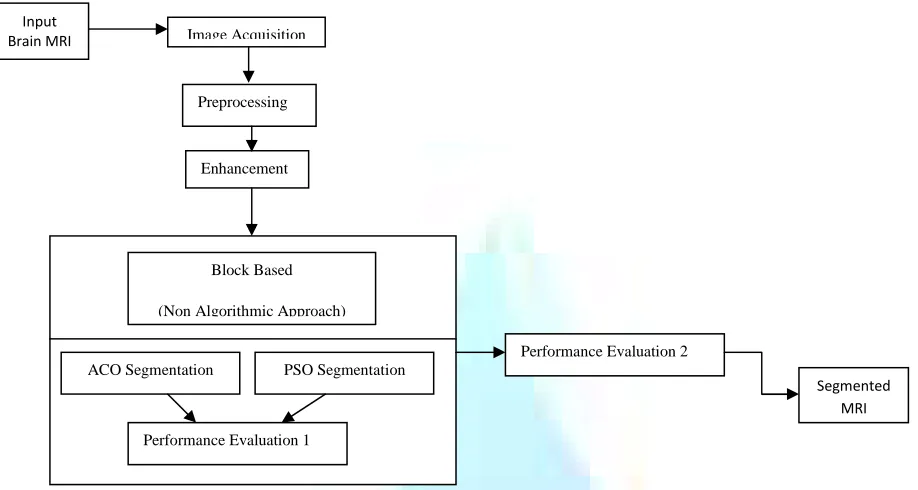
The proposed system focuses the brain MRI segmentation using metaheuristics algorithms. Recently, many researchers have focused their attention on a new class of algorithms, called metaheuristics. A metaheuristic is a set of algorithmic concepts that can be used to define heuristic methods applicable to a wide set of different problems. In other words, a metaheuristic is a general algorithmic framework, which can be applied to different optimization problems with relatively few modifications to make them, adapted to a specific problem. The use of metaheuristics has significantly increased the ability of finding very high-quality solutions to hard, practically relevant combinatorial optimization problems in a reasonable time. This is particularly true for large and poorly understood problems. The remainder of the paper is organized as follows: section (3) focuses on the process of preprocessing and enhancement. Section (4) describes the segmentation, Section (5) displays the segmentation using algorithmic approach, Section (6) denotes the non algorithmic approach, section (7) displays experiments and results of the segmentation finally Section (8) tells conclusion of the paper. The following figure 1 displays the overall structure of the proposed system.
VOLUME NO.2(2012),ISSUE NO.10(OCTOBER) ISSN 2231-5756
INTERNATIONAL JOURNAL OF RESEARCH IN COMMERCE, IT & MANAGEMENT
FIG 1: THE STRUCTURE OF BRAIN TUMOR MR IMAGE SEGMENTATION
This intelligent system uses medical images as a input to analyses tumor tissue from MRI brain images. The images were acquired on a Siemens MAGNETOM1 1.0 tesla MRI system. The images were digital and 256 X 256 pixels in size. The gray scale was quantized into 12 bits, which allowed 4096 different pixel
intensities. A 3D FLASH techniquewas used to generate 64 or 128 contiguous thin slices. The MR images were transferred to a KONTRON MIPRON2 image
processing workstation, and existing enhancement techniques were applied. The workstation used eight bits for each pixel, or 256 intensity levels. A software program compressed the 12 bit magnetic resonance images linearly to a maximum intensity of 255.
2.
REVIEW OF LITERATURE
The initial objective of MRI brain image segmentation is to partition the given MRI brain image into non-intersecting regions describing real anatomical structures. Over the last decade, many methods have been proposed to tackle this problem. A partial list includes surface model, Deformable and dynamic Contour model, Iterative growing model. One of the earliest approaches to segmentation of brain MRI was presented by Ahmed et al [1]. demonstrate the qualitatively and quantitatively that the physiologically based algorithm outperforms two classical segmentation techniques. Angela et al[2]. Developed a gamma camera based on a multi-wire proportional chamber equipped with a high rate, digital electronic read-out system for imaging applications in nuclear medicine. Azadeh [3] presents our proposed methods and results for the analysis of the brain spectra of patients with three tumor types. Benedicte et al[4] report describes initial use of an accumulating healthy database currently comprising 50 subjects aged 20–72. Bricq[5] presents a unifying framework for unsupervised segmentation of multimodal brain MR images including partial volume effect, bias field correction, and information given by a probabilistic atlas. Chunyan et al[6] presents deformable model-based method is adapted in the system. And by the graphic user interface, the segmentation can be intervened by user interactively at real time. Corina et al[7] focuses on the automated extraction of the cerebrospinal fluid-tissue boundary, particularly around the ventricular surface, from serial structural MRI of the brain acquired in imaging studies of aging and dementia.Elizabeth et al[8]reports to detect and quantify tortuosity abnormalities on high-resolution MRA images offers a new approach to the noninvasive diagnosis of malignancy. Erik et al[9] integrates automatic segmentation based on supervised learning with an interactive multi-scale watershed segmentation method. The combined method automatically provides an initial segmentation that applies the building blocks that the user can use in the interactive method. Guido et al[10] uses an EM-type algorithm that includes tissue classification, inhomogeneity correction and brain stripping into an iterative optimization scheme using a mixture distribution model. Hideki et al[11] used region segmentation techniques to extract boundaries of the brain tumor and edematous regions. Iftekharuddin et al[12]presents Two novel fractal-based texture features are exploited for pediatric brain tumor segmentation and classification in MRI. One of the two texture features uses piecewise-triangular-prism-surface-area (PTPSA) algorithm for fractal feature extraction. Jason[13]focused formulation for incorporating soft model assignments into the calculation of affinities, which are traditionally model free. Jeffreyet al[14] introduced an automated method using probabilistic reasoning over both space and time to segment brain tumors from 4D spatio-temporal MRI data. Kabir etal[15] addressed in this paper is the automatic segmentation of stroke lesions on MR multi-sequences. Lesions enhance differently depending on the MR modality and there is an obvious gain in trying to account for various sources of information in a single procedure.
3.
PREPROCESSING AND ENHANCEMENT
This proposed system for pre-processing and enhancement through Magnetic Resonance Image (MRI) is a gradient based image enhancement method and is based on the first derivative, local statistics. In Preprocessing and Enhancement stage, medical Image is converted into standard format with contrast manipulation; noise reduction by background removal, edge sharpening, filtering process and removal of film artifacts. Preprocessing functions involve those operations that are normally required prior to the main data analysis and extraction of information, and are generally grouped as radiometric or geometric corrections. Radiometric corrections include correcting the data for sensor irregularities and unwanted sensor or atmospheric noise, removal of non-brain voxels and converting the data so they accurately represent the reflected or emitted radiation measured by the sensor. This Automatic system proposes a gradient-based image enhancement method in order to improve the image quality and visibility of low-contrast features while suppressing the noises. Image enhancement is the improvement of image quality without knowledge about the source of degradation.
3.1 REMOVAL OF FILM ARTIFACTS
This paper presents an integrated method of the adaptive enhancement for an unsupervised global-to-local segmentation of brain tissues in three-dimensional (3-D) MRI (Magnetic Resonance Imaging) images. The MRI brain image consists of film artifacts or label on the MRI such as patient name, age and marks. Film artifacts that are removed using tracking algorithm .It is based on image intensity .In this algorithm, starting from the first row and first column, the intensity value of the pixels are analyzed and the threshold value of the film artifacts are found. The threshold value, greater than that of the threshold value is removed from MRI. The high intensity value of film artifacts are removed from MRI brain image. During the removal of film artifacts, the image consists of salt and pepper noise .The above image is given to enhancement stage for removing high intensity components and the above noise. The following figure 2 displays that the input and output of preprocessing stage.
Image Acquisition
Preprocessing
Enhancement
Performance Evaluation 2 Block Based
(Non Algorithmic Approach)
ACO Segmentation PSO Segmentation
Performance Evaluation 1
Segmented MRI Input
The above figure (a) displays the natural brain MRI, it contains number of film artifacts and labels. After the preprocessing the output of the br displayed (Fig 2: b) without artifacts and labels.
3.2 WEIGHTED MEDIAN FILTER
Weighted Median (WM) filters have attracted a growing number of interests in the past few years. In this paper, a weighted median (WM) filter is proposed for improving the performance of brain MRI with out high frequency noise. The merit of using weighted median filter is, it can re
MRI without disturbing of the edges. In this enhancement stage, It adjusts the size of filtering window adaptively according the pixel points in the filtering window are grouped adaptively by certain ru
similarity, finally the noise detected are filtering-treated. The evaluation criteria for weighted Median filtering is considered as follows:
FIG 3: PERFORMANCE A
the weighted median filtering is applied for each pixel of an 3 ×3, 5 ×5, 7 ×7, 9 ×9, 11 ×11 sliding window of neighborhood p mean gray value of foreground , mean value of background and contrast
4.
SEGMENTATION
Medical image segmentation refers to the segmentation of known anatomic structures from medical images thereof, such as cardiac ventricles or kidneys, abnormalities such as tumors and cysts, as well as other structures such as b
Segmentation is the partitioning of image data into related sections or regions. This paper has led to the development of a wide range of segmentation methods addressing specific problems in medical applications. Some methods proposed in the literature are extensions of methods origi
segmentation.
4.1 REMOVAL OF SKULL AREAS FROM BRAIN MRI
First stage of the segmentation is removal of skull portion from MR brain images. The human skull is a bony structure, part o
head, the brain is enclosed by skulls, these are provides the fundamental security to brain which supports the structures of the face and forms a c brain. The third section of this automatic system explains the removal of skull portions from MR brain images. These
and bottom of skull. The following table shows the tracking algorithm is used to remove unwanted portion of MRI that means le that are not required for further processing.
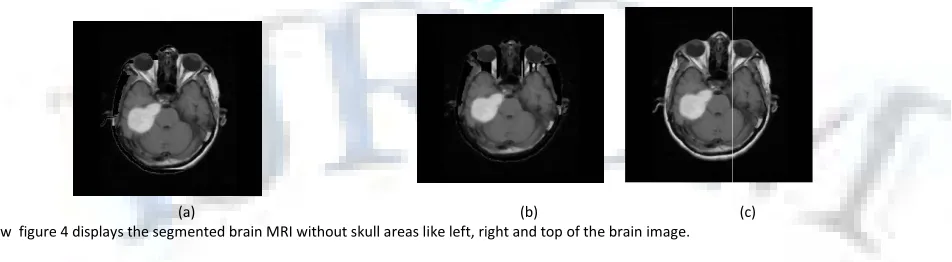
FIG 4: BRAIN MRI WITHOUT UN
(a)
The below figure 4 displays the segmented brain MRI without skull areas like left, right and top of the brain
5.
ALGORITHMIC APPROACH
The proposed intelligent technique based on histogram thresholding used to produce a binary image to segment tumor region fro segmentation the threshold value is used to find the suspicious region from
Starting from the first row and first column of the MRI brain image, the intensity values are analyzed. The intensity values
changed to zero(black)and the intensity values greater than the threshold are changed to one(white) in order to perform the morphological ope the four and eight connected pixels in the MRI binary image. Once the connected components are removed the MRI bi
tissue. The special coordinates of the tissue points are mapped and suspicious regions are enhanced using ACO and PSO. Before Preprocessing
FIG 2: REMOVAL OF FILM ARTIFACTS
displays the natural brain MRI, it contains number of film artifacts and labels. After the preprocessing the output of the br
d a growing number of interests in the past few years. In this paper, a weighted median (WM) filter is proposed for improving the performance of brain MRI with out high frequency noise. The merit of using weighted median filter is, it can re
MRI without disturbing of the edges. In this enhancement stage, It adjusts the size of filtering window adaptively according
the pixel points in the filtering window are grouped adaptively by certain rules and gives corresponding weight to each group of pixel points according to treated. The evaluation criteria for weighted Median filtering is considered as follows:
FIG 3: PERFORMANCE ANALYSIS OF WEIGHTED MEDIAN FILTER
the weighted median filtering is applied for each pixel of an 3 ×3, 5 ×5, 7 ×7, 9 ×9, 11 ×11 sliding window of neighborhood p mean gray value of foreground , mean value of background and contrast value.
Medical image segmentation refers to the segmentation of known anatomic structures from medical images. Structures of interest include organs or parts
thereof, such as cardiac ventricles or kidneys, abnormalities such as tumors and cysts, as well as other structures such as b
data into related sections or regions. This paper has led to the development of a wide range of segmentation methods addressing specific problems in medical applications. Some methods proposed in the literature are extensions of methods origi
First stage of the segmentation is removal of skull portion from MR brain images. The human skull is a bony structure, part o
losed by skulls, these are provides the fundamental security to brain which supports the structures of the face and forms a c
brain. The third section of this automatic system explains the removal of skull portions from MR brain images. These skull portions are divided in to left, right and bottom of skull. The following table shows the tracking algorithm is used to remove unwanted portion of MRI that means le
BRAIN MRI WITHOUT UNWANTED LEFT, TOP AND RIGHT SKULL PORTIONS
(b)
The below figure 4 displays the segmented brain MRI without skull areas like left, right and top of the brain image.
The proposed intelligent technique based on histogram thresholding used to produce a binary image to segment tumor region fro
segmentation the threshold value is used to find the suspicious region from brain MRI .The local optimum in the histogram is selected as the threshold value. Starting from the first row and first column of the MRI brain image, the intensity values are analyzed. The intensity values
black)and the intensity values greater than the threshold are changed to one(white) in order to perform the morphological ope
the four and eight connected pixels in the MRI binary image. Once the connected components are removed the MRI binary image contains only the brain tumor tissue. The special coordinates of the tissue points are mapped and suspicious regions are enhanced using ACO and PSO.
(a) Before Preprocessing
(b)After Preprocessing
displays the natural brain MRI, it contains number of film artifacts and labels. After the preprocessing the output of the brain MRI is
d a growing number of interests in the past few years. In this paper, a weighted median (WM) filter is proposed for improving the performance of brain MRI with out high frequency noise. The merit of using weighted median filter is, it can remove salt and pepper noise from MRI without disturbing of the edges. In this enhancement stage, It adjusts the size of filtering window adaptively according to number of noise points in window, les and gives corresponding weight to each group of pixel points according to treated. The evaluation criteria for weighted Median filtering is considered as follows:
the weighted median filtering is applied for each pixel of an 3 ×3, 5 ×5, 7 ×7, 9 ×9, 11 ×11 sliding window of neighborhood pixels are extracted and analyzed the
Structures of interest include organs or parts thereof, such as cardiac ventricles or kidneys, abnormalities such as tumors and cysts, as well as other structures such as bones, vessels, brain structures etc. This data into related sections or regions. This paper has led to the development of a wide range of segmentation methods addressing specific problems in medical applications. Some methods proposed in the literature are extensions of methods originally proposed for generic image
First stage of the segmentation is removal of skull portion from MR brain images. The human skull is a bony structure, part of the skeleton that is in the human losed by skulls, these are provides the fundamental security to brain which supports the structures of the face and forms a cavity for the skull portions are divided in to left, right and bottom of skull. The following table shows the tracking algorithm is used to remove unwanted portion of MRI that means left, right and top skull portions
RIGHT SKULL PORTIONS
(c)
VOLUME NO.2(2012),ISSUE NO.10(OCTOBER) ISSN 2231-5756
INTERNATIONAL JOURNAL OF RESEARCH IN COMMERCE, IT & MANAGEMENT
5.1 ANT COLONY OPTIMIZATION
Ant colony optimization (ACO) is a population-based meta heuristic that can be used to find approximate solutions to difficult optimization problems. In ACO, a set of software agents called artificial ants search for good solutions to a given optimization problem. To apply ACO, the optimization problem is transformed into the problem of finding the best path on a weighted graph. The artificial ants (hereafter ants) incrementally build solutions by moving on the graph. The solution construction process is stochastic and is biased by a pheromone model, that is, a set of parameters associated with graph components (either nodes or edges) whose values are modified at runtime by the ants. The ant colony optimization algorithm (ACO), is a probabilistic technique for solving computational problems which can be reduced to finding good paths through graphs.This algorithm is a member of ant colony algorithms family, in swarm intelligence methods, and it constitutes some metaheuristic optimizations.In our implementation, we are using 20 numbers of iterations. Select the image pixels, which are having optimim level, are stored as a separate image. This segmented image is used for the next step, to extract the textural features for classification microcalcifications. The ACO algorithm for our implementation is as follows:
Step 1: Read the MRI image or the ROI image and stored in a two dimensional matrix. Step 2: Pixels with same gray value are labeled with same number.
Step 3: For each kernel in the image, calculate the posterior energy U (x) value. Step 4: The posterior energy values of all the kernels are stored in a separate matrix.
Step 5: Ant Colony System is used to minimize the posterior energy function. The procedure is as follows:
Step 6: Initialize the values of number of iterations (N), number of ants (K), initial pheromone value (T0), a constant value for pheromone update (ρ).[here,we are
using N=20,K=10, T0=0.001 and ρ =0.9]
Step 7: Create a solution matrix (S) to store the labels of all the pixels, posterior energy values of all the pixels, initial pheromone values for all the ants at each pixels, and a flag column to mention whether the pixels is selected by the ant or not.
Step 8: Store the labels and the energy function values in S.
Step 9: Initialize the pheromone values, T0=0.001.
Step 10: Initialize all the flag values for all the ants with 0,it means that pixels is not selected yet,if it is set to 1 means selected. Step 11: Select a random pixel for each ant, which is not selected previously.
Step 12: Update the pheromone values for the selected pixels by all the ants.
Step 13: Using GA, select the minimum value from the set, assign as local minimum (Lmin).
Step 14: Compare this local minimum (Lmin) with the global minimum (Gmin), if Lmin is less than Gmin,assign Gmin = Lmin. Step 15: Select the ant, whose solution is equal to local minimum, to update its pheromone globally.
Step 16: Perform the steps (13) to (15) till all the image pixels have been selected. Step 17: Perform the steps (7) to (16) for M times.
Step 18: The Gmin has the optimum label which minimizes the posterior energy function. Step 19: Store the pixels has the optimum label in a separate image that is the segmented image.
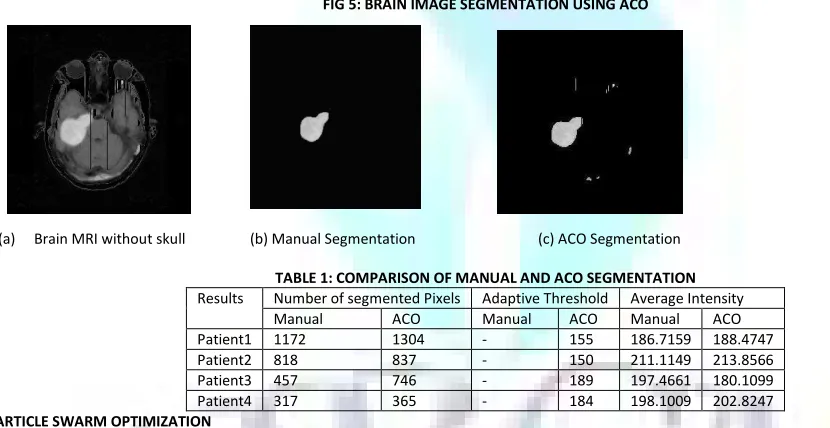
The above algorithm is used to segment brain tumor tissue from brain MRI.The following figure displays the tumor tissue from brain MRI.
FIG 5: BRAIN IMAGE SEGMENTATION USING ACO
(a) Brain MRI without skull (b) Manual Segmentation (c) ACO Segmentation
TABLE 1: COMPARISON OF MANUAL AND ACO SEGMENTATION
Results Number of segmented Pixels Adaptive Threshold Average Intensity
Manual ACO Manual ACO Manual ACO
Patient1 1172 1304 - 155 186.7159 188.4747
Patient2 818 837 - 150 211.1149 213.8566
Patient3 457 746 - 189 197.4661 180.1099
Patient4 317 365 - 184 198.1009 202.8247
5.2 PARTICLE SWARM OPTIMIZATION
Particle swarm optimization (pso) is one of the modern heuristic algorithms that can be applied to non linear and non continuous optimization problems. It is a population-based stochastic optimization technique for continuous nonlinear functions.PSO learned from the scenario and used it to solve the optimization
problems. Particle Swarm Optimizationis an optimization technique which provides an evolutionary based search. This search algorithm was introduced by Dr
Russ Eberhart and Dr James Kennedy in 1995. The term PSO refers to a relatively new family of algorithms that may be used to find optimal or near to optimal solutions to numerical and qualitative problems. The PSO algorithm for our implementation is as follows:
Step 1: Load the image the size is 256x256 (each element corresponds to a gray value Between 0 to 256 and their classes are determined.
Step 2: Divide the image to 3x3(or) 5 x5(or)7 x7 labels etc.
Step 3: Initialize all particles inside the labels.
Step 4: Calculate the fitness value for all pixels in the label.
Step 5: Select the best optimum (pBest) value for the label.
If (fitness value<best fitness value (pBest) in history update current value =new pBest else current value= fitness value After selection of current value elements are put in their respective labels.
Step 6: Repeat Step 4 and 5 for all elements until end of the label.
Step 7: Choose the particle with the best fitness value of all the particles as the gBest.
Step 8: Calculate particle velocity for each particle.
v [cp] = v[cp] + c1 * rand() * (pbest[p] - present[p]) + c2 * rand() * (gbest[p] - present[]) v [cp] = current particle velocity, pbest[cp] =best fitness value, gbest[] = fitness values of the all particles, rand()= random number between (0,1), c1, c2 are learning factors. Usually c1 = c2 = 2.
Step 9: Update particle position for each particle according the given solution. present[] = persent[] + v[]
After updation of velocity and position of each particle
Step 10: Go to step 2 for further labels.
TABLE 2: COMPARISON OF MANUAL AND PSO SEGMENTATION
Results Number of segmented Pixels Adaptive Threshold Average Intensity
Manual PSO Manual PSO Manual PSO
Patient1 1172 1372 - 245 186.7159 188.5767
Patient2 818 987 - 240 211.1149 217.1015
Patient3 457 845 - 220 197.4661 183.4333
Patient4 317 456 - 222 198.1009 210.6767
6.
NON ALGORITHMIC APPROACH
6.1 BLOCK BASED APPROACH
This paper consists of an efficient registration framework which has features of block based technique. Here normal patient image is compared with reference images. The following table shows normal image and reference image taken for comparison. In Block based technique, both the given reference MR brain image (256 × 265) and the normal image (256 × 265) has been divided into several blocks. Each and every block of both the images is 64 ×64. After blocking, subtraction has been done between the two images. This subtracted value is then checked with the threshold value, in our method. Then first block from both the images were subtracted and the average value of all the pixels in that block were calculated. This average value is then compared our threshold value of 80,000 and if any of which is found to cross this limit, those patient details will be stored in the database as a doubtful case. This method based on Average intensity measure for blocks of both normal and target image was calculated and compared. If there is any abnormality found in the normal image then it is stored in segmented database. Otherwise it is stored in normal database. In the following table, block 1 to block 4 of both source and target image does not have difference in average intensity but in block5 to block 8 has different values. Those values are stored in segmented database. The below figure 5 shows block based method with brain MRI.
FIG. 6: BRAIN MRI SEGMENTATION USING BLOCK BASED METHOD
6.2 AVERAGE INTENSITY MEASURE
Average intensity measure for blocks of both normal and target image was calculated and compared. If there is any abnormality found in the normal image then it is stored in segmented database. Otherwise it is stored in normal database. In the following table, block 1 to block 4 of both source and target image does not have difference in average intensity but in block5 to block 8 has different values. Those values are stored in segmented database.
TABLE 3: AVERAGE INTENSITY VALUE BASED ON BLOCKS
7. RESULTS AND EXPERIMENTS
FIG. 7: BRAIN IMAGE SEGMENTATION USING PSO
The performance evaluation of the algorithmic approaches are evaluated .This evaluation is use to compare Haralick feature of the brain MRI images are through ACO and PSO algorithms .the following table displayes the feature comparison of ACO and PSO algorithms. In this result, performance of the PSO algorithm is better than ACO. PSO gives more accuracy and it is use to segment tumor area from brain MRI is well and efficient than ACO.
Image Block 9 Block 10 Block 11 Block 12 Block 13 Block 14 Block 15 Block 16
Source 49 87 62 4 8 38 14 2
target 1 57 97 62 4 8 38 14 2
target 2 75 105 62 4 8 38 14 2
target 3 49 90 62 4 8 38 14 2
Image Block 1 Block 2 Block 3 Block 4 Block 5 Block 6 Block 7 Block 8
Source 31 67 51 2 68 71 86 5
target 1 31 67 51 2 77 91 86 5
target 2 31 67 51 2 68 71 86 5
VOLUME NO.2(2012),ISSUE NO.10(OCTOBER) ISSN 2231-5756
INTERNATIONAL JOURNAL OF RESEARCH IN COMMERCE, IT & MANAGEMENT
TABLE 4: COMPARISON OF MRI HARALIC FEATURES Haralick Features Normal Image Manual ACO PSO
Angular Secend moment 0.1762 0.1002 0.1225 0.1225
Contrast 0.0476 0.0439 0.0440 0.0440
Correlation 0.0667 0.0577 0.0575 0.0575
Som of square ( Variance) 0.0628 0.0579 0.0590 0.0596
Invers distant moment 0.3575 0.1734 0.1927 0.1927
Som average 0.0938 0.0780 0.0776 0.0776
Sum Variance 0.0556 0.0416 0.0424 0.0425
Sum entropy 0.1734 0.1202 0.1235 0.1245
Entropy 0.2828 0.1295 0.1473 0.1478
Difference variance 0.5211 0.1550 0.1729 0.1735
Difference entropy 0.1660 0.1178 0.1190 0.1197
Information measures of correlation 0.2784 0.1295 0.1472 0.1477
Information measures of correlation 0.0000 0.0000 0.0000 0.0000
Maximal Correlation Coefficient 0.0000 0.0000 0.0000 0.0000
8. CONCLUSION
The Intelligent segmentation of brain tumor from Magnetic Resonance Images (MRI) described a gradient-based brain image segmentation using Ant colony optimization (ACO) Particle Swarm Optimization (PSO) and block based technique (BB). Initially the preprocessing stages are finished through tracking algorithms. Next the processed brain MRI is segmented using Ant colony optimization algorithm, particle optimization and Block based technique.The merit of this intelligent segmentation is detecting and evaluating the two Meta heuristic algorithms and their performance for the segmentation of brain tumor tissue from brain MRI. We are generalizing PSO algorithm to suit for the brain MRI from any database and the statistical result shows the proposed PSO algorithm can perform better than ACO and Block based technique for tumor detection.
REFERENCES
1. Ahmed Saad, Ben Smith, Ghassan Hamarneh, Torsten M¨oller,” Simultaneous Segmentation, Kinetic Parameter Estimation, and Uncertainty Visualization of
Dynamic PET Images”, Springer on Medical Image Computing and Computer Assisted Intervention" (MICCAI) , Volume 4792/2007, 726-733, October 2007.
2. Angela Barr,GiovanniCarugno,Sandro Centro, Georges Charpak, Garth Cruickshank, MarieLenoble , Jacques Lewiner,:” Imaging Brain Tumors Using a
Multi-Wire Gamma Camera and Thallium-201” , IEEE on Nuclear Science Symposium Conference Record, Volume: 1, 452- 456,july 2001.
3. Azadeh yazdan-shahmorad, Hamid soltanian-zadeh,reza A.Zoroofi,:”MRSI Braintumor characterization using Wavelet and Wavelet packets Feature spaces
and Artificial Neural Networks”,IEEE Transactions on Engineering in Medicine and Biology Society, 2004. IEMBS '04. 26th Annual International Conference, Volume: 1, 1810-1813 ,sep 2004.
4. Benedicte Mortamet, Donglin Zeng, Guido Gerig, MarcelPrastawa, ElizabethBullitt,”Effects of Healthy Aging Measured By Intracranial Compartment
Volumes Using Designed MR Brain Database”, Med Image Comput Comput Assist Interv Int Conf Med Image Comput Comput Assist Interv, 383–391, 2005.
5. Bricq.S, Collet.Ch, Armspach.J.P,:”Unifying Framework for Multimodal brain MRI Segmentation based on Hidden Markov Chains”, Elsevier on Medical
Image Analysis,March, 2008. Volume 12, Issue 6, Pages 639-652, December 2008.
6. Chunyan Jiang,Xinhua Zhang,Wanjun Huang,Christoph Meinel.:”Segmentation and Quantification of Brain Tumor,”IEEE International Symposium on Virtual
Environment, Human-Computer interfaces and Measurement Systems, 61- 66, USA July 2004.
7. Corina S.Drapaca,Valerie Cardenas,Colin Studholme,:”Segmentation of tissueboundary evolution from brain MR Image sequences usingmulti-phaselevel
sets”,Elsevier science inc on Computer vision and image understanding, Volume 100 , Issue 3, 312 – 329,December2005.
8. Elizabeth Bullitt,Donglin Zeng,Guido Gerig,Stephen Aylward,Sarang Joshi,J.Keithsmith,Weili Lin,Matthew G.Ewend,:”Vessel Tortuosity and Brain Tumor
Malingnancy:A Blinded Study”,Academic Radiology, Volume 12, Issue 10, Pages 1232-1240,Auguest 2005.
9. ErikDam, Marcoloog, Marloes Letteboer,:”Integrating Automatic and Interactive Brain tumor Segmentation”,Proceedings of the 17th International
Conference on Pattern Recognition (ICPR’04), IEEE Computer Society, Volume: 3, 790- 793, August 2004.
10. Guido Gerig, Marcel Prastawa, Wili Lin, John Gilmore,:”Assessing Early Brain Development in Neonates by Segmentation of High-Resolution 3T MRI”,
Springer link on short communications, Volume 2879/2003 , 979-980 2003.
11. Hideki yamamoto and Katsuhiko Sugita, Noriki Kanzaki, Ikuo Johja and Yoshio Hiraki,Michiyoshi uwahara , : “Magnetic Resonance Image Enhancement
Using V- Filter”, IEEE on Aerospace and Electronic Systems Magazine, Volume: 5, Issue: 6 June 1990.
12. Iftekharuddin K. M, Zheng J., Islam M. A, Ogg R. J,:“Brain Tumor Detection in MRI: Technique and Statistical Validation”,Conference on Signals, Systems
and Computers, 2006. ACSSC '06. Fortieth Asilomar, 1983-1987, Oct. 29 2006.
13. Jason J. Corso, Eitan Sharon, Alan Yuille,” Multilevel Segmentation and Integrated Bayesian Model Classification with an Application to Brain Tumor
Segmentation”, Springer on Medical image computing, Volume 4191/2006, 790-798, September 29, 2006.
14. Jeffrey Solomon, John A. Butman, Arun Sood,:” Segmentation of brain tumors in 4D MR images using the Hidden Markov model”, Elsevier on Computer
Methods and Programs in Biomedicine”,USA, Pages 76-85 , Volume 84, Issue 2, Pages 76-85, December 2006.
15. Kabir.Y, Dojat.M, Scherrer.B, Forbes.F, Garbay.C:”Multimodal MRI Segmentation of ischemic stroke Lesions”, 29th Annual International Conference of the
REQUEST FOR FEEDBACK
Dear Readers
At the very outset, International Journal of Research in Commerce, IT and Management (IJRCM)
acknowledges & appreciates your efforts in showing interest in our present issue under your kind perusal.
I would like to request you to supply your critical comments and suggestions about the material published
in this issue as well as on the journal as a whole, on our E-mail i.e.
for further
improvements in the interest of research.
If you have any queries please feel free to contact us on our E-mail
.
I am sure that your feedback and deliberations would make future issues better – a result of our joint
effort.
Looking forward an appropriate consideration.
With sincere regards
Thanking you profoundly
Academically yours
Sd/-
VOLUME NO.2(2012),ISSUE NO.10(OCTOBER) ISSN 2231-5756