A Monthly Double-Blind Peer Reviewed Refereed Open Access International e-Journal - Included in the International Serial Directories
Indexed & Listed at:
Ulrich's Periodicals Directory ©, ProQuest, U.S.A., EBSCO Publishing, U.S.A., Cabell’s Directories of Publishing Opportunities, U.S.A. as well as in Open J-Gage, India [link of the same is duly available at Inflibnet of University Grants Commission (U.G.C.)]
VOLUME NO.2(2012),ISSUE NO.6(JUNE) ISSN 2231-5756
CONTENTS
CONTENTS
CONTENTS
CONTENTS
Sr.No.
TITLE & NAME OF THE AUTHOR (S)
Page No.
1. THE IMPACT OF PLANNING AND CONTROL ON SERVICE SMES SUCCESS
GAD VITNER & SIBYLLE HEILBRUNN
1
2. CHALLENGES FOR SMALL AND MEDIUM ENTERPRISES IN INFORMATION TECHNOLOGY IN THE CITY OF BANGALORE, INDIA
SULAKSHA NAYAK & DR. HARISHA G. JOSHI
9
3. ROLE OF MANAGEMENT INFORMATION SYSTEMS IN MANAGERIAL DECISION MAKING OF ORGANIZATIONS IN THE GLOBAL BUSINESS WORLD
MD. ZAHIR UDDIN ARIF, MOHAMMAD MIZENUR RAHAMAN & MD. NASIR UDDIN
14
4. EFFECTS OF CALL CENTER CRM PRACTICES ON EMPLOYEE JOB SATISFACTION
DR. ALIYU OLAYEMI ABDULLATEEF
19
5. DETERMINANTS OF CAPITAL STRUCTURE: EVIDENCE FROM TANZANIA’S LISTED NON FINANCIAL COMPANIES
BUNDALA, NTOGWA NG'HABI & DR. CLIFFORD G. MACHOGU
24
6. RELATIONSHIP BETWEEN INTRINSIC REWARDS AND JOB SATISFACTION: A COMPARATIVE STUDY OF PUBLIC AND PRIVATE ORGANIZATION
TAUSIF M.
33
7. NUCLEAR ENERGY IN INDIA: A COMPULSION FOR THE FUTURE
DR. KAMLESH KUMAR DUBEY & SUBODH PANDE
42
8. CONTEXTUAL FACTORS FOR EFFECTIVE IMPLEMENTATION OF PERFORMANCE APPRAISAL IN THE INDIAN IT SECTOR: AN EMPIRICAL STUDY
SUJOYA RAY MOULIK & DR. SITANATH MAZUMDAR
47
9. A STUDY OF CITIZEN CENTRIC SERVICE DELIVERY THROUGH e-GOVERNANCE: CASE STUDY OF e-MITRA IN JAIPUR DISTRICT
RAKESH SINGHAL & DR. JAGDISH PRASAD
53
10. TWO UNIT COLD STANDBY PRIORITY SYSTEM WITH FAULT DETECTION AND PROVISION OF REST
VIKAS SHARMA, J P SINGH JOOREL, RAKESH CHIB & ANKUSH BHARTI
61
11. MACRO ECONOMIC FACTORS INFLUENCING THE COMMODITY MARKET WITH SPECIAL REFERENCE TO GOLD AND SILVER
DR. G. PANDURANGAN, R. MAGENDIRAN, L. S. SRIDHAR & R. RAJKOKILA
68
12. CRYTICAL ANALYSIS OF EXPONENTIAL SMOOTHING METHODS FOR FORECASTING
UDAI BHAN TRIVEDI
71
13. COMPARATIVE STUDY ON RETAIL LIABILITIES, PRODUCTS & SERVICES OF DISTRICT CENTRAL CO-OPERATIVE BANK & AXIS BANK
ABHINAV JOG & ZOHRA ZABEEN SABUNWALA
75
14. SECURE KEY EXCHANGE WITH RANDOM CHALLENGE RESPONSES IN CLOUD
BINU V. P & DR. SREEKUMAR A
81
15. COMPUTATIONAL TRACKING AND MONITORING FOR EFFICIENCY ENHANCEMENT OF SOLAR BASED REFRIGERATION
V. SATHYA MOORTHY, P.A. BALAJI, K. VENKAT & G.GOPU
84
16. FINANCIAL ANALYSIS OF OIL AND PETROLEUM INDUSTRY
DR. ASHA SHARMA
90
17. ANOVA BETWEEN THE STATEMENT REGARDING THE MOBILE BANKING FACILITY AND TYPE OF MOBILE PHONE OWNED: A STUDY WITH REFERENCE TO TENKASI AT VIRUDHUNAGAR DSITRICT
DR. S. VALLI DEVASENA
98
18. VIDEO REGISTRATION BY INTEGRATION OF IMAGE MOTIONS
V.FRANCIS DENSIL RAJ & S.SANJEEVE KUMAR
103
19. ANALYZING THE TRADITIONAL INDUCTION FORMAT AND RE – DESIGING INDUCTION PROCESS AT TATA CHEMICALS LTD, MITHAPUR
PARUL BHATI
112
20. THE JOURNEY OF E-FILING OF INCOME TAX RETURNS IN INDIA
MEENU GUPTA
118
21. ROLE OF FINANCIAL TECHNOLOGY IN ERADICATION OF FINANCIAL EXCLUSION
DR. SARIKA SRIVASTAVA & ANUPAMA AMBUJAKSHAN
122
22. ATTRITION: THE BIGGEST PROBLEM IN INDIAN IT INDUSTRIES
VIDYA SUNIL KADAM
126
23. INFORMATION TECHNOLOGY IN KNOWLEDGE MANAGEMENT
M. SREEDEVI
132
24. A STUDY OF EMPLOYEE ENGAGEMENT & EMPLOYEE CONNECTS’ TO GAIN SUSTAINABLE COMPETITIVE ADVANTAGE IN GLOBALIZED ERA
NEERU RAGHAV
136
25. BIG-BOX RETAIL STORE IN INDIA – A CASE STUDY APPROACH WITH WALMART
M. P. SUGANYA & DR. R. SHANTHI
142
26. IMPACT OF INFORMATION TECHNOLOGY ON ORGANISATIONAL CULTURE OF STATE BANK OF INDIA AND ITS ASSOCIATED BANKS IN SRIGANGANAGAR AND HANUMANGARH DISTRICTS OF RAJASTHAN
MOHITA
146
27. USER PERCEPTION TOWARDS WEB, TELEVISION AND RADIO AS ADVERTISING MEDIA: COMPARATIVE STUDY
SINDU KOPPA & SHAKEEL AHAMED
149
28. STUDY OF GROWTH, INSTABILITY AND SUPPLY RESPONSE OF COMMERCIAL CROPS IN PUNJAB: AN ECONOMETRIC ANALYSIS
SUMAN PARMAR
156
29. DEVELOPMENT AND EMPIRICAL VALIDATION OF A LINEAR STYLE PROGRAM ON ‘STRUCTURE OF THE CELL’ FOR IX GRADE STUDENTS
RAMANJEET KAUR
160
30. PERFORMANCE APPRAISAL OF INDIAN BANKING SECTOR: A COMPARATIVE STUDY OF SELECTED PUBLIC AND FOREIGN BANKS
SAHILA CHAUDHRY
163
INTERNATIONAL JOURNAL OF RESEARCH IN COMMERCE, IT & MANAGEMENT
CHIEF PATRON
CHIEF PATRON
CHIEF PATRON
CHIEF PATRON
PROF. K. K. AGGARWAL
Chancellor, Lingaya’s University, Delhi
Founder Vice-Chancellor, Guru Gobind Singh Indraprastha University, Delhi
Ex. Pro Vice-Chancellor, Guru Jambheshwar University, Hisar
PATRON
PATRON
PATRON
PATRON
SH. RAM BHAJAN AGGARWAL
Ex. State Minister for Home & Tourism, Government of Haryana
Vice-President, Dadri Education Society, Charkhi Dadri
President, Chinar Syntex Ltd. (Textile Mills), Bhiwani
CO
CO
CO
CO----ORDINATOR
ORDINATOR
ORDINATOR
ORDINATOR
AMITA
Faculty, Government M. S., Mohali
ADVISORS
ADVISORS
ADVISORS
ADVISORS
DR. PRIYA RANJAN TRIVEDI
Chancellor, The Global Open University, Nagaland
PROF. M. S. SENAM RAJU
Director A. C. D., School of Management Studies, I.G.N.O.U., New Delhi
PROF. M. N. SHARMA
Chairman, M.B.A., Haryana College of Technology & Management, Kaithal
PROF. S. L. MAHANDRU
Principal (Retd.), Maharaja Agrasen College, Jagadhri
EDITOR
EDITOR
EDITOR
EDITOR
PROF. R. K. SHARMA
Professor, Bharti Vidyapeeth University Institute of Management & Research, New Delhi
CO
CO
CO
CO----EDITOR
EDITOR
EDITOR
EDITOR
DR. BHAVET
Faculty, M. M. Institute of Management, Maharishi Markandeshwar University, Mullana, Ambala, Haryana
EDITORIAL ADVISORY BOARD
EDITORIAL ADVISORY BOARD
EDITORIAL ADVISORY BOARD
EDITORIAL ADVISORY BOARD
DR. RAJESH MODI
Faculty, Yanbu Industrial College, Kingdom of Saudi Arabia
PROF. SANJIV MITTAL
University School of Management Studies, Guru Gobind Singh I. P. University, Delhi
PROF. ANIL K. SAINI
Chairperson (CRC), Guru Gobind Singh I. P. University, Delhi
DR. SAMBHAVNA
Faculty, I.I.T.M., Delhi
DR. MOHENDER KUMAR GUPTA
VOLUME NO.2(2012),ISSUE NO.6(JUNE) ISSN 2231-5756
DR. SHIVAKUMAR DEENE
Asst. Professor, Dept. of Commerce, School of Business Studies, Central University of Karnataka, Gulbarga
MOHITA
Faculty, Yamuna Institute of Engineering & Technology, Village Gadholi, P. O. Gadhola, Yamunanagar
ASSOCIATE EDITORS
ASSOCIATE EDITORS
ASSOCIATE EDITORS
ASSOCIATE EDITORS
PROF. NAWAB ALI KHAN
Department of Commerce, Aligarh Muslim University, Aligarh, U.P.
PROF. ABHAY BANSAL
Head, Department of Information Technology, Amity School of Engineering & Technology, Amity University, Noida
PROF. A. SURYANARAYANA
Department of Business Management, Osmania University, Hyderabad
DR. ASHOK KUMAR
Head, Department of Electronics, D. A. V. College (Lahore), Ambala City
DR. SAMBHAV GARG
Faculty, M. M. Institute of Management, Maharishi Markandeshwar University, Mullana, Ambala, Haryana
PROF. V. SELVAM
SSL, VIT University, Vellore
DR. PARDEEP AHLAWAT
Reader, Institute of Management Studies & Research, Maharshi Dayanand University, Rohtak
S. TABASSUM SULTANA
Associate Professor, Department of Business Management, Matrusri Institute of P.G. Studies, Hyderabad
SURJEET SINGH
Asst. Professor, Department of Computer Science, G. M. N. (P.G.) College, Ambala Cantt.
TECHNICAL
TECHNICAL
TECHNICAL
TECHNICAL ADVISOR
ADVISOR
ADVISOR
ADVISOR
AMITA
Faculty, Government H. S., Mohali
MOHITA
Faculty, Yamuna Institute of Engineering & Technology, Village Gadholi, P. O. Gadhola, Yamunanagar
FINANCIAL ADVISORS
FINANCIAL ADVISORS
FINANCIAL ADVISORS
FINANCIAL ADVISORS
DICKIN GOYAL
Advocate & Tax Adviser, Panchkula
NEENA
Investment Consultant, Chambaghat, Solan, Himachal Pradesh
LEGAL ADVISORS
LEGAL ADVISORS
LEGAL ADVISORS
LEGAL ADVISORS
JITENDER S. CHAHAL
Advocate, Punjab & Haryana High Court, Chandigarh U.T.
CHANDER BHUSHAN SHARMA
Advocate & Consultant, District Courts, Yamunanagar at Jagadhri
SUPERINTENDENT
SUPERINTENDENT
SUPERINTENDENT
SUPERINTENDENT
SURENDER KUMAR POONIA
INTERNATIONAL JOURNAL OF RESEARCH IN COMMERCE, IT & MANAGEMENT
CALL FOR MANUSCRIPTS
CALL FOR MANUSCRIPTS
CALL FOR MANUSCRIPTS
CALL FOR MANUSCRIPTS
Weinvite unpublished novel, original, empirical and high quality research work pertaining to recent developments & practices in the area of Computer, Business, Finance, Marketing, Human Resource Management, General Management, Banking, Insurance, Corporate Governance and emerging paradigms in allied subjects like Accounting Education; Accounting Information Systems; Accounting Theory & Practice; Auditing; Behavioral Accounting; Behavioral Economics; Corporate Finance; Cost Accounting; Econometrics; Economic Development; Economic History; Financial Institutions & Markets; Financial Services; Fiscal Policy; Government & Non Profit Accounting; Industrial Organization; International Economics & Trade; International Finance; Macro Economics; Micro Economics; Monetary Policy; Portfolio & Security Analysis; Public Policy Economics; Real Estate; Regional Economics; Tax Accounting; Advertising & Promotion Management; Business Education; Management Information Systems (MIS); Business Law, Public Responsibility & Ethics; Communication; Direct Marketing; E-Commerce; Global Business; Health Care Administration; Labor Relations & Human Resource Management; Marketing Research; Marketing Theory & Applications; Non-Profit Organizations; Office Administration/Management; Operations Research/Statistics; Organizational Behavior & Theory; Organizational Development; Production/Operations; Public Administration; Purchasing/Materials Management; Retailing; Sales/Selling; Services; Small Business Entrepreneurship; Strategic Management Policy; Technology/Innovation; Tourism, Hospitality & Leisure; Transportation/Physical Distribution; Algorithms; Artificial Intelligence; Compilers & Translation; Computer Aided Design (CAD); Computer Aided Manufacturing; Computer Graphics; Computer Organization & Architecture; Database Structures & Systems; Digital Logic; Discrete Structures; Internet; Management Information Systems; Modeling & Simulation; Multimedia; Neural Systems/Neural Networks; Numerical Analysis/Scientific Computing; Object Oriented Programming; Operating Systems; Programming Languages; Robotics; Symbolic & Formal Logic and Web Design. The above mentioned tracks are only indicative, and not exhaustive.
Anybody can submit the soft copy of his/her manuscript anytime in M.S. Word format after preparing the same as per our submission guidelines duly available on our website under the heading guidelines for submission, at the email addresses: [email protected]or
GUIDELINES FOR SUBMISSION OF MANUSCRIPT
GUIDELINES FOR SUBMISSION OF MANUSCRIPT
GUIDELINES FOR SUBMISSION OF MANUSCRIPT
GUIDELINES FOR SUBMISSION OF MANUSCRIPT
1. COVERING LETTER FOR SUBMISSION:
DATED: _____________
THE EDITOR
IJRCM
Subject: SUBMISSION OF MANUSCRIPT IN THE AREA OF .
(e.g. Finance/Marketing/HRM/General Management/Economics/Psychology/Law/Computer/IT/Engineering/Mathematics/other, please specify)
DEAR SIR/MADAM
Please find my submission of manuscript entitled ‘___________________________________________’ for possible publication in your journals.
I hereby affirm that the contents of this manuscript are original. Furthermore, it has neither been published elsewhere in any language fully or partly, nor is it under review for publication elsewhere.
I affirm that all the author (s) have seen and agreed to the submitted version of the manuscript and their inclusion of name (s) as co-author (s).
Also, if my/our manuscript is accepted, I/We agree to comply with the formalities as given on the website of the journal & you are free to publish our contribution in any of your journals.
NAME OF CORRESPONDING AUTHOR:
Designation:
Affiliation with full address, contact numbers & Pin Code: Residential address with Pin Code:
Mobile Number (s): Landline Number (s): E-mail Address: Alternate E-mail Address:
NOTES:
a) The whole manuscript is required to be in ONE MS WORD FILE only (pdf. version is liable to be rejected without any consideration), which will start from the covering letter, inside the manuscript.
b) The sender is required to mention the following in the SUBJECT COLUMN of the mail:
New Manuscript for Review in the area of (Finance/Marketing/HRM/General Management/Economics/Psychology/Law/Computer/IT/
Engineering/Mathematics/other, please specify)
c) There is no need to give any text in the body of mail, except the cases where the author wishes to give any specific message w.r.t. to the manuscript. d) The total size of the file containing the manuscript is required to be below 500 KB.
e) Abstract alone will not be considered for review, and the author is required to submit the complete manuscript in the first instance.
f) The journal gives acknowledgement w.r.t. the receipt of every email and in case of non-receipt of acknowledgment from the journal, w.r.t. the submission of manuscript, within two days of submission, the corresponding author is required to demand for the same by sending separate mail to the journal.
2. MANUSCRIPT TITLE: The title of the paper should be in a 12 point Calibri Font. It should be bold typed, centered and fully capitalised.
3. AUTHOR NAME (S) & AFFILIATIONS: The author (s) full name, designation, affiliation (s), address, mobile/landline numbers, and email/alternate email address should be in italic & 11-point Calibri Font. It must be centered underneath the title.
4. ABSTRACT: Abstract should be in fully italicized text, not exceeding 250 words. The abstract must be informative and explain the background, aims, methods,
VOLUME NO.2(2012),ISSUE NO.6(JUNE) ISSN 2231-5756
5. KEYWORDS: Abstract must be followed by a list of keywords, subject to the maximum of five. These should be arranged in alphabetic order separated by commas and full stops at the end.
6. MANUSCRIPT: Manuscript must be in BRITISH ENGLISH prepared on a standard A4 size PORTRAIT SETTING PAPER. It must be prepared on a single space and
single column with 1” margin set for top, bottom, left and right. It should be typed in 8 point Calibri Font with page numbers at the bottom and centre of every page. It should be free from grammatical, spelling and punctuation errors and must be thoroughly edited.
7. HEADINGS: All the headings should be in a 10 point Calibri Font. These must be bold-faced, aligned left and fully capitalised. Leave a blank line before each
heading.
8. SUB-HEADINGS: All the sub-headings should be in a 8 point Calibri Font. These must be bold-faced, aligned left and fully capitalised.
9. MAIN TEXT: The main text should follow the following sequence:
INTRODUCTION
REVIEW OF LITERATURE
NEED/IMPORTANCE OF THE STUDY
STATEMENT OF THE PROBLEM
OBJECTIVES
HYPOTHESES
RESEARCH METHODOLOGY
RESULTS & DISCUSSION
FINDINGS
RECOMMENDATIONS/SUGGESTIONS
CONCLUSIONS
SCOPE FOR FURTHER RESEARCH
ACKNOWLEDGMENTS
REFERENCES
APPENDIX/ANNEXURE
It should be in a 8 point Calibri Font, single spaced and justified. The manuscript should preferably not exceed 5000 WORDS.
10. FIGURES &TABLES: These should be simple, crystal clear, centered, separately numbered & self explained, and titles must be above the table/figure. Sources of data should be mentioned below the table/figure. It should be ensured that the tables/figures are referred to from the main text.
11. EQUATIONS: These should be consecutively numbered in parentheses, horizontally centered with equation number placed at the right.
12. REFERENCES: The list of all references should be alphabetically arranged. The author (s) should mention only the actually utilised references in the preparation
of manuscript and they are supposed to follow Harvard Style of Referencing. The author (s) are supposed to follow the references as per the following:
•
All works cited in the text (including sources for tables and figures) should be listed alphabetically.•
Use (ed.) for one editor, and (ed.s) for multiple editors.•
When listing two or more works by one author, use --- (20xx), such as after Kohl (1997), use --- (2001), etc, in chronologically ascending order.•
Indicate (opening and closing) page numbers for articles in journals and for chapters in books.•
The title of books and journals should be in italics. Double quotation marks are used for titles of journal articles, book chapters, dissertations, reports, working papers, unpublished material, etc.•
For titles in a language other than English, provide an English translation in parentheses.•
The location of endnotes within the text should be indicated by superscript numbers.PLEASE USE THE FOLLOWING FOR STYLE AND PUNCTUATION IN REFERENCES: BOOKS
•
Bowersox, Donald J., Closs, David J., (1996), "Logistical Management." Tata McGraw, Hill, New Delhi.•
Hunker, H.L. and A.J. Wright (1963), "Factors of Industrial Location in Ohio" Ohio State University, Nigeria. CONTRIBUTIONS TO BOOKS•
Sharma T., Kwatra, G. (2008) Effectiveness of Social Advertising: A Study of Selected Campaigns, Corporate Social Responsibility, Edited by David Crowther & Nicholas Capaldi, Ashgate Research Companion to Corporate Social Responsibility, Chapter 15, pp 287-303.JOURNAL AND OTHER ARTICLES
•
Schemenner, R.W., Huber, J.C. and Cook, R.L. (1987), "Geographic Differences and the Location of New Manufacturing Facilities," Journal of Urban Economics, Vol. 21, No. 1, pp. 83-104.CONFERENCE PAPERS
•
Garg, Sambhav (2011): "Business Ethics" Paper presented at the Annual International Conference for the All India Management Association, New Delhi, India, 19–22 June.UNPUBLISHED DISSERTATIONS AND THESES
•
Kumar S. (2011): "Customer Value: A Comparative Study of Rural and Urban Customers," Thesis, Kurukshetra University, Kurukshetra. ONLINE RESOURCES•
Always indicate the date that the source was accessed, as online resources are frequently updated or removed. WEBSITEINTERNATIONAL JOURNAL OF RESEARCH IN COMMERCE, IT & MANAGEMENT
ROLE OF MANAGEMENT INFORMATION SYSTEMS IN MANAGERIAL DECISION MAKING OF
ORGANIZATIONS IN THE GLOBAL BUSINESS WORLD
MD. ZAHIR UDDIN ARIF
ASST. PROFESSOR
DEPARTMENT OF MARKETING
FACULTY OF BUSINESS STUDIES
JAGANNATH UNIVERSITY
DHAKA, BANGLADESH
MOHAMMAD MIZENUR RAHAMAN
ASST. PROFESSOR
DEPARTMENT OF BUSINESS ADMINISTRATION
SHAHJALAL UNIVERSITY OF SCIENCE AND TECHNOLOGY
SYLHET, BANGLADESH
MD. NASIR UDDIN
SENIOR OFFICER
COMPLIANCE MONITORING
CHITTAGONG STOCK EXCHANGE
DHAKA, BANGLADESH
ABSTRACT
The present paper focuses on how information technology plays an imperative role to change the global business world. It also aims that how information systems help managers to cope with the changes. This paper is prepared mainly in the light of secondary information gathering, reviewing and analyzing the existing international literatures published in the relevant books, journals, magazines and websites. The study finds a clear picture that now-a-days decision making strongly depends on information systems. The study also identifies that MIS is one of the most important information systems applications from different information systems (executive support systems, decisions support systems, management information systems, office automation systems, knowledge work systems and transaction processing systems) that provide help to the manager for taking effective decision in an organization. In global environment, competitiveness is the most important factor that must be kept in mind to be successful. MIS can play an effective role in an organization for taking “right decisions at right time and right place” by analyzing the surrounding situations with the help of other information systems like ESS, DSS, and TPS in global competitive environment.
KEYWORDS
Management Information Systems, Information Technology, Organization, Competitive environment, Global business world.
INTRODUCTION
he future is about technology, not about emotion. It is about how people think and feel in the digital world. How many times have people changed their minds about whether they will use a new technology or not (Dixon, 2004)? Pertinently, information technology is one of the important key factors for that future change and mostly on business world. With the passage of time, needs and wants and way of behaving of human beings have been changed. It is about a revolution that is making profound changes in human life. The changes are happening in all parts of society and in all parts of the world. Some of these are social and political and others are ecological. Some are evolutionary, others revolutionary (Islam and Haque, 2003). Though these changes are ordinary part of human life, it has superior impact on modern business world. With the change of time, technology (combination of information technology and communication technology) plays a crucial role in the change of business world. Today’s business world is not more unknown with the concept of globalization. In global environment competitiveness is the most important factor that must be kept in mind to be successful. There is a proverb- “taking right decision at the time is the key to success”. And in taking a particular decision, managers need information.
So it can be said that decision making is a process which depends on information system. This information system can be established either manually or by using computer. Effective decision making is the precondition of organizational success and it relies on efficient information systems. An efficient information system means information systems that reduce time, cost, complexity and data redundancy. To design an information system, system designer should consider the factors that may make a system efficient.
OBJECTIVES OF THE STUDY
The main objective of the study is to identify and analyze the role of management information systems in managerial decision making of an organization. In connection with this main objective, the specific objectives are as follows:
i) To define and elaborate managerial decision making process and information systems. ii) To identify the information system needs in an organization.
iii) To show the interrelationship between information system and decision making process of an organization.
METHODOLOGY OF THE STUDY
This paper is prepared mainly based on secondary information gathering, reviewing and analyzing the existing international literatures published in the relevant books, journals, magazines and websites. Researchers’ personal observations at different times at different organizations have been taken into consideration for insight vision of the study. However, some of the managerial level employees of different well reputed organizations have been consulted through convenience sampling with a set of unstructured questionnaire related to information systems used in different organizations and impact of the systems on managerial decision making. Based on this information a final conclusion has been made which shows the interrelationship between management information system and managerial decision making.
VOLUME NO.2(2012),ISSUE NO.6(JUNE) ISSN 2231-5756
MANAGERIAL DECISION MAKING PROCESS
Decision making can be defined as the selection of a course of action from among alternatives. Decision making is an important part of an organization and success of any organization depends on its strategic decision. However, the managerial decision making process consists of some steps which are the followings: 1. Developing premises: Manager develops premises for the decision making process by identifying problems and opportunities.
2. Identifying alternatives: On the basis of the developing premises, decision maker develops available alternatives for making effective decision.
3. Evaluating alternatives and choosing best alternatives: Once appropriate alternatives have been found, the next step in planning is to evaluate them and select the one that will be the best contribution to the goal. There are various approaches available e.g. cost effectiveness analysis, marginal analysis etc. 4. Decision implementation: Lastly, the best alternative which is selected among the alternatives will be implemented by the organization.
COMPONENTS OF AN INFORMATION SYSTEM
Information systems can be defined as an arrangement of people, data, process, information presentation and information technology that interact together to support day to day operations of business as well as support the problem solving and decision making needs of a management (Whitten, 2002). From this definition, it is clear that an information system has the following components:
People Data Process
Information presentation Information technology
So, information system is a set of interrelated components that retrieve, process, store, and distribute information to support operations, management and decision making activities of an organization.
Information systems develop for the purpose of solving business problems and helping to the people of business community (users). These people are important part of an information system.
Data are raw facts about the organization and its business transactions. Most data items have little meaning and use by themselves. Data are the observations, measurement and recording from the source where source are consisting of the physical activities and objects, which are relevant to the business. On the other hand information is data that has been refined and organized by processing and purposeful intelligence. Information systems present the information according to the needs of the decision maker. Information technology is a contemporary term that describes the combination of computer technology (hardware and software) with telecommunication technology (data, image, and voice networks).
KINDS OF INFORMATION SYSTEM APPLICATIONS
In today’s practical business world, different classes of information systems applications are available. Each class serves the needs of different types users. Important systems applications are the followings:
Transaction Processing Systems Management Information Systems Decision Support Systems Expert Systems
Office automation and work group.
TRANSACTION PROCESSING SYSTEMS (TPS)
A transaction processing systems are information systems applications that capture and process data about business transaction (Whitten et al., 2002). Transaction processing systems process transactions in two basic ways: (i) Batch processing, where transaction data are accumulated over a period of time and processed periodically, and (ii) Real time processing also known as online processing, where data are processed immediately after a transaction occurred (O’Brien, 2003).
TPS takes transactions and events as input and produces detailed reports and summaries as output for operational level manager. The database of transactions stored in TPS is used to support management information systems. Individual TPS supports individual functional area.
DECISION SUPPORT SYSTEMS (DSS)
It is an information system application that provides its users with decision-oriented information whenever decision-making situation arises. When it used by executive managers, is called executive information systems. DSS designed actually for unstructured decisions that can’t be predicted. Decision support systems also help managers react quickly to changing needs (Alter S, 1980).
EXPERT SYSTEMS (ES)
Expert systems are programmed decision making information systems that capture and reproduce the knowledge and expertise of an expert problem solver or decision maker. It is implemented with artificial intelligence that captures, stores, and provides access to the reasoning of the experts like human being.
MANAGEMENT INFORMATION SYSTEMS (MIS)
MIS is an information system application that provides for management oriented reporting. These reports are usually generated on a predetermined schedule and appreciate pre-arranged format. It serves the management level of the organization with online access to the organization’s current performance and historical records. MIS primarily serves the functions of planning, controlling, and decision making at the management level.
BASIC CHARACTERISTICS OF MIS
MIS has some basic characteristics that are as follows:
MIS supports structured and semi-structured decisions at the operational level and management control level i.e. mid level of management.
MIS takes processed transaction data such as bills, orders, pay checks, and internal data as input from TPS and produce output as structured reports, materials requirements planning, production scheduling, sales forecasting etc.
MIS generally aids in decision making using past and present internal data rather than external.
MIS draws from different departments or functional area like production, marketing, finance, research and development.
CATEGORIES OR LEVELS OF MIS
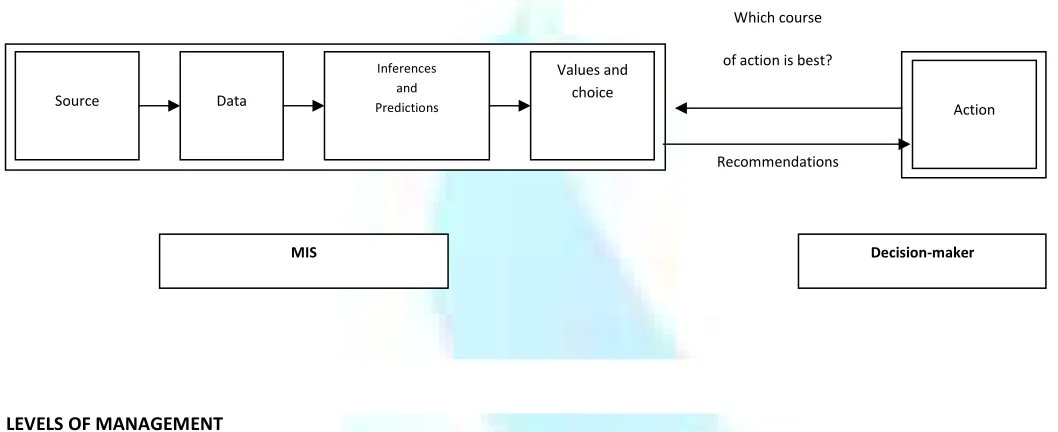
Management Information system has four categories or levels. There is a basic difference between the “Information System” and “Decision Making System” i.e. where the information system leaves off and the decision maker begins. The process of decision making consists of five activities (Mason and Swason, 1981).
1. Source – consisting of the physical activities and objects, which are relevant to the business.
2. Data – observation, measurement and recording of data from source.
3. Inference and prediction drawn from data
4. Values and choice – evaluation of inferences with regard to the values (objectives or goals) of the organization and choosing a course of action.
INTERNATIONAL JOURNAL OF RESEARCH IN COMMERCE, IT & MANAGEMENT
Again, MIS is of four categories (Mason, 1981). These are as follows:Databank information system. Predictive information system. Decision – making information system. Decision taking information system.
DECISION MAKING MANAGEMENT INFORMATION SYSTEM
In the global business world, MIS plays very important role as it helps the decision maker to take an effective decision. Decision making management information system includes those in which the organization’s value system and the criteria for choice are incorporated into the MIS itself. Thus it provides structured decision to the mid level managers and based on these information managers take action. (Masons, 1981).
FIGURE 1: MASON’S DECISION MAKING PROCESS THROUGH MIS
LEVELS OF MANAGEMENT
Levels of management means the managerial hierarchy in an organization, typically three distinct levels: executive, middle and first line; usually portrayed as pyramid (Skinner and Ivancevich, 2004).
TOP MANAGEMENT
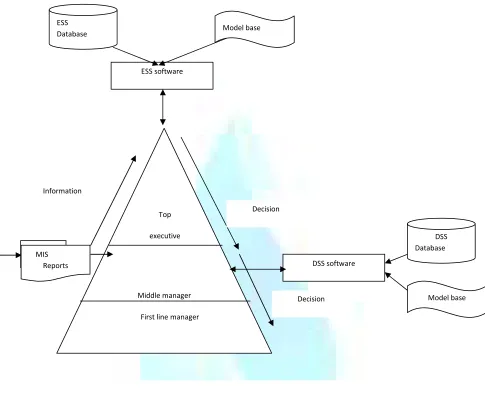
Top management is responsible for the overall management of an organization. These people are called executives. They establish operating and guide the organization’s interactions with its environment. They actually take the decisions on non-programmer facts and those are strategic. Non-programmed decisions are used for unstructured, novel, and ill-defined situations of a nonrecurring nature. DSS and ESS help to the top level manager to take effective decisions.
MID-LEVEL MANAGEMENT
The middle level of the management hierarchy includes supervisors, college deans, project director, and regional sales coordinator. These managers receive the broad overall strategies, missions and objectives from executive level managers and translate them into specific action program. The middle level manager implements semi-structured decisions. They have taken routine decisions and taken strategic decisions collaboration with top executives. MIS directly provides semi-structure decisions and they aid to the mid level manager.
LOWER-LEVEL OR FIRST LINE MANAGEMENT
First line manager supervises employees and resources at the lowest levels of the organizational hierarchy. Most of their concerns with seeing that specific work assignments are carried out on time. They have taken structured decisions and taken help from their top. TPS aids to the first line manager by providing routine decisions.
RELATIONSHIP BETWEEN MIS AND MANAGEMENT LEVELS
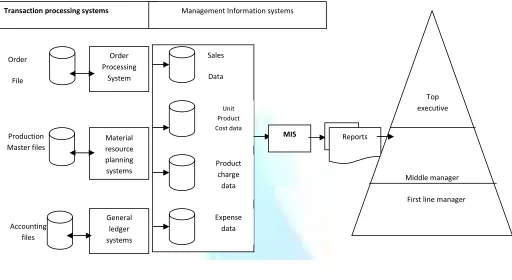
MIS is an information system application that serves ‘Decision Making’- one of the important functions of management at the management levels of the organization by providing routine summery and exception reports. MIS actually provides routine information and exception reports to the mid level manager and mid level manager takes decision on the basis of those reports. Strategic decisions are made by top executives and DSS and ESS help to the executive level for making strategic decisions.
MIS
Source Data
Inferences and Predictions
Values and choice
Action Which course
of action is best?
Recommendations
VOLUME NO.2(2012),ISSUE NO.6(JUNE) ISSN 2231-5756
FIGURE 2: RELATIONSHIP BETWEEN MIS AND MANAGEMENT LEVELS
DECISION MAKING PROCESS OF MANAGEMENT USING MIS
In today’s business, decision-making is very important. Wherever the level, management of the organization make decisions on the basis of information, information may be manual or may be computerized. MIS is one of the important information system applications that help the different level managers to take effective decisions. MIS directly helps the mid level manager by providing routine reports on the basis of TPS information that are collected from organizations’ operational activities. DSS also facilitate the decision making process of semi-structured tasks. These systems are designed not to replace managerial judgment but to support it and to make the decision process more effective (Weihrich and Koontz, 2000). ESS also helps the senior manager by providing critical information from a wide variety of internal and external sources (O’Brien, 2003).
On the basis of information transferring process i.e. bottom–up and decision-transferring process i.e. top–down, middle level manager makes decision based on MIS reports and transfer information to the top executives that are strategic. Mid level manager gets strategic decisions from top executives for proper implementation.
Sales
Data
Accounting files Production Master files
Transaction processing systems Management Information systems
Order
File
Order Processing
System
Material resource planning systems
General ledger systems
Unit Product Cost data
Product charge
data
Expense data
MIS Reports
Middle manager
INTERNATIONAL JOURNAL OF RESEARCH IN COMMERCE, IT & MANAGEMENT
FIGURE 3: DECISION MAKING PROCESS OF MANAGEMENT THROUGH MIS
CONCLUSION
Efficient managers are those whose decisions are effective. To do this, managers have to have insights and foresights on today’s global information systems. Management Information System is an important weapon for the global world business managers to see the success of their organizations in a nearest day. MIS plays a vital role in the organization for taking right decision in a short time on the basis of gathered information from operation level of the organizations. Not only that but also it helps the strategic manager to take strategic decisions with the assistance of DSS and ESS. But, an important fact is that they must maintain to make balance between objective of the organization and the technological capabilities of the organization. So, MIS is a vital component of decision making task of managements in the organization in global business and information world.
REFERENCES
1. Banerjee, U. K. and Sachdeva, R. K. (2002), Management Information Systems, 2nd revised edition, Associated Business Corporation, Dhaka, pp. 9-16.
2. Dixon, P. (2004), “Impact on New Technology on Consumer Life Styles and Business Strategy”, IBS Global Executive Summit, Stockholm, September, 2004.
http://www.globalchange.com/ppt/ibs/index.htm, Retrieved on January, 25, 2012.
3. Islam, M. B. and Haque, M. M. (2003), “Information Systems and Its Application in Managerial Decision Making”, Business Review (A Journal of Business
Administration Discipline, Khulna University, Khulna), Vol. 3, No. 2, July–December, pp. 43-49.
4. Laudon, C. K. and Laudon, P. J. (2002), Management Information Systems, 7th edition, Pearson Education, New York.
5. Mason, R. O. and Swason, E. B. (1981), Basic Concepts for Designing MIS in Measurement for Management Decision, Addison-Wesley Publishing Co.
6. O’Brien, J. A. (2002), Management Information Systems, 5th edition, McGraw–Hill Irwin, New Delhi, pp. 4-11.
7. Skinner and Ivancevich (2004), Business for the 21st Century.
8. Steven, A. (1980), Decision Support Systems: Current Practice and Continuing Challenges, Addison wisely Publishing Co., p. 9.
9. Weihrich, H. and Koontz, H. (2000), “Management– A Global Perspective”, 10th edition, McGraw-Hill Publishing Co., Singapore, pp. 212-213.
10. Whitten, J. L., Bentley, L. D. and Dittman, K. C. (2002), Systems Analysis and Design Methods, 5th edition, Tata McGraw–Hill Publishing Company Limited,
New Delhi, pp. 8-49. Information
MIS
Reports
Middle manager
First line manager Top
executive
Decision ESS software
ESS
Database Model base
DSS software
DSS Database
VOLUME NO.2(2012),ISSUE NO.6(JUNE) ISSN 2231-5756
REQUEST FOR FEEDBACK
Dear Readers
At the very outset, Internation]al Journal of Research in Commerce, IT and Management (IJRCM)
acknowledges & appreciates your efforts in showing interest in our present issue under your kind perusal.
I would like to request you to supply your critical comments and suggestions about the material published
in this issue as well as on the journal as a whole, on our E-mails i.e.
or
for further improvements in the interest of research.
If you have any queries please feel free to contact us on our E-mail
.
I am sure that your feedback and deliberations would make future issues better – a result of our joint
effort.
Looking forward an appropriate consideration.
With sincere regards
Thanking you profoundly
Academically yours
Sd/-