Please cite this article as: H. Karimi, M. Bashiri , S. Nickel, Capacitated Single Allocation P-Hub Covering Problem in Multi-modal Network Using Tabu Search, International Journal of Engineering (IJE), TRANSACTIONS C: Aspects Vol. 29, No. 6, (June 2016)
International Journal of Engineering
J o u r n a l H o m e p a g e : w w w . i j e . i rCapacitated Single Allocation P-Hub Covering Problem in Multi-modal Network
Using Tabu Search
H. Karimia, M. Bashiri*b, S. Nickelc
a University of Bojnord, Department of industrial engineering, Bojnord, Iran b Shahed University, Department of industrial engineering, Tehran, Iran
c Institute for Operations Research, Karlsruhe Institute of Technology (KIT), Karlsruhe, Germany
P A P E R I N F O
Paper history:
Received 23 December 2015 Received in revised form 23 April 2016 Accepted 02 June 2016
Keywords: Hub Location Covering; Multi-Modal Tabu Search Valid Inequality Capacity
A B S T R A C T
The goals of hub location problems are finding the location of hub facilities and determining the allocation of non-hub nodes to these located hubs. In this work, we discuss the multi-modal single allocation capacitated p-hub covering problem over fully interconnected hub networks. Therefore, we provide a formulation to this end. The purpose of our model is to find the location of hubs and the hub links between them at a selected combination of modes for each origin-destination. Furthermore, it determines the allocation of non-hub nodes to the located hubs at the best mode for each allocation such that the travel time between any origin–destination pair is not greater than a given time bound. In addition, the capacity of hub nodes is considered. Six valid inequalities are presented to tight the linear programming lower bound. We present a heuristic based on tabu search algorithm and test the performance of it on the Australian Post (AP) data set.
doi: 10.5829/idosi.ije.2016.29.06c.00
1. INTRODUCTION1
A hub location problem is applied when it is cost-effective to join and distribute the flow at a centralised location called a hub node. Flow concentration and consolidation take place on the arcs that unify hub nodes, called hub links. These links allow for a more efficient transportation of origin-destination (O-D) flows. It is also possible to remove many expensive direct links between O-D pairs. The advantage of using hubs is that by consolidating the flow, economies of scale can be achieved, such that transferring flow between hubs is cheaper than the cost of moving flow directly between non-hubs. Non-hubs can be connected to one or more hubs, depending on whether we deal with a single or multiple allocation strategy. It is usually assumed that the hubs are fully interconnected, while non-hubs are not connected to each other. Therefore, all flows have to be routed via at least one hub. Hence, such a logistic network consists of two parts, called the ―hub-and-spoke‖ network.
1*Corresponding Author’s Email: [email protected] (M. Bashiri)
This research follows the mentioned assumptions. Commodities are shipped in the hub-and-spoke network in three phases: 1) Collecting: they move along their origin nodes to the assigned hub nodes, 2) Transferring: commodities go through the hub arcs if necessary, and 3) Distributing: commodities depart from the hubs and arrive in destination nodes. The unit cost factor of the transferring phase is
. The transferring cost factor
is usually less than the collecting and distributing cost factors because of economies of scale from the gathering of flows at the hubs and the transfer of these bundled flows through the hub arc [1]. Typical applications of hub locations include airline passenger travel [2], telecommunication systems [3] and postal networks [4].H. Karimi et al. / IJE TRANSACTIONS C: Aspects Vol. 29, No. 6, (June 2016)
[7] and Farahani et al. [8] which contains some recent trends on hub location. Campbell [9] categorised this problem into three important cases: hub median, hub centre and hub covering problem. Another classification in hub location is related to the capacity of hub nodes or arcs. Here, multi-modal system as one of important issues in transportation system is studied. Multi-modal transport, which is taking advantage of combination of transport modes for a trip between which a transfer is necessary, seems an interesting approach to solving transportation problems with respect to the deteriorating accessibility of city centres, recurrent congestion, and environmental impact [10]. Interested readers in the multi-modal transportation study the SteadieSeifi et al [11] and therein references.
Trade hubs are one of real applications of the multi-modal transportation system. The trade success of each country depends on its trade infrastructure, and the main component is transportation facilitators, so trade growth in each country can occur if the trade hubs are designed and developed properly. In contrast, trade hubs connect most trade routes with some facilitation to decrease the total transportation cost with the lowest delivery time, so according to its geographic position, each location should employ different modes of transportation systems. Hence, most of trade hubs use multi-modal transportation systems, and it is obvious that the goods can be imported by train from the origin country and re-exported by the sea to the destination country. Multi-modal transportation systems in the real trade hubs show that we need to consider the transportation type in the hub location problems, which is why we call it a multi-modal problem.
The remainder of the paper is organised as follows. In Section 2, the related literature is reviewed, and then the problem is stated. In section 3, the model is introduced in details. In the next section, a tabu search-based algorithm is proposed to handle the model. In Section 5, we present the results of computational tests performed to analyse valid inequalities and the proposed algorithm performances. The paper ends with some conclusions drawn by the research.
2. RELATED WORKS AND PROBLEM
DESCRIPTION
In this section, First, we review the literature of the hub covering problem, then the capacitated hub location problem is considered. Also the problem charasteristics are described.
2. 1. Hub Covering Problem Campbell [9] provided the hub set and hub maximal covering problem with single and multiple allocation. Kara and Tansel [12] advanced the single allocation hub set covering
problem formulation and its linearisation at a later time. A new formulation for the single allocation hub set covering problem was proposed by Wagner [13]. Moreover, a formulation for a multiple allocation hub set covering problem with quantity-independent discount factors has been introduced. Ernst et al. [14] suggested a novel formulation based on the coverage radius concept. This novel idea improved the single and multiple allocation hub set covering problems. Hamacher and Meyer [15]contemplated similarities and differences in the various formulations for hub covering problems, and analysed the feasibility polyhedron of this problem. Weng et al. [16] designed a new formulation for multiple allocation hub maximal covering problems. In addition, two artificial intelligence heuristic methods based on the genetic algorithm and tabu search to solve this model have been employed. Subsequently, Tan and Kara [17] provided hub covering formulations for cargo delivery systems and introduced a Turkish dataset.
covering location problem. Two objectives have been considered in their modelling. The first objective was to minimize the total costs of opening, reopening, activating, covering and transporters purchasing. The second was the sum of the times of travelling commodities from the origin to destination via hubs. Davari et al. [26] suggested an incomplete hub covering problem. Their model considered the imprecise flow between nodes. Mohammadi et al. [27] developed a new stochastic multi-modal model for the hub covering location with two objectives. Unlike our suggested model, the employed mode which was used between O-Ds was not determined with their model. However, just a new variable was used to find the number of required mode. Moreover, Setak and Karimi [28] formulated the gradual hub covering location problem. They employed a tabu search based heuristic algorithm to handle the large instances.
2. 2. Capacitated Hub Location Aykin [29] presented the capacitated hub-and-spoke network design problem in which hubs have a fixed capacity for directing flows between the nodes served by the system. The problem was formulated under a networking policy allowing both direct (nonstop) and hub-connected (one-hub-stop and two-(one-hub-stop) services between the nodes. A branch and bound algorithm and a heuristic procedure partitioning the set of solutions on the basis of hub locations have been proposed. Campbell [9] proposed the single and multiple allocation capacitated hub location problem.
Other work by Aykin [30] analyses a capacitated hub location problem with fixed costs and a given number of hubs to be located. Two policies, which called strict and non-strict (direct connections are allowed) have been studied. Moreover, a counting algorithm and a tabu search-based greedy interchange heuristic have been proposed. Two new formulations for the capacitated single allocation hub location problem have been provided by Ernst and Krishnamoorthy [31]. Two heuristic approaches to cope with these models have been applied. The first one was tabu search, and the other one was the random descent. Optimal solutions by using an LP-based branch and bound method with the initial upper bound supplied by these heuristics have been achieved. Moreover, the algorithm has been evaluated on the AP data set, because the CAB data set does not contain fixed costs and capacities.
Subsequently, Ebery et al. [32]suggested the multiple allocation version of the capacitated hub location problem based on the Ernst and Krishnamoorthy [31] models. They constructed an efficient heuristic algorithm using the shortest paths. A model for the capacitated one-stop multiple allocation hub location problem has been presented by Sasaki and Fukushima [33]. This model considered capacity constraints both on hubs and arcs. Marin [34] presented splittable capacitated multiple
allocation hub location problems and useful properties of the optimal solutions that can be used to speed up the resolution. Rodriguez and Salazar [35] proposed a model of the capacitated hub location problem in which the arcs linking hubs are not assumed to make a complete graph. A mixed integer linear programming formulation and two branch-and-cut algorithms based on decomposition techniques have been proposed. Randall [36] used an ant colony to solve the capacitated single allocation hub location problem. Costa et al. [37] introduced a second objective function to the model besides the traditional cost minimising function that tried to minimise the time to process the flow entering the hubs.
H. Karimi et al. / IJE TRANSACTIONS C: Aspects Vol. 29, No. 6, (June 2016)
nodes. Zamani and Razmi [45] propose a single allocation p-hub location-routing problem with multimodality in hub link.
In this research, we provide the Multi-Modal Single Allocation Capacitated p-Hub Covering Problem (MMSACpHCP) model. This model merges the two important concepts in the hub location problem: capacity and covering. Moreover, selection of the combination of modes is a decision variable in the proposed model to create an efficient route in the hub-and-spoke network. MMSACpHCP is classified as a multi-modal design (see Figure 1). The scope and features of MMSACpHCP based on the studied literature are shown in this figure.
Kara and Tansel [46] and Ernstet al. [14] proved that hub covering problems can be categorised by NP-Hard class. We propose six valid inequalities to achieve tighten lower bound. Moreover, to cope with the MMSACpHCP model, we present a tabu search-based algorithm and test this method for a well-known AP data set.
3. MATHEMATICAL FORMULATION
This section is dedicated to describing the MMSACpHCP model formulation. We consider the time coverage in this model. If the time for the path from i to j via k and m
is not greater than a specific value ( ), then O-D (i,j) is covered by hubsk and m. We assume that N
1,2,...n
is node set withn
nodes and L
1,2,...l
combination of modes. The triangle inequality is supposed for the all arcs. The mathematical model locates hubs from the node set and allocates the non-hub nodes to these hubs, depending on the capacity of the hub nodes and the coverage time bound. Moreover, the combination of modes for each O-Ds route is determined. So, the hub network is constructed. The model forces the travel time between any O-D pair to be less than a given time bound. The definition of the model decision variables and parameters are as follows:Parameters:
0,1 is discount factor for the hub to hub link. is time bound for each link between two nodes. Wij is flow
from node i to j. Fkis the fixed cost of a hub at node k. Cikl is the cost of transshipment from node i to k at combination of modesl, also, Cikmjl Cikl ClkmCmjl ,
l jmki l
ikmj C
C is the transshipment cost from nodes i to j via hubs k and m with combination of modesl.Tikl is the transportation time between nodes i and kat
combination of modesl, moreover,
l mj l km l ik l
ikmj T T T
T ,Tikmjl Tjmkil is the travel time between nodes i and j via hubs k and mwith
combination of modesl. k is the capacity of the hub installed at node k.pis the number of required hubs.
l ikmj
V is the coverage matrix. This matrix is calculated as following: l j m k i w o T V l ikmj l
ikmj , , , ,
. 0 1 Variables: 1 l ikmj
X if node i sends its flow via hub kandm to node j by combination of modesl ; otherwise Xikmjl 0 . Thess variables types in MMSACpHCP are continous. Rely on the formulation constraints, they just can take binary value. 1
ik
Z if non-hub node i allocates to hub node k; otherwise Zkm0. 1
kk
Z means node k is a hub.
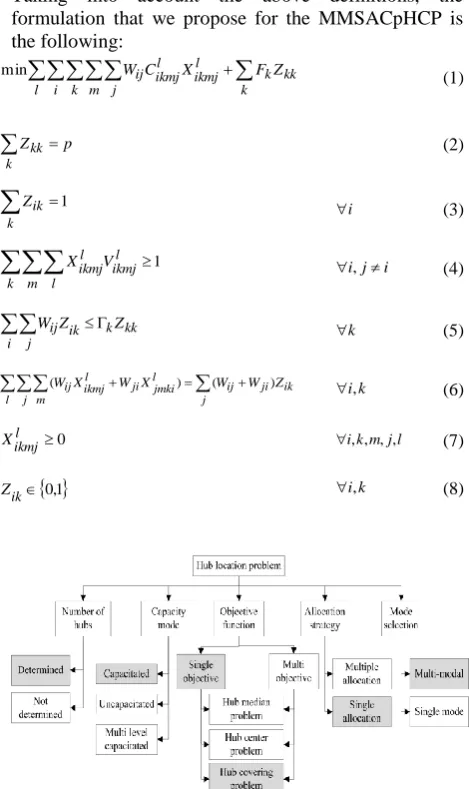
Taking into account the above definitions, the formulation that we propose for the MMSACpHCP is the following:
k kk k l i k m jl ikmj l ikmj
ijC X F Z
W min (1)
k kk p Z (2) 1
k ikZ i
(3)
1
k m l
l ikmj l ikmjV
X i,ji (4)
kk k i j
ik
ijZ Z
W
k (5) j ik ji ij
l j m
l jmki ji l ikmj
ijX W X W W Z
W ) ( )
( i,k
(6)
0
l ikmj
X i,k,m,j,l (7)
0,1 ik
Z i,k (8)
In this formulation, the objective function minimises the overall cost, which consists of two parts: the cost for routing the flow in the network and the cost for installing the hubs. The required hubs are satisfied by Constraint (2). Constraints (3) ensure that all nodes are allocated to a single hub. Constraints (4) ensure that the transportation time between each O-D pair does not exceed the time bound ( ). Constraints (5) refer to the capacity of the hubs; also they guarantee that non-hub nodes can only be allocated to installed hubs. Constraint (6) involves divergence equations at node k for flow associated with node
i
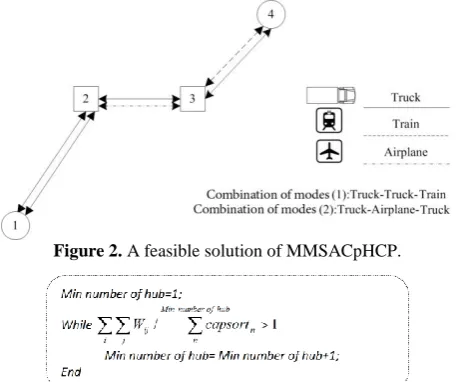
. Constraints (7) and (8) are domain constraints. An example solution of this model is depicted in Figure 2.The solution in the Figure 2 has two combination of modes defined in the figure. In addition, covering and capacity constraint should be considered in this solution. As stated by this figure, combination (1) is made by two types (truck and train), and combination (2) includes three types (truck, airplane and train). According to its solution,
1 1 1234
X implies that the first combination of modes can be
selected for O-D (1, 4). Moreover, X12342 1 infers that the second combination of modes can be chosen for this O-D. If combination (1) is selected for the route between O-D (1, 4), the combination of modes for (1, 4) is the same as (4, 1), since we suppose that the triangle inequality and symmetric data for travel cost and time between each two nodes.
Generally, the model contains 2
n binary variables, l
n4 positive variable and 2n22nn1constraints, where n and lare the number of nodes and combination of modes, respectively. These variables and constraints will make it extremely challenging to find the optimal solution, especially for large values ofn. Therefore, in the section 4, we introduce a tabu search-based heuristic to solve the MMSACpHCP model for realistic network dimensions at a reasonable computational time.
3. 1. Valid Inequalities One of the most efficacious methods to tighten the linear relaxations of the formulations is valid inequalities. These inequalities release some fractional solutions from the solution space such that a stronger lower bound can be achieved from linear programming (LP). In this paper, we employ the following six valid inequalities.
Constraints (9) and (10) are two sets of valid inequalities that caused some enrichment for the LP. These constraints state when the nodes k and
m
are both hub nodes, the total flow depart from k and/ordestined to j should be routed via a hub link.
1
kk mm
l j k l
kkmj Z Z
X k,mk (9)
1
kk mm
l j k l
jmkk Z Z
X k,mk
(10)
Another valid inequality is found on some variables characteristic of MMSACpHCP. By constraints (11), we ensure that node
i
is routed to hub node k by one type of transportation mode, when non-hub node i is allocated to hub nodek.ik l
l ikkk Z
X
i,k (11)Constraints (12) are presented as a different valid inequality. By these constraints, when node k is a hub node, the summation of all hub links which applied one type of modality and connected to it should be at least equal to it. It must be noted that constraints (12) are valid whenp1.
kk l m
l
kkmm Z
X
k (12)The constraints (13) note that at least one O-D route is directed through selected hubs, when node kand m simultaneously are hub nodes and connected via one mode.
l
l kkmm l i j i
l
ikmj X
X 2 k,m
(13)
The last valid inequality for MMSACpHCP is based on the number of non-hub allocation to hub nodes. When a node is a hub node, at most Np1 non-hub nodes can be allocated to it. The constraints (14) describe it.
kk i
ik N p Z
Z ( 1)
k (14)One of the properties of MMSACpHCP is the minimum number of hub nodes. This property can be calculated based on the capacity and flow of the nodes. First, we sort the capacity in descending order and call it capsort. The following procedure in Figure 3 finds the minimum number of hubs. We apply this property to define the p
in tested instances.
Figure 2. A feasible solution of MMSACpHCP.
H. Karimi et al. / IJE TRANSACTIONS C: Aspects Vol. 29, No. 6, (June 2016)
4. TABU SEARCH-BASED HEURISTIC ALGORITHM
For large scale instances, NP-hard problems are in most cases only tractable by heuristics. The renowned tabu search heuristic methodology is applied in order to avoid trapping at a local optimal solution. This approach has found vast acceptance for solving combinatorial optimisation problems for two reasons: it provides relatively good solutions without consuming much CPU time, and it is easy to execute in most situations.
TS scientific method was selected to depend on the earlier literature for p-hub location problem. Skorin-Kapov et al. [47] showed that TS can find high-quality solutions, which have less than 1% optimality gaps for the p-hub median problem. MMSACpHCP objective function and p-hub median problem are alike. TS handles the solution approach to run away from a local optimum and to move to former unexamined areas of the solution space [48]. A short-term memory is employed, which entered a node previously managed shifts. Such shifts are believed tabu for some period of time. This assists to escape re-inspecting solutions that were lately seen. To veto a tabu move, an aspiration criterion is applied, so that not to miss a better solution throughout the search. A long-term memory list is used to begin the search process another time from an antecedent unvisited part of the solution space [49, 50].
Two aspects of TS are intensification face and diversification face. TS commences at a randomly generated initial solution and included with a set of hub nodes (p). We run the model with four types of neighbourhoods. A pair-wise exchange of a non-hub node with a hub node produces the neighbourhood solutions of the current solution. This interchange is called a shift or move. As a move is made, its qualities such as entering a node and exiting node are listed in a tabu list. The search moves from one solution to the next and terminated when local optimum is procured, in the intensification aspect. After it is completed, TS takes part in the diversification aspect. In this aspect, the TS restarts the search procedure from a new solution.
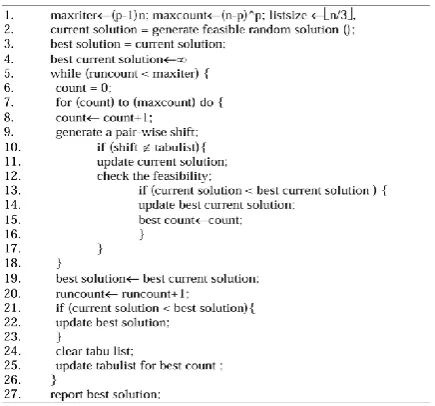
The pseudo-code of TS developed for this study is shown in Figure 4. The TS parameters are set at the beginning of procedure. The while loop in line 5 executes the main body of TS. The search begins with a randomly solution in which hub locations are picked out. In sequential iterations, the set of hub locations change under pair-wise interchange. Pair-wise swap exchanges two hub and non-hub nodes. As we have n
nodes and phub nodes, p
p n )
( pair-wise swap should be done. From a given set of hub locations, the optimal solution can be generated by finding the hub-spoke structure which minimises the cost of hub-and-spoke network. The structure must be feasible according to the service time coverage necessities and capacity of chosen hub nodes. Two important characteristic of our TS based approaches are explained in the following.
Combination of modes selection. We select the best combination relies on the coverage constraint and cost of them. First Vikmjl and Cikmjl are generated. Subsequently, the best combination (BMikmj) for each O-D is selected as
follows:
l l ikmj l ikmj
ikmj ikm j V C
BM (, , , )|min . According to
the chosen combination for each O-D, the allocation procedure can be done.
Allocation strategy. In the TS approach, a heuristic procedure to allocation non-hub nodes to selected hub nodes in each swap is suggested. We define total cost (
ik
TC ) for each non-hub and its potential hub as H
k N i C w TC
L l j Nm H
l ikmj ij
ik
, , where Nis set of
nodes, His set of selected hub and Lis set of combination of modes. Then, for each non-hub, a hub node can be found
by minimising the total cost as follows:
ik
k ik TF TF H k N i
IX ( , )|min , where IXis an index.
Hence, the single allocation strategy obtains using )
( )
(i IX hubk IX
allocate . The pseudo code of the tabu search algorithm is described in Figure 4.
In the absence of optimal solutions to use as benchmarks, upper bounds or lower bounds are needed. These lower bounds are required to be tight for the solution evaluation to be accurate in MMSACpHCP. The lower bounds of MMSACpHCP are gained by using LP for it with the suggested valid inequality. Parameters were chosen after extensive computational testing and analysis both on solution quality and computational efficiency. To test the performance of TS, we execute it on some benchmarks in the next section.
5. COMPUTATIONAL EXPERIMENTS
In this section, the performance of valid inequalities, the tabu search-based algorithm and time bound under various conditions is considered. A number of standard problem benchmarks are applied. The most well-known and established data set for testing the performance of algorithms for hub location problems is the CAB data set. However, the CAB data set cannot be used in the MMSACpHCP model that we are attempting to solve, because the data set does not include capacity restrictions and fixed costs on the nodes. We apply the AP dataset, which is derived from a real application to a postal delivery network. It includes 200 nodes, which portray postcode districts; the direction of their coordinates and flow volumes (mail flow); in addition, here,0.75. A feature of this data is that the flow matrix is not symmetrical (i.e., Wij Wji andWii0). We employ near to half of the time bounds which Ernst et al. [14] calculated them.
Results for the AP data set for problems of size n = 10, 20 are given. All the tests were executed in MATLAB 7.8 (for TS) and GAMS 23.5 with CPLEX 12 solver. They were run on an experimental computer that is equipped with 2.99 GB of RAM and a Pentium microprocessor running at 2.53 GHz. For the larger problems (n>20), our machine cannot run the model, since they employ much memory. So the exact solution cannot be reached.
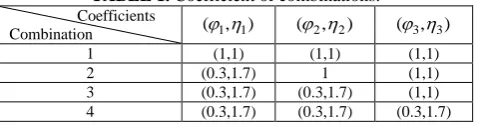
The AP data set also includes capacities and fixed costs on the nodes. Two types of fixed costs: tight (T) and loose (L) are considered. We also consider two types of capacities: tight (T) and loose (L). For each benchmark, four types of problems LL, LT, TL and TT are used. Because the AP data set does not consider multi-modal data, we take into account four combination of modes for these benchmarks. We use some coefficients for travel time and cost of combination (coefficient for travel time of mode() , coefficient for cost of mode() ) for each link between O-D, so three coefficients pairs must be applied for each O-D. The following assumptions are embedded in table 1 for AP data set.
The following calculations are run for the dataset: ,
3 2
1 ik km mj
l j i
ikmj T T T
T l ,
j i ikmj l
j i
jmki T
T
mj km ik
j i
ikmj C C C
C1 1 2 3 andCljmkiijCikmjl ij
Moreover, we defined two time bounds for each benchmark instance. The first coverage limit (i.e., lower one) is tighter than the second one for each test.
TABLE 1. Coefficient of combinations. Coefficients
Combination (1,1) (2,2) (3,3)
1 (1,1) (1,1) (1,1)
2 (0.3,1.7) 1 (1,1)
3 (0.3,1.7) (0.3,1.7) (1,1) 4 (0.3,1.7) (0.3,1.7) (0.3,1.7)
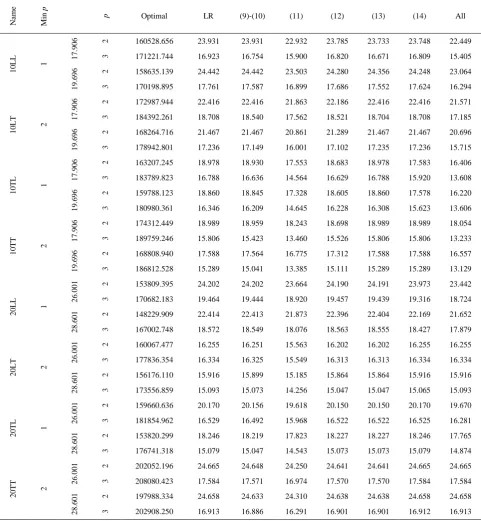
5. 1. Valid Inequality Performance Comparisons among valid inequalities are done, in the first part of the computational study. Seven forms of MMSACpHCP are run with respect to the valid inequalities. The first form is relied just on pure linear relaxation of MMSACpHCP, called LR. Valid inequalities (9)-(10), (11), (12), (13) and (14) are added to the model, and implemented in the second, third, fourth, fifth and sixth forms, respectively. At last, MMSACpHCP with all valid inequalities are place as the last form. The results of linear relaxation objective function gap (i.e.,
1
relaxedsolution/Optimal
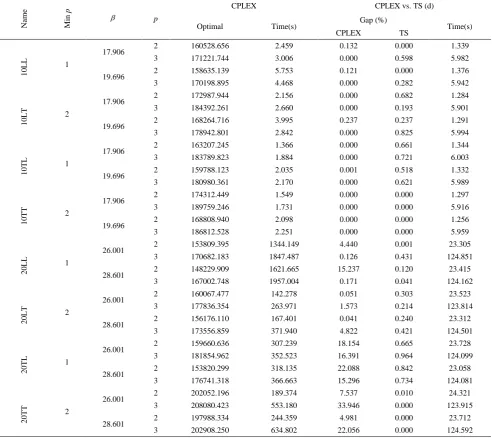
100) are given in Tables 2 for each instance size.An inclusive overview of the instances results runs on AP is provided in the last row (i.e., ―average‖) of Table 2. As general trend, in average, using all valid inequalities (i.e., column ―All‖) give the best lower bound resulting, and tighter than any other implementation. In fact, using all valid inequalities lifts %1.251 lower bound of pure linear relaxation of MMSACpHCP. Moreover, valid inequality (11) is the most effective inequality in tightening the model. 5. 2. TS Performance TS solution approaches are run ten times for instances and the average values are reported, in this subsection. According to table 3, the CPLEX consumes much more average computational time than the proposed tabu search-based algorithm (average CPU time for CPLEX and TS are 335.1435 and 38.76856, respectively).
Figure 5 shows the meaningful improvement in computational time to solve MMSACpHCP with TS for AP20. We let CPLEX uses the same time as TS. Then, the qualities of gaps for TS and CPLEX are compared (see Figure 6). In the Figures 5 and 6, the odd and even numbers in horizontal axis express p2 andp3, respectively. In Figure 6, 1 to 16 relates to the AP 10, and the remainders are for AP 20.
TS has a reasonable objective function value (OFV) for MMSACpHCP. The tabu search-based algorithm performs better when the problem constraints are loose, and the number of nodes is increased. Moreover, it can be used for all MMSACpHCP problems. The TS achieves a small gap for the tested instances. The gap for TS and CPLEX in the same time as TS is defined as
H. Karimi et al. / IJE TRANSACTIONS C: Aspects Vol. 29, No. 6, (June 2016)
TABLE 2. The GAP (%) performances of the implementations of MMSACpHCP.
N
ame
M
in
p
p Optimal LR (9)-(10) (11) (12) (13) (14) All
1
0
LL 1 1
7
.9
0
6 2 160528.656 23.931 23.931 22.932 23.785 23.733 23.748 22.449 3 171221.744 16.923 16.754 15.900 16.820 16.671 16.809 15.405
1
9
.6
9
6 2 158635.139 24.442 24.442 23.503 24.280 24.356 24.248 23.064 3 170198.895 17.761 17.587 16.899 17.686 17.552 17.624 16.294
1
0
LT 2 1
7
.9
0
6 2 172987.944 22.416 22.416 21.863 22.186 22.416 22.416 21.571 3 184392.261 18.708 18.540 17.562 18.521 18.704 18.708 17.185
1
9
.6
9
6 2 168264.716 21.467 21.467 20.861 21.289 21.467 21.467 20.696 3 178942.801 17.236 17.149 16.001 17.102 17.235 17.236 15.715
1
0
TL 1 1
7
.9
0
6 2 163207.245 18.978 18.930 17.553 18.683 18.978 17.583 16.406 3 183789.823 16.788 16.636 14.564 16.629 16.788 15.920 13.608
1
9
.6
9
6 2 159788.123 18.860 18.845 17.328 18.605 18.860 17.578 16.220 3 180980.361 16.346 16.209 14.645 16.228 16.308 15.623 13.606
1
0
TT 2 1
7
.9
0
6 2 174312.449 18.989 18.959 18.243 18.698 18.989 18.989 18.054 3 189759.246 15.806 15.423 13.460 15.526 15.806 15.806 13.233
1
9
.6
9
6 2 168808.940 17.588 17.564 16.775 17.312 17.588 17.588 16.557 3 186812.528 15.289 15.041 13.385 15.111 15.289 15.289 13.129
2
0
LL 1 2
6
.0
0
1 2 153809.395 24.202 24.202 23.664 24.190 24.191 23.973 23.442 3 170682.183 19.464 19.444 18.920 19.457 19.439 19.316 18.724
2
8
.6
0
1 2 148229.909 22.414 22.413 21.873 22.396 22.404 22.169 21.652 3 167002.748 18.572 18.549 18.076 18.563 18.555 18.427 17.879
2
0
LT 2 2
6
.0
0
1 2 160067.477 16.255 16.251 15.563 16.202 16.202 16.255 16.255 3 177836.354 16.334 16.325 15.549 16.313 16.313 16.334 16.334
2
8
.6
0
1 2 156176.110 15.916 15.899 15.185 15.864 15.864 15.916 15.916 3 173556.859 15.093 15.073 14.256 15.047 15.047 15.065 15.093
2
0
TL 1 2
6
.0
0
1 2 159660.636 20.170 20.156 19.618 20.150 20.150 20.170 19.670 3 181854.962 16.529 16.492 15.968 16.522 16.522 16.525 16.281
2
8
.6
0
1 2 153820.299 18.246 18.219 17.823 18.227 18.227 18.246 17.765 3 176741.318 15.079 15.047 14.543 15.073 15.073 15.079 14.874
2
0
TT 2 2
6
.0
0
1 2 202052.196 24.665 24.648 24.250 24.641 24.641 24.665 24.665 3 208080.423 17.584 17.571 16.974 17.570 17.570 17.584 17.584
2
8
.6
0
1 2 197988.334 24.658 24.633 24.310 24.638 24.638 24.658 24.658 3 202908.250 16.913 16.886 16.291 16.901 16.901 16.912 16.913
5. 3. Time Bound Performance When the instance is loose for time bound, the CPLEX average CPU time is 356.7238 and for tight time bound, it is 313.56325. We conclude that the loose time bound consumes much more time to solve the problem. Moreover, the objective function values for tight time
Figure 5. TS and CPLEX computational times (s) comparison for AP 20.
Figure 6. CPLEX quality gap vs. TS, in the same computational time as TS.
TABLE 3. Computational comparison of CPLEX and the tabu search-based algorithm.
N
ame
M
in
p
p
CPLEX CPLEX vs. TS (d)
Optimal Time(s) Gap (%) Time(s)
CPLEX TS
1
0
LL 1
17.906 2 160528.656 2.459 0.132 0.000 1.339
3 171221.744 3.006 0.000 0.598 5.982
19.696 2 158635.139 5.753 0.121 0.000 1.376
3 170198.895 4.468 0.000 0.282 5.942
1
0
LT 2
17.906 2 172987.944 2.156 0.000 0.682 1.284
3 184392.261 2.660 0.000 0.193 5.901
19.696 2 168264.716 3.995 0.237 0.237 1.291
3 178942.801 2.842 0.000 0.825 5.994
1
0
TL 1
17.906 2 163207.245 1.366 0.000 0.661 1.344
3 183789.823 1.884 0.000 0.721 6.003
19.696 2 159788.123 2.035 0.001 0.518 1.332
3 180980.361 2.170 0.000 0.621 5.989
1
0
TT 2
17.906 2 174312.449 1.549 0.000 0.000 1.297
3 189759.246 1.731 0.000 0.000 5.916
19.696 2 168808.940 2.098 0.000 0.000 1.256
3 186812.528 2.251 0.000 0.000 5.959
20
LL 1
26.001 2 153809.395 1344.149 4.440 0.001 23.305 3 170682.183 1847.487 0.126 0.431 124.851 28.601 2 148229.909 1621.665 15.237 0.120 23.415
3 167002.748 1957.004 0.171 0.041 124.162
2
0
LT 2
26.001 2 160067.477 142.278 0.051 0.303 23.523 3 177836.354 263.971 1.573 0.214 123.814 28.601 2 156176.110 167.401 0.041 0.240 23.312
3 173556.859 371.940 4.822 0.421 124.501
2
0
TL 1
26.001 2 159660.636 307.239 18.154 0.665 23.728 3 181854.962 352.523 16.391 0.964 124.099 28.601 2 153820.299 318.135 22.088 0.842 23.058
3 176741.318 366.663 15.296 0.734 124.081
2
0
TT 2
26.001 2 202052.196 189.374 7.537 0.010 24.321 3 208080.423 553.180 33.946 0.000 123.915 28.601 2 197988.334 244.359 4.981 0.000 23.712
H. Karimi et al. / IJE TRANSACTIONS C: Aspects Vol. 29, No. 6, (June 2016)
6. CONCLUSIONS
The MMSACpHCP model has a wide range of applications in trade hubs networks when multi-modal transportation is considered. In this paper, in addition to modelling the multi-modal single allocation capacitated p-hub covering problem, to solve realistically sized problems, we provide a tabu search-based heuristic algorithm. Moreover, family of valid inequalities to strengthen the formulation are proposed. The innovation of this study is multi-modality on all links with the capacity constraint on the hub nodes under the predetermined time bound. In multi-modal hub-and-spoke network, each O-D can be connected by combination of modes which is including at most three types of transportation means. Constructing feasible solutions for the MMSACpHCP model in contrast to the other hub location problems, particularly with tight time bounds, is difficult. Consequently, we apply a heuristic approach to the allocation non-hub to hub nodes and construct feasible solutions. We tested the TS algorithm on the well-known AP data set. We compared the performance of the TS with CPLEX and found that TS obtained more efficient solutions. The computational times of it are better than CPLEX in the tested instances. The outcomes also present that using all suggested valid inequalities have a good performance on MMSACpHCP.
7. References
1. O’Kelly, M.E. and Bryan, D., "Hub location with flow economies of scale", Transportation Research Part B: Methodological, Vol. 32, No. 8, (1998), 605-616.
2. Bryan, D.L. and O'Kelly, M.E., "Hub‐and‐spoke networks in air transportation: An analytical review", Journal of regional science, Vol. 39, No. 2, (1999), 275-295.
3. Carello, G., Della Croce, F., Ghirardi, M. and Tadei, R., "Solving the hub location problem in telecommunication network design: A local search approach", Networks, Vol. 44, No. 2, (2004), 94-105.
4. Çetiner, S., Sepil, C. and Süral, H., "Hubbing and routing in postal delivery systems", Annals of Operations Research, Vol. 181, No. 1, (2010), 109-124.
5. O'kelly, M.E., "A quadratic integer program for the location of interacting hub facilities", European Journal of Operational Research, Vol. 32, No. 3, (1987), 393-404.
6. O'kelly, M.E., "The location of interacting hub facilities",
Transportation science, Vol. 20, No. 2, (1986), 92-106. 7. Alumur, S. and Kara, B.Y., "Network hub location problems:
The state of the art", European Journal of Operational Research, Vol. 190, No. 1, (2008), 1-21.
8. Farahani, R.Z., Hekmatfar, M., Arabani, A.B. and Nikbakhsh, E., "Hub location problems: A review of models, classification, solution techniques, and applications", Computers & Industrial Engineering, Vol. 64, No. 4, (2013), 1096-1109.
9. Campbell, J.F., "Integer programming formulations of discrete hub location problems", European Journal of Operational Research, Vol. 72, No. 2, (1994), 387-405.
10. Van Nes, R., "Design of multimodal transport networks: A hierarchical approach, TU Delft, Delft University of Technology, (2002).
11. SteadieSeifi, M., Dellaert, N.P., Nuijten, W., Van Woensel, T. and Raoufi, R., "Multimodal freight transportation planning: A literature review", European Journal of Operational Research, Vol. 233, No. 1, (2014), 1-15.
12. Kara, B. and Tansel, B., "The single-assignment hub covering problem: Models and linearizations", Journal of the Operational Research Society, Vol. 54, No. 1, (2003), 59-64. 13. Wagner, B., "Model formulations for hub covering problems",
Journal of the Operational Research Society, Vol. 59, No. 7, (2008), 932-938.
14. Ernst, A.T., Jiang, H., Krishnamoorthy, M., Baatar, D. and Judge, C., "Reformulations and computational results for uncapacitated single and multiple allocation hub covering problems", in Unpublished Report, CSIRO Mathematical and Information Sciences, Citeseer, (2005).
15. Hamacher, H.W. and Meyer, T., "Hub cover and hub center problems, Technische Universität Kaiserslautern, Fachbereich Mathematik, (2006).
16. Weng, K.-r., Yang, C. and Ma, Y.-f., "Two artificial intelligence heuristics in solving multiple allocation hub maximal covering problem", in International Conference on Intelligent Computing, Springer. Vol., No. Issue, (2006), 737-744.
17. Tan, P.Z. and Kara, B.Y., "A hub covering model for cargo delivery systems", Networks, Vol. 49, No. 1, (2007), 28-39. 18. Weng, K. and Wang, Y., "Evolutionary algorithms for multiple
allocation hub set covering problem", in Networking, Sensing and Control, 2008. ICNSC 2008. IEEE International Conference on, IEEE. Vol., No. Issue, (2008), 408-411.
19. Qu, B. and Weng, K., "Path relinking approach for multiple allocation hub maximal covering problem", Computers & Mathematics with Applications, Vol. 57, No. 11, (2009), 1890-1894.
20. Calık, H., Alumur, S.A., Kara, B.Y. and Karasan, O.E., "A tabu-search based heuristic for the hub covering problem over incomplete hub networks", Computers & Operations Research, Vol. 36, No. 12, (2009), 3088-3096.
21. Ishfaq, R. and Sox, C.R., "Hub location–allocation in intermodal logistic networks", European Journal of Operational Research, Vol. 210, No. 2, (2011), 213-230.
22. Karimi, H. and Bashiri, M., "Hub covering location problems with different coverage types", Scientia Iranica, Vol. 18, No. 6, (2011), 1571-1578.
23. Alumur, S.A., Kara, B.Y. and Karasan, O.E., "Multimodal hub location and hub network design", Omega, Vol. 40, No. 6, (2012), 927-939.
24. Alumur, S.A., Yaman, H. and Kara, B.Y., "Hierarchical multimodal hub location problem with time-definite deliveries",
Transportation Research Part E: Logistics and Transportation Review, Vol. 48, No. 6, (2012), 1107-1120.
27. Mohammadi, M., Jolai, F. and Tavakkoli-Moghaddam, R., "Solving a new stochastic multi-mode p-hub covering location problem considering risk by a novel multi-objective algorithm",
Applied Mathematical Modelling, Vol. 37, No. 24, (2013), 10053-10073.
28. Setak, M. and Karimi, H., "Hub covering location problem under gradual decay function", Journal of Scientific & Industrial Research, Vol. 73, No., (2014), 145-148.
29. Aykin, T., "Lagrangian relaxation based approaches to capacitated hub-and-spoke network design problem", European Journal of Operational Research, Vol. 79, No. 3, (1994), 501-523.
30. Aykin, T., "Networking policies for hub-and-spoke systems with application to the air transportation system", Transportation science, Vol. 29, No. 3, (1995), 201-221.
31. Ernst, A.T. and Krishnamoorthy, M., "Solution algorithms for the capacitated single allocation hub location problem", Annals of Operations Research, Vol. 86, No., (1999), 141-159. 32. Ebery, J., Krishnamoorthy, M., Ernst, A. and Boland, N., "The
capacitated multiple allocation hub location problem: Formulations and algorithms", European Journal of Operational Research, Vol. 120, No. 3, (2000), 614-631. 33. Sasaki, M. and Fukushima, M., "On the hub-and-spoke model
with arc capacity conatraints", Journal of the Operations Research Society of Japan, Vol. 46, No. 4, (2003), 409-428. 34. Marín, A., "Formulating and solving splittable capacitated
multiple allocation hub location problems", Computers & Operations Research, Vol. 32, No. 12, (2005), 3093-3109. 35. Rodriguez-Martin, I. and Salazar-Gonzalez, J.J., "Solving a
capacitated hub location problem", European Journal of Operational Research, Vol. 184, No. 2, (2008), 468-479. 36. Randall, M., "Solution approaches for the capacitated single
allocation hub location problem using ant colony optimisation",
Computational Optimization and Applications, Vol. 39, No. 2, (2008), 239-261.
37. da Graça Costa, M., Captivo, M.E. and Clímaco, J., "Capacitated single allocation hub location problem—a bi-criteria approach",
Computers & Operations Research, Vol. 35, No. 11, (2008), 3671-3695.
38. Contreras, I., Díaz, J.A. and Fernández, E., "Lagrangean relaxation for the capacitated hub location problem with single assignment", OR spectrum, Vol. 31, No. 3, (2009), 483-505.
39. Kratica, J., Milanović, M., Stanimirović, Z. and Tošić, D., "An evolutionary-based approach for solving a capacitated hub location problem", Applied Soft Computing, Vol. 11, No. 2, (2011), 1858-1866.
40. Correia, I., Nickel, S. and Saldanha-da-Gama, F., "Single-assignment hub location problems with multiple capacity levels", Transportation Research Part B: Methodological, Vol. 44, No. 8, (2010), 1047-1066.
41. Correia, I., Nickel, S. and Saldanha-da-Gama, F., "The capacitated single-allocation hub location problem revisited: A note on a classical formulation", European Journal of Operational Research, Vol. 207, No. 1, (2010), 92-96. 42. Groothedde, B., Ruijgrok, C. and Tavasszy, L., "Towards
collaborative, intermodal hub networks: A case study in the fast moving consumer goods market", Transportation Research Part E: Logistics and Transportation Review, Vol. 41, No. 6, (2005), 567-583.
43. O'Kelly, M.E. and Lao, Y., "Mode choice in a hub‐and‐spoke network: A zero‐one linear programming approach",
Geographical Analysis, Vol. 23, No. 4, (1991), 283-297. 44. Sedehzadeh, S. and Tavakkoli-Moghaddam, R., "Using a fuzzy
approach for a new bi-objective model for a multi-modal tree p-hub median location problem", International Journal of Fuzzy Computation and Modelling, Vol. 1, No. 2, (2014), 194-211. 45. Zameni, S. and Razmi, J., "Multimodal transportation p-hub
location routing problem with simultaneous pick-ups and deliveries", Journal of Optimization in Industrial Engineering, Vol. 8, No. 17, (2015), 11-20.
46. Kara, B.Y. and Tansel, B.C., "On the single-assignment p-hub center problem", European Journal of Operational Research, Vol. 125, No. 3, (2000), 648-655.
47. Skorin-Kapov, D., Skorin-Kapov, J. and O'Kelly, M., "Tight linear programming relaxations of uncapacitated p-hub median problems", European Journal of Operational Research, Vol. 94, No. 3, (1996), 582-593.
48. Klincewicz, J.G., "Avoiding local optima in thep-hub location problem using tabu search and grasp", Annals of Operations Research, Vol. 40, No. 1, (1992), 283-302.
49. Glover, F., "Tabu search-part i", ORSA Journal on computing, Vol. 1, No. 3, (1989), 190-206.
H. Karimi et al. / IJE TRANSACTIONS C: Aspects Vol. 29, No. 6, (June 2016)
Capacitated Single Allocation P-Hub Covering Problem in Multi-modal Network
Using Tabu Search
H. Karimia, M. Bashirib, S. Nickelc
a University of Bojnord, Department of industrial engineering, Bojnord, Iran b Shahed University, Department of industrial engineering, Tehran, Iran
c Institute for Operations Research, Karlsruhe Institute of Technology (KIT), Karlsruhe, Germany
P A P E R I N F O
Paper history:
Received 23 December 2015 Received in revised form 23 April 2016 Accepted 02 June 2016
Keywords: Hub Location Covering; Multi-Modal Tabu Search Valid Inequality Capacity
ديكچ ه
نبکم ٍلئسم زا فذَ نبکم هتفبی ،رًحم یببی
نبکم هیا ٍب بَرًحمریغ صیصخت ي رًحم یبَ ٍلئسم بم ،قیقحت هیا رد .تسا بَ
نبکم یببی
p
-تیفرظ یششًپ رًحم ثحب درًم ار یرًحم لمبک ٍکبش تلبح رد یُجيذىچ ي ٍوبگی صیصخت تلبح رد راد
لًمرف کی ،تُج هیمَ ٍب .میداد رارق یذىب
نبکم هتفبی بم لذم فذَ .تسا ٌذش ٍئارا ٍلئسم هیا یارب تبطببترا ي رًحم یبَ
نآ یرًحم أذبم رَ یارب یلقو ي لمح ٍجي ٍب ٍجًت بب بَ
رد بَرًحم ٍب بَرًحم ریغ صیصخت ،هیا رب ٌيلاع .تسا ذصقم
ا رتشیب ذصقم رَ ٍب أذبم رَ زا رفس نبمز بت ذش ذَاًخ هییعت یلقو ي لمح ٍجي هیرتُب .دًشو ،ٌذش ٌداد یوبمز ذح کی ز
بیلارتسا تسپ ٌداد ٍعًمجم یير رب متیرًگلا هیا درکلمع ٍک ٌذش ٍئارا سیو یربکتبا ٍعًىمم یًجتسج متیرًگلا کی ،هیىچمَ .تسا ٍتفرگ رارق یسررب درًم .