A Monthly Double-Blind Peer Reviewed (Refereed/Juried) Open Access International e-Journal - Included in the International Serial Directories
Indexed & Listed at:
VOLUME NO.2(2012),ISSUE NO.12(DECEMBER) ISSN2231-5756
INTERNATIONAL JOURNAL OF RESEARCH IN COMMERCE, IT & MANAGEMENT
CONTENTS
CONTENTS
CONTENTS
CONTENTS
Sr.No.
TITLE & NAME OF THE AUTHOR (S)
Page No. 1. EFFECTIVENESS OF PAY-FOR-PERFORMANCE AND FIXED-PAY PRACTICES: AN ASSESSMENT OF PAY SATISFACTION, COMMITMENT AND
TURNOVER INTENTION
PRINCY THOMAS & DR. G. NAGALINGAPPA
1
2. ROLE OF CORPORATE GOVERNANCE ON PERFORMANCE OF PRIVATE COMMERCIAL BANKS IN BANGLADESH: AN ECONOMETRIC ANALYSIS
DR. MD NAZRUL ISLAM, MOHAMMAD MASUD ALAM & MOHAMMAD ASHRAFUL FERDOUS CHOWDHURY
6
3. IDENTIFYING OPPORTUNITIES, CHALLENGES AND INFRASTRUCTURE REQUIREMENTS FOR ESTABLISHING SECONDARY MARKETS IN ETHIOPIA
KANNAN SIMHAKUTTY ASURI & LETENAH EJIGU
12
4. A NOVEL BANKRUPTCY PREDICTION MODEL BASED ON SUPPORT VECTOR DATA DESCRIPTION METHOD
ALIREZA DEHVARI, FEZEH ZAHEDI FARD & MAHDI SALEHI
17
5. ANALYSIS OF FACTORS INFLUENCING EXPORT VOLUME: THE NIGERIAN EXPERIENCE
KAREEM, R.O, OKI A.S, RAHEEM, K.A & BASHEER, N.O
24
6. A MODEL FOR ORGANIZING, MEASURING, ANALYZING STUDENTS’ KNOWLEDGE AND PERFORMANCE
ROY MATHEW
32
7. DETERMINANTS OF CUSTOMER LOYALTY AND SUBSCRIBER CHURN OF MOBILE PHONE SERVICES IN GHANA
JACOB NUNOO & CHRISTIAN KYEREMEH
38
8. FACTORS AFFECTING CUSTOMERS’ ATTITUDE TOWARDS INFORMATION TECHNOLOGY ADOPTION IN COMMERCIAL BANKS OF ETHIOPIA: A CASE STUDY OF SELECTED BANKS IN MEKELLE CITY
ZEMENU AYNADIS
42
9. EFFECTIVE USE OF TRAINING FEEDBACK FOR REINFORCEMENT OF LEARNING AND EMPLOYEE DEVELOPMENT
AJAY KR VERMA, SUDHIR WARIER & LRK KRISHNAN
53
10. IMPACT OF DEMOGRAPHIC VARIABLES ON FACTORS OF JOB SATISFACTION OF EMPLOYEES IN PUBLIC SECTOR: AN EMPIRICAL STUDY
DR. RIZWANA ANSARI, DR. T. N. MURTY, NILOUFER QURAISHY & S A SAMEERA
62
11. SUBSCRIBERS’ ATTITUDE TOWARDS DTH SERVICES
M. J. SENTHIL KUMAR & DR. N. R. NAGARAJAN
69
12. ISSUES AND CHALLENGES INDIAN BUSINESS: VISION 2020 WITH THE REFERENCE OF MICRO, SMALL AND MEDIUM ENTERPRISES (MSMEs) IN INDIA
DR. M. L. GUPTA, DR. SHWETABH MITTAL & PRIYANKA GUPTA
73
13. ENHANCING JOB SATISFACTION OF SOFTWARE PROFESSIONALS: THE RELEVANCE OF EMOTIONAL QUOTIENT
V. ANOOPKUMAR & DR. R. GANESAN
82
14. A SURVEY ON CONSUMER ATTITUDE TO CHOOSE AND USE VARIOUS TELECOM SERVICES
V. BALAKUMAR & DR. C. SWARNALATHA
88
15. COUNTERPRODUCTIVE WORK BEHAVIOUR (CWB) AND LOCUS OF CONTROL (LOC) AMONG MANAGERS
DR. RISHIPAL & PAWAN KUMAR CHAND
94
16. CORPORATE GOVERNANCE FAILURES IN INDIA - A REVIEW
KAISETTY. BALAJI & DR. Y. VENU GOPALA RAO
98
17. SIGNIFICANCE OF INCLUSIVE GROWTH IN INDIAN ECONOMIC DEVELOPMENT – A STUDY
DR. T. C. CHANDRASHEKAR
103
18. A STUDY ON EMPLOYEE JOB PERFORMANCE (A COMPARATIVE STUDY OF SELECT PUBLIC AND PRIVATE ORGANIZATIONS)
S.FAKRUDDIN ALI AHMED & DR. G. MALYADRI
110
19. ORGANISATIONAL AND ENVIRONMENTAL DETERMINANTS OF PERFORMANCE APPRAISAL SYSTEM: A REVIEW AND FRAMEWORK FROM CONTEXTUAL PERSPECTIVE
SAPNA TANEJA, DR. RAVIKESH SRIVASTAVA & DR. N. RAVICHANDRAN
117
20. E-LEARNING INITIATIVES TO AUGMENT BUSINESS PERFORMANCE: AN EMPIRICAL STUDY OF SELECT AUTO COMPONENT FIRMS
DR. AISHA M. SHERIFF & GEETHA R
127
21. INTERPRETIVE STRUCTURAL MODELING BASED APPROACH FOR ADOPTING CPFR IN INDIAN INDUSTRIES
RAJESH A. KUBDE & DR. SATISH V. BANSOD
136
22. TECHNOLOGY TRENDS AND IMPACT OF ROBOTICS IN THE CORPORATE WORLD AT DIFFERENT LEVELS OF MANAGEMENT
P. POONGUZHALI & DR. A. CHANDRA MOHAN
141
23. PERFORMANCE APPRAISAL ACT AS A MAJOR MOTIVATIONAL SOURCE
NAILA IQBAL
147
24. FOREIGN DIRECT INVESTMENT FLOWS INTO INDIA AND THEIR CAUSAL RELATIONSHIP WITH ECONOMIC GROWTH SINCE LIBERALISATION
S. GRAHALSKSHMI & DR. M. JAYALAKSHMI
150
25. INCLUSIVE GROWTH AND REGIONAL DISPARITIES IN ANDHRA PRADESH
V. VANEENDRA NATHA SASTRY
159
26. STRATEGIES TO COPE UP WORK - PLACE STRESSORS: AN EMPIRICAL STUDY IN EDUCATIONAL INSTITUTIONS
B. LAVANYA
162
27. DETERMINANTS OF JOB SATISFACTION AMONG EMPLOYEES IN INFORMATION TECHNOLOGY INDUSTRY IN DELHI
BRAJESH KUMAR & DR. AWADHESH KUMAR
166
28. MODERN CHALLENGES TO WOMEN ENTREPRENEURSHIP DEVELOPMENT: A STUDY OF DISTRICT RAJOURI IN JAMMU AND KASHMIR STATE
AASIM MIR
169
29. INTERNATIONAL HRM CHALLENGES FOR MNC’s
B. G. VENKATESH PRASAD & N. CHETAN KUMAR
173
30. INSIDER TRADING: GOVERNANCE, ETHICAL AND REGULATORY PERSPECTIVE
NIDHI SAHORE
177
CHIEF PATRON
CHIEF PATRON
CHIEF PATRON
CHIEF PATRON
PROF. K. K. AGGARWAL
Chancellor, Lingaya’s University, Delhi
Founder Vice-Chancellor, Guru Gobind Singh Indraprastha University, Delhi
Ex. Pro Vice-Chancellor, Guru Jambheshwar University, Hisar
FOUNDER
FOUNDER
FOUNDER
FOUNDER PATRON
PATRON
PATRON
PATRON
LATE SH. RAM BHAJAN AGGARWAL
Former State Minister for Home & Tourism, Government of Haryana
Former Vice-President, Dadri Education Society, Charkhi Dadri
Former President, Chinar Syntex Ltd. (Textile Mills), Bhiwani
CO
CO
CO
CO----ORDINATOR
ORDINATOR
ORDINATOR
ORDINATOR
AMITA
Faculty, Government M. S., Mohali
ADVISORS
ADVISORS
ADVISORS
ADVISORS
DR. PRIYA RANJAN TRIVEDI
Chancellor, The Global Open University, Nagaland
PROF. M. S. SENAM RAJU
Director A. C. D., School of Management Studies, I.G.N.O.U., New Delhi
PROF. M. N. SHARMA
Chairman, M.B.A., Haryana College of Technology & Management, Kaithal
PROF. S. L. MAHANDRU
Principal (Retd.), Maharaja Agrasen College, Jagadhri
EDITOR
EDITOR
EDITOR
EDITOR
PROF. R. K. SHARMA
Professor, Bharti Vidyapeeth University Institute of Management & Research, New Delhi
CO
CO
CO
CO----EDITOR
EDITOR
EDITOR
EDITOR
DR. BHAVET
Faculty, M. M. Institute of Management, Maharishi Markandeshwar University, Mullana, Ambala, Haryana
EDITORIAL ADVISORY BOARD
EDITORIAL ADVISORY BOARD
EDITORIAL ADVISORY BOARD
EDITORIAL ADVISORY BOARD
DR. RAJESH MODI
Faculty, Yanbu Industrial College, Kingdom of Saudi Arabia
PROF. SANJIV MITTAL
University School of Management Studies, Guru Gobind Singh I. P. University, Delhi
PROF. ANIL K. SAINI
Chairperson (CRC), Guru Gobind Singh I. P. University, Delhi
DR. SAMBHAVNA
VOLUME NO.2(2012),ISSUE NO.12(DECEMBER) ISSN2231-5756
INTERNATIONAL JOURNAL OF RESEARCH IN COMMERCE, IT & MANAGEMENT
DR. MOHENDER KUMAR GUPTA
Associate Professor, P. J. L. N. Government College, Faridabad
DR. SHIVAKUMAR DEENE
Asst. Professor, Dept. of Commerce, School of Business Studies, Central University of Karnataka, Gulbarga
ASSOCIATE EDITORS
ASSOCIATE EDITORS
ASSOCIATE EDITORS
ASSOCIATE EDITORS
PROF. NAWAB ALI KHAN
Department of Commerce, Aligarh Muslim University, Aligarh, U.P.
PROF. ABHAY BANSAL
Head, Department of Information Technology, Amity School of Engineering & Technology, Amity
University, Noida
PROF. A. SURYANARAYANA
Department of Business Management, Osmania University, Hyderabad
DR. SAMBHAV GARG
Faculty, M. M. Institute of Management, Maharishi Markandeshwar University, Mullana, Ambala, Haryana
PROF. V. SELVAM
SSL, VIT University, Vellore
DR. PARDEEP AHLAWAT
Associate Professor, Institute of Management Studies & Research, Maharshi Dayanand University, Rohtak
DR. S. TABASSUM SULTANA
Associate Professor, Department of Business Management, Matrusri Institute of P.G. Studies, Hyderabad
SURJEET SINGH
Asst. Professor, Department of Computer Science, G. M. N. (P.G.) College, Ambala Cantt.
TECHNICAL ADVISOR
TECHNICAL ADVISOR
TECHNICAL ADVISOR
TECHNICAL ADVISOR
AMITA
Faculty, Government M. S., Mohali
FINANCIAL ADVISORS
FINANCIAL ADVISORS
FINANCIAL ADVISORS
FINANCIAL ADVISORS
DICKIN GOYAL
Advocate & Tax Adviser, Panchkula
NEENA
Investment Consultant, Chambaghat, Solan, Himachal Pradesh
LEGAL ADVISORS
LEGAL ADVISORS
LEGAL ADVISORS
LEGAL ADVISORS
JITENDER S. CHAHAL
Advocate, Punjab & Haryana High Court, Chandigarh U.T.
CHANDER BHUSHAN SHARMA
Advocate & Consultant, District Courts, Yamunanagar at Jagadhri
SUPERINTENDENT
SUPERINTENDENT
SUPERINTENDENT
SUPERINTENDENT
SURENDER KUMAR POONIA
CALL FOR MANUSCRIPTS
CALL FOR MANUSCRIPTS
CALL FOR MANUSCRIPTS
CALL FOR MANUSCRIPTS
Weinvite unpublished novel, original, empirical and high quality research work pertaining to recent developments & practices in the area of Computer, Business, Finance, Marketing, Human Resource Management, General Management, Banking, Insurance, Corporate Governance and emerging paradigms in allied subjects like Accounting Education; Accounting Information Systems; Accounting Theory & Practice; Auditing; Behavioral Accounting; Behavioral Economics; Corporate Finance; Cost Accounting; Econometrics; Economic Development; Economic History; Financial Institutions & Markets; Financial Services; Fiscal Policy; Government & Non Profit Accounting; Industrial Organization; International Economics & Trade; International Finance; Macro Economics; Micro Economics; Monetary Policy; Portfolio & Security Analysis; Public Policy Economics; Real Estate; Regional Economics; Tax Accounting; Advertising & Promotion Management; Business Education; Management Information Systems (MIS); Business Law, Public Responsibility & Ethics; Communication; Direct Marketing; E-Commerce; Global Business; Health Care Administration; Labor Relations & Human Resource Management; Marketing Research; Marketing Theory & Applications; Non-Profit Organizations; Office Administration/Management; Operations Research/Statistics; Organizational Behavior & Theory; Organizational Development; Production/Operations; Public Administration; Purchasing/Materials Management; Retailing; Sales/Selling; Services; Small Business Entrepreneurship; Strategic Management Policy; Technology/Innovation; Tourism, Hospitality & Leisure; Transportation/Physical Distribution; Algorithms; Artificial Intelligence; Compilers & Translation; Computer Aided Design (CAD); Computer Aided Manufacturing; Computer Graphics; Computer Organization & Architecture; Database Structures & Systems; Digital Logic; Discrete Structures; Internet; Management Information Systems; Modeling & Simulation; Multimedia; Neural Systems/Neural Networks; Numerical Analysis/Scientific Computing; Object Oriented Programming; Operating Systems; Programming Languages; Robotics; Symbolic & Formal Logic and Web Design. The above mentioned tracks are only indicative, and not exhaustive.
Anybody can submit the soft copy of his/her manuscript anytime in M.S. Word format after preparing the same as per our submission guidelines duly available on our website under the heading guidelines for submission, at the email address: [email protected].
GUIDELINES FOR SUBM
GUIDELINES FOR SUBM
GUIDELINES FOR SUBM
GUIDELINES FOR SUBMISSION OF MANUSCRIPT
ISSION OF MANUSCRIPT
ISSION OF MANUSCRIPT
ISSION OF MANUSCRIPT
1. COVERING LETTER FOR SUBMISSION:
DATED: _____________ THE EDITOR
IJRCM
Subject: SUBMISSION OF MANUSCRIPT IN THE AREA OF .
(e.g. Finance/Marketing/HRM/General Management/Economics/Psychology/Law/Computer/IT/Engineering/Mathematics/other, please specify)
DEAR SIR/MADAM
Please find my submission of manuscript entitled ‘___________________________________________’ for possible publication in your journals.
I hereby affirm that the contents of this manuscript are original. Furthermore, it has neither been published elsewhere in any language fully or partly, nor is it under review for publication elsewhere.
I affirm that all the author (s) have seen and agreed to the submitted version of the manuscript and their inclusion of name (s) as co-author (s).
Also, if my/our manuscript is accepted, I/We agree to comply with the formalities as given on the website of the journal & you are free to publish our contribution in any of your journals.
NAME OF CORRESPONDING AUTHOR:
Designation:
Affiliation with full address, contact numbers & Pin Code: Residential address with Pin Code:
Mobile Number (s): Landline Number (s): E-mail Address: Alternate E-mail Address:
NOTES:
a) The whole manuscript is required to be in ONE MS WORD FILE only (pdf. version is liable to be rejected without any consideration), which will start from the covering letter, inside the manuscript.
b) The sender is required to mention the following in the SUBJECT COLUMN of the mail:
New Manuscript for Review in the area of (Finance/Marketing/HRM/General Management/Economics/Psychology/Law/Computer/IT/
Engineering/Mathematics/other, please specify)
c) There is no need to give any text in the body of mail, except the cases where the author wishes to give any specific message w.r.t. to the manuscript. d) The total size of the file containing the manuscript is required to be below 500 KB.
e) Abstract alone will not be considered for review, and the author is required to submit the complete manuscript in the first instance.
f) The journal gives acknowledgement w.r.t. the receipt of every email and in case of non-receipt of acknowledgment from the journal, w.r.t. the submission of manuscript, within two days of submission, the corresponding author is required to demand for the same by sending separate mail to the journal.
2. MANUSCRIPT TITLE: The title of the paper should be in a 12 point Calibri Font. It should be bold typed, centered and fully capitalised.
3. AUTHOR NAME (S) & AFFILIATIONS: The author (s) full name, designation, affiliation (s), address, mobile/landline numbers, and email/alternate email address should be in italic & 11-point Calibri Font. It must be centered underneath the title.
4. ABSTRACT: Abstract should be in fully italicized text, not exceeding 250 words. The abstract must be informative and explain the background, aims, methods,
VOLUME NO.2(2012),ISSUE NO.12(DECEMBER) ISSN2231-5756
INTERNATIONAL JOURNAL OF RESEARCH IN COMMERCE, IT & MANAGEMENT
5. KEYWORDS: Abstract must be followed by a list of keywords, subject to the maximum of five. These should be arranged in alphabetic order separated by commas and full stops at the end.
6. MANUSCRIPT: Manuscript must be in BRITISH ENGLISH prepared on a standard A4 size PORTRAIT SETTING PAPER. It must be prepared on a single space and
single column with 1” margin set for top, bottom, left and right. It should be typed in 8 point Calibri Font with page numbers at the bottom and centre of every page. It should be free from grammatical, spelling and punctuation errors and must be thoroughly edited.
7. HEADINGS: All the headings should be in a 10 point Calibri Font. These must be bold-faced, aligned left and fully capitalised. Leave a blank line before each
heading.
8. SUB-HEADINGS: All the sub-headings should be in a 8 point Calibri Font. These must be bold-faced, aligned left and fully capitalised.
9. MAIN TEXT: The main text should follow the following sequence:
INTRODUCTION
REVIEW OF LITERATURE
NEED/IMPORTANCE OF THE STUDY
STATEMENT OF THE PROBLEM
OBJECTIVES
HYPOTHESES
RESEARCH METHODOLOGY
RESULTS & DISCUSSION
FINDINGS
RECOMMENDATIONS/SUGGESTIONS
CONCLUSIONS
SCOPE FOR FURTHER RESEARCH
ACKNOWLEDGMENTS
REFERENCES
APPENDIX/ANNEXURE
It should be in a 8 point Calibri Font, single spaced and justified. The manuscript should preferably not exceed 5000 WORDS.
10. FIGURES & TABLES: These should be simple, crystal clear, centered, separately numbered & self explained, and titles must be above the table/figure. Sources of data should be mentioned below the table/figure. It should be ensured that the tables/figures are referred to from the main text.
11. EQUATIONS: These should be consecutively numbered in parentheses, horizontally centered with equation number placed at the right.
12. REFERENCES: The list of all references should be alphabetically arranged. The author (s) should mention only the actually utilised references in the preparation
of manuscript and they are supposed to follow Harvard Style of Referencing. The author (s) are supposed to follow the references as per the following:
•
All works cited in the text (including sources for tables and figures) should be listed alphabetically.•
Use (ed.) for one editor, and (ed.s) for multiple editors.•
When listing two or more works by one author, use --- (20xx), such as after Kohl (1997), use --- (2001), etc, in chronologically ascending order.•
Indicate (opening and closing) page numbers for articles in journals and for chapters in books.•
The title of books and journals should be in italics. Double quotation marks are used for titles of journal articles, book chapters, dissertations, reports, working papers, unpublished material, etc.•
For titles in a language other than English, provide an English translation in parentheses.•
The location of endnotes within the text should be indicated by superscript numbers.PLEASE USE THE FOLLOWING FOR STYLE AND PUNCTUATION IN REFERENCES: BOOKS
•
Bowersox, Donald J., Closs, David J., (1996), "Logistical Management." Tata McGraw, Hill, New Delhi.•
Hunker, H.L. and A.J. Wright (1963), "Factors of Industrial Location in Ohio" Ohio State University, Nigeria. CONTRIBUTIONS TO BOOKS•
Sharma T., Kwatra, G. (2008) Effectiveness of Social Advertising: A Study of Selected Campaigns, Corporate Social Responsibility, Edited by David Crowther & Nicholas Capaldi, Ashgate Research Companion to Corporate Social Responsibility, Chapter 15, pp 287-303.JOURNAL AND OTHER ARTICLES
•
Schemenner, R.W., Huber, J.C. and Cook, R.L. (1987), "Geographic Differences and the Location of New Manufacturing Facilities," Journal of Urban Economics, Vol. 21, No. 1, pp. 83-104.CONFERENCE PAPERS
•
Garg, Sambhav (2011): "Business Ethics" Paper presented at the Annual International Conference for the All India Management Association, New Delhi, India, 19–22 June.UNPUBLISHED DISSERTATIONS AND THESES
•
Kumar S. (2011): "Customer Value: A Comparative Study of Rural and Urban Customers," Thesis, Kurukshetra University, Kurukshetra. ONLINE RESOURCES•
Always indicate the date that the source was accessed, as online resources are frequently updated or removed. WEBSITESINTERPRETIVE STRUCTURAL MODELING BASED APPROACH FOR ADOPTING CPFR IN INDIAN INDUSTRIES
RAJESH A. KUBDE
ASSOCIATE PROFESSOR
MECHANICAL ENGINEERING DEPARTMENT
PROF. RAM MEGHE INSTITUTE OF TECHNOLOGY & RESEARCH
BADNERA- AMRAVATI
DR. SATISH V. BANSOD
PROFESSOR
MECHANICAL ENGINEERING DEPARTMENT
PROF. RAM MEGHE INSTITUTE OF TECHNOLOGY & RESEARCH
BADNERA- AMRAVATI
ABSTRACT
Collaborative planning forecasting and replenishment (CPFR) is the latest technology offers great potential to improve supply chain effectiveness by making a balance between the necessary customer demand and the sufficient product supply. This paper is concerned with the identification of the variables that are important for CPFR adoption. An empirical survey was conducted among Indian industries to investigate the knowledge about CPFR adoption. In order to understand key variables in CPFR implementation, interpretive structural modeling approach have been applied. This structure portrayed to identify mutual relationship between the variables. The aim of this paper is to develop a framework to improve business performance. Such an integrated framework has significant insights into relationship between variables and enables a better understanding of important factors necessary for CPFR adoption in Indian industries.
KEYWORDS
supply chain management (SCM), collaborative planning forecasting and replenishment (CPFR), interpretive structural modeling (ISM).
1. INTRODUCTION
n the context of a dynamic supply chain, improving business performance has become a critical issue for most of the Indian industries. A recent survey on supply chain management practices in India shows that, now, Indian companies is aligning supply chain strategy with business strategy for minimizing inventories (Sahay B.S. et al. 2006). CPFR is one of those supply chain strategy. The term CPFR was first introduced in 1995 in connection with a pilot project between fMart, Warner-Lambert, Benchmarking partners, SAP and Manugistics (Cooke, 1998). The CPFR initiative has proven very valuable to Wal-Mart. The company has a joint initiative with P&G where managers from both companies jointly forecast sales of P&G products at Wal-Mart stores and then jointly plan replenishment strategies (Chopra and Meindl, 2001). In CPFR, a business practice combines the intelligence of multiple partners in the planning and fulfillments of customer demand. The benefits resulting from a successful application of CPFR include reduction in stock-outs, improved inventory management, shorter cycle times, increase in sales revenues, stronger relationships between trading partners, better overall system visibility, customer service and improved cost structures (VICS, 1998).
Most companies and industries can benefit from CPFR. However, companies that experience variation in demand buy or sell a product on a periodic basis and those deals in highly differentiated or branded products will benefit the most (Attaran and Attran, 2007). CPFR adoption in Indian industries is not an easy task. For every organization adoption issue, such as objectives for adoption, strategic drivers of adoption, obstacles for adoption and affected operational areas are extremely important (Borade and Bansod, 2010). Hence, without establishing mutual correlation between these variables, many organizations may not recognize its full potential.
This paper mainly focuses on the factors influencing CPFR adoption and looks forward to develop widely accepted criteria to evaluate successful adoption of CPFR efforts for Indian organizations. It attempts to understand a framework of interrelationships of mutually involved variables. In order to understand key factors in adopting CPFR, an interpretive structural modeling approach have been applied for the design of the framework.
2. LITERATURE REVIEW
In fiercely competitive markets, now many organizations in India started adopting SCM process. The objective of this research is to design CPFR framework. Therefore we studied the research issues related to CPFR. Following sections provide the general issues that are involved in CPFR adoption, which are later employed in ISM. According to Stank et al. (1999), CPFR is a collaborative initiative aimed at “making inventory management more efficient and cost-effective, while improving customer service, and leveraging technology to significantly improve profitability”. By following CPFR, companies can dramatically improve supply chain effectiveness with demand planning, synchronized production scheduling, logistic planning and new product design (Attaran and Attaran, 2007). Lack of visibility of true consumer demand and collaborative relationships based upon joint decision making remains significant barriers to the goal of supply chain integration. CPFR is a strategy which promises to overcome these barriers (Barratt and Oliveira, 2001). Tage Skjoett-Larsen et al. (2003) found the reason why a firm enters into basic CPFR collaboration is the advantage of increased information exchange, minimizing the cost of transactions. Further CPFR collaboration has a network approach focusing primarily on generation of trust in the relationships. Fliedner (2003) found various obstacles to CPFR implementation in the literature, these are; lack of trust in sharing sensitive information, lack of internal forecast collaboration, availability and cost of technology/expertise, fragmented information sharing standards, aggregation concerns (number of forecasts and frequency of generation) and fear of collusion. Albright (2002) contended that CPFR implementation can reduce inventory levels, increase sales, and improve trade partnerships. Thus the literature helps to identify driver/enablers and obstacles related to CPFR. Sections below provide the research methodology for finding out objectives necessary for CPFR adoption, which are later employed in ISM.
3. RESEARCH METHODOLOGY
The CPFR literature emphasize on several criteria as an essential prerequisite. But this research focuses on two objectives as; 1) To find out most important objectives necessary for CPFR adoption
2) To establish a structure of inter-relationships between these objectives.
In this study the objectives were identified from a survey of Indian industries. The questions pertaining to objectives were asked. We surveyed the questionnaire in which 52 questions were presented in a closed-ended and open-ended format. The entire questionnaire consisted of three parts: (1) CPFR adoption, (2) Obstacles, (3) Effect. This may help respondents to browse the questions easily. A nominal question (Yes/No) was asked from respondents in order to clarify whether they have adopted CPFR or not. Respondents were also requested to assign a Likert scale score (5=very high to very low=1) to give importance and
VOLUME NO.2(2012),ISSUE NO.12(DECEMBER) ISSN2231-5756
INTERNATIONAL JOURNAL OF RESEARCH IN COMMERCE, IT & MANAGEMENT
weight age to each criterion. In order to respond to the research questions, the Interpretive Structural Modeling (ISM) was employed to extract patterns from data (RezaSigari Tarbrizi et al., 2010).
4. INTERPRETIVE STRUCTURAL MODELING (ISM)
An ISM is a qualitative tool that was developed by Warfield with the objective of understanding the complex relationships among elements related to a subject (Sahney, 2008). According to Singh and Kant (2008), ISM is interpretive as based on group’s judgment and decision whether and how the system’s elements are linked. It is structural as constructed on the relationship’s foundation and final structure is exploited from complex set of systems variables. The adoption of CPFR in an organization depends on objectives. This issue is strongly correlated. The existing autonomous, direct linkages and indirect linkages among the element are identified. Based on primacy, precedence and causality, this element is structured into a multilevel structure. The ultimate result presents a hierarchical structure of the element that is representative of their networks and relationships, with their classification into various levels (Singh and Kant, 2008; Borade and Bansod, 2011).
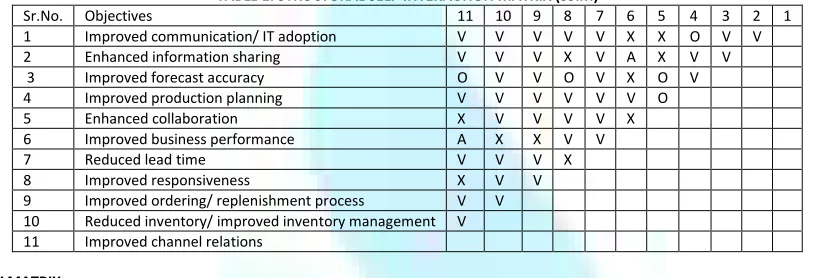
4.1 STRUCTURAL SELF-INTERACTION MATRIX (SSIM)
For analyzing the adoption objectives in developing an SSIM, the following four symbols have been used to denote the direction of relationship between the variables (Singh and Kant, 2008);
V variable i will help to achieve variable j, A variable j will help to achieve variable I,
X variable i will and j will help to achieve each other and O variable i and j are unrelated.
Based on contextual relationships, the structural self interaction matrix is developed.
TABLE 1: STRUCTURAL SELF-INTERACTION MATRIX (SSIM)
Sr.No. Objectives 11 10 9 8 7 6 5 4 3 2 1
1 Improved communication/ IT adoption V V V V V X X O V V
2 Enhanced information sharing V V V X V A X V V
3 Improved forecast accuracy O V V O V X O V
4 Improved production planning V V V V V V O
5 Enhanced collaboration X V V V V X
6 Improved business performance A X X V V
7 Reduced lead time V V V X
8 Improved responsiveness X V V
9 Improved ordering/ replenishment process V V
10 Reduced inventory/ improved inventory management V 11 Improved channel relations
4.2 REACHABILITY MATRIX
The SSIM has been converted into a binary matrix called the initial reachability matrix by substituting V, A, X and O by 1 and 0 as per case. The substitution of 1’s and 0’s are as per the following rules;
1) If the (i, j) entry in the SSIM is V, the (i, j) entry in the reachability matrix becomes 1, and the (j, i) entry becomes 0, 2) If the (i, j) entry in the SSIM is A, the (i, j) entry in the reachability matrix becomes 0, and the (j, i) entry becomes 1, 3) If the (i, j) entry in the SSIM is X, the (i, j) entry in the reachability matrix becomes 1 and the (j, i) entry also becomes 1, 4) If the (i, j) entry in the SSIM is O, the (i, j) entry in the reachability matrix becomes 0, and the (j, i) entry also becomes O.
After exploiting initially reachability matrix, driving power and dependence power were calculated for each objective. The driving power for each variable is the total number of variables (including itself), which it may help achieve. Dependence power is the total number of variables (including itself), which may help achieve it (Jharkharia and Shankar, 2005).
TABLE 2: REACHABILITY MATRIX
Objectives 1 2 3 4 5 6 7 8 9 10 11 Driving Power
1 1 1 1 0 1 1 1 0 1 1 1 9
2 1 1 1 1 1 1 1 1 1 1 0 10
3 0 0 1 1 0 1 1 0 1 1 0 6
4 0 0 0 1 0 1 1 1 1 1 1 7
5 1 1 0 0 1 1 1 1 1 1 1 9
6 1 1 1 1 1 1 1 1 1 1 0 10
7 0 0 0 1 0 1 1 1 1 1 1 7
8 1 1 0 1 1 1 1 1 1 1 1 10
9 0 1 0 1 0 1 1 1 1 1 1 8
10 0 0 0 1 0 1 0 0 1 1 1 5
11 1 1 0 1 1 1 0 1 0 1 1 8
Dependence 6 7 4 9 6 11 9 8 10 11 8
4.3 LEVEL PARTITIONS
Objectives Reachability Set
1 1,2,3,5,6,7,8,9,10,11
2 1,2,3,4,5,6,7,8,9,10,11
3 3,4,6, 9,10
4 4,6,7,8,9,10
5 1,2,5,6,7,8,9,10,11
6 6,7,8,9,10
7 6,7,8,9,10,11
8 5,6,7,8,11
9 6,7,9,10
10 6,10
11 1,2,5,6,8,11
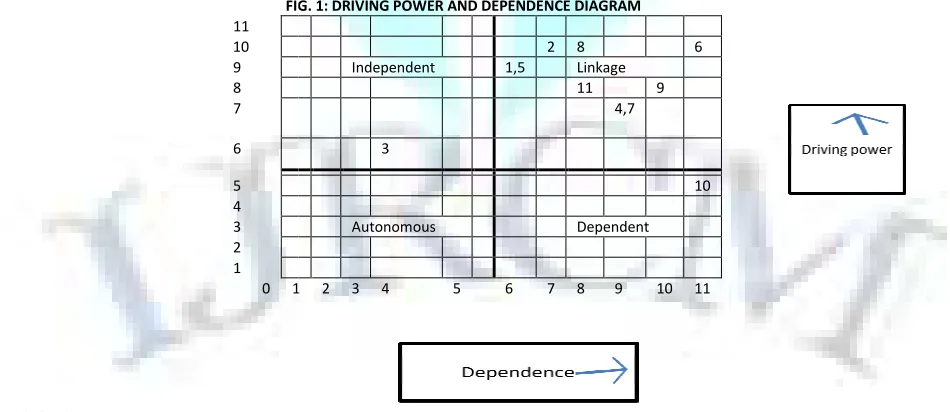
4.4 CLASSIFICATION OF VARIABLES
The ISM technique presents a hierarchical structure that depicts the direct and indirect
precedence and causality over and among each other. There exists a group of design characteristics, which are critical to the
maximum detail and attention. They have the highest driving force and the lowest dependence in the system. These are drivers. Another set of design characteristics has high dependence. These are the dependents. Between these two, there are the linkage and autonomous variab
characteristics are dependent on the drivers, but assist the existence and functioning of dependents (Sahney, 2008). Dependin dependence power, all the variables are categorized as autonomous, dependent, linkage and indepen
the objective improved communication/IT adoption has driving power 9 and dependence power of 6 hence it is kept at a position
power of 9 and dependence power of 6. The first cluster includes “autonomous variables” that have weak driver power and weak dependence. These variables are relatively disconnected from the system. The second cluster consists of the dependent variables that have a weak driver p
Third cluster has the linkage variables that have strong drive power and dependence. Any action on these variables will have feedback effect on themselves. The fourth cluster includes independent variables with st
2005).
The findings from the application of the ISM technique are as follows; Cluster 1: autonomous variables
None
Cluster 2: dependent variables
Reduced inventory/improved inventory management Cluster 3: linkage variables
Improved communication, enhanced collaboration, enhanced information sharing, improved responsiveness, improved channel relat planning, reduced lead time, improved ordering/replenishment process, improv
Cluster 4: independent variables Improved forecast accuracy
4.5 FORMATION OF ISM BASED MODEL
Using the final attrition of reachability matrices, a structural model is developed. The variables connected by arrows shows This graph is called as an initial directed graph or initial diagraph. These diagraphs are principally hierarchical results o iteration of reachability matrices. By applying ISM methodology the
those are level I elements (Anantatmula and Kanungo, 2005). Once the level I is determined, it is removed and then next same next level elements (Singh and Kant, 2008). Table III shows that, objective 10 is a level I objective. Therefore it is at the to and 8 is a level II objective so it is below objective 10. Objectives; 9, 7 and 6 comes as
3 and 4 are level IV, objective 5 is level V and objectives 1 and 2 are level VI objectives respectively. All objectives are the relationship among the variables.
FIG.
5. DISCUSSIONS
The analyzed contingent factors were limited to these variables because it was felt that they are most directly linked to CPF the literature and as emerged from investigated cases (Danese, 2007). In order to have a common f
observed that entire 11 objectives are important for CPFR adoption, although in varying degrees. By adopting ISM, we found th
of objectives irrespective of type of industry. Fliedner (2003) research suggested that CPFR would become an indispensable instrument in any future supply chain. Our study shows information sharing and improved communication with IT adoption as the supreme objective of CPFR adopt
has a high dependence and low driving power. Literature reveals that the crux of CPFR is real time information sharing and co Stank et al. (1999) evaluated CPFR attempts to lessen the problem associated with
11 10 9 8 7 6 5 4 3 2 1 0 1
TABLE 3: LEVEL PARTITIONS
Reachability Set Antecedent Set Intersection Set Level
1,2,3,5,6,7,8,9,10,11 1,5,11 1,5,11 VI
1,2,3,4,5,6,7,8,9,10,11 1,2,5,11 1,2,5,11 VI
3,4,6, 9,10 1,2,3 3 IV
4,6,7,8,9,10 2,3,4 4 IV
1,2,5,6,7,8,9,10,11 1,2,5,11 1,2,5,11 V
6,7,8,9,10 1,2,3,4,5,6,8,11 6,8 III
6,7,8,9,10,11 2,3,4,6,7,11 6,7,11 III
5,6,7,8,11 1,2,5,6,11 5,6,11 II
6,7,9,10 2,3,8,9 9 III
6,10 2,3,4,5,8,10 10 I
1,2,5,6,8,11 1,2,5,8 1,2,5,8 II
The ISM technique presents a hierarchical structure that depicts the direct and indirect linkages between the various components in a system, based on primacy, precedence and causality over and among each other. There exists a group of design characteristics, which are critical to the
on. They have the highest driving force and the lowest dependence in the system. These are drivers. Another set of design characteristics has high dependence. These are the dependents. Between these two, there are the linkage and autonomous variab
characteristics are dependent on the drivers, but assist the existence and functioning of dependents (Sahney, 2008). Dependin
dependence power, all the variables are categorized as autonomous, dependent, linkage and independent variables (Borade and Bansod, 2011). In this study, the objective improved communication/IT adoption has driving power 9 and dependence power of 6 hence it is kept at a position
first cluster includes “autonomous variables” that have weak driver power and weak dependence. These variables are relatively disconnected from the system. The second cluster consists of the dependent variables that have a weak driver p
Third cluster has the linkage variables that have strong drive power and dependence. Any action on these variables will have
feedback effect on themselves. The fourth cluster includes independent variables with strong drive power and weak dependence (Jharkharia and Shankar,
The findings from the application of the ISM technique are as follows;
Improved communication, enhanced collaboration, enhanced information sharing, improved responsiveness, improved channel relat planning, reduced lead time, improved ordering/replenishment process, improved business performance
Using the final attrition of reachability matrices, a structural model is developed. The variables connected by arrows shows
This graph is called as an initial directed graph or initial diagraph. These diagraphs are principally hierarchical results obtained from tables indicating the final iteration of reachability matrices. By applying ISM methodology the diagraph is formed. If elements; of which reachability and intersection sets are similar than those are level I elements (Anantatmula and Kanungo, 2005). Once the level I is determined, it is removed and then next same
t level elements (Singh and Kant, 2008). Table III shows that, objective 10 is a level I objective. Therefore it is at the to
and 8 is a level II objective so it is below objective 10. Objectives; 9, 7 and 6 comes as a level III objectives hence it is kept below objectives 11 and 8. Objectives; 3 and 4 are level IV, objective 5 is level V and objectives 1 and 2 are level VI objectives respectively. All objectives are finally connected through arrows to show
FIG. 1: DRIVING POWER AND DEPENDENCE DIAGRAM
The analyzed contingent factors were limited to these variables because it was felt that they are most directly linked to CPF
the literature and as emerged from investigated cases (Danese, 2007). In order to have a common framework for adoption, an ISM model was developed. IT is observed that entire 11 objectives are important for CPFR adoption, although in varying degrees. By adopting ISM, we found th
industry. Fliedner (2003) research suggested that CPFR would become an indispensable instrument in any future supply chain. Our study shows information sharing and improved communication with IT adoption as the supreme objective of CPFR adopt
has a high dependence and low driving power. Literature reveals that the crux of CPFR is real time information sharing and co
Stank et al. (1999) evaluated CPFR attempts to lessen the problem associated with traditional anticipatory demand forecasts by co
2 8 6
Independent 1,5 Linkage
11 9
4,7
3
10
Autonomous Dependent
1 2 3 4 5 6 7 8 9 10 11
Level
linkages between the various components in a system, based on primacy, precedence and causality over and among each other. There exists a group of design characteristics, which are critical to the success of a system and require on. They have the highest driving force and the lowest dependence in the system. These are drivers. Another set of design characteristics has high dependence. These are the dependents. Between these two, there are the linkage and autonomous variables. Their design characteristics are dependent on the drivers, but assist the existence and functioning of dependents (Sahney, 2008). Depending upon driving power and dent variables (Borade and Bansod, 2011). In this study, the objective improved communication/IT adoption has driving power 9 and dependence power of 6 hence it is kept at a position which corresponds to a driving first cluster includes “autonomous variables” that have weak driver power and weak dependence. These variables are relatively disconnected from the system. The second cluster consists of the dependent variables that have a weak driver power but the strong dependence. Third cluster has the linkage variables that have strong drive power and dependence. Any action on these variables will have an effect on the others and a
rong drive power and weak dependence (Jharkharia and Shankar,
Improved communication, enhanced collaboration, enhanced information sharing, improved responsiveness, improved channel relations, improved production
Using the final attrition of reachability matrices, a structural model is developed. The variables connected by arrows shows the relationship between variables. btained from tables indicating the final diagraph is formed. If elements; of which reachability and intersection sets are similar than those are level I elements (Anantatmula and Kanungo, 2005). Once the level I is determined, it is removed and then next same process is reiterated to discover t level elements (Singh and Kant, 2008). Table III shows that, objective 10 is a level I objective. Therefore it is at the top. In the similar fashion, objective 11 a level III objectives hence it is kept below objectives 11 and 8. Objectives; finally connected through arrows to show
The analyzed contingent factors were limited to these variables because it was felt that they are most directly linked to CPFR implementation, as suggested by ramework for adoption, an ISM model was developed. IT is observed that entire 11 objectives are important for CPFR adoption, although in varying degrees. By adopting ISM, we found the level of variable in the hierarchy industry. Fliedner (2003) research suggested that CPFR would become an indispensable instrument in any future supply chain. Our study shows information sharing and improved communication with IT adoption as the supreme objective of CPFR adoption. While reduced inventory has a high dependence and low driving power. Literature reveals that the crux of CPFR is real time information sharing and collaborative inventory management. traditional anticipatory demand forecasts by co-operating with trading
VOLUME NO.2(2012),ISSUE NO.12(DECEMBER) ISSN2231-5756
INTERNATIONAL JOURNAL OF RESEARCH IN COMMERCE, IT & MANAGEMENT
partners to better match supply and demand. Therefore, without any doubt, the basic premise of CPFR is improving the demand forecasting process. Hence, while adopting CPFR, management should have the objective of improving the forecasting accuracy, which would ultimately lead to improved business performance by improving order/replenishment process and reducing lead time. Kwon and Suh (2005) observed that effective supply chain planning based on shared information and trust between and among partners is an essential element for successful supply chain implementation. We had also similar observations. Lack of suitable information technology infrastructure and lack of mutual understanding between supply chain partners were found to be the major obstacles for the adoption. In the study, IT adoption derived higher driving power. It implies the importance of this objective in CPFR adoption. Albright (2002) demonstrated that CPFR implementation can reduce inventory levels, increase sales, and improve trade partnerships. Our study, observed highest dependence power for reduced inventory. Basically CPFR is a tool meant for managing inventory.It is observed that there are no autonomous variables in this study. Hence, all the variables focused in the study are important for adoption of CPFR. There is only one dependent variable. Reduced inventory have high dependence power and low driving power. Hence, organizations must understand the effect of this variable on others.
Improved communication, enhanced information sharing, improved production planning, enhanced collaboration, improved business performance, reduced lead time, improved responsiveness, improved ordering process, and improved channel relations. These variables have strong driving power and strong dependence power. Of all the 11 variables, these variables are very important because they strongly influence the adoption process.
Independent variables have very high driving power and low dependence power. Improved forecast accuracy was found to be independent variables in this study. For CPFR adoption, this is a strong driver; which influence all other variables. Hence, management must give high priority and should understand the importance of this variable.
FIG.2. THE DIGRAPH FOR ISM BASED FRAMEWORK
6. CONCLUSIONS
CPFR is a process, which is adopted by organizations for improving business performance. The process is in nascent stage in India. This paper attempted to establish the relationships among the objectives necessary for adopting CPFR by using Interpretive Structural Modeling. Finally, a hierarchical structure of the elements representative of their networks and relationships with their classification into various levels was developed. This will helped organizations to get aware of the importance of each objective for adopting CPFR process. From the study, it is concluded that all 11 objectives are important for CPFR adoption. It is found that major objective of CPFR adoption should be information sharing and IT adoption. It is further concluded that most important strategic driver for CPFR adoption is forecast accuracy. Finally, it is concluded that CPFR improves channel relations, production planning and replenishment process.
Academicians and industries could use results of this study for implementing CPFR in Indian industries. In this study, only 11 objectives were considered; however, many more variables could be used for developing a broader and generic framework. Interpretive Structural Modeling approach could be used for validating the framework.
7. REFERENCES
1. Albright, B., (2002). CPFR’s secret benefit. Frontline Solutions, 3 (11), 30-5.
2. Attaran, M., S., Attaran, (2007). Collaborative Supply Chain Management: The most promising practice for building efficient and sustainable supply chains. Business Process Management Journal, 13, 390-404.
3. Barratt, M., Oliveira, A., (2001). Exploring the experiences of collaborative planning initiatives. International Journal of Physical Distribution and Logistics Management, 31 (4), 266-289.
4. Borade, A.B., Bansod, S.V., (2010). Study of Vendor Managed Inventory Practices in Indian Industries. Journal of Manufacturing Technology Management, 21 (8), 1013-1038.
5. Chopra, S., P., Meindl, (2001). Supply Chain Management: Strategy, Planning and Operation. Prentice-Hall Inc., Upper Saddle River, New Jersey, USA. 6. Cooke, J.A., (1998). “VMI: very mixed impact?,” Logistics Management and Distrbution Report, 37 (12), 51-4.
7. Gene Fliedner, (2003). CPFR: an emerging supply chain tool. Industrial Management and Data Systems, 103 (1), 14-21.
8. Jharkharia, S., Shankar, R., (2005). IT-enablement of supply chains: Understanding the barriers. Journal Enterp. Inf. Manag., 18 (1), 11-27.
9. Kwon, I.G., T., Suh, (2005). Trust, commitment and relationships in supply chain management: A path analysis. Supply Chain Management an Int. J., 10, 26-33.
10. Pamela Danese, (2007). Designing CPFR collaborations: insights from seven case studies. International Journal of Operations and Production Management, 27 (2), 181-204.
Reduced inventory/ improved inventory management
Improved channel relations Improved responsiveness
Reduced lead time
Improved ordering/ replenishment process Improved business performance
Improved forecast accuracy Improved production planning
Enhanced collaboration
11. Reza Sigari Tabrizi, Y.P., Foong, N., Ebrahimi, (2010). Using Interpretive Structural Modeling to determine the relationships among knowledge management criteria inside Malaysian organizations. World Academy of Science, Engineering and Technology, 72, 727-732.
12. Sahay, B.S., Gupta, N.D., Mohan, R., (2006). Managing supply chains for competitiveness: the Indian scenario. Supply Chain Management International Journal, 11 (1), 15-24.
13. Sahney, S., (2008). Critical success factors in online retail- An application of quality function deployment and interpretive structural modeling. International Journal of Business Information, 3 (1), 144-163.
14. Singh, M.D., R., Kant, (2008). Knowledge management barriers: An interpretive structural modeling approach. International Journal of Management Science and Engineering Management, 2 (3), 141-150.
15. Skjoett-Larsen, T., Thernoe, C., Andresen, C.,(2003). Supply chain collaboration- Theoretical perspectives and empirical evidence. International Journal of Physical Distribution and Logistics Management, 33 (6), 531-549.
16. Stank, T.P., Daugherty, P.J., Autry, C.W., (1999). Collaborative planning: supporting automatic replenishment programs. Supply Chain Management: An International Journal, 4 (2), 75-85.
17. VICS, (1998). Collaborative Planning Forecasting and Replenishment CPFR Guidelines Voluntary Inter Industry Commerce Standards. LawrenceVille NJ. Available at: www.cpfr.org
VOLUME NO.2(2012),ISSUE NO.12(DECEMBER) ISSN2231-5756
INTERNATIONAL JOURNAL OF RESEARCH IN COMMERCE, IT & MANAGEMENT
REQUEST FOR FEEDBACK
Dear Readers
At the very outset, International Journal of Research in Commerce, IT and Management (IJRCM)
acknowledges & appreciates your efforts in showing interest in our present issue under your kind perusal.
I would like to request you to supply your critical comments and suggestions about the material published
in this issue as well as on the journal as a whole, on our E-mail i.e.
for further
improvements in the interest of research.
If you have any queries please feel free to contact us on our E-mail
.
I am sure that your feedback and deliberations would make future issues better – a result of our joint
effort.
Looking forward an appropriate consideration.
With sincere regards
Thanking you profoundly
Academically yours
Sd/-