Vol. 1, No. 3, (2013), 77-103
Investigating Different Memory Pathways L2
Learners use: A Practical Application to the
Brain Compatible Learning
Behzad Nasirpour
Department of Foreign Language and Linguistics Islamic Azad University, Shiraz Branch
Shiraz, Iran
nasirpour [email protected]
Abstract. Memory is not a single entity. It is a gift of Mother Nature, the ability of living organisms to retain and to utilize acquired knowl-edge. Memory is precisely related to learning, in that memory in biolog-ical systems entails learning and that learning implies retention of such information. Memory can be divided into multifaceted systems. The renaissance of encephalon compatible learning applies the new brain research to teaching and learning. This revolution will change school start times and discipline, continuous assessment, teaching strategies, budget priorities, classroom ambience, use of hi-tech, and even the way we think of physical education. But before considering the practical applications of this research, it is necessary to have a useful model for deciphering it. This study investigates the memory pathways that a group of EFL learners in Iran were inclined to use, the factors af-fecting this, and conscious recollection/retrieval in learning second lan-guage. The researcher studied the individuals’ memory/learning readi-ness before going to school, investigated their memory self-efficacy, and determined which memory pathway(s) was/were preferred by L2 learn-ers. The researcher gathered data using three instruments, researcher made report Measure of Memory (SRMM), Bandura’s Memory Efficacy Questionnaire (MSEQ) followed by the researcher-made Self-report Memory/learning Readiness Interview (SMRI). Both descriptive statistics (mean scores, variances, standard deviations, and frequencies) and inferential statistics were run on the data. The results of the first instrument (SRMM), the interview (SMRI), and MSEQ were in agree-ment with theories, experiagree-ments, and hypotheses agree-mentioned.
Keywords: Memory pathways, encephalon compatible learning, declar-ative memory, non-declardeclar-ative memory, semantic memory, episodic mem-ory, priming
Received: May 2013; Accepted: September 2013
1. Introduction
The intricate topic on memory has engaged linguists, psychologists, and neuroscientists for as long as they have been interested in the relation-ship among brain, mind, behavior, and language. Among the vast lit-erature on memories, the theoretical aspects of applied linguistics, fo-cusing on LLSs and declarative, procedural memory, and working mem-ory, will be reviewed followed by theoretical and empirical aspects of memory pathways put forward by neuropsychologists and neuroscientists who amass considerable evidence for the hypothesis that hippocampal, temporal, cortical, and cerebellar regions contribute to memory. Later on, encephalic-minded discipline works out a compromise agreement re-viewed from each camp.
1.1 Linguists’ explanations on memories
L2 acquisition besides learning strategies is described to be a complex cognitive skill within cognitive-theoretical framework. Linguists who be-long to processing school of thought claim that LLSs begin with declar-ative knowledge, that can be proceduralized with rehearsal and pro-ceed through the cognitive, associative and autonomous stages. Declar-ative knowledge that consists of consciously known facts requires pro-cessing in short-term memory (STM) to be stored in long-term mem-ory (LTM). The propositions in LTM are organized and differentiated from schemata which present a set of statements, rules, or facts. At the very moment, the strategy which is being applied could be scruti-nized through any form of data collection by interrupting ongoing mental processes. Rabinowitz and Chi (1987) stated whether or not automatic use of learning techniques qualifies as being strategic; similar mental processes are being used when the strategy is still of declarative knowl-edge. Ericsson and Simon (1987) discovered that strategies that have become proceduralized may be operating automatically through con-nections in LTM and the process does not enter STM and it may be inaccessible for introspective report.
per-spectives. The second school investigates approaches that study the ac-quisition of language from emergentists’ point of view. In this school, the second language is acquired through usage, by extracting pattern and regularities from the input, and building ever-stronger association in the brain (Mitchell & Myles, 2004). McLaughlin (1990) believes that learn-ing involves a shift from controlled towards automatic processlearn-ing. Learn-ers first resort to “controlled processing” in the second language. This controlled processing involves the temporary activation of a selection of information nodes in the memory, in a new configuration. Such process-ing requires a lot of attentional control on the part of subject, and is constrained by the limitations of the STM. McLaughlin (1990) believes that words have to be put together in a piecemeal fashion, one at a time and they have not been memorized as an unanalyzed chunk. Through re-peated activation, sequences first produced by controlled processing be-come automatic. Automatized sequences are stored as units in the LTM, which means that they can be made available very rapidly whenever the situation requires it. Another processing model from cognitive psychol-ogy is Anderson’s (1985) ACT model. This model is not dissimilar from McLaughlin’s. It is more widespread, and the terminology is different, but practice leading to automatization also plays a central role. It en-ables declarative memory to become procedural knowledge. One of the major discrepancies is that Anderson claims that there are three types of memory: a working memory, similar to McLaughlin’s STM and therefore tightly capacity-limited, and two kinds of LTM-a declarative long-term memory and a procedural long-term memory. Anderson (1985) believes that declarative and procedural knowledge are different kinds of knowl-edge that are stored differently. According to Anderson, the move from declarative to procedural memory takes place in three stages: the cogni-tive stage, the associacogni-tive stage, and the autonomous stage. It was the ACT model that has been applied to the field of language learning strate-gies (LLSs) by researchers such as O’Malley and Chamot (1990). On the other hand, connectionism likens the brain to a computer that would consist of neural networks complex clusters of links between informa-tion (Mitchell & Myles, 2004).
strat-egy was to administer two portions of task; while the person is processing the less demanding portion automatically, the conscious mind will set free to use learning strategies for more demanding portion and the latter becomes available for introspective analysis. They had a hard evidence of dictation to keep tabs on learning strategies because of its deliberate processing. In terms of memory before the advent of executive control in lower stages of genetic epistemology, heuristic process casts the footings of declarative knowledge and requires processing in STM, the theory has raised but not resolved to the bottom; whether the processed knowledge is stored separately in two languages or as a single system. Also the dif-fuse boundaries between cognitive strategy and metacognitive strategy have been a contentious issue among analysts. Furthermore, the cor-respondence between mental process and stages in acquiring a complex cognitive skill, strategic rules and communicative competence is still ten-able. Declarative memory is often easy to form and is easily forgotten, whereas procedural memories tend to require repetition and practice from time to time but less likely to be forgotten. As for planning, mon-itoring and checking the outcome of learning, O’Malley and Chamot (1990) and Brown (1994) found indication of metacognitive knowledge under the name “problem identification”. It was experienced that direct attention to the task while it was ongoing became somehow obscure to elucidate the boundary between using executive thinking skill and using it as an integral aspect of task performance. Also, selective attention to overall aspect rather than executive function was conveyed. O’Malley and Chamot (1990) believe that declarative information is used in lan-guage comprehension and production. He also pointed out that strategic processing as well as production system is affiliated to the SLA. Rumell-hart and Norman (1978) postulated that memory system has no refer-ence to procedural knowledge; much might not be gained in precision by a number of other investigators. Declarative memories can be ac-cessed for conscious recollection; however, the procedures we learn can be performed without conscious recollection.
1.2 Neuropsychologists’ explanations on memories
Investigating Different Memory Pathways L2 Learners use: ... 81
but not others, like addresses and dates. Students who are thought of as “lazy learners” may indeed recall only what they can. Retrieval is spe-cific. The success of that retrieval is highly dependent upon state, time, and context. Facing different contexts we usually ask ourselves “which kind of memory can be retrieved and how it can be retrieved” (Jensen, 1998).
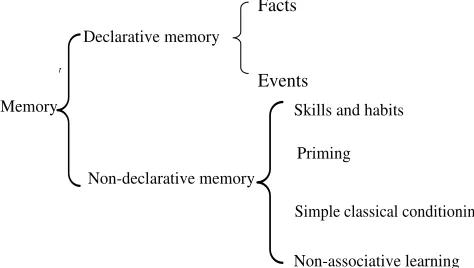
Figure1: Model of Memory Pathways, adopted from Jensen (1998)
By using the right system, in the right way, students can consistently ex-perience better recall of their learning. “Explicit Memory” Includes both “STM” (5-20 seconds) and “working memory” (seven +/- chunks). It comes in several forms including the more word-based semantic memory and the event-type episodic memory. “Semantic memory” is an explicit memory as well as factual or linguistic memory. It’s a part of declarative memory and includes the names, facts, figures, and textbook informa-tion. In fact, only explicit memory pathways have a STM or a working memory. Jensen (1998) states that “semantic memory” requires the use of language which triggers through association. This may be a relatively new need; humans have had little use for semantic recall until recent his-tory when books, schools, literacy, and social mobility became common. It is the weakest of our retrieval systems. The storage of semantic mem-ories seems to be distributed throughout the cerebrum. It is not that we are incapable of retrieving. The brain is not well-equipped to routinely
92
Investigating Different Memory Pathways ...
93
B. Nasirpour1.2 Neuropsychologists on memories
It is typical of us to be good at one type of recall, like faces and places, but
not others, like addresses and dates. Students who are thought of as “lazy
learners” may indeed recall only what they can. Retrieval is specific. The
success of that retrieval is highly dependent upon state, time, and context.
Facing different contexts we usually ask ourselves “which kind of memory
can be retrieved and how it can be retrieved” (Jensen, 1998).
Figure1.1: Models of Memory Pathways, adopted from Jensen (1998)
By using the right system, in the right way, students can consistently
experience better recall of their learning. “Explicit Memory” Includes
both “STM” (5–20 seconds) and “working memory” (seven +/– chunks).
It comes in several forms including the more word-based semantic
memory and the event-type episodic memory. “Semantic memory” is
an explicit memory as well as factual or linguistic memory. It’s a part of
declarative memory and includes the names, facts, figures, and textbook
information. In fact, only explicit memory pathways have a STM or a
working memory. Jensen (1998) states that “semantic memory” requires
retrieve this type of information. It requires the use of language triggers through association. Jensen (1998) continues that semantic learning will be inaccessible if the original learning is trivial, too complex, and too “contaminated” with other learning. It may also lack relevance or suffi-cient sensory stimulation.
and word length are deteriorated. Children with SLI reveal a larger ef-fect of deficiency in the syntactic complexity than sentence length which is examined in the listening span task (ML). The listening task is com-posed of sentences with syntax complexity of heterogeneous length to check their concurrent processing performance. The children with SLI cannot process simultaneously the exact words in the context and the semantic and syntactic information of the sentences. Among adults with SLI, increased complexity results in decreased accuracy; therefore, she concludes that the processing of complex sentences requires working memory capacity.
LTD (long-term depression) is considered to hold one of the poles of memory-procedural memories; furthermore, LTP (long-term potenti-ation) is presumed to entail declarative memories. To Squire and Zola-Morgan (1991), declarative memory entails conscious recollection of facts and events. Declarative memories are available to conscious recollec-tion. Non-declarative memory relates to a collection of abilities wherein performance changes due to experience but without affording access to conscious memory of the original experience. Non-associative learning in-cludes habituation and sensitization. To Bear, Connors, and Paradisco, (2007), procedural learning is divided into two facets of learning; (1) non-associative learning and (2) associative learning.
Figure 2: Memory systems (Adapted from Squire and Zola-Morgan, 1991)
To Squire (1992) and Schacter (1996), “declarative or explicit memory” resides in hippocampus in medial temporal lobes. It is the memory we
94
Investigating Different Memory Pathways ...
95
B. Nasirpour
events. Declarative memories are available to conscious recollection. Non-declarative memory relates to a collection of abilities wherein performance changes due to experience but without affording access to conscious memory of the original experience. Non-associative learning includes habituation and sensitization. To Bear, Connors, and Paradisco, (2007), procedural learning is divided into two facets of learning; (1) non-associative learning and (2) associative learning.
Figure1.2: Memory systems (Adapted from Squire and Zola-Morgan, 1991) To Squire (1992) and Schacter (1996), “declarative or explicit memory” resides in hippocampus in medial temporal lobes. It is the memory we can describe, elucidate, and write about. The written exam, essay or any exam-type recall used in schools and colleges are one of the exam-types. “Semantic memory” or “linguistic memory” is a factual, explicit entity as a part of declarative memory includes: names, figures, fact, and any informative texts
can describe, elucidate, and write about. The written exam, essay or any exam-type recall used in schools and colleges are one of the types. “Se-mantic memory” or “linguistic memory” is a factual, explicit entity as a part of declarative memory includes: names, figures, fact, and any informative texts and contexts that challenge the brain. Declarative or explicit memory entails STM and working memory (Jensen, 1998). Bi-ologically “episodic and semantic memory” that reside in hippocampus are distinguished by their organizations. They are constituents of declar-ative memory. Episodic memory acts as our record of unique personal experiences. It is the capacity to mentally call back the momentum and besides it re-experiences a particular incident. Semantic memory as our general world knowledge involves in time-independent factual informa-tion and is organized by logical and abstract dimensions. Hence, episodic memory is organized along temporal dimensions and the contents of it involve autobiographical information (Tulving, 2002). Therefore, declar-ative memory is to collect and bring memories up to conscious experi-ence and manipulation. Declarative memory is featured by its excellent expression which is in turn flexible in that the contents of it are the repository of various behaviors. The integration of declarative realistic properties in hippocampal circuitry with one another has been under study since it is difficult to probe how they share the same organization footings. Eichenbaum concludes that it is not perceptible what biologi-cally realistic mechanisms can clarify high level cognitive properties such as (1) mental time travel, (2) flexible expression, and (3) conscious rec-ollection (as cited in Gazzaniga, 2004).
Procedural memory is known as motor memory, body learning, or habit memory. It is expressed by student responses, actions, or behav-iors. It’s activated by physical movements, sports, games, theater, and role play (Jensen, 1998). Even if you have not ridden a bike for years, you can usually do it again without practice. Procedural memory ap-pears to have unlimited storage, requires minimal review, and needs little intrinsic motivation. Memories of learned skills involve both the basal ganglia (located near the middle of the brain) and the cerebellum. In fact, the best examples of physical evidence found so far for any mem-ory in the brain are those from skill memmem-ory. This evidence is located in the cerebellum (Thompson, 1993). To the brain, the body is not a separate isolated entity. Body and brain are part of the same contiguous organism, and what happens to the body happens to the brain. This dual stimulus creates a more detailed “map” for the brain to use for storage and retrieval (Squire, 1992). That is why learners may tell you that the most memorable classroom experiences were based on practical learning.
1.3 The renaissance of encephalon compatible learning: A fol-low up to “postmodernism”
learners-need discipline dispensing with the irrelevant and improvident of re-conceptualization of tradition. Kumaravadivelu’s postmodernism (1994) fits the bill to the extent he broaches that L2 teachers are not to seek alternative methods, but rather an alternative to methods. Hence it could not be considered a sure-fire recipe since it is based on learn-ers’ need and teachlearn-ers’ experience and awareness coping with classroom ambience. Kumaravadivelu’s expression is untrammeled to the extent that the impossibility of its presuppositions could still be on a crusade since to him, fabricating any individual method to be effective seems to be far-fetched. However, context, setting goals, and learners’ expecta-tion play an inevitable role for a method to be implemented; probing learners’ encephalon (brain and cranial nerves) will throw light upon the crux. Pica (2000) wished to aver that the integration of communica-tion methodology with tradicommunica-tional methodologies that might be served effectively in instructional practices. To the researcher, skepticism is the end-product of such determination since docile and tractable acceptance of what has been mustered of methodologies and hypotheses is going to muddle our application.
the product of implicit evaluation of a stimulus, could be either harmful or beneficial as a prerequisite for conscious (explicit) memory. How-ever, “feeling” is the conscious reflection of what we appraise uncon-sciously. Arnold’s appraisal theory describes the generation of emotion as follows: first, unconscious implicit evaluation of stimuli; next, action tendency; third, peripheral responses and finally conscious experience (as cited in Kandel et al., 2000).
To be inclusive, the evidence suggests that emotional intelligence develops early, and the school years might be fairly late for nurturing emotional literacy. Much of child’s emotional intelligence is learned in the first year of his/her formative years. Children learn how to react in myriads of simple practiced cause-and-effect situations with parents (Wilson, Willner, Kurz, & Nadel, 1986). Most educators know the value of crawling and tottering time, in developing learning readiness. Grad-ually emotional intelligence stage will be developed into emotional lit-eracy stage in which declarative memory thrives. Declarative memory supports the capacity to recollect facts and events, and it supports the encoding of memories in terms of relationships among the elements being learned. The stored representations are flexible and led to successful per-formance. Non-declarative memory abilities are skills and habits, simple form of conditioning, priming, and other ways that change our reaction with the world. What is learned in non-declarative memory will be ex-pressed through performance and what is learned in declarative memory will be expressed in recollection (Eichenbaum & Cohen, 2001). Anthony et al. state that priming is a form of non-declarative memory that is re-flected as non-conscious effects of previous experience on future behavior (as cited in Gazzaniga, 2004).
at a prior state during the first critical 48 months which provides dis-similarity and idiosyncrasy among many different possible futures. To what extent do children need to alter their brain? Vygotsky’s “sign and tool” theory (1978) could cover both motor brain and language de-velopment; furthermore, Jensen (1998) claims that motor brain, early thinking skills, visual brain and language development are to be shaped and customized. He continued that early motor stimulation (such as crawling) is needed for school success. Research on motor skills shows that it has a great influence on reading, writing, vision, hearing, atten-tion, sensory motor development, rapid response via lower-level adap-tive reaction, intention, limbic system, and simple conditioning. Visual brain development thrives much earlier than that of motor brain develop-ment. Infants get visual stimulating input by handling different objects to explore the world. Therefore, TV, play station, and computer games are two-dimensional but the real world is three-dimensional. Also, TV does not provide interaction, feedback, reflection, and comparison. Au-ditory brain recognizes the early survival sounds in the receptor sites as well as auditory phones. Therefore, brain develops specific neural cells to be capable of receiving phones. Thus, exposure to the words articu-lated by parents and folks, physical phonetics and environmental sounds shape the brain. Weinberger believes that children are very receptive to music. Since mathematics and music are homorganic they have related circuitry; consequently, one may influence the other in future (as cited in Jensen, 1998). Since early sounds mold the brain, music is also con-sidered to assist learning as well. Parents who talk to their children frequently and use bigger adult lexicons will make a huge vocabulary which will lead to a desirable reading skill later on. We must not forget that knack of reading occurs at different ages, some can read at age five, others at six, and the rest at ten (Greenberg, 1991).
rehearsing of hippocampus function as well as memory.
According to Jenson (1998) teachers must also pay attention what stimulates better thinking, learning, and recall among children. To him, some three levels such as: student, school principals, and community can influence children. It means that beside the nature, nurture can be influ-ential. Enrichment process of the brain reacts to certain impacts of the environment such as threat, embarrassment, humiliation, sarcasm, etc.
Why are some L2 learners better at speaking? Are they able to use a specific type of memory for a certain type of skill better? While explicit learning involves neocortical structures as well as the hippocam-pal formation, implicit memory involves the cerebellum and amygdala and the specific sensory and motor systems recruited for the task being learned. Implicit procedural learning is essential to the development of any motor skill as well as cognitive activity. Spoken languages require the use of action verbs, helping words, or suffixes which are the realm of procedural memory, rather than word order to explain subject-object relationships. Word-order dependent languages rely on short-term mem-ory for simpler structures and working memmem-ory for more complicated syntactic functions (Wiltgen, Wood, & Levy, 2011).
Kandel et al. (2000) elucidates that not only are reading and listening processed separately, but the act of thinking about a word’s meaning (in the absence of sensory inputs) activates a still different area in the left frontal cortex. He concludes that observations illustrate three points: (1) the cognitive processing for language occurs in the left hemisphere and is independent of pathways that process the sensory or motor modalities used in language, (2) speech and hearing are not necessary conditions for the emergence of language capabilities in the left hemisphere, and (3) spoken language represents only one of a family of cognitive skills mediated by the left hemisphere.
1.4 Objectives of the study The objectives of the study are:
1. Investigating individuals’ types of memory which are quite specific to language learners.
readiness develops memory/brain before puberty (1 to 6 years in age). 3. Investigating the extent to which individuals differ and use either explicit memory or procedural associative memory.
4. Investigating whether individuals use episodic memory, semantic memory, procedural or non-declarative memory as their main retrievals in order to set and apply an encephalic-minded discipline.
5. Investigating whether L2 learners use different types of memory the moment they use different language skills.
1.5 Research questions
Based on the objectives of the study, the present study aims at answering the following research questions:
1. Are there any differences/relationships between and among indi-viduals in types of memory they use?
2. Does getting necessary stimulation for school readiness before puberty (1 to 6 years in age) influence memory/brain development?
3. Is there any significant difference/relationship between individuals in using specific types of memories?
4. Is there any significant difference among individuals regarding episodic memory, semantic memory, or non-declarative memory as their main memory pathways?
5. Do L2 learners use different types of memory the moment they use different language skills?
1.6 Theoretical framework of the study
2. Method
2.1 Participants
The participants of the study comprised 65 (33 males and 32 females) EFL intermediate learners studying at “Management and Technology In-stitute”. The reason for selecting these students was that they would be mature enough to perform on questionnaire and interview. All students were native speakers of Persian and ranged between 20 to 27 years in age. The participants were not chosen on the account of their academic scores, intelligence, sex, racial segregation, etc. Instead, they were se-lected on the basis of their maturity to understand and explain their ret-rospective view and background on memory pathways. Therefore, they were randomly selected from five intact classes and all the participants in each class received questionnaires (SRMM).
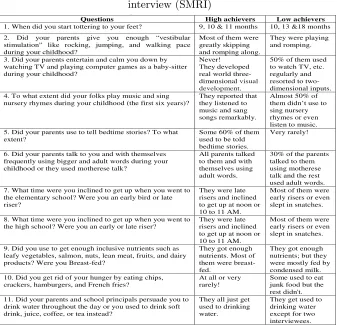
For the second phase, from these five intact classes, ten top stu-dents (high-achievers) as well as seven low-achievers on the score-sheet (comprised 17 male/female intermediate learners) were selected. The se-lection was based on their marks listed on their Master Cards in three successive terms in 2012. By observing the normal probability curve of the marks, the researcher skipped the cases that were piled up in the middle and selected those who were piled up at the two sides. Later on, they were announced to collect some information about their childhood from their parents in advance. They were both interviewed (SMRI) and required to answer a 10-item questionnaire (MSEQ).
2.2 Instruments
The MSEQ is unique in that it is derived from Bandura’s Self-efficacy Methodology including 50 items identifying 10 memory tasks for which subjects assess their memory abilities (Bandura, Adams, & Beyer, 1977; Bandura, Adams, Hardy, & Howells, 1980). Out of 50 items, 10 were selected to be used to compare the efficacy level of the high and low achievers of the study. Individuals were asked to consider how well they believed they can perform on a given task. The reliability index for the questionnaire obtained through Cronbach’s Alpha was 0.90 which was quite a high index and approximately similar to that of MSEQ measured by Berry, West, & Dennehey (1989).
The researcher made a Self-report Memory/learning Readiness Inter-view (SMRI) comprising 11 items identifying different school readiness questions indicative of timing of motor development, visual brain de-ficiency, auditory brain development, language development (through vocabulary acquirement), maintenance of memory, malnutrition and de-hydration leading to memory loss.
2.3 Procedures for data collection and analyses
The data were collected in two consecutive weeks in the late winter 2012. All participants were given a brief overview of the study including the objectives of the questionnaire, the time required for completion and the directions for answering the items of the questionnaire. The participants were assured of the confidentiality of the results and the advantages of the study. The descriptive statistics were calculated for the data to determine the types of memory pathways the participants are tilted to utilize. Later, inferential statistical procedures were run on the data which will be reported in the next section.
3. Results and Discussion
Investigating Different Memory Pathways L2 Learners use: ... 93
the mean for participants who tilted towards either semantic or episodic memory was 3.51 (SD= 0.37). They assigned some 61.5% of the partic-ipants using either semantic or episodic memory. Besides, some 15.4% of the participants were good at both. Collectively, 77% of the par-ticipants were the high users of declarative memory (users of either episodic/semantic memory, or even both) and the rest were moderate users (see Table 6). With regard to non-declarative memory, the mean of non-declarative memory was running at about 3.73 (SD= 0.60) and 74% of the participants inclined towards this type of memory and some 21.5% of the participants were considered as moderate users of non-declarative memory as well.
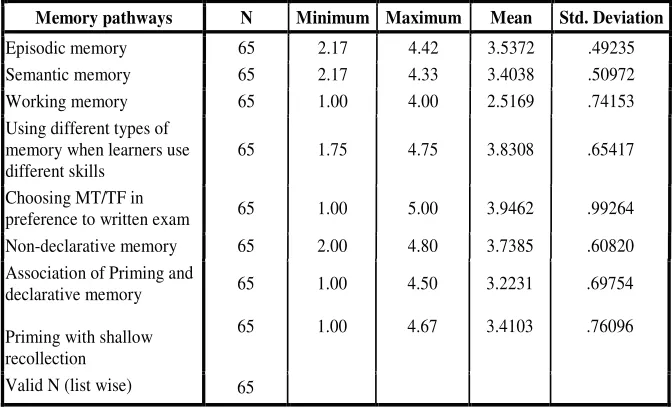
Table 1: Mean and SD of the whole memory pathways used by the participants
As it is evident in Table 1, the highly frequently used declarative/explicit memory was episodic memory which showed a high mean of 3.53 with regard to semantic memory with a moderate mean of 3.40.
Seemingly, the highest frequently memory used in Table 1 was “non-declarative memory” with a high mean of 3.73 (SD= .60). The next highly frequently used memory was “episodic memory” with a mean of 3.53 (SD=.49). Then came “semantic memory” with a moderate mean of
106
107
toward a certain type of memory pathway. Table 3.1 shows the means, standard deviations, of memory pathways used by the participants of the study. The result of the descriptive statistic analysis showed that the mean for participants who tilted towards either semantic or episodic memory was 3.51 (SD= 0.37). They assigned some 61.5% of the participants using either semantic or episodic memory. Besides, some 15.4% of the participants were good at both. Collectively, 77% of the participants were the high users of declarative memory (users of either episodic/semantic memory, or even both) and the rest were moderate users (see Table 3.6). With regard to declarative memory, the mean of non-declarative memory was running at about 3.73 (SD= 0.60) and 74% of the participants inclined towards this type of memory and some 21.5% of the participants were considered as moderate users of non-declarative memory as well.
Table 3.1: Mean and SD of the whole memory pathways used by the participants
���������������������������������������������������������������������������������������������� ����������������������������������������������������������������������������������������������� ���������������������������������������������������������������������������������������������� ������������������������������������������������������������������������������������������� �����������������������������
���������������������������������������������������������������� �������������
���������������� �� ������� ������� ����� ��������������
���������������� ��� ����� ����� ������� ������� ���������������� ��� ����� ����� ������� ������� ��������������� ��� ����� ����� ������� ������� �������������������������
������������������������� �����������������
��� ����� ����� ������� �������
������������������
��������������������������� ��� ����� ����� ������� ������� ����������������������� ��� ����� ����� ������� ������� ���������������������������
�������������������
��������������������� �������������
���
���
�����
�����
�����
�����
�������
�������
�������
�������
�������������������� ���
������
��������������������������������������������������������������������������������������������������� ������� ������ ������� �� ����� ����� ��� ����� ����� ������� ��� ��������� ������� ����� �� ��������� ���������������
��������������������������������������������������������������������������������������������� ����� �� ����� ����� ��� ����� ����� ������ ���� ����� ������� ����������� ����� ������� ���� ���������� ��������������������������������������������������������������������������������������� �������������������������������������������������������������������������������������������� �������������������������������������������������
3.40 (SD=.50), followed by “association of priming and declarative” and “working memory” with means of 3.22 (SD=.69) and 2.51 (SD=.74).
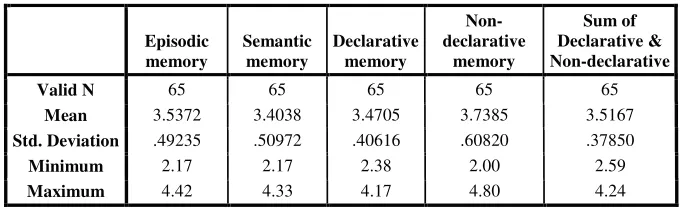
As it is evident in Table 2 and as mentioned earlier, all of the mem-ory pathways of this study fell within either moderate or high range of use. The highest frequently memory pathway was non-declarative mem-ory with a mean of 3.73. The next highly frequently used memmem-ory was episodic memory with a mean of 3.53. The next highly frequently used memory was declarative with a mean of 3.47 followed by the least mem-ory used, semantic memmem-ory, with a mean of 3.40 which was also consid-ered moderate memory using this pathway among the participants. The reason the researcher missed out working memory in Table 2 is that infor-mation acquired by declarative memory can ordinarily be supported by non-declarative memory, the nature of recognition memory, and memory for single items versus memory for conjunctions or associations which are the realm of working memory. Therefore, in Table 2 for the time being, it is to be preferred to concentrate on hippocampal dominate declarative memory as well as non-declarative memory abilities.
Table 2: Mean and SD of the declarative, non-declarative, and sum of both declarative and non-declarative memory as an overall memory
pathway
To top it all, the results of the analysis in Table 2 were subjected to ANOVA (Table 3). The difference between the means of four dependent variables, as indicated in Table 2, clarified that the differences between semantic, episodic, and declarative means were significant at p < 0.05
(Table 3), except for non-declarative memory.
108
Investigating Different Memory Pathways ...
109
B. NasirpourTable 3.2:
Mean and SD of the declarative, non-declarative, and sum
of both declarative and non-declarative memory as an overall memory
pathway
To top it all, the results of the analysis in Table 3.2 subjected to ANOVA
(Table 3.3). The difference between the means of four dependent variables,
as indicated in Table 3.2, clarified that the differences between semantic,
episodic, and declarative means were significant at p<0.05 (Table 3.3),
except for non-declarative memory.
Table 4.3:
ANOVA results on episodic, semantic, declarative,
non-declarative mean, and the mean of overall memory pathways
�������������������������������������������������������������������������������������������� ������ ���� ����� ����������� ��������� ������� ������ ����� �������� ������ ���� �������������� ���� ������� ���� ����������� ������� ���� �������� ������� ��������� ���� ��� ����� ������������ ��������� ��� ������������ ������� ���� ����������� ��� ���������� ��� ���������������� �������� ���� ������� ��� ������������ �������� ���� ������� ���� ������� ������ ������� ������� ���� ������������� ��� ������������������������������������������������������������������������������������������������ ����������������������������������������������������������������������������������������������� ������������������������������
���������������������������������������������������������������������������� ��������������������������������������������������������������������
��������� �������
��������� �������
������������ �������
���� ������������
�������
������� �������������� ���������������
�������� ��� ��� ��� ��� ���
����� ������� ������� ������� ������� �������
�������������� ������� ������� ������� ������� �������
�������� ����� ����� ����� ����� �����
�������� ����� ����� ����� ����� �����
�������� ���� ��� ����� ���� �������� ��� ���� ��������� ��� ������ ���� ���������� ��� ������ ������� ������ ���� ����������� �������� ���� ������ ��� ����� ���������� ����������� ��� ���������� ��� ������ ����� ���������� �������������������������������������������������������������������������������������������������� ���������������������������������������������������
���������������������������������������������������������������������������� ����������������������������������������������
������� �������� ���
�����
������� �� �����
�������������� ��������������� ������� ��� ����� ������ �����
�������������� ������ ��� �����
������ ������� ���
�������������� ��������������� ������� ��� ����� ������ �����
�������������� ������ ��� �����
������ ������� ���
���������������� ��������������� ������� ��� ����� ������� �����
�������������� ����� ��� �����
������ ������� ���
���������������� �����
��������������� ������� ��� ����� ������ �����
�������������� ������ ��� �����
������ ������� ���
�������������������������������������������������������������������������������������������� ������ ���� ����� ����������� ��������� ������� ������ ����� �������� ������ ���� �������������� ���� ������� ���� ����������� ������� ���� �������� ������� ��������� ���� ��� ����� ������������ ��������� ��� ������������ ������� ���� ����������� ��� ���������� ��� ���������������� �������� ���� ������� ��� ������������ �������� ���� ������� ���� ������� ������ ������� ������� ���� ������������� ��� ������������������������������������������������������������������������������������������������ ����������������������������������������������������������������������������������������������� ������������������������������
���������������������������������������������������������������������������� ��������������������������������������������������������������������
��������� �������
��������� �������
������������ �������
���� ������������
�������
������� �������������� ���������������
�������� ��� ��� ��� ��� ���
����� ������� ������� ������� ������� �������
�������������� ������� ������� ������� ������� �������
�������� ����� ����� ����� ����� �����
�������� ����� ����� ����� ����� �����
�������� ���� ��� ����� ���� �������� ��� ���� ��������� ��� ������ ���� ���������� ��� ������ ������� ������ ���� ����������� �������� ���� ������ ��� ����� ���������� ����������� ��� ���������� ��� ������ ����� ���������� �������������������������������������������������������������������������������������������������� ���������������������������������������������������
���������������������������������������������������������������������������� ����������������������������������������������
������� �������� ���
�����
������� �� �����
�������������� ��������������� ������� ��� ����� ������ �����
�������������� ������ ��� �����
������ ������� ���
�������������� ��������������� ������� ��� ����� ������ �����
�������������� ������ ��� �����
������ ������� ���
���������������� ��������������� ������� ��� ����� ������� �����
�������������� ����� ��� �����
������ ������� ���
���������������� �����
��������������� ������� ��� ����� ������ �����
�������������� ������ ��� �����
Investigating Different Memory Pathways L2 Learners use: ... 95
Table 3: ANOVA results on episodic, semantic, declarative, non-declarative mean, and the mean of overall memory pathways
In order to see the frequency and percentage of non-declarative memory pathway, frequency distribution and percentage in SPSS were run. The results presented in Table 4 are indicative of the fact that the highest frequency belongs to the participants who were good at non-declarative memory which is running at about 74%. Seemingly, 95% of the partici-pants were good and moderate users.
Table 4: The frequency and percentage of non-declarative memory
As illustrated in Table 5, frequency distribution and percentage present the data in order to indicate that 68% of the participants in this study
108
Investigating Different Memory Pathways ...
109
B. Nasirpour
Table 3.2:
Mean and SD of the declarative, non-declarative, and sum
of both declarative and non-declarative memory as an overall memory
pathway
To top it all, the results of the analysis in Table 3.2 subjected to ANOVA
(Table 3.3). The difference between the means of four dependent variables,
as indicated in Table 3.2, clarified that the differences between semantic,
episodic, and declarative means were significant at p<0.05 (Table 3.3),
except for non-declarative memory.
Table 4.3:
ANOVA results on episodic, semantic, declarative,
non-declarative mean, and the mean of overall memory pathways
������� ���� ����������� ������� ���� �������� ������� ��������� ���� ��� ����� ������������ ��������� ��� ������������ ������� ���� ����������� ��� ���������� ��� ���������������� �������� ���� ������� ��� ������������ �������� ���� ������� ���� ������� ������ ������� ������� ���� ������������� ��� ������������������������������������������������������������������������������������������������ ����������������������������������������������������������������������������������������������� ������������������������������ ���������������������������������������������������������������������������� �������������������������������������������������������������������� ��������� ������� ��������� ������� ������������ ������� ���� ������������ ������� ������� �������������� ��������������� �������� ��� ��� ��� ��� ��� ����� ������� ������� ������� ������� ������� �������������� ������� ������� ������� ������� ������� �������� ����� ����� ����� ����� ����� �������� ����� ����� ����� ����� ����� �������� ���� ��� ����� ���� �������� ��� ���� ��������� ��� ������ ���� ���������� ��� ������ ������� ������ ���� ����������� �������� ���� ������ ��� ����� ���������� ����������� ��� ���������� ��� ������ ����� ���������� �������������������������������������������������������������������������������������������������� ��������������������������������������������������� ���������������������������������������������������������������������������� ���������������������������������������������� ������� �������� ��� ����� ������� �� ����� �������������� ��������������� ������� ��� ����� ������ ����� �������������� ������ ��� ����� ������ ������� ��� �������������� ��������������� ������� ��� ����� ������ ����� �������������� ������ ��� ����� ������ ������� ��� ���������������� ��������������� ������� ��� ����� ������� ����� �������������� ����� ��� ����� ������ ������� ��� ���������������� ����� ��������������� ������� ��� ����� ������ ����� �������������� ������ ��� ����� ������ ������� ��� �������������������������������������������������������������������������������������������� ������ ���� ����� ����������� ��������� ������� ������ ����� �������� ������ ���� �������������� ���� ������� ���� ����������� ������� ���� �������� ������� ��������� ���� ��� ����� ������������ ��������� ��� ������������ ������� ���� ����������� ��� ���������� ��� ���������������� �������� ���� ������� ��� ������������ �������� ���� ������� ���� ������� ������ ������� ������� ���� ������������� ��� ������������������������������������������������������������������������������������������������ ����������������������������������������������������������������������������������������������� ������������������������������ ���������������������������������������������������������������������������� �������������������������������������������������������������������� ��������� ������� ��������� ������� ������������ ������� ���� ������������ ������� ������� �������������� ��������������� �������� ��� ��� ��� ��� ��� ����� ������� ������� ������� ������� ������� �������������� ������� ������� ������� ������� ������� �������� ����� ����� ����� ����� ����� �������� ����� ����� ����� ����� ����� �������� ���� ��� ����� ���� �������� ��� ���� ��������� ��� ������ ���� ���������� ��� ������ ������� ������ ���� ����������� �������� ���� ������ ��� ����� ���������� ����������� ��� ���������� ��� ������ ����� ���������� �������������������������������������������������������������������������������������������������� ��������������������������������������������������� ���������������������������������������������������������������������������� ���������������������������������������������� ������� �������� ��� ����� ������� �� ����� �������������� ��������������� ������� ��� ����� ������ ����� �������������� ������ ��� ����� ������ ������� ��� �������������� ��������������� ������� ��� ����� ������ ����� �������������� ������ ��� ����� ������ ������� ��� ���������������� ��������������� ������� ��� ����� ������� ����� �������������� ����� ��� ����� ������ ������� ��� ���������������� ����� ��������������� ������� ��� ����� ������ ����� �������������� ������ ��� ����� ������ ������� ���
110
Investigating Different Memory Pathways ...
111
B. NasirpourIn order to see the frequency and percentage of non-declarative memory
pathway, frequency distribution and percentage in SPSS were run. The
results presented in Table 3.4 are indicative of the fact that the highest
frequency belongs to the participants who were good at non-declarative
memory which is running at about 74%. Seemingly, 95% of the participants
were good and moderate users.
Table 3.4:
The frequency and percentage of non-declarative memory
As illustrated in Table 3.5, frequency distribution and percentage present
the data in order to indicate that 68% of the participants in this study
were inclined to take MC/TF exam rather than the written one. 26% of
the participants were neutral and 6% of the participants preferred to take
written exam.
Table 3.5:
The percentage and frequency of MC/TF preference
As it is obvious in Table 3.6, the overall episodic memory use was
reasonable in which some 41% of the participants were good and besides
some 15% were good at both semantic and episodic. 41% and15% makes
������ ������ ��� ���� ���� ���������� ���� ����������� ��� ���������������� ������� ��������� ���������� ��������������������������������������������������������������������������������������������������� ������������������������������������������������������������������������������������������������� ������� ������ ��� �������� ��� ������ ����� ����������� ���� ��� ���� ������������� ����� ����� ���� ���������������� ������������������������������������������������������������������ ��������� �������� ������������� ����������� �������� ������������������������������� ��� ����� ����� ����� ���������������������������� ������� ��� ����� ����� ����� ������������������������������� �� ���� ���� ������ ������ ��� ������ ������ ����������������������������������������������������������������������������������������������������� ������������������������������������������������������������������������������������������������� ��������������������������������������������������������������������������������������������������� �������������� ������������������������������������������������������������ ��������� �������� ������������� ����������� �������� ���������������������������������� ������������� ��� ����� ����� ����� �������������� ��� ����� ����� ����� ��������������������������� �� ���� ���� ������ ������ ��� ������ ������ �������������������������������������������������������������������������������������������������� ���� ��� ���� ������������� ����� ����� ���� �������� ����� ���� ����� ����� ��� ����� ��������� ���� ��������������������� ���������������������������������������������� ���������������������� ���������������������������������������������������������������������������������������������������� ���� ��� ���� ������������� ����� ����� ��� ��������� ������� ��������� ������������ ������ ���� ����� ���������������������������������������������������������������������������������������������������� ���������������������������������������������� ��� ������ ������ ��� ���� ���� ���������� ���� ����������� ��� ���������������� ������� ��������� ���������� ��������������������������������������������������������������������������������������������������� ������������������������������������������������������������������������������������������������� ������� ������ ��� �������� ��� ������ ����� ����������� ���� ��� ���� ������������� ����� ����� ���� ���������������� ������������������������������������������������������������������ ��������� �������� ������������� ����������� �������� ������������������������������� ��� ����� ����� ����� ���������������������������� ������� ��� ����� ����� ����� ������������������������������� �� ���� ���� ������ ������ ��� ������ ������ ����������������������������������������������������������������������������������������������������� ������������������������������������������������������������������������������������������������� ������������������������������������������������������������������������������������������