Spring 2019
Hyperparameter Optimization on Neural Machine Translation
Hyperparameter Optimization on Neural Machine Translation
Souparni Agnihotri
Iowa State University, [email protected]
Follow this and additional works at: https://lib.dr.iastate.edu/creativecomponents
Part of the Artificial Intelligence and Robotics Commons
Recommended Citation Recommended Citation
Agnihotri, Souparni, "Hyperparameter Optimization on Neural Machine Translation" (2019). Creative Components. 124.
https://lib.dr.iastate.edu/creativecomponents/124
by
Souparni Agnihotri
A Creative Component submitted to the Graduate Faculty
in partial fulfillment of the requirements for the degree of
MASTER OF SCIENCE
Major: Computer Engineering
Program of Study Committee: Chinmay Hegde, Major Professor
The student author, whose presentation of the scholarship herein was approved by the program of study committee, is solely responsible for the content of this dissertation/thesis. The Graduate College will ensure this dissertation/thesis is globally accessible and will not permit alterations
after a degree is conferred.
Iowa State University
Ames, Iowa
2019
TABLE OF CONTENTS
Page
LIST OF TABLES . . . v
LIST OF FIGURES . . . vi
ACKNOWLEDGMENTS . . . vii
ABSTRACT . . . viii
CHAPTER 1. OVERVIEW . . . 1
1.1 Introduction . . . 1
CHAPTER 2. REVIEW OF LITERATURE . . . 3
2.1 Recurrent Neural Networks . . . 3
2.2 Encoder Decoder Model . . . 4
2.3 Vanishing Gradient Decent . . . 5
2.4 Long Short Term Memory Networks . . . 5
2.5 The Transformer . . . 6
2.6 ELMo . . . 8
2.7 BERT . . . 8
2.8 Sequence to Sequence Learning with Neural Networks . . . 9
2.9 Hyper parameter Optimization . . . 10
CHAPTER 3. METHODS AND PROCEDURES . . . 11
3.1 Introduction . . . 11
3.2 Hyperparameter selection . . . 11
3.2.1 Learning Rate . . . 11
3.3.1 Stochastic Gradient Descent . . . 12
3.3.2 Adam Optimizer . . . 12
3.4 Type of attention . . . 12
3.4.1 Bahdanau . . . 13
3.4.2 Luong . . . 13
3.5 Attention Architecture . . . 13
3.5.1 Standard . . . 13
3.5.2 Google Neural Machine Translation (GNMT) . . . 13
3.6 Encoder type . . . 14
3.6.1 Unidirectional . . . 14
3.6.2 Regularization . . . 15
3.7 Inference mode . . . 15
3.7.1 Greedy . . . 15
3.7.2 Beam Search . . . 16
3.8 Testing mechanism . . . 17
3.8.1 BLEU scores . . . 17
3.9 Random Search . . . 17
3.10 Successive Halving . . . 17
3.11 Hyperband . . . 18
CHAPTER 4. RESULTS . . . 20
4.1 System Configurations: . . . 20
4.2 Training Data: . . . 20
4.3 Evaluation . . . 20
CHAPTER 5. SUMMARY AND DISCUSSION . . . 26
LIST OF TABLES
Page
4.1 The different hyperparameter configurations obtained via random search . . 21
4.2 The different hyperparameter configurations obtained via random search . . 21
4.3 The different hyperparameter configurations obtained via successive halving 22
LIST OF FIGURES
Page
2.1 Architecture of an RNN . . . 3
4figure.14 6figure.17 7figure.19 3.1 Bi-directional RNNs (http://opennmt.net/OpenNMT) . . . 15
16figure.45 4.1 The variation of the BLEU for every step in the training process . . . 23
4.2 The variation of the BLEU score obtained with respect to different learning rates. The congiguration used was . . . 24
4.3 Vietnamese to English translations . . . 24
4.4 Vietnamese to English translations . . . 25
4.5 German to English translation at epoch 122000 . . . 25
ACKNOWLEDGMENTS
I would like to take this opportunity to express my thanks to Dr. Chinmay Hegde for his help
during the various aspects of conducting research and the writing of this thesis. His guidance,
patience and support were invaluable throughout my degree, and his insights and words of
ABSTRACT
With the growth of deep learning in the recent years, there have been several models created to
tackle different real world goals, autonomously. One such goal is the automatic translation of text
from one language to another. This is commonly known as Neural Machine Translation (NMT).
NMT has proved to be a significant challenge to achieve, given the fluidity of human language.
Most NMT models rely on Recurrent Neural Networks (RNNs) and deep Long Short-Term
Memory networks (LSTMs). In this study, we will explore the Sequence to Sequence Learning with
Neural Networks Model (Sutskever et al. (5)) and perform an ablation study of the model on two
different data sets - the English-Vietnamese parallel corpus by the IWSLT Evaluation Campaign,
CHAPTER 1. OVERVIEW
In the recent years, Neural Machine Translation (NMT) has seen immense growth. In this
report, we introduce Neural Machine Translation and the major concepts associated with it.
Ar-chitectures such as Recurrent Neural Network (RNN), Long Short term Memory Networks (LSTM),
the Transformer, Sequence to Sequence learning with Neural Networks and the Google Neural
Ma-chine Translation model (GNMT) are crutial for understanding NMT in detail. We then explain
the hyperparameters that can be tuned to make the Machine Translation Model better and discuss
different ways to find the right hyperparameter configuration for a given dataset. We show the
results obtained from our experiments and the inferences that can be gained from them. This
report will provide insight to training and testing of future NMT models.
1.1 Introduction
Neural Machine Translation has generated a lot of interest in solving the Machine Translation
problem in the recent years. The use of Deep Neural Networks (DNNs) has proved extremely
powerful because of their ability to perform arbitrary parallel computation within a small number
of steps. In addition, DNNs support supervised backpropogation so that when they are trained with
enough information, supervised backpropogation might find the optimal parameters to solve the
problem. However, one of the biggest limitations of DNNs is that it can only be applied to problems
whose inputs and outputs can be sensibly encoded with vectors of the same dimensionality. To solve
this issue, LSTMs are introduced. One of the useful properties of LSTMs is that they can learn to
map an input sentence of variable length into a fixed dimensional vector representation, Translations
tend to be paraphrases of the input sentence and the translation objective encourages LSTMs to
find sentence representations that capture their meaning as sentences with similar meanings will
For this study, we use the seq2seq model provided by Neural Machine Translation (seq2seq)
tutorial (Luong et al. (9)) which uses an encoder-decoder mechanism to generate the machine
translations. We compare and contrast the workings of different hyperparameters on the two
CHAPTER 2. REVIEW OF LITERATURE
2.1 Recurrent Neural Networks
Recurrent Neural Networks are networks in which information is propagated from the previous
time step to the next time step. They can be thought of as multiple copies of the same network,
each passing a message from one successor to another. This chain-like structure suggests that RNNs
can be associated with sequences or lists and have thus found a variety of applications like speech
recognition, language processing and machine translation.
RNNs simply accept an input sequence x and output a sequence y. The crucial factor is that that
the output’s vector is influenced not only by the corresponding input, but by the whole sequence
of inputs that has been fed in. RNNs can be shaped as a form of repeating modules of a neural
network. The repeating module contains a single simple structure – such as that of a single tanh
[image:12.612.95.513.454.648.2]layer as shown below.
Figure 2.1 Architecture of an RNN
When an RNN takes a sentence in as an input, it handles the sentence word by word. This
are long, the model is prone to forgetting the content of distant positions as described insection 2.3.
All these issues are solved with the introduction of the transformer architecture insection 2.5.
2.2 Encoder Decoder Model
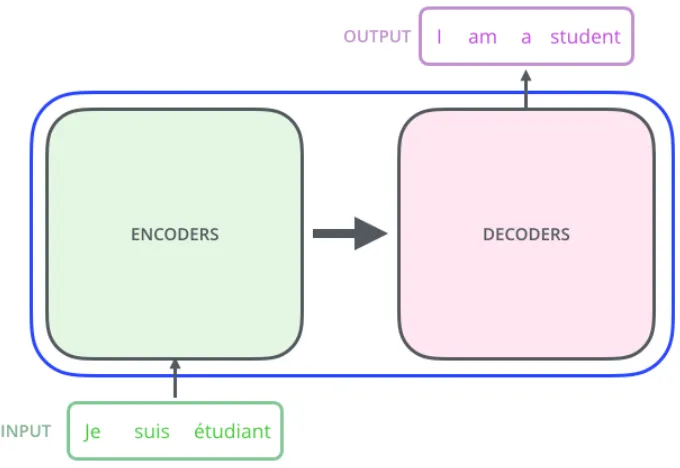
One of the most common types of architectures used for machine translation is the
encoder-decoder model. The encoder - true to its name - encodes the sequence to a fixed dimensional vector.
[image:13.612.131.471.286.520.2]The decoder then processes this vector to produce a translation.
Figure 2.2 Depiction of the Encoder Decoder Model taken from ”The Illustrated Trans-former”.Alammar Jay. (13)
One of the key benefits to such a model is the ability to handle variable length input and
output sentences of text. Later in the report, we will see when encoder decoder models were first
2.3 Vanishing Gradient Decent
In language modeling, there are cases where there is a need to store very long-term dependencies.
Suppose we have to predict the last word in the sentence ”I live in Germany and I speak fluent
German.” We need the context of Germany to predict the word German. There is a chance that
the gap between the relevant information and the point where it is needed becomes very large.
The shortcomings of RNNs shows up when they are no longer able to connect the long term
dependencies.
This was further explored in the paper ”Learning Long-Term Dependencies with Gradient
Descent is Difficult” Bengio et al (1). As the context length between two words increases, layers in
the unrolled RNN also increase. As the network becomes deeper the gradients flowing back in the
back propagation step becomes smaller. As a result, the learning rate becomes very slow and makes
it infeasible to expect long term dependencies for that language. As a result, RNNs face difficulty
in memorizing previous words very far away in the sequence and can only make predictions based
on the recent words.
Long Short Term Memory Networks (LSTMs) solve this issue.
2.4 Long Short Term Memory Networks
LSTMs are a special kind of RNN capable of learning long-term dependencies. They are
ex-plicitly designed to solve the vanishing gradient problem.
They differ from regular RNNs in that the recurring/repeating module has a different structure.
Instead of a single neural network layer, there are 4 layers interacting with each other. The LSTM
maintains a cell state that carries the information across it. The LSTM has the ability to add or
remove information to the cell state through carefully regulated structures called gates. Gates are
composed out of a sigmoid neural net layer and a pointwise multiplication operation. This way,
they have the ability to optionally let information through. This layer is also called the ”forget
The second step is to decide what information is going to be stored in the cell state. First, a
sigmoid layer decides which values are going to be updated and a tanh layer creates a vector of
candidate values that would be added to the state. Both these values are combined to create an
updated version of the cell state.
The final step decides what is going to be the output. First, a sigmoid layer is run to decide
which parts of the cell state is going to be in the output. Then this cell state is put through tanh
and multiply the output of the sigmoid gate. This will ensure that the output will contain only the
[image:15.612.89.520.290.453.2]parts we want it to contain.
Figure 2.3 LSTM picture taken from(author?) (LSTM- Colah’s blog)
2.5 The Transformer
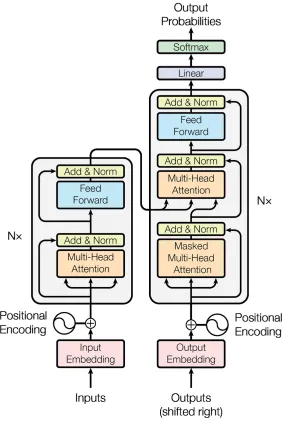
The Transformer is a model that uses attention to speed up the training of attention networks.
They allow for significantly more parallelization and thus solves the regular problems faced by
RNNs. The Transformer follows the overall architecture of the encoder decoder model by using
stacked attention and point wise fully connected layers for both the encoder and the decoder.
The encoding component has a stack of encoders on top of each other and the decoding
com-ponent also has a stack of decoders of the same length. Each of the encoders is broken down into
applied to the feed forward neural network. The decoder is composed of both those layers but has
an attention layer in between them to focus on relevant parts of the sentence.
[image:16.612.165.448.175.598.2]The architecture of the Transformer is as follows:
2.6 ELMo
Over the last one year, a new type of deep contextualized word representation was introduced
that models the complex characteristics of word use as well as how these uses vary across linguistic
contexts. According to the ”Deep Contextualized Word Representations” paper, these word
em-beddings are learned functions of the internal states of a deep bidirectional language model (biLM),
which is pre-trained on a large text-corpus.
The three salient ELMo representations are:
• Contextual - The representation of each word depends on the entire context in which it is
used.
• Deep - The word representations combine all the layers of a deep pre-trained neural network
• Character based - ELMo representations are purely character based, allowing the network to
use morphological clues to form robust representations for out-of-vocabulary tokens unseen
in training.
It has been found that adding ELMo to existing NLP systems has significantly improved the state
of the art for every considered task. The above information was referred from Peters et al. (11)
2.7 BERT
Bidirectional Encoder Representations from Transformers (BERT) is a recent approach
pub-lished in Devlin et al. (12). It is designed to pre-train bidirectional representations of Transformer
and apply it to language modeling. The paper shows that a language model which is bidirectionally
trained can have a deeper sense of language context and flow than uni directional models. Since
BERTs main goal is to generate a language model, it only uses the encoder mechanism of the
Transformer. The specifics of the BERT model can be obtained from the paper. BERT can be
• Classification tasks can be carried out by adding a classification layer on top of the
Trans-former output
• Using BERT, Question Answering models can be trained by learning two extra vectors that
mark the beginning and the end of an answer.
It has been shown that using BERT has provided state of the art results on a wide variety of
Natural Language Processing (NLP) tasks. BERT has proven to be a breakthrough in Machine
Learning and NLP. Its approchability and fast fine-tuning allows for a wide range of applications.
2.8 Sequence to Sequence Learning with Neural Networks
Sequence to Sequence Learning with Neural Networks was introduced in 2014. The paper
introduced an end to end to sequence learning. Their method used a multilayered LSTM to map
the input sequence to a vector of fixed dimensionality and then another deep LSTM to decode the
target sentence from the vector. The paper, ”Sequence to Sequnce Learning with Neural Networks”
Sutskever et al. (5) specifically tackles the translation of English to French on the WMT14 dataset.
Although LSTMs have been developed to do machine translation, the authors approach had some
major modifications that built on top of regular LSTMs. One of the things LSTMs suffer from
is their performance on very large sentences as even they tend to forget some very long term
dependencies. One of the major modifications the authors made, was that they reversed the order
of words in the source sentence but not the target sentence in the training and test set. By doing so,
they introduced many short term dependencies that made the optimization problem much simpler.
For example, given an input sequence a, b, c and it had to be translated to x, y and z , the LSTM
was asked to map c, b, a to x, y and z instead of doing a direct mapping. This way, a would be in
close proximity with x, b in close proximity y with and so on.
Their overall model differed from a regular LSTM in the fact that they used two different
LSTMs. The first LSTM is used to read the input sequence and obtain a large fixed dimensional
vector representation. The second LSTM, which is essentially a RNN language model conditioned
increases the number of model parameters at negligible computational cost, making it natural to
train on multiple language pairs simultaneously. In addition to the above, the authors used a deep
LSTM of four layers as they found that it significantly outperforms shallow LSTMs.
A fascinating result of this approach is that the source sentences were reversed. The authors
found that doing so increased the BLEU scores from 25.9 to 30.6. They believe this is because of
the introduction of many short term dependencies. In general, when a source sentence and target
sentence is concatenated together, each word in the source sentence is very far away from the target
sentence. But when the source sentence is reversed, the average distance between the corresponding
words in the source and target language remain unchanged. Since the first few words in the source
sentence are very close to the first few words in the target sentence, back propagation could have
an easier time finding the sequence and communicating with the source and target sentence which
results in overall improvement in performance.
2.9 Hyper parameter Optimization
While training a model, it is important to know which hyperparameters to choose.
Hyperpa-rameters refer to the paHyperpa-rameters that are set before the start of training. The time required to
train and test a model is dependent on the types of hyperparameters chosen. The tune-ability of an
algorithm, hyperparameter, or interacting hyperparameters is a measure of how much performance
can be gained by tuning it. For an LSTM, the learning rate followed by the network size are its most
crucial hyperparameters. Hyperparameter optimization relies on finding the most optimal tuple
which will minimize the predefined loss function on a given data. In this paper we will specifically
analyze which hyperparameters work best on the NMT models – specifically the model inspired by
CHAPTER 3. METHODS AND PROCEDURES
3.1 Introduction
The basis for hyperparameter optimization lies in picking the right hyperparameters before
training. Once these hyperparameters are picked, it is important to narrow down our options so
that we end up with a certain configuration that would work on our given model and dataset.
This section introduces the different hyperparameters that were chosen and the algorithms used to
narrow down the list so as to obtain the most optimal hyperparameters for the given NMT task.
3.2 Hyperparameter selection
3.2.1 Learning Rate
The learning rate is a hyperparameter that controls how much the weights of the network are
getting adjusted with respect to the loss gradient. Typically learning rates are configured at random
by the user. It is often hard to get it right. The way in which learning rate changes over time
(training epochs) is referred to learning rate decay, ”Adaptive learning rate” is a process in which a
small learning rate is chosen and if the performance doesn’t improve after a fixed number of epochs,
the learning rate is increased by a fixed number tested again. An adaptive learning rate generally
outperforms a model with a badly configured learning rate.
3.3 Optimizer
An optimizer is a mathematical way of measuring how wrong the predictions are, Optimizers
tie together the loss function and the model parameters by updating the model in response to the
output of the loss function. There are two types of optimizers we will discuss - Stochastic Gradient
3.3.1 Stochastic Gradient Descent
Gradient descent is an algorithm that has been used all across Machine Learning to optimize.
There are three steps involved in gradient descent –
• Calculate what a small change in each individual weight would do to the loss function
• Adjust each individual weight based on its gradient.
• Repeating the first two steps until loss is minimized
It is important to find the right learning rate so as to avoid the gradient from getting stuck in
a local minima.
In Stochastic gradient descent, instead of calculating the gradients of all of our training examples
on every pass of the gradient, we only use a small subset or mini-batches of training examples. The
reason this is done is to first reduce the variance in parameter update and hence, lead to a more
stable convergence; and second, to utilize highly optimized matrix operations that should be used
for computing the cost and gradient.
3.3.2 Adam Optimizer
Adam stands for adaptive moment estimation. Adam utilizes the concept of momentum by
adding fractions of previous gradients to the current one. We are not going to go into the
math-ematics of this here but it is important to remember that all optimizers have the same goal:
minimizing the loss function.
3.4 Type of attention
This describes the type of attention mechanism that we use in the encoder and decoder. More
3.4.1 Bahdanau
This mechanism gives decoder a way to ”pay attention” to parts of the input rather than
relying on a single vector. Attention is calculated with a feedforward layer in the decoder which
then creates a new vector which is processed through a softmax layer to create attention weights
that are multiplied with encoders outputs to create a new context vector which is used to predict
the next output. The attention scores in Bahdanau are calculated using the concat mechanism
which involves taking a dot product between a new parameter va and a linear transform of the
states concatenated together.
3.4.2 Luong
The Effective Approaches to Attention-based Neural Machine Translation introduced by Luong
et al. describes a few more attention models that offer improvements and simplification. The main
difference between the luong attention and the bahdanau mechanism is the scoring. In luong, the
specific score function that compares two states is a dot product between the current states and
the previous hidden state of the network.
3.5 Attention Architecture
3.5.1 Standard
The standard attention architecture refers to the architecture described in sequence to sequence
learning with neural networks (section 2.8)
3.5.2 Google Neural Machine Translation (GNMT)
The GNMT model described by Wu et al. (7) aims to address the issue that NMT systems
lack robustness, particularly when the input sentences contain rare words. The model consists of
a deep LSTM network with 8 encoder and 8 decoder layers using residual connections as well as
bottom layer of the decoder to the top layer of the encoder in an attempt to improve parallelism
and decrease training time. In the GNMT model, the words are divided into a limited set of
sub-word units in order to handle rare sub-words. According to the paper, this method provides a good
balance between the flexibility of character-delimited models and the efficiency of word-delimited
models, naturally handles translation of rare words, and ultimately improves the overall accuracy
of the system. In addition, their beam search technique employs a length-normalization procedure
and uses a coverage penalty, which encourages generation of an output sentence that is most likely
to cover all the words in the source sentence. This architecture has achieved state of the art
performance on the EMT’14 English-to-French and English-to-German datasets.
3.6 Encoder type
3.6.1 Unidirectional
A unidirectional encoder is a simple recurrent neural network. (LSTM) The unidirectional
LSTM only preserves information from the past as the inputs it gets are only from the past.
3.6.1.1 Bi-directional
The bidirectional encoder consists of two independent encoders. One for the encoding of the
normal sequence and another for the encoding for the reversed sentence. Hence, the input is run
two ways – one from the past to the future and another from the future to the past. The output
and final states are concatanated or summed. Using the two hidden states, we can, at any point in
time, preserve the information from both the past and the future.
The figure 3.1 illustrates the past and the future states interacting with each other.
3.6.1.2 GNMT
The Google encoder is an encoder with a single bidirectional layer as described in Wu et al.
Figure 3.1 Bi-directional RNNs (http://opennmt.net/OpenNMT)
3.6.2 Regularization
Regularization is used to prevent neural networks from overfitting and increase generalization
capacity. Dropout is an effective regularization strategy introduced by (4). It is only applied during
the training process. In general, a batch of individual neurons are disabled with a probability p. If
p is set to 0 there will be no dropout. The default regularization is dropout with a probability of
0.2. That is the dropout we use throughout our experiments as previous experiments have proven
to show that it works well.
3.7 Inference mode
After training a model, it is usually released for inference. During inference, we only have access
to the source sentences (encoder inputs). Then there are three ways to do the decoding – sampling,
greedy and beam search.
3.7.1 Greedy
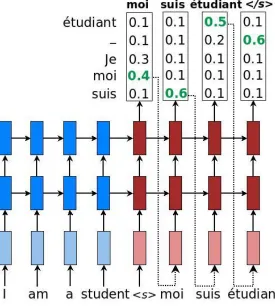
As soon as the decoder gets the starting symbol < s > from the encoder, for each time step on
logit value is chosen. This is then passed in as input to the next time step. This process is continued
until the end of sentence marker < /s >is reached. The figure below shows greedy inference very
[image:25.612.166.441.179.487.2]well.
Figure 3.2 Greedy decoding obtained from Luong et al. (9)
3.7.2 Beam Search
Beam Search uses breadth-first search to build its search tree but only keeps the top N (beam
size) nodes at each level in memory. The next level is then expanded from those N nodes. Its
3.8 Testing mechanism
3.8.1 BLEU scores
The Billingual Evaluation Understudy (BLEU) score Papineni et al. (2) is a common way to
find how well a machine translation system performed when there can be multiple good outputs.
Consider the following example: In French: Le chat est sur le tapis Reference English translation:
The cat is on the mat NMT English translation: There is a cat on the mat.
Both the English translations are equally good. Suppose we had the MT model predict the
translation to be The the the the the we know this is not a very good translation but we need to
measure exactly how bad this is. The BLEU score gives us this measure. It uses n-grams and finds
what fraction of the n-grams in the machine translation output also exist in the references. The
metric ranges from 0 to 1 and few translations attain a score of 1 unless they are identical to the
reference translation.
3.9 Random Search
For a long time, grid search (building a model for every configuration of hyperparameters and
evaluating each model) and manual search were the most widely used strategies for hyperparameter
optimization. In 2012, two researchers from the University of Montreal introduced random search
in their paper ”Random Search for Hyper-Parameter Optimization” (3). Random search is a very
simple concept – random combinations of the hyperparameters are chosen and trained. Random
search seemed to find the better models by effectively searching a larger, less promising configuration
space.
3.10 Successive Halving
Successive halving is an improvement over random search. The idea of successive halving is to
first try N hyperparameter settings for some fixed amount of time T. Then, we keep N/2 of the
to temporarily halt the training of a model, save the model and then proceed with the training.
The latter part can be problematic when using open source neural network models as it might be
difficult to stop and restart the training at any time with different configurations. Our adaptation
works around this issue by simply training them to completion and showing that the same results
can be obtained.
3.11 Hyperband
The paper for Hyperband can be refered from Li et al (15) Hyperband adopts both random
search and successive halving for hyperparameter optimization. It is a bandit-based strategy for
hyperparameter optimization that iteratively allocates resources to a set of random configurations.
Given a predefined budget B for one iteration, like time or total number of epochs, Hyperband
samples a fixed number of configurations uniformly at random and uses successive halving to discard
poorly performing configurations. The following steps explains the algorithm in more detail
1. Randomly sample a set of hyperparameter configurations
2. Evaluate the performances of all currently remaining configurations.
3. Throw out the bottom half of the worst performing configurations.
4. Repeat step 2 until only one configuration remains.
3.12 Proposed Algorithm
In our implementation of hyperparameter optimization we perform a slight modification in the
successive halving phase.
We allow each of the configurations to execute to completion before making a decision to discard
or keep that particular configuration. In addition, adaptive learning rates is implemented where
the learning rate is increased in specific increments after starting from a specific minimum. We
ended up checking for the learning rate after deciding on the other hyperparameters.The algorithm
Algorithm 1 Modified Successive Halving
input: previous configurations O, record of previously obtained BLEU scores B, number of configurations N, number of epochsE
output: The BLEU score for current configuration; the next configuration to consider C
while N != 1 do if O < N then
create random configurationC
TrainC
Record BLEU score binB O+ +;
else
for allconfigs C inO do
Find N/2 configurations with the highest BLEU scores.
N =N/2
Retrain the model with the different configurations.
Record the BLEU scores in B and repeat until only one configuration is left.
end for end if end while
As is evident, this algorithm is a combination of random search and successive halving. In
the first N configurations, the hyperparameters are randomly picked. In our implementation the
learning rate was picked in uniform random intervals from 0.0001 to 0.1. After the random search
was done, we resorted to successive halving by training N/2 number of configurations and doubling
the number of epochs. At this point, we also know a subset of the hyperparameters that work
better than the others so we can even reduce the range of different hyperparameters to choose
from. The main difference from regular successive halving is that we run each of the configurations
to completion instead of halting the model and changing the configurations and then continuing.
We found that this helps make the results more accurate although it takes more time to train to
completion.
Once the optimal set of hyperparameters are obtained, the learning rate was further configured
using the learning rate schedule. This helped us find a subset of values that would help us obtain
CHAPTER 4. RESULTS
4.1 System Configurations:
The training was done on a CentOS system that was running the NVIDIA GeForce GTX 1080
GPU. The CPU used is Intel Xeon CPU E5-2620 v3 with a 2.40GHz clock. It has 12 CPU cores
and a 64GB RAM.
4.2 Training Data:
The English-Vietnamese parallel corpus of TED talks (133K sentence pairs) provided by the
IWSLT Evaluation Campaign.
For the large scale training we used the German-English parallel corpus (4.5M sentence pairs)
provided by the WMT Evaluation Campaign.
4.3 Evaluation
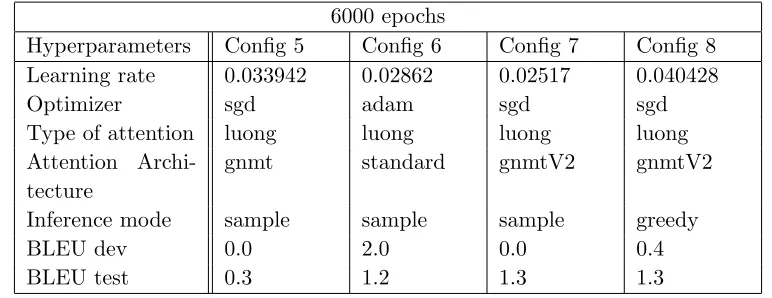
Random search was first applied and each of the model configurations were trained for 6000
epochs. The results are shown in Table 4.1 and 4.2
It is clear to see that beam search and greedy inference modes performed better than the sample
inference. Using successive halving, we can choose the top 4 performing configurations and run
them for 12,000 epochs. The BLEU scores improved significantly. When beam search is used, the
beam width is always 10. The results are shown in Table 4.3
After narrowing down the four configurations from successive halving, it is clear which
con-figuration is the best for the given dataset. Keeping other hyperparameters the same, the luong
attention model seemed to outperform the bahdanau attention. In addition, for the given dataset,
the standard attention architecture seemed to perform better than the GNMT architecture. This
6000 epochs
Hyperparameters Config 1 Config 2 Config 3 Config 4 Learning rate 0.001392 0.03648 0.00993 0.01135
Optimizer sgd sgd sgd adam
Type of attention luong luong bahdanau luong Attention
Archi-tecture
standard standard standard gnmtV2
Inference mode sample sample greedy beam search; beam width 10
BLEU dev 0.0 0.2 5.3 5.6
[image:30.612.118.493.107.299.2]BLEU test 0.0 0.4 1.4 1.4
Table 4.1 The different hyperparameter configurations obtained via random search
6000 epochs
Hyperparameters Config 5 Config 6 Config 7 Config 8 Learning rate 0.033942 0.02862 0.02517 0.040428
Optimizer sgd adam sgd sgd
Type of attention luong luong luong luong Attention
Archi-tecture
gnmt standard gnmtV2 gnmtV2
Inference mode sample sample sample greedy
BLEU dev 0.0 2.0 0.0 0.4
BLEU test 0.3 1.2 1.3 1.3
Table 4.2 The different hyperparameter configurations obtained via random search
adam optimizer, GNMT architecture, bahdanau attention adn beam search inference performed
way worse than the other configurations in table 4.3. So we discarded that set of hyperparameters.
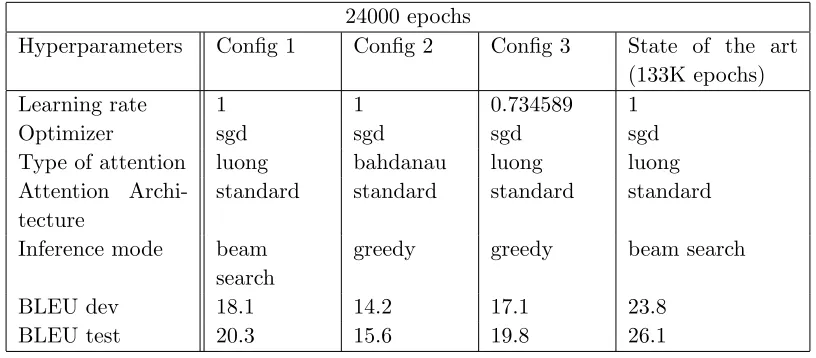
We ran the given configuration for 24000 epochs. Although we only needed to train one of the
configurations, we trained the model with a a different inference mode. It was interesting to see
how beam search performed slightly better than greedy when the other configurations remained
the same. The encoders used for the Vietnamese-English translation was unidirectional. The State
of the art results mentioned below uses the bidirectional encoder.
We observe that beam search clearly helps the model perform better than greedy. The current
[image:30.612.112.498.330.479.2]12000 epochs
Hyperparameters Config 1 Config 2 Config 3 Config 4 Learning rate 0.001392 0.03648 0.00993 0.01135
Optimizer sgd adam sgd sgd
Type of attention luong bahdanau luong bahdanau Attention
Archi-tecture
standard gnmtV2 gnmtV2 standard
Inference mode greedy beam search
beam search
greedy
BLEU dev 14.1 6.0 11.6 11.7
[image:31.612.118.495.106.270.2]BLEU test 16.1 5.1 12.8 12.3
Table 4.3 The different hyperparameter configurations obtained via successive halving
24000 epochs
Hyperparameters Config 1 Config 2 Config 3 State of the art (133K epochs) Learning rate 1 1 0.734589 1
Optimizer sgd sgd sgd sgd
Type of attention luong bahdanau luong luong Attention
Archi-tecture
standard standard standard standard
Inference mode beam search
greedy greedy beam search
BLEU dev 18.1 14.2 17.1 23.8 BLEU test 20.3 15.6 19.8 26.1
Table 4.4 The final hyperparameter configurations for the given model and dataset
fixed amount of active candidates at each time step. The greedy strategy only compares one
most-likely candidate. Thus the larger search space could help beam search make better judgements
about past word relationships. Some other observations we made are that – Adam optimizer
tends to give reasonable results for unfamiliar architectures but SGD with scheduled learning rate
tends to lead to better performance. Luong style works well with different settings. But from
other resources we find out that Bahdanau style attention often works better with bidirectionality
on the encoder side. For the Vietnameese-English translations, unidirectional encoders and the
standard architecture worked very well. However when we trained the German-English dataset,
[image:31.612.102.510.301.480.2]In the following figures, all the experiments are trained with the configuration:
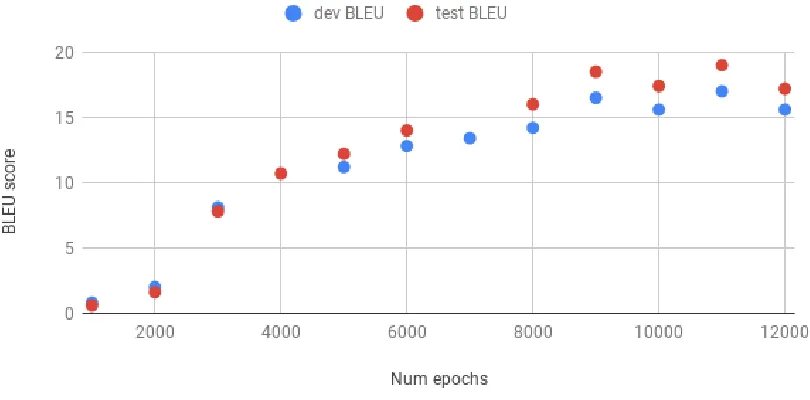
• Number of epochs - 6000
• Optimizer - sgd
• Type of attention - Luong
• Encoder - uni-directional
[image:32.612.108.513.341.541.2]• Inference mode - Beam search
Figure 4.1 The variation of the BLEU for every step in the training process
We see a near logarithmic increase in the BLEU scores. There is a high of 18.1 at around 11,000
epochs.
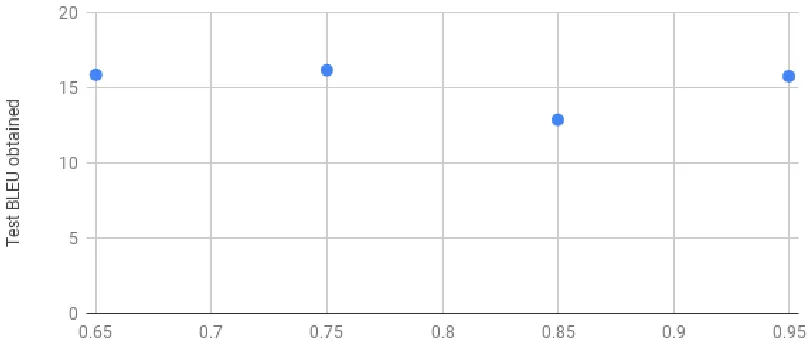
From the learning rate schedule, we can see that the BLEU score was at its best when the
learning rate was between 0.65 to 0.75. The next thing to try would be to create another schedule
and increase the learning rate with smaller increments to narrow down the prospects. Figures 4.3
Figure 4.2 The variation of the BLEU score obtained with respect to different learning rates. The congiguration used was
Figure 4.3 Vietnamese to English translations
For the German to English translations we found the optimal parameters to be
-• Optimizer - sgd
• Type of attention - normed bahdanau
• Attention architecture - gnmtV2
• Encoder - Gnmt
Figure 4.4 Vietnamese to English translations
We trained this configuration to 122,000 steps and got a dev BLEU score of 22.2 and a test
BLEU of 22.4. Fig 4.5 and 4.6 show some of the results obtained from these tests.
Figure 4.5 German to English translation at epoch 122000
CHAPTER 5. SUMMARY AND DISCUSSION
Machine Translation has seen significant progress over the last few years. In this work we showed
that a layered LSTM layer like in the sequence to sequence learning model and the GNMT model
work differently on different datasets. In addition, every hyperparameter affects the performance
of the model. When making any model, we have an idea about the top hyperparameters that
affect the model the most and in the case of NMT, the attention architecture, optimizers, attention
mechanism and the inference mode can significantly impact the results and performance of the
model.
We need to keep in mind that not all datasets work with the configurations shown in this report.
The report only covers the Vietnamese to English and the German to English translations. Given
a different dataset, it is difficult to pinpoint exactly what configuration would be the most optimal,
but we can narrow down the options by utilizing one of the hyperparameter optimization methods
described in this report.
Further work can be put into exploring other algorithms for finding the learning rate. This
report introduced adaptive learning rates but it would be interesting to explore search algorithms
for continuous variables to hone in on a good learning rate. In addition, more research can be put
REFERENCES
[1] Bengio Yoshua., Simard Patrice., Frasconi Paolo. (1994). Learning Long-Term Dependencies
with Gradient Descent is Difficult.IEEE Transactions on Neural Networks,
[2] Papineni Kishore., Roukos Salim., Ward Todd., Xhu Wei-Jing (2002) BLEU: a Method for
Au-tomatic Evaluation of Machine TranslationAssociation for Computational Linguistics (ACL)
[3] James Bergstra., Yoshua Bengio. (2012) Random Search for Hyper-Parameter Optimization.
Journal of Machine Learning Research 13 (2012) 281-305
[4] Srtvastava Nitish, Hinton Geoffery, Krizhevsky Alex, Sutskever Ilya, Salakhutdinov Ruslan.
(2014) Droupout: A Simple Way to Prevent Neural Networks from Overfitting. Journal of
Machine Learning Research 15 (2014)
[5] Sutskever Iiya., Vinyals Oriol., Le V. Quoc (2014). Sequence to Sequence Learning with Neural
Networks.NIPS 2014.
[6] Luong Minh-Tang., Pham Hieu., Manning D. Christopher. (2015) Effective Approaches to
Attention-based Neural Machine Translation. arXiv:1508.04025
[7] Yonghui Wu, Mike Schuster, Zhifeng Chen, Quoc V. Le, Mohammad Norouzi, Wolfgang
Macherey, Maxim Krikun, Yuan Cao, Qin Gao, Klaus Macherey, Jeff Klingner, Apurva Shah,
Melvin Johnson, Xiaobing Liu, ukasz Kaiser, Stephan Gouws, Yoshikiyo Kato, Taku Kudo,
Hideto Kazawa, Keith Stevens, George Kurian, Nishant Patil, Wei Wang, Cliff Young, Jason
Smith, Jason Riesa, Alex Rudnick, Oriol Vinyals, Greg Corrado, Macduff Hughes, Jeffrey Dean
(2016) Googles Neural Machine Translation System: Bridging the Gap between Human and
[8] Zhou, J., Cao, Y., Wang, X., Li, P., and Xu, W. (2016). Deep Recurrent Models with
Fast-Forward Connections for Neural Machine Translation.CoRR abs
[9] Minh-Thang Luong., Eugene Brevdo., Rui Zhao. (2017). Neural Machine Translation (seq2seq)
Tutorialhttps://github.com/tensorflow/nmt,
[10] Vaswani Ashish, Shazeer Noam, Parmar Niki, Uszkoreit Jakob, Jones Llion, Gomez N Aidan,
Kaiser Lukasz and Polosukhin Illia. Attention Is All You Need.arXiv:1706.03762v5,
[11] Peters E. Matthew., Neumann Mark., Iyyer Mohit., Gardner Matt., Clark Christopher.,
Lee Kenton., Zettlemoyer Luke. (2018) ELMo - Deep Contextualized Word Representations
NAACL,
[12] Devlin Jacob, Chang Ming-Wei, Lee Kenton and Toutanova Kristina. (2018) BERT:
Pre-training of Deep Bidirectional Transformers for Language Understanding.arXiv:1810.04805,
[13] Alammar Jay. (2018) The Illustrated Transformer.
http://jalammar.github.io/illustrated-transformer/
[14] spro. (2018) Practical PyTorch: Translation with a Sequence to Sequence Network and
At-tention.
https://github.com/spro/practical-pytorch/blob/master/seq2seq-translation/seq2seq-translation.ipynb
[15] Li Lisha, Jamieson Kevin, DeSalvo Giulia, Rostamizadeh Afshin, Talwalkar Ameet
(2018) Hyperband: A Novel Bandit-Based Approach to Hyperparameter Optimization
arXiv:1603.06560v4
[OpenNMT] OpenNMT tutorials http://opennmt.net/OpenNMT/training/models/
[LSTM- Colah’s blog] Understanding LSTM Networks – colah’s blog