A Monthly Double-Blind Peer Reviewed (Refereed/Juried) Open Access International e-Journal - Included in the International Serial Directories
Indexed & Listed at:
Ulrich's Periodicals Directory ©, ProQuest, U.S.A., EBSCO Publishing, U.S.A., Cabell’s Directories of Publishing Opportunities, U.S.A., Open J-Gage, India [link of the same is duly available at Inflibnet of University Grants Commission (U.G.C.)],
VOLUME NO.3(2013),ISSUE NO.06(JUNE) ISSN 2231-5756
INTERNATIONAL JOURNAL OF RESEARCH IN COMMERCE, IT & MANAGEMENT
CONTENTS
CONTENTS
CONTENTS
CONTENTS
Sr.
No.
TITLE & NAME OF THE AUTHOR (S)
Page No. 1. ISSUES AND SUGGESTIONS FOR THE IMPLEMENTATION OF THE INDIA’S RIGHT TO INFORMATION ACT 2005 IN LIGHT OF THE LATIN AMERICAN
COUNTRIES’ EXPERIENCE
DR. PRATIBHA J.MISHRA
1
2. AN EMPIRICAL STUDY ON JOB STRESS IN PRIVATE SECTOR BANKS OF UTTARAKHAND REGION
MEERA SHARMA & LT. COL. DR. R. L. RAINA
7
3. FOREIGN DIRECT INVESTMENT IN INDIA: AN OVERVIEW
DR. MOHAMMAD SAIF AHMAD
14
4. REFLECTIONS ON VILLAGE PEOPLE’S SOCIO - ECONOMIC CONDITIONS BEFORE AND AFTER NREGS: A DETAILED STUDY OF ARIYALUR DISTRICT, TAMIL NADU
DR. P. ILANGO & G. SUNDHARAMOORTHI
19
5. THE CAUSAL EFFECTS OF EDUCATION ON TECHNOLOGY IMPLEMENTATION – EVIDENCE FROM INDIAN IT INDUSTRY
S.M.LALITHA & DR. A. SATYA NANDINI
25
6. A STUDY ON ONLINE SHOPPING BEHAVIOUR OF TEACHERS WORKING IN SELF-FINANCING COLLEGES IN NAMAKKAL DISTRICT WITH SPECIAL REFERENCE TO K.S.R COLLEGE OF ARTS AND SCIENCE, TIRUCHENGODE, NAMAKKAL DISTRICT
SARAVANAN. R., YOGANANDAN. G. & RUBY. N
31
7. AN OVERVIEW OF RESEARCH IN COMMERCE AND MANAGEMENT IN SHIVAJI UNIVERSITY
DR. GURUNATH J. FAGARE & DR. PRAVEEN CHOUGALE
38
8. VARIABLE SELECTION IN REGRESSION MODELS
M.SUDARSANA RAO, M.SUNITHA & M.VENKATARAMANAIH
46
9. CUSTOMER ATTITUDE TOWARDS SERVICES AND AMENITIES PROVIDED BY STAR HOTELS: A STUDY WITH REFERENCE TO MADURAI CITY
DR. JACQUELINE GIGI VIJAYAKUMAR
50
10. QUALITY AND SUSTAINABILITY OF JOINT LIABILITY GROUPS AND MICROFINANCE INSTITUTIONS: A CASE STUDY OF CASHPOR MICROCREDIT SERVICES
DR. MANESH CHOUBEY
56
11. INDIAN MUTUAL FUND MARKET: AN OVERVIEW
JITENDRA KUMAR & DR. ANINDITA ADHIKARY
63
12. SMART APPROACHES FOR PROVIDING THE SPD’S (SECURITY, PRIVACY & DATA INTEGRITY) SERVICE IN CLOUD COMPUTING
M.SRINIVASAN & J.SUJATHA
67
13. A COMPARATIVE STUDY ON ETHICAL DECISION-MAKING OF PURCHASING PROFESSIONALS IN TAIWAN AND CHINA
YI-HUI HO
70
14. THE INTERNAL AUDIT FUNCTION EFFECTIVENESS IN THE JORDANIAN INDUSTRIAL SECTOR
DR. YUSUF ALI KHALAF AL-HROOT
75
15. STUDY ON ROLE OF EFFECTIVE LEADERSHIP ON SELLING VARIOUS INSURANCE POLICIES OF ICICI PRUDENTIAL: A CASE STUDY OF SUBHASH MARG BRANCH, DARYAGANJ
SUBHRANSU SEKHAR JENA
80
16. AN EMPIRICAL STUDY ON WEAK-FORM OF MARKET EFFICIENCY OF NATIONAL STOCK EXCHANGE
DR. VIJAY GONDALIYA
89
17. THE GOLDEN ROUTE TO LIQUIDITY: A PERFORMANCE ANALYSIS OF GOLD LOAN COMPANIES
DR. NIBEDITA ROY
94
18. STUDY ON THE MANAGEMENT OF CURRENT LIABILITIES OF NEPA LIMITED
DR. ADARSH ARORA
99
19. QUALITY OF MEDICAL SERVICES: A COMPARATIVE STUDY OF PRIVATE AND GOVERNMENT HOSPITALS IN SANGLI DISTRICT
SACHIN H.LAD
105
20. DIVIDEND POLICY AND BANK PERFORMANCE: THE CASE OF ETHIOPIAN PRIVATE COMMERCIAL BANKS
NEBYU ADAMU ABEBE & TILAHUN AEMIRO TEHULU
109
21. CUSTOMER KNOWLEDGE: A TOOL FOR THE GROWTH OF E-LEARNING INDUSTRY
DR. MERAJ NAEM, MOHD TARIQUE KHAN & ZEEBA KAMIL
115
22. THE EFFECTS OF ORGANIZED RETAIL SECTOR ON CONSUMER SATISFACTION: A CASE STUDY IN MYSORE CITY
ASHWINI.K.J & DR. NAVITHA THIMMAIAH
122
23. PERCEIVED BENEFITS AND RISKS OF ELECTRONIC DIVIDEND AS A PAYMENT MEDIUM IN THE NIGERIA COMMERCIAL BANKS
OLADEJO, MORUF. O & FASINA, H T
127
24. INDO - CANADIAN TRADE RELATION IN THE MATH OF POST REFORM PERIOD
ANITHA C.V & DR. NAVITHA THIMMAIAH
133
25. IMPACT OF BOARD STRUCTURE ON CORPORATE FINANCIAL PERFORMANCE
AKINYOMI OLADELE JOHN
140
26. WORK LIFE BALANCE: A SOURCE OF JOB SATISFACTION: A STUDY ON THE VIEW OF WOMEN EMPLOYEES IN INFORMATION TECHNOLOGY (IT) SECTOR
NIRMALA.N
145
27. SCHOOL LEADERSHIP DEVELOPMENT PRACTICES: FOCUS ON SECONDARY SCHOOL PRINCIPALS IN EAST SHOWA, ETHIOPIA
FEKADU CHERINET ABIE
148
28. EMOTIONAL INTELLIGENCE OF THE MANAGERS IN THE BANKING SECTOR IN SRI LANKA
U.W.M.R. SAMPATH KAPPAGODA
153
29. IMPACT OF CORPORATE SOCIAL RESPONSIBILITY PRACTICES ON MEDIUM SCALE ENTERPRISES
RAJESH MEENA
157
30. IMPACT OF CASHLITE POLICY ON ECONOMIC ACTIVITIES IN NIGERIAN ECONOMY: AN EMPIRICAL ANALYSIS
DR. A. P. OLANNYE & A.O ODITA
162
INTERNATIONAL JOURNAL OF RESEARCH IN COMMERCE, IT & MANAGEMENT
CHIEF PATRON
CHIEF PATRON
CHIEF PATRON
CHIEF PATRON
PROF. K. K. AGGARWAL
Chairman, Malaviya National Institute of Technology, Jaipur
(An institute of National Importance & fully funded by Ministry of Human Resource Development, Government of India)
Chancellor, K. R. Mangalam University, Gurgaon
Chancellor, Lingaya’s University, Faridabad
Founder Vice-Chancellor (1998-2008), Guru Gobind Singh Indraprastha University, Delhi
Ex. Pro Vice-Chancellor, Guru Jambheshwar University, Hisar
FOUNDER
FOUNDER
FOUNDER
FOUNDER PATRON
PATRON
PATRON
PATRON
LATE SH. RAM BHAJAN AGGARWAL
Former State Minister for Home & Tourism, Government of Haryana
Former Vice-President, Dadri Education Society, Charkhi Dadri
Former President, Chinar Syntex Ltd. (Textile Mills), Bhiwani
CO
CO
CO
CO----ORDINATOR
ORDINATOR
ORDINATOR
ORDINATOR
AMITA
Faculty, Government M. S., Mohali
ADVISORS
ADVISORS
ADVISORS
ADVISORS
DR. PRIYA RANJAN TRIVEDI
Chancellor, The Global Open University, Nagaland
PROF. M. S. SENAM RAJU
Director A. C. D., School of Management Studies, I.G.N.O.U., New Delhi
PROF. M. N. SHARMA
Chairman, M.B.A., Haryana College of Technology & Management, Kaithal
PROF. S. L. MAHANDRU
Principal (Retd.), Maharaja Agrasen College, Jagadhri
EDITOR
EDITOR
EDITOR
EDITOR
PROF. R. K. SHARMA
Professor, Bharti Vidyapeeth University Institute of Management & Research, New Delhi
CO
CO
CO
CO----EDITOR
EDITOR
EDITOR
EDITOR
DR. BHAVET
Faculty, Shree Ram Institute of Business & Management, Urjani
EDITORIAL ADVISORY BOARD
EDITORIAL ADVISORY BOARD
EDITORIAL ADVISORY BOARD
EDITORIAL ADVISORY BOARD
DR. RAJESH MODI
Faculty, Yanbu Industrial College, Kingdom of Saudi Arabia
PROF. SANJIV MITTAL
University School of Management Studies, Guru Gobind Singh I. P. University, Delhi
PROF. ANIL K. SAINI
VOLUME NO.3(2013),ISSUE NO.06(JUNE) ISSN 2231-5756
INTERNATIONAL JOURNAL OF RESEARCH IN COMMERCE, IT & MANAGEMENT
DR. SAMBHAVNA
Faculty, I.I.T.M., Delhi
DR. MOHENDER KUMAR GUPTA
Associate Professor, P. J. L. N. Government College, Faridabad
DR. SHIVAKUMAR DEENE
Asst. Professor, Dept. of Commerce, School of Business Studies, Central University of Karnataka, Gulbarga
ASSOCIATE EDITORS
ASSOCIATE EDITORS
ASSOCIATE EDITORS
ASSOCIATE EDITORS
PROF. NAWAB ALI KHAN
Department of Commerce, Aligarh Muslim University, Aligarh, U.P.
PROF. ABHAY BANSAL
Head, Department of Information Technology, Amity School of Engineering & Technology, Amity
University, Noida
PROF. A. SURYANARAYANA
Department of Business Management, Osmania University, Hyderabad
DR. SAMBHAV GARG
Faculty, Shree Ram Institute of Business & Management, Urjani
PROF. V. SELVAM
SSL, VIT University, Vellore
DR. PARDEEP AHLAWAT
Associate Professor, Institute of Management Studies & Research, Maharshi Dayanand University, Rohtak
DR. S. TABASSUM SULTANA
Associate Professor, Department of Business Management, Matrusri Institute of P.G. Studies, Hyderabad
SURJEET SINGH
Asst. Professor, Department of Computer Science, G. M. N. (P.G.) College, Ambala Cantt.
TECHNICAL ADVISOR
TECHNICAL ADVISOR
TECHNICAL ADVISOR
TECHNICAL ADVISOR
AMITA
Faculty, Government M. S., Mohali
FINANCIAL ADVISORS
FINANCIAL ADVISORS
FINANCIAL ADVISORS
FINANCIAL ADVISORS
DICKIN GOYAL
Advocate & Tax Adviser, Panchkula
NEENA
Investment Consultant, Chambaghat, Solan, Himachal Pradesh
LEGAL ADVISORS
LEGAL ADVISORS
LEGAL ADVISORS
LEGAL ADVISORS
JITENDER S. CHAHAL
Advocate, Punjab & Haryana High Court, Chandigarh U.T.
CHANDER BHUSHAN SHARMA
Advocate & Consultant, District Courts, Yamunanagar at Jagadhri
SUPERINTENDENT
SUPERINTENDENT
SUPERINTENDENT
SUPERINTENDENT
INTERNATIONAL JOURNAL OF RESEARCH IN COMMERCE, IT & MANAGEMENT
CALL FOR MANUSCRIPTS
CALL FOR MANUSCRIPTS
CALL FOR MANUSCRIPTS
CALL FOR MANUSCRIPTS
We invite unpublished novel, original, empirical and high quality research work pertaining to recent developments & practices in the areas of Computer Science & Applications; Commerce; Business; Finance; Marketing; Human Resource Management; General Management; Banking; Economics; Tourism Administration & Management; Education; Law; Library & Information Science; Defence & Strategic Studies; Electronic Science; Corporate Governance; Industrial Relations; and emerging paradigms in allied subjects like Accounting; Accounting Information Systems; Accounting Theory & Practice; Auditing; Behavioral Accounting; Behavioral Economics; Corporate Finance; Cost Accounting; Econometrics; Economic Development; Economic History; Financial Institutions & Markets; Financial Services; Fiscal Policy; Government & Non Profit Accounting; Industrial Organization; International Economics & Trade; International Finance; Macro Economics; Micro Economics; Rural Economics; Co-operation; Demography: Development Planning; Development Studies; Econometrics; Applied Economics; Development Economics; Business Economics; Monetary Policy; Public Policy Economics; Real Estate; Regional Economics; Political Science; Continuing Education; Labour Welfare; Philosophy; Psychology; Sociology; Tax Accounting; Advertising & Promotion Management; Management Information Systems (MIS); Business Law; Public Responsibility & Ethics; Communication; Direct Marketing; E-Commerce; Global Business; Health Care Administration; Labour Relations & Human Resource Management; Marketing Research; Marketing Theory & Applications; Non-Profit Organizations; Office Administration/Management; Operations Research/Statistics; Organizational Behavior & Theory; Organizational Development; Production/Operations; International Relations; Human Rights & Duties; Public Administration; Population Studies; Purchasing/Materials Management; Retailing; Sales/Selling; Services; Small Business Entrepreneurship; Strategic Management Policy; Technology/Innovation; Tourism & Hospitality; Transportation Distribution; Algorithms; Artificial Intelligence; Compilers & Translation; Computer Aided Design (CAD); Computer Aided Manufacturing; Computer Graphics; Computer Organization & Architecture; Database Structures & Systems; Discrete Structures; Internet; Management Information Systems; Modeling & Simulation; Neural Systems/Neural Networks; Numerical Analysis/Scientific Computing; Object Oriented Programming; Operating Systems; Programming Languages; Robotics; Symbolic & Formal Logic; Web Design and emerging paradigms in allied subjects.
Anybody can submit the soft copy of unpublished novel; original; empirical and high quality research work/manuscriptanytime in M.S. Word format
after preparing the same as per our GUIDELINES FOR SUBMISSION; at our email address i.e. [email protected] or online by clicking the link online submission as given on our website (FOR ONLINE SUBMISSION, CLICK HERE).
GUIDELINES FOR SUBMISSION OF MANUSCRIPT
GUIDELINES FOR SUBMISSION OF MANUSCRIPT
GUIDELINES FOR SUBMISSION OF MANUSCRIPT
GUIDELINES FOR SUBMISSION OF MANUSCRIPT
1. COVERING LETTER FOR SUBMISSION:
DATED: _____________ THE EDITOR
IJRCM
Subject: SUBMISSION OF MANUSCRIPT IN THE AREA OF.
(e.g. Finance/Marketing/HRM/General Management/Economics/Psychology/Law/Computer/IT/Engineering/Mathematics/other, please specify)
DEAR SIR/MADAM
Please find my submission of manuscript entitled ‘___________________________________________’ for possible publication in your journals.
I hereby affirm that the contents of this manuscript are original. Furthermore, it has neither been published elsewhere in any language fully or partly, nor is it under review for publication elsewhere.
I affirm that all the author (s) have seen and agreed to the submitted version of the manuscript and their inclusion of name (s) as co-author (s).
Also, if my/our manuscript is accepted, I/We agree to comply with the formalities as given on the website of the journal & you are free to publish our contribution in any of your journals.
NAME OF CORRESPONDING AUTHOR: Designation:
Affiliation with full address, contact numbers & Pin Code: Residential address with Pin Code:
Mobile Number (s): Landline Number (s): E-mail Address: Alternate E-mail Address:
NOTES:
a) The whole manuscript is required to be in ONE MS WORD FILE only (pdf. version is liable to be rejected without any consideration), which will start from the covering letter, inside the manuscript.
b) The sender is required to mentionthe following in the SUBJECT COLUMN of the mail:
New Manuscript for Review in the area of (Finance/Marketing/HRM/General Management/Economics/Psychology/Law/Computer/IT/ Engineering/Mathematics/other, please specify)
c) There is no need to give any text in the body of mail, except the cases where the author wishes to give any specific message w.r.t. to the manuscript. d) The total size of the file containing the manuscript is required to be below 500 KB.
e) Abstract alone will not be considered for review, and the author is required to submit the complete manuscript in the first instance.
f) The journal gives acknowledgement w.r.t. the receipt of every email and in case of non-receipt of acknowledgment from the journal, w.r.t. the submission of manuscript, within two days of submission, the corresponding author is required to demand for the same by sending separate mail to the journal.
2. MANUSCRIPT TITLE: The title of the paper should be in a 12 point Calibri Font. It should be bold typed, centered and fully capitalised.
3. AUTHOR NAME (S) & AFFILIATIONS: The author (s) full name, designation, affiliation (s), address, mobile/landline numbers, and email/alternate email address should be in italic & 11-point Calibri Font. It must be centered underneath the title.
VOLUME NO.3(2013),ISSUE NO.06(JUNE) ISSN 2231-5756
INTERNATIONAL JOURNAL OF RESEARCH IN COMMERCE, IT & MANAGEMENT
5. KEYWORDS: Abstract must be followed by a list of keywords, subject to the maximum of five. These should be arranged in alphabetic order separated by commas and full stops at the end.
6. MANUSCRIPT: Manuscript must be in BRITISH ENGLISH prepared on a standard A4 size PORTRAIT SETTING PAPER. It must be prepared on a single space and single column with 1” margin set for top, bottom, left and right. It should be typed in 8 point Calibri Font with page numbers at the bottom and centre of every page. It should be free from grammatical, spelling and punctuation errors and must be thoroughly edited.
7. HEADINGS: All the headings should be in a 10 point Calibri Font. These must be bold-faced, aligned left and fully capitalised. Leave a blank line before each heading.
8. SUB-HEADINGS: All the sub-headings should be in a 8 point Calibri Font. These must be bold-faced, aligned left and fully capitalised.
9. MAIN TEXT: The main text should follow the following sequence:
INTRODUCTION
REVIEW OF LITERATURE
NEED/IMPORTANCE OF THE STUDY
STATEMENT OF THE PROBLEM
OBJECTIVES
HYPOTHESES
RESEARCH METHODOLOGY
RESULTS & DISCUSSION
FINDINGS
RECOMMENDATIONS/SUGGESTIONS
CONCLUSIONS
SCOPE FOR FURTHER RESEARCH
ACKNOWLEDGMENTS
REFERENCES
APPENDIX/ANNEXURE
It should be in a 8 point Calibri Font, single spaced and justified. The manuscript should preferably not exceed 5000 WORDS.
10. FIGURES &TABLES: These should be simple, crystal clear, centered, separately numbered & self explained, and titles must be above the table/figure. Sources of data should be mentioned below the table/figure. It should be ensured that the tables/figures are referred to from the main text.
11. EQUATIONS:These should be consecutively numbered in parentheses, horizontally centered with equation number placed at the right.
12. REFERENCES: The list of all references should be alphabetically arranged. The author (s) should mention only the actually utilised references in the preparation of manuscript and they are supposed to follow Harvard Style of Referencing. The author (s) are supposed to follow the references as per the following:
•
All works cited in the text (including sources for tables and figures) should be listed alphabetically.•
Use (ed.) for one editor, and (ed.s) for multiple editors.•
When listing two or more works by one author, use --- (20xx), such as after Kohl (1997), use --- (2001), etc, in chronologically ascending order.•
Indicate (opening and closing) page numbers for articles in journals and for chapters in books.•
The title of books and journals should be in italics. Double quotation marks are used for titles of journal articles, book chapters, dissertations, reports, working papers, unpublished material, etc.•
For titles in a language other than English, provide an English translation in parentheses.•
The location of endnotes within the text should be indicated by superscript numbers.PLEASE USE THE FOLLOWING FOR STYLE AND PUNCTUATION IN REFERENCES: BOOKS
•
Bowersox, Donald J., Closs, David J., (1996), "Logistical Management." Tata McGraw, Hill, New Delhi.•
Hunker, H.L. and A.J. Wright (1963), "Factors of Industrial Location in Ohio" Ohio State University, Nigeria.CONTRIBUTIONS TO BOOKS
•
Sharma T., Kwatra, G. (2008) Effectiveness of Social Advertising: A Study of Selected Campaigns, Corporate Social Responsibility, Edited by David Crowther & Nicholas Capaldi, Ashgate Research Companion to Corporate Social Responsibility, Chapter 15, pp 287-303.JOURNAL AND OTHER ARTICLES
•
Schemenner, R.W., Huber, J.C. and Cook, R.L. (1987), "Geographic Differences and the Location of New Manufacturing Facilities," Journal of Urban Economics, Vol. 21, No. 1, pp. 83-104.CONFERENCE PAPERS
•
Garg, Sambhav (2011): "Business Ethics" Paper presented at the Annual International Conference for the All India Management Association, New Delhi, India, 19–22 June.UNPUBLISHED DISSERTATIONS AND THESES
•
Kumar S. (2011): "Customer Value: A Comparative Study of Rural and Urban Customers," Thesis, Kurukshetra University, Kurukshetra.ONLINE RESOURCES
•
Always indicate the date that the source was accessed, as online resources are frequently updated or removed.WEBSITES
INTERNATIONAL JOURNAL OF RESEARCH IN COMMERCE, IT & MANAGEMENT
CUSTOMER KNOWLEDGE: A TOOL FOR THE GROWTH OF E-LEARNING INDUSTRY
DR. MERAJ NAEM
ASST. PROFESSOR
SKYLINE UNIVERSITY COLLEGE
SHARJAH
MOHD TARIQUE KHAN
LECTURER
DEPARTMENT OF MARKETING AND E-COMMERCE
CBA
JAZAN UNIVERSITY
JAZAN
ZEEBA KAMIL
ASST. PROFESSOR
CBA
JAZAN UNIVERSITY
JAZAN
ABSTRACT
Customer Knowledge is a blend combination of Information, experience & expertise, which is needed for the creation of knowledge during the process of exchange between customer and industry. In e-learning it is concerned with the dynamic integration of systems and people in pursuit of enrichment of the knowledge wealth of learning Industry. On the basis of this we can say that Customer Knowledge is a tool for the growth of e-learning industry and the advantage of such tool is that it gives demonstrator an ability to express his ideas, views and flow of thoughts rather than simply explaining them which may be more confusing when delivered via traditional text instructions. Education industry can create virtual environment in which all aspects of a course are handled through a consistent user interfaces throughout the institution. For e-learning industry Customer knowledge is that knowledge which is not owned by the industry but by others who may not be willing to share such knowledge. Here these two entities are working together with the shared goal in mind and the customer becomes an active and key participant in the knowledge creation process. E-learning emphasizes the opportunities for knowing customer in the digital economy so in this paper research has been conducted to focus on the aspect that e-learning industry’s success and growth is dependent on the successful creation, acquisition, management and use of its own and customer’s knowledge across its business process.
KEYWORDS
Customer Knowledge, customer knowledge management, knowledge management, CRM, e-learning.
INTRODUCTION
nowledge is the main resource and the ability to acquire through which any organization can gain the advantage over their competitors. The ability to create knowledge will become the knowledge of tomorrow. With the importance of knowledge, organizations start looking a major element i.e. Customer Knowledge. It is a combination of information and data.
Customer knowledge is a combination of understanding, significance, and situation information. According to Paquette “The processes that an organization employs to manage the recognition, attainment and utilization of customer knowledge are collectively referred to as Customer Knowledge Management”. “E-learning” may be defined as instruction delivered electronically via the Internet, Intranets, or multimedia platforms such as CD-ROM or DVD (Hall, 2003; O’Neill, Singh, & O’Donoghue, 2004). In E-Learning industry there are so many new channels for CKM & CRM concepts, and in these channels service experience and data gathering about the Customer (Learner or Students) are closely attached. Moreover, in electronic environment the medium between the customer and companies are computers. Through which each and every activities and online behavior of learner can be recorded. The style of e-learning emphasizes the opportunities for knowing learners in the digital economy.
As we know that the main objectives of customer knowledge management are
• Segmentize the customer base
• Understand customer’s behavior
• Product Innovations
• Improve Business in terms of selling
• Identify the need and want of your customer
So with the help of these objectives we are able to enhance the quality of learning industry by knowing the behavior and requirement of learners because E-learning has grown tremendously over the past several years as technology has been integrated into education and training. Since many users today have access to direct Internet connections, e-learning is often identified with web-based learning (Hall, 2003). E-learning can be implemented in a variety of ways, such as through the use of self-paced independent study units, asynchronous interactive sessions (where participants interact at different times) or synchronous interactive settings (where learners meet in real time) (Ryan, 2001).
LITERATURE REVIEW
According to Paquette in 2006 an important aspect of customer knowledge is that the two entities are working together with a shared goal in mind and the customer becomes an active and key participant in knowledge creation process.
According to Guaspari (1998) Customer knowledge refers to understanding your customers, their needs, wants and aims and is essential if a business is to align its processes, products and services to build real customer relationship.
According to Gibbert et al. (2002) CKM is a strategic process by which companies emancipate their customers from passive recipient of product and services to empowerment as knowledge partners.
Su et al. (2006) presents the CKM process comprises of four stages which are supported by the applications of different methods in information technology.
VOLUME NO.3(2013),ISSUE NO.06(JUNE) ISSN 2231-5756
INTERNATIONAL JOURNAL OF RESEARCH IN COMMERCE, IT & MANAGEMENT
• At the first stage, the company identifies perspective product benefits in terms of a customer’s perceived value, in the form of features, functions and other attributes which can be communicated to the customers.
• At the second stage, the company acquires knowledge about the customers by understanding the customer’s background, needs, and preference pattern toward product features.
• At the third stage, the tacit customer knowledge, dispersed among the individual customers is excavated, and it can be codified into explicit customer knowledge desired by the company.
• Finally, once the segmentation task is completed, the characteristics of the customer’s needs in each segment are studied in order to extract the need patterns in each segment.
• Acquiring knowledge of customer form the first point of the cycle. Through processing it becomes the knowledge about the customers. In order to influence that knowledge for innovation and improvement it must disseminate within the organisation and the next step is to use this knowledge for the customer and developed provide and communicated to the customers. And finally organisations retrieve the knowledge from the customers in a very refined form and this is the point where this cycle closes.
• Effective CKM systems have the possible to translate data into knowledge. It is necessary that the organisation have the knowledge culture that will add to the effective and efficient processing, dissemination and utilisation of knowledge management.
• Customer knowledge is knowledge that resides within the customers, not knowledge about them. The processes that a firm employs to manage the identification, gaining and utilization of customer knowledge are collectively referred to as Customer Knowledge Management.
What we know about learning is an important starting point for exploring the use of technology and the design and success of online and blended learning. The basis of effective online learning is comparable to the foundation of effective learning in general. Among the many theories surrounding how people learn, this paper focuses on three aspects of learning, which in turn are tied to the use of the online learning components integrated in the two courses of the study. Learning theory suggests that learning is promoted or enhanced (1) when students are actively involved in the learning, (2) when assignments reflect real-life contexts and experiences, and (3) when critical thinking or deep learning is promoted through applied and reflective activities (Bransford, Brown, & Cocking, 2000; Driscoll 2002). Each of these aspects of learning are briefly reviewed, with a subsequent discussion of how the online learning components integrated in the two courses were chosen with these dimensions in mind. Numerous studies have demonstrated that a student’s active involvement in the learning process enhances learning, a process often referred to as active learning (Benek-Rivera & Matthews, 2004; Sarason & Banbury, 2004). Simply stated, active learning involves “instructional activities involving students in doing things and thinking about what they are doing” (Bonwell & Eisen, 1991, p. 5). Interactive instruction or “learning by doing” has been found to result in positive learning outcomes (Picciano, 2002; Watkins, 2005). Because many new technologies and web based activities are interactive, online coursework has the potential to create environments where students actively engage with material and learn by doing, refining their understanding as they build new knowledge (Johnston, Killion & Omomen, 2005; Pallof & Pratt, 2003). As Driscoll (2002) observes, “When students become active participants in the knowledge construction process, the focus of learning shifts from covering the curriculum to working with ideas. and using technology tools ‘to think with’ facilitates working with ideas and learning from that process” (also see Scardamalia 2002).
In addition to potential cost savings, e-learning has pedagogical potential beyond traditional methods related to the principles of learning discussed. For instance, multimedia capabilities can be used with learning exercises that allow learners to apply concepts realistically. Or, animation can help demonstrate concepts and events difficult to portray in traditional classes, which, in turn, can facilitate a more accurate communication of important ideas. E-learning can deliver “new” information not contained in traditional sources, effectively reinforcing other course information through offering examples, explanations, assessments, and exercises. In this way, online instruction can potentially enhance learning compared to what can be accomplished using a classroom only approach (McEwen, 1997).
In 1998, Beller noted that very little research attention has been devoted to web-based education and learning. Although additional research has been conducted since that time, many unexamined issues remain (O’Neill, Singh, & O’Donoghue 2004, Piccoli et al., 2001). Specifically, Wang (2003) found that research seldom addresses the element of learner satisfaction with e-learning. Yet, as the use of e-learning and blended learning continues to expand significantly in business environments, we must gain an improved understanding of where, when, and under what circumstances online and blended learning can be applied most effectively as well as how it can best be implemented.
RESEARCH METHODOLOGY
The purpose of this research is to analyze the customer’s knowledge (student) as an effective tool for the E-Learning which is emerging as a form of business in education Industry. This research is of exploratory type. Since it is a valuable method to find out what is exactly happening in initial stages and it has an advantage which is flexible and adaptable to change.
A quantitative approach has been chosen for this purpose as quantitative approach is one which posses numerical and statistical base. It uses generalizations, based on the processes results of the investigation and emphasizes the measurement and analysis of causal relationships between variables.
For this research Survey method has been selected and the sampling tool is Questionnaire. Usually Survey method is well associated with the quantitative approach. It is a popular and common strategy in business research. It allows collecting large amount of data from a sizeable population in a highly economical way. Based most often on questionnaire, data are standardized and allows comparison easily. SPSS is used as statistical tool for the data analysis and conducting Chi-square test.
A Probability and Simple Random Sampling Technique has been used to collect the responses of various under-graduate /graduate /post-graduate students and teachers, who usually play a very significant role in e-learning process. 110 samples had been studied from the Lucknow (India) area as the sample size of this research.
Following variables has been considered for the study, which are as Use of Internet for Information gathering (V1), Use of Internet for E-Commerce/E-Business (V2), Use of Internet for Research Work (V3), Customer Knowledge in E-Learning techniques to enhance the Quality of Education (V4), Customer Knowledge can develop E-Learning techniques as an effective way due to its accessibility (V5), Customer Knowledge and creativity if properly managed can results Innovations (V6), Customer Knowledge/ Ideas/ Creativity if properly used can develop an effective E- Learning system (V7).
HYPOTHESIS TESTING & DATA ANALYSIS
Hypothesis developed for this study is as follows:
H1: Occupation has a significant relation with the use of Internet for gathering Information (V1).
H2: Occupation has a significant relation with the use of Internet for doing E-Commerce/E-Business (V2).
H3: Occupation has a significant relation with the use of Internet for doing research work (V3).
H4: Level of Education has a significant relation with the customer’s knowledge in E-Learning techniques to enhance the quality of education (V4).
H5: Age of Customer has a significant relation with the development of E-Learning techniques due to its accessibility (V5).
H6: Level of Education has a significant relation with the management of customer’s knowledge & Creativity in E-Learning to do Innovations (V6).
INTERNATIONAL JOURNAL OF RESEARCH IN COMMERCE, IT & MANAGEMENT
FREQUENCY TABLE
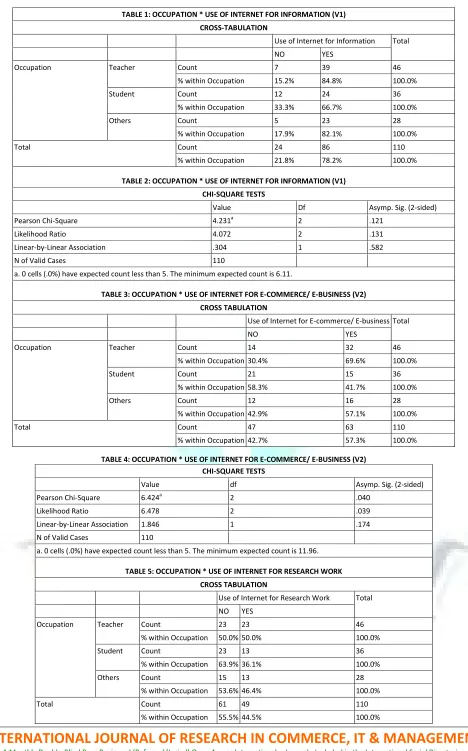
TABLE 1: OCCUPATION * USE OF INTERNET FOR INFORMATION (V1) CROSS-TABULATION
Use of Internet for Information Total
NO YES
Occupation Teacher Count 7 39 46
% within Occupation 15.2% 84.8% 100.0%
Student Count 12 24 36
% within Occupation 33.3% 66.7% 100.0%
Others Count 5 23 28
% within Occupation 17.9% 82.1% 100.0%
Total Count 24 86 110
% within Occupation 21.8% 78.2% 100.0%
TABLE 2: OCCUPATION * USE OF INTERNET FOR INFORMATION (V1) CHI-SQUARE TESTS
Value Df Asymp. Sig. (2-sided)
Pearson Chi-Square 4.231a
2 .121
Likelihood Ratio 4.072 2 .131
Linear-by-Linear Association .304 1 .582
N of Valid Cases 110
a. 0 cells (.0%) have expected count less than 5. The minimum expected count is 6.11.
TABLE 3:OCCUPATION * USE OF INTERNET FOR E-COMMERCE/ E-BUSINESS (V2) CROSS TABULATION
Use of Internet for E-commerce/ E-business Total
NO YES
Occupation Teacher Count 14 32 46
% within Occupation 30.4% 69.6% 100.0%
Student Count 21 15 36
% within Occupation 58.3% 41.7% 100.0%
Others Count 12 16 28
% within Occupation 42.9% 57.1% 100.0%
Total Count 47 63 110
% within Occupation 42.7% 57.3% 100.0%
TABLE 4: OCCUPATION * USE OF INTERNET FOR E-COMMERCE/ E-BUSINESS (V2) CHI-SQUARE TESTS
Value df Asymp. Sig. (2-sided)
Pearson Chi-Square 6.424a 2 .040
Likelihood Ratio 6.478 2 .039
Linear-by-Linear Association 1.846 1 .174
N of Valid Cases 110
a. 0 cells (.0%) have expected count less than 5. The minimum expected count is 11.96.
TABLE 5:OCCUPATION * USE OF INTERNET FOR RESEARCH WORK CROSS TABULATION
Use of Internet for Research Work Total NO YES
Occupation Teacher Count 23 23 46
% within Occupation 50.0% 50.0% 100.0%
Student Count 23 13 36
% within Occupation 63.9% 36.1% 100.0%
Others Count 15 13 28
% within Occupation 53.6% 46.4% 100.0%
Total Count 61 49 110
VOLUME NO.3(2013),ISSUE NO.06(JUNE) ISSN 2231-5756
INTERNATIONAL JOURNAL OF RESEARCH IN COMMERCE, IT & MANAGEMENT
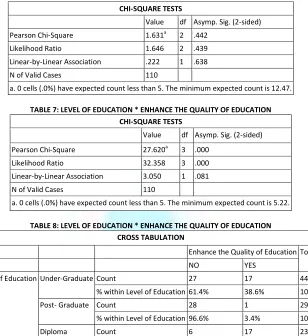
TABLE 6: OCCUPATION * USE OF INTERNET FOR RESEARCH WORKCHI-SQUARE TESTS
Value df Asymp. Sig. (2-sided) Pearson Chi-Square 1.631a
2 .442 Likelihood Ratio 1.646 2 .439 Linear-by-Linear Association .222 1 .638
N of Valid Cases 110
a. 0 cells (.0%) have expected count less than 5. The minimum expected count is 12.47.
TABLE 7: LEVEL OF EDUCATION * ENHANCE THE QUALITY OF EDUCATION CHI-SQUARE TESTS
Value df Asymp. Sig. (2-sided)
Pearson Chi-Square 27.620a 3 .000 Likelihood Ratio 32.358 3 .000 Linear-by-Linear Association 3.050 1 .081
N of Valid Cases 110
a. 0 cells (.0%) have expected count less than 5. The minimum expected count is 5.22.
TABLE 8: LEVEL OF EDUCATION * ENHANCE THE QUALITY OF EDUCATION CROSS TABULATION
Enhance the Quality of Education Total
NO YES
Level of Education Under-Graduate Count 27 17 44 % within Level of Education 61.4% 38.6% 100.0%
Post- Graduate Count 28 1 29
% within Level of Education 96.6% 3.4% 100.0%
Diploma Count 6 17 23
% within Level of Education 26.1% 73.9% 100.0%
PG - Diploma Count 8 6 14
% within Level of Education 57.1% 42.9% 100.0%
Total Count 69 41 110
% within Level of Education 62.7% 37.3% 100.0%
TABLE 9:LEVEL OF EDUCATION * DEVELOPMENT OF E-LEARNING DUE TO ITS ACCESSIBILITY CROSS TABULATION
Development of E-Learning due to its accessibility Total
NO YES
Level of Education Under-Graduate Count 2 42 44
% within Level of Education 4.5% 95.5% 100.0%
Post- Graduate Count 0 29 29
% within Level of Education .0% 100.0% 100.0%
Diploma Count 0 23 23
% within Level of Education .0% 100.0% 100.0%
PG - Diploma Count 1 13 14
% within Level of Education 7.1% 92.9% 100.0%
Total Count 3 107 110
% within Level of Education 2.7% 97.3% 100.0%
TABLE 10: LEVEL OF EDUCATION * DEVELOPMENT OF E-LEARNING DUE TO ITS ACCESSIBILITY CHI-SQUARE TESTS
Value df Asymp. Sig. (2-sided) Pearson Chi-Square 8.135a 3 .043
Likelihood Ratio 7.431 3 .059 Linear-by-Linear Association 2.243 1 .134
N of Valid Cases 110
INTERNATIONAL JOURNAL OF RESEARCH IN COMMERCE, IT & MANAGEMENT
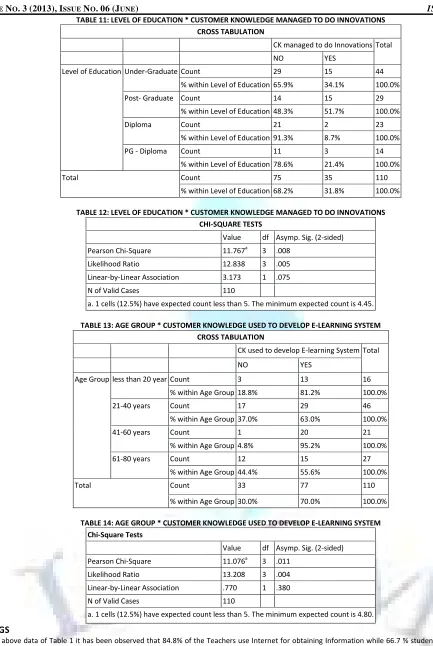
TABLE 11: LEVEL OF EDUCATION * CUSTOMER KNOWLEDGE MANAGED TO DO INNOVATIONSCROSS TABULATION
CK managed to do Innovations Total
NO YES
Level of Education Under-Graduate Count 29 15 44 % within Level of Education 65.9% 34.1% 100.0%
Post- Graduate Count 14 15 29
% within Level of Education 48.3% 51.7% 100.0%
Diploma Count 21 2 23
% within Level of Education 91.3% 8.7% 100.0%
PG - Diploma Count 11 3 14
% within Level of Education 78.6% 21.4% 100.0%
Total Count 75 35 110
% within Level of Education 68.2% 31.8% 100.0%
TABLE 12: LEVEL OF EDUCATION * CUSTOMER KNOWLEDGE MANAGED TO DO INNOVATIONS CHI-SQUARE TESTS
Value df Asymp. Sig. (2-sided) Pearson Chi-Square 11.767a 3 .008
Likelihood Ratio 12.838 3 .005 Linear-by-Linear Association 3.173 1 .075
N of Valid Cases 110
a. 1 cells (12.5%) have expected count less than 5. The minimum expected count is 4.45.
TABLE 13: AGE GROUP * CUSTOMER KNOWLEDGE USED TO DEVELOP E-LEARNING SYSTEM CROSS TABULATION
CK used to develop E-learning System Total
NO YES
Age Group less than 20 year Count 3 13 16 % within Age Group 18.8% 81.2% 100.0%
21-40 years Count 17 29 46
% within Age Group 37.0% 63.0% 100.0%
41-60 years Count 1 20 21
% within Age Group 4.8% 95.2% 100.0%
61-80 years Count 12 15 27
% within Age Group 44.4% 55.6% 100.0%
Total Count 33 77 110
% within Age Group 30.0% 70.0% 100.0%
TABLE 14: AGE GROUP * CUSTOMER KNOWLEDGE USED TO DEVELOP E-LEARNING SYSTEM Chi-Square Tests
Value df Asymp. Sig. (2-sided) Pearson Chi-Square 11.076a 3 .011
Likelihood Ratio 13.208 3 .004 Linear-by-Linear Association .770 1 .380
N of Valid Cases 110
a. 1 cells (12.5%) have expected count less than 5. The minimum expected count is 4.80.
FINDINGS
From the above data of Table 1 it has been observed that 84.8% of the Teachers use Internet for obtaining Information while 66.7 % students get information from the Internet. Not only Teachers or Students but other people (82.1%) also prefer to use Internet to obtain Information. This shows that there is an inclination of mass is towards the use of electronic modes for obtaining Information.
From the Chi-square test (Table 2) it has been found that the two-sided asymptotic significance value of Pearson chi-square is greater than 0.10 which shows that there is no significant relationship with the occupation of respondent with the use of Internet for obtaining Information.
From the above data of Table 3 it has been observed that 69.6% of the Teachers and 41.7 % students use Internet for doing E - Commerce / E – Business transactions while 57.1% of other respondents perform E-Commerce / E – Business from the Internet. Still a big mass of total 42.7 % of the respondents doesn’t use Internet for E – Commerce / E – Business or we can say they don’t prefer to perform E – Commerce transactions. This reflects that still Indian community hesitates to perform business transactions electronically whether it to purchase goods or to go for e-learning.
VOLUME NO.3(2013),ISSUE NO.06(JUNE) ISSN 2231-5756
INTERNATIONAL JOURNAL OF RESEARCH IN COMMERCE, IT & MANAGEMENT
From the above data of Table 5 it has been observed that 50% of the Teachers use Internet for their research work while only 36.1 % students use Internet to perform their Research work. Other people (46.4%) also prefer to use Internet to perform various research works. This lacking behavior for using Internet for the purpose of research work may be because of lacking research interest in the students and Teachers or due to some other reasons.
From the Chi-square test (Table 6) it has been found that the two-sided asymptotic significance value of Pearson chi-square is less than 0.10 which shows that there is significant relationship with the occupation of respondent with the use of Internet for their Research work.
From the above data of Table 8 it has been observed that 61.4% of the respondents dealing with Under-Graduate courses, 96.6% of the respondents dealing with Post-Graduate courses, and 57.1% respondents dealing with Post-Graduate Diploma courses have a doubt on enhancing the quality of education through e-learning while 73.3 % respondents dealing with Diploma courses believe that thru E-e-learning we can enhance the quality of education as we will be exposed to the International quality of teaching methodology and when it is a mixture of the customer’s ideas who is the ultimate end-user will definitely enhance the quality of education.
From the Chi-square test (Table 7) it has been found that the two-sided asymptotic significance value of Pearson chi-square is less than 0.10 which shows that there is a significant relationship with the Level of Education of which the respondent is dealing and the enhancement of quality of education thru involvement of Customers in E-learning.
In table-9, 97.3% of the total respondents dealing with various educational levels strongly believe that E-learning can be developed by utilizing the customer’s knowledge and it’s only because of its flexible accessibility. 100% of the respondents dealing with the Post-graduate and diploma courses, 95.5% from Under-graduate courses and 92.9% of Post-Under-graduate diploma courses are in agreement of this view while 4.5% of the respondents dealing with Under-Under-graduate courses & 7.1% dealing with Post-graduate diploma courses still believe that not only its flexible accessibility there is something more to be required to develop the e-learning thru its customer knowledge.
From the Chi-square test (Table 10) it has been found that the two-sided asymptotic significance value of Pearson chi-square is less than 0.10 which shows that there is a significant relationship with the Level of Education of which the respondent is dealing and the development of E-learning thru its customer’s knowledge due to its flexible accessibility.
68.2% of the total respondents in (table 11) dealing with various level of education don’t believe that if customer knowledge is properly managed in e-learning environment it can results in Innovations while 34.1%, 51.7% 8.7% and 31.8% of respondents dealing with undergraduate courses, Post-graduate courses, Diploma courses and Post-graduate diploma courses respectively believe that if the customer knowledge can be managed properly, it can create wonders. From the Chi-square test (Table 12) it has been found that the two-sided asymptotic significance value of Pearson chi-square is less than 0.10 which shows that there is a significant relationship with the Level of Education of which the respondent is dealing and the management of customer’s knowledge for E-learning to result in innovations.
In table 13, 70.0% of the respondents of various age group are in agreement that Customer Knowledge of the students of E-learning environment can be used to develop E-learning system effectively which are as 81.2% of the respondents from the age-group of less than 20 years, 63.0% of the respondents from the age group of 21-40 years, 95.2% of the respondents from the age-group of 41-60years and 55.6% of the respondents from the age-group of 61-80 years believe that if the customers knowledge of the students is used, an effective E-learning system can be developed.
From the Chi-square test (Table 14) it has been found that the two-sided asymptotic significance value of Pearson chi-square is less than 0.10 which shows that there is significant relationship with the age group of population with the development of E-learning system by using its own customer knowledge/ creativity and ideas.
CONCLUSION
At first glance, the results of this study may cause some readers to question the value of incorporating online learning units into a traditional course. The ultimate question for educational research is how to use this Customer’s Knowledge (A combination of understanding, significance, and situation information) tool to maximize learning opportunities in e-learning process. The result of this research shows that that irrespective of the occupation of the customer people are using internet (an electronic mode) for obtaining their information but simultaneously on other hand still they are hesitating to go for commerce or e-business transactions may be because of reliability and trust. Though retrieving information from Internet is too responsive and fast but it is very difficult to rely on it as it is a mess of right and wrong information but still it is found from this research that there is an inclination of mass towards the use of electronic modes for obtaining Information. From this research it has been observed that still people in India are doing less work on Internet for their research purpose while for such type of task Internet is a better platform and in future if we have to develop the e-learning, we have to motivate them to become more Internet savvy as the more they will do their research work on Internet, e-learning organizations will be able to gather more and more views to develop this aspect. For developing the e-learning models the industry have to make their products which suits to their customers according to their understanding, mode of learning, grasping power, requirement and utility. So until and unless they will not provide a platform to their customers for customization of their course content and its presentation, learning pattern, resolving queries, assessment criteria etc they will not be able to provide a product for all of their customers which can be from diversified in nature due to globalization.
The biggest advantage of e-learning is its flexibility and accessibility which makes their customers to learn as per their convenience of time and place and definitely if they were in full blow they can generate better ideas for its development. Now the matter is for the industry that how it manages and utilizes their customers knowledge for the development of new products for the industry and not only this they should develop such type of programs in which the interest of their customer can be developed, to compel them to become more active and participative to generate new ideas by using their creativity. There is no scope of doubt if most of their customers will develop their creativity and share their ideas, the quality enhancement will ultimately take place. As the use of student’s (customer) knowledge which resides within them and their ability for innovation and improvements that helps in the development of this e-learning industry which will enhance the quality of education and develop effective e-learning system. Further research will likely yield additional insight to educators and trainers about where, when, and how to apply this CKM tool to develop e-learning.
REFERENCES
1. Adler, R. W., Milne, M. J. & Stablein, R.. (2001). Situated motivation: An empirical test in an accounting class. Canadian Journal of Administrative Sciences, 18(2), 101-116.
2. Ancona, D. G., & Caldwell, D. F. (1992). Demography and design predictors of new product team performance.
3. Beller, M. & Or, E. (1998). The crossroads between lifelong learning and information technology: A challenge facing leading universities. Journal of Computer-Mediated Communication (online journal), 4(2) (December). Retrieved 16 May 2006 from http://jcmc.indiana.edu/vol4/issue2/beller.html 4. Benbunan-Fich, R. & Starr, R. H. (2003). Mediators of the effectiveness of online courses. IEEE Transactions on Professional Communication, 46(4), 296-312. 5. Benek-Rivera, J., & Matthews, V.E. (2004). Active learning with jeopardy: Students ask the questions. Journal of Management Education, 28, 104-118
Knowing, Learning, and Instruction (p. 361-392). Hillsdale, NJ: Erlbaum. 6. Beri G.C - Marketing Research (Tata Mc Graw Hill, 4th
Edition).
7. Bose, R. and Sugumaran, V. (2003) Application of Knowledge Management Technology in Customer Relationship Management, Knowledge and Process Management, 10, 1, 3-17.
8. Bradshaw, D. and Brash, C. (2001) Management customer relationships in the e-business world: how to personalise computer relationships for increased profitability, International Journal of Retail & Distribution Management, 29, 12, 520-530.
9. Bransford, J. D., Brown, A. L., & Cocking, R. R. (Eds.). (2000). How people learn: Brain, mind experience, and school committee on developments in the science of learning. Commission on Behavioral and Social Sciences and Education of the National Research Council, National Academy Press.
INTERNATIONAL JOURNAL OF RESEARCH IN COMMERCE, IT & MANAGEMENT
11. Brown, K. M. (1996). The role of internal and external factors in the discontinuation of off-campus students. Distance Education, 17(1), 44-71.
12. Bueren, A., Schierholz, R., Kolbe, L. and Brenner, W. (2005) Improving Performance of Customer Processes with Knowledge Management, Business Process Management Journal.
13. Burke, L. A. & Moore, J. E. (2003). A perennial dilemma in OB education: Engaging the traditional student. Academy of Management Learning & Education, 2(1), 37-53.
14. Chesbrough, H. W. (2003) Open innovation : the new imperative for creating and profiting from technology, Harvard Business School Press, Boston, Mass. 15. Cole, M. S., Field, H. S. & Harris, S. G. (2004). Student learning motivation and psychological hardiness: Interactive effects on students’ reactions to a
management class. Academy of Management Learning &Education, 3(1), 64-85. 16. Cooper and Schindler - Business Research Methods (Tata Mc Graw Hill, 9th Edition).
17. Croteau, A.-M. And Li, P. (2003) Critical Success Factors of CRM Technological Initiatives, Canadian Journal of Administrative Sciences, 20, 1, 21-34. 18. Davenport, T. H. and Glaser, J. (2002) Just-in-Time Delivery Comes to Knowledge Management, Harvard Business Review.
19. Davenport, T. H. and Klahr, P. (1998) Managing Customer Support Knowledge, California Management Review, 40, 3, 195-208.
20. Davenport, T. H., Harris, J. G. and Kohli, A. K. (2001) How Do They Know Their Customers So Well?, MIT Sloan Management Review, 42, 2, 63-73. 21. Davis, J. (2000). Traditional vs. online learning: It’s not an either/or proposition. Employment Relations Today, 27(1), 47-60.
22. Day, G. S. (2000) Capabilities for Forging Customer Relationships, Marketing Science Institute, Cambridge, MA. 23. Driscoll, M. & Carliner, S. (2005). Advanced web-based training strategies. San Francisco: Pfeiffer.
24. Driscoll, M. (2002). How people learn (and what technology might have to do with it). ERIC Clearinghouse on Information and Technology Syracuse, NY. Retrieved 5 January 2006 from http://www.ericdigests.org/2003-3/learn.htm
25. Duffy, T. M., & Cunningham, D. J. (1996). Constructivism: Implications for the design and delivery of instruction. In D. H. Jonassen (Ed.), Handbook of research for educational communications and technology.
26. Eisenhardt, K. M. (1989) Building Theories from Case Study Research, Academy of Management Review, 14, 4, 532- 550.
27. E-learning replaces classroom. (2003). Health Management Technology, 24(4), 50-51.Frankola, K. (2001). Why online learners drop out. Workforce, 10, 52-60.
28. Eppler, M., Seifried, P. and Röpnack, A. (1999) Improving Knowledge Intensive Processes through an Enterprise Knowledge Medium, New Orleans, 222-230. 29. Fahey, L. (2001) Linking E-business and operating processes: the role of knowledge management, IBM Systems Journal, 40, 4, 889-907.
30. Ferstl, O. K. and Sinz, E. J. (1998) SOM: Modeling of Business Systems, In: Handbook on Architectures of Information Systems (Eds., Bernus, P., Mertins, K. and Schmidt, G.), Springer, Berlin etc., pp. 339-358.
31. Garcia-Murillo, M. and Annabi, H. (2002) Customer Knowledge Management, Journal of the Operational Research Society, 53, 875-884.
32. Gebert, H., Geib, M., Kolbe, L. and Riempp, G. (2002) Towards Customer Knowledge Management, Proceedings of the 2nd International Conference on Electronic Business (ICEB 2002), Taipei, Taiwan.
33. Gebert, H., Geib, M., Kolbe, L. M. and Brenner, W. (2003) Knowledge-enabled Customer Relationship Management, Journal of Knowledge Management, 7, 5, 107-123.
34. Geib, M. and Riempp, G. (2002) Customer Knowledge Management, In: Geschäftsprozessorientiertes Wissensmanagement - Effektive Wissensnutzung bei der Planung und Umsetzung von Geschäftsprozessen (Eds., Abecker, A., Hinkelmann, K., Maus, H. and Müller, H. J.), Springer, Berlin et al., pp. 393-417. 35. Geib, M., Kolbe, L. M. and Brenner, W. (2004) Collaborative Customer Management in Financial Services Alliances, Proceedings of the Tenth Americas
Conference on Information Systems (AMCIS 2004), New York City, NY, 3805-3817.
36. Geib, M., Reichold, A., Kolbe, L. M. and Brenner, W. (2005) Architecture for Customer Relationship Management Approaches in Financial Services, 38th Hawaii International Conference on System Sciences 2005 (HICSS-38), Big Island, Hawaii.
37. Gibbert, M., Leibold, M. and Probst, G. (2002) Five Styles of Customer Knowledge Management, and How Smart Companies Use Them To Create Value, European Management Journal, 20, 5, 459 - 469.
38. Ives, B. and Learmonth, G. P. (1984) The Information System as a Competitive Weapon, Communications of the ACM, 27, 12, 1193-1201. 39. Kothari C R – Research Methodology Methods & Techniques (New Age International Publishers, 2nd
Edition, 2004).
40. Kristensson, P., Gustafsson, A. and Archer, T. (2004) Harnessing the Creative Potential among Users, The Journal of Product Innovation Management, 4-14. 41. Massey, A. P., Montoya-Weiss, M. M. and Holcom, K. (2001) Re-engineering the Customer Relationship: Leveraging Knowledge Assets at IBM, Decision
Support Systems, 32, 2, 155-170.
42. New York: Macmillan. Eble, K. (1994). Craft of teaching: A guide to mastering the professor's art (2nd edition), New York: Jossey-Bass. 43. Österle, H. (1995) Business in the Information Age: Heading for new Processes, Springer, Berlin et al.
44. Tapan Kumar Roy & Christos Stavropoulos. (2007) Customer Knowledge Management in the E-Business Environment,Lulea University of Technology. 45. Taylor, S. A. and Baker, T. L. (1994) An assessment of the relationship between service quality and customer satisfaction in the formation of consumers'
purchase intentions, Journal of Retailing, 70, 2, 163-178.
VOLUME NO.3(2013),ISSUE NO.06(JUNE) ISSN 2231-5756
INTERNATIONAL JOURNAL OF RESEARCH IN COMMERCE, IT & MANAGEMENT
REQUEST FOR FEEDBACK
Dear Readers
At the very outset, International Journal of Research in Commerce, IT and Management (IJRCM)
acknowledges & appreciates your efforts in showing interest in our present issue under your kind perusal.
I would like to request you to supply your critical comments and suggestions about the material published
in this issue as well as on the journal as a whole, on our E-mail i.e.
for further
improvements in the interest of research.
If you have any queries please feel free to contact us on our E-mail
.
I am sure that your feedback and deliberations would make future issues better – a result of our joint
effort.
Looking forward an appropriate consideration.
With sincere regards
Thanking you profoundly
Academically yours
Sd/-