Please cite this article as: A. M. Khoshnood, H. Khaksari, J. Roshanian, S. M. Hasani, Active Noise Cancellation using Online Wavelet Based Control System: Numerical and Experimental Study, International Journal of Engineering (IJE), TRANSACTIONS A: Basics Vol. 30, No. 1, (January 2017) 120-126
International Journal of Engineering
J o u r n a l H o m e p a g e : w w w . i j e . i rActive Noise Cancellation using Online Wavelet Based Control System: Numerical
and Experimental Study
A. M. Khoshnood*, H. Khaksari, J. Roshanian, S. M. Hasani
Aerospace Department, K. N. Toosi University of Technology, Tehran, Iran
P A P E R I N F O
Paper history:
Received 08 November 2015
Received in revised form 16 September 2016 Accepted 05 January 2017
Keywords:
Reaction Wheel Wavelet De-noising System Identification Prediction
Hardware in the Loop
A B S T R A C T
Reaction wheels (RWs) used for attitude control of space vehicle systems usually encounter with undesired wide band noises. These noises which significantly affect the performance of regulator controller must tune the review or review rate of RWs. According to wide frequency band of noises in RWs the common approaches of noise cancellation cannot conveniently reduce the effects of the noise. Therefore, the advanced analyzer of frequency domain signal processing such as wavelets must be used to realize the noise cancellation. In this regards, only the online application of wavelets can be practical. In this paper, an online active noise canceller based on online wavelet theory is employed to omit the effects of undesired noise. In this way, dynamic identification of a RW as well as wavelet delay compensation are used simultaneously to design an active noise cancellation system. Numerical and experimental investigations of KNTU test setup as a hard ware in the loop system show the preferences of the proposed method of online noise cancellation.
doi: 10.5829/idosi.ije.2017.30.01a.15
1. INTRODUCTION1
Attitude control of spacecraft generally requires an external force or torque, often provided by thrusters and Reaction Wheels (RWs). RWs can counteract zero-mean torques on the spacecraft without the consumption of precious fuel and can store momentum induced by very low frequency or DC torques [1]. These actuators are often employed as an attitude controller in large angle slewing maneuvers [2]. Other applications of RWs include vibration compensation and orientation control of solar arrays [3]. A typical RW consists of a rotating fly wheel suspended on ball bearings covered in housing and driven by an internal brushless DC motor. During the manufacturing process, RWs are balanced to minimize the vibrations that occur during operation. However, it has been found that the vibration forces and torques emitted by a RW can degrade the performance of precision instruments in space [4]. A RW mode control is provided by accelerating and decelerating
1*Corresponding Author’s Email: [email protected] (A. M.
Khoshnood)
wavelet theory for RWs [6]. The major drawback of employing standard wavelet de-noising is an inevitable delay arising from the signal processing which can considerably degrade the performance and stability of RW feedback controller. In this way, a few publications are available that address the issue of decreasing delay in the signal processing to obtain acceptable de-noising level. From these works, Chaplais et al. [5] developed a wavelet transform method that operates only on past data to minimize any delay arising from standard wavelet processing. The de-noising level decreased in the previous researches are less than the de-noising level required to provide acceptable feedback control loop performance.
In this study, an improved technique of online wavelet de-noising based on identification of the RW dynamic is presented. The proposed approach simultaneously employs the estimator filter and the wavelet theory with the Smith predictor to decrease the noisy signal level. With the online application of the wavelet theory, the online estimation of the RW dynamic leads to compensation of the delay of the wavelet based on the signal processing. In this regards, the delay compensation is implemented using the Smith predictor approach in which the Smith model is simultaneously estimated. The preliminary control system of the RW with the wavelet de-nosing block and the delay compensation system are a package for the RW review control without noise. It is noticeable that the preliminary control system can be a Proportional-Integrated-Derivative (PID) controller. One can state that the PID controller with the wavelet block significantly performs as a new control system which operates in multi rate sampling. This control system can be named a wavelet based PID control system.
An experimental setup of the RW system and a numerical simulation are carried out to assess the performance of the proposed method. Numerical and experimental simulation results demonstrate superior de-noising performance in comparison to the other methods in the presence of the de-noising delay.
The presented work can be used in integrated systems such as INS/GPS navigation. Also, the new method can be applicable in de-noising processes in which all noises including white and colored noises can be omitted. Overall, with application of wavelet in a closed loop control system all advantages of wavelet analyzers are employed for the closed loop control systems.
This paper is organized as follows: section 2 presents the dynamic modeling of the RW. Wavelet theory and filter banks are given in section 3. The strategy of active noise cancellation is presented in section 4. Results and discussion of the paper are described in section 5. In this section the brief explanation of the experimental set up is given. In section 6 the conclusion of the paper is set out.
2. REACTION WHEEL DYNAMIC DESCRIPTION
The RW consists of a flywheel and a motor. The motors power the flywheel and must provide the necessary torque to balance the moments that are produced by the electromagnets. The spinning wheel stores the system angular momentum, balances the system and guides it to the steady-state rotation through the spin-up [7]. The spinning wheel is supposed to provide the required inertial momentum (Iw) and the electrical motor
supports the required angular velocity (Ωw) and angular
acceleration.
The conventional RW model is derived based on modeling of DC torque motor. DC torque motor directly provides rotary motion and coupled with wheels or drums and cables and can provide translational motion. In general, the torque generated by a DC motor is proportional to the armature current and the strength of the magnetic field. The motor torque is as:
i kt =
τ (1)
The back electromotive force (EMF) ( )e is proportional
to the angular velocity θ
dt
d of the shaft with a constant
factor:
dt d k
e e
θ
= (2)
In SI units, one can set
t
e k
k = . Therefore, k is used to represent both the motor torque constant and the back EMF constant. Overall, the following governing equations based on Newton's 2nd law and Kirchhoff's voltage laws are derived as follows:
t
e
k T dt d b dt d J
V dt d k Ri dt di L V e Ri dt di L
= = θ + θ
= θ + +
→
= + +
2
2 (3)
where J is the inertial momentum of the RW and b is the friction stickiness. Applying the Laplace transform, the above modeling equations can be expressed in terms of the Laplace variable s as:
e t t
k k ) b Js )( R Ls (
k )
s ( V
) s ( w
+ + +
= (4)
and for the RW considered in this work the transfer function is given as:
4 20 + 12 +
40
=s2 s .
) s ( V
) s ( w
(5)
The specifications of the RW are listed in Table 1.
3. WAVELET THEORY AND FILER BANKS
TABLE 1. Specifications of the RW Value Parameters 1 R 0.5 L 0.01 Ke 0.2 Kt 0.01 J
In this approach, the signal under analysis is passed through a pair of low-pass and high-pass filters, and is then down sampled, yielding the approximations and the details [8]. The dawn sampling reduces the time of decomposition. The approximations are again through the same pair of low-pass and high-pass filters on the next level, which produce another set of approximations and details.
This process is repeated until the desired decomposition level is completed. These filters are called quadrature mirror filters (QMF). The QMF enables signals to be decomposed without any loss of original information and allows inverse discrete wavelet transform to perfectly reconstruct the original signal. One disadvantage with the WT is the poor frequency resolution at high frequencies.
One of the recent practical applications of the WT is employing this analyzer tool for de-noising. Although, many activities have been proposed based on wavelet de-noising in the industrial applications and academic researches [9], the online de-noising is a new and recent idea which is very much practical and useful. This method of wavelet application leads to employment of the wavelet and related filter banks simultaneously in closed loop control systems [10]. In the previous works, the wavelet tools have been considerably used in offline loop in which the analyses of the system responses must be done after the system operations [11].
The online wavelet de-nosing method is
significantly useful for online vibration and noise control and the other similar fields. In addition, new control systems can be proposed by combining the online wavelet applications and the control algorithms.
Wavelet based de-noising method depends on the proper selection of mother wavelet which matches the shape of the signals to be extracted from the noise. This will result in large wavelet coefficients at few levels which are associated with signals of interest; whereas noise is more widely spread among the levels which results in small wavelet coefficients. De-noising can be performed by reconstructing the signals after eliminating the coefficients associated with noise, while collecting those associated with the signal. Therefore, the proper selection of a mother wavelet is required for pulse de-noising.
4. CONTROL SYSTEM DESIGN USING ONLINE WAVELET
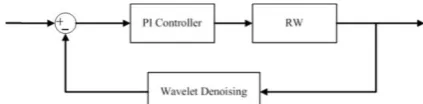
Control system design for the RW is based on wavelet filter bank as a result of undesired noise. The noise applied on the RW can degrade the common controller. Therefore, the online wavelet for de-noising must combine with the control system. In this situation, the review control system as well as the de-noising block constructs a new control system called wavelet based controller. The overall block diagram of the new control system is shown in Figure 1.
Online employment of the wavelet filter bank in the closed loop control system have problem of delay. Hence, the delay prediction methods have been proposed for resolving the mentioned challenge. Form the practical prediction methods, the Smith predictor can be used for the online wavelet in the closed loop controller. But in this approach, it is required to have a model of the system.
In this study as a practical idea the model of the system is made using online estimation. In this regard, the common control system with the wavelet filter bank and the mode estimated Smith predictor generally lead to a new controller with active noise cancellation.
4. 1. RW Parameters Estimation In order to
compensate any delay arisen from wavelet processing, it is required to estimate the dynamic model of RW (RW transfer function). For this purpose, the parametrical transfer function of the RW model is defined as follows:
(13)
where A0, A1, …An are model parameters of the
nominator and B0, B1, …Bn are model parameters of the
denominator. The transfer function (11) can be then written in discrete form as:
) A ... q A q )( t ( U ) B ... q B )( t ( Y n n n m m + + + = + + 1 ¬ 1 1 ¬ 1 (14)
where q is the forward shift operator.
Equation (14) can be written as a differential equation:
) n t ( u B ... ) n m t ( u B ) n t ( y A ... ) t ( y A ) t ( y m n ¬ + + 1 ¬ ¬ + + ¬ ¬ ¬ 1 ¬ ¬ = 1 1 (15)
Assume that the sequence of inputs {u(l),u(2), ...,u(t)} has been applied to the system and the corresponding sequence of outputs {y(l),y(2),... ,y(t)} has been observed.
Introduce the parameter vector:
(16)
and the regression vector:
(17)
Notice that the output signal appears delayed in the regression vector. This model is called an autoregressive model. The way in which the elements are ordered in matrix θ is arbitrary provided that <p (t—1) is similarly
reordered. Later, when dealing with adaptive control, it will be natural to reorder the terms. The convention that the time index of the φ vector is the time when all elements in the vector are available is also assumed. The model can formally be written as a regression model:
(18)
Parameter estimation can be done by applying the Recursive Least Square (RLS). Recursive identification algorithms update the parameters recursively. The equation that describes the RLS method is as follows:
(19)
where λ(t), k(t), P(t) are called the forgetting factors and correct the gain and covariance matrix [12]. The transfer function of the RW in discrete form is acquired by employing RLS identification techniques as follows:
𝐻(𝑧) =1.992 × 10
−5𝑧 + 1.984 × 10⁻⁵
𝑧2− 1.988. 𝑧 + 0.9881
4. 2. Wavelet Performance in the Closed Loop Control System The wavelet like the Fourier transform employs inner product of the input function to extract the output of the transform as:
𝑤𝑓(𝑎, 𝑏) =< 𝑓(𝑡), 𝜓 ( 𝑡−𝑏
𝑎) ≥ ∫ 𝑓(𝑡)
1 √|𝑎| +∞
−∞ 𝜓∗(
𝑡−𝑧
𝑠 ) 𝑑𝑡 (20)
where
𝜓
is the mother wavelet function and a and b are transformation parameters that can be represented as follows [13-15]:𝑎 = 2−𝑗, 𝑏 = 2−𝑗. 𝑘 ∀𝑗, 𝑘 ∈ 𝑧 (21)
Therefore,
𝑑𝑗,𝑘=< 𝑓(𝑡), 𝜓𝑗,𝑘(𝑡) >= ∫ 𝑓(𝑡). 2
𝑗
2𝜓∗(2𝑗− 𝑘)𝑑𝑡 (22)
In this study, two high and low pass filter are employed to construct a set of quadrature mirror filter bank including (low-pass filter) and (high-pass filter) as follows:
𝑌ℎ𝑖𝑔ℎ[𝑘] = ∑ 𝑥[𝑛]𝑔(2𝑘 − 𝑛)𝑛 (23)
𝑌𝑙𝑜𝑤[𝑘] = ∑ 𝑥[𝑛]ℎ(2𝑘 − 𝑛)𝑛 (24)
In this work, the filter used for filter banks are a tree level Finite Impulsive Response (FIR) and extracted from Daubechies 2 based wavelet. This wavelet was introduced by Daubechies in 1992. The family of the
Daubechies wavelets is orthogonal, however,
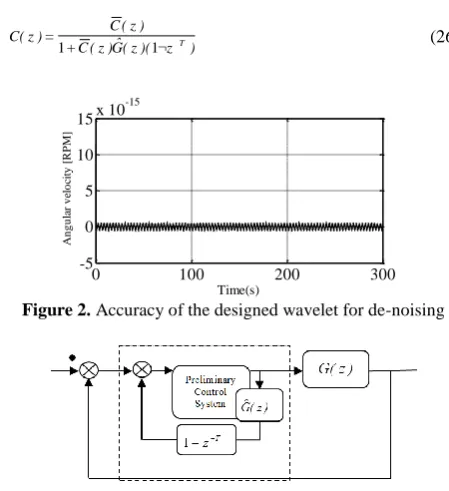
asymmetric, which introduces a large phase distortion. The error of the designed wavelet is shown in Figure 2.
In several works in which wavelet transform is used, the de-noising is implemented in the open-loop structure. For attitude control of the RW with de-noising the wavelet filter bank must be directly inserted in the closed loop control system as illustrated in Figure 1. The delay generated from wavelet performance can degrade the stability and the performance of the closed-loop control system. Therefore, this challenge must be resolved using prediction methods.
4. 3. Delay Compensation The simple form of
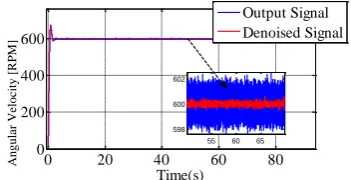
SP method was first used for chemical processes. The framework of the SP method is illustrated in Figure 3.
In this figure, the main system where G (z) has an inherent delay and SP is employed to omit or decrease the delay in the closed loop control system. If the preliminary controller is C(z) and the new control
system is C (z), the transfer function of the closed loop is defined as:
) z )( z ( Gˆ ) z ( C ) z ( C ) z ( C T ¬ 1 + 1 = (26)
Figure 2. Accuracy of the designed wavelet for de-noising
Figure 3. Comparison of control deflection of fault at t = 60 s
m n B B A A 1 1 )], ( .... ) 1 ( ) ( .... ) 1 ( [ ) 1
(t yt yt n ut m n ut n
T
( 1) )(t t
y T
) ( ) ( ) ( ) ( ) ( ) ( ) ( ) ( ) ( ) ( ) ( ˆ ) ( ) ( ˆ ) ( ) ( ˆ ) ( ˆ 1 1 1 1 1 1 t P t t k I t P t t P t I t t P t k t t t y t k t t T T T0 100 200 300
-5 0 5 10 15x 10
where Gˆ(z) is the model of the main system without
delay.
The main drawbacks of the SP are the accuracy of the value of the system delay (T) and the delay-less model of the system (Gˆ(z)). If these two parameters are accurately realized, the performance of SP is guaranteed and the delay is compensated. The delay in the DCT filter bank is deterministic; therefore, the main difficulty in SP design procedure is to introduce a delay-less model of the system. The focus of this study is to define an adjustable model reference for replacing Gˆ(z) in
Figure 3.
5. NUMERICAL AND EXPERIMENTAL RESULTS
5. 1. Numerical simulation The dynamic model
description in section 2 and the control system presented in the last part are numerically simulated. The
simulation was done in MATLAB/SIMULINK
environment. The result of simulation show the preference and convenient performance of the online wavelet based controller. It is noticeable that the overall control system consists of three parts: A Proportional Integral (PI) controller primarily controls the review of the RW without disturbances. Secondly, a wavelet based filter bank for de-noising the disturbances and finally, a predictor for delay compensation. All of the three parts demonstrated in this section as well as the dynamic model of the RW are numerically modelled.
Figure 4 shows the step response of the system. In this figure, the performance of the response without de-noising part is shown. From this figure the effects of undesired noise on the RW are investigated.
The noise is modelled considering Gaussian distribution with standard deviation 0.01. In Figure 5, the performance of the RW with de-noising filter bank and without Smith predictor is shown.
5. 2. Experimental Results A Hardware-In-The
Loop (HIL) setup is constructed to assess the de-nosing control system designed for the RW.In this HIL stand called KNTU RW, the RW is mounted as a hardware part and the other parts of the system is modelled in the software as shown in Figure 6.
The output of the RW is the review of the wheel and the input of RW is the voltage made from the software. The overall system is worked in real time case. In Figure 7 the response of the RW with and without de-noising system is demonstrated.
This figure shows that the controller reduce the effect of the inherent noise of the RW. This noise reduction is realized in spite of the long time signal processing of the wavelet filter bank.
Figure 4. The performance of the closed loop response with and without de-noising sub-system
Figure 5. The performance of the RW with de-noising filter bank and without Smith predictor
Figure 6. Schematic of the HIL stand called NASIR RW
Figure 7. The response of the RW with and without de-noising system (In HIL system)
6. CONCLUSION
De-noising of signals in noise is one of the main issues in industrial devices. For systems with closed loop controllers the application of de-noising part must be implemented as online software. In this paper, using wavelet theory, a de-noising system is designed to reduce or omit the undesired noise in a RW.
0 20 40 60 80
0 200 400 600
Time(s)
A
ngul
a
r
V
e
loc
it
y
[R
P
M
]
55 60 65
598 600 602
Output Signal Denoised Signal
0 50 100 150 200
-5 0 5 10x 10
50
Time(s)
A
n
g
u
lar
V
el
o
ci
ty
[RPM]
0 20 40 60 80 100
0 200 400 600 800
Time(s)
A
n
g
u
lar
V
el
o
ci
ty
The online implementation of the wavelet filter bank encounters with some challenges. Unknown dynamic of the RW and the delay generated from the de-noising are two challenges which lead to decrease the performance of the de-noising.
In this work, using the simultaneous system identification of the RW and a predictor, the delay of the signal processing is significantly directed to the out of the loop. Hence, the wavelet based de-noising can be implemented in the closed loop controller.
In order to validate the proposed method for the RW de-noising an experimental setup is designed. The wavelet based filter bank with the delay compensation part is examined on the experimental RW and the numerical and experimental results are compared. The results show that both numerical and experimental responses ensure the capability of the proposed approach of RW de-noising.
7. REFERENCES
1. Bialke, B., "High fidelity mathematical modeling of reaction wheel performance", Guidance and Control, (1998), 483-496. 2. Masterson, R.A., Miller, D.W. and Grogan, R.L., "Development
and validation of reaction wheel disturbance models: Empirical model", Journal of Sound and Vibration, Vol. 249, No. 3, (2002), 575-598.
3. Laskin, R. and San Martin, M., "Control/structure system design of a spaceborne optical interferometer", in AAS/AIAA Astrodynamics Specialist Conference. (1989).
4. Hasha, M., "Reaction wheel mechanical noise variations", Space Telescope Program Engineering Memo SSS, Vol. 218, No., (1986), 175-183.
5. Chaplais, F., Tsiotras, P. and Jung, D., "On-line wavelet denoising with application to the control of a reaction wheel
system", in AIAA Guidance, Navigation, and Control Conference, AIAA Paper. (2004), 5335-5345.
6. Huang, B., Sun, P.J. and Wang, X.M., "The denoising method based on wavelet transform in signal dynamic detection", in Advanced Materials Research, Trans Tech Publ. Vol. 889, (2014), 766-769.
7. Kamesh, D., Pandiyan, R. and Ghosal, A., "Passive vibration isolation of reaction wheel disturbances using a low frequency flexible space platform", Journal of Sound and Vibration, Vol. 331, No. 6, (2012), 1310-1330.
8. H. Khaksari, A. M. Khoshnood, J. Roshanian., "Active noise cancelation in a reaction wheel by simultaneous using of dynamical system identification and online wavelet", Journal of Modarres Mechanical Engineering, Vol. 15, No. 3, (2015), 146-152.
9. Debnath, L., "Wavelet transforms and time-frequency signal analysis, Springer Science & Business Media, (2012).
10. Truchetet, F. and Laligant, O., "Wavelets in industrial applications: A review", in Optics East, International Society for Optics and Photonics., (2004), 1-14.
11. Rui, X., Ke, M., Feng, Q. and Zhen-Lei, W., "Online wavelet denoising via a moving window", Acta Automatica Sinica, Vol. 33, No. 9, (2007), 897-901.
12. Donoho, D.L., "De-noising by soft-thresholding", IEEE Transactions on Information Theory, Vol. 41, No. 3, (1995), 613-627.
13. Khoshnood, A., Roshanian, J., Jafari, A. and Khaki-Sedigh, A., "An adjustable model reference adaptive control for a flexible launch vehicle", Journal of Dynamic Systems, Measurement, and Control, Vol. 132, No. 4, (2010), 041010.
14. Khoshnood, A.M. and Kavianipour, O., "Vibration suppression of fuel sloshing using subband adaptive filtering", International Journal of Engineering TRANSACTIONS A: Basics, Vol. 28, No. 10, (2015).
Active Noise Cancellation using Online Wavelet Based Control System: Numerical
and Experimental Study
A. M. Khoshnood, H. Khaksari, J. Roshanian, S. M. Hasani
Aerospace Department, K. N. Toosi University of Technology, Tehran, Iran
P A P E R I N F O
Paper history:
Received 08 November 2015
Received in revised form 16 September 2016 Accepted 05 January 2017
Keywords:
Reaction Wheel Wavelet De-noising System Identification Prediction
Hardware in the Loop
ديكچ ه
نهپ دناب یاهزیون اب امومع دنوش یم هدافتسا ییاضف یاه متسیس تیعضو لرتنک یارب هک یلمعلا سکع یاه خرچ وربور یبولطمان ار یلمعلا یکع خرچ رود خرن و رود میظنت هفیظو هک هدننک لرتنک درکلمع رب یمهم رثا اهزیون نیا .دنتسه
شور اذل .دوب دهاوخن قفوم زیون شهاک یارب لومعم یاه شور زا هدافتسا زیون نهپ دناب هب هجوت اب .تشاد دهاوخ دراد فتسا دروم تسیاب یم کجوم ریظن لانگیس لیلحت هتفرشیپ یاه طخ یود یاه شور اهنت اتسار نیا رد .دنریگب رارق هدا
هتفرگ رارق هدافتسا دروم کجوم یروئت ساسا رب لاعف و طخ یور شور کی ،هلاقم نیا رد .دنتسه هدافتسا لباق کجوم یخات هدننک ناربج هارمه هب یلمعلا سکع خرچ ییاسانش ،اتسار نیا رد .دومن فذح ار هدش داجیا زیون ناوتب ات تسا ر
تروص هب ریصن هجاوخ هنومن هاگتسد یور رب یبرجت و یددع یزاس هیبش ،نایم نیا رد .تسا هدش یزاس هیبش کجوم .تسا هدش هداد ناشن شور یرترب و هدش ماجنا هقلح رد رازفا تخس