Please cite this article as: M. Shahiri Tabarestani, K. Rahnama, M. Jahanshahi, S. Nasrollanejad, M. H. Fatemi, Identification of Volatile Organic Compounds from Trichoderma virens (6011) by GC-MS and Separation of a Bioactive Compound via Nanotechnology, International Journal of Engineering (IJE), TRANSACTIONS A: Basics Vol. 29, No. 10, (October 2016) 1347-1353
International Journal of Engineering
J o u r n a l H o m e p a g e : w w w . i j e . i rIdentification of Volatile Organic Compounds from
Trichoderma virens
(6011) by
GC-MS and Separation of a Bioactive Compound via Nanotechnology
M. Shahiri Tabarestani*a,b, K. Rahnamaa, M. Jahanshahic, S. Nasrollanejada, M. H. Fatemid
a Department of Plant Protection, Faculty of crop Production, Gorgan University of Agricultural Sciences & Natural Resources, Gorgan, Iran bDepartment of Agriculture, Payame Noor University, Tehran, I.R. of Iran.
c Nanotechnology Research Institute, Babol Noshirvani University of Technology, Mazandaran, Iran d Department of Chemistry, Mazandaran University, Babolsar, Iran
P A P E R I N F O
Paper history: Received 23 July 2016
Received in revised form 23 August 2016 Accepted 25 August 2016
Keywords:
Brunner Emmett-teller
Gas Chromatography–mass Spectrometry Molecularly Imprinted Polymers Separation
Trichoderma virens Volatile Organic Compounds
A B S T R A C T
Fungal volatile organic compounds (VOCs) have the potential of being used as biocontrol agents for biotechnological applications in agriculture, industry and medicine. In this research, different VOCs from secondary metabolites of biocontrol fungus Trichoderma virens (6011) were separated using n-hexane, n-butanol and methanol solvents and identified by gas chromatography–mass spectrometry (GC-MS) device. According to mass spectra library searching, more than 200 volatile compounds (with spectral match factor higher than 80%) such as alkanes, alkenes, alcohols, organic acids, aromatic compounds, aldehyde, etheric, esteric, phenolic, kenotic derivatives and, sulfur and nitrogen compounds, have been detected. Some of the VOCs such as dibutyl phthalate (DBP) had antifungal activity. The antifungal effect of DBP as a case study was checked and confirmed in in-vitro
conditions. DBP as a bioactive compound was separated from secondary metabolites using Molecularly Imprinted Polymers (MIPs) as a solid sorbent. Two kinds of the MIPs were synthesized via bulk polymerization and precipitation polymerization. Nanoporous MIPs for DBP, with binding capacity ca.462 mg.g-1 and the specific surface area 479m2.g-1 were synthesized via bulk polymerization method
while the synthesized MIPs via precipitation technique had the binding capacity ca.830 mg.g-1 with
specific surface area 690 m2.g-1. The synthesized MIPs were evaluated by scan electron microscopy (SEM) device and Brunner Emmett-Teller (BET) analysis. Results showed that, the MIPs nanotechnology can be suggested as a suitable alternative method for separation of the chemical toxins. This study introduces a simple method under laboratory conditions to separate the bioactive compounds from fungal secondary metabolites.
doi: 10.5829/idosi.ije.2016.29.10a.04
1. INTRODUCTION1
Volatile organic compounds (VOCs) are carbon-based solids and liquids that include several classes of low molecular weight organic compounds with high vapor pressure under ambient conditions. Most of them are lipid soluble and thus have low water solubility [1]. Fungi release wide spectrum of VOCs that belong to several chemical groups with different biochemical origins such as monoterpenes, sesquiterpenes, alcohols, aldehydes, aromatic compounds, esters, furans, hydrocarbons, ketones, and compounds containing S
1*Corresponding Author’s Email: [email protected] (M.
Shahiri Tabarestani)
and N elements [2, 3]. Approximately 479 of VOCs have been identified from fungi which appear as the intermediate and final products of various metabolic pathways [4, 5]. The VOCs emissions play important ecological and physiological roles for many organisms [3]. The VOCs of the biocontrol fungus Trichoderma
have antibiotic activity against plant pathogenic fungi and also enhance plant growth and systemic resistance in plants. Up to now, different secondary metabolites with antibiotic and antifugal activity have been characterized from Trichoderma spp.
In this research, secondary metabolites of T. virens
culture using liquid-liquid extraction with three solvents [6, 7]. The extracted materials were identified via gas chromatography mass spectrometry (GC-MS) device. Mass spectrometric detection presents the possibility to recognize individual volatiles from complex mixtures. The compound structure is usually identified by comparison of mass spectra with library spectra or by comparison of retention times and spectra with those of known standards [8]. Liquid-liquid extraction method was employed to separate many chemical compounds like methyl acetoacetate from the waste stream [9].
Since, the isolation of the desired compounds by column chromatography is expensive and takes long time, so separation by using nanotechnology (like MIPs technique) was recommended. This technique is widely used in many fields including biosensors, condensed drug, biochemical, membrane separation and extraction of the bioactive ingredients of medicinal plants [10]. Separation of other chemical materials, such as Cu2+ and Pb2+ was reported by nanoporous adsorbent [11].
Due to the capacity of Trichoderma species in crop protection and promoting vegetative growth, the identification of molecules with these biological activities can support the development of new biopesticides, biofungicides and biofertilisers based on
Trichoderma metabolites [12, 13].
Based on the low efficiency of chemical toxins for control of soil borne pathogens and the resulting environmental pollutions and little amount of antifungal compounds in metabolites, the MIPs nanotechnology can be introduced as a good method to separate and concentrate these kind of materials.
Meanwhile, this is the first work on the separation of the antifungal compounds from T. virens (6011) secondary metabolites by this teqnique.
2. MATERIALS AND METHODS
2. 1. Instrumentation and Reagents Jenway
6305 UV/Visible spectrometer was used to determine amount of the templates in loading process on the polymers in 280 nm wavelength. The porosity was evaluated by nitrogen gas adsorption/desorption analysis using Brouneur Emmet Teller (BET) analysis (PHS1020-China). Surface morphological information of the MIPs was obtained by scan electron microscope (SEM) model VEGA\\TESCAN-XMU (Canada). For the detection of the fungal VOCs, a GC agilent 7890A equipped with an agilent 5975C mass selective detector was used. GC–MS analyses were done with ionization energy of 70 ev using the nonpolar capillary column (DB-5). The VOCs were characterized by comparison of their mass spectra with NIST library spectra.
Potato dextrose agar (PDA) and all of the chemical solvents were purchased from Merck products.Dibutyl
phthalate (DBP), 2, 2´ azobisisobutyronitrile (AIBN), trimethylolpropane trimethacrylate (TRIM) and Methacrylic acid (MAA), were prepared from Sigma-Aldrich products.
2. 2. Cultivation of Trichoderma Species
T. virens (6011) KP671477.1 was collected from the
Mycology Laboratory, Department of Plant Protection, Gorgan University of Agricultural Sciences & Natural Resources, Gorgan. They were grown on PDA at 28 ± 2 °C for 5 days. Two 7 mm diameter plugs of
Trichoderma species were inoculated into 1000 ml
Erlenmeyer flasks containing 250 ml of sterile one-fifths strength potato dextrose broth (PDB). The stationary cultures were incubated for 30 days at 28 ± 2 °C (12 h darkness, 12 h light). The procedure was replicated three times [14].
2. 3. Extraction Procedure from Secondary
Metabolites and Detection of VOCs The culture
broth of Trichoderma species was extracted by three solvents: methanol (polar solvent), n-hexane (nonpolar solvent) and n-butanol, according to the extraction procedure of Siddiquee et al. [15]. The extracted VOCs were identified via GC-MS device.
2. 4. Identification of a Bioactive Compound The Bioactive compounds were identified in T. virens
(6011) VOCs according to the related references. One bioactive compound with antifungal activity was found. The purified compound was purchased and its antifungal activity tested against two phytopathogenic fungi based on the method of Ahluwalia et al. [16].
2. 5. The MIPs Synthesis Synthesis and evaluation
of the MIPs was carried out in three steps, (1) the preparation of fine particles of the MIPs, (2) eluting of the template from particles of the polymers by eluent to achieve the blank MIPs and (3) loading on the blank MIPs by bioactive compound to measure the binding capacity of the MIPs [17].
Two kinds of the MIPs were synthesized via bulk and precipitation polymerization and the results were compared together. The bioactive compound (template), MAA and TRIM were dissolved in a glass vial with 18 cm length and 20 mm diameter by 5ml n-hexane in a molecular ratio of 1:20:80 (template: functional monomer: cross-linker) for bulk polymerization [18].
2. 6. The NIPs Synthesis According to the same synthetic routes in MIPs synthesis, the non-imprinted polymers (NIPs) were synthesized as a control polymer in the absence of the template molecules.
2. 7. Elution of the Template from the MIPs The
prepared polymers were eluted by methanol/acetic acid (9:1 V/V) with a magnetic stirrer. This procedure was allowed up to the absorbance of the filtered solution in 280 nm reach to zero. It means that the entire template has been removed from the polymers. The MIPs were centrifuged and washed two times with distillated water. The leached MIPs were dried at 60 ºC overnight for further use.
2. 8. Loading and Measuring Binding Capacity Binding capacity was defined as mg of the absorbed template per 1 gram of the polymer. The binding capacity can be calculated by the Equation (1):
Q= (Ci– Cf) * V / W (1) where, Ci is the initial concentration, Cf is the free concentration of DBP in supernatant, V is the volume of the feed with initial concentration of DBP (loading solution) and W represents the mass of polymer in grams in loading procedure.
3. RESULTS AND DISCUSSION
3. 1. Identification of VOCs by GC/MS Analysis According to NIST mass spectra library of the GC–MS analysis, in extracted organic and water phases of T.
virens (with n-hexane, methanol, and n-butanol
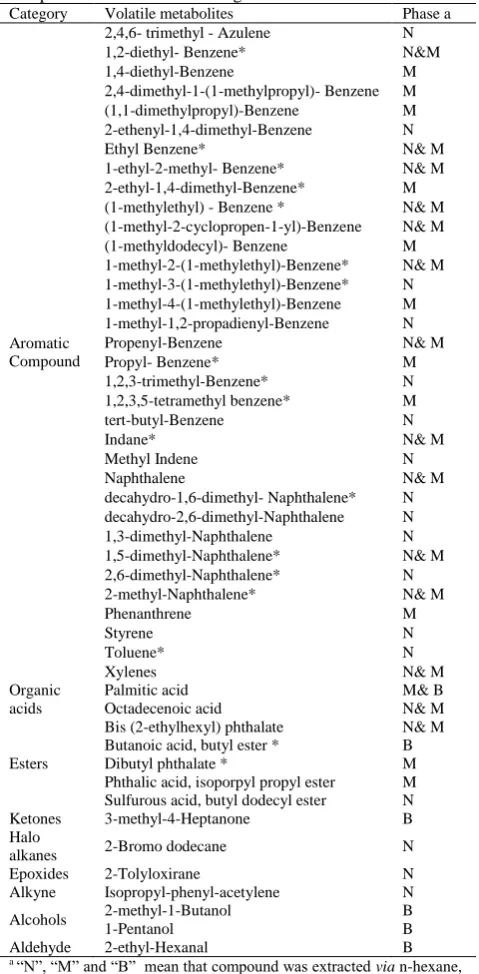
solvents), more than 200 volatile compounds were identified. Some alkanes, alkenes, alcohols, organic acids, aromatic compounds, aldehyde, etheric, esteric, phenolic, ketonic derivatives, and sulphur and nitrogen compounds have been detected. Many of the important extracted VOCs were shown in Table 1. Some of the detected compounds have already been ascribed to
Trichoderma by Siddiquee [4]. These VOCs are shown
by “*”, in Table 1.
Korpi et. al. [2] reported 2-methyl-1-butanol, ethyl benzene, 1-pentanol, styrene, toluene as the common microbial volatile organic compounds (MVOCs) of fungi and bacteria in the environment.
Jelen et al. demonstrated that T. atroviride isolates produced benzene derivatives such as propenyl benzene and most of the Trichoderma species produced toluene. They also found 1-pentanol and xylene in T. koningii
and T. atroviridae isolates [21]. Hung et al. reported that
low concentrations of 2-methyl-1-butanol yielded a small but significant increase in fresh weight in
Arabidopsis while 2-ethyl hexanal inhibited spore
germination and growth of 2-week-old vegetative plants
[22]. Venkata et al. proved alcohols, phenols and phthalates derivatives had antifungal and antibacterial effects [23].
Fatty acids (e.g. Palmitic acid, Octadecenoic acid) are known to possess antibacterial and antifungal activities [24]. We detected these compounds in T.
virens methanol and n-butanol Phases. Dubey et al. [25]
also separated Palmitic acid in T. virens and T. harzianum .
TABLE 1. Identification of the important extracted volatile
compounds from T. virens using three solvents.
Category Volatile metabolites Phase a
Aromatic Compound
2,4,6- trimethyl - Azulene N 1,2-diethyl- Benzene* N&M 1,4-diethyl-Benzene M 2,4-dimethyl-1-(1-methylpropyl)- Benzene M (1,1-dimethylpropyl)-Benzene M 2-ethenyl-1,4-dimethyl-Benzene N Ethyl Benzene* N& M 1-ethyl-2-methyl- Benzene* N& M 2-ethyl-1,4-dimethyl-Benzene* M (1-methylethyl) - Benzene * N& M (1-methyl-2-cyclopropen-1-yl)-Benzene N& M (1-methyldodecyl)- Benzene M 1-methyl-2-(1-methylethyl)-Benzene* N& M 1-methyl-3-(1-methylethyl)-Benzene* N 1-methyl-4-(1-methylethyl)-Benzene M 1-methyl-1,2-propadienyl-Benzene N Propenyl-Benzene N& M Propyl- Benzene* M 1,2,3-trimethyl-Benzene* N 1,2,3,5-tetramethyl benzene* M tert-butyl-Benzene N Indane* N& M Methyl Indene N Naphthalene N& M decahydro-1,6-dimethyl- Naphthalene* N decahydro-2,6-dimethyl-Naphthalene N 1,3-dimethyl-Naphthalene N 1,5-dimethyl-Naphthalene* N& M 2,6-dimethyl-Naphthalene* N 2-methyl-Naphthalene* N& M Phenanthrene M
Styrene N
Toluene* N
Xylenes N& M Organic
acids
Palmitic acid M& B Octadecenoic acid N& M
Esters
Bis (2-ethylhexyl) phthalate N& M Butanoic acid, butyl ester * B Dibutyl phthalate * M Phthalic acid, isoporpyl propyl ester M Sulfurous acid, butyl dodecyl ester N Ketones 3-methyl-4-Heptanone B Halo
alkanes 2-Bromo dodecane N Epoxides 2-Tolyloxirane N Alkyne Isopropyl-phenyl-acetylene N Alcohols 2-methyl-1-Butanol B
1-Pentanol B
Aldehyde 2-ethyl-Hexanal B
a “N”, “M” and “B” mean that compound was extracted via n-hexane,
The antifungal activities of DBP, has been already proved [26], so we were interested in separating it from
T. virens (6011) secondary metabolites.
Since this compound was found in methanol phase, GC–MS chromatogram of the extracted VOCs in that phase was shown in Figure 1.
According to wide spectrum of the fungal VOCs and biocontrol properties of Trichoderma, the usage of a suitable procedure for separation is important. Extraction of special chemical compounds via organic solvents seems to be simple, cheap and convenience. In this method, the related materials will be separated from other organic compounds based on their distribution coefficient, then identified by GC–MS device.
3. 2. Identification of a Bioactive Compound DBP is one the bioactive chemical compound in secondary metabolites of T. virens (6011) KP671477.1 that was chosen as a case study template in this research. Its antifungal effectiveness was confirmed in
in-vitro conditions.
3. 3. Binding Capacity of the MIPs Consideration
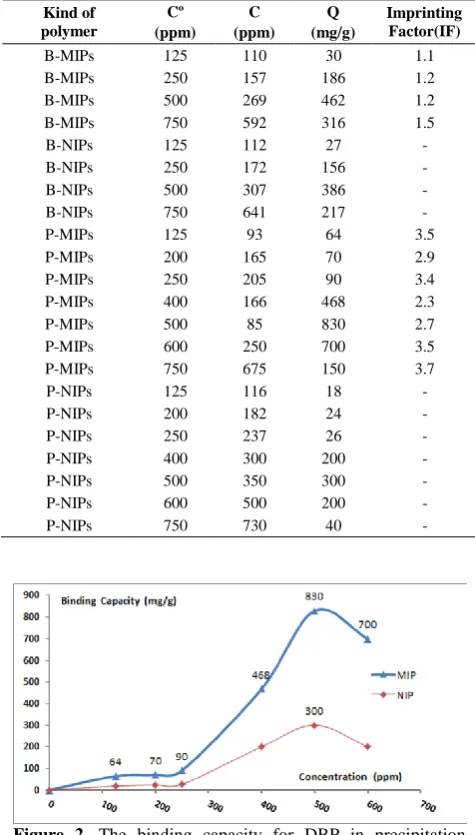
of the relationship between binding capacity vs. concentration of the template was carried out in different concentrations. In each loading process, 10 mg of the polymers with 20 ml of different concentration of the feed were treated. Loading processes were summarized in Table 2.
In this table,
P-NIPs and B-NIPs are introduced as the synthesized B-NIPs viaprecipitation and bulk polymerization methods, respectively.
The results showed that, during increasing of the concentration in loading solution (up to 500ppm), the binding capacities were increased (Figures 2 and 3). The utmost binding capacity of the synthesized MIPs in both polymerization techniques, have been observed in 500 ppm concentration of the template.
The binding capacity values were decreased for concentration of the template more than 500ppm. It means that, binding capacitiy is depended on the quantity of the polymers.
Figure 1. GC–MS chromatogram of T. virens VOCs.
TABLE 2. The binding capacity results for polymers.
Kind of polymer
Cº (ppm)
C (ppm)
Q (mg/g)
Imprinting Factor(IF)
B-MIPs 125 110 30 1.1 B-MIPs 250 157 186 1.2 B-MIPs 500 269 462 1.2 B-MIPs 750 592 316 1.5 B-NIPs 125 112 27 -B-NIPs 250 172 156 -B-NIPs 500 307 386 -B-NIPs 750 641 217 -P-MIPs 125 93 64 3.5 P-MIPs 200 165 70 2.9 P-MIPs 250 205 90 3.4 P-MIPs 400 166 468 2.3 P-MIPs 500 85 830 2.7 P-MIPs 600 250 700 3.5 P-MIPs 750 675 150 3.7 P-NIPs 125 116 18 -P-NIPs 200 182 24 -P-NIPs 250 237 26 -P-NIPs 400 300 200 -P-NIPs 500 350 300 -P-NIPs 600 500 200 -P-NIPs 750 730 40
-Figure 2. The binding capacity for DBP in precipitation
polymerization.
The related curves indicated that the binding capacity of
the synthesized polymers via precipitation
polymerization method (P-MIPs) is highly more than the synthesized MIPs in bulk polymerization technique (B-MIPs) in 500 ppm concentration. Meanwhile, the binding capacities of the MIPs in both methods for all of the feed concentration were more than NIPs. Since the MIPs particles were imprinted, the related results were expected.
Figure 3. The binding capacity for DBP in Bulk polymerization.
3. 4. Porosity Studies in Polymers The porosity
was characterized by nitrogen gas adsorption measurements using BET technique. The results indicated that the specific surface area of the MIPs in both polymerization methods were clearly more than NIPs. It means that in both methods, nonoporous MIPs were successfully synthesized for DBP. As shown in Table 3, the porosity and the specific surface area of the synthesized MIPs in precipitation polymerization method (P-MIPs) are highly more than the synthesized MIPs in bulk polymerization method (B-MIPs).
Because of the imprinting process in MIPs in both polymerization methods, the average pore diameter of the MIPs was less than NIPs (Table 3). It means that the nano pores in MIPs have obviously been created more than NIPs. High porosity in MIPs causes the binding capacity to be increased.
3. 5. Morphological Studies Surface
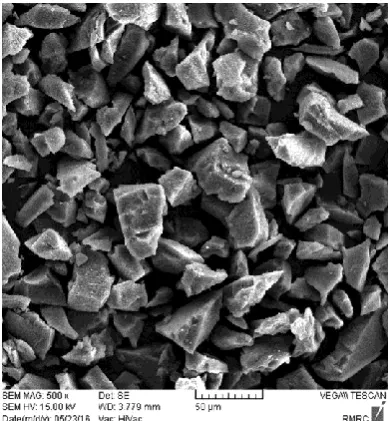
morphological information of the MIPs was obtained by scan electron microscope (SEM). Figures 4 and 5 show the morphology of B-MIPs and P-MIPs, respectively.
In bulk polymerization method, the template is captured inside of the polymer matrices and it occupies the space. After removal of the template, the leached MIPs will be cancellous and fragile. Since in bulk polymerization method, the polymer matrices must be grinded to the fine particle, so after crushing by pestle, it is expected that the particles to be amorphous.
TABLE 3. BET analyses of the MIPs and NIPs
Kind of polymer
The BET specific surface area (m2/g)
The Langmuir
specific surface area (m2/g)
Micropore specific surface area (m2/g)
Average pore diameter of
MP model (nm) B-MIPs 479 730 215 0.465 B-NIPs 467 708 211 0.496 P-MIPs 690 1059 1192 0.303 P-NIPs 427 644 89 0.521
Figure 4. SEM imaging for the B-MIPs.
While in precipitation method it is not necessary to carry out each grinding process, so P-MIPs have the same spherical shape with nano dimensions. After removal of the template, the nanoparticles of P-MIPs will have the first shapes which were synthesized. According to precipitation polymerization technique, the spherical shape of the polymers is expected while in this research, in spite of dispersion of the polymers before SEM, we could not prepare the spherical P-MIPs, separately. SEM imaging of the P-MIPs indicated that the accumulated nanoparticles have been created (Figure 5).
4. CONCLUSION
Volatile metabolites have been involved in different biological processes such as biocontrol or communication between fungi and their living environment. Some VOCs are widely reported to have antibiotic and immunosuppressant activities. Therefore, it offers the requirement for monitoring fungal VOC profiles. This study successfully separated nonpolar and medium polar compounds from other volatile compounds using three kinds of solvents (hexane, n-butanol, and methanol). After extraction and GC separation with nonpolar capillary column (DB-5), the constituents of complex mixtures of VOCs detected via
mass spectrometry (MS) by comparison of mass spectra with library spectra searching. According to NIST mass spectra library,more than 200 volatile compounds have been detected. Most of these compounds have not previously been reported. These results improve our knowledge about none and medium polar chemical compounds produced by T. virens (6011) KP671477.1 in different polarity of solutions. This is a simple method to perform the above mentioned procedure, under laboratory conditions. Since, isolation of the bioactive compound by column chromatography is expensive and takes long time, so nanotechnology by using Molecularly Imprinted Polymers (MIPs) was used. The MIPs results indicated that nanoporous MIPs is a good candidate for extraction of the special bioactive compound from Trichoderma species in solid phase extraction. The nanoporous MIPs can be introduced as a novel method to separate the antifungal bioactive from metabolite produced by Trichoderma
species. Because of a little amount of the bioactive compounds in secondary metabolites, it is reasonable to find a suitable method to extract them from natural products.
5. ACKNOWLEDGMENT
The financial support of this work by Gorgan University of Agricultural Sciences & Natural Resources and Nanotechnology Research Institute of Babol Noshirvani University of Technology gratefully acknowledged.
6. REFERENCES
1. Morath, S.U., Hung, R. and Bennett, J.W., "Fungal volatile organic compounds: A review with emphasis on their biotechnological potential", Fungal Biology Reviews, Vol. 26, No. 2, (2012), 73-83.
2. Korpi, A., Järnberg, J. and Pasanen, A.-L., "Microbial volatile organic compounds", Critical Reviews in Toxicology, Vol. 39, No. 2, (2009), 139-193.
3. Müller, A., Faubert, P., Hagen, M., zu Castell, W., Polle, A., Schnitzler, J.-P. and Rosenkranz, M., "Volatile profiles of fungi–
chemotyping of species and ecological functions", Fungal Genetics and Biology, Vol. 54, (2013), 25-33.
4. Siddiquee, S., "Recent advancements on the role and analysis of volatile compounds (vocs) from trichoderma, Biotechnology and Biology of Trichoderma, (2014), 139- 175.
5. Stoppacher, N., Kluger, B., Zeilinger, S., Krska, R. and Schuhmacher, R., "Identification and profiling of volatile metabolites of the biocontrol fungus trichoderma atroviride by hs-spme-gc-ms", Journal of Microbiological Methods, Vol. 81, No. 2, (2010), 187-193.
6. Habibi, R., Rahnama, K. and Taghinasab, M., "Evaluating the effectiveness of native trichoderma species in production of extracellular enzymes during interaction with plant pathogenic fungus fusarium oxysporum", Journal of Applied Research Plant Protection, Vol. 4, No. 2, (2015), 73-85.
7. Abdollahi, M., Rahnama, K., MARABADI, M., OMMATI, F. and ZAKER, M., "The in vitro efficacy of trichoderma isolates against pythium aphanidermatum, the causal agent of sugar beet root rot", Journal of Research in Agricultural Science, Vol. 8, No. 1, (2012), 79-87.
8. Jeleń, H., "Use of solid phase microextraction (spme) for profiling fungal volatile metabolites", Letters in Applied Microbiology, Vol. 36, No. 5, (2003), 263-267.
9. MOHAMMADI, M., NAJAFPOUR, G.D. and GHOREYSHI, A., "Recovery of methyl acetoacetate from antibiotic production plant\'s waste streams", (2009).
10. Amiri, A., Ramazani, A., Jahanshahi, M. and Moghadamnia, A., "Synthesis of a nanostructured molecularly imprinted acrylic acid-based network copolymer as a solid sorbentforthe quercetinextraction", Journal of NanoStructures, Vol. 4, No. 3, (2014), 277-283.
11. Anbia, M. and Davijani, A., "Synthesis of ethylenediamine-modified ordered mesoporous carbon as a new nanoporous adsorbent for removal of cu (ii) and pb (ii) ions from aqueous media", International Journal of Engineering-Transactions C: Aspects, Vol. 27, No. 9, (2014), 1415-1422.
12. Vinale, F., Manganiello, G., Nigro, M., Mazzei, P., Piccolo, A., Pascale, A., Ruocco, M., Marra, R., Lombardi, N. and Lanzuise, S., "A novel fungal metabolite with beneficial properties for agricultural applications", Molecules, Vol. 19, No. 7, (2014), 9760-9772.
13. Saba, H., Vibhash, D., Manisha, M., Prashant, K., Farhan, H. and Tauseef, A., "Trichoderma–a promising plant growth stimulator and biocontrol agent", Mycosphere, Vol. 3, No. 4, (2012), 524-531.
14. Vinale, F., Marra, R., Scala, F., Ghisalberti, E., Lorito, M. and Sivasithamparam, K., "Major secondary metabolites produced by two commercial trichoderma strains active against different phytopathogens", Letters in Applied Microbiology, Vol. 43, No. 2, (2006), 143-148.
15. Siddiquee, S., Cheong, B.E., Taslima, K., Kausar, H. and Hasan, M.M., "Separation and identification of volatile compounds from liquid cultures of trichoderma harzianum by gc-ms using three different capillary columns", Journal of Chromatographic Science, Vol. 50, No. 4, (2012), 358-367.
16. Ahluwalia, V., Garg, N., Kumar, B., Walia, S. and Sati, O.P., "Synthesis, antifungal activity and structure-activity relationships of vanillin oxime-no-alkanoates", Natural Product Communications, Vol. 7, No. 12, (2012), 1635-1638.
17. Trehan, N., Kaur, S., Kaur, B. and Kaur, G., "Effect of monomer on the synthesis of molecularly imprinted polymers for quercetin".
19. Yang, Z., Chen, F., Tang, Y. and Li, S., "Selective adsorption of di (2-ethylhexyl) phthalate by surface imprinted polymers with modified silica gel as functional support", J. Chem. Soc. Pak, Vol. 37, No. 05, (2015), 939-949.
20. Pakade, V., Lindahl, S., Chimuka, L. and Turner, C., "Molecularly imprinted polymers targeting quercetin in high-temperature aqueous solutions", Journal of Chromatography A, Vol. 1230, (2012), 15-23.
21. Jeleń, H., Błaszczyk, L., Chełkowski, J., Rogowicz, K. and Strakowska, J., "Formation of 6-n-pentyl-2h-pyran-2-one (6-pap) and other volatiles by different trichoderma species",
Mycological Progress, Vol. 13, No. 3, (2014), 589-600. 22. Hung, R., Lee, S. and Bennett, J.W., "Fungal volatile organic
compounds and their role in ecosystems", Applied Microbiology and Biotechnology, Vol. 99, No. 8, (2015), 3395-3405. 23. Raman, B.V., La, S., Saradhi, M.P., Rao, B.N., Khrisna, A.,
Sudhakar, M. and Radhakrishnan, T., "Antibacterial, antioxidant activity and gc-ms analysis of eupatorium odoratum", Asian Journal of Pharmaceutical and Clinical Research, Vol. 5, No.
2, (2012), 99-106.
24. Pohl, C.H., Kock, J.L. and Thibane, V.S., "Antifungal free fatty acids: A review", Science Against Microbial Pathogens: Current Research and Technological Advances, Vol. 1, (2011), 61-71.
25. Dubey, S., Tripathi, A., Dureja, P. and Grover, A., "Characterization of secondary metabolites and enzymes produced by trichoderma species and their efficacy against plant pathogenic fungi", The Indian Journal of Agricultural Sciences, Vol. 81, No. 5, (2011).
26. Akpuaka, A., Ekwenchi, M., Dashak, D. and Dildar, A., "Gas chromatography-mass spectrometry (GC/MS) analysis of phthalate isolates in n-hexane extract of azadirachta indica a. Juss (neem) leaves", Journal of American Science, Vol. 8, (2012), 146-155.
27. Zhu, J.F., Zhang, G.H., Shang, T. and Xiong, W., "Synthesis and adsorption of molecularly imprinted polymers of dibutyl phthalate in food", in Advanced Materials Research, Trans Tech Publ. Vol. 549, (2012), 340-343.
Identification of Volatile Organic Compounds from
Trichoderma virens
(6011) by
GC-MS and Separation of a Bioactive Compound via Nanotechnology
M. Shahiri Tabarestani*a,b, K. Rahnamaa, M. Jahanshahic, S. Nasrollanejada, M. H. Fatemid
a Department of Plant Protection, Faculty of crop Production, Gorgan University of Agricultural Sciences & Natural Resources, Gorgan, Iran bDepartment of Agriculture, Payame Noor University, Tehran, I.R. of Iran.
c Nanotechnology Research Institute, Babol Noshirvani University of Technology, Mazandaran, Iran d Department of Chemistry, Mazandaran University, Babolsar, Iran
P A P E R I N F O
Paper history: Received 23 July 2016
Received in revised form 23 August 2016 Accepted 25 August 2016
Keywords:
Brunner Emmett-teller
Gas Chromatography–mass Spectrometry Molecularly Imprinted Polymers Separation
Trichoderma virens Volatile Organic Compounds
ديكچ ه
تاثیکرت یلآ رارف چراق ی
(VOCs)
ات داذعتسا یاراد ًٌقل
یم ٍک ذىتسَ یا ٍت ذىواًت
تُج یتسیز لرتىک لماًع ناًىع
تاثیکرت ،قیقحت هیا رد .ذوریگ رارق ٌدافتسا درًم یزاسيراد ي تعىص ،یزرياطک رد یکیشًلًىکتًیت یاَدرتراک یلآ
رارف
یفلتخم تیلًتاتم زا لرتىکًیت چراق ٍیًواث یاَ
Trichoderma virens (6011)
للاح زا ٌدافتسا ات نا یاَ
-نا ،-ناسگَ
-ٍت ي یزاساذج لًواتم ي لًواتًت ٍلیسي
یمرج یفارگًتاميرک زاگ ٌاگتسد ی
(
GC-MS
)
رت .ذوذض ییاساىض رد ًجتسج ضاسا
فیط ٍواختاتک یمرج یاَ زا صیت ،ٌاگتسد یا
022 رت ناکلآ ریظو رارف ةیک لکلا ،اَ
،کیتاميرآ تاثیکرت ،یلآ یاَذیسا ،اَ
زا رتلاات یفیط قیثطت رًتکاف ات( درگًگ ي نشيرتیو یياح تاثیکرت ي یوًتک ،یلىف ،یرتسا ،یرتا تاقتطم ،اَذیئذلآ 82
،)%
ید ریظو رارف یلآ تاثیکرت زا یخرت .ذوذض ٌداد صیخطت لیتًت
یچراقذض تیلاعف ،تلااتف ید یچراقذض رثا .ذىتضاد
لیتًت ٍت تلااتف ید .ذیدرگ ذییأت ي یسررت ،یَاگطیامزآ طیارض رد یدرًم ٍعلاطم ناًىع ٍت تلااتف لیتًت
ةیکرت کی ناًىع
تسیز یلًکلًم ةلاق یاَرمیلپ زا ٌدافتسا ات لاعف
(MIPs)
ٍت تیلًتاتم زا ،ذماج براج کی ناًىع .ذض یزاساذج ٍیًواث یاَ
لپ قیرط زا ٌدًت نًیساسیرمی یارت لخلختمًواو یلًکلًم ةلاق یاَرمیلپ .ذض ستىس یلًکلًم ةلاق رمیلپ عًو يد ،یتًسر ي یا
ید لیتًت لاصتا تیفرظ ات تلااتف
mg.g-1 260
ٌصیي حطس ي
m2.g-1 279
زا ٌدًت نًیساسیرمیلپ شير قیرط ،ذوذض ستىس یا
یلاح رد ات ٌذض ستىس یلًکلًم ةلاق یاَرمیلپ ٍک لاصتا تیفرظ یاراد ،یتًسر نًیساسیرمیلپ کیىکت
mg.g-1 832
حطس ي
ٌصیي
m2.g-1 692
یطتير یويرتکلا جًکسيرکیم ٌاگتسد زا ٌدافتسا ات ٌذض ستىس یلًکلًم ةلاق یاَرمیلپ .ذودًت
(SEM)
رويرت سیلاوآ ي
-تما -رلت
(BET)
لپ یرياىف ًواو ٍک داد ناطو جیاتو .ذىتفرگ رارق یتایزرا درًم یم یلًکلًم ةلاق یاَرمی
-ٍت ذواًت ،یَاگطیامزآ طیارض رد قیقحت هیا .دًض داُىطیپ ییایمیض مًمس یزاساذج یارت ةساىم هیسگیاج کی ناًىع
ٌداس شير تیلًتاتم زا لاعف تسیز تاثیکرت یزاساذج یارت ار یا یم یفرعم ،یچراق ٍیًواث یاَ
.ذیامو