Please cite this article as,H. Mobki, M. H. Sadeghi, G. Rezazadeh.,Application of Thau Observer for Fault Detection of Micro Parallel Plate Capacitor Subjected to Nonlinear Electrostatic Force`, International Journal of Engineering (IJE), TRANSACTIONS B: Applications Vol. 28, No. 2, (February 2015) 270-276
International Journal of Engineering
J o u r n a l H o m e p a g e : w w w . i j e . i rApplication of Thau Observer for Fault Detection of Micro Parallel Plate Capacitor
Subjected to Nonlinear Electrostatic Force
H. Mobki*a, M. H. Sadeghia, G. Rezazadehb
a Department of Mechanical Engineering, University of Tabriz, Tabriz, Iran b Department of Mechanical Engineering, Urmia University, Urmia, Iran
P A P E R I N F O
Paper history: Received 16 May 2014
Received in revised form 06 November2014 Accepted 13November2014
Keywords: Fault detection Thau observer nonlinear force
micro-parallel plate capacitor noise and uncertainty
A B S T R A C T
This paper investigates the fault detection of a micro parallel plate capacitor subjected tononlinear electrostatic force. For this purpose, Thau observer, which has demonstrated good performance in fault detection of nonlinear systems,as well asgoverning nonlinear dynamic equation of the capacitor,is presented. Upper and lower threshold for fault detection have been obtained. The robustness of the observer to noise, uncertainty as well as sensitivity to faults wasinvestigated. Finally, simulation results for fault detection of the capacitor are obtained and the ability of the observer in the vicinity of dynamic pull-in voltage has been checked.
doi: 10.5829/idosi.ije.2015.28.02b.13
1. INTRODUCTION1
In recent decades, micro electro mechanical (MEM) systems have gained popularity on engineering and industry for their remarkable advantages such as small size in order of magnitudes, high performance, possibilities for batch manufacturing, cost effective integration with electronic systems, and low (virtually zero) DC power consumption [1].
MEM tunable capacitors are the main parts of RF integrated circuits such as tunable filters and resonators [2].Furthermore, these devices with electrostatic actuation have been widely designed, fabricated, used and analyzed in micro actuators [3, 4] micro-phone [5-7], sensors [8, 9], capacitive micro-plate [10, 11] and micro capacitors [12, 13]. Despite the extensive effort accomplished on MEMS, there are not yet sufficient studies concentrating on fault detection of such systems. In the development of MEM systems, fabrication failure and fault analysis play a major role in evolution reliability.
1*Corresponding Author’s Email:[email protected] (H. Mobki)
Choice of suitable method for fault detection of a system depends on the knowledge of physical laws and parameters of the system. For the system with the defined physical laws and parameters, white box analysis (kalman filter, extended kalman filter, Thau observer [14-17]) can be applied for fault detection. In this case, a residual signal can be obtained by comparing estimated output (state) with process output (state).
For the defined physical laws and unknown system parameters, gray box analysis (parameter identification, geometric approach [18-21]) can be implemented for fault detection. Using this analysis, system parameters can be extracted and residual signal can be obtained by comparing estimated parameter with nominal one.
In these analyses, violation of residual from threshold indicates the occurrence of fault in system.
If both physical laws and parameters of the system are undefined, fault detection process may be performed using black box analysis. This method can be used for fault detection, if only change of measured signal is related to system fault [17].
Most of the MEM systems are nonlinear in nature. Some studies regarding fault detection of these structures have been conducted. Asgary et al. [22]
studied fault detection of nonlinear MEM devices using neural network. Reppa and Tzes [23] applied set membership identification for micro electrostatic actuators. They assumed that the system is linearly parameterizable, and the parameter vector contains quantities thatare susceptible to faults. Another study [24] on fault detection of MEM using frequency response was done by Zahidul Islam et al. Izadian and Famouri [25] studied fault diagnosis of micro lateral comb resonators. Their remarkable work is based on using multiple model adaptive estimators, but the electrostatic force term that is applied in this study is linearly proportion to state space.
The aim of this paper is to develop diagnostic observer applied for the fault detection of a capacitive MEM switch in the presence of nonlinear electrostatic force. This is accomplished using "Thau" observer [26]. For this case, governing dynamic equation and parameters of systems are known. Thau’s condition is a very useful analysis tool for state estimation and fault detection of nonlinear systems that ensures the asymptotic stability of the observer [27-30]. Atwo-parallel plate capacitor was applied to show the efficiency of the Thau observer for the fracture detection of a supporter beam of the capacitor. The stability condition for application of this observer in various circumstances was obtained and is presented. Furthermore, the ability of the observer in the vicinity of the unstable condition was analyzed.
2. MODEL DESCRIPTION
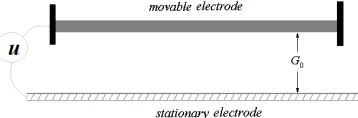
Figure 1a shows schematic view of a parallel plate capacitor, which consists of a movable electrode suspended over a stationary conductor plate. The primary gap between two electrodes is Go. Attractive
electrostatic force due to the applied bias voltage u pulls movable electrode down towards the stationary plate. Figure 1b shows top view of the movable electrode, which is suspended by six supporting beams (three at each side). The area and thickness of movable electrode are S and h, respectively. Width, thickness and length of beams are b, h, and L, respectively. The equivalent stiffness of each beam isk = 1 2E I L3, where E and I are Young’s modulus and cross section moment of inertia, respectively. The movable electrode is considered isotropic with density ofr .
a. Front view of capacitor
b. top view of capacitor
Figure 1. Parallel plate tunable capacitor
3. MATHEMATICAL MODELING
The governing dynamic equation of an electro-mechanical tunable capacitor such as the one in Figure 1.a can be described as:
2
2 eq elec
d z dz
m c k z q
dt + dt+ = (1)
where z, m, c, and keq, are the deflection, mass, damping
coefficient, and equivalent stiffness (keq =6k) of the movable electrode, respectively. Also, qelecrepresents
electrostatic force.
When the actuating voltage u is applied between the movable and stationary electrodes, the electrostatic force is computed using a standard parallel capacitance model, which yields [31]:
2 0
2 0
2 ( )
e le c
Su q
G z
e
=
- (2)
where 12 2 1 2
8.854 10
0 C N m
e = ´ - - - is the permittivity of
the vacuum within the gap.
For convenience, Equation (1) may be rewritten in a non-dimensional form by defining the following parameters [32]:
0 z w
G
= ,
t t
t= * (3)
wheret is the dimensionless time, and m
t keq *
= .
Therefore, Equation (1) may be written as:
2 2
2 (1 )2
d w dw u
c w
d d w
a
t + ¢ t + = - ( 4)
where
c
¢
anda
are dimensionless damping and electrostatic coefficients, respectively, defined as:eq
k t
c c:'= *
, 0
3 0 :
2 eq
S k G
e
a = ( 5 )
generated by comparing the outputs of the system and their estimates obtained by an observer. For safe (fault-free) system, without any disturbances and modeling uncertainties, the outputs are equal with their estimations. In this condition, residual equals to zero. Any deviation of residual from zero will announce thepresence of a fault. Existence of the disturbances and uncertainties are unavoidable, and the residual signal is not completely decoupled from their effect; so, even for fault-free system, residual deviates from zero. Therefore, a threshold is needed to handle the effect of disturbances and uncertainties. Selection of threshold plays an important role in the performance of the fault detection system. If it is selected too high, some faults would not be detected. Conversely, if it is selected too low, disturbances and uncertainties will result in false alarms [33]. In this paper, the Thau observer is applied for residual generation and the threshold is obtained based on the asymptotic results of residual with extreme magnitude of the uncertainty.
4. THAU OBSERVER
The Thau observer was designed for the state estimation of a nonlinear dynamical system [26]. It has already been applied for fault detection of non-linear dynamic systems [27]. Consider the nonlinear system with form of:
( , ) ( , )
x Ax Bu g x u x u y Cx h = + + + = & (6)
where x RÎ n , u RÎ rand
y R
Î pare state, input and output vectors, respectively; A, B, and C are known system matrices, g x u( , ) represents the nonlinear function and ( , )h x u represents unknown nonlinear function which contains noises and uncertainties. It must be noted that h( , )x u is a bounded function.For implementation of Thau observer, the following conditions must be satisfied:
1. matrices A and C are observable, i.e. n1
C C A
C A
-æ ö ç ÷ ç ÷ ç ÷ ç ÷ è ø M
is full rank.
2. the nonlinear function g x u( , ) is continuously differentiable and satisfies the Lipschitz condition locally with constant g, i.e:
x x u x g u x
g( , )- (ˆ, ) £g -ˆ (7)
If the above conditions are satisfied, the structure of the Thau observer for Eq. 6 is given by:
ˆ ˆ ( , )ˆ ( ˆ)
ˆ
x Ax Bu g x u K y y
r y Cx
= + + +
=
-&
(8)
where ˆx and ˆy represent estimated state and output, r is residual and K=P C-1 Tis the gain of observer and the
matrix P is the solution of the Lyapunov equation
0
T T
A P PA C C+ - +qP= ( 9)
where
q
is a positive parameter which is chosen in such a way that Eq. 9 has a positive definite solution[33].4. 1. Mathematical Model in State Space Form Consider x1=w and
2 dw x
dt
= ; so, Eq. 4 rewritten in the
state space form as:
[ ]
1 1 2
2 2 2
1 1 2 0 0 1 1 ' (1 ) 1 0 x x u
x c x
x x y
x a
ì é ù
é ù é ùé ù
ï = +ê ú
ê ú ê úê ú
ï ë- - û ê ú
ï ë û ë û ê - ú
í ë û
ï é ù
ï = ê ú
ï ë û
î
& &
(10)
Matrix 10 01
C C A
é ù = é ù
ê ú ê ú
ë û ë û is full rank; therefore, system is observable. As it is stated in [12], 0 £ x £ 0 .6 6, so,
term 2 2 (1 ) u x a
- is locally Lipschitz and terms 1 and 2 for
observer design is fulfilled. In this paper, output is considered as the non-dimensional deflection w. Pursuing the same procedure, the structure of the Thau observer may be rewritten as:
1 1 2
2 2
2
1 0
ˆ 0 1 ˆ
ˆ 1 ' ˆ
ˆ (1 ) ˆ ( ) ˆ x x u x c x x
K y y
r y y a
ìé ù é ù
é ù
é ù
ïê ú= +ê ú
ê ú
ê ú
ï - - ê ú
ïê úë û ë û ë û ê - ú
í ë û
ï+
-ï
ï =
-î
&
& (11)
5. SIMULATION RESULTS
In this section, fault detection of parallel plate capacitor with nonlinear electrostatic term has been developed. Spatial properties of the capacitor are shown in Table 1. The system output is position of the movable electrode with respect to the stationary electrode. Residual is obtained using Thau observer as the difference of system output and the estimated one.It is assumed that the applied voltage is contaminated by noise with 26dB. SNR2, and also 5% uncertainty in determination of
0
S G .
TABLE 1. Spatial properties of the micro parallel plate capacitor
Properties Value
Area of movable electrode (S) 400mm´400mm
Thickness of movable electrode 1mm
Thickness of beam 1mm
Length of beams 100mm
young's modulus of beams 169GPa
Go 4mm
density 2300 3
Kg m
The simulated fault is the fracture of one of the six supporter beams, being an abrupt fault. As a result, the beam fracture decreases the stiffness and damping of the system to5
6keq and 5
6c
, respectively. It is considered
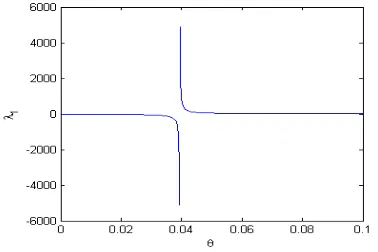
that magnitudes of mass for faulty and fault free cases are the same.As mentioned before, for application of Thau observer, the P matrix, depending on the parameterq, must be positive definite. Figures 2 and 3 show the variation of the first and second eigenvalues of the matrix P with respect to q. As it is seen, for q³0.04 the eigenvalues are positive, making the matrix P positive definite.
5. 1. Determination of the Static Threshold In this part, the static thresholds are determined. Upper and lower thresholds are obtained based on the asymptotic results of the residual for fault-free capacitor (ARRFFC), considering maximum amount of noise for the upper threshold and minimum amount of noise for the lower threshold. The level of uncertainty was maximum (5%) for both cases. Figures 4 and 5 show the convergence of ARRFFC and determination of upper and lower threshold for q=1 and u=5.2V. As shown in
these figures, upper and lower threshold equal to 3
9.7 10´ - and-8.2 10´ -3, respectively.
Figure 2. First eigenvalue
l
1 versusq
parameterFigure 3. Second eigenvalue
l
2 versusq
parameterFigure 4. ARRFFC considering maximum magnitude of noise and maximum amount of uncertainty versus time for
1
q =
Figure 5. ARRFFC considering minimum magnitude of noise and maximum amount of uncertainty versus time for
1
q =
In continuation, sensitivity of observer for different amount of q has been discussed. As mentioned before, selection of threshold plays an important role in the performance of fault detection scheme. If it is selected too high, sensitivity of observer to fault may be decreased, and if it is selected too low, disturbance and uncertainty will result in existence of fault alarm.
increasing q, the sensitivity of the observer to noise and uncertainty is increased, resulting in decrease of robustness. As shown in Figure 8 for q=2, the sensitivity is so high that the observer residuals surpass the threshold levels, for the fault-free case. On the other hand, with q=0.1 the sensitivity is too low to detect faults. In this paper, for fault detection,q is selected as one which has a suitable level of sensitivity to fault detection in the presence of noise and uncertainty.
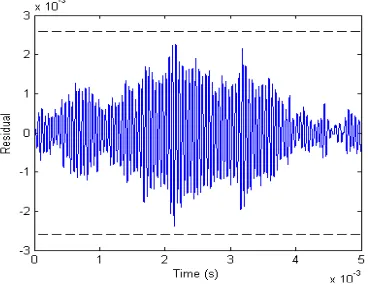
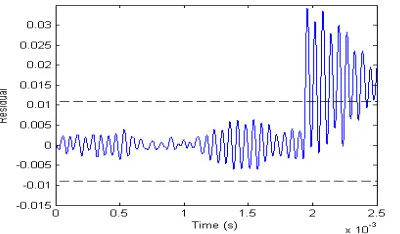
5. 2. Fault Detection Results for q=1 Figures 9-12 show residual versus time for various amounts of applied voltages. Fracture of the beam occurred in this time interval.These figures show that Thau observer with q=1has good ability in quick detection of fault. Dynamic pull-in voltage for fault-free capacitor is 5.82V, and for faulty capacitor is about 5.35V. Dynamic pull-in phenomenon is an unstable condition which can occur in MEMS capacitor subjected to nonlinear electrostatic force [1], [10, 11], and [34]. In this condition, movable electrode knocks up to the stationary electrode and loses its stability. As shown in Figure 12, this observer can detect fault of capacitor in the vicinity of dynamic pull-in voltage (unstable condition).
Figure 6. Residual versus time for q=0.1
Figure 7. Residual versus time for q=1
Figure 8. Residual versus time for q=2
Figure 9. Residual versus time for u= 1V andq=1
Figure 10. Residual versus time for u= 2V andq=1
Figure 12. Residual versus time for u= 5.3V andq=1
6. CONCLUDING REMARKS
In this paper the problem of fault detection of a type of nonlinear system, which is a parallel plate capacitor, was studied. The approach is based upon designing a Thau-type observer sensitive to specific fault. The nonlinear dynamic model of the capacitor in two cases of healthy (no-fault) and cracked failure mode was obtained and the performance of the observer investigated.
Upper and lower threshold limits were obtained based on asymptotic results of the residuals for fault-free case. Moreover, the sensitivity of the observer to fault as well as robustness to the noise and uncertainty was examined. The results show that with increasing
q parameter higher than a limit has an adverse effect on fault detection in the presence of noise. Proper value of
q parameter, making the observer robust to noise and sensitive to fault, was selected. It was shown that Thau observer has good ability in fracture detection of the supporter beam of the capacitor, even in the vicinity of dynamic pull-in voltage.
7. REFERENCES
1. Mobki, H., Rezazadeh, G., Sadeghi, M., Vakili-Tahami, F. and Seyyed-Fakhrabadi, M.-M., "A comprehensive study of stability in an electro-statically actuated micro-beam", International Journal of Non-Linear Mechanics, Vol. 48, (2013), 78-85. 2. Shavezipur, M., Khajepour, A. and Hashemi, S., "The
application of structural nonlinearity in the development of linearly tunable mems capacitors", Journal of Micromechanics and Microengineering, Vol. 18, No. 3, (2008), 035016. 3. Abbasnejad, B., Shabani, R. and Rezazadeh, G., "Stability
analysis in parametrically excited electrostatic torsional micro-actuators", International Journal of Engineering-Transactions C: Aspects, Vol. 27, No. 3, (2013), 487.
4. Taghizadeh, M. and Mobki, H., "Bifurcation analysis of torsional micromirror actuated by electrostatic forces", Archives of Mechanics, Vol. 66, No. 2, (2014), 95-111.
5. Taybi, M. and Ganji, B.A., "The effect of corrugations on mechanical sensitivity of diaphragmfor mems capacitive
microphone", International Journal of Engineering-Transactions C: Aspects, Vol. 26, No. 11, (2013), 1332-1330. 6. Ganji, B.A. and Majlis, B.Y., "Fabrication and characterization
of a new mems capacitive microphone using perforated diaphragm", International Journal of Engineering-Transactions C: Aspects, Vol. 22, No. 2, (2009), 153-160. 7. Ganji, B.A. and Nateri, M., "Fabrication of a novel mems
capacitive microphone using lateral slotted diaphragm",
International Journal of Engineering-Transactions C: Aspects, Vol. 23, No. 3&4, (2010), 191-200.
8. Ganji, B.A. and Shahiri, M., "Analytical analysis of capacitive pressure sensor with clamped diaphragm (research note)",
International Journal of Engineering-Transactions C: Aspects, Vol. 26, No. 3, (2013), 297-302.
9. Ganji, B.A. and Shams Nateri, M., "Modeling of capacitance and sensitivity of a mems pressure sensor", International Journal of Engineering, Vol. 26, No. 11, (2013), 1331-1336. 10. Rashvand, K., Rezazadeh, G. and Madinei, H., "Effect of
length-scale parameter on pull-in voltage and natural frequency of a micro-plate", International Journal of Engineering (1025-2495), Vol. 27, No. 3, (2014).
11. Rashvand, K., Rezazadeh, G., Mobki, H. and Ghayesh, M.H., "On the size-dependent behavior of a capacitive circular micro-plate considering the variable length-scale parameter",
International Journal of Mechanical Sciences, Vol. 77, (2013), 333-342.
12. Mobki, H., Rashvand, K., Afrang, S., Sadegh, M.H. and Rezazadeh, G., "Design, simulation and bifurcation analysis of a novel micromachined tunable capacitor with extended tunability", Transactions of the Canadian Society for Mechanical Engineering, Vol. 38, No. 1, (2014), 15-29. 13. Mobki, H., Sadeghi, M.H., Afrang, S. and Rezazadeh, G., "On
the tunability of a mems based variable capacitor with a novel structure", Microsystem Technologies, Vol. 17, No. 9, (2011), 1447-1452.
14. Wei, X., Verhaegen, M. and van Engelen, T., "Sensor fault detection and isolation for wind turbines based on subspace identification and kalman filter techniques", International Journal of Adaptive Control and Signal Processing, Vol. 24, No. 8, (2010), 687-707.
15. Tarantino, R., Szigeti, F. and Colina-Morles, E., "Generalized luenberger observer-based fault-detection filter design: An industrial application", Control Engineering Practice, Vol. 8, No. 6, (2000), 665-671.
16. Frank, P.M. and Ding, X., "Survey of robust residual generation and evaluation methods in observer-based fault detection systems", Journal of Process Control, Vol. 7, No. 6, (1997), 403-424.
17. Isermann, R., "Fault-diagnosis systems, Springer, (2006). 18. Rahimi, N., Sadeghi, M. and Mahjoob, M., "Performance of the
geometric approach to fault detection and isolation in siso, miso, simo and mimo systems", Journal of Zhejiang University SCIENCE A, Vol. 8, No. 9, (2007), 1443-1451.
19. Wang, S., Huang, W. and Zhu, Z., "Transient modeling and parameter identification based on wavelet and correlation filtering for rotating machine fault diagnosis", Mechanical Systems and Signal Processing, Vol. 25, No. 4, (2011), 1299-1320.
20. Zogg, D., Shafai, E. and Geering, H., "Fault diagnosis for heat pumps with parameter identification and clustering", Control Engineering Practice, Vol. 14, No. 12, (2006), 1435-1444. 21. Suonan, J. and Qi, J., "An accurate fault location algorithm for
transmission line based on r– l model parameter identification",
22. Asgary, R., Mohammadi, K. and Zwolinski, M., "Using neural networks as a fault detection mechanism in mems devices",
Microelectronics Reliability, Vol. 47, No. 1, (2007), 142-149. 23. Reppa, V. and Tzes, A., "Application of set membership
identification for fault detection of mems", in Robotics and Automation,. ICRA. Proceedings IEEE International Conference on, (2006), 643-648.
24. Tiong, S.H. and Ali, M., "Faults detection approach for self-testable rf mems", in IEEE International Conference on Semiconductor Electronics. (2006), 329-333.
25. Izadian, A. and Famouri, P., "Fault diagnosis of mems lateral comb resonators using multiple-model adaptive estimators",
Control Systems Technology, IEEE Transactions on, Vol. 18, No. 5, (2010), 1233-1240.
26. Thau, F., "Observing the state of non-linear dynamic systems†",
International Journal of Control, Vol. 17, No. 3, (1973), 471-479.
27. Freddi, A., Longhi, S. and Monteriù, A., "A diagnostic thau observer for a class of unmanned vehicles", Journal of Intelligent & Robotic Systems, Vol. 67, No. 1, (2012), 61-73. 28. Chen, W. and Saif, M., "Observer-based strategies for actuator
fault detection, isolation and estimation for certain class of uncertain nonlinear systems", IET Control Theory & Applications, Vol. 1, No. 6, (2007), 1672-1680.
29. Cen, Z. and Noura, H., "An adaptive thau observer for estimating the time-varying loe fault of quadrotor actuators", in Control and Fault-Tolerant Systems (SysTol), Conference on, (2013), 468-473.
30. Zhahoui, C., Noura, H., Susilo, T.B. and Al Younes, Y., "Engineering implementation on fault diagnosis for quadrotors based on nonlinear observer", in The 25th Chinese Control and Decision Conference , Guiyang, China. (2013).
31. Lin, W.-H. and Zhao, Y.-P., "Nonlinear behavior for nanoscale electrostatic actuators with casimir force", Chaos, Solitons & Fractals, Vol. 23, No. 5, (2005), 1777-1785.
32. Tahami, F., Mobki, H., Janbahan, A. and Rezazadeh, G., "Pull-in phenomena and dynamic response of a capacitive nano-beam switch", Sensors & Transducers Journal, Vol. 110, No. 11, (2009), 26-37.
33. Abid, M., "Fault detection in nonlinear systems: An observer-based approach", Universität Duisburg-Essen, Fakultät für Ingenieurwissenschaften» Elektrotechnik und Informationstechnik» Automatisierungstechnik und komplexe Systeme, (2013),
34. Mobki, H., Sadeghi, M.H., Rezazadeh, G. and Fathalilou, M., "Nonlinear behavior of a nano-scale beam considering length scale-parameter", Applied Mathematical Modelling, Vol. 38, No. 5, (2014), 1881-1895.
Application of Thau Observer for Fault Detection of Micro Parallel Plate Capacitor
Subjected to Nonlinear Electrostatic Force
H. Mobkia, M. H. Sadeghia, G. Rezazadehb
a Department of Mechanical Engineering, University of Tabriz, Tabriz, Iran b Department of Mechanical Engineering, Urmia University, Urmia, Iran
P A P E R I N F O
Paper history: Received 16 May 2014
Received in revised form 06 November 2014 Accepted 13November 2014
Keywords: Fault Detection Thau Observer Nonlinear Force
Micro-Parallel Plate Capacitor Noise And Uncertainty
هﺪﯿﮑﭼ
ﺐﯿﻋﻪﻟﺎﻘﻣﻦﯾارد ﯽﺑﺎﯾ
ﺰﯾر ﺮﯿﻏيوﺮﯿﻧﺮﯿﺛﺎﺗﺖﺤﺗﻪﮐيزاﻮﻣﻪﺤﻔﺻنزﺎﺧ درادراﺮﻗﮏﯿﺗﺎﺘﺳاوﺮﺘﮑﻟاﯽﻄﺧ
، راﺮﻗﯽﺳرﺮﺑدرﻮﻣ
ﺖﺳاﻪﺘﻓﺮﮔ . ﺖﯿﺋوررﻮﻈﻨﻣﻦﯾا ﻪﺑ ياﺮﺑﯽﺑﻮﺧﺖﯿﻠﺑﺎﻗ ﻪﮐﻮﺋﺎﺗ ﺮﮔ
ﺐﯿﻋ ﻢﺘﺴﯿﺳﯽﺑﺎﯾ درادﯽﻄﺧﺮﯿﻏيﺎﻫ ،
ﻪﺋارا تﻻدﺎﻌﻣو
ﻦﯿﯿﻌﺗنزﺎﺧﯽﮑﯿﻣﺎﻨﯾدﯽﻄﺧﺮﯿﻏ هﺪﺷ
ﺖﺳا . ﻪﻧﺎﺘﺳآ ﺐﯿﻋﯽﻨﯿﯾﺎﭘوﯽﯾﻻﺎﺑي وﺐﯿﻋﻪﺑﺮﮕﺘﯿﺋورﺖﯿﺳﺎﺴﺣوهﺪﺷﻦﯿﯿﻌﺗﯽﺑﺎﯾ
ﺖﺳاهﺪﺷهﺪﯿﺠﻨﺳ ﺖﯿﻌﻄﻗمﺪﻋوشﺎﺸﺘﻏادﻮﺟوﻞﺑﺎﻘﻣردنآﺖﻣوﺎﻘﻣ .
ﺐﯿﻋياﺮﺑيزﺎﺳﻪﯿﺒﺷﺞﯾﺎﺘﻧﺎﻬﺘﻧارد نزﺎﺧﯽﺑﺎﯾ
ﻪﺋاراوﻦﯿﯿﻌﺗ ﺖﯿﺋورﯽﯾﺎﻧاﻮﺗو
ﺐﯿﻋردﺮﮔ ﺖﺳاهﺪﺷهﺪﯿﺠﻨﺳيراﺪﯾﺎﭘﺎﻧژﺎﺘﻟوﯽﮑﯾدﺰﻧردﻢﺘﺴﯿﺳﯽﺑﺎﯾ .