Inzinerine Ekonomika-Engineering Economics, 2016, 27(4), 472–478
How to Develop Key Stakeholders Trust in Terms of Corporate Reputation
Migle Matuleviciene, Jurgita Stravinskiene
Kaunas University of Technology
K. Donelaicio st. 73, 44029, Kaunas, Lithuania
E-mail. [email protected], [email protected]
http://dx.doi.org/10.5755/j01.ee.27.4.13987
In scientific literature, the trust of key stakeholders is considered to be the base for the survival of organizations. In the context of the relation between corporate reputation and the trust of stakeholders, scientists agree on evident importance of corporate reputation for the development of stakeholder trust in the organization; however, there is a lack of recommendations suggesting how an organization should develop the trust of key stakeholders using corporate reputation. The article presents a summarized view onthe relationship between the main dimensions of corporate reputation and the factors of key stakeholder trust in the organization. Such relationships reveal that it is purposeful to invoke corporate reputation in order to develop trust of key stakeholders. Also, the article states the relation between the factors determining different stakeholders’ trust in the organization and different dimensions of corporate reputation based on which the trust of the key stakeholders of the organization should be developed. The result of the theoretical study is a developed conceptual model of key stakeholder trust development in terms of corporate reputation. The model will be applied in further empirical studies on the development of trust of the key stakeholders: customers, employees, shareholders and suppliers.
Keywords: Trust, Development of Trust, Corporate Reputation, Key Stakeholders, Organization.
Introduction
Analysis of the scientific literature on the development of trust of key stakeholders in an organization revealed that the development of trust of key stakeholders in an organization is analyzed within two contexts: building of trust and restoration of trust. These views caused a necessity to analyse how organizations should develop the trust of the key stakeholders in terms of corporate reputation in order to ensure not only successful everyday activities of the organization but also the survival of the organization in case of critical situations. Therefore, further analysis of corporate reputation, in consideration of its importance to stakeholder trust, is necessary.
The research problem is structured as a question, i.e. how to develop the trust of the key stakeholders in terms of corporate reputation?
The research aims to reveal the development process of key stakeholders trust in terms of corporate reputation
The object of this research is the revelation of the development of the key stakeholder trust in terms of corporate reputation.
The research methods involve systemic and comparative analysis of scientific literature.
Literature Review
Identification and Argumentation of Key
Stakeholders of an Organization
Scientists, in order to distance themselves from the identification of particular stakeholders of an organization, use stakeholder classification according to particular criteria, thus it is not known which stakeholders may be considered to be major. Despite of that, classification of stakeholders into homogenious groups (Fiedler &
Kirchgeorg, 2007) is a strong basis for identification of key stakeholders.
The main criterion of stakeholder classification is stakeholder influence on/power over the organizational activities (Bryson, 2004; Florea & Florea, 2013; Freeman, 1984; Gil-Lafuente & Paula, 2013; Gregory, 2007; Henriques & Sadorsky, 1999; Mitchell et al., 1997; Polonsky & Scott, 2005); some scientists name this as organization‘s dependence on the stakeholders and closeness of the stakeholders to the organization (Lafuente & Paula, 2013). According to Gil-Lafuente and Paula (2013), the closest stakeholders are those with whom the organization interacts most often or maintains long-term relationships and that influence daily activities of the organization. On the basis of this aproach, customers, employees, shareholders and suppliers were considered as the key stakeholders of an organization.
Development of Key Stakeholders Trust in
Terms of Corporate Reputation
Weber et al. (2015) define the development of trust as “the process by which that state is achieved, shaped, and influenced” (p. 78). Many other scientists, including Dietz and Hartog (2006), Doney and Cannon (1997), Fang et al.
(2008), Laeequddin et al. (2012), Schilke and Cook (2013), Six and Skinner (2010) also treat the development of trust as the process. After analyzing the development of key stakeholders trust in terms of corporate reputation the following statements can be made:
1. There are stages in trust development.
2. Corporate reputation may be considered as the main factor of trust development.
3. The trust can be of cognitive and emotional nature. 4. Trust in the representatives of the organization may
According to Bennett and Gabriel (2001), Dowling (2004), Iannuzzi (2000), Jahansoozi (2006), Park et al.
(20121), Schanz (2009), the research data of “Edelman Trust
Barometer” (2014), the research data of “Reputation Institute” (2012), Van der Merwe (2014), Verhoeven et al.
(2012) it can be stated that corporate reputation can create or develop the stakeholder trust while introducing, attracting and encouraging stakeholders to approach, commit, cooperate with the organization, adopt to invest; it can also reduce the risk of stakeholder withdrawal. Based on this, a conclusion is made that corporate reputation can be considered as a very important factor while aiming to develop the trust of the stakeholders in the organization. This forces to perform a more detailed analysis on how corporate reputation relates to trust of particular stakeholders.
Fundamental dimensions of corporate reputation. The scientific literature provides many dimensions of corporate reputation that can be combined, grouped and compared considering their relation to certain stakeholders. Time-tested reputation assessment methodologies “Fortune 500”, “Reputation Quotient”, and “RepTrak” are based on similar corporate reputation dimensions that are analogous to the
dimensions identified by Fombrun and van Riel in 1999 and that most of the scientists have been using for many years. These dimensions are emotional appeal, products and services, financial performance, vision and leadership, workplace environment, and social responsibility.
Eisenegger (2009) provides a more common approach on corporate reputation dimensions. According to Eisenegger (2009), reputation is comprised of three basic dimensions - characteristics to all persons and organizations - that help to perceive the general reputation; these are functional, social and expressive dimensions. The functional dimension is based on rationality and expresses objective truth about the organization through the competences and successful activities of the organization. The social dimension is based on ethical organization performance, expresses social benevolence of the organization through fairness and responsibility of the organization. The expressive dimension is based on subjective beauty of the organization. It was noticed that these corporate reputation dimensions suggested by Eisengger (2009) properly define and combine the main dimensions of corporate reputation found in the scientific literature (see Table 1).
Table 1
Structure of Corporate Reputation (Based on Eisenegger, 2009)
Object Dimensions Subdimensions
CORPORATE REPUTATION
FUNCTIONAL
Financial performance Good financial results Global reach
Vision and leadership
Quality of management Business strategy Organisation structure Leadership
Products and services
Product offer Customer orientation Innovation and value creation
SOCIAL
Workplace environment Organisational culture Human resources
Social responsibility Fair, ethical organisation performance Social and environmental responsibility
EXPRESSIVE Emotional appeal
Emotional attractiveness Brand image
Positive media image
Factors affecting major stakeholders trust. The scientists differently view and identify the factors of stakeholder trust in the organization. In the reviewed scientific literature, no uniform approach is found to what factors determine stakeholder trust in the organization. After
a detailed analysis of the scientific literature, the factors of the key stakeholders - customers, employees, shareholders, and suppliers - trust in the organization were identified (see Table 2).
Table 2
Factors Affecting Key Stakeholders Trust
Stakeholder Factors affecting stakeholders trust Source
Customers
- quality of products and services - good organization (as an employer) status - customer orientation
- social and environmental responsibility - financial stability of the organization
Boshoff (2009), Shahsavari and Faryabi (2013), Terblanche (2014), Walsh and Beatty (2007), Walsh et al. (20091, 20092)
Employees
- leadership
- employee involvement in the management of the organization
- human resource management
Gould-Williams (2003), Lau and Liden (2008), Sendjaya and Pekerti (2010), Xu and Thomas (2011)
Shareholders - corporate management (with reference to corporate governance ratings) Ertugrul and Hegde (2009), Klozikova and Dockalikova (2014), Shank et al. (2013)
Suppliers
- product - business - personalities - relationship - third parties
The relationship between the main dimensions of corporate reputation and the factors of key stakeholder trust in the organization. After identification of the main dimensions of corporate reputation found in the scientific literature, it was observed that these dimensions are related
- and quite often even identical - to factors of key stakeholder trust in the organization provided by the scientists. In other words, corporate reputation dimensions reveal that the trust of stakeholders can be based on certain corporate reputation dimensions (see Table 3).
Table 3
Interpretation of the Relationship between the Factors Determining the Stakeholders Trust in the Organization and the Equated Corporate Reputation Dimensions (Developed on the Basis of Theoretical Studies on Stakeholders Trust in an Organization and
Corporate Reputation)
Stakeholder Factors affecting stakeholders trust in the organization
The dimensions of corporate reputation equated to factors affecting stakeholders trust in the organization
Customers
Quality of products and services Products and services
Good organization (as an employer) status Workplace environment Human resources
Customer orientation Customer orientation
Social and environmental responsibility
Social responsibility
Fair, ethical organization performance Human resources
Financial stability of the organization
Good financial results Global reach Vision and leadership Innovation and value creation
Employees
Leadership Vision and leadership
Employee involvement in the management of the organization
Workplace environment Organizational culture Human resources
Human resource management
Human resources Workplace environment Social responsibility
Fair, ethical organization performance
Shareholders Corporate management (with reference to corporate governance ratings)
Good financial results Global reach
Quality of management Business strategy Organization structure Leadership
Suppliers
Product Products and services
Brand image
Business
Customer orientation Good financial results Global reach Business strategy
Personalities Human resources
Relationship
Organizational culture Emotional attractiveness
Fair, ethical organization performance
Third parties Positive media image
The relationship between the factors determining the stakeholder trust in the organization and the dimensions of corporate reputation revealed the purposefulness of invoking corporate reputation in order to develop stakeholder trust. It is concluded that factors of different stakeholders’ trust in the organization are related to different corporate reputation dimensions.
Results
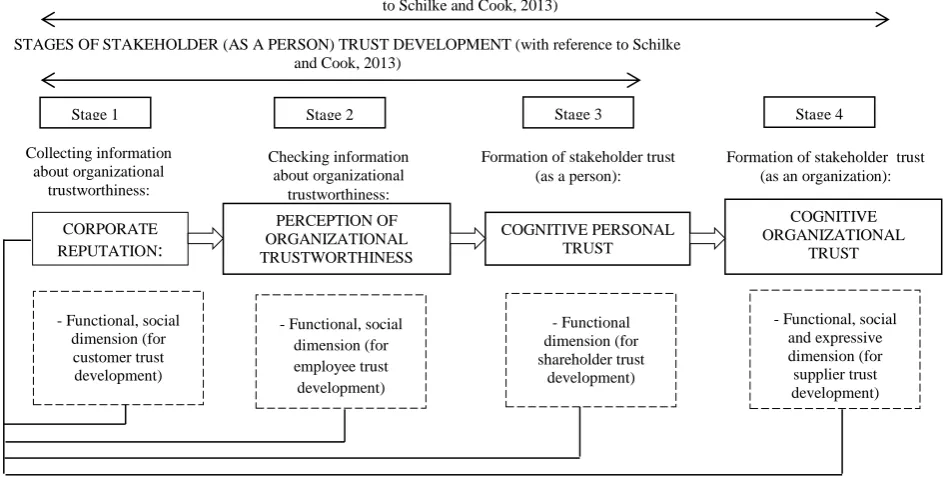
Based on the discussed theoretical studies on key stakeholders of an organization, stakeholder trust development, corporate reputation, and the factors determining the stakeholder trust, a conceptual model of key stakeholder trust development concerning the aspect of corporate reputation has been developed (see Figure 1).
The conceptual model of key stakeholder trust development in terms of corporate reputation reflects
stakeholder trust development of dual nature: trust between the stakeholder as a person and the organization (trust developed in three stages) and trust between the stakeholder as an organization and the organization (interorganizational trust developed in four stages).
Figure 1. Conceptual Model of Key Stakeholder Trust Development in Terms of Corporate Reputation
In case the trust is developed between the stakeholder as a person and an organization, the trust development ends in the third stage. However, the trust development between the stakeholder as an organization and another organization ends in the fourth stage, i.e. the trust of the person representing an organization that was formed in the third stage determines if the organization represented by the person will place trust in the other organization-partner. It is likely that the personal trust developed in the third stage will result in the stakeholder - as an organization - trust in the organization-partner.
Considering the theoretical study on fundamental dimensions of corporate reputation and its’ relationship with factors affecting stakeholder trust a conceptual model was designed involving dimensions of corporate reputation influential on the development of each stakeholders trust. It is proposed that both functional and social dimension of corporate reputation impact the development of customer and employee trust. The trust of shareholders can be developed only through functional dimension of corporate reputation while the trust of suppliers can be developed invoking all dimensions of corporate reputation, i.e. functional, social and expressive. To summarise, this model could be used with the purpose to identify the main tools which can help to develop – e.g. to create, to maintain or to restore the trust of particular stakeholder groups under unstable circumstances.
Conclusions
Stated that corporate reputation can create or develop the trust of stakeholders there was found the relationship between the main dimensions of corporate reputation and the factors of key stakeholders trust in the organization. This relationship has revealed thatthe trust of stakeholders can be based on certain dimensions of corporate reputation.
With reference to these insights, it is suggested to take note of the particular dimensions of corporate reputation on purpose to develop the trust of key stakeholders.
Whereas the development of trust has been defined as the process, it was highlighted that this process involves four stages through which the trust can be developed or not. The focal point was to ascertain which dimensions of corporate reputation impact this process in consideration of each stakeholder group. Summarizing the results of the theoretical study, it is concluded that in order to develop customer and employee trust in the organization, the organization should pay most attention to functional and social dimensions of corporate reputation; in case of shareholder trust - the attention should be paid to functional dimension; and in case of supplier trust the attention should be paid to functional, social and expressive dimensions of corporate reputation. The identified dimensions serve as main sources of information about corporate reputation that influence the perception of the organizational trustworthiness in the minds of the aforementioned stakeholders. The perception of the organizational trustworthiness that is determined by theidentified dimensions improves personal cognitive and organizational cognitive trust of individual stakeholders in the particular organization. The insights of a theoretical study reveal how the trust of the separate stakeholders should be developed.
However, future empirical research could shed further light on common dimensions of corporate reputation when developing the trust of key stakeholders. Since there were identified four fundamental stakeholder groups, four separate empirical surveys are planned to be held. Various sectors of outsourcing research opportunities were considered. According to public relations company “Nova media” (2013), Lithuanian consumer confidence index in thefollowing business sectors is decreasing: energy and natural resource companies, retail chains and shops, Stage 1 Collecting information about organizational trustworthiness: CORPORATE REPUTATION: Stage 2 Checking information about organizational trustworthiness: PERCEPTION OF ORGANIZATIONAL TRUSTWORTHINESS Stage 3
Formation of stakeholder trust (as a person):
Stage 4
COGNITIVE PERSONAL TRUST
Formation of stakeholder trust (as an organization):
COGNITIVE ORGANIZATIONAL
TRUST STAGES OF STAKEHOLDER (AS A PERSON) TRUST DEVELOPMENT (with reference to Schilke
and Cook, 2013)
STAGES OF STAKEHOLDER (AS THE ORGANIZATION) TRUST DEVELOPMENT (with reference to Schilke and Cook, 2013)
- Functional, social dimension (for customer trust development) - Functional dimension (for shareholder trust development) - Functional, social
dimension (for employee trust development)
construction and real estate companies, food and beverage manufacturers, pharmaceutical companies, banks and insurance companies, transport and transport companies, telecommunication companies and information technology companies. It should be noted that the majority of listed business sectors have faced crises which have negatively affected the reputation of the aforementioned business sectors. One of more interesting but less obvious remarks is that distrust in one business sector can reduce the trust in other similar business sector. In the media, pharmaceutical
sector is often identified with pharmacy sector. This situation increases public distrust of pharmacies. Invoking appropriate dimensions of corporate reputation it is possible to reduce the impact of third parties on stakeholder trust in particular business sector by developing stakeholder trust. Considering the problem of identifying pharmaceutical sector with pharmacy sector it can be useful to verify empirically the development of key stakeholders trust in case of pharmacy sector.
References
Bennett, R., & Gabriel, H. (2001). Reputation, trust and supplier commitment: the case of shipping company/seaport relations. Journal of Business & Industrial Marketing, 16 (6), 424–438. http://dx.doi.org/10.1108/EUM0000000006018 Boshoff, C. (2009). A psychometric assessment of an instrument to measure a service firm's customer-based corporate
reputation. South African Journal of Business Management, 40 (2), 35–44.
Bryson, J. M. (2004). What to do when stakeholders matter. Stakeholder identification and analysis techniques. Public Management Review, 6 (1), 21–53. http://dx.doi.org/10.1080/14719030410001675722
Dietz, G., & Hartog, D. N. D. (2006). Measuring trust inside organisations. Personnel Review, 35 (5), 557–588. http://dx.doi.org/10.1108/00483480610682299
Doney, P. M., & Cannon, J. P. (1997). An examination of the nature of trust in buyer-seller relationships. Journal of Marketing, 61, 35–51.http://dx.doi.org/10.2307/1251829
Dowling, G. R. (2004). Corporate reputations: should you compete on yours? California Management Review, 46 (3), 19– 36. http://dx.doi.org/10.2307/41166219
Edelman. (2014). 2014 Edelman Trust Barometer. Building Trust. Available from internet: http://www.edelman.com/ insights/intellectual-property/2014-edelman-trust-barometer/building-trust/
Eisenegger, M. (2009). Trust and reputation in the age of globalisation. In: J. Klewes, & R. Wreschniok (Eds.), Reputation capital. Building and maintaining trust in the 21st century (pp.11–22). Berlin: Springer-Verlag Berlin Heidelberg. http://dx.doi.org/10.1007/978-3-642-01630-1_2
Ertugrul, M., & Hegde, S. (2009). Corporate governance ratings and firm performance. Financial Management, Spring,
139–160.http://dx.doi.org/10.1111/j.1755-053X.2009.01031.x
Fang, E., Palmatier, R. W., Scheer, L. K., & Li, N. (2008). Trust at different organizational levels. Journal of Marketing, 72, 80–98.http://dx.doi.org/10.1509/jmkg.72.2.80
Fiedler, L., & Kirchgeorg, M. (2007). The role concept in corporate branding and stakeholder management reconsidered: are stakeholder groups really different? Corporate Reputation Review, 10 (3), 177–188. http://dx.doi.org/10. 1057/palgrave.crr.1550050
Florea, R., & Florea, R. (2013). Stakeholders interests analyse and harmonization - starting point of strategic approach.
Economy Transdisciplinarity Cognition, 16 (1), 130–135.
Fortune 500. (2015). World's Most Admired Companies 2015. Nine Key Attributes of Reputation. Available from internet: http://fortune.com/worlds-most-admired-companies/
Freeman, R. E. (1984). Strategic management: a stakeholder approach. Boston: Pitman.
Gil – Lafuente, A. M., & Paula, L. B. (2013). Algorithm applied in the identification of stakeholders. Kybernetes, 42 (5), 674–685. http://dx.doi.org/10.1108/K-04-2013-0073
Gould-Williams, J. (2003). The importance of HR practices and workplace trust in achieving superior performance: a study of public-sector organizations. International Journal of Human Resource Management, 14 (1), 28–54. http://dx.doi.org/10.1080/09585190210158501
Gregory, A. (2007). Involving stakeholders in developing brands: the communication dimension. Journal of Marketing Management, 23 (1/2), 59–73. http://dx.doi.org/10.1362/026725707X178558
Harris Interactive. (2015). The Harris Poll Reputation Quotient® (RQ®). Available from internet: http://www.harrisinteractive.com/Products/ReputationQuotient.aspx
Iannuzzi, A. (2000). Stakeholder trust: how do I get it? Environmental Quality Management, Autumn, 69–73. http://dx.doi.org/10.1002/1520-6483(200023)10:1<69::AID-TQEM8>3.0.CO;2-D
Jahansoozi, J. (2006). Organization – stakeholder relationships: exploring trust and transparency. Journal of Management Development, 25 (10), 942–955.http://dx.doi.org/10.1108/02621710610708577
Klozikova, J., & Dockalikova, I. (2014). Corporate governance rating: synthesis of rating models of corporate governance with utilization methods AHP and DEMATEL. Proceedings of the European Conference on Management, Leadership & Governance, 460–471.
Laeequddin, M., & Sardana, G. D. (2010). What breaks trust in customer supplier relationship? Management Decision, 48 (3), 353–365.http://dx.doi.org/10.1108/00251741011037738
Laeequddin, M., Sahay, B. S., Sahay, V., & Waheed, K. A. (2012). Trust building in supply chain partners relationship: an integrated conceptual model. Journal of Management Development, 31 (6), 550–564. http://dx.doi.org/10. 1108/02621711211230858
Lau, D. C., & Liden, R. C. (2008). Antecedents of coworker trust: leaders' blessings. Journal of Applied Psychology, 93 (5), 1130–1138.http://dx.doi.org/10.1037/0021-9010.93.5.1130
Mitchell, R. K., Agle, B. R., & Wood, D. J. (1997). Toward a theory of stakeholder identification and salience: defining the principle of who and what really counts. Academy of Management Review, 22 (4), 853–886.
Nova Media", public relations company (2013). Pasitikėjimas verslu Lietuvoje. Available from internet: http://www.novamedia.lt/tyrimai/Tyrimo%20ataskaita_2013_atnaujinta.pdf
Park, J., Gunn, F., & Han, S. L. (20121). Multidimensional trust building in e-retailing: cross-cultural differences in trust formation and implications for perceived risk. Journal of Retailing and Consumer Services, 19, 304–312. http://dx.doi.org/10.1016/j.jretconser.2012.03.003
Polonsky, M. J., & Scott, D. (2005). An empirical examination of the stakeholder strategy matrix. European Journal of Marketing, 39 (9/10), 1199–1215. http://dx.doi.org/10.1108/03090560510610806
Reputation Institute. (2012). The 2012 Global RepTrak® 100: results and report. Available from internet: http://www.rankingthebrands.com/PDF/2012%20RepTrak%20100-Global_Report,%20Reputation%20Institute.pdf Schanz, K. U. (2009). Maintaining stakeholder trust in difficult times: some fundamental reflections in light of the credit
crisis. The Geneva Papers, 34, 260–270.http://dx.doi.org/10.1057/gpp.2009.4
Schilke, O., & Cook, K. S. (2013). A cross-level process theory of trust development in interorganizational relationships.
Strategic Organization, 11 (3), 281–303. http://dx.doi.org/10.1177/1476127012472096
Sendjaya, S., & Pekerti, A. (2010). Servant leadership as antecedent of trust in organizations. Leadership & Organization Development Journal, 31 (7), 643–663. http://dx.doi.org/10.1108/01437731011079673
Shahsavari, A., & Faryabi, M. (2013). The effect of customer-based corporate reputation on customers' citizenship behaviors in banking industry. Research Journal of Applied Sciences, Engineering and Technology, 6 (20), 3746–3755.
Shank, T., Hill, R. P., & Stang, J. (2013). Do investors benefit from good corporate governance? Corporate Governance, 13 (4), 384–396.http://dx.doi.org/10.1108/CG-03-2010-0027
Six, F., & Skinner, D. (2010). Managing trust and trouble in interpersonal work relationships: evidence from two Dutch organizations. The International Journal of Human Resource Management, 21 (1), 109–124.http://dx.doi.org/10. 1080/09585190903466913
Terblanche, N. S. (2014). Validation of the customer-based corporate reputation scale in a retail context. International Journal of Market Research, 56 (5), 655–671.http://dx.doi.org/10.2501/IJMR-2014-044
Van der Merwe, W. A. J., & Puth, G. (2014). Towards a conceptual model of the relationship between corporate trust and corporate reputation. Corporate Reputation Review, 17, 138–156.http://dx.doi.org/10.1057/crr.2014.4
Verhoeven, J. W. M., Van Hoof, J. J., Keurs, V. T., & Van Vuuren, M. (2012). Effects of apologies and crisis responsibility on corporate and spokesperson reputation. Public Relations Review, 38, 501–504.http://dx.doi.org/10.1016/ j.pubrev.2012.02.002
Viitaharju, L., & Lahdesmaki, M. (2012). Antecedents of trust in asymmetrical business relationships. Differing perceptions between food producers and retailers. Marketing Intelligence & Planning, 30 (5), 567–587.http://dx.doi.org/10. 1108/02634501211251061
Walsh, G., & Beatty, S. E. (2007). Customer-based corporate reputation of a service firm: scale development and validation.
Walsh, G., Beatty, S. E., & Shiu, E. M. K. (20091). The customer-based corporate reputation scale: replication and short form. Journal of Business Research, 62, 924–930.http://dx.doi.org/10.1016/j.jbusres.2007.11.018
Walsh, G., Mitchell, V. W., Jackson, P. R., & Beatty, S. E. (20092). Examining the antecedents and consequences of corporate reputation: a customer perspective. British Journal of Management, 20, 187–203.http://dx.doi.org/10. 1111/j.1467-8551.2007.00557.x
Weber, J. M., Malhotra, D., & Murnighan, J. K. (2005). Normal acts of irrational trust: motivated attributions and the trust development process. Research in Organizational Behavior, 26, 75–101.http://dx.doi.org/10.1016/S0191-3085(04)26003-8
Xu, J., & Thomas, H. C. (2011). How can leaders achieve high employee engagement? Leadership & Organization Development Journal, 32 (4), 399–416.http://dx.doi.org/10.1108/01437731111134661