International Journal for Mathematics Teaching and Learning 2017, Vol. 18.3, 273 - 292
273
In-Service Teachers’ Perceptions and Interpretations of Students’
Errors in Mathematics
Million Chauraya
Midlands State University, Zimbabwe
Samuel Mashingaidze
Midlands State University, Zimbabwe
This paper reports on findings of a research study that investigated in-service secondary school teachers’ perceptions and interpretations of students’ errors in mathematics. The study used a survey research design in which a questionnaire with two sections was used to collect data. The first section sought to find out the teachers’ perceptions of the nature of errors. In the second part the teachers were asked to explain five common errors in algebra. A sample of forty-two mathematics teachers randomly drawn from one university in Zimbabwe constituted the respondents for the study. The findings showed that teachers perceived errors as not solely due to the student, but also as due to other factors arising from teaching and the nature of the subject. The teachers also regarded errors as useful for further inquiry in mathematics, as a normal part of learning, and as a result of previous knowledge not well understood by learners. In their explanations of given errors in algebra the teachers gave mainly procedural explanations, some of which lacked clarity or were incorrect. The study recommends the need for pre-service and in-service teacher professional development programmes to incorporate error analyses so as to develop teachers’ understanding of the nature and role of errors in the teaching and learning of mathematics.
Keywords: Errors; mathematics; school teachers; algebra; conceptions of errors
Students’ learning of mathematics involves making errors. Errors are common in the teaching and learning of the subject as well as in students’ written work. During instruction mathematics teachers respond differently to their students’ errors. Some teachers respond by ignoring errors while others make efforts to engage with the errors (Brodie, 2014). For more than a decade there has been a growing interest in students’ errors and misconceptions in mathematics (Borasi, 1987; Brodie, 2014; Shalem & Sapire, 2012; Smith, Disessa, & Roschelle, 1993), and research in this area is on-going. There have been calls for teachers to embrace errors rather than avoid them (Borasi, 1987). Such thinking is based on the justification that errors in mathematics are pervasive and systematic (Nesher, 1987), and often are a result of mathematical thinking on the part of the students, and hence are reasoned and reasonable for the students (Brodie, 2014).
These views on errors suggest that teachers need to respond to students’ errors in ways that involve understanding the students’ thinking behind the error, which in turn can inform teaching. Such ways of dealing with errors require that teachers shift their understanding of students’ errors; from viewing errors as obstacles to learning mathematics, to an understanding of errors as integral to learning mathematics and as possible sources of learning mathematical concepts (Borasi, 1994). In this study we investigated a group of in-service secondary school mathematics teachers’ understanding of students’ errors in mathematics. Understanding how mathematics teachers’ perceived and interpreted students’ errors was seen as one way of accounting for the ways in which teachers’ respond to errors in instructional situations.
The nature of errors in mathematics
International Journal for Mathematics Teaching and Learning 2017, Vol. 18.3, 273 - 292
274
Africa called the Data Informed Practice Improvement Project (DIPIP) errors were defined as “systematic, persistent and pervasive mistakes performed by learners across a range of contexts” (Brodie, 2014, p. 223). In DIPIP students’ errors were regarded as evidence of learner thinking on which teachers could draw to help learners understand mathematical concepts. In this paper we share the same view of errors and argue that teachers need to view errors as integral to learning mathematics if they are to help students in teaching and learning situations. In the study we sought to find out how a group of practicing mathematics teachers viewed and explained learner errors.
In mathematics errors are different from slips. Slips are mistakes that are easily corrected (Olivier, 1996). In teaching and learning situations when students make slips these are often easily identified and corrected either by the student or the teacher. Slips usually do not recur once they are corrected. Errors are mistakes that tend to recur. Errors arise independently of teaching methods used (Peng & Luo, 2009) and are often persistent even when corrected (Smith et al., 1993). According to White (2005) it is important for teachers to find out why students make the errors in the first place. Errors have also been characterised as a world-wide phenomenon and are made by students of any age, country, or ability (Gagatsis & Kyriakides, 2000). These ideas highlight the pervasiveness and persistence of errors, which implies that irrespective of teaching methods, errors will always arise in the process of students’ learning of mathematics. It was our view in this paper that teachers need to have this understanding of errors if they are to engage productively with errors in their teaching for the benefit of students’ understanding of mathematical concepts.
Theoretical explanations of errors in mathematics
Theoretical explanations for errors have been provided mainly from a constructivist perspective. Before the advent of constructivism, errors were negatively viewed as digressions, a result of some confusion on the part of the student, and as unfortunate events that had to be eliminated and avoided at all times (Gagatsis & Kyriakides, 2000; White, 2005). From a constructivist perspective, errors are explained as:
results of gaps in comprehension that threaten students’ construction of knowledge and the coherent structure of mathematics (Legutko, 2008);
the result of applying previously acquired and correct knowledge to mathematical situations where the knowledge is inapplicable (Gagatsis & Kyriakides, 2000; Radatz, 1979);
a result of misconceptions, which are “consistent conceptual frameworks based on earlier acquired knowledge” (Nesher, 1987, p. 33) and make sense to students as they make conceptual links to knowledge they acquired previously (Lourens & Molefe, 2011);
a result of prior conceptions or misconceptions that students use to interpret phenomena, events and situations in their construction of knowledge in the classroom (Erlwanger, 1973; Smith et al., 1993).
International Journal for Mathematics Teaching and Learning 2017, Vol. 18.3, 273 - 292
275
These constructivist explanations of errors highlight the centrality of students’ conceptual structures and how these structures are deployed in learning new mathematical knowledge. As students are faced with new situations they draw on their prior knowledge or experiences to make sense of the new situations. The basic cognitive argument is that in making attempts to work with previously acquired knowledge in novel situations students’ prior knowledge becomes inadequate for explaining phenomena and solving new problems, hence errors occur (Smith et al., 1993). Thus errors are seen as reasonable and sensible for students in that they are a result of a student’s reasoning within the context of existing mathematical knowledge and the student is normally convinced that the working is correct (Brodie, 2014; Lourens & Molefe, 2011). This view of errors suggests the need for teachers to engage with students’ errors in ways that enable them to identify the students’ thinking or conceptions behind any observed errors. Such knowledge will enable teachers to deal with students’ errors in ways that support students in accessing the correct mathematical knowledge.
This study reported in this paper was based on the argument that teachers’ perceptions and understandings of students’ errors can support or constrain their ways of engaging with errors in instructional situations. The research questions on which this study was based were:
i) What conceptions of errors do practising mathematics teachers hold?
ii) How do practising mathematics teachers interpret some common students’ errors in algebra?
The study was conducted in the area of algebra. Our interest in algebra was motivated by the significance of algebra in mathematics and the challenges that students face in learning this area of mathematics (Booth, 1988; Usiskin, 1995, 1999).
Some research findings on teachers’ conceptions of students’ errors
Research on teachers’ perceptions of students’ errors can be classified into three categories. The first category relates to studies that sought to investigate teachers’ interpretations of common students’ errors in mathematics (e.g. Gagatsis & Kyriakides, 2000; Shalem, Sapire, & Sorto, 2014; Sheinuk, 2010). The second category is that of studies that sought to explain the reasons for students’ errors in mathematics (e.g. Hall, 2002; Legutko, 2008; McNamara & Shaughnessy, 2011; Radatz, 1979). The last category are studies that investigated teachers’ perceptions of students’ errors (e.g. Gagatsis & Kyriakides, 2000). Our study fell in the first category of these studies. We elaborate on some findings of the studies in this category.
International Journal for Mathematics Teaching and Learning 2017, Vol. 18.3, 273 - 292
276
knowledge of the mathematics content to explain learners’ errors, and that the explanations were mostly procedural rather than conceptual.
In their study, Gagatsis and Kyriakides (2000) asked teachers who participated in an in-service course in mathematics about their understanding of causes of students’ errors and their explanations of particular errors. The researchers found that the specialised course had an effect on the teachers’ understandings and explanations of errors. The teachers no longer attributed errors to student factors only such as students’ attitudes, but saw and explained errors as a result of the nature of mathematical knowledge and the rules in mathematics, for example viewing errors as a result of previous correct knowledge which is not applicable in a new situation. The teachers also attributed students’ errors to the ‘didactic contract’. The didactic contract refers to “the widespread tendency by pupils to answer school mathematics word problems with apparent disregard for the reality of the situations described by the text of the problems” (Gagatsis & Kyriakides, 2000, p. 28). Examples of adhering to the didactic contract occur when students accept a solution to a problem on the basis of their computation, although the solution may not make sense in the context of the problem.
The study by Gagatsis and Kyriakides influenced our study in two ways. In the first part of our study we investigated the participating teachers’ understanding of the nature of errors and their attribution of the sources of errors in mathematics. This is similar to Gagatsis and Kyriakides’ investigation of the teachers’ understanding of the causes of students’ errors. In the second part of our study we investigated the teachers’ interpretation of some common students’ errors in algebra; which is similar to Gagatsis and Kyriakides’ study of the teachers’ interpretation of particular errors in mathematics. The difference in the second part of the study was that we investigated the teachers’ explanations of errors on algebra, while Gagatsis and Kyriakides focused on errors in arithmetic. Because of the similarities in our study to the study by Gagatsis and Kyriakides we adapted their questionnaire in our study with some modifications, and we elaborate on this in the methodology section below.
Students’ errors in algebra
For most students entering secondary school, learning algebra marks a departure from the world of numbers that they were used to in the primary school to the use of letters in learning mathematics. Although the rules for manipulating numbers are the same as those for algebraic systems, students usually find it difficult to shift from working with numbers to working with letters (Booth, 1988). Research on students’ errors in algebra highlights some common errors that are attributed to students’ understanding of letters as used in algebra and algebraic processes (Booth, 1988; Booth & Koedinger, 2008; Legutko, 2008).
Booth’s work on students’ errors and misconceptions in algebra has highlighted some interesting insights into possible origins of errors and misconceptions (e.g. Booth, 1988; Booth, Barbieri, Eyer, & Pare-Blagoev, 2014; Booth & Koedinger, 2008). According to Booth (1988) students’ errors in algebra can be attributed to: a conception that answers have to be numerical; students’ interpretation of operational symbols in algebra; perceptions of letters as objects rather than variables; and misunderstandings from arithmetic that are carried over to algebra. In his study, Booth (1988) found that students could not find the perimeter of an n-sided regular shape when given the length of each side. For the students the perimeter could only be found if the numerical value of n was known. The study also found that when given expressions such as
b
a 5
International Journal for Mathematics Teaching and Learning 2017, Vol. 18.3, 273 - 292
277
a signal to add as normally used in arithmetic, and a belief that an answer has to be a ‘single’ term. Students could also not explain the meaning of letters in given expressions. For example when asked what y represented in an expression such as 3+5y, students said that y stood for anything such as a ‘yatch’ or ‘yam’ (Booth, 1988). Such responses indicated students’ conceptions of letters as standing for objects rather than variables, and such conceptions have been found to cause a number of common errors in learning algebra. It is important for mathematics teachers to understand and explain these errors if they are to help students to deal with some of the common errors in algebra. In this paper we present teachers’ explanations of some common students’ errors in algebra. We were interested in finding out if the teachers could explain these errors in ways that showed that they understood the students’ reasoning behind these errors, and how the errors could be tied to some misconceptions in algebra.
Methodology
The study used a survey research design. The research participants were forty-two secondary school mathematics teachers enrolled for the Bachelor of Education (B. Ed.) degree in mathematics at one university in Zimbabwe. The B. Ed. degree is offered to teachers with teaching diplomas who want to upgrade their qualifications to degree level, majoring in particular teaching subjects. The study was carried out at the point of enrolment as one way of ascertaining the learning needs for the teachers, which information could be used in further designing of the content of the degree programme. All the participants had teaching diplomas from the various teachers’ training colleges in Zimbabwe and all had majored in mathematics. Most of them had post-diploma mathematics teaching experience of between four and ten years, although the maximum teaching experience was twenty-three years. Twelve of the respondents were Heads of Mathematics Departments (HODs) in their schools.
Data was collected using a questionnaire adapted from the study by Gagatsis and Kyriakides (2000) with some adjustments. While Gagatsis and Kyriakides studied teachers’ understanding of students’ errors, the focus of our study was on teachers’ perceptions on the nature and possible causes of errors. We also wanted to find out how the teachers explained some common errors in algebra. The questionnaire had two sections. The first section had nineteen statements on the nature and possible causes of students’ errors in mathematics. The teachers had to respond by indicating their level of agreement or disagreement with each statement by choosing from the options: Strongly Agree (SA); Agree (A); Undecided (U); Disagree (DA); Strongly Disagree (SDA). In the second section of the questionnaire the teachers were provided with five sample student errors in algebra and were required to give explanations or reasons for each error. The aim of this section of the questionnaire was to find out how the teachers interpreted the errors by giving reasons why students would make each error. This is similar to Part B of the questionnaire used by Gagatsis and Kyriakides (2000) although the examples of errors were different. Another difference between our study and the Gagatsis and Kyriakides study was in the participants. In our study the teachers were practising secondary school mathematics teachers who had not attended any specific mathematics course on errors, while the other study involved teachers who had attended a specific course in mathematics.
Data Analysis
International Journal for Mathematics Teaching and Learning 2017, Vol. 18.3, 273 - 292
278
responses we classified the statements into three categories as follows: statements that linked errors to student related factors such as knowledge, attitudes and study habits; statements that connected errors to teaching and teacher behaviours; and statements that connected errors to the content and nature of mathematics. This categorisation was influenced, in part, by research findings on teachers’ interpretations of students’ mathematical errors. For example, Gagatsis and Christou (1997) found that most primary school teachers attributed errors to students’ psychological situations, limited capabilities and lack of knowledge. The categorisation enabled us to determine the extent to which the teachers attributed errors to a particular category of factors. We present and analyse the results of the teachers’ responses to statements in each category separately in the next section.
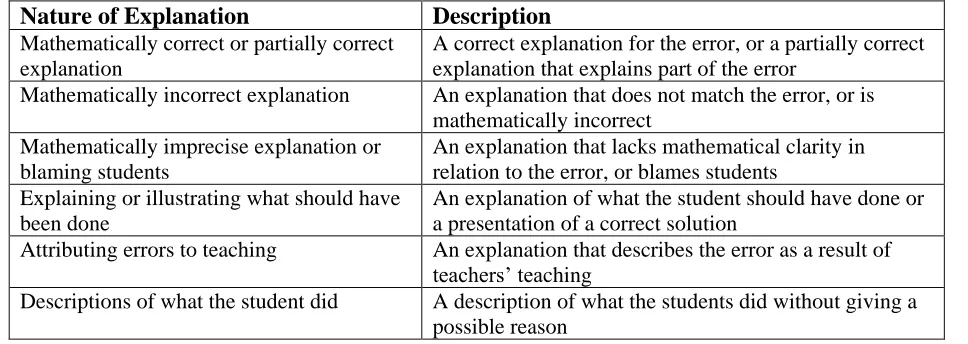
Data on teachers’ interpretation or explanations of some common student errors was analysed using a coding framework developed through a thematic analysis of the teachers’ explanations of the errors (Vaismoradi, Turunen, & Bondas, 2013). Six categories or codes were developed into a coding framework shown in Table 1 below.
Nature of Explanation Description
Mathematically correct or partially correct explanation
A correct explanation for the error, or a partially correct explanation that explains part of the error
Mathematically incorrect explanation An explanation that does not match the error, or is mathematically incorrect
Mathematically imprecise explanation or blaming students
An explanation that lacks mathematical clarity in relation to the error, or blames students
Explaining or illustrating what should have been done
An explanation of what the student should have done or a presentation of a correct solution
Attributing errors to teaching An explanation that describes the error as a result of teachers’ teaching
Descriptions of what the student did A description of what the students did without giving a possible reason
Table 1: Framework for analysing teachers’ explanations of the given errors
In one category we combined an explanation that was not mathematically precise in terms of what the error was with blaming students for the error. This was done because in the majority of cases the teachers expressed both in one explanation. An example of such explanations was “Student has a problem in removing brackets on quadratic expressions”. Such explanations tended to begin by blaming the student and then making reference, in unclear terms, to what was the mathematical cause behind the error. In validating the framework, the two of us initially coded the teachers’ reasons or explanations of each error separately and then we discussed and agreed on the validity of each code.
It should be noted that although the teachers were asked to give a possible reason or explanation for each error, the framework shows that some of the teacher responses were not actually reasons for the errors. For example, explaining what the students should have done does not constitute a reason for the error. Similarly, simply describing what the student did is not a reason for why the students made the error. We however classified these responses as significant codes due to their frequency in the teachers’ responses. We revisit this observation later in the paper.
International Journal for Mathematics Teaching and Learning 2017, Vol. 18.3, 273 - 292
279
We present and discuss our findings in two parts. In the first part we present our findings on the teachers’ perceptions of learners’ errors and in the second part we present the teachers’ explanations of the five common students’ errors in algebra.
The teachers’ perceptions of errors in mathematics
As indicated above in our analysis we categorised the statements on learner errors in the questionnaire into the following three categories: statements linking errors to student-related factors; statements linking errors to teachers’ teaching and selection of tasks in mathematics; and statements linking errors to the nature of mathematics and learning mathematics. For expediency in our analysis we classified ‘Strongly Agree’ (SA) and ‘Agree’ (A) as indicating agreement with a statement. Similarly ‘Disagree’ (DA) and ‘Strongly Disagree’ (DA) were grouped together as indicating disagreement with a statement. Thus in our analysis we finally had three categories of responses on each statement: ‘Agreement’; ‘Undecided’ or ‘Disagreement’. The frequencies of responses to each statement were expressed as percentages, and the results are presented in the form of graphs.
Responses on statements linking errors to student-related factors
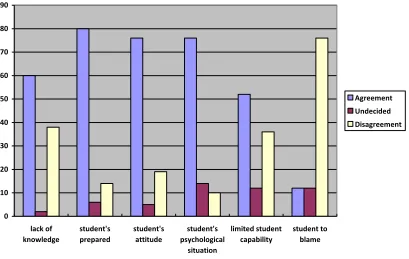
Fig. 1 shows the results on statements that linked errors to student-related factors. The statements in the questionnaire had the following as possible reasons why students make errors: a student’s lack of knowledge; a student’s preparedness or lack of preparedness; a student’s attitude; a student’s psychological situation; a student’s limited capability or competence; and simply blaming students for errors.
0 10 20 30 40 50 60 70 80 90
lack of knowledge
student's prepared
student's attitude
student's psychological
situation
limited student capability
student to blame
Agreement Undecided Disagreement
International Journal for Mathematics Teaching and Learning 2017, Vol. 18.3, 273 - 292
280
The graph shows that most of the teachers in the study attributed errors to student-related factors such as lack of knowledge, lack of adequate preparation, students’ attitudes, students’ psychological situations and students’ limited capabilities. This is consistent with other research findings that show the tendency by teachers to perceive errors as results of student-related factors (e.g. Gagatsis & Christou, 1997; Gagatsis & Kyriakides, 2000). Accounting for students’ errors through student-related deficiencies and/or incapabilities can constrain teachers’ efforts to understand more pertinent causes of students’ errors such as the nature of the tasks and prior learning experiences. An interesting finding was that the teachers tended to disagree with the statement that students were to blame for errors. This could be an indication that the teachers perceived other factors besides students to be the cause of errors, something that could have been ascertained through interviews with the respondents. We did not interview the teachers, and this was a limitation in our study.
Responses on statements linking errors teachers’ teaching
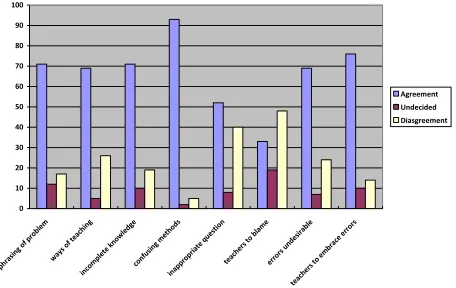
Eight statements in Part A of the questionnaire were on teacher pedagogical practices as possible reasons for students’ errors. Fig. 2 below shows the results of the teachers’ responses on these statements.
0 10 20 30 40 50 60 70 80 90 100
phr asing
of probl em
way s of
teachi ng
incom plet
e knowl edge
conf using
met hods
inappropr iate
que stion
teache rs to bl
ame
errors unde
sirabl e
teache rs to em
brace e rrors
Agreement Undecided Diasgreement
Fig. 2: Teachers’ responses on statements linking errors to teachers’ pedagogy (N=42)
International Journal for Mathematics Teaching and Learning 2017, Vol. 18.3, 273 - 292
281
student-related factors such as forgetting previously taught knowledge, we classified them in this category as they reflected connections to how students’ understanding of the teachers’ teaching could explain errors. The teachers’ agreement with these statements could indicate their awareness of how their teaching could contribute to students’ errors. However there were mixed responses to the statement linking errors to the inappropriateness of mathematical tasks to students’ capabilities, with a slight majority agreeing and a significant number disagreeing. Agreement with the statement may indicate awareness that some mathematical tasks may be beyond students’ capabilities, and therefore could be the source of errors in mathematics. Disagreement with the statement could be an indication that these teachers believed the mathematical tasks given to students were always within the students’ capabilities, and therefore any errors should be a result of student-related factors. The teachers were also split in terms of agreement with the statement that teachers were to blame for students’ errors. A slight majority disagreed; an indication that these teachers regarded their teaching as not contributing to students’ errors. Such a perception on the part of teachers reflects an incomplete understanding of errors as pervasive and often recurrent, irrespective of the way teachers teach (Brodie, 2014).
Responses on statements linking errors to the nature of mathematics and mathematics learning
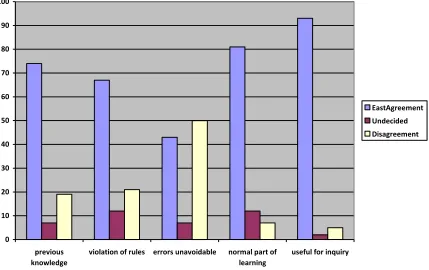
Fig 3 shows how the teachers responded to statements linking errors to the nature of mathematics and mathematics learning.
0 10 20 30 40 50 60 70 80 90 100
previous knowledge
violation of rules errors unavoidable normal part of learning
useful for inquiry
EastAgreement Undecided Disagreement
Fig. 3: The teachers’ responses to statements linking errors to the nature of mathematics
International Journal for Mathematics Teaching and Learning 2017, Vol. 18.3, 273 - 292
282
mathematics; and the potential of errors as useful resources for inquiry into mathematical concepts. The underlying theme in the statements is that errors are a normal part of learning mathematics.
Fig. 3 shows that the teachers were mostly in agreement with four statements that linked errors to the nature of mathematics as a subject. Viewing errors as due to generalisation of correct mathematical knowledge to situations where such knowledge is inapplicable can be attributed to the teachers’ understanding of the nature of mathematics where some forms of knowledge can be used to solve mathematical tasks in different areas of the subject. The teachers’ agreement with attribution of errors to violation of mathematical rules could be a result of their awareness that mathematics is a rule dominated subject, and errors can be a result of confusing one rule with another rule. Students are usually taught to memorise rules or procedures without any understanding of the conceptual meanings of the procedures, hence forgetting or mixing up one procedure with another is expected in students’ solutions of mathematical tasks. The teachers were also in agreement that errors are a normal part of learning mathematics and that errors can be useful resources for inquiry in mathematics. Agreement with these statements could be an indication of their appreciation that errors are part and parcel of mathematics and learning mathematics. However there was split agreement with the statement that errors are unavoidable in mathematics. A slight majority of the teachers perceived errors as avoidable. Perceiving errors as avoidable is inconsistent with some theoretical explanations of the nature of errors in mathematics, which highlight that errors show students’ reasoning; are a necessary part of learning mathematics; and can provide teachers access to students’ thinking (e.g. Borasi, 1994; Brodie, 2014). Teachers who perceive errors as avoidable are likely to be frustrated when learners make errors.
Our findings on the teachers’ perceptions of errors raise a number of issues. The teachers were generally in agreement that errors were linked to student-related factors, something that was found out in other studies (e.g. Gagatsis & Christou, 1997). While it is correct that these factors can contribute to errors, errors cannot be wholly attributed to students, and doing so reinforces the tendency to place the blame for errors on students. We believe that teachers need to view errors as due to other causes rather than student related factors only. Hence the finding from our study that significant numbers of teachers were in agreement that teaching-related factors can contribute to the occurrence of errors was fortifying for us. Such an understanding of errors can support shifts from blaming students for errors. Teachers were also in agreement that errors could be due to the nature of mathematics. We think this understanding of the nature of errors is a useful and progressive step towards realising that errors are pervasive, systematic and persistent (Nesher, 1987; Smith et al., 1993) and are unavoidable in teaching situations (White, 2005). Teachers who have this understanding of the nature of mathematics are likely to engage with errors, rather than avoid them in their teaching.
International Journal for Mathematics Teaching and Learning 2017, Vol. 18.3, 273 - 292
283
blame students for errors, and in the process constrain their capacity to productively engage with errors for the benefit of students’ learning.
The teachers’ interpretation of some common student errors in algebra
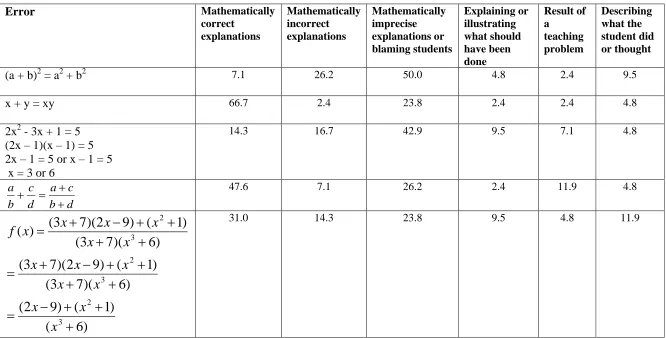
In this section we present the teachers’ explanations of five common errors in algebra according to the categories or codes described earlier in the paper. Table 2 below shows the percentages of the teachers’ responses in each category for each error.
International Journal for Mathematics Teaching and Learning 2017, Vol. 18.3, 273 - 292
284
Error Mathematically
correct explanations Mathematically incorrect explanations Mathematically imprecise explanations or blaming students Explaining or illustrating what should have been done Result of a teaching problem Describing what the student did or thought
(a + b)2 = a2 + b2 7.1 26.2 50.0 4.8 2.4 9.5
x + y = xy 66.7 2.4 23.8 2.4 2.4 4.8
2x2 - 3x + 1 = 5 (2x – 1)(x – 1) = 5 2x – 1 = 5 or x – 1 = 5 x = 3 or 6
14.3 16.7 42.9 9.5 7.1 4.8
d b c a d c b a
47.6 7.1 26.2 2.4 11.9 4.8
)
6
(
)
1
(
)
9
2
(
)
6
)(
7
3
(
)
1
(
)
9
2
)(
7
3
(
)
6
)(
7
3
(
)
1
(
)
9
2
)(
7
3
(
)
(
3 2 3 2 3 2
x
x
x
x
x
x
x
x
x
x
x
x
x
x
f
31.0 14.3 23.8 9.5 4.8 11.9
International Journal for Mathematics Teaching and Learning 2017, Vol. 18.3, 273 - 292
285
Teachers’ explanations of the error on binomial expansion
The error, (a + b)2 = a2 + b2, is a common error is algebra which is normally associated with over-generalisation of statements such as (ab)2 = a2b2 or (a x b)2 = a2 x b2. Results show that generally the teachers found this error difficult to explain. Only seven percent of the teachers gave correct explanations. Fifty percent of the teachers gave mathematically imprecise explanations or simply blamed students for the error without giving reasons for the error. Examples of imprecise explanations were:
‘lack of knowledge of expansion of brackets or expressions’; ‘misconception of expansion’; ‘student has a problem in removing brackets on quadratic expressions’; ‘violation of mathematical rules’; and ‘pupil is lazy to follow the expansion procedures’.
These explanations were imprecise in that they did not actually indicate what was actually wrong; the tendency was to generalise the error as due to ‘removing brackets’. The explanations also linked the error to the procedure for expanding (a + b)2, rather than connecting the error to other mathematical structures and procedures.
A significant number of the teachers (26.2%) gave mathematically incorrect explanations. Examples of such explanations were:
‘students confusing a2
-b2 with a2+b2’; ‘lack of knowledge of order of operations’; ‘poor background of indices’; and ‘incomplete knowledge on factorisation’.
We classified these explanations as incorrect because there was very little connection between the explanation and the error. That a significant number of teachers gave incorrect explanations for the error was a cause for concern to us. Failure to correctly explain a student’s error implies that the teacher won’t be able to access the reasoning behind the error, and therefore may not be able to productively help the student in correcting the error.
Teachers’ explanations of the conjoining error
The second error, x + y = xy, is also common in algebra and is an example of conjoining the terms (Booth, 1988). Such an error is due to students’ interpretation of the ‘+’ and ‘=’ signs. For twelve-year olds up to fourteen-year-old students the two signs are signals that an action has to be performed that results in an answer (Booth, 1988). This is understandable given that in the domain of real numbers the result of addition is always another number that is unique. This understanding is normally carried forward into algebra, resulting in such errors.
Most of the teachers in the study (66.7%) provided mathematically correct or partially correct explanations of this error. Examples of the explanations were:
‘just as the addition of say 1+2=3 which is a single answer, pupil seeks to get single answer by eliminating the plus’; ‘failure to note the difference between addition of numbers and that of letters’; and pupil failed to understand terms that cannot be added together e.g. g+p, but they can be multiplied to give a term g x p = gp but g + p ≠ gp’.
International Journal for Mathematics Teaching and Learning 2017, Vol. 18.3, 273 - 292
286
The next category of explanations of this error worth mentioning was that of imprecise explanations or blaming students. A significant number of teachers (23.8%) gave such explanations as:
‘lack of mastery of the algebraic processes’; ‘failure to apply knowledge on addition of symbolic terms’; ‘failing to interpret the meaning of basic operations and their applicability to algebra’; ‘pupil cannot apply concepts taught on addition of unlike terms’; and ‘failure to understand concept of addition and multiplication of algebraic terms’.
A common theme in these explanations is blaming students without specifying the underlying cause or thinking behind the error. The explanations do not actually specify what it is that the students know or think that could have resulted in the error. Such explanations of errors are not helpful if teachers are to engage with errors in productive ways.
The teachers’ explanations of the error on solving a quadratic equation through factorisation
The third error is also quite common when students are solving quadratic equations using the method of factorisation. The method is based on an application of one of the properties of the number ‘0’, i.e. if for any two numbers, a and b, a x b = 0 it implies that either a = 0 or b = 0. In teaching situations this explanation of why the right hand side has to be equal to zero is not usually provided to students. Teachers usually emphasise factorisation, and once factors are easily identifiable students may rush into factorising disregarding the other conditions necessary for the method to work.
Only 14.3% of the teachers gave correct, or partially correct, explanations. Examples of these explanations were:
‘student lacks the knowledge that factorisation can only be done when the RHS=0’; ‘student is not aware of the standard form of the quadratic equation which is ax2+bx+c=0’; and ‘generalisation of solving quadratic equations in factorised form, i.e. (A)(B) = 0 where the pupil is used to say either A=0 or B=0’.
Although these explanations are correct, they are procedural in that they are based on descriptions of the procedures to follow in solving quadratic equations through factorisation. There was no evidence to suggest that the teachers were aware of the reason why the right hand side has to be zero; or why the equation has to be in ‘standard form’ of a quadratic equation.
Most of the teachers (42.9%) gave mathematically imprecise explanations of this error. Examples of such explanations were:
‘failure to rearrange the equation’; ‘student forgot to exclude 5 since 5 has not been moved to the other side when factorising’, ‘failure to understand the method of solving equations’; ‘lack of techniques in solving equations especially quadratic equations’; ‘misunderstanding of quadratic expressions’; and ‘failure to grasp the concept of solving quadratic equations’.
International Journal for Mathematics Teaching and Learning 2017, Vol. 18.3, 273 - 292
287
There was a significant number of teachers (16.7%) who gave incorrect explanations of this error. Examples of such explanations were:
‘student confused the use of the quadratic formula and factorisation method of solving quadratic equations’; ‘failure to understand the meaning of a bracket and using the wrong concept’; ‘student is able to factorise but the error is on simplification of equations on 2x-1’; and ‘student failed to find the factors so that the result will mean two factors should replace the unlike term and when multiplied obtain the last term after multiplying by 2’.
For us these explanations were incorrect in the sense that they did not explain the error in any meaningful way. The explanations reflect inadequate understanding of the error and the thinking behind the error.
Teachers’ explanations of the error in adding algebraic fractions
The fourth error in adding two algebraic fractions is also common, and is usually associated with the students’ belief that when adding fractions one has to add numerators and denominators separately (Brown & Quinn, 2006). Such an understanding can also be an over-generalisation of multiplication of common fractions to addition of similar fractions. The error can also be linked to inadequate understanding of what a common denominator is and why one has to find a common denominator when adding fractions.
Most of the teachers (46.7%) were able to give correct or partially correct explanations for this error. Examples of the explanations were:
‘student confuses addition of fractions with multiplication of fractions’; ‘failure to find the common denominator’; ‘no idea on addition of fractions with different denominators’; ‘lack of enough knowledge on expressing algebraic fractions as a single fraction where a common denominator should be calculated first’; and ‘little knowledge on how to find a common denominator of algebraic fractions’.
While these explanations were correct, they were all procedural explanations that described either what the student could not do or what steps the student did not know. This is consistent with how addition of such fractions is taught. Teachers normally teach students the procedures of how to add such fractions, step by step, without engaging with the meaning of a denominator and a common denominator.
A significant number of the teachers (26.2%) gave explanations that were imprecise or blamed students for the error. Examples of such explanations were:
‘misunderstanding of the concepts of addition of fractions’; ‘failing to apply the rule for addition of fractions’; ‘misconceptions on addition and simplification of algebraic expressions’; ‘violation of mathematical rules’; ‘failure to find the LCM’; ‘lacking knowledge of adding fractions by first dividing by the lowest common multiple’; and ‘applied a wrong method for addition of fractions’.
International Journal for Mathematics Teaching and Learning 2017, Vol. 18.3, 273 - 292
288
An interesting observation was that 11.9% of the teachers saw this error as a result of teaching. Examples of these teachers’ explanations were:
‘improper teaching of fractions, pupils believe that addition of fractions is when you add numerators on their own and denominators on their own’; ‘the basic rules for addition of fractions might have been missed from primary school level’; ‘right from Grade 7 the student did not grasp the method of simplifying fractions through addition’; and ‘the concept of finding the common denominator was not well understood or it was not taught well’.
These explanations indicate that the teachers were able to connect the error to previously taught knowledge on addition of numerical common fractions. For these teachers the error was a result of some deficiency in teaching addition of fractions involving real numbers. Linking the error to prior teaching and learning experiences situates teachers in positions in which they can make informed decisions on how to help students to deal with the error, or how to change their teaching.
Teachers’ explanations of the error in simplifying algebraic fractions by identifying and
cancelling common factors
The fifth error arises in students’ efforts to work with the idea of identifying common factors in the numerator and denominator of a given fraction, and cancelling out the common factor(s). In teaching situations teachers normally emphasise the need to identify and cancel factors that are common in both the numerator and the denominator. In this case such knowledge leads the students to identify (3x+7) as a common factor in both numerator and denominator, and cancelling it. This is a case in which mathematical knowledge which is valid and correct in some cases, is applied wrongly in a context where it leads to an error.
Thirty one percent (31%) of the teachers gave correct or partially correct explanations for this error. Examples of these explanations were:
‘failed to recognise that there is addition of expressions on the numerator and solved as if its multiplication throughout’; ‘students have not grasped the concept that one can only divide when 3x+7 is a factor for both (2x-9) and (x2+1); ‘lack of knowledge that 3x+7 has to be the factor of the whole numerator as well as of the denominator that one can cancel it out’; ‘not aware that the numerator has two terms hence there is no common factor in the numerator’; and ‘dividing by what is being thought to be a common factor’.
The explanations correctly attributed the error to failure to notice that the numerator consists of two terms and that 3x+7 is not a common factor of these two terms.
The next category of explanations in terms of popularity (23.8%) was that of mathematically imprecise explanations or blaming students: Examples of the explanations were:
International Journal for Mathematics Teaching and Learning 2017, Vol. 18.3, 273 - 292
289
As with the other explanations in the same category for the other errors presented above, these explanations are not specific or detailed enough to show an understanding of the error. Each explanation is vague on what is involved in making the error.
A significant number of the teachers (14.3%) gave mathematically incorrect explanations of the error. Examples of these explanations were:
‘failing to understand that multiplication is not distributive under addition’; ‘this may be caused by failure to open brackets’; ‘pupil cannot factorise an expression completely and then identify the common factors of both numerator and denominator’; ‘the idea of a common denominator is lacking’; and ‘lack of knowledge in addition of fractions’.
These explanations are not linked to the error and do not explain the error in any way. The explanations indicate the teachers’ inability to explain what is involved in the error, a situation that constrains them in engaging with errors and helping students deal with such errors.
Another significant number of the teachers (11.9%) gave explanations that were descriptions of what the students did or thought. These explanations were mostly correct, but did not include why the students made the error. Examples of such explanations were:
‘students think that it’s possible to cancel anyhow’; ‘3x+7’ is taken as a factor’, ‘student applied the concept of dividing the fraction or reducing the fraction to its lowest term; ‘pupil saw 3x+7 as common, he/she thought it has already been factorised, has been betrayed by the brackets that follow’
Describing what students have done in making errors is an initial step towards engaging with the error. Correct descriptions of what the students have done, or think, in making the error can lead to the next step which is interrogating why students think the way they do (Brodie, 2014).
Results on the teachers’ explanations of the five errors show that the teachers were largely able to explain the conjoining error followed by the error on addition of fractions. In both cases the teachers gave correct procedural explanations that highlighted gaps in students’ understanding, or linked the error to previous knowledge involving numbers. Attributing errors to gaps in understanding and incorrect application of previously learnt knowledge are some ways of explaining errors from a constructivist perspective (Booth, 1988; Gagatsis & Christou, 1997; Legutko, 2008). The error on simplifying fractions by cancelling a common factor was correctly explained by 31% of the teachers, indicating that the majority found the error difficult to explain. Similarly the teachers found the errors on the binomial expansion and solving quadratic equations by factorisation difficult to explain. The three errors involved algebraic processes that are not easily linked to numerical processes in arithmetic, hence making it difficult for the teachers to explain. However none of these correct explanations were conceptual in nature, which highlights the tendency by teachers to focus more on procedural aspects of a task than on the conceptual mathematics involved in the task (Shalem et al., 2014; Sheinuk, 2010).
International Journal for Mathematics Teaching and Learning 2017, Vol. 18.3, 273 - 292
290
describe or explain, the next step is to interpret the error by finding out students’ thinking that contributes to the error (Brodie, 2014). Blaming students for errors was also common in the teachers’ imprecise explanations. While this is consistent with what research has shown (e.g. Gagatsis & Christou, 1997), such explanations are counterproductive in that they limit access to other more meaningful explanations for errors. Teachers need to shift from blaming students for errors to viewing errors as integral to the process of learning mathematics.
The results also show that significant numbers of teachers gave explanations that were incorrect, or did not explain the errors in any way. This was more pronounced in the errors in: binomial expansion; solving a quadratic equation by factorisation; and simplifying algebraic fractions by cancelling out a ‘common’ factor. That some teachers gave incorrect explanations is also a cause for concern. In instructional situations, if a teacher fails to correctly explain a student’s error, he/she is likely to engage with the error in ways that do not actually help students to correct the error. It is therefore imperative that teachers take time to understand, and at least describe correctly students’ errors, if they are to be able to assist students to deal with errors.
Our results also show that low numbers of teachers gave explanations that explained what the students should have done. Explaining what should have been done, or illustrating the correct way of answering a task, are ways of avoiding an error. In instructional situations the implication is that such teachers would just show students the correct solution without actually engaging with the observed errors. Similarly there were low numbers of teachers who gave explanations that described what the students did or thought in making each error, which is also an unproductive way of engaging with errors because the erroneous thinking behind the error is not identified.
Conclusions
Given that errors are very common in mathematics, the need for teachers to engage with errors in teaching situations cannot continue to be overlooked. Research in this area can only help to illuminate some of the major issues in how teachers regard, and deal with, errors as they teach. Our findings showed that teachers perceive errors differently. Some of the perceptions show initial understanding of the steps in engaging with errors (Brodie, 2014), for example viewing errors as part of the mathematics and the process of learning the subject. However some of the teachers’ perceptions evidenced in our study show inadequate understanding of the nature of errors, and how students come to make errors in mathematics. These gaps in teachers’ understanding of errors may need to be addressed if teachers are to engage with errors productively in instructional situations.
International Journal for Mathematics Teaching and Learning 2017, Vol. 18.3, 273 - 292
291
In summary, we recommend therefore that both pre-service and in-service professional development programmes include developing mathematics teachers’ understanding of the nature and role of errors in learning mathematics, as well as their capacity to account for errors in algebra in ways that show deep understanding of algebraic concepts and processes. Such knowledge can help teachers in improving their understanding and how to engage with errors productively in teaching and learning situations.
References
Booth, L. R. (1984). Algebra: Children's strategies and errors. A report on strategies and errors in a secondary mathematics project. London: NFER-NELSON Publications Co. Ltd.
Booth, L. R. (1988). Children's Difficulties in Beginning Algebra. In A. F. Coxford (Ed.), The Ideas of Algebra,
K-12 (pp. 20-32). Reston VA: NCTM.
Booth, L. R., Barbieri, C., Eyer, F., & Pare-Blagoev, E. J. (2014). Persistent and Pernicious Errors in Algebraic
Problem Solving. Journal of Problem Solving, 7(1), 10-23.
Booth, L. R., & Koedinger, K. R. (2008). Key misconceptions in algebraic problem solving. In B. C. Love, K.
McRae & V. M. Sloutsky (Eds.), Proceedings of the Annual Conference of the Cognitive Science Society
(pp. 571-576). Austin, TX: Cognitive Science Society.
Borasi, R. (1987). Exploring Mathematics through the Analysis of Errors. For the Learning of Mathematics, 7(3),
2-8.
Borasi, R. (1994). Capitalising on Errors as "Springboards for Inquiry": A Teaching Experiment. Journal for Research in Mathematics Education, 25(2), 166-208.
Brodie, K. (2014). Learning about learner errors in professional learning communities. Educational Studies in Mathematics, 85(2), 221-239.
Brown, G., & Quinn, R. J. (2006). Algebra Students' Difficulty with Fractions: An Error Analysis. Australian Mathematics Teacher, 62(4), 28-40.
Erlwanger, S. (1973). Benny's Conception of Rules and Answers in IPI Mathematics Journal of Children's
Mathematical Behavior, 1(2), 87-107.
Gagatsis, A., & Christou, C. (1997). Errors in mathematics: A multidimensional approach. Scientia Paedagogica Experimentalis, 34(1), 403-434.
Gagatsis, A., & Kyriakides, L. (2000). Teachers' Attitudes Towards their Students' Mathematical Errors.
Educational Research and Evaluation, 6(1), 24-58.
Hall, R. D. G. (2002). An Analysis of Errors Made in the Solution of Simple Linear Equations. Philosophy of Mathematics Education Journal, 15(1), 1-67.
Legutko, M. (2008). An Analysis of Students' Mathematical Errors in the Teaching-Research Process. In B.
Czarnocha (Ed.), Handbook of Mathematics Teaching Research: Teaching Experiment - A Tool for
Teacher-Researchers (pp. 141-152). Poland: University of Rzeszow: Rzeszow.
Lourens, F., & Molefe, N. (2011). Error Analysis of Mathematics Test Items. Paper presented at the 11th International Conference of the Mathematics Education into the 21st Century Project, Grahamstown, Rhodes University.
McNamara, J., & Shaughnessy, M. M. (2011). Student errors: What can they tell us about what students do
understand? www.mathsolutions.com
Nesher, P. (1987). Towards an Instructional Theory: the Role of Students' Misconceptions For the Learning of Mathematics 7. Montreal, Canada: FLM Publishing Association.
Olivier, A. (1996). Handling pupils' misconceptions. Pythagoras, 21(10-19).
Peng, A., & Luo, Z. (2009). A framework for examining mathematics teacher knowledge as used in error analysis.
For the Learning of Mathematics, 29(3), 22-25.
Radatz, H. (1979). Error Analysis in Mathematics Education. Journal for Research in Mathematics Education,
10(3), 163-172.
Shalem, Y., & Sapire, I. (2012). Teacher learning about learners' errors. Paper presented at the Teacher Education
Conference, University of Pretoria, Pretoria.
Shalem, Y., Sapire, I., & Sorto, M. A. (2014). Teachers' explanations of learners' errors in standardised mathematics
assessments. PYTHAGORAS, 35(1), 1-11.
Sheinuk, L. C. (2010). Intermediate phase mathematics teachers' reasoning about learners' mathematical thinking.
International Journal for Mathematics Teaching and Learning 2017, Vol. 18.3, 273 - 292
292
Smith, J. P., Disessa, A. A., & Roschelle, J. (1993). Misconceptions Reconceived: A Constructivist Analysis of
Knowledge in Transition. THE JOURNAL OF THE LEARNING SCIENCES, 3(2), 115-163.
Usiskin, Z. (1995). Why is Algebra Important to Learn? American Educator, 1(1), 30-37.
Usiskin, Z. (1999). Conceptions of School Algebra and Uses of Variables. In B. Moses (Ed.), Algebraic Thinking,
Grades K-12: Readings from NCTM's School-Based Journals and Other Publications (pp. 7-13). Reston, Va: National Council of Mathematics.
Vaismoradi, M., Turunen, H., & Bondas, T. (2013). Content analysis and thematic analysis: Implications for
conducting a qualitative descriptive study. Nursing and Health Sciences, 15(1), 398-405.
White, A. L. (2005). Active Mathematics in Classrooms: Finding out why children make mistakes - and then doing