ISSN 2185-3762
Studies in Self-Access Learning Journal https://sisaljournal.org
Disseminating a Learner Voice through Collaborative Reflection
Airi Ota, Kanda University of International Studies, Japan
Kie Yamamoto, Kanda University of International Studies, Japan
Corresponding author: [email protected]
Publication date: June, 2018.
To cite this article
Ota, A., & Yamamoto, K. (2018). Disseminating a learner voice through collaborative reflection. Studies in Self-Access Learning Journal, 9(2), 234-242.
To link to this article
https://sisaljournal.org/archives/jun18/ota_yamamoto
This article may be used for research, teaching and private study purposes. Please contact the authors for permission to re-print elsewhere.
Disseminating a Learner Voice Through Collaborative Reflection
Airi Ota, Kanda University of International Studies, Japan
Kie Yamamoto, Kanda University of International Studies, Japan
Abstract
This paper reports on a series of collaborative work on weaving and disseminating a personal narrative presented at the annual conference of the Japan Association for Self-Access Learning (JASAL) in 2017. The authors of this paper, Ota and Yamamoto, have engaged in advising
dialogue in the self-access learning center in their institution since 2016. After completing one year of study abroad in the United States, Ota was passionately sharing her experience with her advisor, Yamamoto, in advising sessions. Her willingness to share her voice encouraged them to showcase her journey in overcoming hardships during study abroad at JASAL 2017. Drawing on Ota’s study abroad experience, they discussed emerging themes in her written work throughout the continuous advising dialogues. Simultaneously, taking a reflexive approach, they actively shared their views and background as a crucial dimension of co-constructing Ota’s personal narrative. Reflecting on their collaborative work, the authors illuminate the active roles of self-access learning centers and the educators in empowering learners to disseminate their voice as a form of activating their agency.
Keywords: Language learner identity, Study abroad, Advising in language learning, Narrative inquiry
story, which lead both of them to disseminate Ota’s narrative for other learners as well as educators at JASAL 2017. The reflexive dialogue between Ota and Yamamoto became the main data source and the analytical scope in their collaborative work; in other words, beyond the given positioning as an advisee and a learning advisor, they openly shared their perspectives stemming from their sociocultural backgrounds. Thus it is the authors’ hope that this paper highlights the importance of their reflexivity in the process of making sense of Ota’s learning experience. Moreover, the
advising notes from the series of advising sessions since 2016 played a crucial role in following her learning trajectory over the period of a year. The unique approach to her personal narrative enabled them to unfold her critical experiences, including the struggles with negotiating her identities within new academic community and the socialization with the significant others she encountered in the States.
This paper will first detail their background including the advising context at KUIS as well as Ota and Yamamoto’s reflexivity. It will next move onto the summary of their collaborative work. Within this section, Ota’s written narrative, which became the foundational data in their work, will be presented. The paper will conclude by illuminating the value of disseminating learners’narratives and the role of educators from sociocultural perspectives.
Background
In order to clarify the context of this study, this section provides the overview of advising support in KUIS and the researchers’reflexivity drawing on Ota and Yamamoto’s advising history as well as their sociocultural backgrounds.
Advising support in KUIS
about their everyday language learning. The topics covered in the session vary; they include not only linguistic questions but also affective issues (e.g. speaking anxiety, peer pressure in
classroom), personal issues (e.g. part-time job, club activities), and future-related issues (e.g. study abroad, job-hunting, postgraduate study). Defining language learning as a social process that involves identity development (Benson & Cooker, 2013; Lamb, 2013; Norton & Toohey, 2002), the dialogue between a learner and a learning advisor often appears discursive rather than prescriptive. Thus, the role of learning advisors in ALL is multifaceted; they are not only positioned as language experts but also as supporters, listeners and significant others.
Ota and Yamamoto in advising sessions
Ota has been using the booked advising support since she started her study at KUIS. She was seeking advice for learning grammar effectively when she requested the first advising session with Yamamoto. While the first several sessions appeared to be more or less tutorial in style, gradually Ota started reflecting on the reason for going abroad, for her future dream, and for choosing to come to the advising space every week. “Whenever I am here (advising room), I feel like being a different person” (Ota, personal communication, n.d.). Yamamoto, who had been engaging in the advising dialogue with Ota, found these words powerful as it signaled Ota's in-depth reflection on her sense of self beyond language acquisition. Simultaneously, it encouraged Yamamoto to continue documenting Ota’s transformation in language learning longitudinally, including her study abroad.
While their positions can be distinguished as an advisee and a learning advisor, in that learning was mutual, they found several similarities between them. Growing up in Japan, they were both entirely exposed to Japanese secondary education, including the traditional
grammar-translation style English teaching methodology. Although they are from different regions of Japan and different generations, their sociocultural background led them to gravitate toward sharing their own experiences in advising sessions. Indeed, Ota’s stories often reminded Yamamoto of her past self because she had also spent a year abroad when she was a college student. Drawing on their reflexivity, the ongoing dialogue between Yamamoto and Ota played a crucial role in analyzing Ota’s narrative in their collaborative work.
The Collaborative Approach to Disseminating Ota’s First Person Narrative
Collaborative work on their presentation
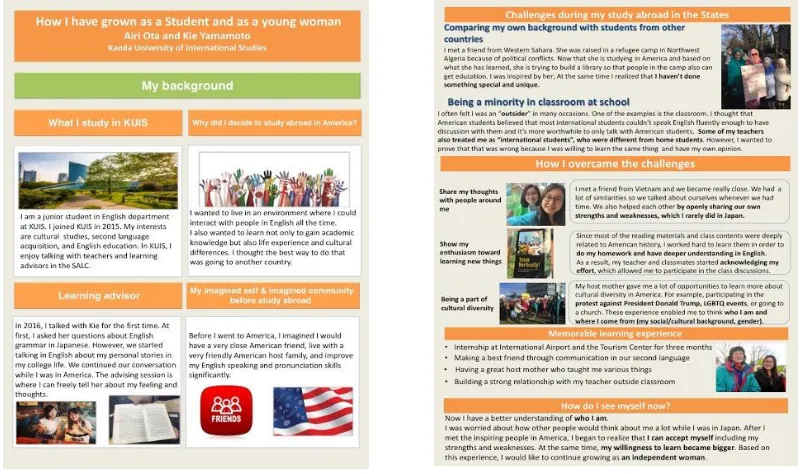
In preparation for the presentation at JASAL 2017, Ota first started writing her study abroad experience as a first step to make a presentation. Based on her writing, she reflected on the changes and challenges within herself in the advising sessions with Yamamoto. Simultaneously, Yamamoto went over the advising notes written down in the previous sessions in order to elicit in-depth stories. The emerging themes in their dialogues were chosen as the main topics to be covered in their poster presentation. Using free time after school, they discussed the contents and design and created the posters below (Figure 1). Prior to the conference, with the support from other learning advisors, they ran through the presentation several times.
Figure 1. The posters created for JASAL 2017
In this paper, the authors decided to share Ota’s written narrative as crucial data of this study in the hope of inviting the audience to delve into the firsthand stories and make sense of what the challenges and changes meant to her growth. Her narrative starts with her struggles of
negotiating her identities in the different academic communities in her new life. It then plots the critical experiences with other members of the communities that empowered her to initiate the transformation within herself.
How I have grown as a student and as a young woman (Ota, October 2017)
challenging situations in my school. One of my friends, whom I met there, is from Western Sahara but was raised in a refugee camp in Northwest Algeria for more than half of her life because of political conflicts in her country. She is now a successful student at the school and has been doing a project of building a library at the refugee camp so that people in the camp can study and get an education. Looking at inspiring people like her, I got disappointed with myself; I felt like no matter how much I tried I wouldn't even get to the starting line when other people were already at the finish line. Thinking about where I came from, I felt like having no special experience or reason to study abroad. I was not even speaking English properly at that time. Thus, I couldn’t stop
comparing myself with other students.
Another difficulty in my life in America was that I frequently felt I was an "outsider" on many occasions. Because my English was not fluent, I felt scared of talking to others, especially in the classroom. As I was from a collectivist country, Japan, where many people don't usually express their opinions or counter statements while other people are talking, I got intimidated by their talk. I felt like I didn't belong to the class and it seemed like they were talking around me. However, I wanted to prove that that was wrong and I was also learning the same things and had my own opinion.
Although I faced these challenges, I tried my best to overcome those situations by accepting who I am and showing my enthusiasm to become a part of the community. During my study
abroad, I met someone from Vietnam and we became close friends. We had many similarities in terms of personalities and lifestyles. Because we were taking the same English class and took the same bus, we had a lot of time to talk each other. She was really into TED Talks and introduced me to a video that got my attention immediately. It was called "the power of introverts" by Susan Cain. The content of the video really explained who I am and how I am different from other people. By openly talking about my personality with my friend from other country, I started accepting myself and becoming confident as an introvert. I gradually realized that I didn't need to copy other people's achievement to satisfy myself; instead, I started thinking about reaching my own goal to be
successful because everyone has a different definition of being successful. This change within myself also encouraged me to show my willingness to be a part of the classroom community in school. Since the reading materials were deeply related to American history and culture which I was not familiar with, I needed to take a lot of extra time to learn them in order to do my
classmates. These changes made me feel less scared to ask and talk to American classmates and more comfortable being included in the classroom.
In addition to the classroom experience, I had a lot of opportunities to learn about the cultural diversity in America outside the school, which allowed me to see myself as a part of the community. For example, I joined several events held by the LGBT community in my school. Being an“international student”in America, I though deeply about how it would be to be a minority in the society. This experience helped me become more open-minded. Another memorable experience was participating in a protest against the U.S. president with my host mother. This event enabled me to understand the importance of having my own voice. I also learned about women’s rights from my host mother and my writing teacher. Living in Japan, I had never thought about it deeply before. It even gave me a chance to think about the reason why we do not even talk about it. Now I am living here again, and I am facing gender inequality in various situations such as job hunting.
I feel really happy to become who I want to be; now I can see what is happening around me from various perspectives. Without the challenges, I would not have been able to realize what is happening outside my own small world. I don’t see myself as a different person from who I used to be before studying abroad in the States; however, I can certainly see different dimensions within myself, who was created through interaction with others. It is like a kaleidoscope that shows different colors and shapes.
At JASAL 2017
In the poster presentation at JASAL 2017, Ota’s narrative received significant attention from different groups within the audience (Figure 2). The main questions from the participants included how she built relationships with others in America, how she had been dealing with reverse culture shock since she had returned to Japan and how she felt about the change within herself. Particularly, her voice empowered those who were willing to study abroad to draw their positive future selves. In her post-presentation email correspondence, she noted that “I was very happy because my experience helped them to have a big picture of what it will be like to study in another
country” (Ota, personal communication, December 2017). The presentation became a good
Figure 2. Ota and Yamamoto’s presentation at JASAL 2017
Disseminating Language Learner Narratives: Implications from the Collaborative Work
As illustrated in the previous section, Ota’s narrative depicted her agency beyond language learning. While the marginalization from the English academic discourse was perceived as a great challenge, she continued seeking a breakthrough by working on her weaknesses and interacting with other learners as well as teachers. Moreover, her willingness to learn empowered her to become a part of diverse communities (e.g. participating in the political protest, communicating with the LGBT community). It is important to note that her autonomous actions illustrated in her narrative were not simply derived from her innate capacity to control her learning. Indeed, she had been a self-driven student with high motivation to learn English prior to study abroad in the United States. However, her personal narrative implies that the drastically different sociocultural context urged her to re-conceptualize herself from being a highly motivated English learner to be an active participant of the English academic community. Therefore, Ota’s agency needs to be understood in relation to her identity construction in a particular sociocultural setting.
In addition to the theoretical insight into Ota’s learning experience, the reflection on their collaborative work provides several implications with the professional community in the field of self-access learning. First, the opportunity to disseminate language learner’s narratives is needed as a means of inspiring and empowering other learners to pursue their aspiration for language
(Barkhuizen, 2011, p. 397). In other words, participating in everyday interaction with learners could generate their willingness to share their voices.
Although the implications above are limited as they draw on a single case study, Ota and Yamamoto’s collaborative approach to the narrative sheds light on potential research as well as practices in the self-access learning context.
Concluding Remarks
This paper has presented collaborative work on disseminating the voice of a language learner who overcame various hardships in the study abroad context. Drawing on the authors' unique relationship, they have demonstrated a reflexive approach to Ota's personal narrative to make sense of her experiences in the new academic community. It is their hope that this paper invites readers, particularly those who are in charge of supporting language learning, to actively engage in co-constructing learners' narratives in everyday interaction and empowering them to share their voice as a form of supporting learner agency.
Notes on the Contributors
Airi Ota is an undergraduate student at Kanda University of International Studies. She studied hospitality, American history and gender equality at Whatcom Community College in the United States. Her research interests include advising in language learning, learner motivation and language learner identity.
Kie Yamamoto is a learning advisor in the Self-Access Learning Center at Kanda University of International Studies in Chiba. She holds an M.S.Ed from Temple University Japan, and is
currently pursuing an Ed.D at the University of Bath in the UK. Her research interests are language learner identity, advising discourse, and narrative analysis.
References
Barkhuizen, G. (2011). Narrative knowledging in TESOL. TESOL Quarterly, 45(3), 391-414. doi:10.5054/tq.2011.261888
Benson, P., & Cooker, L. (2013). The social and the individual in Applied Linguistics research. In P. Benson & L. Cooker (Eds.), The applied linguistic individual:Sociocultural approaches to identity, agency and autonomy (pp. 1-16). Sheffield, UK: Equinox
Block, D. (2007). Second language identities. London, UK: Continuum.
Chik, A., & Benson, P. (2008). Frequent flyer: A narrative of overseas study in English. In P. Kalaja, V. Menezes, & A. M. F. Barcelos (Eds.), Narratives of learning and teaching EFL (pp. 155-170). London, UK: Palgrave.
Karlsson, L. (2012). Sharing stories: Autobiographical narratives in advising. In J. Mynard & L. Carson (Eds.), Advising in language learning: Dialogue, tools and context (pp. 185-204). Harlow, UK: Pearson Education.
Kato, S., & Mynard, J. (2015). Reflective dialogue: Advising in language learning. New York, NY: Routledge.
Lamb, M. (2013). The struggle to belong: Individual language learners and teachers in situated learning theory. In P. Benson & L. Cooker (Eds.), The applied linguistic individual: Autonomy, agency and identity (pp. 32-45). Sheffield, UK: Equinox.
Morita, N. (2004). Negotiating participation and identity in second language academic communities. TESOL Quarterly, 38, 573-603. doi:10.2307/3588281
Murphey, T., & Arao, H. (2001). Changing reported beliefs through near peer role modeling. TESL-EJ, 5(3), 1-15. Retrieved from http://www.tesl-ej.org/ej19/a1.html
Norton, B. (2001). Non-participation, imagined communities, and the language classroom. In M. Breen (Ed.), Learner contributions to language learning: New directions in research (pp. 156-171). Harlow, UK: Pearson Education.
Norton, B., & Toohey, K. (2002). Identity and language learning. In R. B. Kaplan (Ed.), The Oxford handbook of applied linguistics (pp. 115–123). New York, NY: Oxford University Press.
Tassinari, M. G., & Ciekanski, M. (2013). Accessing the self in self-access learning: Emotions and feelings in language advising. Studies in Self-Access Learning Journal, 4(4), 262-280. Retrieved from https://sisaljournal.org/archives/dec13/tassinari_ciekanski/
Yamashita, H. (2015). Affect and the development of learner autonomy through advising. Studies in Self-Access Learning Journal, 6(1), 62-85. Retrieved from