Carolina Aguilar Aravena
*, Luciene Stamato Delazari
a Geodetic Sciences Graduate Program, Federal University of Paraná, Curitiba, Brazil. [email protected],
* Corresponding author
Abstract: The use of Indoor Positioning Systems (IPS) has gained an exponential growth due to the high availability of infrastructure to carry out its development. In this context this work presents the development of an Open Source Software for indoor positioning with the use of WIFI networks, since in this type of environment the pedestrian needs a greater assistance for its location and navigation. The application was developed in Android Studio, with a database generated using the WIFI routers of the study area. In addition, the position of the user in real time is showed in a map. The positioning techniques used for this application were Proximity, Center of Mass and Trilateration.The results shows that it is possible to obtain a high level of agreement in the identification of building and floor. The results also show that it is possible to develop an indoor positioning application through WIFI networks.
Keywords: Indoor Positioning, Open Source Software, Location Based Services
1. Introduction
Currently, the position of people or objects in indoor and outdoor space, have an important role in the daily activities of the society. Regarding this, most of the developed positioning systems are designed for outdoor use. Normally a pedestrian almost always ends its journey entering a closed space, so there is a need for assistance in this type of environment (Huang & Gartner, 2010; Trevisan & Perez 2017).
In both environments, the pedestrians are guided based on reference points, which, in the case of the indoor environment can be altered frequently, adding complexity to the location and navigation for this type of environment. In addition, in the indoor environment, it is difficult to maintain the north-south orientation as in the outdoor space (Nossum, 2013). Therefore, it is necessary to implement systems that help the user in indoor environments, when the user does not know the environment or when there are changes in it. For outdoor environments, the AGPS (Assisted Global Positioning System) has been used as a solution for the position with telephones, which should not be used in indoor space due to the attenuation that is generated in its signal, caused by the structure of this type of spaces, translated into an error of approximately 32 meters (Figueiredo et al, 2019). Another solution is the use of GSM (Global System for Mobile Communications), which provides adequate precision for indoor space, due to configurations of the environment (Trevisan & Perez, 2017).
The interest in the Location Based System (LBS) in mobile devices grows daily. In parallel with this, the technologies of wireless communication, such as the WIFI technology are of mass use and they are implemented in most of the current buildings. This is the case of the Federal University of Paraná (UFPR) that has a network of WIFI routers called "UFPR sem fio". One of the reasons for the growth of the use of WIFI technology is the economic accessibility
and integration in different mobile devices. Considering this, it is an adequate solution to be used in indoor positioning, since it has features such as high connections, speed and a standardized infrastructure (Kolodziej & Hjelm, 2006; Trevisan & Perez, 2017).
As for systems that assist the pedestrians, there are private systems such as Here We Go, Proximi.io and WIFARER, among others. In the case of a system developed by universities, the UFPR CampusMap (UCM) corresponds to a web system, developed by the research group in Cartography and GIS of the Geodetic Sciences Graduate Program, designed to represent outdoor and indoor environments of the UFPR campuses. Concerning the indoor environment, it presents two cartographic representations: schematic map and floor plan (Delazari et al., 2019)
Currently, the UCM system has tools to perform the route calculation between different points, but it does not present the positioning functionality, and it is only available with Internet access in a browser.
In this work, we present the development of an application for mobile devices, in the context of UFPR CampusMap, developed in Android Studio, for indoor positioning through WIFI networks.
2. Methodology
2.1 Study area
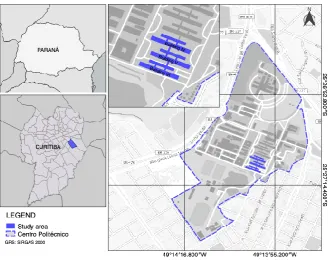
Figure 1. Study Area.
2.2 Routers coverage analysis
The first step was to register the data of the routers, when it were collected the SSID (Service Set Identifier), BSSID (Basic Service Set Identifier), cartographic coordinates, floor and building. To determine the coordinates of each router, a topographic survey based on distances has been carried out, where the walls of the building was used as
references. The transmission protocol for the routers (model: CISCO AIR-SAP1602I-T-K9) is 802.11n. According to this protocol, each router has a coverage of 70 meters (Andrews, 2012). Based on this information, a coverage map was generated, using a buffer with the theoretical coverage generated for each router, to verify the complete coverage of the network in the study area.
Figure 2. Network coverage.
2.3 Application development
The application was developed on Android Studio v.3.1.2, with the plugin Mapbox Android Map Sdk v.6.1.1, using three positioning techniques: the proximity, the center of mass with weights and the trilateration. The fingerprint technique is mostly used for indoor positioning, although in this investigation was used others three techniques because the fingerprint since it generates a delay in obtaining the position of 2 to 3 seconds in a sample of 40
points which makes it impossible to apply it in real time (Boonsriwai & Apavatjrut, 2013).
2.3.1 Proximity
2.3.2 Center of mass
This technique is based on assigning the object position by designation of weights to the routers according to their proximity. The proximity is determined by the descending order of the RSSI routers. For each router coordinates, weights were assigned based on RSSI order, for next, weighted average is determined (Mautz, 2012).
2.3.3 Trilateration
The position of an object is estimated by measuring the distance from multiple reference points. In the case of using the RSS principle, the object detects the signal strength of the routers, and its position is determined by the intersection of the directions of the signals. Based on circular coverage maps, a set of distances are estimated that are combined to identify points of intersection. The area with the highest number of points is assumed to correspond to the area of the object (Kolodziej & Hjelm, 2006). The mathematical model of this method is:
(𝑥
𝑛− 𝑥
𝑑)
2+ (𝑦
𝑛
− 𝑦
𝑑)
2= 𝑟
𝑛2 (1)Where:
xn, yn = coordinates of n routers;
xd, yd = coordinates of the device;
rn = distance from the device to n WIFI routers.
2.3.4 Creation of database
According to the routers survey, a Sqlite database was made in the application, with the following information available in a table: SSID, BSSID, floor, building, coordinates. This data is stored on the phone. In addition, three more tables were created, one for storing the RSSI data measured, the second for the calculated distances and the last one for the estimated position.
2.3.5 Base Map Design
To add the map to the application, as was mentioned, the Mapbox Android map plugin was used. This add-on allows adding maps to applications developed in the Android platform, iOS and web maps. With Mapbox it is possible to choose the colour style of the map base, add JSON files, marker, among other functions. In order to add the base map of the Campi or edit the colour style of Mapbox's own base map, they have a web extension called "Mapbox Studio", in which it is possible to add data in different formats to the application (such as: shapefile, JSON and csv).
2.3.6 Interface Design
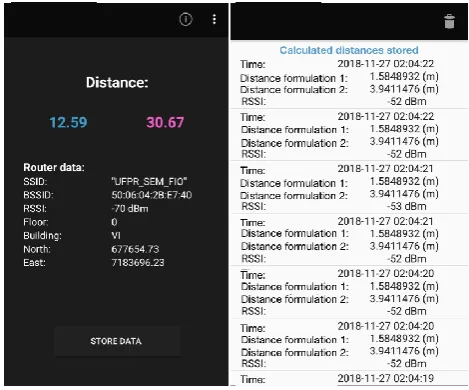
Aiming to make the application could be used for different investigations of WIFI technology and indoor positioning, different "activities" were designed (denomination used in Android Studio for the screens of the application). The first activity was designed to obtain information regarding the router (SSID, BSSID, floor, building and RSSI) where the device was connected and associated with a distance measured in the field. These data were stored for
later use and presented in another activity. The interfaces for these activities are the following.
Figure 3. RSSI measured activity - Stored RSSI Data Activity.
Later, an activity was designed to calculate the distance for two different formulations, both based on the equation of signal attenuation in the travelled path.
Figure 4. Distance determination activity - Stored Distance Data Activity.
𝑟
𝑛= 𝑑
0∙ 10
𝑃𝑟−𝑃020 (2)
𝑟
𝑛= 10
𝑃𝑟−27,56−20∙log(𝑓)
20 (3)
Where:
rn= Distance from the device to a WIFI router;
Pr = RSSI measured in the position of the device;
P0 = RSSI measured at a fixed distance d0; f = Frequency of signal transmission.
Afterwards, two more activities were created (Figure 5): the first one was to determine the user's position, presenting the user with the result of the estimated position according to the three techniques mentioned above, the second with respect to the stored data. For each of the data storage activities, the user has the possibility to delete the data (if necessary) stored in the tables of the database.
Figure 5. Position determination activity - Stored Position Data Activity.
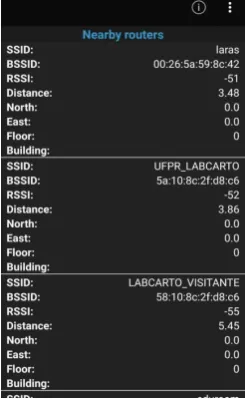
An activity was designed where the routers of all the networks next to the user were presented (Figure 6). When the router is registered in the database the information regarding its location (floor, building and its cartographic coordinates) is presented.
Figure 6. Activity of routers near the device.
Additionally, two more activities were added, so that the user could visualize the data of the WIFI routers registered in the database. The first shows the data in a ListView and the second one inserted in a map. By clicking on each marker, the user can see the information of each router.
Figure 7. Activities of Registered Routers in ListView - Map.
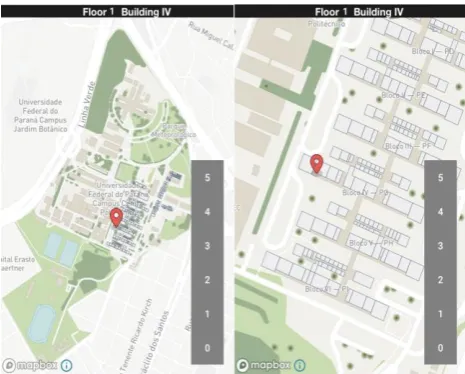
Figure 8. Position Activity Interface with different zoom.
In figure 8 it is possible to see the interface designed for the device, where the upper part of the screen exhibits the floor and the building where the user is located; in the central part, the map with the user's position marker, and farther right the buttons to change the layers according to the floor.
In addition, the layers in JSON format of the different rooms of the study area in the Campi were added, allowing the user to change the layer of rooms that he/she wants to see according to the selection of the floor.
3.
Experimental Evaluation
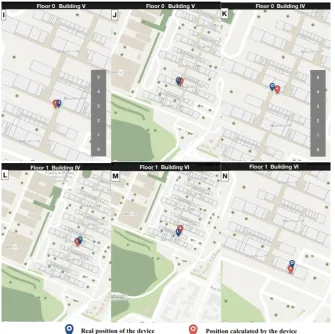
Figure 9. Detection test of the building, floor and room.
According to the images presented in the figures B, E, H, I, J and M, the application correctly detected the environment where the smartphone was located, while for the other images, the position marker was very close to the real position of the smartphone, as in the case of
Figure 9-C where it is in the next room.
3.1 Results
To determine the positioning technique was determined the accuracy for different techniques, the smartphone was placed in 13 different positions, with 110 data per position. The results of this were the following:
Technique Average
planimetric discrepancy [m]
Standard deviation [m]
Center of mass 10,43 ±6,06
Center of mass with weights
7,39 ±4,39
Trilateration 8,38 ±3,14
Table 1. Results of techniques.
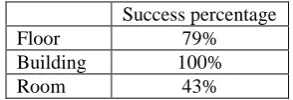
As stated to the samples taken (Figures 9 and 10), the success percentages are the following:
Success percentage
Floor 79%
Building 100%
Room 43%
Table 2.Success percentage.
4.
Conclusions
This work presents the development of an open source solution for research in the WIFI technology and in the indoor positioning. Through the software Android Studio we developed an application for this platform. WIFI technology was chosen, because it is a mass use technology implemented in most of the buildings and added to a large part of the current mobile telephones. Besides that, it does not need a complex infrastructure to be used for positioning, only a network of routers and a device that can read the intensity of each of them. Based on the results shown in Table 1, the technique of center of mass with weights was chosen, to be presented on the map, since it was the one that generated the least planimetric discrepancy.
As for the results obtained, is based on the information the floor and building, so it is possible that the application can help the user's location in the indoor environment, but it is necessary to improve the calculation of the location, doing more test or using another positioning technique that provides greater precision.
Acknowledgements
Author Carolina Aguilar Aravena thanks the Organization of American States (OEA) and the Grupo Coimbra de Universidades Brasileiras (GCUB), for the master's scholarship; Author Luciene Stamato Delazari thanks the Brazilian National Council for Scientific and Technological Development (CNPq - Grant process N. 310312/2017-5).
References
Al Nuaimi, K., & Kamel, H. (2011). A survey of indoor positioning systems and algorithms. In Innovations in information technology (IIT), 2011 international
conference on (pp. 185–190).
http://doi.org/10.1109/INNOVATIONS.2011.5893813
Andrews, J. (2012). A+ Guide to Software. Course Technology, Cengage Learning, ed.6.
Boonsriwai, S., & Apavatjrut, A. (2013, May). Indoor WIFI localization on mobile devices. In 2013 10th
International Conference on Electrical
Engineering/Electronics, Computer,
Telecommunications and Information Technology (pp.
1-5). IEEE.
Brković, M., & Simić, M. (2014). Multidimensional optimization of signal space distance parameters in WLAN positioning. The Scientific World Journal, 2014, vol. 2014. http://dx.doi.org/10.1155/2014/986061 Delazari, L. S., Filho, L. E., Sarot, R. V., Farias, P. P.,
Antunes, A., & dos Santos, S. B. (2019). 9 - Mapping Indoor Environments: Challenges Related to the Cartographic Representation and Routes. In J. Conesa, A. Pérez-Navarro, J. Torres-Sospedra, & R. Montoliu (Eds.), Geographical and Fingerprinting Data to Create Systems for Indoor Positioning and Indoor/Outdoor
Navigation (pp. 169–186). Academic Press.
https://doi.org/https://doi.org/10.1016/B978-0-12-813189-3.00009-5
Figueiredo e Silva, P., Richter, P., Talvitie, J., Laitinen, E., & Lohan, E. S. (2019). 13 - Challenges and Solutions in Received Signal Strength-Based Seamless Positioning. In J. Conesa, A. Pérez-Navarro, J. Torres-Sospedra, & R. B. T.-G. and F. D. to C. S. for I. P. and I. N. Montoliu (Eds.), Intelligent Data-Centric Systems (pp. 249–285).
Academic Press.
https://doi.org/https://doi.org/10.1016/B978-0-12-813189-3.00013-7
Huang, H., & Gartner, G. (2010). A Survey of Mobile Indoor Navigation Systems. In G. Gartner & F. Ortag (Eds.), Cartography in Central and Eastern Europe: CEE 2009 (pp. 305–319). Berlin, Heidelberg: Springer Berlin Heidelberg. https://doi.org/10.1007/978-3-642-03294-3_20
Kolodziej, K. W., & Hjelm, J. (2006). Local positioning systems: LBS applications and services. CRC press. ed.1. https://doi.org/10.1201/9781420005004
Mautz, R. (2012). Indoor Positioning Technologies. ETH Zurich, Department of Civil, Environmental and Geomatic Engineering, Institute of Geodesy and
Photogrammetry. Retrieved from
https://books.google.com.br/books?id=BsHpMgEACA AJ
Nossum, A. S. (2013). Developing a Framework for Describing and Comparing Indoor Maps. The
Cartographic Journal, 50(3), 218–224.
https://doi.org/10.1179/1743277413Y.0000000055