Effect of ion exchange substrate on grass root development
and cohesion of sandy soil
Mariola Chomczyńska1*, Vladimir Soldatov2, Henryk Wasąg1, and Marcin Turski3 1Faculty of Environmental Engineering, Lublin University of Technology, Nadbystrzycka 40B, Lublin 20-618, Poland 2Institute of Physical Organic Chemistry, Belarus National Academy of Science, Surganov 13, Minsk 220072, Belarus
3Institute of Agrophysics, Polish Academy of Sciences, Doświadczalna 4, 20-290 Lublin, Poland
Received April 30, 2016; acceptedJune 8, 2016
*Corresponding author e-mail: [email protected] A b s t r a c t. The effect of small additions of ion exchange substrate (nutrient carrier) on root development and accompany-ing ground cohesion (characterized by its penetration resistance) was studied. During two pot experiments Dactylis glomerata L. was grown on sand and its mixture with 1 and 2% (v/v) of ion exchange substrate, respectively. The number and total length of roots were measured during the first test. Penetration resistance was measured with a pentrologger, following the second experi-ment. After six weeks of growth, number and length of roots in sand mixture with 1 and 2% substrate was greater than in sand-only medium by 211-287 and 273-323%, respectively. At the same time, penetration resistance in series with substrate addi-tions was significantly higher than in control medium at depth of 2.5-7(8) cm, whereas after 12 week of growth, penetration resistance in series with 1 and 2% substrate additions was signifi-cantly greater than in control sand at the whole analyzed depth. The highest resistance values in media with substrate additions 2-2.5 times greater than those in sand alone – were observed at depth of 3.5-4.0 cm. Higher resistance of sand-substrate mixtures results from more intensive development of root systems, form-ing a mesh which binds sand particles. Such media would be less susceptible to erosion.
K e y w o r d s: ion exchange substrate, soil cohesion, soil ero-sion, Dactylis glomerata L., treatments
INTRODUCTION
The use of synthetic ion exchange resins in soil and environment studies has attracted much attention and many journal articles have been published on this matter. The rich overview of historic and current developments in the use of ion exchange techniques in soil research was presented by
Qian and Schoenau (2002). It is commonly known that the plant growth on sandy soils can be supported by intensive fertilization. Ion exchange substrates can be used for this purpose as an addition or alternative to organic or mineral fertilizers because they contain the full set of nutrient ele-ments in chemically bound form and high concentrations. What is more, they do not cause salinization of the irriga-tion water, do not undergo wind and water erosion and they are sterile and easily sterilisable.
The ion exchange substrates are mixtures of cation and anion exchangers loaded with macro- and micronutrient ions in appropriate ratios. The preparation of ion exchange substrates is based on providing the mixtures of cation and anion exchangers with the ionic composition that assures the availability of biogenic elements for plants to the same degree as in nutrient solutions. The ion exchange substrates differ from conventional fertilizers in several respects. The ions of nutrients are bound to the polymer matrices of the cation or anion exchanger and are not washed out by rain-falls. A high concentration of the nutrient ions in the ion exchange substrates (~ 8% of mass) does not cause osmotic shock of the root tissues and many biological experiments have shown that plants grow successfully in the pure ion exchange substrate with high yield (70-80 g of dry biomass per 1 kg of dry substrate). The ion exchangers present in the substrates retain only ions of nutrient elements and deliv-er them to the rhizosphdeliv-ere in exchange to the root ionic metabolites (mainly H+, HCO
3-) (Soldatov, 1988). The ion
exchange substrates are produced in limited amounts in
the Institute of Physical Organic Chemistry of the Belarus National Academy of Sciences (under trade name Biona). They differ from each other in the type of the ion exchan- gers used as their constituents, nutrients concentrations and their proportions. These factors can be used to control pH of soil solution contacting plant roots after introduc-ing ion exchange substrate into the ground (Soldatov, 1998; Soldatov and Peryskina,1985).
The advantages of ion exchange substrates (richness in nutrients, activity as natural soil exchange complex, stabi- lity to decomposition and erosion) led to the idea of using them for biological soil restoration and improvement of fertility and mechanical characteristics of sandy soils. The Lublin University of Technology, Poland, has commenced modeling studies with different kinds of ion exchange sub-strates as fertilizer additions to sand (Soldatov et al., 1997; Wasąg et al., 2000). In these tests the main objective was to maximize the plant biomass. It has been shown that addi-tion of one volume percent of the substrate is sufficient for the fertilization of barren grounds. The influence of sub-strate addition on the development of plant root systems, which is important for the improvement of stabilization and anti-erosive function of plants, has not been studied so far. Therefore, the aim of present studies was to determine the effect of small additions of ion exchange substrate on
the development of plant root systems and accompanying variations of cohesion characteristics of the ground charac-terized by its penetration resistance.
MATERIAL AND METHODS
The studies were performed with Dactylis glomerata L. (var. Amba) (orchard grass) used as the test species rec-ommended for plant restoration mixtures (Maciak, 1999). D. glomerata is one of the most common grass species in Poland. It grows on moderately wet and dry mineral soils and on fertile peat soils.
The sand from sand mine in Gołab near Puławy (Eastern Poland) was used in the research. Its granulo- metric composition (determined by laser diffraction me- thod (Sochan et al., 2012)) was the following:
– 2-1 mm – 0%; – 1-0.5 mm – 17.7%; – 0.5-0.25 mm – 54.3%; – 0.25-0.1 mm – 27.7%; – 0.1-0.05 mm – 0.06% – <0.05 mm – 0.3%.
The pH value of sand-water extract was 6.01. The con-tents of macronutrients available for plants in the sand were determined according to Polish standards (Lityński and Jurkowska, 1982; Ostrowska et al., 1991). Chemical analysis indicated that sand was deficient in available macronutrients (Table 1).
The ion exchange substrate was prepared by mixing monoionic K+, Mg2+, Ca2+ forms of the cation exchanger
(KU-2) and NO3-, H
2PO4- and SO42- forms of the anion
exchanger (EDE-10P). The cation contents in the monoionic form samples were determined by means of ICP spectro- meter (Jobin Yvon 238 Ultrace) in the extracts obtained by substituting the target ions with H+ ions. The contents of
all anions in the monoionic form samples were determined using ion chromatography (DIONEX ICS-3000) in the extracts obtained by the complete substitution of the target ions with OH-. The percentage of different ionic forms of
ion exchangers and the contents of nutrient ions in the sub-strate are given in Tables 2 and 3, respectively.
The effect of the ion exchange substrate addition on the development of plant root system was studied in the first experiment. Three series of media were prepared for the pot tests: the control series with sand and two test series with homogenous mixture of the sand with 1 and 2% (v/v) of the substrate (S+1% and S+2%), respec-tively. Eight pots filled with 4.14 dm3 of the medium
were used in each series. Individual pots (length – 24 cm, width – 11.5 cm, depth – 21 cm) were equipped with
T a b l e 1. Contents of available macronutrients in sand (mg per 100 g)
N* P K Mg Ca S
0.20 (N-NH4)
<0.13 (N-NO3) 0.48 <1.99 1.00 4.41 0.53 (S-SO4)
*Determined in extract: N – 1% K2SO4, P – 0.04 M (CH3CHOHCOO)2Ca, K – 0.04 M (CH3CHOHCOO)2Ca, Mg – 0.0125M CaCl2, Ca – 0.03M CH3COOH, S – 0.5M CH3COOH+0.25M CH3COONH4.
T a b l e 2. The mass percent of monoionic forms in 100 g of the ion exchange substrate
Form
NO3- H2PO4- SO42- Ca2+ Mg2+ K+
15.5 7.6 24.7 40.5 6.9 4.8
T a b l e 3. Contents of macronutrient ions in the ion exchange substrate (mmol per 100 g)
Ion NO3- H2PO4- SO42- Ca2+ Mg2+ K+ pH
Content 65.0 23.6 216.6 367.7 66.0 18.8 4.45*
a single transparent wall that enabled root develop-ment to be observed (Bohm, 1979; Neumann et al., 2009). After media preparation sprouts of D. glomerata were planted in specific pots (eleven sprouts in each pot). The experiment was carried out in the phytotron with a 13/11 h light/dark regime. The day- and night-time air temperatures were 25 and 16°C, respectively. The plants were watered with distilled water. The vegetative growth period lasted 42 days. The root systems of the test species were traced on foils placed on the transparent pot walls eve-ry 4-5 days during the first of three experimental weeks and every 2-3 days during the successive experimental weeks. When the experiment was terminated, the stems of plants were cut and roots were separated. The wet and dry (dried at 105°C) biomass of stems and roots was measured. The number and length of plant roots were determined using the drawings of the root systems on foils. Roots were suc-cessively counted in the areas of 50 cm2 squares marked on
foils and corresponding to the media depth of 1.5-8.5 cm. In the same areas, the root lengths were measured using a curvemeter (Run-MateTMClub) and were summed to
obtain the total values per pot according to the method described by Bohm (1979). The wet and dry biomass of stems and roots, as well as the number and total length of the roots were used to calculate arithmetic mean values for all experimental series.
The soil penetration resistance is characterized by the force applied to the penetrating unit at a specified speed of penetration into the medium related to the unit area, N m-2.In the present study penetration resistance was
mea-sured using a pentrologger (Eijkelkamp) equipped with a 5 cm2-baseand 60o cone, which was inserted into media
with speed of 2 cm s-1. The resistance was measured at depth
of 2.25-10 cm. No meaningful results might be obtained at the lower depths. In order to minimize the wall-effect the pots used for these measurements were of larger size than those in the first experiment (the volume was 9.9 l-1).
The vegetation pots were of rectangular shape with length 33 cm, width 20 cm and depth occupied by the soil 13.5 cm. Such dimensions enabled to perform three measurements
of penetration resistance (diagonally) in one pot. The dis-tance between measurement points was about 8 cm, the distance between two extreme points and short and long walls of pot was about 5 cm.
For the purpose of this test, the same series of media were prepared as in the first experiment. Nine hundred nineteen seeds of D. glomerata were sown in each pot. The experiment was carried out in the phytotron under the same conditions as those in the first trial. In the first part of the experiment, the vegetative growth period lasted 6 weeks. The stems were then cut down in ten pots in each series but the roots were not separated. In five pots in each series the plants grew for 6 consecutive weeks under identical conditions as described above. After six and twelve weeks of plant growth, media of intact structure (roots were not separated) were adjusted to the state of field water capacity to measure the resistance to penetration (Eijkelkamp, 2010; Ślusarczyk, 1979). In each pot there were three resistance measurements, therefore, there were fifteen measurements for each media series. The results obtained were used for the calculation of mean values characterizing the experi-mental series (arithmetical mean values).
The statistical significance of differences between mean values characterizing the experimental series in the ex- periments was assessed using Student t-test or the Aspin-Welch v-test at the confidence coefficient p = 0.95. Student t-test was used when variances for compared mean va- lues did not differ significantly (the Fisher-Snedecor F-test). When variances differed significantly, the Aspin-Welch v-test was applied (Czermiński et al., 1992; Zgirski and Gondko, 1998).
RESULTS AND DISCUSSION
Results of the first experiment on the development of plant root systems are presented in Tables 4 and 5. The additions of the ion exchange substrate to sand affected the vegetation cycle of D. glomerata advantageously convert-ing practically fruitless sand to a nutritious medium. Stem and root biomass of plants in series with substrate additions
T a b l e 4. Mean stem and root biomass of D. glomerata in the six week experiment
Biomass (g per pot)
Media series Biomass ratio
S S+1% S+2% (S+1%)/S (S+2%)/S (S+2%)/(S+1%)
Wet stem 0.13±0.02a 12.58±1.20b 16.31±2.33c 94.62 122.62 1.30
Dry stem 0.02±0.005a 1.86±0.22b 2.36±0.38c 77.63 98.38 1.27
Wet root 0.43±0.05a 13.17±1.95b 16.34±3.86bc 30.35 37.65 1.24
Dry root 0.07±0.016a 1.60±0.21b 1.96±0.44bc 22.51 27.62 1.23
was incomparably greater than in the controls. Differences in plant biomass between series S+1% and S+2% were much lower, namely 23-30%. During the observation period, the morphological root parameters of D. glomerata in sand enriched with substrate additions were also significantly higher than those in the control series (Table 5). At the end of the experiment, the mean number and length of roots in the 50 cm2 cross-section through sand-1% substrate mix were
greater than in sand-only medium by 211 and 273%, respec-tively. The mean number and length of roots found for the cross-section of the sand-2% substrate mix were higher by 287 and 323%, respectively than those for sand alone. The values of morphological root parameters obtained in series S+2% exceeded those for series S+1% during the whole observation period. However, their improvement was not proportional to the double increase of the ion exchange
T a b l e 5. Root number and total root length of D. glomerata in the six week experiment
Vegetative growth period
(day)
Media series Ratio for media series
S S+1% S+2% (S+1%)/S (S+2%)/S (S+2%)/(S+1%)
Mean root number
11 5.8±0.7a 8.0±3.1ab 13.9±4.5c 1.38 2.40 1.74
15 11.3±1.8a 20.6±5.4b 27.4±6.9c 1.82 2.40 1.32
20 18.9±3.6a 38.3±9.5b 47.8±11.8bc 2.03 2.53 1.25
22 21.6±4.6a 47.0±1.7b 63.8±19.9bc 2.18 2.94 1.35
24 23.5±5.0a 56.5±11.1b 80.8±20.3c 2.40 3.42 1.42
27 24.8±5.8a 69.3±10.9b 92.8±17.9c 2.79 3.75 1.34
29 27.0±6.0a 79.3±11.5b 104.9±19.6c 2.94 3.87 1.32
31 29.0±5.9a 87.4±12.5b 117.8±21.8c 3.01 4.05 1.34
34 31.4±4.8a 95.0±13.7b 128.1±23.1c 3.03 4.08 1.35
36 34.1±6.3a 106.1±±5.2b 136.1±22.0c 3.11 3.99 1.28
38 37.0±6.6a 111.9±16.4b 140.8±22.7c 3.02 3.79 1.25
41 38.5±7.0a 119.6±18.2b 149.1±24.7c 3.11 3.87 1.25
Mean total root length (cm)
11 10.64±3.58a 7.38±5.12ab 13.11±3.97ac 0.69 1.23 1.78
15 18.71±3.93a 27.90±13.25ab 41.31±14.89bc 1.49 2.21 1.48
20 28.36±5.33a 67.74±19.18b 83.30±25.41bc 2.39 2.94 1.23
22 31.63±6.91a 79.63±21.77b 100.99±30.06bc 2.52 3.19 1.27
24 33.70±7.87a 92.58±22.52b 119.30±32.13bc 2.75 3.54 1.29
27 36.30±8.98a 110.23±22.38b 136.39±32.40bc 3.04 3.76 1.24
29 38.85±10.47a 126.81±23.19b 156.69±36.79bc 3.26 4.03 1.24
31 41.31±11.48a 144.91±26.58b 177.60±38.38bc 3.51 4.30 1.23
34 45.24±11.67a 163.39±30.56b 199.29±43.97bc 3.61 4.41 1.22
36 48.31±11.71a 177.06±31.34b 213.70±41.44bc 3.66 4.43 1.21
38 51.61±12.30a 189.16±32.89b 220.18±43.28bc 3.66 4.27 1.16
41 55.05±13.93a 205.61±39.94b 233.21±50.38bc 3.73 4.23 1.13
substrate in the experimental soil. At the end of the experi-ment, number and length of grass roots in the 50 cm2
cross-section of the sand-2% substrate mix were higher than those for sand-1% substrate mix by 25 and 13%, respectively. The increase in root length obtained in series S+2% was not statistically significant compared to that for series S+1%.
The increase in values of root morphological para- meters after enriching sand with substrate additions indi-cated intensified development of root systems, which was partly due to the formation of more lateral roots. Among nutrients introduced together with the substrate nitrogen, phosphorus, calcium and magnesium are reported to affect development of plant lateral roots (Cao et al., 2013; Gruber et al., 2013; Rogers and Benfey, 2015). It was observed that Mg deficiency or deprivation decreased density or number of lateral roots in Arabidopsis thaliana (Gruber et al., 2013) and in Poncirus trifoliata (Cao et al., 2013). According to Cao et al. (2013) strict calcium deficiency resulted in reduced number of lateral roots in P. trifoliate as well. Furthermore, studies showed that under low P and N concentrations in media density or number of lateral roots in Arabidopsis increased (De Pessemier et al., 2013; Gruber et al., 2013; Niu et al., 2013). However, there are some reports showing the opposite tendencies. For instance, Fageria and Moreira (2011) informed about greater root branching in Zea mays with increasing levels of N fertilizer applied and Niu et al. (2013) reported that some Z. mays genotypes showed a decrease in the number of lateral roots under P deficiency. These reports agree with the results of our study because plants growing in the control series (sand without substrate addition, hence with very low N, P levels) produced less lateral roots than plants growing on sand sup-plemented with the ion exchange substrate.
It was demonstrated in many reports that plants exhi- bited intensive lateral root proliferation (Linkohor et al., 2002; Topp and Benfey, 2012; Trapeznikov et al., 2003; Yu et al., 2014) or increased root growth (Farley and Fitter, 1999; Jackson and Caldwell, 1989; Jing et al., 2010; Li et al., 2012) in nutrient-rich soil patches or nutrient-rich medium zones as compared to control weaker nutri-ent patches/zones. The studies described in references mentioned above had a localized nutrient supply where particular parts of the plant root system were in contact with patches/regions of a medium differing in nutrient concentrations. Such patches were absent in the sand-sub-strate mixture because sand particles were comparable to granules of ion exchangers in size, and both medium com-ponents were well mixed. Therefore, a mechanism of the phenomenon of enhanced root growth under conditions of a heterogeneous distribution of nutrient ions is probably different from the one observed in our studies.
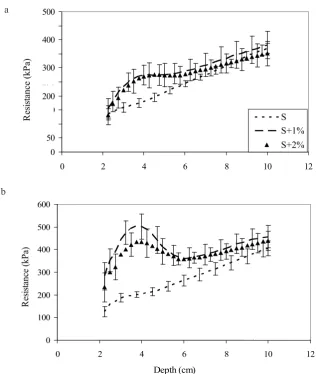
Results of the second experiment on the soil pene- tration are presented in Fig. 1. After six weeks of plant growth the media penetration resistance in series with
substrate additions, ie S+1% and S+2%, was significantly higher than that of control medium at depth of 2.5-8.0 cm and 2.5-7.25 cm, respectively (Fig. 1a). The greatest dif-ferences in resistance between control medium and sand supplemented with the substrate were found at the depth of 3.3-4.0 cm. In both fertilized media the resistance va- lues exceeded that of the sand alone by 50%. Above and below these layers the differences in resistance between the control and fertilized series decreased. The differences in resistance values between the samples with 1 and 2% sub-strate were not statistically significant and generally did not exceed 10%.
The penetration resistance of media in series with 1 and 2% substrate additions after twelve weeks of plant growth was significantly higher than that of control sand at the whole analyzed depth (Fig. 1b). The highest resistance va- lues in the medium supplemented with 1% substrate were observed at the depth of 3.5-4.0 cm where this parameter was 2.5 times greater than that found for sand alone. At the same depth the highest difference in the penetration resistance was observed between sand alone and sand-2% substrate mix – in this case resistance value was two times greater than that for the controls. Resistance values for both fertilized series decreased above and below the depth of 3.5-4.0 cm; however, until the depth of 8 cm they exceeded values determined for the control series by about 20%. The higher resistance of sand-substrate mixtures can be explained by more intensive development of plant root systems. The results of the first experiment showed that the substrate additions to sand significantly increased number and length of roots. Therefore, root system formed a spe-cific mesh that bound sand particles, so that the media had greater penetration resistance. Such media would be less susceptible to the destructive action of wind and water and therefore more resistant to erosion.
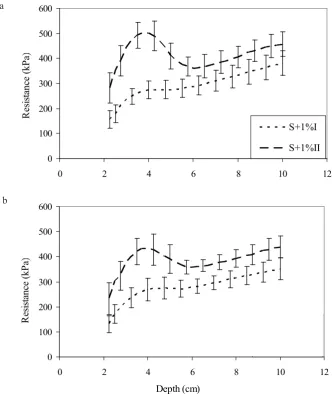
The effect of increasing the resistance for used sub-strate doses depended on the duration of plant growth. After twelve weeks of grass growth the resistance to pe- netration of media supplemented with substrate additions at the whole analyzed depth was significantly greater as compared to that measured after six weeks of plant growth (Fig. 2). The greatest differences in values of resis- tance between fertilized media were at the depth of 2.5-4.5 (5.0) cm. In both fertilized media after twelve weeks of grass growth, resistance values in these layers exceeded those measured for media after six weeks of grass growth by 50-96% (Fig. 2).
resistance at the depth of 0-20 cm by greater compaction of topsoil caused by vehicle traffic. Laboski et al. (1998) found under Z. mays cultivation that an increase in penetra-tion resistance of sandy soil at depth of 0.15-0.35 m was caused by the presence of natural compacted layer.
In our study, as it was described above, the influence of intensity of root growth on penetration resistance was observed. However, the results reported in some papers (Głąb and Szewczyk, 2014) do not indicate the afore-mentioned dependence. The penetration resistance is widely used as one of indicators of soil compaction and its influence on root morphology and architecture is often dis-cussed (Aggarwal et al., 2006; Głąb, 2013b). The changes in soil compaction (and penetration resistance, respective-ly) significantly modify water properties of the soil such as infiltration ability and plant available water capacity (Głąb and Szewczyk, 2014; Zhang et al., 2006). In heavy soils, the increased compaction (and hence – greater penetra-tion resistance) negatively affects the plant root growth.
Whereas in the investigated sandy medium, the increase in penetration resistance can be a reflection of improved plant available water capacity connected with increasing percent-age of mezo- and micropores. It can also positively modify the intensity of root growth and this phenomenon can result in a further increase in penetration resistance along with the progressing development of plants.
CONCLUSIONS
1. The minor additions of ion exchange substrate into sand (1 and 2% v/v) strongly intensified the growth of Dactylis glomerata L., used as a test culture, and deve- lopment of its root system. That caused a significant improvement of the sandy medium cohesion reflected in increasing its penetration resistance reaching 250% at the depth of 3.5 cm already in 12 weeks vegetation period.
2. Sand media supplemented with 1 and 2% v/v sub-strate addition did not differ significantly between each other in penetration resistance.
0 100 200 300 400 500 600
0 2 4 6 8 10 12
Depth (cm)
Re
sis
tan
ce
(k
Pa
)
S S+1% S+2% b
0 50 100 150 200 250 300 350 400 450 500
0 2 4 6 8 10 12
Depth (cm)
R
es
ist
an
ce
(k
Pa
)
S S+1% S+2% a
3. Addition of 1% of the substrate can be recommended as a mean causing intensive plants growth on barren sands and improvement of the sandy soils cohesion.
Conflict of interest: The Authors do not declare
con-flict of interest.
REFERENCES
Aggarwal P., Choudhary K.K., Singh A.K., and Chakraborty D., 2006. Variation in soil strength and rooting characteris-tics of wheat in relation to soil management. Geoderma, 136, 353-363.
Bohm W., 1979. Methods of studying root systems. Springer, Berlin, Heidelberg, New York.
Cao X., Chen C., Zhang D., Shu B., Xiao J., and Xia R., 2013.
Influence of nutrient deficiency on root architecture and root hair morphology of trifoliate orange (Poncirus trifo-liata L. Raf.) seedlings under sand culture. Sci. Hort., 162, 100-105.
Czermiński J.B., Iwaszewicz A., Paszek Z., and Sikorski A.,
1992. Statistical methods for chemists (in Polish). PWN, Warsaw, Poland.
De Pessemier J., Chardon F., Juraniec M., Delaplace P., and Hermans C., 2013. Natural variation of the root morpho-logical response to nitrate supply in Arabidopsis thaliana. Mech. Develop., 130, 45-53.
Eijkelkamp Agrisearch Equipment, 2010. Pentrologger. Operating instructions. Giesbeek, Netherlands.
Fageria N.K. and Moreira A., 2011. The role of mineral nutri-tion on root growth of crop plants. In: Advances in Agronomy (Ed. D.L. Sparks). Academic Press, San Diego, CA, USA.
Farley R.A. and Fitter A.H., 1999. The responses of seven co-occurring woodland herbaceous perennials to localized nutrient-rich patches. J. Ecol., 87, 849-859.
Głąb T., 2013a. Effect of tractor traffic and N fertilization on the root morphology of grass/red clover mixture. Soil Till. Res., 134, 163-171.
0 100 200 300 400 500 600
0 2 4 6 8 10 12
Depth (cm)
R
es
ist
an
ce
(k
Pa
)
S+1%I S+1%II
0 100 200 300 400 500 600
0 2 4 6 8 10 12
Depth (cm)
R
es
ist
an
ce
(k
Pa
)
S+2%I S+2%II
Fig. 2. Changes in mean resistance of: a – S+1% and b – S+2% substrate mix with depth after six (S+1%I) and twelve (S+1%II) weeks of plant growth (I – standard deviation, n = 15).
a
Głąb T., 2013b. Impact of soil compaction on root development and yield of meadow-grass. Int. Agrophys., 27, 7-13. Głąb T. and Szewczyk W., 2014. Influence of simulated traffic
and roots of turfgrass species on soil pore characteristics. Geoderma, 230-231, 221-228.
Gruber B.D., Giehl R.F.H., Friedel S., and Wirén N., 2013.
Plasticity of the arabidopsis root system under nutrient defi-ciencies. Plant Physiol., 163, 161-179.
Jackson R.B. and Caldwell M.M., 1989. Timing and degree of root proliferation in fertile-soil microsites for three cold-desert perennials. Oecologia, 81, 149-53.
Jing J., Ruia Y., Zhanga F., Rengelb Z., and Shena J., 2010.
Localized application of phosphorus and ammonium improves growth of maize seedlings by stimulating root proliferation and rhizosphere acidification. Field Crop. Res., 119, 355-364.
Laboski C.A.M., Dowdy R.H., Allmaras R.R., and Lamb J.A., 1998. Soil strength and water content influences on corn root distribution in a sandy soil. Plant Soil, 203, 239-247.
Li H.B., Zhang F.S., and Shen J.B., 2012. Contribution of root proliferation in nutrient-rich soil patches to nutrient uptake and growth of maize. Pedosphere, 22, 776-784.
Linkohor B.I., Williamson L.C., Fitter A.H., and Ottoline
Leyser H.M., 2002. Nitrate and phosphate availability and distribution have different effects on root system archi- tecture of Arabidopsis. Plant J., 29(6), 751-760.
Lityński T. and Jurkowska H., 1982. Soil fertility and plant nutrition (in Polish). PWN, Warsaw, Poland.
Maciak F., 1999. Protection and restoration of the environment (in Polish). SGGW Press, Warsaw, Poland.
Neumann G., Timothy S.G., and Plassard C., 2009. Strategies and methods for studying the rhizosphere – the plant scien- ce toolbox. Plant Soil, 321, 431- 456.
Niu Y.F., Chai R.S., Jin G.L., Wang H., Tang C.X., and Zhang Y.S., 2013. Responses of root architecture development to low phosphorus availability: a review. Ann. Bot., 112, 391-408.
Ostrowska A., Gawliński S., and Szczubiałka Z., 1991. Methods for analysis and evaluation of soil and plant pro-perties (in Polish). Institute of Environmental Protection, Warsaw, Poland.
Qian P. and Schoenau J.J., 2002. Practical applications of ion exchange resins in agricultural and environmental soil research. Can. J. Soil Sci., 82, 9-21.
Rogers E.D. and Benfey P.N., 2015. Regulation of plant root sys-tem architecture: implications for crop advancement. Curr. Opin. Biotech., 32, 93-98.
Sochan A., Bieganowski A., Ryżak M., Dobrowolski R., and Bartmiński P., 2012. Comparison of soil texture deter-mined by two dispersion units of Mastersizer 2000. Int. Agrophys., 26, 99-102.
Soldatov V.S., 1988. Ion exchanger mixtures used as artificial nutrient media for plants. In: Ion Exchange for Industry (Ed. M. Streat). Ellis Horwood, London, UK.
Soldatov V.S., 1998. Potentiometric titration of ion exchangers. React. Funct. Polym., 38, 73-112.
Soldatov V.S., Pawłowski L., Kloc E., Szymańska M., and
Matusevich V.V., 1997. Remediation of depleted soils by addition of ion exchange resins. Ecol. Eng., 8, 337-345.
Soldatov V.S. and Perishkina H.G., 1985. Artificial soils for plants (in Russian). Nauka i Technika, Minsk, Belarus. Ślusarczyk E., 1979. Determination of useful retention of mineral
soils for forecasting and design of irrigation (in Polish). Melior. Roln., 3(53), 1-10.
Topp C.N. and Benfey P.N., 2012. Growth control of root archi-tecture. In: Plant biotechnology and agriculture. Prospects for the 21st century (Eds A. Altman, P.M. Hasegawa). Academic Press, London, UK.
Trapeznikov V.K., Ivanov I.I., and Kudoyarova G.R., 2003. Effect of heterogeneous distribution of nutrients on root growth, ABA content and drought resistance of wheat plants. Plant Soil, 252, 207-214.
Wasąg H., Pawłowski L., Soldatov V.S., Szymańska M., Chomczyńska M., Kołodyńska M., Ostrowski J., Rut B., Skwarek A., and Młodawska G., 2000. Restoration of degraded soils using ion exchange resins (in Polish). KBN No. 3 T09 C 105 14 Research Report, Lublin University of Technology, Lublin, Poland.
Yu P., White P.J., Hochholdinger F., and Li C., 2014. Pheno- typic plasticity of the maize root system in response to hete- rogeneous nitrogen availability. Planta, 240, 667-678.
Zhang S., Grip H., and Lovdahl L., 2006. Effect of soil compac-tion on hydraulic properties of two loess soils in China. Soil Till. Res., 90, 117-125.
Zhao D., Wright D.L., Marois J.J., Mackowiak C.L., and Brennan M., 2010. Improved growth and nutrient status of an oat cover crop in sod-based versus conventional peanut-cotton rotations. Agron. Sustain. Dev., 30, 497-504.