*Corresponding author
The effect of injection parameters on dimensional accuracy of wax
patterns for investment casting
E. Baratia,* and J. Akbarib
a Faculty of Mechanical Engineering, Malek-Ashtar University of Technology, Shahinshahr, 8315734194, Iran bMechanical Engineering Department, Sharif University of Technology, Tehran, Iran
Article info:
Type: Research
Abstract
Thermal expansion and hot deformation are two phenomena causing dimensional errors in investment casting. This error occurs in dimensions between the die and wax pattern. Therefore, the wax's thermo-physical and thermo-mechanical properties, the metal die features, and the process parameters affect the dimensions of the wax pattern. Some important effective process parameters are the injection temperature, die temperature, and holding time. In this paper, the effect of injection parameters on the dimensional accuracy of the wax model created by a metallic die is studied. The Taguchi formulation based on the design of experiments is applied to obtain the optimum condition in achieving the best dimensional accuracy. The studied specimen has an “F” shape with 10 dimensions. The root mean square (RMS) of dimensional differences is considered for accuracy analysis. The results show that if the injection temperature, injection pressure, and holding time are considered as 80oC, 20 bar, and 2.5 min, respectively, the best accuracy may be achieved.
Received: 29/05/2018 Revised: 28/01/2019 Accepted: 02/01/2019 Online: 05/02/2019
Keywords:
Investment casting, Wax,
Dimensional accuracy, Taguchi approach.
Nomenclature
A, B, C Serial of factors
Ai Total results that include factor A
F f
F-ratio
Degree of freedom N Number of experiments
NAi Total number of experiments in
which level i of factor A is present P Percent influence
ST Total variation
S' Pure sum of squares
T Total results
V Ve
Yi
𝑌̅
Mean of squares Variance of error term Data results
Mean of data results
1. Introduction
through pouring the melt. Dimensional errors between the die cavity and the wax pattern is an important factors affecting the dimensional accuracy of the final specimen. This dimensional error is influenced by the injection parameters. Therefore, it is necessary to select the optimum conditions of injection parameters in order to achieve the best accuracy in wax specimens. Dimensional accuracy analysis is one of the most research interest in recent years [2-7]. Sabau and Viswanathan [8] studied the wax material properties to better predict the dimensional errors in the step of wax pattern making. Some experiments on the wax pattern of gas turbine blade have been carried out by Rezavand and Behravesh [9]. They obtained the best value for injection temperature and holding time to achieve predictable dimensional errors. They concluded that the holding time is more effective parameter than the injection temperature in dimensional accuracy. Hard (polyurethane) and soft room temperature vulcanization (RTV) tools have been used by Yarlagadda and Hock [10]. They compared the dimensional accuracy of the wax specimens made by these two molds and optimized the injection parameters on them. Centrifugal casting and argon vacuum casting machines for making better wax dimensions have been compared by Cheng et al. [11]. The factors affecting the wax shrinkage and determination of the best values for injection parameters are the goals of a paper written by Bonilla et al. [12]. In two separate works, Gebelin et al. [13, 14] modeled the wax injection process for investment casting. The biomedical implant and development of its casting process to make the FDM pattern have been reviewed by Singh et al. [15]. Hybrid investment casting and its wax dimensions, as well as final specimen dimensions, were the main aim of the research reported by Kumar et al. [16]. In some papers, the surface finish and accuracy of some biomedical implants manufactured by investment casting process have been studied by Singh et al. [17-19]. The Bukingham's Pi approach has been used in another paper written by Singh et al. [20] to model the accuracy of the wax patterns. The shrinkage of the thin-walled hollow turbine blade has been modeled by Dong et al. [21]. Barbosa and Puga [22] studied on
ultrasonic melt processing of investment casting of aluminum alloys at low pressure.
The Taguchi approach can reduce the number of experiments and assess the optimum conditions for investment casting. Park et al. [23] studied the Taguchi procedure outputs for less dimensional errors on powder-binder separation. They obtained better material properties and process parameters than before. Valinejad and Soleymani [24] used the Taguchi approach for prediction of the best values of the operating factors in the deposition of the wax. Sun et al. [25] used the Taguchi approach for parametric optimization of selective laser melting.
In this paper, the effect of three injection parameters, namely injection pressure, injection temperature, and holding time on the dimensional accuracy of wax patterns of investment casting are analyzed. For determination of the optimum values of injection parameters in making the wax patterns, the Taguchi approach based on the design of experiments (DOE) is used. The interaction between factors is also evaluated.
2. Theoretical background
2.1. The design of experiments (DOE)
Two separate design methods named full factorial and fractional factorial designs are developed in recent years to obtain more accurate and further results from experimental procedures. In these two methods, the input parameters influencing the output parameter are studied by programming the experimental process. The full factorial design method is appropriate where the number of input parameters (named factors) and their effective values (named levels) are few. The number of experiments using the full factorial design method will be the number of levels powered by the number of factors. So, if the number of factors and their levels is greater, the full factorial design method will be more expensive and time consuming. In this situation, the fractional factorial design method may be a better choice
.
War II in Japan. He prepared some standard tables, in order to design the experiments. These standard tables are known as orthogonal arrays. By using these orthogonal arrays and caring out only a few experiments out of full factorial experiments, it is possible to standardize the optimum results [26].
2. 2. Performing the analysis of variance in Taguchi method
The first step in the design of experiments is the determination of the input parameters (factors) and their well-defined values (levels). In another step, an appropriate orthogonal array should be selected based on the number of factors and the number of their levels using the Taguchi method. After using an orthogonal array in Taguchi method and caring out the experiments, the analysis of variance should be performed [27]. If the results of the experiments are Y1; Y2; . .
.YN, the first step of performing the analysis of
variance is calculating the mean of the results named 𝑌̅. The total variation can be evaluated by:
N i iT Y Y
S 1
2
(1)
After that, the variation caused by each input parameter named the sum of squares should be evaluated. For example, for an input parameter named "A", the formulation is:
N T N A N A S A A A 2 2 2 2 1 ... 2 1
(2)
In the above formulation, NA2 is the total number
of experiments including the level 2 of the input parameter A. The parameter A1 is the sum of the
results that the level 1 of the input parameter A is present. The parameter T is the total number of results.
The mean squares (or variance) of the results may be evaluated by the following equation:
A A A
f S
V (3)
The F-ratio of the results can be calculated by Eq. (4) as follows:
e A A
V V
F (4)
In the above equation, Ve is the variance of the
error term. This parameter should be calculated by dividing the SA by the errors degrees of
freedom.
The pure sum of squares for each input parameter may be evaluated by:
e A
A
A S V
f
S
(5)where fA is the degrees of freedom for input
parameter A.
The percent influence of each factor may be evaluated separately by the following equation [27]: T A A S S
P (6)
2. 3. Interaction of the input parameters
In some orthogonal arrays, only the factors and their levels can be studied. However, it is realized that the input parameters (factors) may interact with each other. So, some other orthogonal arrays have been developed considering these interactions between the factors. By studying the interactions of the input parameters, the exact and real value for each individual input parameter may be evaluated [28]. Therefore, one should use the developed orthogonal arrays in order to study the interactions between the factors.
2. 4. Determination the optimum values for input parameters
the less main effects of each factor perform the optimum values for input parameters.
3.Experimental program
3.1. Design of appropriate model for analyzing the dimensional accuracy
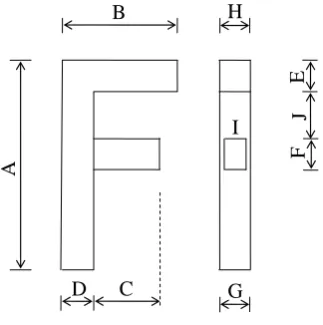
Design or determination of a pattern is one of the important steps in the study of the dimensional accuracy of the wax models used in investment casting. The model should have different lengths to study various values of length on dimensional accuracy. Also, the model should have various thicknesses to study the thickness shrinkages in wax. However, the model should be simple enough to remove the wax model from the die, easily. Therefore, a model of F-shape (Fig. 1) is selected as the case study model in this paper, considering the above factors.
A
B
C D
E
F
G H
I J
Fig. 1. Geometry of the pattern.
As can be observed from Fig. 1, there are ten sections (named A to J) on the pattern, in which the dimensional errors between the metallic die cavity and the wax model should be evaluated. However, the output parameter (named dimensional accuracy) should be only one data according to the Taguchi orthogonal arrays. So,
one should define a characteristic parameter that contains all ten dimensions. In this paper, the root mean square of the dimensional errors of ten sections is considered as the characteristic value. It is evident that if the characteristic value for each experiment is smaller, more accuracy is achieved and the dimensional errors becomes smaller.
3.2. Design of experiment using the Taguchi method and performing the experiments
Three factors named injection temperature, injection pressure, and holding time are considered as input parameters affecting the output parameter named dimensional accuracy. It should be noted that the selection of these input parameters is carried out based on performing a good experimental program. Some other input parameters may have an insignificant effect on the output parameter, such as room humidity. Also, some other input parameters may have a significant effect on dimensional accuracy, but they are not measurable or controllable during the tests. For example, the used machine for making the wax pattern could not measure and control the injection speed during the test. So, it is not possible to consider the injection speed as an input parameter affecting the output parameter.
Four different values for each input parameter are selected. These values (levels) is well-defined based on the authors' previous experiences. The input parameters (factors) and their values (levels) are listed in Table 1. If the full factorial design method is used, the total number of 43 experiments should be carried
out. However, by using the Taguchi method based on fractional factorial design method, the total number of required experiments may be reduced to 16.
Table 1. Factors and their levels.
Serial Factors Level
1 2 3 4
A Injection temperature (oC) 70 75 80 85
B Holding time (min) 1 1.5 2 2.5
In this reduction procedure, the modified L16 orthogonal array proposed by Taguchi is used. The other ambient and process parameters are assumed to be constant during the tests.
An aluminum die (Fig. 2) is used to produce the wax patterns under different injection conditions. This die is produced by a CNC machine. Two guides are designed in order to achieve the alignments. The die temperature is assumed to be constant and equal to 5oC in all
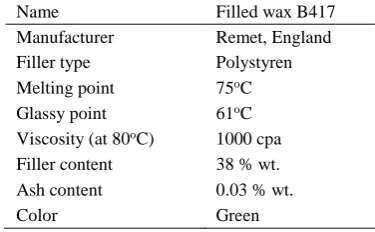
experiments. No cooling procedure is considered in all experiments. So, the wax injected to the die is cooled by heat transfer with ambient. When the upper part of the die is mounting on the lower part, a pressure of about 5 MPa is carried out by the machine to keep the parts of the die and avoid them from separating. The wax properties are listed in Table 2. The dimensions of various sections of the die cavity are listed in Table 3. Note that these dimensions, selected arbitrarily, are the nominal dimensions of the die cavity.
Fig. 2. An aluminum die used to produce wax patterns under different conditions.
Table 2. Properties of wax used in this research.
Name Filled wax B417
Manufacturer Remet, England
Filler type Polystyren
Melting point 75oC
Glassy point 61oC
Viscosity (at 80oC) 1000 cpa
Filler content 38 % wt.
Ash content 0.03 % wt.
Color Green
Table 3. The dimensions of selected pattern.
Section A B C D E F G H I J
Dimension
(mm) 110 60 35 15 15 15 12 12 8 30
The modified L16 (M16) orthogonal array based on the Taguchi approach are listed in Table 4. After determination of 16 experiments out of all 64 experiments (based on full factorial design method), the selected experiments are carried out. In each experiment, the dimensions of each section (A to J) are measured and compared by nominal data reported in Table 3. Then the mean root squares of errors are evaluated. It should be noted that for repeatability, each row in Table 4 (each experiment with specific input parameter values) is carried out twice. Therefore, two columns named "Result 1" and "Result 2" are introduced in Table 4, reporting the root mean squares of experiments for each row.
In order to evaluate the effect of interactions between factors, eight experiments are carried out using the L8 orthogonal array. The levels 1 and 4 of each input parameter are chosen. The L8 orthogonal array is listed in Table 5. Similar to Table 4, there are two columns named Result 1 and Result 2 indicating the root mean squares of each experiment.
4. Results and discussion
Table 4. Modified L16 (M16) orthogonal array of the Taguchi approach and the results of experiment.
Trial Factor A Factor B Factor C Result 1 Result 2
1 2 3 4 5
1 1 1 1 1 1 0.6498 0.6395
2 1 2 2 2 2 0.5755 0.6387
3 1 3 3 3 3 0.5643 0.5799
4 1 4 4 4 4 0.6230 0.5603
5 2 1 2 3 4 0.5765 0.5991
6 2 2 1 4 3 0.6967 0.6516
7 2 3 4 1 2 0.5773 0.5036
8 2 4 3 2 1 0.6406 0.5866
9 3 1 3 4 2 0.7304 0.6860
10 3 2 4 3 1 0.5424 0.5749
11 3 3 1 2 4 0.5655 0.6339
12 3 4 2 1 3 0.4738 0.4933
13 4 1 4 2 3 0.6705 0.6758
14 4 2 3 1 4 0.6186 0.6141
15 4 3 2 4 1 0.6264 0.6845
16 4 4 1 3 2 0.5877 0.6527
Table 5. The L8 orthogonal array of the Taguchi approach to evaluate the interactions between factors and the results of experiments.
Trial A B A*B C A*C B*C Result 1 Result 2
1 2 3 4 5 6 7
1 1 1 1 1 1 1 1 0.6624 0.6477
2 1 1 1 2 2 2 2 0.6843 0.5877
3 1 2 2 1 1 2 2 0.6203 0.5420
4 1 2 2 2 2 1 1 0.6334 0.5603
5 2 1 2 1 2 1 2 0.6152 0.6678
6 2 1 2 2 1 2 1 0.5722 0.6150
7 2 2 1 1 2 2 1 0.5672 0.6037
8 2 2 1 2 1 1 2 0.5681 0.6374
Table 6. Main effects of selected factors.
Serial Factor Level 1 Level 2 Level 3 Level 4
A Injection temperature (oC) 0.614 0.604 0.588 0.641
B Holding time (min) 0.653 0.614 0.592 0.577
C Injection pressure (bar) 0.571 0.623 0.585 0.627
0.56 0.58 0.60 0.62 0.64 0.66
1 2 3 4 1 2 3 4 1 2 3 4
Mai
n
e
ffec
ts
Selected factors
A B C
Fig. 3. Main effects of selected factors.
Table 7. Analysis of variance (ANOVA) of the main factors.
Factors DOF Sum of squares Variance F-ratio Pure sum Percent
A 3 0.0124 0.0041 2.5256 0.0117 10.5
B 3 0.0264 0.0081 5.3620 0.0299 26.8
C 3 0.0365 0.0122 7.4104 0.0316 28.3
Other/error 22 0.0361 0.0016 34.4
Total 31 100.0
Table 8. The main effects of input parameters and the interactions between them.
Factor Level 1 Level 2 L1 – L2
A 0.617 0.606 0.011
B 0.632 0.592 0.040
A * B 0.620 0.603 0.017
C 0.616 0.607 0.009
A * C 0.608 0.615 -0.007
B * C 0.609 0.614 -0.005
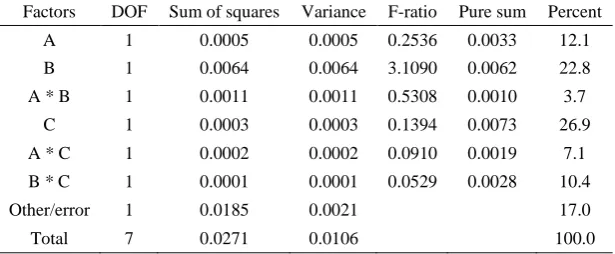
Table 9. The analysis of variance of the main factors and their interactions.
Factors DOF Sum of squares Variance F-ratio Pure sum Percent
A 1 0.0005 0.0005 0.2536 0.0033 12.1
B 1 0.0064 0.0064 3.1090 0.0062 22.8
A * B 1 0.0011 0.0011 0.5308 0.0010 3.7
C 1 0.0003 0.0003 0.1394 0.0073 26.9
A * C 1 0.0002 0.0002 0.0910 0.0019 7.1
B * C 1 0.0001 0.0001 0.0529 0.0028 10.4
Other/error 1 0.0185 0.0021 17.0
Total 7 0.0271 0.0106 100.0
Table 10. Optimum point of factor to achieve good dimensional accuracy and their contribution
Serial Factors Value Level Contribution
A Injection temperature 80oC 3 -0.02165
B Holding time 2.5min 4 -0.03192
C Injection pressure 20bar 1 -0.03792
Total contribution from all factors -0.0915
Current grand average performance 0.6092
Expected result at optimum condition 0.5177
Therefore, the results of Table 9 are in agreement with those reported in Table 7. One can evaluate the percent influence of interactions of the factors by summing the interactions of each two factors from Table 9 (i.e. 3.7 + 7.1 + 10.4 = 21.2%). The results of Table 9 show that the factor C (injection pressure) is more dominant in the dimensional accuracy of wax models made by the studied metallic mold.
Using the Taguchi approach, it is concluded that the optimum levels of input parameters in order to achieve the best dimensional accuracy of wax patterns is 80oC for injection temperature, 2.5
minute for holding time, and 20 bar for injection pressure. The optimum levels of input parameters and their contribution to the overall results are listed in Table 10.
characteristic values of this point are 0.4738 and 0.4933. It can be observed from the results listed in Table 4 that Taguchi procedure can predict the optimum conditions accruable since the 12th trial
of the experiments has a smaller root mean square of the dimensional errors.
It should be noted that the dimensional errors of the wax specimen made under optimum levels of input parameters are in the range of the permissible tolerance of investment casting. According to investment casting references, the permissible tolerance for straight dimensions is 0.005 inch per inch or 0.5%. The RMS of the dimensions is 137.3 (dimensions listed in Table 3). So, the permissible tolerance of whole dimensions is 137.3 × 0.005=0.686. The RMS of dimensional differences of the model produced at optimum conditions is 0.4738 and 0.4933 in two tries. Therefore, the errors are acceptable. Rezavand and Behravesh [9] studied the effect of injection temperature and holding time on the dimensional accuracy of wax patterns in a gas turbine blade. They found that the effect of holding time has a further effect on dimensional accuracy compared with injection temperature. The results of this paper are in agreement with their results. However, in the present paper, the effect of injection pressure on dimensional errors of wax specimens is also studied. The results show that this parameter is the most effective parameter among studied parameters on dimensional accuracy.
5. Conclusions
Dimensional accuracy of wax specimens used as a sacrificed specimen in investment casting may be influenced by some input parameters such as injection temperature, holding time, and injection pressure. In this paper, the effects of each input parameters are studied. It is concluded that the injection pressure is the most effective parameter on dimensional errors of wax specimens created by the metallic mold. The Taguchi procedure based on fractional factorial design method in the design of experiments shows that the optimum values of input parameters to achieve the best dimensional accuracy may be 80oC for injection temperature,
2.5 min for holding time, and 20 bar for injection
pressure. The dimensional errors of the wax pattern made under these optimum values are in the range of permissible tolerance of investment casting manufacturing procedure.
References
[1] C. Yuan, and S. Jones, "Investigation of fiber modified ceramic moulds for investment casting", J. Europ. Ceram. Soci., Vol. 23, No. 3, pp. 399-407, (2003). [2] J. Jiang, and X.Y. Liu, "Dimensional variations of casting and moulds in the ceramic mould casting process", J. Mater. Process. Tech., Vol. 189, No. 1-3, pp. 247-255, (2007).
[3] J. Fischer, A. Ebinger, T. Hagi, B. Stawarczyk, A. Wenger, and E. Keller, "Mold filling and dimensional accuracy of titanium casting in a spinel-based investment", Dental Materials, Vol. 25, No. 11, pp. 1376-1382, (2009).
[4] R. Singh, S. Singh, and V. Mahajan, "Investigations for dimensional accuracy of investment casting process after cycle time reduction by advancements in shell moulding", Procedia Mater. Sci., Vol. 6, pp. 859-865, (2014).
[5] R. Singh, J. Singh, and S. Singh, "Investigation for dimensional accuracy of AMC prepared by FDM assisted investment casting using nylon-6 waste based reinforced filament", Measurement, Vol. 79, pp. 253-259, (2016).
[6] M. Kafara, J. Kemnitzer, H. H. Westermann, and R. Steinhilper, "Influence of binder quantity on dimensional accuracy and resilience in 3D-printing", Procedia Manufacturing, Vol. 21, pp. 638-646, (2018).
[7] J. S. Chohan, R. Singh, K.S. Boparai, R. Penna, and F. Fraternali, "Dimensional accuracy analysis of coupled fused deposition modeling and vapour smoothing operations for biomedical applications", Composites Part B, Vol. 117, pp. 138-149, (2017).
Mater. Sci. Eng. A, Vol. 362, No. 1-2, pp. 125-134, (2003).
[9] S. A. M. Rezavand, and A. H. Behravesh, "An experimental investigation on dimensional stability of injected wax patterns of gas turbine blades", J. Mater. Proc. Tech., Vol. 182, No. 1-3, pp. 580-587, (2007).
[10] P. K. Yarlagadda, and T. S. Hock, "Statistical analysis on accuracy of wax patterns used in investment casting process", J. Mater. Proc. Tech., Vol. 138, No. 1-3, pp. 720-725, (2003).
[11] T. L. Chang, C. Maruyama, S. N. White, S. Son, and A. A. Caputom, "Dimensional accuracy analysis of implant framework casting from two casting systems", J. Prosth. Dent., Vol. 20, No. 5, pp. 67-75, (2006).
[12] W. Bonilla, S. H. Masood, and P. Iovenitti, "An investigation of wax patterns for accuracy improvement in investment cast parts", Int. J. Advanced Manufacturing Technology, Vol. 18, pp. 348-356, (2001).
[13] J. C. Gebelin, M. R. Jolly, A. M. Cendrowicz, S. Blackburn, and J. Cirre, "Simulation of die filling for the wax injection process: Part I. models for material behavior", Metal Mater. Trans. B, Vol. 35, pp. 755-759, (2004).
[14] J. C. Gebelin, M. R. Jolly, A. M. Cendrowicz, S. Blackburn, and J. Cirre, "Simulation of die filling for the wax injection process: Part II. Numerical simulation", Metal Mater. Trans. B, Vol. 35, No. 4, pp. 760-768, (2004).
[15] D. Singh, R. Singh, and K. S. Boparai, "Development and surface improvement of FDM pattern based investment casting of biomedical implants: A state of art review", J. Manuf. Proc., Vol. 31, pp. 80-95, (2018).
[16] P. Kumar, R. Singh, and I.P. Ahuja, "Investigations on dimensional accuracy of the components prepared by hybrid investment casting", J. Manuf. Process, Vol. 20, No. 3, pp. 525-533, (2015). [17] J. Singh, and H. Singh, "Dimensional
accuracy and surface finish of biomedical
implant fabricated as rapid investment casting for small or medium quantity production", J. Manuf. Proc., Vol. 25, pp. 201-211, (2017).
[18] R. Singh, S. Singh, and G. Singh, "Dimensional accuracy comparison of investment castings prepared with wax and ABS patterns for bio-medical application", Procedia Mater. Sci., Vol. 6, pp. 851-858, (2014).
[19] R. Singh, R. Singh, J.S. Dureja, I. Farina, and F. Fabbrocino, "Investigations for dimensional accuracy of Al alloy/Al-MMC developed by combining stir casting and ABS replica based investment casting", Composites Part B, Vol. 115, pp. 203-208, (2017).
[20] R. Singh, and S. Singh, "Modeling of dimensional accuracy in precision investment casting using Buckingham's Pi approach", Materialstoday, Vol. 4, No. 2, Part A, pp. 1598-1605, (2017).
[21] Y. W. Dong, X. L. Li, Q. Zhao, J. Yang, and M. Dao, "Modeling of shrinkage during investment casting of thin-walled hollow turbine blades", J. Mater. Process. Tech., Vol. 244, pp. 190-203, (2017). [22] J. Barbosa, and H. Puga, "Ultrasonic melt
processing in the low pressure investment casting of Al alloys", J. Mater. Process. Tech., Vol. 244, pp. 150-156, (2017). [23] D.Y. Park, D.S. Shin, H. Cho, and S.J.
Park, "Effects of material and processing conditions on powder-binder separation using the Taguchi method", Powder Tech., Vol. 321, pp. 369-379, (2017). [24] R. Valinejad, and R. Soleymani Nazar,
"An experimental design approach for investigating the effects of operating factors on the wax deposition in pipelines", Fuel, Vol. 106, pp. 843-850, (2013).
cement-based grouts", Tun Underground Spa. Tech., Vol. 20, No. 2, pp. 167-173, (2005). [27] R. K. Roy, Design of experiments using
the Taguchi approach. 3rd edition, Wiley,
Mississauga, ISBN: 0-471-36101-1, (2001).
[28] K. K. Prasad, S. V. Mohan, R. S. Rao, B.
R. Pati, and P. N. Sarma, "Laccase production by Pleurotus ostreatus 1804: optimization of submerged culture
conditions by Taguchi DOE
methodology", Bio Engineering J., Vol. 24, No. 1, pp. 17-26, (2005).
How to cite this paper:
E. Barati and J. Akbari, “ The effect of injection parameters on dimensional accuracy of wax patterns for investment casting”,
Journal of Computational and Applied Research in Mechanical Engineering, Vol. 9, No. 2, pp. 313-322, (2019).