Garment industry in Lithuania: a study of
self-reported dermatological problems
Correspondence to: Aistė Audickaitė, Vilnius University Hospital Santariškių Clinics, Kairiūkščio St. 2, LT-08411 Vilnius, Lithuania. E-mail: [email protected]
Edita Naruševičiūtė-Skripkienė1,
Beatričė Moskalionė2, Aistė Audickaitė1,
Jūratė Grigaitienė1,
Matilda Bylaitė-Bučinskienė1
1 Centre of Dermatovenereology, Vilnius University, Vilnius, Lithuania
2 The Faculty of Medicine,
Vilnius University, Vilnius, Lithuania
Background. According to our knowledge, there are no official medical statistics about skin problems of Lithuanian textile work-ers.The aim of the study is to evaluate work related skin problems in this occupational field, their character, and what alterations if any can be carried out.
Materials and methods. A self-reported anonymous survey was carried out in 12 randomly selected textile factories from 6 cit-ies of Lithuania in 2013–2014. Data were analyzed by SPSS v21.0.
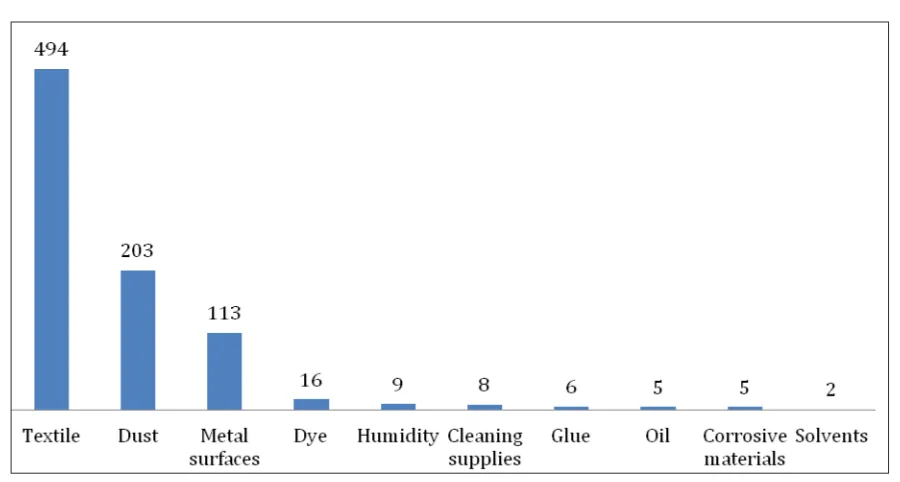
Results. 91% of all the employees (551) were females with the mean experience in textile industry of 14.2 years (SD 7.2). The majority (63%) of the respondents were sewing machine op-erators. The most commonly mentioned risk factors were textile (89.7%) and dust (36.8%) containing different chemical substanc-es that we did not analyze in our study. 83.1% of the rsubstanc-espondents had no air conditioning systems at their working place. Atopic skin diseases were declared by 165(30%) workers. 208(37.7%) partici-pants complained about skin problems. Dermatological treatment was received by 190(91.4%) respondents (topical corticosteroids, antibiotics and emollients) and was effective in 74.7% of all cas-es. Almost all of the respondents (97%) declared having no train-ing about occupational skin problems and skin protection mea-sures during apprenticeship, though 59% of them pointed out it would be desirable. Still, the usage of emollients at work is rather high – 76.6%.
Conclusions. Our study highlighted that improvement is needed in pre-occupational councelling and working conditions.
Key words: risk factors, skin, textile workers
INTRODUCTION
Textile dermatitis resulting from contact with cloth-ing and other textiles is not a rare phenomenon, though its incidence is not very clear due to lack of epidemiological studies (1–2). Sick leave appears to
be frequent in textile industries (3). A turnover rate of employees in textile industry in some countries is higher compared with that of other industries (4).
general Lithuanian population (5–6). The analysis of the morbidity of textile garment industry work-ers in one of Lithuanian regions, Kaunas, was also performed. It was more concentrated on general health aspects with lack of attention to skin prob-lems. According to the authors, the morbidity is not very high – 1.94 sick leave cases in men and 2.29 in women per 100 workers a year (7). The Lithuanian Registry of Occupational Skin Diseases reports that throughout all occupational fields there were only 4 cases of occupational skin diseases in 2013 (8).
Since 2011 the Centre of Dermatovenereology at Vilnius University Hospital Santariškių Clinics is performing descriptive self-reported by employ-ees studies in various occupational settings with the aim to get data and increase awareness on oc-cupational skin diseases in Lithuania. According to us, textile workers in Lithuania are rarely seeking for dermatological help and official medical statis-tics about dermatological problems of textile work-ers are not available. So the period 2013–2014 was dedicated to textile workers in garment industry.
The aim of this study is to evaluate if there are any dermatological work related problems in this occupational field, their character, what an urge for dermatological help is, as well what alterations can be carried out.
MATERIALS AND METHODS
A self-reported survey on occupational skin prob-lems in textile garment industry was carried out in 2013–2014. The survey was conducted in 12 dif-ferent textile garment production companies that were randomly selected from 6 cities in 4 different (out of 10) districts of Lithuania.
Workers in garment industry who had been di-rectly exposed to textile production environment filled up questionnaires in an anonymous manner by their own and employers’ consent. The original ques-tionnaire was created in the Lithuanian language by a dermatologist, later translated into the Russian language because of lack of Lithuanian language knowledge by some textile workers. It consisted of 35 original questions and was designed to describe demographics (age, sex, education, specialization, experience, working hours per week), possible occu-pational risk factors (textiles, dyes, metals and other materials used in garment industry, dustiness) and occupational skin protection measures which were
used. There were also questions to detect changes of the skin and general health complaints arising after starting working in textile garment industry.
A descriptive statistical analysis was performed with 511 questionnaires using the SPSS v21.0 sta-tistical software programme for Windows. Con-tinuous variables are presented as mean ± stardard deviation, categorical variables are given as fre-quences and percentages. A p value <0.05 was con-sidered significant.
RESULTS
The majority of 551 participants (91%) were wom-en. The mean age of the employees was 42.9 years (SD 8.6). The mean duration of employment in textile industry was 14.2 years (SD 7.2) and usually they worked 42.35 hours per week (SD 3.79).
The average duration as an apprentice was 14.7 months (SD 15.0). Occupational skills were mostly acquired at a workplace (44%), more rarely at voca-tional schools (27%), during the courses (14%) and very seldom on their own. Others did not specify where they acquired speciality skills (11%). 4% of all participants refused to declare their education. The majority of the respondents (97%) declared they had no training on occupational skin prob-lems and skin protection measures during appren-ticeship, though 59% of them pointed out it would be desirable.
Atopic diseases were declared by 165(30%) workers that participated in our study. Allergic rhi-nitis was mentioned in 56%, allergic conjuctivitis in 22%, atopic dermatitis in 18% of the cases and bronchial asthma was mentioned by 8% of the re-spondents.
Present skin complaints were pointed out by 208(37.7%) participants. The majority of affected workers (79.8%) were those working for more than 5 years in this occupational field (p < 0.05). The most commonly affected body sites were arms (97.1%), face (74.5%), legs (42.8%), and neck (36.5%). All affected localizations are listed in the Table.
Table. Affected skin sites declared by employees after they start to work in textile garment industry
Site No. (%)
Arms 202(97.1%)
Face (widespread) 155(74.5%)
Legs 89(42.8%)
Neck 76(36.5%)
Eyelids (only) 67(32.2%)
Hands 66(31.7%)
Feet 48(23.1%)
Waist 24(11.5%)
Signs of acute eczema with a combination of symptoms like erythema, vesicles and itching were indicated only in 1 employee on his face.
A combi-nation of erythema, scaling and itching was declared by 16 workers on eyelids, other parts of the face, neck, hands and arms. All of those 17 respondents with signs of eczema declared having atopy. Almost 28% of the participants had frictional calluses, 17.1% were with skin burns from irons/heat-presses.
A high prevalence of nail changes was noticed in 186(33.8%) employees: 77% of those declared hav-ing rough, rippled nails, 16% had thickened nails and 7% had discoloration of the nail plates.
After beginning the work in textile garment in-dustry 320(58.1%) workers started to feel irritation and redness of the eyes (66%), a tickling and sore throat (12 and 3%, respectively), a dry cough (18%) and other changes in oral mucosa (1%).
There was seasonal influence on symptoms in 301(54.6%) respondents with significant worsening during cold seasons in autumn and winter (30 and 43%) and less during holiday season in spring and summer (4 and 23%), respectively.
Textile garment workers do use skin protec-tion measures in daily practice: 76.6% apply emol-lients, 18.1% use aprons, 12.7% wear protective gloves, 11.1% apply facial masks and 1.1% have fin-gerstalls. Dermatological treatment was received by 190(91.4%) out of 208 respondents with skin com-plaints. They were managed with topical cortico-steroids (5%), topical antibiotics (12%), and emol-lients (83%). It was effective in 74.7% of all cases.
DISCUSSION
A comparison between our data and results in oth-er publications is not an easy task because of a lim-ited amount of publications and different methods of enrollment.
There are mostly middle aged women working in textile industry in Lithuania. Our findings are similar to data from other countries, like Italy and United Kingdom (1, 9). According to our study, employees do not have enough knowledge about occupational skin problems and their solutions but they would like to. The reason is the lack of train-ings at a working place.
Workers in textile industry are exposed to var-ious hazards during the manufacture process (7). Textile dyes, finish resins, rubber additives and machine oil are the most commonly mentioned culprits of textile allergy (1–2, 10–16). The par-ticipants in our study declared that they were working with dyed textiles, but most of them did not know what kind of dyes were used. They were mainly working with synthetic textiles and more rarely with natural ones. Man-made fibers like nylon, spandex, rubber and just few natural fibers like wool and silk have been linked to dermato-logical problems (17). Textile fibers mainly cause irritant contact dermatitis (16).Metals were often mentioned in our study being in direct contact with skin. Airborne particulates from all these materials in their working environment are very important hazards. There is data that cotton dust is often contaminated with Gram-negative bacte-rias, which contain endotoxins that might be re-leased into the air during cotton processing (18). Flu, cough, eye and skin infections are the most common diseases among workers affected by par-ticulate matter like textile dust (19). So dustiness, affecting more than 1/3 of the employees in our study, is of concern.
Individuals with atopy are a special risk pop-ulation for occupational irritant contact dermati-tis (20). It is known that irritant contact dermatitis is slightly more frequent than allergic contact der-matitis in textile industry (12–13, 16). More than a third of our investigated employees had atopic history, 30(5%) of them had atopic dermatitis. Atopic disease prevalence (30%) in our survey is similar to data from other studies: 22.4% in those investigated for textile contact dermatitis (1) and
31–35.9% in patients diagnosed with occupa-tional allergic contact dermatitis of different or-igin (21). We may presume that improvement in pre-occupational councelling about the impor-tance of atopy presence might be preventative for development of occupational textile dermatitis in our country.
Occupational allergic and irritant contact der-matitis as well as contact urticaria to textiles have already been reported (12–13). Contact dermatitis is by far the most common clinical manifestation, especially the chronic one (1, 16). Irritant contact dermatitis is slightly more frequent than allergic contact dermatitis (12). Less frequent manifesta-tions include the following: prurigo-like, purpuric lesions, hyperpigmentated patches and papular, papulopustular lesions, with more atypical forms being erythema multiforme-like lesions, num-mular-like lesions, lichenifications and erythro-dermia, even lymphomatoid dermatitis (1, 13, 22, 23). Practitioners must always be in awareness because of various clinical presentations. The ma-jority (16 respondents) of those 17 participants, who declared signs of eczema in our study, were having signs of chronic eczema. For more accu-rate data a clinical investigation of those ill indi-viduals would be preferable. When a patient seeks for dermatological help other causes of dermatitis must be considered and excluded, such as atopic dermatitis, psoriasis, and fungal infection (12).
It is also important to discuss affected body locations with the patient. Occupational cases demonstrate common involvement of hands in many studies (12–13, 24). Lack of hand involve-ment is considered to mean reduced likelihood of work-related dermatitis in textile workers. Face involvement is presumably from airborne particu-lates, and is usually related to the limited engineer-ing controls, and an inconsistent use of protective equipment (12). Diseased body skin sites that are unprotected with clothes like face, neck, hands and arms, confirm a suspicion that airborne particles might be the reason of this type of affection.
Seasonal variation of symptoms is known. Our acquired information is similar to data from other studies (26) where health complaints improve in spring and summer months and get worse during cold seasons.
According to our knowledge, there is a lack of data about occupational nail changes in textile in-dustry. We support a suggestion that textile indus-try workers should be followed for the develop-ment of onychomycosis (27) because we found more than one third of the respondents having nail changes. This will be a topic for further inves-tigations of ethiology and diagnosis of these nail changes if they seek for medical help.
The standard treatment of textile contact der-matitis is with topical or systemic corticosteroids according to the current skin condition and strict avoidance of an offending source (13). The work-ers in our study who had applied for medical help were also mainly treated with topical cortico-steroids. Treatment with barrier creams in favour with hydrocarbon creams in comparison with silicone creams lowers the incidence of objective skin lesions (28). A rate of usage of emollients and other skin protection measures in our study is also rather high, despite having no training about oc-cupational skin diseases. However, it is a question for disscusion if these measures are sufficient and used properly.
Textile dermatitis has a wide spectrum of typ-ical and atyptyp-ical clintyp-ical presentations that may mimic other skin pathologies, so to make a correct diagnosis there is a need for extensive knowledge of health professionals and availability of the skin patch testing.
CONCLUSIONS
Our study is focusing on self-reported derma-tological problems in textile garment industry. The most commonly mentioned risk factors were textile and dust containing different chemical sub-stances which we did not analyze. Uncovered with clothes body sites (face and arms) were mainly af-fected. It has highlighted that almost all respond-ents did not have any trainings before the start of the work and most of them would like to have one. Therefore it seems that improvement is needed in pre-occupational councelling, working condi-tions. A better knowledge of skin protection and
higher rate of seeking dermatological help may potentially lower the incidence of work related skin problems.
Received 13 October 2015 Accepted 2015 November 2015
References
1. Lisi P, Stingeni L, Cristaudo A, Foti C, Pigatto P, Gola M, et al. Clinical and epidemiological features of textile contact dermatitis: an Italian multicentre study. Contact Derm. 2014; 70: 344–50. http://dx. doi.org/10.1111/cod.12179
2. Slodownik D, Williams J, Tate B, Tam M, Cahill J, Frowen K, et al. Textile allergy – the Melbourne experience. Contact Derm. 2011; 65: 38–42. http:// dx.doi.org/10.1111/j.1600-0536.2010.01861.x 3. Bilban M. Occupational Medicine in the Slovene
Area. J Occup Health. 2005; 47: 193–200. http://dx. doi.org/10.1539/joh.47.193
4. Bakirci N, Kalaca S, Fletcher AM, Pickering CA, Tumerdem N, Cali S, et al. Predictors of early leaving from the cotton spinning mill environ-ment in newly hired workers. Occup Environ Med. 2006; 63: 126–30. http://dx.doi.org/10.1136/ oem.2005.021352
5. Kuzmickiene I, Stukonis M, Didžiapetris R. [Ma-lignant tumor incidence in employees of the Aly-tus textile factory (1978–1997)]. Medicina (Kau-nas). 2002; 38: 1018–25. Lithuanian.
6. Kuzmickiene I, Stukonis M. Cancer incidence among women flax textile manufacturing workers in Lithuania. Occup Environ Med. 2010; 67: 500– 2. http://dx.doi.org/10.1136/oem.2009.048058 7. Ustinaviciene R, Piesine L. [Morbidity of textile
industry workers in Kaunas]. Medicina (Kaunas). 2007; 43(6): 495–500. Lithuanian.
8. Registry of occupational diseases in Lithuania in 2013 [Internet]. Available from: http://www.hi.lt/ images/2013%20m_%20ataskaita%20nauja.pdf 9. Smith J, Gawkrodger DJ. Contact dermatitis from
textile and dye allergens requires a high index of suspicion for diagnosis. Contact Derm. 2002; 47(2): 112–3.
11. Hatch KL, Maibach HI. Textile chemical finish der-matitis. Contact Derm. 1986; 14(1): 1–13. http:// dx.doi.org/ 10.1111/j.1600-0536.1986.tb01145.x 12. Soni BP, Sherertz EF. Contact dermatitis in
the tex-tile industry: a review of 72 patients. Am J Contact Dermat. 1996; 7(4): 226–30.
13. Lazarov A. Textile dermatitis in patients with con-tact sensitization in Israel: a 4-year prospective study. J Eur Acad Dermatol Venereol. 2004; 18(5): 531–7. http://dx.doi.org/10.1111/j.1468-3083.2004.00967.x 14. Coman G, Blickenstaff N, Edwards A, Maibach H.
Dermatotoxicologic clinical solutions: textile dye dermatitis patch testing. Cutan Ocul Toxicol. 2014 [cited 2014 Mach 31]. http://dx.doi.org/10.3109/15 569527.2014.883403. Available from: http://infor-mahealthcare.com
15. Hatch KL, Maibach HI. Textile dermatitis: an up-date. (I). Resins, additives and fibers. Contact Derm. 1995; 32(6): 319–26.
16. Le Coz CJ. Clothing. In: Jonsen JD, Frosch PJ, Le-poittevin JP, eds. Contact Dermatitis. 5th ed. Spring-er. 2011. p. 793–817.
17. Hatch KL, Maibach HI. Textile fiber dermatitis. Contact Derm. 1985; 12(1): 1–11.
18. Paudyal P, Semple S, Niven R, Tavernier G, Ay-res JG. Exposure to dust and endotoxin in textile processing workers. Ann Occup Hyg. 2011; 55: 403–9. http://dx.doi.org/10.1093/annhyg/meq084 19. Tahir MW, Mumtaz MW, Tauseef S, Sajjad M,
Na-zeer A, Farheen N, et al. Monitoring of cotton dust and health risk assessment in small-scale weaving industry. Environ Monit Assess. 2012 Aug; 184(8): 4879–88. http://dx.doi.org/10.1007/s10661-011-2309-y
20. Landeck L, Visser M, Skudlik C, Brans R, Kezic S, John SM. Clinical course of occupational irritant contact dermatitis of the hands in relation to filag-grin genotype status and atopy. Br J Dermatol.
2012; 167(6): 1302–09. http://dx.doi.org/10.1111/ bjd.12035
21. Barbieri MT, Cocco ME, Cocco P. Prevalence of atopic conditions in patients with occupational contact allergic dermatitis: comparison between diagnostic tool. Med Lav. 2013; 104(6): 460–6. 22. Tognetti L, Giorgini S, Lotti T. Prurigo-like eczema
as an unsuspected presentation of textile dermati-tis. Eur J Dermatol. 2011; 21: 139–40.
23. Narganes LM, Sambucety PS, Gonzalez IR, Ri-vas MO, Prieto MA. Lymphomatoid dermatitis caused by contact with textile dyes. Contact Derm. 2013; 68(1): 62–4. http://dx.doi.org/10.1111/j.1600-0536.2012.02164.x
24. Singhi MK, Menghani PR, Kachhawa D, Bansal M. Occupational contact dermatitis among the tra-ditional ‘tie and dye’ cottage industry in Western Rajasthan. Indian J Dermatol Venereol Leprol [serial online]. 2005 [cited 2014 May 6]; 71: 329– 32. Available from: http://www.ijdvl.com/text. asp?2005/71/5/329/16783
25. Panda Lukongo Kitronza J, de Brouwer C. Health problems in textile industry in Democratic Repub-lic of Congo. Rev Med Brux. 2010; 31(6): 513–20. 26. Lensen G, Jungbauer F, Gonçalo M, Coenraads PJ.
Airborne irritant contact dermatitis and conjuncti-vitis after occupational exposure to chlorothalonil in textiles. Contact Derm. 2007; 57(3): 181–6. 27. Kaçar N, Ergin Ş, Ergin Ç, Arslan Ş, Erdoğan BŞ.
Carpet weaving: an occupational risk for onycho-mycosis? J Eur Acad Dermatol Venereol. 2010; 24: 353–55.
Edita Naruševičiūtė-Skripkienė, Beatričė Moskalionė, Aistė Audickaitė,
Jūratė Grigaitienė, Matilda Bylaitė-Bučinskienė TEKSTILĖS PRAMONĖ LIETUVOJE:
DERMATOLOGINIŲ PROBLEMŲ TYRIMAS
Santrauka
Įžanga. Mūsų žiniomis, nėra oficialios medicinos sta-tistikos apie Lietuvos tekstilės pramonėje dirbančiųjų odos problemas. Tyrimo tikslas – įvertinti su šiuo darbu susijusias odos problemas, pobūdį bei būdus, kaip jų iš-vengti.
Metodika. 2013–2014 m. anonimine anketa apklaus-ti 12-os atsiapklaus-tikapklaus-tinai pasirinktų teksapklaus-tilės gamyklų šešiuose Lietuvos miestuose darbuotojai. Duomenys analizuoti SPSS v21.0 programa.
Rezultatai. 91 % visų apklaustųjų (551) buvo mo-terys; jų vidutinė darbo trukmė tekstilės pramonė-je – 14,2 metų (SD 7,2). Dauguma (63 %)
apklaustų-jų buvo siuvėjai. Dažniausi rizikos veiksniai – tekstilė (89,7 %) ir dulkės (36,8 %), kuriuos sudaro skirtingos cheminės medžiagos; jų savo tyrime neanalizavome. 83,1 % dirbančiųjų savo darbo vietoje neturėjo oro kondicionavimo sistemos. Atopiniu dermatitu sirgo 165 (30 %) darbuotojų, 208 (37,7 %) apklaustųjų tvirti-no turį odos problemų. Gydymas (vietiniai kortikoste-roidai, antibiotikai, emolientai) paskirtas 190 (91,4 %) respondentų, jis buvo efektyvus 74,7 % dirbančiųjų. Beveik visi apklaustieji (97 %) teigė, kad nebuvo infor-muoti apie profesines odos ligas ir odos priežiūrą dar-be; 59 % iš jų norėtų tokių mokymų. Emolientų varto-jimo statistika darbe yra pakankamai gera, juos tepasi 76,6 % apklaustųjų.
Išvada. Tyrimas atskleidė, kad, norint darbe išveng-ti dermatologinių problemų, ypač svarbu gerinišveng-ti darbo sąlygas bei organizuoti mokymus prieš pradedant dirbti.