Volume 2, Issue 9, September 2013
Page 70
Abstract
The electronic structure properties of II-VI Zinc-blende CdSe nanocrystals was studied by using Ab-initio Density functional theory (DFT) coupled with large unit cell (LUC)method of core atoms(8,16,54,64) for 3D periodic boundary condition (PBC), and in 2D(PBC ) calculation was used to simulated oxygenated (001)-(1x1) surface. Total energy , energy gap, cohesive energy , ionicity , valence band width , conduction band width , and highest degeneracy of states were calculated. The energy gap within the range ( 1.73- 1.77 eV ) for core part, while in surface part is smaller than in core part .Two kinds of cells were investigated( 8, 64 ) core atoms with a cubic Bravais multiple Cells and ( 16, 54 ) core atoms with a parallelepiped primitive multiple cells. The cohesive energy and ionicity are decrease when the number of core atoms increase . The highest degeneracy of states is increase with the number of core atoms increase. The highest density of state of core part is higher than that at surface part, this is due to the broken symmetry and the surface discontinuity and existence of new kind of atoms (oxygen atoms).
Keywords: Ab–initio density functional theory (DFT), Large Unit Cell (LUC), Electronic properties of CdSe
1.
INTRODUCTION
Semiconductor nanocrystals exhibit unique size and shape- dependent optical properties due to the quantum confinement effects and thus may find a wide range of applications in optoelectronic devices, photocatalysis , solar energy conversion and biological imaging and labeling . The II-VI semiconductor nanocrystals , such as CdSe , CdTe , and CdS, nanocrystals , are the group of nanostructures that have been mostly investigated because of their high luminescence efficiency and easily adjustable luminescence [ 1,2 ], from ultraviolet to near infrared region by nanocrystals size showing the prospective for optoelectronic devices and biological imaging as well as labeling applications . As a direct wide band gap ( 1.74 eV ) semiconductor , CdSe nanocrystals may be potentially used in optoelectronics of nonlinear optics and light emitting diodes . The nanoparticles are of great scientific interest as they are effectively a bridge between bulk materials and atomic or molecular structures. Bulk material should have constant physical properties regardless its size , but at the nano -scale this is often not the same case . we say begging is size dependent . The properties of materials change as their size approaches the nano-scale and the percentage of atoms at in the core becomes significant . Some of the properties of CdSe , molar mass ( 191. 37 g / mol ) , appearance ( black , translucent , adamantine crystals ) , odorless , density ( 5.816 g / cm ³ ) , melting point ( 1268 º c , 1541 K , 2314 º F ) , refractive index ( 2.5 ) , crystal structure ( three crystalline form of CdSe are known : wurtzite ( hexagonal ) , sphalerite (cubic ) and rock -salt (cubic ) . The sphalerite CdSe structure is unstable and converts to the wurtzite from upon moderate heating . The transition start at about ( 130 º c ) ,and at 700 º c ) it completes with in a day . The rock -salt structure is only observed under high pressure [ 3] .The production of cadmium selenide has been carried out in two different ways . The preparation of bulk crystalline CdSe is done by the High Pressure Vertical Bridgman method or High-Pressure Vertical Zone Melting . [4].
Cadmium selenide may also be produce in the form of nanoparticles . Several methods for the production of CdSe nanoparticles have been developed : arrested precipitation in solution , synthesis in structure media , high temperature pyrolysis , sonochemical , and radiolytic methods are just a few . [5, 6].
2.
THEORY
Density functional theory (DFT) with the large unit cell (LUC ) were used in the evaluation of the electronic structure of CdSe nanocrystals using ab-initio method. The Large unit cell (LUC) gives us the profits gained from cyclic boundary in simulating the solid . The LUC alters the shape and the size of the primitive unit cell so that the symmetry points in the original Brillouin zone at a wave vector k become equivalent to the central symmetry point in the new reduced zone [7] . In this method, the number of atoms in the central cell (at k=0) is increased to match the real number of nanocrystal atoms. The large unit cell method is a supercell method that was suggested and first applied for the investigation of the electronic band structure of semiconductors . This method differs from other supercell methods. Instead of adding additional k points to the reciprocal space, the number of atoms in the central cell (k=0) is increased and a larger central unit cell is formed [8]. k=0 is an essential part of the theory of LUC because it uses only one point in the reciprocal space that means only one cluster of atoms exist which is the features of quantum dots [9]. The calculations are carried out by using Gaussian 03 program [10]. The periodic boundary condition (PBC) method available in Gaussian 03 program is used to perform the present tasks [11]
Study the electronic properties of core
-oxidization CdSe nanocrystals
Mohammed T.Hussein1, Bushra A. Hassan2
Thekra K.Abdal Raheam 3 and Hassan B.Jasim 4
Volume 2, Issue 9, September 2013
Page 71
We shall use the density functional theory at the generalized gradient approximation (GGA) method level [12].Kohn-Sham density theory [13,14] is widely used for self consistent – field electronic structure calculations of the ground state properties of atoms, molecules, and solids. In this theory, only exchange – correlation energy
C X
XC
E
E
E
as a functional of the electron spin densitiesn
(
r
)
and
n
(
r
)
must be approximated The local spin density (LSD) approximation:)
,
(
]
,
[
n
n
d
3r
n
n
n
E
XCLSD unifXC (1)Where
n
n
n
, and the generalized gradient approximation (GGA) [15,16])
,
,
,
(
]
,
[
3.
n
d
r
f
n
n
n
n
n
E
GGAXC (2)
In comparison with LSD, GGA's tend to improve total energy, atomization energies, energy barriers and structural energy differences.
To facilitate particle calculations,
unifXC and f must be parameterized analytic functions. The exchange-correlationenergy per particle of a uniform electron gas,
E
XCLSD(
n
,
n
)
, is well established [17], but the best choice for)
,
,
,
(
n
n
n
n
f
is still a matter of debate.3.
RESULTS AND DISCUSSIONS
The nanocrystal core 3D periodic boundary condition (PBC) of CdSe nanocrystalls calculations has been studied and using 2D (PBC) with particular regard to the oxygenated (001)-(1x1) surface is added to obtain a complete electronic structure view. Fig.(1,2) shows the total energy as a function of the lattice constant optimization of 8 and 54 atom core LUC respectively. The results show that the minimum at the bottom represents the equilibrium lattice constant of this cell, while the equilibrium lattice constant occurred at a point in which the attraction forces between the atoms equals to the repulsion forces.
Fig. (1) Total energy versus with lattice constant of CdSe nanocrystals for 8 core atoms.
Volume 2, Issue 9, September 2013
Page 72
The calculations were carried out for the core geometries as shown in figures (3,4 ).Fig. ( 3) : color online CdSe ( 8) atoms core LUC( Cubic Bravais Cell multiple )
Fig. (4) color online CdSe ( 54) atoms core LUC (parallelepiped primitive cell multiple )
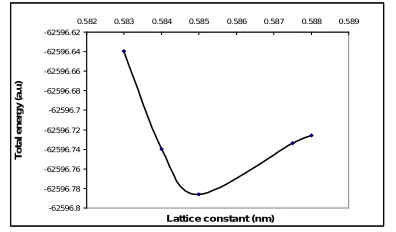
Fig. (5) shows the total energy variation with lattice constant variation for 8 atoms of the surface part . These curves and similar curves for other LUCs are used to obtain equilibrium lattice constants for these cells but the lattice constant is (0.585 nm) less than core part. Fig.(6) shows the geometries of oxidized surface for 8 core atoms.
-62596.8 -62596.78 -62596.76 -62596.74 -62596.72 -62596.7 -62596.68 -62596.66 -62596.64 -62596.62
0.582 0.583 0.584 0.585 0.586 0.587 0.588 0.589
Lattice constant (nm)
T
o
ta
l
e
n
e
rg
y
(
a
.u
)
Fig.( 5): Total energy versus lattice constant of 8 – atom oxygenated (001)-(1x1) surface of Cd8Se8O4.
Volume 2, Issue 9, September 2013
Page 73
Fig.(7) shows the relationship between the lattice constant and the number of atoms for all studied LUC sizes of CdSe ( ncs) core. The lattice constants show decreasing values from 0.587 nm for 8 atoms to 0.58 nm for 64 atoms LUC. Alsoshows the optimized core lattice constant of the range of nanocrystals ( 1.76- 2.32 nm).
0.578 0.58 0.582 0.584 0.586 0.588 0.59 0.592
0 10 20 30 40 50 60 70
Number of core atoms
La
tt
ic
e
c
on
s
ta
nt
(
nm
)
Fig. ( 7 ): Lattice constant as a function of number of core atoms for CdSe nanocrystal
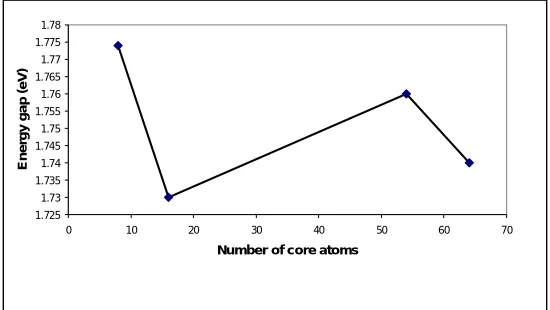
Fig.(8) shows the energy gap the core part plotted against the number of core atoms which show the increase of energy gap with increase of the number of core atom because of exciton bohr radius is less than the quantum confiment. In Fig. (9) the valence band width is shown to increases with increasing number of atoms per LUC, because of the geometry effects on electronic structure of nanocrystals. While we note conduction band width increases with increasing number of atoms per LUC, reaching to 16 atoms, but at 54 atoms C.B. width is decreases to (8.032 eV) and after that it increasing reaching to 64 atoms.
1.725 1.73 1.735 1.74 1.745 1.75 1.755 1.76 1.765 1.77 1.775 1.78
0 10 20 30 40 50 60 70
Number of core atoms
E
n
e
rg
y
g
a
p
(
e
V
)
Fig. ( 8 ): The energy gap variation of number of core atoms of CdSe nanocrystals LUC
.
0 5 10 15 20 25 30
0 10 20 30 40 50 60 70
Number of core atoms
V
.B
w
id
th
&
C
.B
w
id
th
(
e
V
)
V.B C.B
Fig. ( 9): Valence band width and Conduction band width as a function of number of core atoms for CdSe nanocrystal LUC
Volume 2, Issue 9, September 2013
Page 74
02 4 6 8 10 12 14 16
0 10 20 30 40 50 60 70
Number of core atoms
H
O
M
O
&
L
U
M
O
(
e
V
)
HOMO LUMO
Fig. ( 10 ): HOMO & LUMO as a function of number of core atoms of CdSe nanacrystal
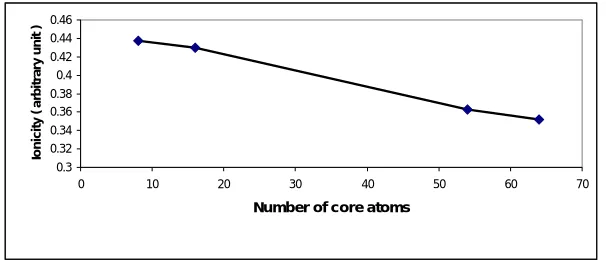
In Fig. (11),the absolute value of the cohesive energy decreases with increasing the number of core atoms per LUC. The atoms on the particle’s surface reconstructed to a more stable structure. The calculated cohesive energy is directly proportional to the value of the total energy. The correct calculated value of the total energy gives a correct value of the cohesive energy. Fig.(12) shows the atomic ionicity decrease with increasing number of atoms for core part.
-6.65 -6.6 -6.55 -6.5 -6.45 -6.4 -6.35 -6.3 -6.25
0 10 20 30 40 50 60 70
Number of core atoms
C
o
h
e
s
iv
e
e
n
e
rg
y
(
e
V
)
Fig. ( 11) The cohesive energy variation with the number of core atoms for CdSe nanocrystal
0.3 0.32 0.34 0.36 0.38 0.4 0.42 0.44 0.46
0 10 20 30 40 50 60 70
Number of core atoms
Io
n
ic
it
y
(
a
rb
it
ra
ry
u
n
it
)
Fig . ( 12 ) The Ionicity variation with the number of core atoms of CdSe nanocrystals LUC
The results of the highest density of states of core 8 atoms LUC and surface 8 atom as a function of energy levels are shown in Fig(13) and Fig.(14) respectively. The results that the core states show larger energy gap and smaller valence and conduction bands. Owing to perfect symmetry of the core, the core states are more density of states. As we move to the surface we see low density of states, small energy gap and wider conduction band. This reflects the broken symmetry and discontinuity at the surface and existence of new kind of atoms (oxygen atoms), and the variation of bond lengths and angles as well as lattice constant [24, 25]. Fig. (15) shows the atomic charge of oxidized Cd8Se8O4 surface as a function of
Volume 2, Issue 9, September 2013
Page 75
01 2 3 4 5 6 7
-30 -20 -10 0 10 20
Energy (e.V)
D
e
n
s
it
y
of
S
ta
te
s
DOS 8 atoms
Eg=1.77 e.V
Fig. (13): Density of states of 8 Core atoms of core part of CdSe . Valence band
are shown with bold lines while conduction band are shown with ordinary lines. The energy gap is shown between the two
bands where Eg=1.77eV
Fig.(14) : Density of states of Cd8Se8O4 . Valence band are shown
with bold lines while conduction band are shown with ordinary lines. The energy gap is shown between the two bands.
-0.5 -0.4 -0.3 -0.2 -0.1 0 0.1 0.2 0.3 0.4 0.5
0 2 4 6 8 10 12
Layer number
A
to
m
ic
c
h
a
rg
e
(
A
rb
it
ra
ry
u
n
it
)
o o
Cd
Se
Cd
Se
Cd
Se
Cd
Se
Fig.(15): Atomic charges as a function of layers depth of oxidized Cd8Se8O4
4- CONCLUSION
Volume 2, Issue 9, September 2013
Page 76
higher than that of the surface part. This reflects the high symmetry and equal bond lengths and angles in perfect CdSe nanocrystals structure.References
[1] C. M. Donega, P. Liljeroth, and D. Vanmaekelbergh,Small, 1, 1152- 1162(2005).
[2] Colvin , V.L. Schlamp , M.C. Alivisatos , A.P. " light - emitting diodes made from cadmium selenide nanocystals and a semiconducting polymer ", Nature 370 ( 6488) : 354 ( 1994) .
[3] L. I. Berger, " Semiconductor materials". CRC press.ISBN 0-8493-8912-7. p.102 (1996).
[4] K. Rajeshwar, Adv. Mater 4, 23 (1992).
[5] Didenko , Y. Suslick, Ks, "Chemical aerosol flow synthesis of semiconductor nanoparticales" Journal of the American Chemical Society 127 (35) : 12196-7 (2005).
[6] H. Zhang , B. Hu, L. Sun, R. Hovden , F. W. Wise, D. A. Muller , and R.D. Robinsin," Surfactant Ligand Removal and Rational Fabrication of Inorganically Connected Quantum Dots " . Nanolettrs , (2011).
[7] S.M.Sze and K.K. Ng. "Physics of semiconductor devices" , 3rd edition , Wiley (2007) .
[8] R. Evarestov, M. Petrashen, E. Lodovskaya, Phys. Status Solidi b 68, 453-461 (1975) .
[9] H.M. Abduljalil, M.A. Abdulsattar, S.R. Al-Mansoury, Micro & Nano Letters 6, 386 (2011).
[10]M. J. Frisch, G. W. Trucks, H. B. Schlegel, et al.: Gaussian 03, Revision B.01, Gaussian, Inc., Pittsburgh, PA, (2003).
[11]M. A. Abdulsattar, Solid State Sci. 13, 843 (2011).
[12]J. Perdew, K. Burke and M.Ernzerhof, Phys. Rev. Letts. Vol.77, N 18, 3865-3868,(1996) .
[13]W. Kohn and I.J. Sham, Phys. Rev. 140, A 1133 (1965).
[14]R. M. Dreizler and E. K. U. Gross, "Density Functional Theory", (Springer- Verlag, Berlin, (1990); R. G. Parr and W. Yang, Density Functional Theory of Atoms and Molecules(Oxford, New York, (1989).
[15]D. C. Langreth and M. J. Mehl, Phys. Rev. B 28, 1809(1983); A. D. Becke, Phys. Rev. A 38, 3098,(1988) .
[16]J. P. Perdew, J. A. Chevary, S. H. Vosko, K. A. Jackson,M. R. Pederson, D. J. Singh, and C. Fiolhais, Phys. Rev. B46, 6671 (1992); 48, 4978(E) (1993).
[17]J. P. Perdew and Y. Wang, Phys. Rev. B 45, 13 244(1992).
AUTHOR
Dr.Mohammed T.Hussein completed his Ph.D. at the physics department in laser spectroscopy from Complutense University – Madrid-Spain in 1995. His research interests lie in the field of organic semiconductor and molecular spectroscopy. He is currently a member of the Nanotechnology & Optoelectronics Research Group at the Physics department of Baghdad University.
Dr.Bushra A.Hasan completed her Ph.D. at the physics department , College of Science , Baghdad University , specialization in Solid state Physics . She is currently a member of the thin films research group at the physics department of Baghdad university .
Dr. Thekra Kasim completed her Ph.D. at the physics department , College of Science , Baghdad University , specialization in Solid state Physics . She is currently a member of the Materials research group at the physics department of Baghdad University .