ISSN: 2456-1878
www.ijeab.com Page | 237
Standardization, Characterization and Shelf Life
Studies on Sandge, a Traditional Food Adjunct of
Western India
Renu Khedkar
1*, Pratima Shastri
2, Amarinder Singh Bawa
31,3Amity Institute of Food Technology, AUUP, Noida, U.P., India 2
Ex. Dept. of Food Technology, LIT, Nagpur, Maharashtra, India
Abstract—Food adjuncts are an assortment of items that
add variety, spice and crunch to the common menu. Maharashtra is a western state of India. Traditional food adjuncts of Maharashtra include sandge, sandaya, kurdaya, papad, pickles, chutney and chutney powders,wadi etc. Studies were undertaken to standardize the recipe, process parameters and select suitable packaging materials for Sandge(a dried vegetable product made from carrot and /pumpkin/ bottle gourd or radish as well as okra, coriander leaves, sesame seeds, green chilies and salt). Five different combinations using carrot (80%, 60%, 40%), pumpkin / bottle gourd (20%, 40%) each and other ingredients (20%) were prepared and evaluated for sensory characteristics. The product made with carrot (80%) and other ingredients (20%) scored the best. The product from standardized recipe was dried at three different temperatures (45ºC, 50ºC, 55ºC). 50 ºC drying temperature was found to be optimum based on the sensory evaluation. The dehydrated sandge were analyzed for their physico-chemical characteristics, packed in PET/PE and PET/Met.poly/ PE pouches and stored under ambient temperature conditions for a period of 90 days. The decrease in sensory scores was found to be significant in PET/PE packed sandge while the same packed in PET/Met.poly/ PE pouches was found to be acceptable even after 90 days of storage. The colour changes over the storage period were also measured using Lovibond Tintometer.
Keywords— adjunct, carrot, drying, packaging,
nutritional composition,sandge, sorption isotherm , sensory values.
I. INTRODUCTION
Indian cuisine consists of a wide spectrum of food cultures with distinctive regional difference and preferences [1]. Food adjuncts are an assortment of items that are consumed as an accompaniment to the staple food [2]. They add
variety, spice and crunch to the common menu with standard items. Indian cuisine includes a variety of food adjuncts which can be broadly classified into the pickles, chutneys, dry chutney powders, preserves like amlamurabba , dried vegetable products such as sandge and
bharwanmirch, dry semi processed adjuncts like papad, urad mung or channabadi, extruded products from cooked
starchy materials such as Kurdai from wheat , chikwadi from rice or sorghum, and many more local varieties, which are consumed after frying or are made into curry [3]. Maharashtra is a western state of India. Maharashtrian cuisine is rich and diverse ranging from mild vegetarian food of Pune to spicy dishes from Kolhapur and sea food of kolis and konkanis [4]. Traditional food adjuncts of Maharashtra include sandge, sandaya, kurdaya, papad, pickles, chutney and chutney powders,wadi etc. [5]. These food items are relished along with the traditional staple diet of roti (wheat bread), rice/khichdi (cooked rice+pulses),
dal(curry made of pulses) and sabzi (cooked vegetable).
ISSN: 2456-1878
www.ijeab.com Page | 238 quality parameters for most of these products are not
standardized, documented or monitored by any regulatory bodies [3].
Sandgeare dried vegetable products made by mixing grated
carrots and /pumpkin/ bottle gourd or radish with okra, coriander leaves, sesame seeds, green chilies and salt; making it into small balls and drying in hot sun for two to three days. The dried balls are then fried and served along with rice, khichdi or added to curries at the time of scarcity of vegetables [6].Sandge available in market from March to May contain varied ingredients and have short shelf life with poor packaging.
1.1 Nutritive importance
Although consumed in small portions, adjuncts play an important role in nutrition and health. A major ingredient used in sandge formulations is carrot. Carrot is a root crop. It is widely used in various vegetable preparations, pickles and sweet dishes [7]. According to ministry of agriculture, Govt. of India, in the year 2012-13, the production of carrot in India was 11.47 lakh metric tonnes. There is enough production, but the seasonal availability restricts its use to the season when it is available in plenty [8]. People all over the world prefer the consumption of carrot due to its high nutritive value and medicinal uses for its anti-cancerous property [9]. Carrot has the highest β- carotene content (8285µg/100gm) among foods [10]. Carrots are rich in anti-oxidants (falcarinol), vitamins especially vit. C and pyridoxine (vit. B6), folic acid, thiamin, pantothenic acid and contain good levels of minerals like copper, calcium, potassium, manganese and phosphorus [11]. Leafy vegetables such as coriander leaves are inexpensive , contain low levels of fat and are rich sources of carotene, ascorbic acid, folic acid, riboflavin, fiber and minerals like calcium, iron and phosphorus [12-15] . Sesame seeds add a nutty taste and crunch to many Asian dishes [16]. They are an important source of fat, protein, dietary fiber, vitamins such as niacin, folic acid, thiamin, pyridoxine, riboflavin and minerals such as calcium, copper, manganese, magnesium, iron, zinc,and selenium. They are also rich source of omega-6-fatty acids, antioxidants such as sesamol and sesaminol [11].
This study was undertaken to standardize the recipe and the process parameters as well as to evaluate nutritive value of the product during storage using different packaging materials.
II. MATERIALS AND METHODS
Vegetables like carrot (Daucuscarota), pumpkin (Cucurbita
moschata), bottle gourd (Lagenaria vulgaris), coriander
leaves (Coriandrumsativum), fenugreek leaves (Trigonellafoenum-graecum), green chilies (Capsicum
annum), okra were procured from the local vegetable
market. All the vegetables were washed under running water till completely free of dirt. Carrots, bottle gourd and pumpkin were peeled and grated using food processor (Inalsa, India). Coriander and fenugreek leaves were separated from the stems, dried on muslin cloth till surface moisture was evaporated and finely chopped. Okra pods and green chilies were chopped and ground to a fine paste. Sesame seeds(Sesamumindicum) and common salt were procured from the supermarket. Sesame seeds were also cleaned and salt was checked for any impurities.
2.1 Standardization of recipe and process parameters
Sandgerecipe was formulated using various levels of carrot
(20-80%), okra, green chilies, coriander leaves, sesame seeds and salt and the best product was obtained for a combination of carrot (80%), okra (9%), green chilies (3.5%), coriander leaves (2%) , sesame seeds (3.5%) and salt (2%). For incorporation of either pumpkin or bottle gourd in the recipe, sandge formulation was made using pumpkin / bottle gourd at 20% or 40% levels each, while the levels for carrot were maintained at 60% or 40% respectively. The recipe made with carrot at 80% level was taken as control. The five samples were prepared with the given composition and dried in a tray dryer (SM Scientech, Kolkata) at 50°C till constant weight was obtained. Sensory evaluation was performed using nine point hedonic scale with 1 - dislike extremely to 9 - like extremely for the samples by a semi-trained panel of 10 judges [17] . The panelists were earlier made to acquaint themselves with various samples of sandge from the market. The recipe selected on the basis of the sensory analysis was also tested at three different drying temperatures (45ºC, 50ºC, 55ºC). Results of the sensory analysis standardized 50°C as the optimum drying temperature for the recipe. The selection of drying temperature of 50°C has been in consensus with Kaur et al. [18].
2.2 Physico-chemical analysis
ISSN: 2456-1878
www.ijeab.com Page | 239 100gm by 4kcal and that of fat per 100gm by 9kcal
respectively. 2.3 Sorption studies
Moisture sorption studies were conducted on the standardized samples of sandge by keeping 5gm of each of the sample in separate desiccator maintained at different relative humidities e.g.10% RH, 30%RH, 40%RH, 50%RH, 60% RH, 70%RH and 90%RH, using varying normality Sulphuric acid solutions at 25°C [20].Sample weights were noted at regular intervals till there was no further loss or gain in weight .Adverse changes like softness, sogginess, discoloration and mold growth were also noted from time to time. Critical moisture content and equilibrium moisture content were determined from the sorption isotherm. 2.4 Storage studies
Sandge samples (25gm each) were packaged in PET/ PE
(12 µ PET/50 µ PE) and PET/metallized polyester/polythene (10µ/10µ/37.5µ) laminate pouches (10 cm x 10 cm). The packaged samples were kept under ambient temperature (15-35°C) conditions for a period of 90 days. The samples were drawn at an interval of 15 days and evaluated for the sensory quality and compared with a freshly prepared sample. The samples were evaluated for color units of Red, Yellow and Blue using Lovibond Tintometer (model E).
2.5 Statistical analysis
The data were expressed as mean± S.D. Statistical analysis was carried out with SPSS version 21.0 using one-way ANOVA using followed by Tukey’s post hoc test for significance (P ≤. 0.05).
III. RESULTS AND DISCUSSION 3.1 Standardization of recipe of Sandge
Results of the sensory evaluation from Table 1 indicated that among the formulations, the scores for colour ranged between 5.4±0.97 and 8.6± 0.52. Appearance scores were found to be in the range of 5.9±0.99 and 8.1±0.74, flavour values ranged between5.9±0.99 and 8.2±0.79, scores for texture between 4.9±0.74 and 8.0±0.82, taste scored between 4.7±0.82 and 8.1±0.71, while overall acceptance levels varied between 5.2±0.92 and 8.2±0.63. Maximum and significantly higher scores for all the parameters i.e. colour, appearance, flavour, texture, taste and overall appearance were obtained for sample containing 80% carrot. The addition of bottle gourd or pumpkin at a level of 40% affected all the parameters more significantly than at a level of 20%. Also the sandge with pumpkin or bottle gourd at 40% were found to be more salty and less crispy. The higher moisture content and low fibre in pumpkin (92%
moisture content, 0.5% fibre) and in bottle gourd (96% moisture content, 0.6% fibre) than in carrot (88% moisture content, 2.6% fibre) [21]might be responsible for the saltiness and less crispiness in the product. The higher carotene content of carrots (5.33mg/100g) than in pumpkin (50µg/100g) and in bottle gourd (0 µg/100g) imparted bright red colour to the product. The process for the preparation of standardized Sandge is presented in Fig. 1. 3.2 Physico-chemical properties of Sandge
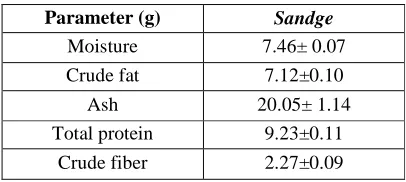
The proximate composition of standardized sandge are reported in Table 2 .Moisture content in standardized sample prior to drying was 92.43% which reduced to 7.46% after drying at 50ºC. Crude fat in sandge was found to be 7.12%. Tadesse, et al. [22] reported the crude fat content of solar dried carrots to be 2.49% on db. The higher fat content of sandge might be due to the presence of sesame seeds having crude fat content (43-50%) [23]. The protein content of standardized sandge is 9.23%. The protein content of solar dried carrots is 5.25%. The increase in protein may be because of higher protein content of sesame seeds (15-20%) and dried okra (16.9-18%) [24]. Total ash is found to be 20.05%, crude fiber 2.79% in the standardized sandge. The higher amount of vegetables might be responsible for the higher carbohydrate content of 56.14%.
ISSN: 2456-1878
www.ijeab.com Page | 240
Fig. 2: Sandge samples in trays for drying
Table 1. Sensory scores for selection of carrot and/pumpkin and bottle gourd (n=10)
Parameter
Scores
Sample 1
Sample 2
Sample 3
Sample 4
Sample 5
Colour 8.6±
0.52 7.7±0.95 6.6±0.97 7.2±0.92 5.4±0.97 Appearance 8.1±0.74 7.7±0.68 6.5±0.97 7.2±0.79 5.9±0.99
Flavour 8.2±0.79 7.6±0.97 6.6±0.97 7.1±0.57 5.9±0.99
Texture 8.0±0.82 7.3±0.82 6.1±0.74 6.9±0.88 4.9±0.74
Taste 8.1±0.71 7.3±0.68 5.8±0.63 7.0±0.94 4.7±0.82
Overall
appearance 8.2±0.63 7.7±0.82 5.9±0.88 7.1±0.57 5.2±0.92
Remarks
Good taste, texture ,
colour and flavour
Colour pale, mild flavour,
less crispy
Colour pale,
less crispy, slightly salty
Colour pale, mild flavour,
less crispy
Less crispy
and more salty
Values are mean±S.D.
Sample 1: carrot 80%+ other20%
Sample 2: carrot60%+ pumpkin(20%)+other 20% Sample 3: carrot 40%+ pumpkin (40%) + other 20% Sample 4: carrot 60%+ bottle gourd (20%) + other 20% Sample 5: carrot 40%+ bottle gourd (40%) + other 20%
Table 2.Physico-chemical characteristics of freshly prepared Sandge (per 100g)
Parameter (g) Sandge
Moisture 7.46± 0.07
Crude fat 7.12±0.10
Ash 20.05± 1.14
Total protein 9.23±0.11
Crude fiber 2.27±0.09
Carbohydrates 56.14
Energy (kcal) 325.6
Salt (NaCl) 10.24± 0.18
Carotene (mg) 5.93 ± 0.17 Vit.C (mg) 7.72±0.12
Calcium (mg) 2.79± 0.16
Iron (mg) 32.95±1.19 Values are average of three replicates± S.D. 3.3 Moisture sorption isotherm
Moisture sorption isotherm was plotted for sandge as represented in Fig.3. The product had an initial moisture content of 7.57%, which corresponds to 42% RH. The critical moisture content was found to be 13.5%, which corresponded to 53%RH, making it unstable at higher relative humidities, being hygroscopic in nature. It gained moisture quickly, became soft and discolored at RH above 70%.
Fig.3: Moisture sorption isotherm for Sandge using sulphuric acid solutions of various RH
3.4 Storage studies
Table 3 indicates the changes in sensory scores of sandge during storage at ambient conditions for a period of 90 days.During the storage period of 90days, it was observed that the overall sensory quality of sandge was 8.7(excellent) on the 0 day which decreased to 1.7 (bad) for PET/PE packaged samples, whereas for PET/Met.Poly/PE packaged sample it was 8.1(very good) after 90days. The samples packaged in PET/Met. Poly /PE laminates showed marginal changes in colour, appearance, flavour, texture and taste during the storage study, but the PET/ PE packaged samples had significant changes in all the parameters after a storage period of 30 days. After 45 days,
0 10 20 30 40 50 60
0 10 30 40 50 60 70 90
%
E
M
C
%RH
ISSN: 2456-1878
www.ijeab.com Page | 241 the quality of the PET/ PE packaged samples was
unacceptable. The samples packaged in PET/Met poly /PE remained in acceptable conditions even after 90days storage. It was statistically proved that the sandge packaged in PET/PE packaging material showed significant (P ≤. 0.05) decrease in all the quality parameters where as for
the PET/Met. Poly/PE, except for texture, the values for all the sensory parameters were not significantly (P > 0.05) affected. Similar results on metallized polyester packaging were obtained for the storage studies conducted on curry leaves chutney powder by Rao et al. [25] and on the flaxseed chutney powder by Satyanarayanaet al.[26].
Table 3: Sensoryscores of sandgeduring storage at ambient temperature conditions for 90 days (n=10)
param eters
PET/ PE
PET/Met poly/PE
0 15 30 45 60 75 90 0 15 30 45 60 75 90
Colour 8.7±0. 48a 8.5± 0.71a 7.8±0. 92a 5.3± 0.95b 3.9± 0.74c 2.6±
0.84d 1.7±0.66
d 8.7 ±0. 48a 8.7 ±0. 48a 8.4 ±0. 70a 7.7±0. 68a 7.4±0. 84a 6.8±
0.79a 6.5±0.97
a Appear ance 8.4±0. 84a 8.3± 0.82a 7.5±0. 97a 5.7± 0.82b 4.9± 0.74b 3.7±
0.82c 2.0±0.67
d 8.7 ±0. 48a 8.4 ±0. 70a 8.2 ±0. 63a 7.4±0. 84a 7.3±0. 82a 6.8±
0.79a 6.2±0.84
a
Flavour 8.7±0. 48a 8.5± 0.71a 7.7±0. 68a 6.5± 0.71b 5.5± 0.53c 3.7±
0.68d 1.8±0.42
e 8.7 ±0. 48a 8.7 ±0. 48a 8.6 ±0. 52a 8.1±0. 88a 7.8±0. 79a 7.5±
0.53a 7.3±0.68
a
Texture 8.7±0. 48a 8.4± 0.70a 7.5±0. 71a 5.8± 0.92b 4.6± 0.52c 2.5±
0.71d 1.5±0.53
e 8.7 ±0. 48a 8.5 ±0. 53a 8.1 ±0. 57a 7.8±0. 63a 7.6±0. 52 a
6.9±
0.57b 6.5±0.53
b
Taste 8.6±0. 70a 8.2± 0.79a 7.3±0. 82a 6.7± 0.95a 3.8± 0.63b 2.5±
0.53c 1.4±0.52
d 8.7 ±0. 48a 8.2 ±0. 42a 7.6 ±0. 52a 7.2±0. 92a 7.1±0. 88a 6.9±
0.74a 6.7±0.95
a Overall appeara nce 8.7±0. 48a 8.2± 0.79 a 7.3±0. 68a 6.5± 0.71a 4.5± 0.97 b 3.1±
0.57c 1.7±0.48
d 8.7 ±0. 48a 8.5 ±0. 53a 8.3 ±0. 48a 8.3±0. 48a 8.3±0. 48a 8.2±
0.42a 8.1±0.57
a Remark s Bright red colour , fresh aroma , crispy textur e Brig ht red colo ur, fresh arom a, crisp y textu r Slight colour chang e, Sligh tly soft, colo ur brow nish red, flavo ur good Colo ur brow nish, textu re soft, flavo ur chan ge Colo ur brow nish, textu re soft, bad odou r Colour brownish, texture more softer,bad odour Bri ght red colo ur, fres h aro ma, cris py text ur Bri ght red colo ur, fres h aro ma, cris py text ur Bri ght red colo ur, fres h aro ma, cris py text u Slight chang e in colour , good flavou r, taste Slight chang e in colour , good flavou r, taste Sligh t chan ge in colo ur, good flavo ur, taste Slight change in colour, good flavour, taste
Similar superscripts indicate non-significant difference at P>0.05 Values are mean±S.D.
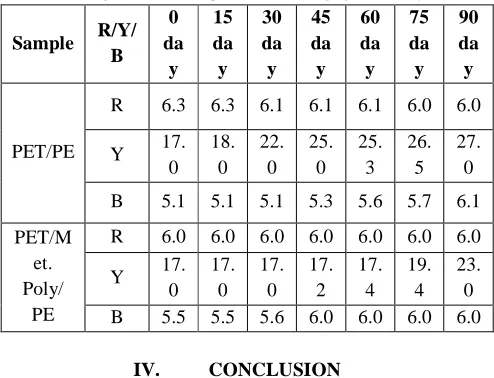
Tintometer colour readings for sandge samples packed in PET/PE and PET/Met. Poly/PE measured using Lovibond tintometer model E have been presented in Table 4. Tintometer colour units for Yellow and Blue showed
ISSN: 2456-1878
www.ijeab.com Page | 242 packaged in PET/PE ,the units for dullness( the least value
among R, Y, B) and yellowness increased, indicating colour fading, whereas the products packaged in PET/Met. Poly/PE showed a marginal increase in the units of dullness and yellowness indicating very little colour change. The changes may be contributed to the increase in non-enzymatic browning and decrease in carotenoids upon exposure to light during storage [27].The changes in colour units had significant effect on the quality of the product. Rao, et al. [28] also observed the effect of colour changes measured using Lovibond Tintometer on the quality of tomato powder and instant tomato pickle mix while Khedkaret al. [29] studied the effect of storage on colour for
metkut, an pulse based food adjunct.
Table. 4: Colour measurement using Lovibond Tintometer during ambient temperature storage for 90 days
Sample R/Y/ B
0 da y
15 da
y 30 da
y 45 da
y 60 da
y 75 da
y 90 da
y
PET/PE
R 6.3 6.3 6.1 6.1 6.1 6.0 6.0
Y 17. 0
18. 0
22. 0
25. 0
25. 3
26. 5
27. 0
B 5.1 5.1 5.1 5.3 5.6 5.7 6.1
PET/M et. Poly/
PE
R 6.0 6.0 6.0 6.0 6.0 6.0 6.0
Y 17. 0
17. 0
17. 0
17. 2
17. 4
19. 4
23. 0 B 5.5 5.5 5.6 6.0 6.0 6.0 6.0
IV. CONCLUSION
Sandge, a traditional food adjunct in Indian cuisine was
standardized and the components, carrot (80%), okra (9%), green chilies (3.5%), sesame seeds (3.5%), coriander leaves and salt (2%) each were found to be optimum. The prepared product was dried in a cabinet drier at 50ºC. It is nutritionally a good source of fiber, protein, vitamin C, carotene and iron. The product when packaged in metallized polyester/ polythene laminated pouches had a shelf life of more than 90 days at ambient temperature conditions. The traditional method of sun drying, although being economical, is highly dependent on climatic conditions, is time consuming and offers no protection against dust from air, rodents and insects. The tray/cabinet drying method is faster, yields a hygienic product of consistent quality and retains sufficient amount of nutrients. PET/Metallized polyester/ polythene packaging extended the shelf life of the product and was attractive. The traditional food adjuncts sector has been dominated by cottage/ small scale
industries. Limited production capacity, technological input and quality assurance has lead to restricted growth of the industry. Standardization of processes, nutritional properties, optimum packaging and storage solutions can help in technological upgradation, quality assurance, consistent and uninterrupted supply of these products, higher turnover and global market for these products.
REFERENCES
[1] Achaya, KT,(2000). The Story of Our Food , University Press India Limited, Hyderabad, India [2] Srinivasan, K., (2010). Traditional Indian Functional
Foods. Functional foods of the east, edited by Shi John, Ho, Chi-Tang, Shahidi, Fereidoon, CRC Press, 51-62
[3] Shastri PN, (2006). Changing face of traditional food adjuncts, Indian Food Industry, 25(6):73-77
[4] Tripathi, V,( 2013). Indian Thali: [ Rajasthani, Gujarati, Punjabi, Maharashtrian , South Indian] (vegetarian), Partridge India
[5] Mukadam, M., (2009).WalawanSanskruti, Retrieved from www.loksatta.com/daily/20090523/chchou.htm .Accessed on 25thJune,2015
[6] Ogle Kamlabai, (1973). In:Ruchira, edn.6, StreeSakhiPrakashan ,Kirloskar Press ,Pune, India [7] Kalra CL, Kulkarni SG and Berry SK, ( 1987), The
carrot-A most popular root vegetable, Indian Food Packer, 41(6):46-73
[8] Varmudy V, (2014). Carrots: A call for increased cultivation, Facts for you, July, 22-23
[9] Suvarnakuta P, Devahastin S and Mujumdar AS, (2005). Drying kinetics and beta-carotene degradation in carrot undergoing different drying processes. Journal of Food Sc., 70: 520-526
[10] Koca N, Burdurlu SH &Karadeniz F, ( 2007). Kinetics of colour changes in dehydrated carrots. Journal of Food Engineering, 78: 449-455,
[11] Sesame seeds nutrition facts,(2014).Retrieved from www.nutrition-and-you.com/sesame-seeds.html. Accessed on 28th June,2015
[12] Oguntona T, (1998) Green leafy vegetables. In: Quality of Plant Foods, Osagi A.U.;Eka O.U.(eds.).Post harvest Research Unit, University of Benin, Benin City, 120-130
ISSN: 2456-1878
www.ijeab.com Page | 243 [14] Bolaji PT, Komolafe GO andAlli E, (2008). Drying
characteristics of selected local vegetable. Nigerian Food Journal, 26(1): 138-143
[15] Chawla, S. and Thakur, M., (2013).
Coriandrumsativum: A promising functional and
medicinal food. Medicinal Plants - International Journal of Phytomedicines and Related industries, 5(2): 59-65
[16] Sesame seeds, 2015. Retrieved from www.whfoods.com/genpage.php?tname=foodspice&d bid=84 .Accessed on 28th June,2015
[17] Amerine MA, Pangborn RM and Roessler EB, (1965). In: Principles of Sensory Evaluation of Food, Academic Press, New York
[18] Kaur SS, Sandhu KS and Ahluwalia P, (2011). Effect of processing parameters on physico-chemical and culinary qualities of dried carrot slices, Journal of Food Science and Technology, April, 48(2): 159-166 [19] Ranganna S, (2001) Handbook of analysis and
quality control for fruit and vegetable products, 2nd edition, Tata-McGraw Hill
[20] Landrock AH and Proctor BE., ( 1951), Mod.Packag., 24 (6): 123
[21]Gopalan, C., Rama Sastri, B.V. and Balasubramanian,
S., (2014) In : Nutritive Value of Indian Foods, National Institute of Nutrition (NIN), ICMR
[22]Tadesse TF, Abera S and Worku S, (2015) Nutritional and sensory properties of solar-dried carrot slices as affected by blanching and osmotic pre-treatments, International Journal of Food Science and Engineering, 5(1):24-32
[23] Jannat B, Oveisi MR, Sadeghi N, Hajimahmoodi M, Behzad M , Choopankari E &Behfar AA., ( 2010). Effects of roasting temperature & time on healthy neutraceuticals of antioxidants and total phenolic content in Iranian Sesame seeds(SesamumIndicum L.), Iran.J. Environmental Health.Sci. Eng.; 7(1): 97-102
[24] Nema PK, Pendre NK, Sharma HP, Rathore SS and Kushwah SS, (2012). Effect of drying temperature and slice size on quality of dried okra(Abelmoschusesculentus (L) Moench), Journal of
Food Science & Technology, 49(3):378-381 [25] Rao DG, Jyothirmayi T & Balaswamy K, ( 2004).
Studies on preparation of curry leaf (Murrayakoenigii L. chutney powder, Food service Research International, 14: 175-187
[26] Satyanarayana A, Rao PP, Rao GN, Mala KS &Balaswamy K, (2013). Preparation and storage
stability of flaxseed chutney powder, a functional food adjunct, Journal of Food Science and Technology, Jan-Feb 50(1): 129-134
[27] Sra S.K., Sandhu K.S. and Ahluwalia P., (2011). Effect of processing parameters on physico-chemical and culinary quality of dried carrot slices, J Food Sci
Tech,48(2): 159–166.
[28] Rao D.G., Narsing Rao, Prabhakar Rao, Balaswamy, P.G. and Balaswamy, K., ( 2011). Preparation of instant tomato pickle mix and evaluation of its storage stability, International Food Research Journal, 18: 589-593
[29] Khedkar,R., Shastri, P. and Bawa, A.S.,(2016).Standardization, chemical characterization and storage studies on Metkut, a pulse based Indian Traditional Food Adjunct, Food Science Research