The Thirty-Third AAAI Conference on Artificial Intelligence (AAAI-19)
Adapting Translation Models for Transcript Disfluency Detection
Qianqian Dong,
1,2Feng Wang,
1Zhen Yang,
1,2Wei Chen,
1Shuang Xu,
1Bo Xu
1,2∗1Institute of Automation, Chinese Academy of Sciences, Beijing, China
2University of Chinese Academy of Sciences, Beijing, China
{dongqianqian2016, feng.wang, yangzhen2014, wei.chen.media, shuang.xu, xubo}@ia.ac.cn
Abstract
Transcript disfluency detection (TDD) is an important com-ponent of the real-time speech translation system, which arouses more and more interests in recent years. This pa-per presents our study on adapting neural machine transla-tion (NMT) models for TDD. We propose a general training framework for adapting NMT models to TDD task rapidly. In this framework, the main structure of the model is imple-mented similar to the NMT model. Additionally, several ex-tended modules and training techniques which are indepen-dent of the NMT model are proposed to improve the perfor-mance, such as the constrained decoding, denoising autoen-coder initialization and a TDD-specific training object. With the proposed training framework, we achieve significant im-provement. However, it is too slow in decoding to be prac-tical. To build a feasible and production-ready solution for TDD, we propose a fast non-autoregressive TDD model fol-lowing the non-autoregressive NMT model emerged recently. Even we do not assume the specific architecture of the NMT model, we build our TDD model on the basis of Transformer, which is the state-of-the-art NMT model. We conduct exten-sive experiments on the publicly available set, Switchboard, and in-house Chinese set. Experimental results show that the proposed model significantly outperforms previous state-of-the-art models.
Introduction
Disfluency is a characteristic of spontaneous speech which makes it different from written text. Transcript disfluency detection is a task of recognizing non-fluent word sequences in spoken language transcripts or automatic speech recog-nition (ASR) results (Lou and Johnson 2017; Wang et al. 2017). Disfluencies are informally defined as interruptions in the normal flow of speech that occur in different forms, including false starts, repairs, repetitions and filled pauses. Frequent disfluencies introduce obstacles to many natural language processing (NLP) tasks, such as dialogue sys-tems, machine translation, natural language understanding and so on. Therefore, it’s necessary to pre-process disflu-encies in source corpus before passed to downstream NLP tasks. As shown in Figure 1, standard annotation of dis-fluency structure (Shriberg 1994) indicates the reparandum
∗
Corresponding author
Copyright c2019, Association for the Advancement of Artificial Intelligence (www.aaai.org). All rights reserved.
A flight[ to Boston
| {z }
RM +{
IM
z}|{
uh }to Denver
| {z }
RP ]
Figure 1: Sentence with disfluencies annotated in English Switchboard corpus. RM=Reparandum, IM=Interregnum, RP=Repair. The preceding RM is corrected by the follow-ing RP.
(words that are discarded, or corrected by the following words), where the interruption point (+) marking the end of the reparandum, and the begin of the associated repair, or an optional interregnum (filled pauses, discourse cue words, etc). Some disfluencies are complicated and may contain di-verse reparandums with arbitrary forms, varying in length, location, and structure. In our experiments, we find that the longest reparandum in the publicly available set, Switch-board, has as long as 15 words. And there are large sim-ilarities in syntax between the reparandum chunk and the following repair chunk. However, the mainstream method in this area is to view detecting disfluencies as a sequence la-beling task which is usually good at capturing local context information and weak in modeling long-range dependencies (Lou and Johnson 2017; Wang et al. 2017).
this extension, the decoding speed of the proposed model is accelerated by 6 times, which is ready for production. We conduct extensive experiments on the publicly available set, Switchboard, and in-house Chinese set. Experimental results show that our final model achieves a new state-of-the-art re-sult.
To summarize, this paper makes the following contribu-tions:
• To the best of our knowledge, we are among the first en-deavors to employ the NMT model to the task of TDD. We provide a new point of view for investigating TDD.
• We propose a general training framework for adapting NMT models to TDD task, which can be applied to any NMT model. Apart from the significant improvement on performance, our model achieves fast decoding speed which enables it ready for production.
• We build our model based on the newly emerged state-of-the-art NMT model and conduct extensive experiments on the publicly available test set Switchboard and in-house Chinese test set. Experimental results show that our model achieves the state-of-the-art performance on both test sets. Additionally, we give deep analysis to investi-gate the strength of our approach over previous methods.
Related Works
Transcript Disfluency Detection
Transcript disfluency detection has gained much attention within NLP and ASR community recently, as the demand for spoken cascaded systems combining ASR and NMT mod-els increases and develops. Existing methods are mainly divided into four types: sequence labeling, parsing-based, noisy channel model, encoder-decoder model. The sequence labeling method labels each word as fluent or not using different model structures, including conditional random fields (Ostendorf and Hahn 2013; Zayats, Ostendorf, and Hajishirzi 2014), hidden Markov models (Liu et al. 2006; Ferguson, Durrett, and Klein 2015), Recurrent Neural Net-work (Hough and Schlangen 2015; Zayats, Ostendorf, and Hajishirzi 2016) or others (Georgila 2009; Qian and Liu 2013). The parsing-based approaches joint the task of de-tecting disfluencies and identifying the syntactic structure of the sentence (Rasooli and Tetreault 2013; Honnibal and Johnson 2014; Yoshikawa, Shindo, and Matsumoto 2016). Noisy channel models use the similarity between reparan-dum and repair as an indicator and language models as a reranker to detect disfluency (Johnson and Charniak 2004; Zwarts and Johnson 2011; Lou and Johnson 2017). The encoder-decoder models regard TDD as a sequence-to-sequence problem (Wang, Che, and Liu 2016). Recently, researchers have used translation models to perform TDD. Neubig et al. (Neubig et al. 2012) presented a monotonic statistical machine translation approach for transforming faithful transcripts to clean transcripts on Japanese. Cho et al. (Cho et al. 2016) investigated a multilingual approach for TDD on English and German multilingual speech tran-scripts. Wang et al. (Wang et al. 2018) proposed a semi-supervised approach to utilize large amounts of WMT2014
unannotated data. The state of the art of TDD on Switch-board without external data is achieved by sequence labeling method (Wang et al. 2017). These models have compara-ble performance, but have no power to solve the long-range dependencies problem, which is essential to detect compli-cated disfluencies with longer spans or distances. Works in Wang et al. (Wang, Che, and Liu 2016) can capture long-range dependencies by using an attention-based Recurrent Neural Network (RNN), but can’t utilize chunk-level infor-mation well at the cost of time complexity and computa-tional complexity.
Neural Machine Translation
In the field of machine translation, the state of the art neu-ral sequence-to-sequence methods have led to a paradigm shift away from phrase-based statistical machine transla-tion (SMT) to NMT. The most popular model for neural machine translation is the attention-based encoder-decoder model (Bahdanau, Cho, and Bengio 2014). The encoder takes the source sentence as input and calculates a represen-tation of each word in the source sentence. The decoder out-puts a translation relying on the representations of the source sentence. The encoder and decoder can be parametrized as RNN, Convolutional Neural Networks (CNN) or hierarchi-cal self-attention models (Vaswani et al. 2017). In this paper, we experiment with Transformer, which achieved state-of-the-art performance on WMT2014English-to-French trans-lation task with markedly less training cost. Its fundamen-tal module is self-attention, a mechanism relating all the position-pairs of a sequence to extract a more expressive sequence representation. The self-attention can draw the de-pendencies between different positions through the position-pair computation. Much of the recent state of the art models in NMT are auto-regressive. When generating a sequence of translation from left to right, predicting the arbitrary sym-bol first requires generating all symsym-bols before the current symbol. During training, the ground truth is known, so con-ditioning on previous symbols can be parallelized. But when actually generating sequential output during inferring, their autoregressive nature prevents these models from utilizing parallel computation. Some recent works have attempted to speed up decoding by training a non-autoregressive transla-tion (NAT) model (Gu et al. 2017). The autoregressive con-nection from an existing encoder-decoder model is directly removed and a great speed increase has been achieved in NAT.
The Approach
The Model Overview
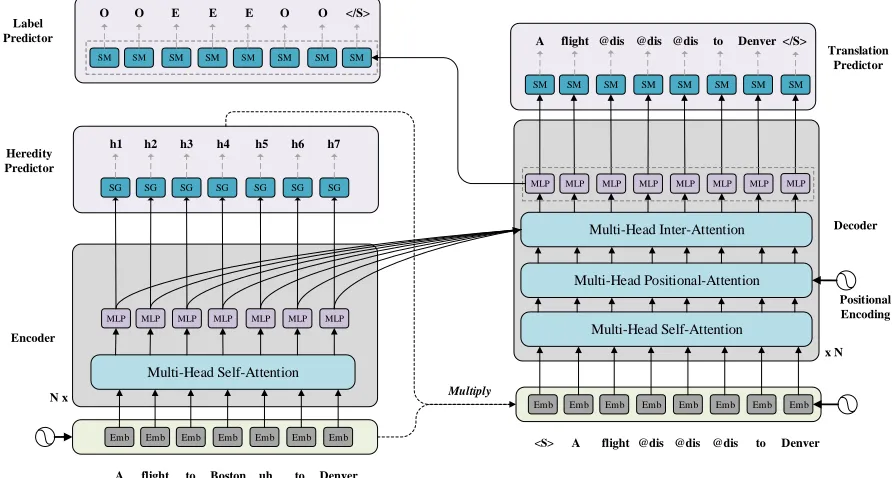
In this paper, the task of TDD is formulated as a translation task from the disfluent utterance to fluent utterance. That is, the source sentences are transcripts said by a lecturer not fully-prepared to give a speech and potentially contain dis-fluencies, whereas the target sentences are the corrected flu-ent sflu-entences. As shown in Figure 2, the model is based on the encoder-decoder architecture: the encoder transforms a disfluent sequenceX = (x1, ..., xT)to a hidden
Emb Emb Emb Emb Emb Emb Emb
A flight to Boston uh to Denver
Multi-Head Self-Attention
MLP MLP MLP MLP MLP MLP MLP
Multi-Head Self-Attention Multi-Head Positional-Attention
Multi-Head Inter-Attention SM SM SM SM
A flight @dis @dis
Positional Encoding Decoder Translation
Predictor
Encoder
N x
x N
Emb Emb Emb Emb Emb Emb Emb
A flight @dis @dis @dis to Denver MLP MLP MLP MLP MLP MLP MLP
SM SM SM
@dis to Denver
Emb
<S>
SM
</S>
MLP SM SM SM SM
O E E
Label Predictor
SM SM SM
E O O
SM
</S>
SG SG SG SG
h1 h2 h3 h4 Heredity
Predictor
SG SG SG
h5 h6 h7
Multiply O
Figure 2: The architecture of our base model. Each sublayer inside the encoder and decoder also includes layer normalization and a residual connection. “SM”=Softmax function and “SG”=Sigmoid function. “Multi-Head Self/Inter/Positional-Attention” is the core structures of Transformer.
an output fluent sequenceY = (y1, ..., yT). The distribution
over possible output sentenceY is:
pAR(Y|X;θ) = T
Y
t=1
p(yt|y0:t−1, x1:T;θ) (1)
We adopt Transformer (Vaswani et al. 2017) as our base model structure, consisting of 6 complex attention/self-attention blocks in the encoder and decoder.
The TDD task is different from machine translation. The goal of the TDD task is to accurately label the disfluencies in the source sentence. The goal of machine translation is to reasonably interpret the target sentence corresponding to the source sentence. In order to adapt the translation model to the TDD task, we propose several extended modules and training techniques, which will be discussed in the sections below. These adaptations are implemented incrementally.
Constrained Decoding
We introduce constrained decoding to make the decoding process effective for the TDD task (marked as “T-TDD”). In order to ensure the consistency in the word order and to-ken coverage of the output result and the source sentence, we have adopted the idea of the copy neural network (Gu et al. 2016). We control the word ordering problem during de-coding by utilizing two softmax layers, named “Label Pre-dictor” and “Translation PrePre-dictor” respectively, as can be seen in Figure 2. When predicting the tokenytat the current
step, we additionally predict a labelztusing a softmax layer
to decide whether to predict a “@dis”. “@dis” is a special symbol that means the word is disfluent. Whenztis equal
to “E”, the model predicts a “@dis”, otherwise the model copies the current token from the source sentence. We intro-duce a weighting factorαto balance the two softmax out-puts. Then the loss function of the model is as follows:
L(x, y, z|θ)
=(1−α)L(x, y|θ) +αL(x, z|θ)
=−
T
X
t=1
(1−α)logP(yt|x, y<t, θ)
−
T
X
t=1
αlogP(zt|x, y<t, θ) (2)
Deletion-Penalty MLE Objective
Because TDD is essentially a two-category annotation task, it is to determine whether the current word is fluent or not. Fluent sentences are obtained by deleting disfluencies. In light of the actual needs of this task, the precision is more important than the recall. The missing deletions will only affect the semantic expression, but the wrong deletions will impair the integrity of the semantics. Therefore, we modify the training objective of the original NMT model by adding a penalty factor for the deletion operations (marked as “+DP-MLE”). Adopting the marking symbols of the translation system, each tokenyiin target sentence is generated by the
estimation (MLE) loss is scaled by a factorλifyiis equal to
the special token “@dis”. Therefore, the final loss ofL(x, y) in Equation 2 is calculated as follows:
L(x, y) =−
T
X
t=1
f(yt)logP(yt|x, y<t, θ),
wheref(yt)is determined by:
f(yt) =
λ if y
t=“@dis”
1 otherwise (3)
DAE Initialization
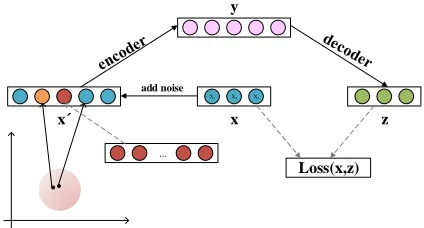
Denoising autoencoder (DAE) is generally employed to ef-fectively pre-train a deep neural network in low-resource NMT. DAEs take a pair of noisy-clean data, and are forced to learn a robust representation of the features. Thus they can correctly recover the correct examples from their cor-rupted counterparts. TDD can be treated as a denoising task where disfluencies are corruptions that have to be deleted. This is similar to the idea of DAE. So we use this method to pre-train our model, called “DAE Initialization” (marked as “+DAE”). Figure 3 shows the process of DAE initialization.
X1 X2 X3
Loss(x,z)
x z
x´
add noise
y
...
Figure 3: The architecture of the DAE initialization.xis the fluent sentence, andx0is the damaged sentence.
We achieve our goal by damaging the fluent target sen-tences in the original training data and then reconstructing them. According to the section of Introduction, there are high semantic and structural similarities between reparan-dums and repairs in the disfluencies. Therefore, we add the noise by randomly selecting several source words in the fluent sentence xand then selecting the words in the pre-trained word embeddings that are closest to the source words as noise to be inserted at the preceding positions of the source words to simulate reparandums. The number of source words being selected is decided by the amount of artificial data we need. The similarity of word embeddings is measured using cosine similarity and noise words with a similarity less than 0.8 will be discarded. The words in the high-frequency set of interregnums are further randomly in-serted between the two chunks above to simulate interreg-nums. The pre-trained word embeddings are trained on the
training source data usingword2vec1. We pre-train our mod-els with the artificial data until the loss function converges, then we use the true training corpus to continue training.
Accelerating Decoding Speed
Although our model has achieved improved performance, the general NMT model is limited by the slow decoding speed, which seriously affects the practicality of our TTD model. We adopt the idea of NAT to speed up the decod-ing process of TDD models (marked as “+NAT”). NATs in-troduce a sequence of discrete latent variables, which is de-signed to model the alignment between the source and target or capture the dependencies among target variables. The la-tent variables sequence will be generated autoregressively, and then each position in the target sequence from the latent variables will be reconstructed in parallel. In NMT, NATs may cause performance degradation due to lack of ground truth input during decoding and destruction of the sequen-tial essence.
Unlike general translation tasks, source and target sen-tences belong to two different languages. In TDD task, a fluent transcription and a disfluent transcription are actually in the same language and there is a small editing distance between them. In the settings of our model, the input and output have strict one-to-one alignment and high similarity, which can compensate for the alignment and dependencies mentioned above. We introduce a continuous latent variable, called “heredity”, to learn the inheritance relationship be-tween the source and target. Therefore, we can automatically learn the generated ground truth during training and infer-ring. As can be seen in Figure 2, we directly generate the input embeddings for the decoder in the translation process, which is obtained by multiplying the heredity and embed-ding input of the encoder element by element. We first ini-tializehereditieswith an all-ones matrix and then generate a translation non-autoregressively conditioned on heredities.
Hereditiesare random variables between 0 and 1 for each
word in the source sentence to represent the conversion rela-tion of embeddings from the encoder input to the decoder input. The heredity predictor module models the heredity
p(ht|x1:T)at each position independently using a one-layer
neural network with a sigmoid activation function on top of the last encoder layer. The distribution over possible output sentenceY ={y1, ..., yT}becomes:
pN AR(Y|X;θ)
= arg max H
p(H|x1:T;θ)· T
Y
t=1
p(yt|x1:T;θ, H)
where H=h1:T;h1:T ∈[0,1]
(4)
The heredity values are a property of each input word but depend on information and context from the entire sentence, so the module has the ability to exploit chunk-level features and capture complicated disfluencies with longer spans or distances.
1
Experimental Setup
Dataset
To directly compare with previous state-of-the-art results in the filed of TDD, we limit our training data strictly to public resources. Our training data includes the Switch-board disfluency-annotated corpus (SwitchSwitch-board portion) of the English Penn Treebank and an in-house Chinese dataset. Firstly, we conduct our experiments on the En-glish Switchboard corpus. Following the experiment set-tings in (Charniak and Johnson 2001; Honnibal and John-son 2014; Wu et al. 2015), we use directory 2 and 3 in PARSED/MRG/SWBD as our training set and split direc-tory 4 into test set, development set, and others. The de-velopment data consists of all sw4[5-9]*.dps files, and test data consists of all sw4[0-1]*.dps files. Based on whether the repair is empty, the same as the reparandum or differ-ent from the reparandum, respectively, the disfluencies can further be divided into three types: restarts without repairs (“restart”), repetitions (“repetition”), and restarts with re-pairs (“repair”). The statistics on the training set, develop-ment set, and test set in Switchboard can be seen in Table 1.
Dataset Total Restart Repair Repetition Train 169494 2726 15662 19519
Dev 9835 261 1354 1375
Test 7677 138 912 1165
Table 1: The statistics on the training set, development set, and test set in Switchboard. Note that a sentence may contain multiple kinds of disfluencies.
We generate the fluent target corpus according to the dis-fluency annotations in the Switchboard corpus by substitut-ing the reparandum, interregnum, filled pauses, discourse markers and so on with the disfluency tag “@dis”, not mak-ing a distinction among different kinds of disfluencies. By this way, we can get a one-to-one parallel corpus of equal length, which can partially solve the over-translation and under-translation. Following previous works (Johnson and Charniak 2004; Honnibal and Johnson 2014), we remove all punctuations and partial words2. Instead of lowercasing
all training and test data, we may also want to keep most words in their natural case, and escape special characters us-ing scripts included in Moses3.
Since no public Chinese corpus is available now, for our Chinese experiments, we collect about 30kspoken sentences from personal statement transcriptions and annotate them with only disfluency annotations according to the guideline similar to Switchboard (Meteer et al. 1995). We respectively select about 1ksentences for development and testing. The rest are used for training. The details for our Chinese TDD dataset and our annotation rules is available online4.
2words are recognized as partial words if they are tagged as
“XX” or end with “-”
3
https://github.com/moses-smt/mosesdecoder
4
https://github.com/dqqcasia/Translation Disfluency Detection /tree/master/data/chinese disfluency
Following previous works (Wang et al. 2017; Lou and Johnson 2017), token-based precision (P), recall (R), and F-score (F) are used as the evaluation metrics.
Training Details
Our models are implemented with TensorFlow5. We use the hyperparameter settings of the base Transformer model described in Vaswani et al. (2017) for encoder stack and decoder stack. We share encoder and decoder word em-beddings during training and inference. For Switchboard dataset, all the sentences are tokenized using Moses and we use a shared word-level vocabulary of 20000. For Chinese corpus, we use a shared character-level vocabulary of 3000 for modeling without word segmentation. We also try exper-iments using a word-level vocabulary, but the result is far inferior to the character-level model. The main reason may be that the word segmentation for Chinese spoken text is very poor. Sentence pairs are batched together by approxi-mate sequence length. Each batch contains a set of sentence pairs with approximately 7000 source tokens and target to-kens. Our models are trained for a max 200000 steps on 2 NVIDIA Titan-X GPUs.
Results and Analysis
We conduct experiments on both the commonly used En-glish Switchboard test set and a set of in-house annotated Chinese data. The following is the results:
Effects of
α
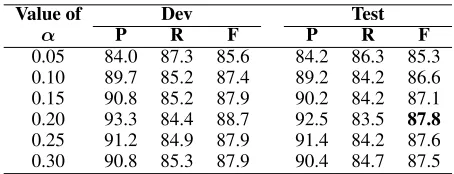
We conduct experiments to find the optimal values ofα. Ex-perimental results on Switchboard are shown in Table 2. In following experiments, the value ofαis set to0.2on Switch-board, and set to0.3on Chinese data.
Value of Dev Test
α P R F P R F
0.05 84.0 87.3 85.6 84.2 86.3 85.3 0.10 89.7 85.2 87.4 89.2 84.2 86.6 0.15 90.8 85.2 87.9 90.2 84.2 87.1 0.20 93.3 84.4 88.7 92.5 83.5 87.8 0.25 91.2 84.9 87.9 91.4 84.2 87.6 0.30 90.8 85.3 87.9 90.4 84.7 87.5
Table 2: Performance on Switchboard data with different values ofα.
Effects of
λ
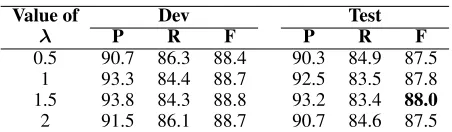
λ affects the precision/recall trade-off and requires tuning for specific tasks. Experimental results on Switchboard can be seen in Table 3. In our experiments, the optimal value of
λis1.5on Switchboard and2on Chinese data respectively.
Effects of artificial data size
Table 4 shows the relationship between the performance of the method and the size of the artificial data6. An
appropri-5
https://github.com/dqqcasia/Translation Disfluency Detection
6
Value of Dev Test
λ P R F P R F
0.5 90.7 86.3 88.4 90.3 84.9 87.5 1 93.3 84.4 88.7 92.5 83.5 87.8 1.5 93.8 84.3 88.8 93.2 83.4 88.0 2 91.5 86.1 88.7 90.7 84.6 87.5
Table 3: Performance on Switchboard data with different values ofλ.
ate amount of artificial data can increase the recall rate and F-score of our model, but it will cause a certain degree of accuracy reduction due to the unreality of the artificial data. We also try to mix the artificial training samples directly into the real training samples, but there’s a performance degra-dation for F-score, which may be due to the artificial data destroying the distribution of real data. Relatively speaking, the DAE initialization method is more robust. The optimal size of artificial data on Chinese data is 50k.
Size of Dev Test artificial data P R F P R F
0k 93.8 84.3 88.8 93.2 83.4 88.0 50k 88.8 87.9 88.3 89.2 87.1 88.1 150k 91.2 87.2 89.1 90.7 86.4 88.5 300k 89.4 88.5 89.0 89.3 88.1 88.7
Table 4: Performance on Switchboard data with different sizes of artificial data.
Effects of the “heredity”
We design two sets of non-autoregressive experiments. To prove the validity of the “heredity”, We also do experiments with models without the “heredity”, where the embedding input of the decoder is set to be 0 (marked as “w/o Hered-ity”). It can be seen from the experimental results in Table 5 that models with the “heredity” (marked as “w/ Heredity”) are superior to models without the “heredity”, with a perfor-mance improvement of 0.9 point.
+NAT Dev Test
model P R F P R F
w/o Heredity 93.8 83.8 88.5 93.4 82.6 87.7 w/ Heredity 92.0 86.4 89.1 94.5 84.1 89.0
Table 5: Performance on Switchboard data of models with or without the “heredity”.
Because there was no publicly available analysis on speed in prior works related to TDD, no comparison is given against prior work. We compare the parameters and speed between “T-TDD” and “+NAT” model, as shown in Table 6. The “T-TDD” model has 87.5M parameters. The “+NAT” model usingheredity introduces additional 0.26M parame-ters, which is quite small compared to the number of param-eters in the base model. Introducing the non-autoregressive property slows down the training speed, but acceptably and not significantly. When running on two Titan-X GPU de-vices, the speed of the “T-TDD” model is 0.0012s per token,
and the speed of the “+NAT” model is 0.0002s per token, which is almost six times faster. Speed is measured using the average decoding speed of a batch. “+NAT” model can better satisfy the real-time requirements in speech transla-tion system.
Method Parameters Train Time Speed
T-TDD 87.5M 12h 0.0012s/token
+NAT 87.7M 20h 0.0002s/token
Table 6: Comparison on parameters and speed on Switch-board data.
Repetitions vs non-repetitions
In order to better understand our model’s performance, we evaluate our model for detecting repetition and non-repetition reparandum, as shown in Table 7. And we obtain the same conclusion: it is much easier to detect repetitions than repetitions. Our model is better at detecting non-repetitions than the previous systems, and achieves a78.3% F-score. It proves that our model can not only capture the features of the local chunk level, but also capture the global features and long-distance dependencies, which is necessary to correctly detect the repairs and restarts. Detecting non-repetitions still needs more powerful models.
Method Repetitions Non-repetitions Either
CRF 93.8 61.4 82.6
Bi-LSTM 93.1 65.3 85.8
Transition-based 93.3 68.7 87.5
+NAT 93.6 78.3 89.0
Table 7: F-score of different types of reparandums on the test set of English Switchboard. Results of non-translation models come from Wang et al. (2017).
Main results
Switchboard corpusTable 8 shows some examples of the predictions of our model for Switchboard. We compare our best model to seven previous top performing systems as shown in Table 9. Our model outperforms the state-of-the-art work by 1.5 points, and achieves an 89.0% F-score. Our model achieves 3.9 points improvements over UBT (Wu et al. 2015), which is the best syntax-based method for TDD. Our model obtains a 3.6 points improvement compared to the best performance by linear statistical sequence label-ing methods leveraglabel-ing prosodic features (Ferguson, Dur-rett, and Klein 2015). Our model also achieves 2.3 points improvement over the attention-based model (Wang, Che, and Liu 2016), which also regards TDD as a sequence-to-sequence problem using RNN. Our model surpasses the best noisy channel models (Lou and Johnson 2017) by 2.2 points. We attribute the success to our model’s strong ability to learn global chunk-level features and the effective state represen-tation.
Source: Huh well um you know I guess it ’s pretty deep feelings uh
Ref: @dis @dis @dis @dis @dis I guess it ’s pretty deep feelings @dis
Model: @dis @dis @dis @dis @dis I guess it ’s pretty deep feelings @dis
Source: I mean you know in retrospect um was it was it Mondale or Dukakis that said you know I ’ll I ’ll tell you
Ref: @dis @dis @dis @dis in retrospect @dis was it @dis @dis Mondale or Dukakis that said @dis @dis I ’ll @dis @dis tell you
Model: @dis @dis @dis @dis in retrospect @dis was it @dis @dis Mondale or Dukakis that said @dis @dis I ’ll @dis @dis tell you
Source: Um do you think I mean do you think our the investment in lives and money was worth it
Ref: @dis do you think @dis @dis @dis @dis @dis @dis the investment in lives and money was worth it
Model: @dis do you think @dis @dis @dis @dis @disour @disinvestment in lives and money was worth it
Source: And one of the things we discussed was you know where our where the budget how the budget situation just got out of hand
Ref: @dis one of the things we discussed was @dis @dis @dis @dis @dis @dis @dis how the budget situation just got out of hand
Model: @dis one of the things we discussed was @dis @diswhere our@dis @disbudgethow the budget situation just got out of hand
Table 8: Examples of the results of our model for Switchboard test data. Underlined words indicate disfluencies in the source sentence, and words in bold indicate where our model predicts incorrectly.
Method P R F
M3N(Qian and Liu, 2013) - - 84.1
UBT (Wu et al., 2015) 90.3 80.5 85.1 semi-CRF (Ferguson et al., 2015) 90.0 81.2 85.4 Bi-LSTM (Zayats et al., 2016) 91.8 80.6 85.9 Attention-based (Wang et al., 2016) 91.6 82.3 86.7 LSTM-NCM (Lou and Johnson, 2017) - - 86.8 Transition-based (Wang et al., 2017) 91.1 84.1 87.5
OURS 94.5 84.1 89.0
Table 9: Comparison with previous state-of-the-art methods on the test set of English Switchboard.
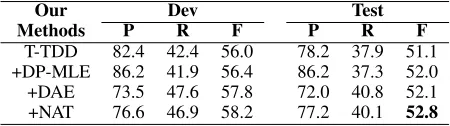
with the baseline “T-TDD” model with a best 52.8% F-score. The performance on Chinese is much lower than that on English Switchboard. Due to the high cost of data anno-tation, the Chinese training set is of small magnitude. Hence the training of the model is not sufficient. Meanwhile, con-sistent with previous researches (Wang et al. 2017), we find Chinese disfluencies have more complicated structure, and the proportion of repair type disfluency and restart type dis-fluency is much higher, which increases the difficulty of de-tection. In addition, the performance of Chinese spoken lan-guage segmentation is poor. However, using the character modeling unit loses the very strong chunk-level features in-side words. The fitting ability of the model declines with a relatively small vocabulary. So the gap between the per-formance on Chinese and English Switchboard does make sense.
Our Dev Test
Methods P R F P R F
T-TDD 82.4 42.4 56.0 78.2 37.9 51.1 +DP-MLE 86.2 41.9 56.4 86.2 37.3 52.0 +DAE 73.5 47.6 57.8 72.0 40.8 52.1 +NAT 76.6 46.9 58.2 77.2 40.1 52.8
Table 10: Performance on Chinese annotated data.
Our model achieves consistent performance in both Chi-nese and English experiments. The results of the base “T-TDD” model have significantly exceeded the current best system. This proves the superiority of the translation mech-anism in the sequence modeling task. We add penalties to the loss of the deletion operation, making the model a bias
towards precision, hence an increase in precision and a drop in recall. Thus we can flexibly adjust the precision, recall, and f-value according to the actual scene. DAE initializa-tion can improve the model’s performance notably on En-glish Switchboard. This shows that the damaged sentences we build can better simulate the phenomenon of transcript disfluencies. The introduction of the “heredity” leads to non-autoregressive models, and the experimental results show that the performance of the “+NAT” model has significantly improved compared to the base model. We conjecture it ben-efits from the consistency of training and inferring processes in the non-autoregressive model, which is inconsistent in au-toregressive model.
Conclusion
We propose a general training framework for adapting the NMT model to TDD task. Several extended modules and training techniques are proposed to improve the perfor-mance, including the constrained decoding, denoising au-toencoder initialization and a TDD-specific training object. And we extend the TDD model with non-autogressive de-coding based on the idea of non-autogressive NMT model. Our models achieve the state-of-the-art F-scores on both the commonly used English Switchboard test set and an in-house annotated Chinese data set. Experiments show that translation models have an advantage over all published methods for TDD. We plan to test different NMT models in the proposed training framework, and investigate how the ability of the NMT model correlates with final TDD per-formance. Besides, we will investigate the effects of other NMT techniques on TDD for further research. We believe our models are applicable to other similar sequence correc-tion tasks, such as grammar error correccorrec-tion, word reorder-ing, and so on.
Acknowledgements
References
Bahdanau, D.; Cho, K.; and Bengio, Y. 2014. Neural ma-chine translation by jointly learning to align and translate.
arXiv preprint arXiv:1409.0473.
Charniak, E., and Johnson, M. 2001. Edit detection and parsing for transcribed speech. In Proceedings of the sec-ond meeting of the North American Chapter of the Associ-ation for ComputAssoci-ational Linguistics on Language technolo-gies, 1–9. Association for Computational Linguistics. Cho, E.; Niehues, J.; Ha, T.-L.; and Waibel, A. 2016. Mul-tilingual disfluency removal using nmt.iwslt2016.
Ferguson, J.; Durrett, G.; and Klein, D. 2015. Disfluency de-tection with a semi-markov model and prosodic features. In
Proceedings of the 2015 Conference of the North American Chapter of the Association for Computational Linguistics:
Human Language Technologies, 257–262.
Georgila, K. 2009. Using integer linear programming for detecting speech disfluencies. In Proceedings of Human Language Technologies: The 2009 Annual Conference of the North American Chapter of the Association for
Computa-tional Linguistics, Companion Volume: Short Papers, 109–
112. Association for Computational Linguistics.
Gu, J.; Lu, Z.; Li, H.; and Li, V. O. 2016. Incorporat-ing copyIncorporat-ing mechanism in sequence-to-sequence learnIncorporat-ing.
arXiv preprint arXiv:1603.06393.
Gu, J.; Bradbury, J.; Xiong, C.; Li, V. O.; and Socher, R. 2017. Non-autoregressive neural machine translation.arXiv
preprint arXiv:1711.02281.
Honnibal, M., and Johnson, M. 2014. Joint incremental disfluency detection and dependency parsing. Transactions
of the Association of Computational Linguistics 2(1):131–
142.
Hough, J., and Schlangen, D. 2015. Recurrent neural net-works for incremental disfluency detection. Interspeech
2015.
Johnson, M., and Charniak, E. 2004. A tag-based noisy-channel model of speech repairs. InProceedings of the 42nd Annual Meeting of the Association for Computational
Lin-guistics (ACL-04).
Liu, Y.; Shriberg, E.; Stolcke, A.; Hillard, D.; Ostendorf, M.; and Harper, M. 2006. Enriching speech recognition with au-tomatic detection of sentence boundaries and disfluencies.
IEEE Transactions on audio, speech, and language process-ing14(5):1526–1540.
Lou, P. J., and Johnson, M. 2017. Disfluency detection using a noisy channel model and a deep neural language model. InProceedings of the 55th Annual Meeting of the Association for Computational Linguistics (Volume 2: Short
Papers), volume 2, 547–553.
Meteer, M. W.; Taylor, A. A.; MacIntyre, R.; and Iyer, R. 1995. Dysfluency annotation stylebook for the switchboard
corpus. University of Pennsylvania.
Neubig, G.; Akita, Y.; Mori, S.; and Kawahara, T. 2012. A monotonic statistical machine translation approach to speak-ing style transformation. Computer Speech & Language
26(5):349–370.
Ostendorf, M., and Hahn, S. 2013. A sequential repeti-tion model for improved disfluency detecrepeti-tion. In
INTER-SPEECH, 2624–2628.
Qian, X., and Liu, Y. 2013. Disfluency detection using multi-step stacked learning. InProceedings of the 2013 Con-ference of the North American Chapter of the Association for Computational Linguistics: Human Language Technolo-gies, 820–825.
Rasooli, M. S., and Tetreault, J. 2013. Joint parsing and disfluency detection in linear time. In Proceedings of the 2013 Conference on Empirical Methods in Natural
Lan-guage Processing, 124–129.
Shriberg, E. E. 1994. Preliminaries to a theory of speech
disfluencies. Ph.D. Dissertation, Citeseer.
Vaswani, A.; Shazeer, N.; Parmar, N.; Uszkoreit, J.; Jones, L.; Gomez, A. N.; Kaiser, Ł.; and Polosukhin, I. 2017. At-tention is all you need. InAdvances in Neural Information
Processing Systems, 6000–6010.
Wang, S.; Che, W.; Zhang, Y.; Zhang, M.; and Liu, T. 2017. Transition-based disfluency detection using lstms. In Pro-ceedings of the 2017 Conference on Empirical Methods in
Natural Language Processing, 2785–2794.
Wang, F.; Chen, W.; Yang, Z.; Dong, Q.; Xu, S.; and Xu, B. 2018. Semi-supervised disfluency detection. In Proceed-ings of the 27th International Conference on Computational
Linguistics, 3529–3538.
Wang, S.; Che, W.; and Liu, T. 2016. A neural attention model for disfluency detection. InProceedings of COLING 2016, the 26th International Conference on Computational
Linguistics: Technical Papers, 278–287.
Wu, S.; Zhang, D.; Zhou, M.; and Zhao, T. 2015. Effi-cient disfluency detection with transition-based parsing. In
Proceedings of the 53rd Annual Meeting of the Associa-tion for ComputaAssocia-tional Linguistics and the 7th InternaAssocia-tional Joint Conference on Natural Language Processing (Volume
1: Long Papers), volume 1, 495–503.
Yoshikawa, M.; Shindo, H.; and Matsumoto, Y. 2016. Joint transition-based dependency parsing and disfluency detec-tion for automatic speech recognidetec-tion texts. InProceedings of the 2016 Conference on Empirical Methods in Natural
Language Processing, 1036–1041.
Zayats, V.; Ostendorf, M.; and Hajishirzi, H. 2014. Multi-domain disfluency and repair detection. InFifteenth Annual Conference of the International Speech Communication
As-sociation.
Zayats, V.; Ostendorf, M.; and Hajishirzi, H. 2016. Dis-fluency detection using a bidirectional lstm. arXiv preprint
arXiv:1604.03209.
Zwarts, S., and Johnson, M. 2011. The impact of lan-guage models and loss functions on repair disfluency detec-tion. InProceedings of the 49th Annual Meeting of the As-sociation for Computational Linguistics: Human Language
Technologies-Volume 1, 703–711. Association for