Machine Learning Algorithms Used for
Adaptive Modelling
Irena Nančovska Šerbec
*, Alenka Žerovnik, Jože Rugelj
Facultu of Education, University of Ljubljana, Kardeljeva ploščad 16, SI-1000 Ljubljana, Slovenia
Abstract
In the web-based system for assessment we use machine learning algorithms for modeling students’ knowledge. We applied clustering of students in similarity groups, attribute (or the most relevant exercises) selection and classification (of students in ability groups) on three different domains. The results of modeling are used for implementation of e-assessment system that adapts to the students needs and knowledge. Decision trees, provide adaptive assessment useful in oral examination and examination of students with special needs. At the same time they provide teachers feedback about the students’ learning behavior during the course. From the student’s point of view, models provide quick self-examination. Based on the decision tree structure, student can get advice on how to improve his success rate.
The same methodology could be used to model tourist’s holyday actiovities, based on his characteristics and preferrences.
Keywords: Adaptive modelling, e-learning, clustering, decission trees
Introduction
Adaptive modelling has been a popular topic in various areas like hypermedia systems, e-commerce systems, e-learning environments and information retrieval. In order to provide adaptivity, these systems need to keep track of different types of information about their users,. In our case we trace students’ knowledge about selected topis [5].
In the paper we present a possible use of machine learning algorithms for modeling students’ knowledge
captured in three different domains:. The first domain consist of validated tests of elementary school mathematics [15], [19], second domain consists of tests from introductory course in programming and the third domain is related to common knowledge about European Union (EU). The paradigm of machine learning modeling of solved tests could be used at different levels of education. It can be integrated in web-based system for learning and assessment, based on principles of e-learning [20] and collaborative learning,[22].
After the presentation of the thematic unit by professor (in our case elementary mathematics “Expressions” or “Introduction into programming with programming language Pascal”), we carry out web testing of students with a wider set of exercises in the first phase. The results of wider testing are saved in a common data base. Testing is anonymous and it enables students multiple testing. In the next phase, we try to “discover” knowledge contained in the data base of solved students’ tests by means of machine learning. We expect that the data base of students’ tests hides the rules of problem solving skills of students and their learning behavior patterns. In the case of EU questionnaire we are modeling common knowledge about EU in the academic environment in Slovenia.
We use the open source software packet WEKA[11]. The following machine learning algorithms are applied:
knowledge about the topics into ability groups. Results of clustering could be compared to the ability groups, formed by the professor, according to the curriculum for elementary schools in Slovenia.
o Algorithms for attribute selection are used to select effective subset of exercises, which distinguish among differently successful students. By selecting the most quality attributes we expect to select the most quality exercises.
o Classification algorithms are used for effective and unbiased student testing with previously selected exercise set. We compare classification accuracies of different algorithms on the level of input-output mapping.
o Decision trees present the structure of knowledge absorption by students who solved the tests and enable generating tests which adapt to the students knowledge.
The main contribution of the paper is the possibility of building adaptive tests based on the decision tree structure. They could be used as supportive tool by professors for performing oral examination and examination of students with special needs. Adaptive assessment could be used in the both scenarios of traditional assessment: summative (e.g. oral) and formative [25], [26]. Their essential property in the formative context is personalization and quick examination. The both properties are desired for students with short concentration. Adaptive tests also provide feedback information for student how to improve his/her learning success.
From the pedagohical point of view, models proposed in the paper could be used in domains of solved tests from different subjects in primary (elementary), secondary or high schools, especially in the schools with setting and streaming, in accordance with expectation of different knowledge absorption of each ability group. If the e-assessment is performed by many generations and web tests are solved by significant number of students discordance between the models and teacher expectations could reflect generation shift or teachers misunderstanding of importance of particular topics for understanding of the entire unit. If the modeled domain is big enough
(contains many records of significantly solved tests), we expect the models to reflect the structure of the knowledge, basic topics involved in the thematic unit, which distinguish among the ability groups. This could be important information to experts, who compose the curriculum. Gathering and extracting information about the behavior of students during the knowledge absorption is otherwise time-consuming work.
However instead of student knowlede or in adition to it we can gather diferent information about user, as: interests, goals and tasks, background, individual traits and context of adaptation [4]. In order to provide adaptivity on the level of personalization, personalization strategies that are composed of personalization parameters are needed [8]. Personalization parameters represent the users’ prior knowledge (or basic interest), other interests, motivation, cognitive abilities, learning styles and so on.
E-learning paradigm
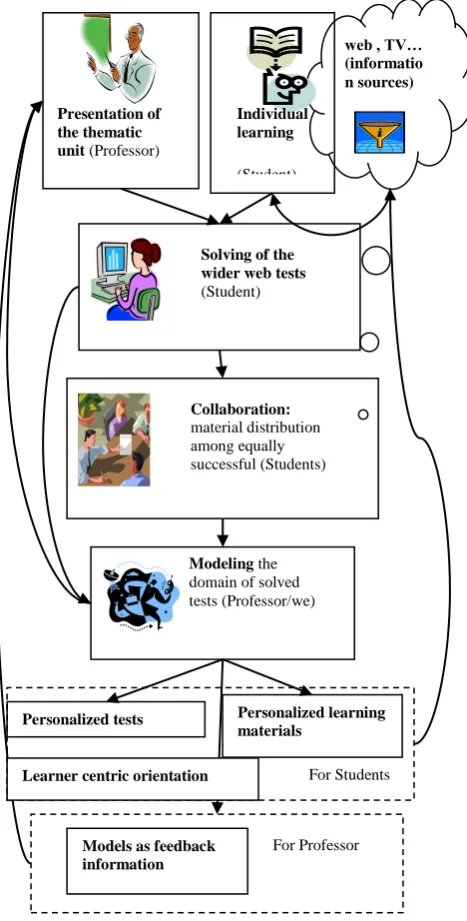
Web-based systems are usually used in distance education, in blended learning or in traditional classroom as a supplement. The system proposed in the paper (fig. 1) could be classified as web-based systems for e-learning or e-assessment. E-learning refers to the use of electronic media and information and communication technologies (ICT) in education. E-learning is including all forms of educational technology in learning and teaching [27]. Computer-aided assessment or e-assessment, ranging from automated multiple-choice tests to more sophisticated systems is becoming a frequently used administrative tool of e-learning systems. Our research is focused on properties of e-assessment used mainly as both contexr as formative and summative assessment. At the same time our system could be used as a part of learning management system (LMS) [20], [21]. The term LMS is here used to describe a wide range of applications that track student training [9].
Machine learning algorithms in e-assessment, state of the art
related to the adaptation of learning materials to the needs and behavior of each student. Materials could be selected from the fixed set of saved documents or extended by web (learning objects). This systems enables distribution of selected learning objects among students with similarities. Collaboration support is also needed in e-learning systems [9]. Creation of learning centric environment is based on the specific characteristics of students and enables communication among students with similar learning behavior [1], [2], [22]. The Internet enables students to be brought together where they can cooperate in learning in groups without space and time limitations. It is, however, quite a challenge to form ideal groups in a short time and ensure satisfactory interaction for students in cyberspace. One of the research challenges in the educational data mining1 is to help teachers to improve group-learning in e-learning by first establishing effective groups with rules based on data mining, and then facilitating student interaction using a system that monitors members’ communication status [22].
The assessment of students is the e-learning issue most commonly tackled by means of data mining methods2, which mainly means application of machine learning algorithms. Some of the mains e-learning subjects to which data mining techniques have been applied are dealing with the assessment of student’s learning performance, provide course adaptation and learning recommendations based on the students’ learning behavior, improvement of student’s problem solving skills, dealing with the evaluation of learning material and educational web-based courses, providing feedback to both teachers and students of e-learning courses, and detection of atypical student’s learning behavior [1], [7], [9], [10], [12], [13], [17], [20]-[26]. Some modern adaptive learning systems adapte the learning environment on the basis of leaning style characteristics of the students [2], [18].
From the e-learning point of view data mining
1 Educational Data Mining (EDM) describes a research field
concerned with the application of data mining, machine learning and statistics to information generated from educational settings (e.g., universities and intelligent tutoring systems) [27].
2In our research we rather use the term “machine learning” then
“data mining” because the modeling is realized on relatively small datasets.
applications in e-learning could be divided into the following categories [7]:
1. Applications dealing with the assessment of students’ learning performance.
2. Applications that provide course adaptation and learning recommendations based on the students’ learning behavior.
3. Approaches dealing with the evaluation of learning material and educational Web-based courses.
4. Applications that involve feedback to both teachers and students of e-learning courses, based on the students’ learning behavior. 5. Developments for the detection of atypical
students’ learning behavior.
We range our approach into categories 1 and 4.
Our approach: integrating machine learning models into the learning environment
Our system enables not only personalization of learning materials but also personalization student’s assessment or testing which adapts to her/his current knowledge [15], [16]. By application of machine learning algorithms we are trying intrinsically to model the mechanisms of knowledge absorption trough the process of adoption of particular thematic unit in the defined learning environment.
In the given paradigm of e-learning (FIG 1) we have “Presentation of the thematic unit (professor)”, except in the case of EU union questionnaire, where the knowledge is mainly adopted from electronic information sources, traveling, as common and specific knowledge, and by individual’s interest on this topic.
FIG 1 STRUCTURE OF THE WEB-BASED SYSTEM FOR E-ASSESSMENT.
Domains
We use machine learning methods on three different methods: domain of elementary school mathematics “Expressions”, domain on “Introduction into
programming” in higher education and knowledge about European Union domain [6], [15], [16], [30], [31]. Questions of type: “choose correct answer” or “fulfill the answer” are solved for each domain.
The values of the attributes are numerical (except the attribute class which is descriptive) and they present achieved points of an individual student for each individual question. The maximum number of points for the test was 100. Attribute Success is the rating of student into three classes as regards the points achieved on the test.
Domain of elementary school mathematics
The system for generation of adapted tests for the students was tested on domain of validated mathematical web tests for the thematic unit Expressions, which is a part of curricula of the 9th grade of elementary school inside the wider theme Arithmetic and Algebra. The testing was performed in two elementary schools in Slovenia. The tests were composed according to didactic standards and curriculum. Solved tests were anonymously stored into MySQL database.
Domain on introduction into programming
The wider test was made of 13 exercises and it was tested on domain of validated knowledge in the first programming language (Pascal). The testing was carried out at the Faculty of Education, University of Ljubljana, in the programming course for computer science students.
Our goal was to find out, how is the knowledge about different concepts in the first programming language connected and to build a representative adaptive testing. Solved tests were anonymously stored into MySQL data-base.
European Union knowledge domain
The domain of EU consists of web-inquire results. Questionnaires were sent to students and teaching staff on a program study of computer science at the Faculty of Education. Fulfilled questionnaires were anonymously stored in MySQL database.
In the database we have collected 120 solved web tests. The questionnaire/test contained 20 exercises each of them marked with 5 points.
Personalized learning materials
Personalized tests Presentation of the thematic unit (Professor)
Solving of the wider web tests (Student)
web , TV… (informatio n sources)
Collaboration: material distribution among equally successful (Students)
Modeling the domain of solved tests (Professor/we)
Individual learning
(Student)
For Students
Models as feedback information
Machine Learning Experiments
Clustering
We perform clustering to take insight how students are clustered into classes (clusters). We make clustering in two ways: with or without a priori given number of clusters. In the first experiment, we leave to the learning algorithm to choose relatively small group of classes (clusters), which contain similar instances [12], [14]. We compare the results of clustering with the results of classical marking and find that clusters’ structure doesn’t coincide with results of tests’ evaluation.
For clustering students into successfulness groups we used two algorithms: k-nearest neighbors [12] and algorithm called expectation maximization (EM) that is based on probability density estimation [29].
We will explain the results of clustering on the domain of EU. We compare the results of clustering into 3 classes with the test results obtained with marking. K-nearest neighbors classifies many Sufficient students into the class Not Sufficient. Surprisingly, for some students algorithm suggested new class and there is no cluster Excellent.
EM algorithm is generalization of k-nearest neighbors and it is based on the estimation of the probability density of the clusters. EM classified students into 6 classes by breaking the class of Sufficiently marked students into smaller clusters. In the experiment with given number of clusters (3), EM algorithm didn’t create cluster for Excellent students.
Selection of quality exercises
We use algorithms for attribute selection for selecting a small set of exercises, which influence the students’ success. For estimation of the exercises’ quality in [15] we used two algorithms: ReliefF [19] and algorithm used for calculating attribute weights in the Support Vector Machine (SVM) method [8]. By quality estimation we indirectly check the proposition if the questions which are not answered correctly by the majority (difficult questions) are important for rating. We find that ReliefF as quality exercises selects exercises correctly solved by majority, but SVM select more difficult exercises or exercises, correctly solved by excellent students.
Classification as marking
On the level of input-output mapping we could test the classification accuracy of different classification algorithms. First we only try only the accuracy of the model and we do not analyze the structure of the model or include the expert knowledge (professors’ experiences) into the model. We compare the accuracy of the following classification methods: decision trees, feed-forward neural networks multilayer perceptron (MP) and support vector machine (SVM).
Decision trees, because of the transparency of their structure, offer explanation of the classification (or rating) and at the same time they are good foundation for generation of personalized tests/tests which adjust to the students’ level of knowledge. If we model the domain of solved tests after the presentation of particular thematic unit [15], [16], decision trees are good feedback information for teacher of how successfully they have presented the unit to their pupils. Unfortunately their classification accuracy is much worse then accuracy of SVM [8]. Therefore for performing of quick testing we propose exercise selection (with ReliefF) and classification with high accuracy algorithm, e.g. with SVM.
Conclusions
We modeled the students’ knowledge captured in the tests on knowledge about the European Union, on primary school mathematics and on introductory course of programming for computer science students. We used algorithms for clustering, attribute selection and classification.
TABLE 1:CLASSIFICATION ACCURACY (IN %) OF ALGORITHMS ON EACH DOMAIN (10-FOLD CROSS VALIDATION/WHOLE TRAINING SET)
Domain/Method Decision
tree -SVM MP
Expressions (math.) 76/100 83/100 76/100
Programming 95/98 96/100 93/100
EU knowledge 88/96 93/100 90/95
who are “rated” by the algorithm EM into cluster with better rate. So they are rated differently then they should be by the criteria of achieved points. For these students we expose the need of personalized learning and training. For students rated by the sum of points worse then they would be classified by EM algorithm, we suppose, have bad motivation, nonattendance in teaching and/or superficiality. We tried to improve the deficiencies mentioned with the consolidation of important topics, which are problematical for particular student. At the same time we see opportunity to use the clustering paradigm for forming students’ clusters with similar learning behavior (e.g. in schools with setting and streaming). These students could help each other to understand some concepts by collaboration, exchange literature, useful URL-s, advices…
By means of algorithms for attribute selection we can help professors to realize representative oral assessment or tests for quick and effective assessing for pupils with special needs. The SVM method achieved the best classification accuracy. Decision trees are interesting models not only because they are predictors but because of the transparency of their structure. As models, they are interesting for teachers as feedback information about the knowledge absorption in classroom or about the learning behavior of their students. At the same time, with absorption of knowledge also the nature of the knowledge is captured. Certain questions (parts of material) are more difficult then the others and need more attention and efforts to be understood. The social structure of students also influences the knowledge absorption (tree structure).
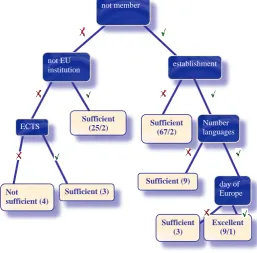
For students, they are interesting as paradigm for personalized test generation (Figure 2, Table 2). The system is asking the student in successive order, one exercise after another. In the background, the algorithm is following the structure of decision tree. The question/exercise in the root of the tree is given to all students. After they answer particular question, the algorithm chooses the next one regarding to the correctness of the current answer. The testing is finished after the leaf of the tree is reached. It means that the student’s knowledge is rated.
FIG 2 DECISION TREE ON THE DOMAIN OF EU.
TABLE 2:LEGEND OF DENOTATION.
mark of the leaf
number in the brackets
joint number of classified instances/incorrectly classified
instances
excellent
number of classified instances in separate
leaf of the tree
9/1
sufficient 103/4
not sufficient
4
REFERENCES
[1] B. G. Aslan, and M. M. Inceoglu, “Machine Learning Based Learner Modeling for Adaptive Web-Based Learning” In O. Gervasi and M. Gavrilova (Eds.): ICCSA 2007, LNCS 4705, Part I, pp. 1133–1145, 2007.
[2] Y. Akbulut, and C. S. Cardak, “Adaptive educational hypermedia accommodating learning styles: A content analysis of publications from 2000 to 2011” Computers & Education, 58 (2), pp. 835–842, February 2012.
[3] C. Ardito, M. Costabile, M. De Marciso, R. Lanzilotti, S. Levialdi., T. Rosseli , and V. Rossano, “An Approach to Usability Evaluation of e-Learning Applications” In Universal Access in the Information Society, 4(3), 2005. [4] P. Brusilovsky, and E. Mill{n, “User Models for Adaptive
Hypermedia and Adaptive Educational Systems” In:
day of Europe not EU
institution
Not sufficient (4)
not member
Sufficient (67/2)
establishment
ECTS Sufficient (25/2) Number
languages
Sufficient (9) Sufficient (3)
Sufficient (3)
Brusilovsky, P., Kobsa, A., Nejdl, W. (eds.) Adaptive Web 2007. LNCS, vol. 4321, pp. 3–53, Springer, Heidelberg, 2007.
[5]B. Ciloglugil , and M. M. Inceoglu, “User Modeling for Adaptive E-Learning Systems” In B. Murgante et al. (Eds.): ICCSA 2012, Part III, pp. 550–561, LNCS 7335, 2012.
[6]A. Canzutti, I. Nančovska Šerbec., J. Rugelj , and A. Žerovnik, “Artificial Intelligence Methods in Adaptive Web-based System for Assessment”, ELHE 2006.
[7]F. Castro , A. Vellido, A. Nebot, and F. Mugica, “Applying Data Mining Techniques to e-Learning Problems”, In Studies in Computational Intelligence (SCI) 62, pp. 183–221, 2007.
[8]N. Cristianini, and J. Shawe-Taylor J, An Introduction to Support Vector Machines and Other Kernel-based Lerning
Methods. 2000, Cambridge University Press.
[9]F. Essalmi, L. Jemni Ben Ayed, M Jemni., Kinshuk, and S. Graf.: “A fully personalization strategy of E-learning scenarios”, Computers in Human Behavior. Emerging and Scripted Roles in Computer-supported Collaborative Learning, 26(4), pp. 581–591, 2010.
[10]S. Gasar S., M. Bohanec, and V. A. Rajkovič , “A combined data mining and decision support approach to educational planning”, Ed. Mladenić D., Lavrač N., Bohanec M., Moyle S., Data mining and decision support: integration and collaboration, The Kluwer international series in engineering and computer science, SECS 745, pp. 203-212, Boston; Dordrecht; London: Kluwer Academic Publishers, 2003.
[11]M. Hall, E. Frank, G. Holmes, B. Pfahringer , P. Reutemann., I. H. Witten, The WEKA Data Mining Software: An Update; SIGKDD Explorations, 11(1) , 2009. [12]I. Kononenko, and M. Kukar, Machine learning and data mining : introduction to principles and algorithms. Chichester: Horwood Publishing, . XIX. 2007.
[13]C.-S. Lee, “Diagnostic, predictive and compositional modeling with data mining in integrated learning environments” Computers & Education, 49 (3), pp. 562– 580, November 2007.
[14]T. M. Mitchell, Machine learning, 1997, McGraw-Hill.
[15]I. Nančovska Šerbec, A. Žerovnik, and J. Rugelj , “Decision trees for individual students’ testing”, Informacijska Družba, 2004, (CD, conference material, in Slovene).
[16]I. Nančovska Šerbec, A. Žerovnik, and J. Rugelj, “Machine Learning Algorithms Used for Validation of the Student Knowledge”, MIPRO 2006, Opatija, Croatia. Vol. 4, Computers in education, pp. 95-100, 2006.
[17]N. Nirmalakhandan, “Computerized adaptive tutorials to improve and assess problem-solving skills” Computers & Education, 49 (4), pp. 1321–1329, December 2007.
[18]U. Ocepek, Z. Bosnić, I. Nančovska Šerbec, and J. Rugelj, “Exploring the relation between learning style models and preferred multimedia types”, Computers & Education, 69, November 2013, pp. 343–355 (in press). [19]M. Robnik-Šikonja, and I. Kononenko, “Theoretical and
Empirical Analysis of RelieF and RreliefF”, Machine Learning Journal, 53, pp. 23 – 69, 2003.
[20]C. Romero, S. Ventura , and E. Garcıa, “Data mining in course management systems: Moodle case study and tutorial”, Computers & Education , 51 (1), pp. 368–384, August 2008.
[21]R C. Romero, S. Ventura (Ed.). Data Mining in E-learning, 2006, WitPress.
[22]P. – C. Sun, H. – K. Cheng., T. –C. Lin, F.-S Wang, “A design to promote group learning in e-learning: Experiences from the field”, Computers & Education, 50(3), pp. 661-677, April 2008, .
[23]T. Tang, and G. Mccalla, “Smart Recommendation for an Evolving E-Learning System, International Journal on E-Learning, 1 (4), pp. 105-129, 2005.
[24]H. Thuneberg, and R. Hotulainen, “Contributions of data mining for psycho-educational research: what selforganizing maps tell us about the wellbeing of gifted students”, High Ability Studies, 17 (1), pp. 87–100, 2006. [25]F.-H. Wang, ”A fuzzy neural network for item
sequencing in personalized cognitive scaffolding with adaptive formative assessment”, Expert Systems with Applications, 27, pp. 11–25, 2004.
enhancing student achievement in Web-based learning” Journal of Computer Assisted Learning, 22(3), pp. 207-217, 2006.
[27]Wikipedia contributors, "Educational data mining, "Wikipedia, The Free Encyclopedia http://en.wikipedia.org/ w/index.php?title=Educational_data_mining&oldid=5719 06199(accessed September 13, 2013).
[28]Wikipedia contributors, "E-learning," Wikipedia, The Free Encyclopedia, http://en.wikipedia.org/w/index.
php?title=E-learning&oldid=572287700 (accessed September 13, 2013).
[29]I. H. Witten, and E. Frank, Data Mining: Practical machine learning tools and techniques, 2005, 2nd Edition, Morgan Kaufmann, San Francisco.
[30]A. Žerovnik, Spletni sistem za pomoč pri učenju in poučevanju, BSc Thesis, University of Ljubljana, Faculty of Education, 2004. (in Slovene)