Proper Lucky Number of Hexagonal Mesh
and Honeycomb Network
D. Antony Xavier1, R.C. Thivyarathi2
1
Department of Mathematics, Loyola College, Chennai, India
2
Department of Mathematics, RMD college, Chennai, India
Abstract
:
Let 𝐺 𝑉, 𝐸 be a graph with vertex set 𝑉 and edge set E . Let 𝑓 be a labeling defined in 𝐺. Define the sum of neighbourhood of vertex 𝑣 bys 𝑣 = 𝑢∈𝑁 𝑣 𝑓 𝑢 , where 𝑁(𝑣) denotes the open
neighbourhood of vertex 𝑣 ∈ 𝑉. A labeling𝑓 is a proper lucky labeling if 𝑓(𝑢) ≠ 𝑓(𝑣) and s(𝑢) ≠
𝑠(𝑣) for all 𝑢, 𝑣 ∈ 𝐸 𝐺 . The proper lucky number of 𝐺, denoted by 𝜂𝑝 𝐺 is the least positive
integer 𝑘 such that 𝐺 has a proper lucky labeling with 1,2, … , 𝑘 as the set of labels. In this paper we determine proper lucky number of Hexagonal mesh and Honeycomb network.
Keywords - Lucky labeling, Proper lucky number,
Hexagonal mesh and Honeycomb network.
1. Introduction
For the basic definitions of graph theory refer Douglas B.West [9] and Harary [13]. A graph labeling is an assignment of integers to the vertices or edges, or both, subject to certain conditions [11]. Rosa, in the year 1967 introduced the concept of labeling, by Graham and Sloane in 1980. The concept of labeling has much importance in graph theory as it is being used in various fields such as communication networks, coding theory, astronomy etc.
Graph coloring is one of the most studied subjects in graph theory. It is an assignment of labels called colors to the elements of a graph, subject to certain constraints. Karonski, Luczak and Thomason [8] initiated the study of proper labeling. The problem of proper labeling offers numerous variants and established great significance
at recent times.
Graph coloring is used in various research areas of computer science such as networking, image segmentation, clustering, image capturing and data mining.The lucky labeling of graphs were studied by A. Ahai et al [2] and S. Akbari et al [3]. Suppose the vertices of a graph 𝐺 were labeled arbitrarily by positive integers and let s 𝑣 denote the sum of labels over all neighbours of vertex 𝑣. A labeling is
lucky if the function s is a proper coloringof 𝐺. The least positive integer 𝑘 for which a graph 𝐺 has a lucky labeling from the set 1,2, … , 𝑘 is the lucky number of𝐺, denoted by 𝜂(𝐺). Kins et al [8] obtained the lower bound of proper lucky number for any connected graph G using clique number 𝜔. The chromatic number of complete graph 𝐾𝑛is
𝜒 𝐾𝑛 = 𝑛. In this paper, we determine the proper
lucky number of Hexagonal mesh and Honeycomb network
.
Definition 1.1[8]:Let 𝐺 𝑉, 𝐸 be a graph with
vertex set 𝑉 and edge set E . Let 𝑓 be a labeling defined in 𝐺. Define the sum of neighbourhood of vertex 𝑣 by s 𝑣 = 𝑢∈𝑁 𝑣 𝑓 𝑢 , where 𝑁(𝑣) denotes the open neighbourhood of vertex of 𝑣 ∈
𝑉. A labeling 𝑓 is a proper lucky labeling if
𝑓(𝑢) ≠ 𝑓(𝑣) and s(𝑢) ≠ 𝑠(𝑣) for all 𝑢, 𝑣 ∈
𝐸 𝐺 . The proper lucky number of 𝐺, denoted by
𝜂𝑝 𝐺 is the least positive integer 𝑘 such that 𝐺 has a proper lucky labeling with 1,2, … , 𝑘 as the set of labels.
Result 1.2 [8]: For any connected graph 𝐺, the
chromatic number is less than or equal to proper lucky number i.e. 𝜒 ≤ 𝜂𝑝.
For any connected graph 𝐺, let 𝜂𝑝 be its proper lucky number and 𝜔 be its clique number, then
𝜔 ≤ 𝜂𝑝.
2.Proper Lucky Number of Hexagonal Mesh
The triangular tessellation is used to define a hexagonal mesh and this is widely studied. A hexagonal mesh of dimension n, denoted by
𝐻𝑋𝑛 it has 3𝑛2− 3𝑛 + 1 vertices and 9𝑛2−
15𝑛 + 6 edges. There are six vertices of degree
three which we call as corner vertices. There is exactly onevertex v at distance 𝑛 − 1from each of thecorner vertices. This vertex is called the centre of 𝐻𝑋𝑛.
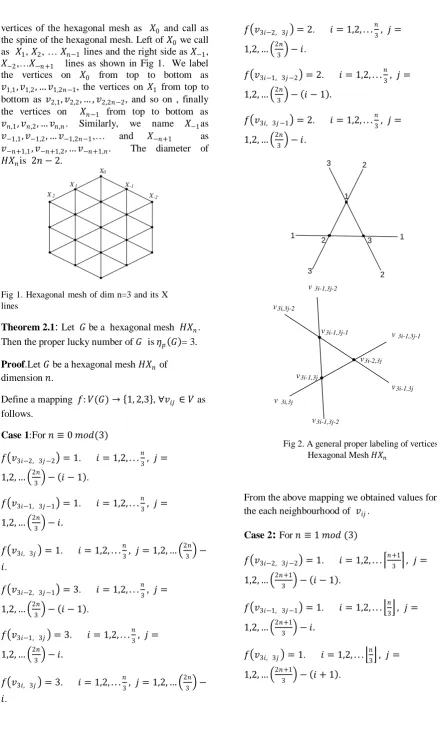
vertices of the hexagonal mesh as 𝑋0 and call as the spine of the hexagonal mesh. Left of 𝑋0 we call as 𝑋1, 𝑋2, … 𝑋𝑛−1 lines and the right side as 𝑋−1,
𝑋−2,…𝑋−𝑛+1 lines as shown in Fig 1. We label the vertices on 𝑋0 from top to bottom as
𝑣1,1, 𝑣1,2, … 𝑣1,2𝑛−1, the vertices on 𝑋1 from top to
bottom as 𝑣2,1, 𝑣2,2, … , 𝑣2,2𝑛−2, and so on , finally the vertices on 𝑋𝑛−1 from top to bottom as
𝑣𝑛,1, 𝑣𝑛,2, … 𝑣𝑛,𝑛. Similarly, we name 𝑋−1as
𝑣−1,1, 𝑣−1,2, … 𝑣−1,2𝑛−1,… and 𝑋−𝑛+1 as
𝑣−𝑛+1,1, 𝑣−𝑛+1,2, … 𝑣−𝑛+1,𝑛. The diameter of
𝐻𝑋𝑛is 2𝑛 − 2.
X
X
X X
X
0 -1
-2 1
2
Fig 1. Hexagonal mesh of dim n=3 and its X lines
Theorem 2.1
:
Let 𝐺 be a hexagonal mesh 𝐻𝑋𝑛.Then the proper lucky number of 𝐺 is 𝜂𝑝 𝐺 = 3.
Proof.Let 𝐺 be a hexagonal mesh 𝐻𝑋𝑛 of
dimension 𝑛.
Define a mapping 𝑓: 𝑉(𝐺) → 1, 2,3 , ∀𝑣𝑖𝑗 ∈ 𝑉 as follows.
Case 1:For 𝑛 ≡ 0 𝑚𝑜𝑑(3)
𝑓 𝑣3𝑖−2, 3𝑗 −2 = 1. 𝑖 = 1,2, . . . 𝑛
3, 𝑗 =
1,2, … 2𝑛3 − 𝑖 − 1 .
𝑓 𝑣3𝑖−1, 3𝑗 −1 = 1. 𝑖 = 1,2, . . .𝑛3, 𝑗 =
1,2, … 2𝑛3 − 𝑖.
𝑓 𝑣3𝑖, 3𝑗 = 1. 𝑖 = 1,2, . . . 𝑛
3, 𝑗 = 1,2, …
2𝑛 3 −
𝑖.
𝑓 𝑣3𝑖−2, 3𝑗 −1 = 3. 𝑖 = 1,2, . . .𝑛3, 𝑗 =
1,2, … 2𝑛3 − 𝑖 − 1 .
𝑓 𝑣3𝑖−1, 3𝑗 = 3. 𝑖 = 1,2, . . .𝑛3, 𝑗 =
1,2, … 2𝑛3 − 𝑖.
𝑓 𝑣3𝑖, 3𝑗 = 3. 𝑖 = 1,2, . . .𝑛3, 𝑗 = 1,2, … 2𝑛3 −
𝑖.
𝑓 𝑣3𝑖−2, 3𝑗 = 2. 𝑖 = 1,2, . . .𝑛3, 𝑗 =
1,2, … 2𝑛3 − 𝑖.
𝑓 𝑣3𝑖−1, 3𝑗 −2 = 2. 𝑖 = 1,2, . . .𝑛3, 𝑗 =
1,2, … 2𝑛3 − 𝑖 − 1 .
𝑓 𝑣3𝑖, 3𝑗 −1 = 2. 𝑖 = 1,2, . . .𝑛3, 𝑗 =
1,2, … 2𝑛3 − 𝑖.
1
2 3
2 3
1
2 3
1
3i-1,3j-1 v
3i-1,3j v
3i-2,3j v 3i-1,3j-2 v
3i,3j-2 v
3i-1,3j-2 v 3i,3j v
3i-1,3j-1 v
3i-1,3j v
Fig 2. A general proper labeling of vertices in Hexagonal Mesh 𝐻𝑋𝑛
From the above mapping we obtained values for the each neighbourhood of 𝑣𝑖𝑗.
Case 2
: For
𝑛 ≡ 1 𝑚𝑜𝑑 (3)𝑓 𝑣3𝑖−2, 3𝑗 −2 = 1. 𝑖 = 1,2, . . . 𝑛+13 , 𝑗 =
1,2, … 2𝑛+13 − 𝑖 − 1 .
𝑓 𝑣3𝑖−1, 3𝑗 −1 = 1. 𝑖 = 1,2, . . . 𝑛3 , 𝑗 =
1,2, … 2𝑛+13 − 𝑖.
𝑓 𝑣3𝑖, 3𝑗 = 1. 𝑖 = 1,2, . . . 𝑛3 , 𝑗 =
𝑓 𝑣3𝑖−2, 3𝑗 −1 = 3. 𝑖 = 1,2, . . . 𝑛+1
3 , 𝑗 =
1,2, … 2𝑛+13 − 𝑖.
𝑓 𝑣3𝑖−1, 3𝑗 = 3. 𝑖 = 1,2, . . . 𝑛
3 , 𝑗 =
1,2, … 2𝑛+13 − 𝑖.
𝑓 𝑣3𝑖, 3𝑗 −2 = 3. 𝑖 = 1,2, . . . 𝑛3 , 𝑗 =
1,2, … 2𝑛+13 − 𝑖.
𝑓 𝑣3𝑖−2, 3𝑗 = 2. 𝑖 = 1,2, . . . 𝑛+1
3 , 𝑗 =
1,2, … 2𝑛+13 − 𝑖.
𝑓 𝑣3𝑖−1, 3𝑗 −2 = 2. 𝑖 = 1,2, . . . 𝑛3 , 𝑗 =
1,2, … 2𝑛+13 − 𝑖.
𝑓 𝑣3𝑖, 3𝑗 −1 = 2. 𝑖 = 1,2, . . . 𝑛3 , 𝑗 =
1,2, … 2𝑛+13 − 𝑖.
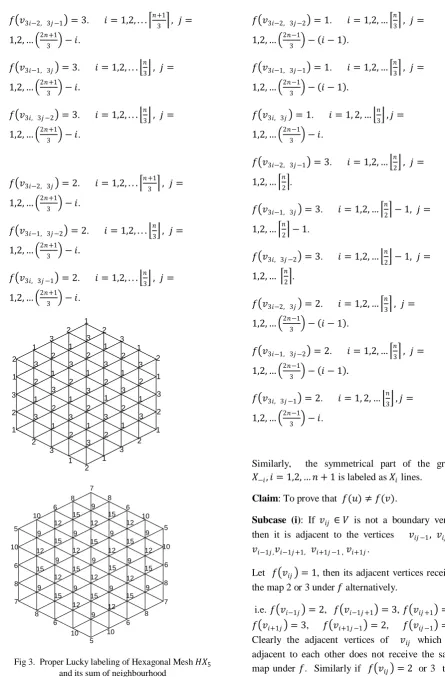
2 3 2 1 2 3 1 2 3 1 3 2 1 3 2 1 3 1 2 3 1 2 3 1 2 1 3 2 1 3 2 1 3 2 1 2 3 1 2 3 1 2 3 2 1 3 2 1 3 1 3 2 1 3 2 1 2 3 2 1 1 7 5 6 8 7 8 9 15 12 9 10 6 12 15 9 12 15 6 10 12 9 15 12 9 15 8 9 12 15 9 12 15 9 5 10 12 9 15 12 9 15 8 6 12 15 9 12 15 6 10 9 12 15 9 8 10 5 6 8 7 10
Fig 3. Proper Lucky labeling of Hexagonal Mesh 𝐻𝑋5
and its sum of neighbourhood
Case 3
:
For 𝑛 ≡ 2𝑚𝑜𝑑(3)𝑓 𝑣3𝑖−2, 3𝑗 −2 = 1. 𝑖 = 1,2, … 𝑛
3 , 𝑗 =
1,2, … 2𝑛−13 − 𝑖 − 1 .
𝑓 𝑣3𝑖−1, 3𝑗 −1 = 1. 𝑖 = 1,2, … 𝑛
3 , 𝑗 =
1,2, … 2𝑛−13 − 𝑖 − 1 .
𝑓 𝑣3𝑖, 3𝑗 = 1. 𝑖 = 1, 2, … 𝑛3 , 𝑗 =
1,2, … 2𝑛−13 − 𝑖.
𝑓 𝑣3𝑖−2, 3𝑗 −1 = 3. 𝑖 = 1,2, … 𝑛2 , 𝑗 =
1,2, … 𝑛2 .
𝑓 𝑣3𝑖−1, 3𝑗 = 3. 𝑖 = 1,2, … 𝑛2 − 1, 𝑗 =
1,2, … 𝑛2 − 1.
𝑓 𝑣3𝑖, 3𝑗 −2 = 3. 𝑖 = 1,2, … 𝑛2 − 1, 𝑗 =
1,2, … 𝑛2 .
𝑓 𝑣3𝑖−2, 3𝑗 = 2. 𝑖 = 1,2, … 𝑛
3 , 𝑗 =
1,2, … 2𝑛−13 − 𝑖 − 1 .
𝑓 𝑣3𝑖−1, 3𝑗 −2 = 2. 𝑖 = 1,2, … 𝑛
3 , 𝑗 =
1,2, … 2𝑛−13 − 𝑖 − 1 .
𝑓 𝑣3𝑖, 3𝑗 −1 = 2. 𝑖 = 1, 2, … 𝑛
3 , 𝑗 =
1,2, … 2𝑛−13 − 𝑖.
Similarly, the symmetrical part of the graph
𝑋−𝑖, 𝑖 = 1,2, … 𝑛 + 1 is labeled as 𝑋𝑖 lines.
Claim: To prove that 𝑓(𝑢) ≠ 𝑓(𝑣).
Subcase (i): If 𝑣𝑖𝑗 ∈ 𝑉 is not a boundary vertex
then it is adjacent to the vertices 𝑣𝑖𝑗 −1, 𝑣𝑖𝑗 +1,
𝑣𝑖−1𝑗 ,𝑣𝑖−1𝑗 +1, 𝑣𝑖+1𝑗 −1 , 𝑣𝑖+1𝑗.
Let 𝑓 𝑣𝑖𝑗 = 1, then its adjacent vertices receives the map 2 or 3 under 𝑓 alternatively.
i.e. 𝑓 𝑣𝑖−1𝑗 = 2, 𝑓 𝑣𝑖−1𝑗 +1 = 3, 𝑓 𝑣𝑖𝑗 +1 = 2,
𝑓 𝑣𝑖+1𝑗 = 3, 𝑓 𝑣𝑖+1𝑗 −1 = 2, 𝑓 𝑣𝑖𝑗 −1 = 3.
Subcase (ii): If 𝑣𝑖𝑗 ∈ 𝑉 is a boundary vertex then it is adjacent to the vertices 𝑣𝑖−1𝑗, 𝑣𝑖−1𝑗 +1, 𝑣𝑖𝑗 +1 or
𝑣𝑖−1𝑗 , 𝑣𝑖−1𝑗 +1, 𝑣𝑖𝑗 +1 .
Let 𝑓 𝑣𝑖𝑗 = 1, then its adjacent vertices receives
the map 2 or 3 under 𝑓 alternatively.
i.e. 𝑓 𝑣𝑖−1𝑗 = 2, 𝑓 𝑣𝑖−1𝑗 +1 = 3, 𝑓 𝑣𝑖𝑗 +1 = 2,
𝑓 𝑣𝑖+1𝑗 = 3 or 𝑓 𝑣𝑖−1𝑗 = 2, 𝑓 𝑣𝑖−1𝑗 = 2.
Clearly the adjacent vertices of 𝑣𝑖𝑗 which are adjacent to each other does not receive the same map under 𝑓. Similarly if 𝑓 𝑣𝑖𝑗 = 2 or 3 then
its
adjacent vertices receives the map 1 and 3 or 1 and 2 under 𝑓 alternatively as discussed above.Clearly 𝑓(𝑢) ≠ 𝑓(𝑣), for all 𝑢, 𝑣 ∈ 𝐸 𝐺 . Hence the given labeling is a proper labeling.
Next we claim that the given mapping is a lucky labeling. That is, to prove 𝑠 𝑢 ≠ 𝑠 𝑣
for all (𝑢, 𝑣) ∈ 𝐸 𝐺 .
We obtain s 𝑣𝑖𝑗 , the inner sum of labels over all neighbours of vertex 𝑣𝑖𝑗 .
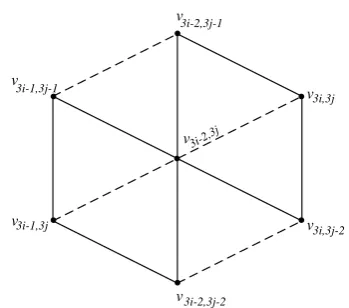
Consider any vertex of 𝐻𝑋𝑛. Let 𝑣(3𝑖, 3𝑗 ) be the
vertex with six adjacent vertices
say
𝑣
(3𝑖, 3𝑗 −1), 𝑣
(3𝑖−1, 3𝑗 ), 𝑣
(3𝑖−1, 3𝑗 −2), 𝑣
(3𝑖, 3𝑗 −2),
𝑣
(3𝑖−2, 3𝑗 )and𝑣
(3𝑖−2, 3𝑗 −1).
Fig 4.Sum of neighbourhood of
𝑣
(3𝑖, 3𝑗 )Fig 4.Sum of neighbourhood of
𝑣
(3𝑖, 3𝑗 )v3i,3j v
3i,3j-1
3i,3j-2
3i-1,3j
3i-1,3j-2 3i-2,3j
3i-2,3j-1
v
v
v
v
v
Fig 4. Sum of neighbourhood of 𝑣(3𝑖, 3𝑗 )
Hence its sum of neighbourhood are
𝑠 𝑣3𝑖, 3𝑗 = 𝑓 𝑣3𝑖, 3𝑗 −1 + 𝑓 𝑣3𝑖−1, 3𝑗
+ 𝑓 𝑣3𝑖−1, 3𝑗 −2 + 𝑓 𝑣3𝑖, 3𝑗 −2
+ 𝑓 𝑣3𝑖−2, 3𝑗 + 𝑓 𝑣3𝑖−2, 3𝑗 −1
= 2+3+2+3+2+3
= 15
Here we are taking 𝑣(3𝑖−2, 3𝑗 ) the adjacent vertices
of 𝑣3𝑖, 3𝑗 .
v3i-2,3 j v3i-2,3j-1
3i-2,3j-2
3i,3j
3i,3j-2 3i-1,3j
3i-1,3j-1 v
v
v
v
v
Fig 5. Sum of neighbourhood of 𝑣(3𝑖−2, 3𝑗 )
𝑠 𝑣3𝑖−2, 3𝑗 = 𝑓 𝑣3𝑖−2, 3𝑗 −1 + 𝑓 𝑣3𝑖, 3𝑗
+ 𝑓 𝑣3𝑖, 3𝑗 −2 + 𝑓 𝑣3𝑖−2, 3𝑗 −2
+ 𝑓 𝑣3𝑖−1, 3𝑗 + 𝑓 𝑣3𝑖−1, 3𝑗 −1
= 3+1+3+1+3+1
= 12
v3i,3j-2 v3i,3j
3i,3j-1
3i-1,3j-2
3i-1,3j-1 3i-2,3j-2
3i-2,3j
v
v
v
v
v
Fig 6. Sum of neighbourhood of 𝑣(3𝑖, 3𝑗 −2)
Similarly, we can show that 𝑠 𝑣3𝑖, 3𝑗 −2 = 9,
𝑠 𝑣3𝑖−2, 3𝑗 −1 = 9,
𝑠 𝑣3𝑖, 3𝑗 −1 = 12 , 𝑠 𝑣3𝑖−1, 3𝑗 = 9 ,
From the above cases we see that 𝑠 𝑢 ≠ 𝑠 𝑣 for
all 𝑢𝑣 ∈ 𝐸 𝐺 .
Similarly, we can prove other cases.
Therefore 𝜂𝑝 ≤ 3 .
Since the clique number of 𝐻𝑋𝑛 is 3, and by the theorem 1.2 𝜂𝑝≥ 3. Therefore 𝜂𝑝 𝐺 = 3.
3. Proper Lucky Number of Honeycomb
Networks
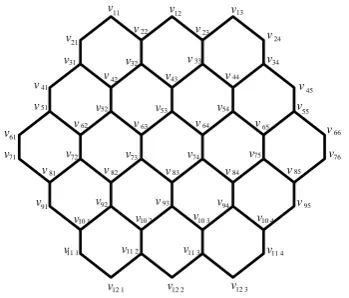
A high level honeycomb network can be constructed from a low level one. A unit honeycomb network is a hexagon, denoted by HC(1). Honeycomb network of size 2 denoted HC(2), can be obtained by adding six hexagons around the boundary edges of HC(1). Inductively, honeycomb network HC(n) can be obtained from HC(n – 1) by adding a layer of hexagons around the boundary edges of HC(n – 1). Alternatively, the size d of HC(n) is determined as the number of hexagons between the center and boundary of HC(n) (inclusive) and the number of vertices and edges of HC(n) are 6𝑛2 and 9𝑛2− 3𝑛 respectively. We use the level numbering scheme proposed by the Sharieh et al.[14] for the honeycomb networks. Each node in HC(n) is identified by a 𝑣𝑖𝑗, where
idenotes the line number in which the node exists, and j denotes the location of the node in the line. A node with the address 1,1 is the first node that exists at line number 1. The node 1,2 refers to the second node that exists at line number 1, and so on. See Fig 7.
v v v
v v v v
v v v v v
v v v v v v
v v v v v
v v v v
v v v v
v v v
v v
v v v v v v
v v v v
v
v v v
v v v
v
11 12 13
21
22 23
24
31 32 33 34
41
42 43 44
45
51 52 53 54 55
61
62 63 64 65
66
71 72 73 74 75 76
81 82 83 84 85
91 92 93 94 95
10 1 10 2 10 3 10 4
11 1 11 2 11 3 11 4
12 1 12 2 12 3
Fig 7. Honeycomb network with addressing HC(3)
Theorem 3.1: Let 𝐺 be a honeycomb 𝐻𝐶 𝑛 .
Then the proper lucky number of 𝐺 is 𝜂𝑝 𝐺 = 2.
Proof. Let 𝐺 be a honeycomb graph 𝐻𝐶 𝑛 of
dimension 𝑛.
Define a mapping 𝑓: 𝑉(𝐺) → 1, 2 , ∀𝑣𝑖𝑗 ∈ 𝑉 as follows
𝑓 𝑣𝑖𝑗 = 1, 𝑖 𝑖𝑠 𝑜𝑑𝑑2, 𝑖 𝑖𝑠 𝑒𝑣𝑒𝑛
Subcase (i): If 𝑣𝑖𝑗 ∈ 𝑉 is not a boundary vertex
then it is adjacent to the even line vertices 𝑣𝑖−1𝑗 −1,
𝑣𝑖−1𝑗, 𝑣𝑖+1 𝑗 , upto 2𝑛 lines and it is adjacent to
the odd line vertices 𝑣𝑖−1𝑗, 𝑣𝑖+1 𝑗, 𝑣𝑖+1 𝑗 +1 , upto
2𝑛 − 1. Below the line 2𝑛, 𝑣𝑖𝑗 is adjacent to even
line vertices 𝑣𝑖−1𝑗, 𝑣𝑖−1 𝑗 +1, 𝑣𝑖+1𝑗 upto 4𝑛-2 and it is adjacent to the odd line vertices 𝑣𝑖−1𝑗,
𝑣𝑖+1𝑗 −1, 𝑣𝑖+1 𝑗 upto 2𝑛 − 1.
Let 𝑓 𝑣𝑖𝑗 = 1, then its adjacent vertices receives the map 2 under 𝑓 alternatively.
Clearly the adjacent vertices of 𝑣𝑖𝑗 which are adjacent to each other does not receive the same map under 𝑓. Similarly if 𝑓 𝑣𝑖𝑗 = 2 then its adjacent vertices receives the map 1 under
𝑓 alternatively.
Subcase (ii): If 𝑣𝑖𝑗 ∈ 𝑉 is a boundary vertex then
the first line of 𝐻𝐶(𝑛) is adjacent to the vertices
𝑣𝑖+1𝑗, 𝑣𝑖+1 𝑗 +1 and the 𝑛𝑡ℎ line is adjacent to the vertices 𝑣𝑖−1𝑗, 𝑣𝑖−1 𝑗 +1 . The left side of the boundary is adjacent to the vertices 𝑣𝑖−1𝑗, 𝑣𝑖+1 𝑗 and the right side of 𝑣𝑖𝑗 is adjacent to even line vertices 𝑣𝑖−1 𝑗 −1, 𝑣𝑖+1𝑗 and the odd line vertices 𝑣𝑖−1𝑗, 𝑣𝑖+1𝑗 +1 upto 2𝑛 lines and below the 2𝑛 lines 𝑣𝑖𝑗 is adjacent to even line vertices
𝑣𝑖−1 𝑗 +1, 𝑣𝑖+1𝑗 and the odd line vertices
𝑣𝑖−1𝑗, 𝑣𝑖+1𝑗 −1.
Let 𝑓 𝑣𝑖𝑗 = 1, then its adjacent vertices receives
the map 2 under 𝑓 alternatively.
Clearly the adjacent vertices of 𝑣𝑖𝑗 which are adjacent to each other does not receive the same map under𝑓. Similarly if 𝑓 𝑣𝑖𝑗 = 2 then its adjacent vertices receives the map 1 under
1 1 1
2 2 2 2
1 1 1 1
2 2 2 2 2
1 1 1 1 1
2 2 2 2 2 2
1 1 1 1 1 1
2 2 2 2 2
1 1 1 1 1
1 1 1 1
2 2 2 2
2 2 2
4 4 4
2 3 3 2
6 6 6 6
2 3 3 3 2
6 6 6 6 6
2 3 3 3 3 2
4 6 6 6 6 4
3 3 3 3 3
4 6 6 6 4
4 6 6 4
2 2 2 2
2 2 2
Fig 8. Proper Lucky labeling of Honeycomb 𝐻𝐶 3 and its sum of neighbourhood
Proof is similar to theorem 2.1.
Conclusion:
In this paper, we obtained the proper lucky number for Hexagonal mesh and Honeycomb network. Futher, we investigate the problems in various interconnection networks such as butterfly, benes, torus etc.
Reference :
1. L. Addhario- Berry, R.E.L.Aldred, K.Dalai, B.A. Reed,
“Vertex coloring edge partitions”, Journal of combinatorial Theory series, vol 94 n.2, p 237-244, July 2005.
2. A. Ahai, A. Dehghan, M. Kazemi, E. Mollaahmedi,
“Computation of Lucky number of planar graphs is NP-hard”, Information processing letters, vol 112, Iss 4, p 109-112, 15th Feb 2012.
3. S. Akhari, M. Ghanbari, R. Manariyat, S. Zare, „ On the lucky choice number of graphs”, Graphs and combinatorics, vol 29 n.2, p 157-163, Mar 2013.
4. G. Chartand, F.Okamoto, P.Zhang, “The sigma chromatic
number of a graph”, Graphs and combinatorics 26 (6), p 755- 773, 2010.
5. Czerwinski, Sebastian, Grytczuk, Jaroslaw, Elazny and
Wiktor, “ Luckylabeling of graphs”, Inf. Process. Lett. 109(18); 1078-1081. Zbl 1197.05125, 2009.
6. A. Dehghan, M.R. Sadeghi, A. Ahadi, “ Algorithmic
complexity of proper labeling problems”, Theoretical computer science, vol 495, p 25-36, 2013.
7. J.Gallian, “ A Dynamic survey of graph labeling,” The
Electronic journal of combinatorics, 1996- 2005.
8. Y.Kins, R.C. Thivyarathi, D.Antony Xavier, “ Proper
Lucky number of Mesh derived aricheture”,
9. LeenaSankari S., Masthan K.M.K., AravindhaBabu N.,
Bhattacharjee T., Elumalai M., "Apoptosis in cancer - an
update", Asian Pacific Journal of Cancer Prevention, ISSN : 1513-7368, 13(10) (2012) PP. 4873-4878.
10. Michal Karonski, Tomasz Luczak, Andrew Thomason,
“Edge weights and vertex colors”, Journal of combinatorics theory series B, vol 91n.1, p151-157, May 2004.
11. A. NellaiMurugan, R. Maria Irudhaya Aspin Chitra,
“Lucky Edge Labeling of Pn, Cn and Corona of Pn, Cn”, IJSIMR, Volume 2, Issue 8, August 2014, pp. 710-718
12. S. Ramachandran and S.Arumugam, „Invitation to graph
theory‟, Scitech publication pvt.Ltd, Reprint, Jan 2009.
13. Subhashree A.R., Parameaswari P.J., Shanthi B., Revathy
C., Parijatham B.O., "The reference intervals for the haematological parameters in healthy adult population of Chennai, Southern India", Journal of Clinical and Diagnostic Research, ISSN : 0973 - 709X, 6(10) (2012), PP. 1675-1680.
14. Sharieh A, Qatawneh M, Almobaideen W, Sleit A,