The Thirty-Third AAAI Conference on Artificial Intelligence (AAAI-19)
Classification with Costly Features Using Deep Reinforcement Learning
Jarom´ır Janisch, Tom´aˇs Pevn´y, Viliam Lis´y
Artificial Intelligence Center, Department of Computer Science Faculty of Electrical Engineering, Czech Technical University in Prague{jaromir.janisch, tomas.pevny, viliam.lisy}@fel.cvut.cz
Abstract
We study a classification problem where each feature can be acquired for a cost and the goal is to optimize a trade-off be-tween the expected classification error and the feature cost. We revisit a former approach that has framed the problem as a se-quential decision-making problem and solved it by Q-learning with a linear approximation, where individual actions are ei-ther requests for feature values or terminate the episode by providing a classification decision. On a set of eight problems, we demonstrate that by replacing the linear approximation with neural networks the approach becomes comparable to the state-of-the-art algorithms developed specifically for this prob-lem. The approach is flexible, as it can be improved with any new reinforcement learning enhancement, it allows inclusion of pre-trained high-performance classifier, and unlike prior art, its performance is robust across all evaluated datasets.
Introduction
In real-world classification problems, one often has to deal with limited resources - time, money, computational power and many other. Medical practitioners strive to make a diag-nosis for their patients with high accuracy. Yet at the same time, they want to minimize the amount of money spent on examinations, or the amount of time that all the procedures take. In the domain of computer security, network traffic is often analyzed by a human operator who queries different ex-pensive data sources or cloud services and eventually decides whether the currently examined traffic is malicious or benign. In robotics, the agent may utilize several measurement de-vices to decide its current position. Here, each measurement has an associated cost in terms of the energy consumption. In all of these cases, the agent gathers a set offeatures, but it is not desirable to have a static set that works on average. Instead, we want to optimize for a specific sample - the cur-rent patient, certain computer on a network or the immediate robot’s location.
These real-world problems give rise to the problem of Classification with Costly Features (CwCF). In this setting, an algorithm has to classify a sample, but can only reveal its features at a defined cost. Each sample is treated indepen-dently, and for each sample the algorithmsequentiallyselects features conditioning on values already revealed. Inherently,
Copyright c2019, Association for the Advancement of Artificial Intelligence (www.aaai.org). All rights reserved.
a
f5
y
1y
2y
3..
.
a
c· · ·
a
f1a
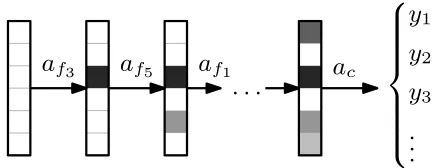
f3Figure 1: Illustrative sequential process of classification. The agent sequentially asks for different features (actionsaf) and
finally performs a classification (ac). The particular decisions
are influenced by the observed values.
a different subset of features can be selected for different samples. The goal is to minimize the expected classification error, while also minimizing the expected incurred cost.
In this paper, we extend the approach taken by Dulac-Arnold et al. (2011), which proposed to formalize the prob-lem as an Markov decision process (MDP) and solve it with linearly approximated Q-learning. In this formalization, each sample corresponds to an episode, where an agent sequen-tially decides whether to acquire another feature and which, or whether to already classify the sample (see Figure 1). At each step, the agent can base its decision on the values of the features acquired so far. For the actions requesting a feature, the agent receives a negative reward, equal to the feature cost. For the classification actions, the reward is based on whether the prediction is correct. Dulac-Arnold et al. prove in their paper that the optimal solution to this MDP corresponds to the optimal solution of the original CwCF problem.
performance initially during the training. Second, we allow the model to selectively use an external High-Performance Classifier (HPC), trained separately with all features. In many real-world domains, there is an existing legacy, cost-agnostic model, which can be utilized. This approach is similar to (Nan and Saligrama 2017), but in our case it is a straightforward extension to the baseline model. We evaluate and compare the method on several two- and multi-class public datasets with number of features ranging from 8 to 784. We do not perform any thorough hyperparameter search for each dataset, yet our method robustly performs well on all of them, while often outperforming the prior-art algorithms. The source code is available atgithub.com/jaromiru/cwcf.
Problem definition
Let(x, y)∈ Dbe a sample drawn from a data distribution D. Vectorx∈ X ⊆Rncontains feature values, wherexiis
a value of featurefi∈ F={f1, ..., fn},nis the number of
features, andy∈ Yis a class. Letc:F →Rbe a function mapping a featuref into its real-valued costc(f), and let
λ∈[0,1]be a cost scaling factor.
The model for classifying one sample is a parametrized couple of functionsyθ : X → Y,zθ : X → ℘(F), where yθclassifies andzθreturns the features used in the
classifi-cation. The goal is to find such parametersθthat minimize the expected classification error along withλscaled expected feature cost. That is:
argmin
θ
1 |D|
X
(x,y)∈D
`(yθ(x), y) +λ
X
f∈zθ(x)
c(f)
(1)
We view the problem as a sequential decision-making prob-lem, where at each step an agent selects a feature to view or makes a class prediction. We use standard reinforcement learning setting, where the agent explores its environment through actions and observes rewards and states. We repre-sent this environment as a partially observable Markov deci-sion process (POMDP), where each episode corresponds to a classification of one sample from a dataset. We use POMDP definition, because it allows a simple definition of the tran-sition mechanics. However, our model solves a transformed MDP with stochastic transitions and rewards.
LetSbe the state space,Aset of actions andr,treward and transition functions. States= (x, y,F¯)∈ Srepresents a sample(x, y)and currently selected set of featuresF¯. The agent receives only an observationo={(xi, fi)| ∀fi∈F}¯ ,
that is, the selected parts ofxwithout the label.
Action a ∈ A = Ac ∪ Af is one of the classification
actionsAc =Y, or feature selecting actionsAf =F.
Clas-sification actionsAc terminate the episode and the agent
receives a reward of0in case of correct classification, else −1. Feature selecting actionsAf reveal the corresponding
valuexiand the agent receives a reward of−λc(fi). The set
of available feature selecting actions is limited to features not yet selected. Reward functionr:S× A →Ris:
r((x, y,F¯), a) =
−λc(fi) ifa∈ Af,a=fi
0 ifa∈ Acanda=y
−1 ifa∈ Acanda6=y
0 10 20 30
Cost
0.75 0.80 0.85 0.90 0.95
Accuracy
λ= 0.0001
λ= 0.001
λ= 0.01
λ= 0.1
λ= 1.0
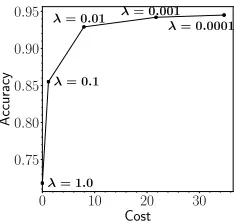
Figure 2: Different settings of λ result in different cost-accuracy trade-off. Five different runs, miniboone dataset.
By altering the value ofλ, one can make a trade-off between precision and average cost. Higherλforces the agent to prefer lower cost and shorter episodes over precision and vice versa. Further intuition can be gained by looking at Figure 2.
The initial state does not contain any disclosed features,
s0 = (x, y,∅), and is drawn from the data distributionD.
The environment is deterministic with a transition function
t:S × A → S ∪ T, whereT is the terminal state:
t((x, y,F¯), a) =
T ifa∈ A
c
(x, y,F ∪¯ a) ifa∈ Af
These properties make the environment inherently episodic, with a maximal length of an episode of|F|+ 1. Finding the optimal policyπθthat maximizes the expected reward in
this environment is equivalent to solving eq. (1), which was shown by Dulac-Arnold et al. (2011).
Background
In Q-learning, one seeks the optimal functionQ∗,
represent-ing the expected discounted reward for takrepresent-ing an actionain a statesand then following the optimal policy, and it satisfies the Bellman equation:
Q∗(s, a) = E
s0∼t(s,a)
h
r(s, a, s0) +γmax
a0 Q
∗(s0, a0)i (2)
wherer(s, a, s0)is the received reward andγ ≤ 1 is the discount factor. A neural network with parametersθtakes a statesand outputs an estimateQθ(s, a), jointly for all actions a. It is optimized by minimizing MSE between the both sides of eq. (2) for transitions(st, at, rt, st+1)empirically
experienced by an agent following a greedy policyπθ(s) =
argmaxaQθ(s, a). Formally, we are looking for parameters θby iteratively minimizing the loss function`θ, for a batch
of transitionsB:
`θ(B) = 1
|B|
X
(st,at,rt,st+1)∈B
(qt−Qθ(st, at))2 (3)
whereqtis regarded as a constant when differentiated, and is
computed as:
qt=
(r
t ifst+1=T
rt+ max a γQ
θ(s
t+1, a) otherwise
As the error decreases, the approximated functionQθ
con-verges toQ∗. However, this method proved to be unstable
in practice (Mnih et al. 2015). In the following section, we briefly describe techniques used in this work that stabilize and speed-up the learning.
Deep Q-learning(Mnih et al. 2015) includes a separate target networkwith parametersφ, which follow parametersθ
with a delay. Here we use the method of Lillicrap et al. (2016), where the weights are regularly updated with expression
φ := (1−ρ)φ+ρθ, with some parameterρ. The slowly changing estimateQφis then used inq
t, whenst+16=T: qt=rt+ max
a γQ φ(s
t+1, a) (5)
Double Q-learning(Van Hasselt, Guez, and Silver 2016) is a technique to reduce bias induced by themaxin eq. (4), by combining the two estimatesQθandQφinto a new formula
forqt, whenst+16=T:
qt=rt+γQφ(st+1,argmax a
Qθ(s
t+1, a)) (6)
In the expression, the maximizing action is taken fromQθ, but its value is estimated with the target networkQφ.
Dueling Architecture(Wang et al. 2016) uses a decom-position of the Q-function into two separate value and ad-vantage functions. The architecture of the network is altered so that the it outputs two estimatesVθ(s)andAθ(s, a)for
all actions a, which are then combined to a final output
Qθ(s, a) = Vθ(s) +Aθ(s, a)− 1 |A|
P
a0Aθ(s, a0). When
training, we take the gradient w.r.t. the final estimateQθ. By incorporating baseline Vθ across different states, this
technique accelerates and stabilizes training.
Retrace(Munos et al. 2016) is a method to efficiently utilize long traces of experience with truncated importance sampling. We store generated trajectories into an experience replay buffer (Lin 1993) and utilize whole episode returns by recursively expanding eq. (2). The stored trajectories are off the current policy and a correction is needed. For a sequence(s0, a0, r0, . . . , sn, an, rn,T), we implement
Re-trace together with Double Q-learning by replacingqtwith
qt=rt+γ E
a∼πθ(st)
Qφ(st+1, a)
+
+γρ¯t+1
qt+1−Qφ(st+1, at+1)
(7)
Where we defineQφ(
T,·) = 0andρ¯t= min(πµ((aatt||sstt)),1)is
a truncated importance sampling between exploration policy
µthat was used when the trajectory was sampled and the current policyπ. We allow the policyπθto be stochastic –
at the beginning, it starts close to the sampling policyµbut becomes increasingly greedy as the training progresses. It prevents premature truncation in the eq. (7) and we observed faster convergence. Note that allqtvalues for a whole episode
can be calculated in O(n) time. Further, it can be easily parallelized across all episodes.
Method
We first describe a Deep Q-learning (DQN) based method, and leave other extensions to the next section.
FFNN Features ¯x Maskm
Qc
Qf
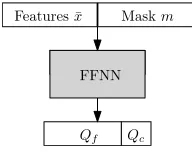
Figure 3: The architecture of the model. The input layer consists of the feature vectorx¯concatenated with the binary maskm, followed by a feed-forward neural network (FFNN). Final fully connected layer jointly outputs Q-values for both classification and feature-selecting actions.
An observationois mapped into a tuple(¯x, m):
¯
xi=
x
i iffi∈F¯
0 otherwise , mi=
1 iff
i∈F¯
0 otherwise
Vectorx¯ ∈Rnis a masked vector of the originalx. It con-tains values of xwhich have been acquired and zeros for unknown values. Maskm ∈ {0,1}n is a vector denoting
whether a specific feature has been acquired, and it contains 1 at a position of acquired features, or 0. The combination of
¯
xandmis required so that the model can differentiate be-tween a feature not present and observed value of zero. Each dataset is normalized with its mean and standard deviation and because we replace unobserved values with zero, this corresponds to the mean-imputation of missing values.
The neural network is fed with concatenated vectorsx¯,m
and output Q-values jointly for all actions. The neural net-work has three fully connected hidden layers, each followed by the ReLu non-linearity, where the number of neurons in individual layers change depending on the used dataset. The overview is shown in Figure 3.
A set of environments with samples randomly drawn from the dataset are simulated and the experienced trajectories are recorded into the experience replay buffer. After each action, a batch of transitionsBis taken from the buffer and optimized upon with Adam (Kingma and Ba 2015), with eqs. (3, 5). The gradient is normalized before back-propagation if its norm exceeds1.0. The target network is updated after each step. Overview of the algorithm and the environment simulation is in Algorithm 1 and 2.
Because all rewards are non-positive, the whole Q-function is also non-positive. We use this knowledge and clip theqt
value so that it is at most0. We experimentally found that this approach avoids an initial explosion in predicted values and weights and speeds up and stabilizes the learning process. The definition of the reward function also results in optimistic initialization: Since the outputs of an untrained network are around zero, the model tends to overestimate the real Q-values, which has a positive effect on exploration.
The environment is episodic with a short average length of episodes, therefore we use undiscounted returns withγ= 1.0. We use-greedy policy that behaves greedily most of the time, but picks a random action with probability. Exploration rate
Extensions
Pre-training Classification actionsAc are terminal and
their Q-values do not depend on any following states. Hence, these Q-values can be efficiently pretrained in a supervised way. Before starting the main method, we repeatedly sample different states by randomly picking a samplexfrom the dataset and generating a maskm. The valuesmifollow the
Bernoulli distribution with probabilityp. As we want to gen-erate states with different amount of observed features, we randomly select√3p∼ U(0,1)for different states. This way, the distribution of generated masksmis shifted towards the initial state with no observed features. We use the generated statessto pretrain the part of the networkQθ(s, a), for
classi-fication actionsa∈ Ac. Since the main algorithm starts with
already accurate classification predictions, this technique has a positive effect on the initial speed of the training process.
HPC Our second extension is the High-Performance Clas-sifier. This can coincide with an expensive and (not-always) accurate oracle, that appears in real-world problems (e.g. the human operator in computer security), or a legacy cost-agnostic system already in place. We model these cases with a separately trained classifier, typically of a different type than neural networks (e.g. random forests or SVM). The extension is implemented by an addition of a separate actionaHPC, that
corresponds to forwarding the current sample to the HPC. The cost for this action is the summed cost of all remaining features, i.e.r(s, aHPC) =−λPf∈F \F¯c(f). The action is
terminal,t(s, aHPC) =T. The model learns to use this
ad-ditional action, which has two main effects: (1) It improves performance for samples needing a large amount of features. (2) It offloads the complex samples to HPC, so the model can focus its capacity more effectively for the rest, improving overall performance. Note that HPC is an optional extension, but is likely to improve performance if the chosen classifier outperforms neural networks on the particular dataset.
Deep RL extensions Since our method is based on a generic RL technique, any domain-independent improvement can be included into the algorithm. Here we decide to include the three described techniques: Double Q-learning, Dueling Architecture and Retrace. Compared to the DQN model, a few changes are necessary: The architecture is changed to Dueling and the optimization step is made on eqs. (3, 7). The baseline agent uses one-step return in eq. (5), but the full agent with Retrace updates the Q-values along the whole sequence with eq. (7). In the latter case, we sample whole episodes instead of individual steps, but we keep the total number of steps in batches similar. The target policy is set to beη-greedy, whereηis linearly decreased towards zero. This way, the target and exploration policy are close together at the beginning of the training, which avoids premature truncations in eq. (7) and speeds-up the training.
Other possible extensions Our method provides a flexible framework that can be extended in numerous ways. More than one external classifier can be included in our model. We hypothesize that the model would learn to adaptively query different classifiers that perform well for the current sample.
Algorithm 1Training
Randomly initialize parametersθandφ
Initialize environmentsEwith(x, y,∅)∈(X,Y, ℘(F)) Initialize replay bufferMwith a random agent
whilenot convergeddo for alle∈ Edo
Simulate one step with-greedy policyπθ:
a=πθ(s); s0, r=STEP(e, a)
Add transition(s, a, r, s0)into circular buffer
M end for
Sample a random batchBfromM for all(si, ai, ri, s0i)∈ Bdo
Compute targetqiaccording to eq. (5)
Clipqiwith maximum of0
end for
Perform one step of gradient descent on`θw.r.t.θ:
`θ(B) = |B|
X
i=1
(qi−Qθ(si, ai))2
Update parametersφ:= (1−ρ)φ+ρθ
end while
Algorithm 2Environment simulation
Operatormarks the element-wise multiplication. functionSTEP(e∈ E,a∈ A)
ifa∈ Acthen r=
0 ifa=e.y −1 ifa6=e.y
Resetewith a new sample(x, y,∅)from a dataset Return(T, r)
else ifa∈ Afthen
Addato set of selected features:e.F¯ =e.F ∪¯ a
Create maskmi= 1iffi ∈F¯and0otherwise
Return((e.xm, m),−λc(a)) end if
end function
Instead of the static reward of−1for misclassification, one can provide actual misclassification costs for the particular domain and our method would find the optimal solution. One could even set different misclassification costs to different classes, leading to the domain of cost-sensitive classification. In real-world cases, several features often come together with one request (e.g. one request to a cloud service can pro-vide many values). In this case, the features can be grouped together to create a macro-feature, which is provided at once. In other cases, the number of the features may be too large to be practical. In these cases, existing algorithms (Wang, Trapeznikov, and Saligrama 2015) can be used to automati-cally group the features.
Experiments
0 20 40
Used features
0.84 0.86 0.88 0.90 0.92 0.94
Accuracy
0 20 40
Used features
0.6 0.7 0.8 0.9
Accuracy
0 100 200 300 400
Used features
0.1 0.2 0.3 0.4
Accuracy
0 200 400 600
Used features
0.5 0.6 0.7 0.8 0.9 1.0
Accuracy
(a) miniboone (b) forest (c) cifar (d) mnist
0 2 4 6
Cost
0.7 0.8 0.9 1.0
Accuracy
RL RL-dqn RL-lin BudgetPrune AdaptGbrt plain NN SVM
0 1 2 3
Cost
0.35 0.40 0.45 0.50 0.55
Accuracy
0 20 40
Used features
0.92 0.94 0.96 0.98
Accuracy
0 100 200 300
Used features
0.50 0.55 0.60 0.65
Accuracy
(e) wine (f) yeast (g) forest-2 (h) cifar-2
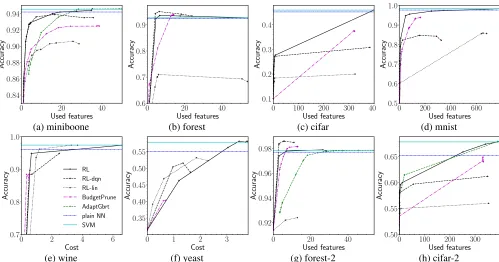
Figure 4: Comparison with prior-art algorithms. Adapt-Gbrt is not shown on (b-f), because the open-sourced code is not compatible with multi-class datasets. RL-lin is Q-learning with linear approximation, RL-dqn is the baseline method. The horizontal lines correspond to the plain neural network based classifier and SVM. Datasets forest-2 and cifar-2 have two clases.
(Nan, Wang, and Saligrama 2016) in Figure 4. We instan-tiate our method in three versions: Q-learning with linear approximation (RL-lin), Q-learning with neural networks (RL-dqn) and the complete agent with all extensions (RL).
Experiment Details
We use several public datasets (Lichman 2013; Krizhevsky and Hinton 2009), which are summarized in Table 1. We use three two-class and five multi-class datasets, with number of features ranging from 8 to 784. Two datasets were as-signed random costs, selected from{0.2,0.4,0.6,0.8}. Other datasets are left with the uniform cost of1.0and the meth-ods work as adaptive feature selection – being able to select different features for different samples. We normalize the datasets with their mean and standard deviation and split them into training, validation and testing sets. Note that our results may differ from those reported in prior-art, because we use different preprocessing and splits.
Adapt-Gbrt is a random forest (RF) based algorithm and, similarly to our HPC extension, it uses an external HPC model. It jointly learns a gating function and Low-Prediction Cost model (LPC) that adaptively approximates HPC in re-gions where it makes accurate predictions. The gating func-tion redirects the samples to either HPC or LPC. BudgetPrune is another algorithm that prunes an existing RF using linear programming to optimize the cost vs. accuracy trade-off.
We obtained the results for both Adapt-Gbrt and Budget-Prune by running the source code published by their authors. The published version of Adapt-Gbrt is restricted to datasets
Dataset feats. cls. #trn #val #tst costs
mnist 784 10 50k 10k 10k U
cifar 400 10 40k 10k 10k U
cifar-2 400 2 40k 10k 10k U
forest 54 7 200k 81k 300k U
forest-2 54 2 200k 81k 300k U
miniboone 50 2 45k 19k 65k U
wine 13 3 70 30 78 V
yeast 8 10 600 200 684 V
Table 1: Used datasets. The cost is either uniform (U) or variable (V) across features.
with only two classes, hence we report it only on those. Separately, we train an SVM as the external classifier on each dataset. Hyperparameters were selected using cross-validation. This SVM is then used as the external classifier (HPC) both in our method and AdaptGbrt. We also train a plain neural network based classifier with the same size as our model for each dataset and report its performance, along with the performance of the SVM.
0 10 20 30
Used features
0.90 0.91 0.92 0.93 0.94 0.95
Accuracy
RL RL-dqn RL-nohpc RL-nopretrain plain NN SVM
0 20 40
Used features
0.90 0.91 0.92 0.93 0.94 0.95 0.96
Accuracy
(a) miniboone (b) forest
Figure 5: Performance of different versions of the algorithm.
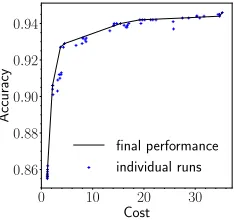
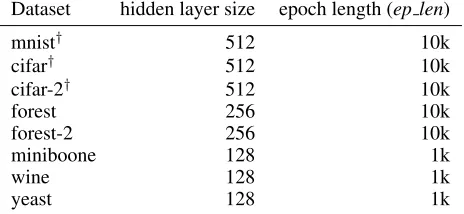
variance between different runs. We show all runs in the miniboone dataset, along with the selected points in Figure 6. We define a hyperparameter epoch length, that differs across datasets, to be a number of training steps. For each dataset, we heuristically estimate the size of the neural net-work (NN) by training NN based classifiers with number of neurons selected from{64,128,256,512}in three layers with ReLu activation. We choose the lowest size that per-forms well on the task, without excess complexity. We use automatic learning-rate scheduling and early-stopping. We track the reward averaged over epochs on the training set and lower the learning-rate immediately when the reward fails to increase. Similarly, we use the average reward on the valida-tion set and interrupt the computavalida-tion if the reward fails to increase consecutively for three epochs.We keep other hy-perparameters the same across all experiments, and their exact values are reported in Tables 2, 3 in the Appendix.
Discussion
Comparing the full agent (RL) to the prior-art, the RL out-performs Adapt-Gbrt and BudgetPrune in miniboone, forest (except for the very low cost range), cifar, mnist and cifar. On cifar-2 and forest-2, there are ranges of costs, where another algorithm is better, but it is a different algorithm each time. Minding the fact that the algorithm was not specifically tuned for each dataset, this indicates high robustness.
A notable result is that the step from linear approximation (RL-lin) to neural networks (RL-dqn) translates into a large
0 10 20 30
Cost
0.86 0.88 0.90 0.92 0.94
Accuracy
final performance individual runs
Figure 6: Different runs of our algorithm in the miniboone dataset. Validation set was used to select the best points.
0 500 1000 1500 2000
Training steps −0.6
−0.5
−0.4
−0.3
−0.2
Rew
ard
RL RL-dqn RL-nohpc RL-nopretrain
Figure 7: Average reward during training. All versions con-verge to a good solution, but with different speed. Miniboone,
λ= 0.01, averaged over 10 runs.
improvement of performance in all tested datasets but yeast and wine. These two datasets are small and the linear method works well. Because the linear approximation is a special case of neural networks, it indicates that the results can be improved if the architecture and hyperparameters were ad-justed separately for each dataset. The additional extensions of the full agent (RL) contributed mainly to the stability of the agent, which was rendered into better performance in the large datasets: cifar, cifar-2 and mnist (Figure 4cdh).
We further investigate the different versions of our algo-rithm in Figure 5 and 7. We found that the there are differ-ences in convergence speeds, which is another important factor beside performance. Without advanced RL techniques, RL-dqn converges slowest. With pretraining, the model is initialized closer to an optima. Another fact is that the perfor-mance improves continuously with progression of the train-ing. This may be useful in non-stationary domains, where the statistics of the domain change in time. Also, the learning can be interrupted anytime, still providing a sensible result.
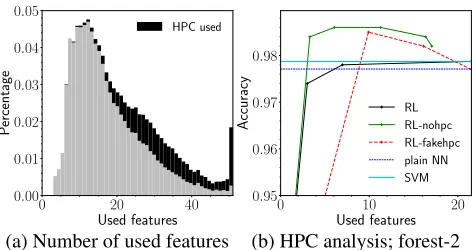
Another interesting fact is that RL-dqn and the version without HPC perform better on the forest dataset. The situa-tion is even more profound in the case of forest-2 (Figure 4g), where the BudgetPrune also outperforms the SVM. We inves-tigated the issue and found that the SVM has 0.995 accuracy on the training set of forest-2, causing the RL agent to overfit and rely on its HPC. To further analyze the issue, we trained models without the external classifier (RL-nohpc) and with a non-predictive HPC (RL-fakehpc), by preparing random predictions for all samples (see Figure 8b). We found that the agent without the external classifier performed better than the agent with HPC, confirming that the agent indeed overfits. With the case of the non-predictive HPC, it introduced some instability into the training, but the performance is still higher for a range of costs. The results show that including HPC should be done with caution – the agent is able to ignore a non-predictive classifier to some extent, but an overfit clas-sifier can be harmful. Surprisingly, the agent without HPC module is not constrained by the performance of the plain neural network, indicating a good generalization ability.
0 20 40
Used features
0.00 0.01 0.02 0.03 0.04 0.05
P
ercentage
HPC used
0 10 20
Used features
0.95 0.96 0.97 0.98
Accuracy
RL RL-nohpc RL-fakehpc plain NN SVM
(a) Number of used features (b) HPC analysis; forest-2
Figure 8: (a) Histogram of number of used features across the whole miniboone dataset, black indicates that the HPC was queried at that point. (b) Comparison of the full agent, an agent without HPC and a non-predictive classifier on the forest-2 dataset. The used SVM has very low training error, causing the RL agent to overfit. The agent is able to ignore the fake HPC to some extent.
which cases the external classifier is used. The agent classifies 40% of all samples with under 15 features and with almost no HPC usage. For the rest of samples, the agent queries the HPC in about 19% cases. The histogram confirms that the agent is classifies adaptively, requesting a different amount of features across samples, and triggering the external classifier on demand. With further analysis, we confirm that the agent also requests adifferentset of features for different samples.
Related Work
We build upon work of Dulac-Arnold et al. (2011), which used Q-learning with linear regression, resulting in limited performance. We replace the linear approximation with neu-ral networks, extend the approach with supervised pretraining and external HPC and thoroughly compare to recent methods. Contardo, Denoyer, and Artieres (2016) use a recurrent neural network that uses attention to select blocks of features and classifies after a fixed number of steps. Compared to our work, decisions of this network are hard to explain. On the other hand, our Q-learning based algorithm produces semantically meaningful values for each action. Moreover, as we use a standard algorithm, we can directly benefit from any enhancements made by the community.
There is a plethora of tree-based algorithms (Xu, Wein-berger, and Chapelle 2012; Kusner et al. 2014; Xu et al. 2013; 2014; Nan, Wang, and Saligrama 2015; 2016; Nan and Saligrama 2017). Last two articles implement BudgetPrune and AdaptGbrt algorithms, that we describe in Experiments. A different set of algorithms employed linear programming (LP) to this domain (Wang, Trapeznikov, and Saligrama 2014; Wang et al. 2014). Wang et al. (2014) use LP to select a model with the best accuracy and lowest cost, from a set of pre-trained models, all of which use a different set of features. The algorithm also chooses a model based on the complexity of the sample, similarly to Adapt-Gbrt.
Wang, Trapeznikov, and Saligrama (2015) propose to re-duce the problem by finding different disjoint subsets of features, that are used together as macro-features. These
macro-features form a graph, which is solved with dynamic programming. The algorithm for finding different subsets of features is complementary to our algorithm and could be possibly used jointly to improve performance.
Trapeznikov and Saligrama (2013) use a fixed order of features to reveal, with increasingly complex models that can use them. However, the order of features is not computed, and it is assumed that it is set manually. Our algorithm is not restricted to a fixed order of features (for each sample it can choose a completely different subset), and it can also find their significance automatically.
Recent work (Maliah and Shani 2018) focuses on CwCF with misclassification costs, constructs decision trees over attribute subsets and use their leaves to form states of an MDP. They directly solve the MDP with value-iteration for small datasets with number of features ranging from 4-17. On the other hand, our method can be used to find an approximate solution to much larger datasets. In this work, we do not account for misclassification costs, but they could be easily incorporated into the rewards for classification actions.
Tan (1993) analyzes a problem similar to our definition, but algorithms introduced there require memorization of all training examples, which is not scalable in many domains.
Conclusion
Classification with costly features (CwCF) is a sequen-tial decision-making problem that inspired many problem-specific solutions. While domain independent methods for general decision-making problems, such as reinforcement learning (RL), have been proposed as a solution, they have not performed well in comparison to the state-of-the-art algo-rithms specifically tailored to this problem. In light of the re-cent progress, we revisit the RL approach and evaluate several Deep Q-learning based algorithms. The investigation shows that even basic Deep RL is comparable and often superior to state-of-the-art algorithms Adapt-Gbrt (Nan and Saligrama 2017) and BudgetPrune (Nan, Wang, and Saligrama 2016).
The RL approach has a relatively low number of parame-ters and is robust with respect to their modification, which facilitates the deployment. It is a modular framework, al-lowing for numerous extensions, for example the supervised pre-training and the inclusion of an external classifier demon-strated in this paper. RL approach can also benefit from future advancements of Deep RL itself, which we demonstrated by utilizing Double Q-learning, Dueling Architecture and Retrace. Lastly, using RL for CwCF enables continual adap-tation to changes in non-sadap-tationary environments, commonly present in real-world problems.
Acknowledgments
the program Projects of Large Research, Development, and Innovations Infrastructures.
Appendix
Symbol description value
|E| no. of parallel environments 1000
γ discount-factor 1.0
Retrace-λ Retrace parameterλ 1.0
ρ target network update factor 0.1
|B| no. of steps in batch 50k
|M| no. of episodes in memory 40k
-start starting exploration 1.0
-end final exploration 0.1
η-start start greediness of policyπ 0.5 η-end final greediness of policyπ 0.0 steps length of exploration phase 2×ep len
LR-pretrain pre-training learning-rate 1×10⁻³
LR-start initial learning-rate 5×10⁻⁴
LR-min minimal learning-rate 1×10⁻⁷
LR-scale learning-rate multiplicator 0.3
Table 2: Global parameters
Dataset hidden layer size epoch length (ep len)
mnist† 512 10k
cifar† 512 10k
cifar-2† 512 10k
forest 256 10k
forest-2 256 10k
miniboone 128 1k
wine 128 1k
yeast 128 1k
Table 3: Dataset parameters. †Specific settings are used: |M|= 10k,LR-pretrain= 2×10⁻⁵,LR-start= 10−5
References
Contardo, G.; Denoyer, L.; and Artieres, T. 2016. Recurrent neural networks for adaptive feature acquisition. InInternational Confer-ence on Neural Information Processing, 591–599. Springer. Dulac-Arnold, G.; Denoyer, L.; Preux, P.; and Gallinari, P. 2011. Datum-wise classification: a sequential approach to sparsity. In Joint European Conference on Machine Learning and Knowledge Discovery in Databases, 375–390. Springer.
Kingma, D. P., and Ba, J. 2015. Adam: A method for stochastic optimization. InInternational Conference on Learning Representa-tions.
Krizhevsky, A., and Hinton, G. 2009. Learning multiple layers of features from tiny images. Master’s thesis, University of Toronto. Kusner, M.; Chen, W.; Zhou, Q.; Xu, Z.; Weinberger, K.; and Chen, Y. 2014. Feature-cost sensitive learning with submodular trees of classifiers. InAAAI Conference on Artificial Intelligence, 1939– 1945.
Lichman, M. 2013. UCI machine learning repository.
Lillicrap, T. P.; Hunt, J. J.; Pritzel, A.; Heess, N.; Erez, T.; Tassa, Y.; Silver, D.; and Wierstra, D. 2016. Continuous control with deep reinforcement learning. InInternational Conference on Learning Representations.
Lin, L.-J. 1993. Reinforcement learning for robots using neural networks. Ph.D. Dissertation, Carnegie Mellon University. Maliah, S., and Shani, G. 2018. Mdp-based cost sensitive clas-sification using decision trees. InAAAI Conference on Artificial Intelligence, 3746–3753.
Mnih, V.; Kavukcuoglu, K.; Silver, D.; Rusu, A. A.; Veness, J.; Bellemare, M. G.; Graves, A.; Riedmiller, M.; Fidjeland, A. K.; Ostrovski, G.; et al. 2015. Human-level control through deep reinforcement learning.Nature518(7540):529–533.
Munos, R.; Stepleton, T.; Harutyunyan, A.; and Bellemare, M. 2016. Safe and efficient off-policy reinforcement learning. InAdvances in Neural Information Processing Systems, 1054–1062.
Nan, F., and Saligrama, V. 2017. Adaptive classification for predic-tion under a budget. InAdvances in Neural Information Processing Systems, 4730–4740.
Nan, F.; Wang, J.; and Saligrama, V. 2015. Feature-budgeted random forest. InInternational Conference on Machine Learning, 1983–1991.
Nan, F.; Wang, J.; and Saligrama, V. 2016. Pruning random forests for prediction on a budget. InAdvances in Neural Information Processing Systems, 2334–2342.
Tan, M. 1993. Cost-sensitive learning of classification knowledge and its applications in robotics.Machine Learning13(1):7–33. Trapeznikov, K., and Saligrama, V. 2013. Supervised sequential classification under budget constraints. InArtificial Intelligence and Statistics, 581–589.
Van Hasselt, H.; Guez, A.; and Silver, D. 2016. Deep reinforcement learning with double q-learning. InAAAI Conference on Artificial Intelligence, 2094–2100.
Wang, J.; Bolukbasi, T.; Trapeznikov, K.; and Saligrama, V. 2014. Model selection by linear programming. InEuropean Conference on Computer Vision, 647–662. Springer.
Wang, Z.; Schaul, T.; Hessel, M.; Hasselt, H.; Lanctot, M.; and Freitas, N. 2016. Dueling network architectures for deep reinforce-ment learning. InInternational Conference on Machine Learning, 1995–2003.
Wang, J.; Trapeznikov, K.; and Saligrama, V. 2014. An lp for sequential learning under budgets. InArtificial Intelligence and Statistics, 987–995.
Wang, J.; Trapeznikov, K.; and Saligrama, V. 2015. Efficient learn-ing by directed acyclic graph for resource constrained prediction. In Advances in Neural Information Processing Systems, 2152–2160. Xu, Z.; Kusner, M.; Weinberger, K.; and Chen, M. 2013. Cost-sensitive tree of classifiers. InInternational Conference on Machine Learning, 133–141.