The Thirty-Third AAAI Conference on Artificial Intelligence (AAAI-19)
Scale Invariant Fully Convolutional Network: Detecting Hands Efficiently
Dan Liu,
1Dawei Du,
2Libo Zhang,
3∗Tiejian Luo,
1Yanjun Wu,
3Feiyue Huang,
4Siwei Lyu
21University of the Chinese Academy of Sciences, China2University at Albany, SUNY, USA 3Institute of Software Chinese Academy of Sciences, China4Tencent Youtu Lab, China
[email protected], [email protected], [email protected],
[email protected], [email protected], [email protected], [email protected]
Abstract
Existing hand detection methods usually follow the pipeline of multiple stages with high computation cost, i.e., feature extraction, region proposal, bounding box regression, and ad-ditional layers for rotated region detection. In this paper, we propose a new Scale Invariant Fully Convolutional Network (SIFCN) trained in an end-to-end fashion to detect hands effi-ciently. Specifically, we merge the feature maps from high to low layers in an iterative way, which handles different scales of hands better with less time overhead comparing to concate-nating them simply. Moreover, we develop the Complemen-tary Weighted Fusion (CWF) block to make full use of the distinctive features among multiple layers to achieve scale invariance. To deal with rotated hand detection, we present the rotation map to get rid of complex rotation and derota-tion layers. Besides, we design the multi-scale loss scheme to accelerate the training process significantly by adding super-vision to the intermediate layers of the network. Compared with the state-of-the-art methods, our algorithm shows com-parable accuracy and runs a4.23times faster speed on the VIVA dataset and achieves better average precision on Ox-ford hand detection dataset at a speed of62.5fps.
Introduction
Hand detection is applied in many tasks such as virtual real-ity, human-computer interaction, and driving monitoring, to name a few. However, it is still challenging due to many dif-ficulties such as the low-resolution, clutter background, oc-clusions, the varying sizes and shapes of hands due to differ-ent view angle, and inconsistdiffer-ent appearances due to chang-ing illuminations.
Several methods have been developed for the hand de-tection in the literature. Traditional methods first employ human-crafted features such as Histograms of Oriented Gra-dients (HOG) (Betancourt et al. 2015) and skin color (Kaku-manu, Makrogiannis, and Bourbakis 2007), and then distin-guish hand regions by classifiers such as SVM (Mittal, Zis-serman, and Torr 2011) and Latent SVM (Felzenszwalb et al. 2010). However, most of these methods are not robust to
∗
Corresponding author: Libo Zhang ([email protected]). This work was partially supported by the National Natural Science Foundation of China under Grant 61807033 and Grant 61771341, partially supported by US NSF IIS-1816227.
Copyright c2019, Association for the Advancement of Artificial Intelligence (www.aaai.org). All rights reserved.
(a) (b)
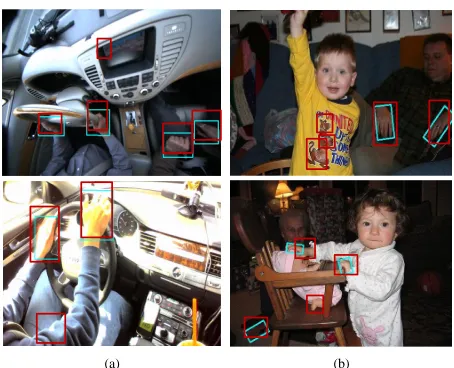
Figure 1: Performance comparison between our SIFCN with ResNet50 backbone (cyan) and Multi-scale fast RCNN (Yan et al. 2017) (red). (a) Examples from the VIVA dataset. (b) Examples from the Oxford dataset.
background clutters, which give rise to high false positive rates.
In recent years, more effective hand detection methods are obtained based on the deep learning based object de-tection methods, for instance, Region-Based Convolutional Networks (R-CNNs) (Girshick et al. 2016), Faster Region-based Convolutional Network (Faster R-CNN) (Ren et al. 2015), and Single Shot MultiBox Detector (SSD) (Liu et al. 2016). Multi-scale features (Le et al. 2017; Yan et al. 2017) extracted by Convolutional Neural Networks are ex-plored to detect different scales of hands. In the very recent work (Deng et al. 2018), rotation and derotation layers are added to the network to handle rotated hands. One prob-lem with the existing deep learning based hand detection methods is that merging all the multi-scale features rudely and the complex network structure to handle rotation usually lead to high computational cost, which limits the practicality of these methods in applications that require fast processing time.
new efficient hand detection method termed as Scale In-variant Fully Convolutional Network (SIFCN). SIFCN em-ploys existing popular deep learning architecture such as VGG16 (Simonyan and Zisserman 2014) or ResNet50 (He et al. 2016) as backbone, and synthesizes multi-scale fea-tures to make predictions so as to be scale-invariant for han-dling hands of different sizes. To reduce the computation cost, we merge feature maps from multiple layers iteratively instead of concatenating them simply. Before that, the1×1
convolution kernel is conducted on feature maps from higher layers to reduce the number of output channels by control-ling the number of kernels, as a result of which the compu-tation cost in the next steps is decreased further more. We develop the Complementary Weighted Fusion (CWF) block to make full use of the distinctive features among multi-ple layers and exploit commulti-plementary information. Different from previous methods using additional rotation and detaion layers (Deng et al. 2018), our model generates the ro-tation map to represent the rotated hand regions effectively. Moreover, we design the multi-scale loss to accelerate the training process by providing supervision to the intermedi-ate layers of the network. Finally, the Non-Maximum Sup-pression (NMS) is applied to the bounding boxes detected by our network to yield the detection results. As shown in Fig-ure 1, our SIFCN method detects different scales of hands well. It achieves fewer false positives and generates more accurate hand locations than Multi-scale fast RCNN (Yan et al. 2017). Besides, our model predicts the hand orientation precisely on the Oxford dataset with rotated hand annota-tions, due to the incorporation of the rotation map. The main contributions of this paper are summarized as follows: • We propose a new Scale Invariant Fully Convolutional
Network for hand detection, which makes full use of the distinctive features of multiple scales in an iterative way with the CWF block.
• We design the multi-scale loss scheme to provide super-vision to the intermediate layers of the network, leading to faster convergence of the network.
• Experiments on VIVA and Oxford datasets show that our method achieves competitive performance with the state-of-the-art hand detection methods but with much im-proved running time efficiency.
Related Work
Traditional Methods. Traditional hand detection meth-ods usually consist of human-crafted feature extraction and classifier training. (Dardas and Georganas 2011) describes a skin detection based method, which uses contour compar-ison to find hands from skin areas. However, it is difficult to distinguish between hands and faces well since faces and fists share similar contour shapes. (Niu et al. 2013) proposes a feature fusion strategy for hand detection in clutter back-ground, but it does not perform well under low resolution and occlusions. (Betancourt et al. 2015) uses the HOG fea-tures to train a SVM classifier, and extend it with a Dynamic Bayesian Network for better performance. (Mittal, Zisser-man, and Torr 2011) combines a hand shape detector, a context-based detector and a skin-based detector to generate
region proposals. Then each proposal is scored to obtain the final results using the SVM classifier. Due to the limitation of hand-crafted features, the performance of these traditional methods is sub-par for practical applications.
Deep learning based Methods. Motivated by the good performance of convolutional neural networks (CNNs) in computer vision, many recent hand detection methods are proposed based on CNN models. (Bambach et al. 2015) de-velops a method combining a candidate region generator and CNNs for hand detections in complex egocentric interac-tions. Context (Zhou, Pillai, and Yalla 2016) is also explored to design the hand detector, which provides extended infor-mation of the prevalent hand shapes and locations. However, the additional context cues lead to complicated preprocess-ing and post-processpreprocess-ing. In (Le et al. 2017), the Fully Con-volutional Network (Long, Shelhamer, and Darrell 2015) is used to generate hand region proposals and then the convo-lution features are sent to the detection network. In terms of merging multi-scale features into a large feature map, the convolution operations are time-consuming in the later steps. Similarly, (Yan et al. 2017) concatenates the multi-scale feature maps from the last three pooling layers into a large feature map. Although different receptive fields are taken into account, simple concatenation of feature maps re-sults in high computation overhead.
On the other hand, hands are typically in a rotated pose, and rarely being precisely horizontal or vertical in real scenes. To predict more accurate locations and poses of hands, (Deng et al. 2018) design a shared network for learn-ing features, a rotation network to predict the rotation angle of region proposals, a derotation layer to obtain axis-aligned rotating feature maps and a detection network for the last classification task. However, the method is of great com-plexity to handle the rotated distances, even when carefully designed.
Different from the aforementioned deep-learning based methods, our model fuses multi-scale features iteratively and handles hand rotation with the rotation map instead of com-plex rotation and derotation layers, resulting in comparable accuracy and better efficiency. To be more specific, since the high-level feature maps reflect the global features while the low-level feature maps contains more local information, the feature maps from different scales are weighted before merged, so that the features from multiple scales can com-plement each other in subsequent process.
Scale Invariant Fully Convolutional Network
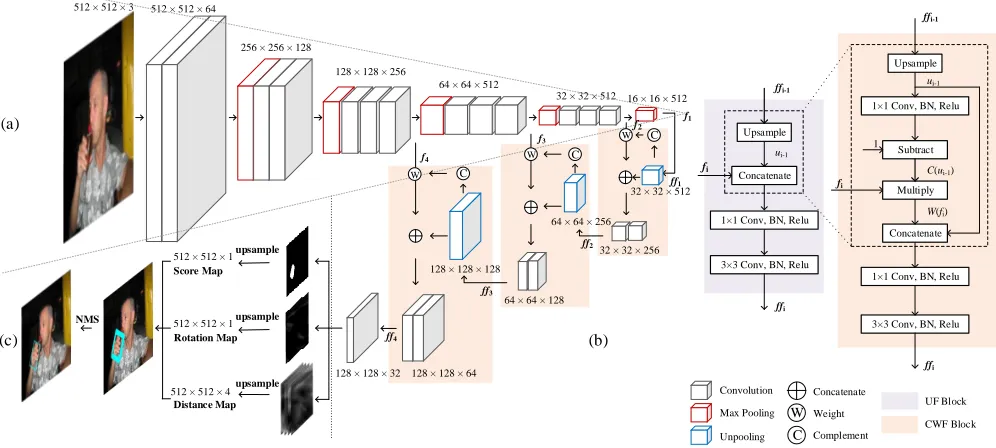
As shown in Figure 2, our network is composed of feature extraction layers, feature fusion layers and output layers. In the following, we first describe these modules. Then, we in-troduce the rotation map to detect rotated hands effectively. Finally, the multi-scale loss function is formulated.Network Architecture
Convolution
Max Pooling
Unpooling 512 × 512 × 3
256 × 256 × 128 512 × 512 × 64
128 × 128 × 256
64 × 64 × 512
32 × 32 × 512
64 × 64 × 128
128 × 128 × 64 128 × 128 × 128
32 × 32 × 256 64 × 64 × 256
128 × 128 × 32 512 × 512 × 1
512 × 512 × 4
Rotation Map
Distance Map
(a)
Concatenate 16 × 16 × 512
32 × 32 × 512 f1 f2 f3 f4 ff1 ff2 ff3 ff4 Upsample ffi-1 ffi ui-1 Concatenate
1×1 Conv, BN, Relu
3×3 Conv, BN, Relu
fi Upsample ffi-1 ui-1 Subtract Multiply s_ui-1 fi Concatenate 1×1 Conv, BN, Relu
1
w_fi
c_fi c_fi
ffi 1×1 Conv, BN, Relu
3×3 Conv, BN, Relu
Upsampling Concatenate 1×1 Convolutions 3×3 Convolutions Feature Maps 512@16×16 Feature Maps 512@32×32 Feature Maps 1024@32×32 Feature Maps 256@32×32 Feature Maps 256@32×32 F e at u re M e rg in g CWF Block
(a) Basic Fusion Block (b) Complementary Weighted Fusion Block
Feature Maps 512@32×32 512 × 512 × 1
Score Map W C W C W C C W Weight Complement Upsample ffi-1 ffi ui-1 Concatenate
1×1 Conv, BN, Relu
3×3 Conv, BN, Relu
Upsample ffi-1
ui-1
Subtract
Multiply
C(ui-1)
fi
Concatenate 1×1 Conv, BN, Relu
1
W(fi)
ffi
1×1 Conv, BN, Relu
3×3 Conv, BN, Relu
fi UF Block (c) (b) NMS upsample upsample upsample
Figure 2: The SIFCN architecture with VGG16 backbone. The network consists of three modules: (a) feature extraction layers, (b) feature fusion layers, and (c) output layers.
taken into consideration in the feature fusion layers, we select the feature maps from pooling-2 to pooling-5 for VGG16, and conv2 1, conv3 1, conv4 1 and conv5 1 for ResNet50. The feature maps extracted from VGG16 or ResNet50 are(14)2,(18)2,(161)2,(321)2the size of input im-ages, corresponding to the above four scales, respectively. The backbone network is pre-trained based on the ImageNet dataset (Krizhevsky, Sutskever, and Hinton 2012).
Feature Fusion Layers. To detect different scales of hands well, it is wise to take full advantage of multi-scale features. However, the computation cost of fusing all fea-ture maps simultaneously can be prohibitive. Therefore, we design the Unweighted Fusion (UF) block to reduce com-putation overhead, as shown in Figure 2(b), which works as follows:
• The last higher level feature maps are up-sampled to fit the size of the current lower level feature maps in the un-pooling layer. Then the feature maps from the two levels are concatenated on the channel dimension.
• Two convolution operations are performed on the con-catenated feature maps. Firstly, the1×1convolution is used to reduce the output channels. Then, the3×3 con-volution is conducted to combine the feature maps of dif-ferent scales.
• The merged feature maps are regarded as the base feature maps in the next UF block.
The UF block is computation-efficient since it merges multi-scale feature maps iteratively. However, it treats the feature maps from different scales equally,i.e., concatenates the current level feature maps with the up-sampled feature
maps from the higher layer directly and then conducts con-volutions on the concatenated feature maps. Thus the re-dundant information in the combined features may under-estimate the distinctive features, resulting in inferior perfor-mance.
To make full use of the distinctive multi-scale features, we introduce Complementary Weighted Fusion (CWF) block as an improved version of UF block. As illustrated in Fig-ure 2(b), the CWF block first weights the current featFig-ure mapsfsby the up-sampled higher level feature mapsus−1
by
W(f
s) =fs∗C(us−1), C(us−1) = 1−Conv1×1(us−1).
(1)
s is the current scale, and W(fs) is the weighted feature
maps.C(us−1)denotes the complementary feature maps of us−1 using the subtraction. Conv1×1 represents the 1×1
convolution.∗denotes element-wise multiplication. Weight-ingfswithC(us−1)can highlight the fine-grained
distinc-tive information contained in fs that us−1 may not have.
Then the CWF block concatenatesus−1withW(fs)instead
offs, so that the feature maps from different scales can fully
complement each other. Finally the same two convolutions as used in the UF block are conducted on the concatenated feature maps.
After the final block (i.e., UF block or CWF block), the feature maps go through the 3 ×3 convolution layer and then are fed to the output layers.
Similar to the confidence map in Fully Convolutional Net-works (FCN) (Long, Shelhamer, and Darrell 2015), each pixel of the score map is a scalar between 0 and1 repre-senting the confidence belonging to a hand region. The rota-tion map only has1channel recording the rotation angle of the box and the pixel value is in(−π/2, π/2). Inspired from the work in (Zhou et al. 2017), the distance map stores the geometry information of hand bounding boxes by 4 chan-nels, which record the distances to four boundaries of the de-tected hand bounding box respectively. The bounding boxes of hands are restored with the three kinds of maps and will be purified with the NMS to yield final results.
Handling Rotated Hand Detection
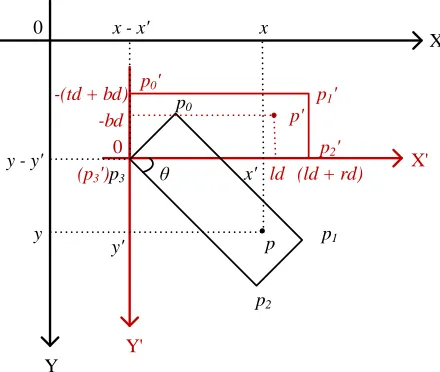
Before performing NMS to remove redundant detection boxes, we restore rotated rectangles from distance maps and rotation maps by estimating the coordinates of the four vertices of the corresponding bounding box for pixels, the scores of which exceed a certain threshold in the score map, called as the score map threshold.
0 X Y X' Y' θ p p' ld -bd y' x' x y p0 p1 p2
(p3')p3 0 x - x'
y - y'
p0'
p1'
p2'
-(td + bd)
(ld + rd)
Figure 3: Restore the corresponding rectangle forpfrom the rotation map and the distance map. The image coordinate system is drawn in black while the auxiliary coordinate sys-tem is red.
To better understand this process, we illustrate with an example of clockwise rotation in Figure 3. Based on the dis-tance map we can obtain the disdis-tancestd,rd,bd,ldfrompto the four boundaries (top, right, bottom, left) of the rectangle
R. In order to calculate the coordinates ofp0, p1, p2, p3 in image coordinate system, an auxiliary coordinate system is introduced withp3 as the origin. The directions of X-axis and Y-axis are the same as the image coordinate system. We rotate R to the horizontal around p3. p0 is the corre-sponding position ofpin the rotated rectangleR0. For two-dimensional rotation, the rotation matrix is
M(θ) =
cosθ −sinθ
sinθ cosθ
, (2)
whereθis the rotation angle with counter-clockwise as the positive direction, which can be restored from the rotation map. Let(x0, y0)be the coordinates ofpin the auxiliary
co-ordinate system. Then we can calculate the rotation ofpas
M(θ) x0 y0 = ld −bd . (3)
Similarly, forp0, p1, p2, we have
M(θ)
x00 y00
=
0
−(td+bd)
,
M(θ)
x01 y10
=
ld+rd
−(td+bd)
,
M(θ)
x02 y20
=
ld+rd
0
,
(4)
where (x0i, y0i), i ∈ {0,1,2} are the coordinates of pi
in the auxiliary coordinate system. Finally, the coordinates
(xi, yi), i ∈ {0,1,2,3}of pi in the image coordinate
sys-tem are calculated by
x3 y3 = x y − x0 y0 , xi yi = x0i y0i
+ x3 y3
, i∈ {0,1,2}.
(5)
(x, y) are the coordinates of p in the image coordinate system. According to Equation (2)∼(5), the rectangle cor-responding p can be restored from the rotation map and distance map and represented as R = {(xi, yi)|i ∈
{0,1,2,3}}.
Multi-Scale Loss Function
As discussed above, the output of the network includes three components, namely the score map, the rotation map and the distance map. For better optimization of our model, we add supervision to the intermediate layers in addition to the top output layer. The total loss, named the multi-scale loss, can be calculated as follows:
L=X
s∈S
ws(αLsco+βLrot+Ldis), (6)
where Lsco, Lrot and Ldis are losses for the score map,
rotation map and distance map, respectively. The scale set
S = {1,2,3,4}represents the scale index of the extracted feature maps. The parameter ws adjusts the weight of the
corresponding scale. The factorsαandβcontrol the weights of the three loss terms. We explain the three loss functions in detail as follows.
Loss Function of Score Map The dice loss is proved to perform well in segmentation tasks to handle the imbalance problem of positive and negative samples (Ronneberger, Fis-cher, and Brox 2015; Milletari, Navab, and Ahmadi 2016; Zhang et al. 2017). Motivated by this strategy, the loss for the score map can be written as:
Lsco=
2PNi pigi PN
i p2i + PN
i g2i
(a) (b)
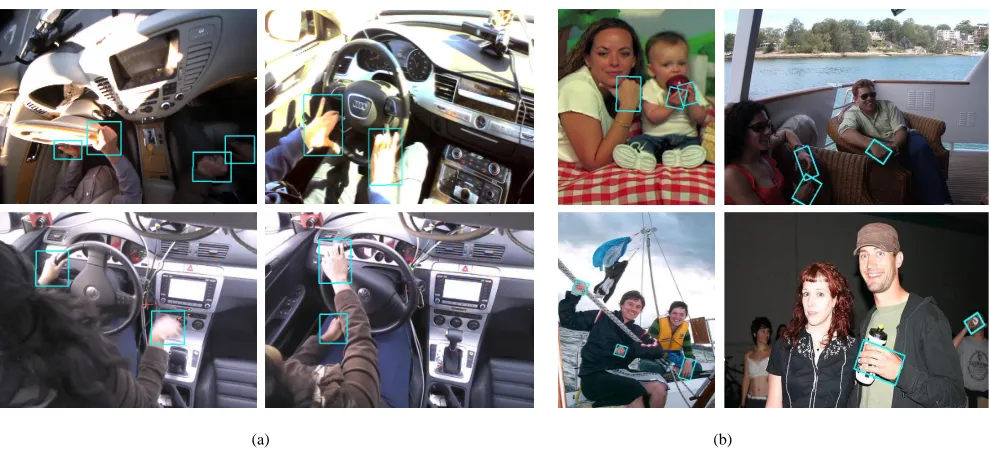
Figure 4: Detection examples of SIFCN with ResNet50 backbone. (a) Examples from the VIVA dataset. (b) Examples from the Oxford dataset.
where the sums run over the allN pixels of the score map.
piis the value of the pixeliin the score map generated by
the prediction network, andgiis the value of pixeliin the
ground truth map.
Loss Function of Rotation Map For the rotation angle, we use cosine function to evaluate the distance between the predicted angleθ˜and the ground truthθ:
Lrot= 1−cos
˜
θ−θ. (8)
Loss Function of Distance Map Since the loss of distance maps should be scale-invariant, the IoU loss (Everingham et al. 2015) is adopted to calculate the loss of distance:
Ldis=−log ˜
X∩X
˜
X∪X, (9)
whereX˜ andX are the predicted axis-aligned box and the ground truth bounding box, respectively.
Experiments
We evaluate our algorithm1, and compare it with existing methods on two benchmark datasets: the VIVA hand de-tection dataset (Das, Ohn-Bar, and Trivedi 2015) and the Oxford hand detection dataset (Mittal, Zisserman, and Torr 2011). We show several qualitative examples in Figure 4. As these results show, the SIFCN with ResNet50 backbone can handle different scales of hands and shapes in various illumination conditions, even the blurred samples.
1
The source code of the proposed method is available at http: //39.107.81.62/Diana/sifcn.
Dataset
VIVA Hand Detection Dataset is used in the Vision for Intelligent Vehicles and Applications Challenge (Das, Ohn-Bar, and Trivedi 2015). The training set includes5,500 an-notated images, and the testing set with ground truths that is publicly accessed includes the same number images. The images are extracted from 54 videos collected in natural-istic driving scenarios. Annotations are given in .txt for-mat. The bounding boxes of hand regions are represented as(x, y, w, h), wherex, yare the upper-left coordinates of the box andw,hare the width and height of the box, respec-tively. Note that, the annotations are axis-aligned so that the rotation angles are set to0in training and the predictions are axis-aligned bounding boxes in our experiments.
Oxford Hand Detection Datasetconsists of three parts: the training set, the validation set and the testing set, with1,844,
406and436images separately. Unlike the VIVA dataset, the images in Oxford dataset are collected from various differ-ent scenes. Moreover, the ground truth is given by the four vertexes(xi, yi), i∈ {1,2,3,4}of the box in the format of
.matand not necessarily to be axis aligned but oriented with respect to the wrist. The rotation angle will be calculated furthermore in our experiments.
Experimental Settings
The experiments are conducted on a single GeForce GTX 1080 GPU and an Intel(R) Core(TM) i7-6700K @ 4.00GHz CPU. For comprehensive evaluation, we try two backbone networks: VGG16 (Simonyan and Zisserman 2014) and ResNet50 (He et al. 2016) with the ImageNet (Krizhevsky, Sutskever, and Hinton 2012) pre-trained models.
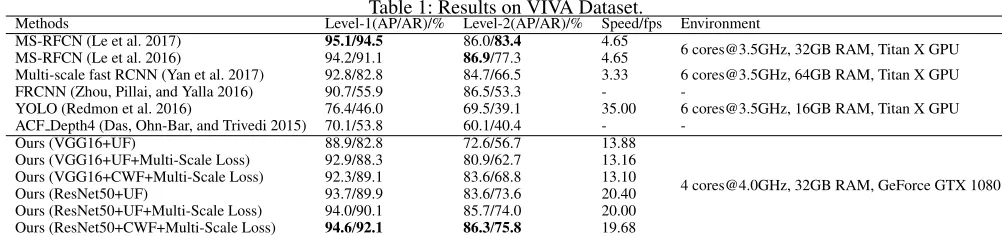
Table 1: Results on VIVA Dataset.
Methods Level-1(AP/AR)/% Level-2(AP/AR)/% Speed/fps Environment
MS-RFCN (Le et al. 2017) 95.1/94.5 86.0/83.4 4.65
6 [email protected], 32GB RAM, Titan X GPU
MS-RFCN (Le et al. 2016) 94.2/91.1 86.9/77.3 4.65
Multi-scale fast RCNN (Yan et al. 2017) 92.8/82.8 84.7/66.5 3.33 6 [email protected], 64GB RAM, Titan X GPU
FRCNN (Zhou, Pillai, and Yalla 2016) 90.7/55.9 86.5/53.3 -
-YOLO (Redmon et al. 2016) 76.4/46.0 69.5/39.1 35.00 6 [email protected], 16GB RAM, Titan X GPU ACF Depth4 (Das, Ohn-Bar, and Trivedi 2015) 70.1/53.8 60.1/40.4 -
-Ours (VGG16+UF) 88.9/82.8 72.6/56.7 13.88
4 [email protected], 32GB RAM, GeForce GTX 1080 Ours (VGG16+UF+Multi-Scale Loss) 92.9/88.3 80.9/62.7 13.16
Ours (VGG16+CWF+Multi-Scale Loss) 92.3/89.1 83.6/68.8 13.10
Ours (ResNet50+UF) 93.7/89.9 83.6/73.6 20.40
Ours (ResNet50+UF+Multi-Scale Loss) 94.0/90.1 85.7/74.0 20.00 Ours (ResNet50+CWF+Multi-Scale Loss) 94.6/92.1 86.3/75.8 19.68
Table 2: Results on Oxford Dataset.
Methods AP/%
MS-RFCN (Le et al. 2017) 75.1
Multiple proposals (Mittal, Zisserman, and Torr 2011) 48.2
Multi-scale CNN (Yan et al. 2017) 58.4
Ours (VGG16+UF) 68.7
Ours (VGG16+UF+Multi-Scale Loss) 77.8
Ours (VGG16+CWF+Multi-Scale Loss) 78.0
Ours (ResNet50+UF) 78.2
Ours (ResNet50+UF+Multi-Scale Loss) 78.6
Ours (ResNet50+CWF+Multi-Scale Loss) 80.4
decay learning rate, the initial value of which is 0.0001
and decays every10,000 iterations with rate0.94.ws, s ∈
{1,2,3,4}are all set to1. The hyper-parametersα,βare set to0.01and20, respectively. Besides, the score map thresh-old is set to0.8and the NMS is conducted with a threshold
0.2.
For data augmentation, we randomly mirror and crop the images, as well as do color jittering by distorting the hue, saturation and brightness. Due to the limitation of the GPU capacity, the batch size is set as 12and all the images are resized to512×512before fed into the network.
Evaluations on VIVA Dataset
Following the Vision for Intelligent Vehicles and Applica-tions Challenge, we evaluate the algorithms on two levels ac-cording to the size of the hand instances. Specifically, Level-1evaluates the instances with minimum height of70pixels whileLevel-2with25pixels. The Average Precision (AP) and Average Recall (AR) are used to rank compared meth-ods on the VIVA dataset. AP is the area under the precision-recall curve and AR is calculated over 9 evenly sampled points in log space between10−2and100false positives per
image. As performed in PASCAL VOC (Everingham et al. 2015), the hit/miss threshold of the overlap between a pair of predicted and ground truth bounding boxes is set to0.5.
As presented in Table 1, we compare our methods with MS-RFCN (Le et al. 2017; 2016), Multi-scale fast RCNN (Yan et al. 2017), FRCNN (Zhou, Pillai, and Yalla 2016), YOLO (Redmon et al. 2016) and ACF Depth4 (Das, Ohn-Bar, and Trivedi 2015). Using VGG16 as the back-bone network, our model achieves92.3%/89.1%(AP/AR) at Level-1 while 83.6%/68.8% (AP/AR) at Level-2. In terms of ResNet50, we obtain more accurate performance,
i.e., 94.6%/92.1% (AP/AR) at Level-1and86.3%/75.8%
(AP/AR) atLevel-2. Besides, the running speeds of SIFCN based on VGG16 and ResNet50 are 13.10 and19.68 fps, respectively.
YOLO (Redmon et al. 2016) performs hand detection in real time, but its accuracy is unsatisfactory. On the contrary, MS-RFCN (Le et al. 2017) performs against other competi-tors in accuracy but the detecting speed is very slow, i.e.,
4.65fps. Therefore, it is of great significance that our model achieves a good trade-off between the accuracy and speed. The model (ResNet50+CWF+Multi-Scale Loss) is compa-rable to (Le et al. 2017) in accuracy while achieves a4.23
times faster running speed as shown in Table 1.
Evaluations on Oxford Dataset
According to the official evaluation tool2 in the Oxford dataset, we report the performance on all the “bigger” hand instances, those with more than1,500pixels. As shown in Table 2, similar to the results on VIVA dataset, ResNet50 performs better than VGG16 as a backbone network. Specif-ically, ResNet50 based SIFCN achieves an improvement of
5.3%in AP score compared with the state-of-the-art MS-RFCN (Le et al. 2017). VGG16 based SIFCN still outper-forms MS-RFCN (Le et al. 2017) by2.9%in AP score. In addition, it is worth mentioning that the detecting speed on the Oxford dataset is up to62.5 fps using ResNet50 while
52.6fps using VGG16.
Ablation Study
We further perform experiments to study the effect of dif-ferent aspects of our model on the detection performance. We choose the Oxford dataset to conduct the ablation exper-iments with the ResNet50 and UF block as the defaults. Effectiveness of multi-scale loss.In order to investigate the effectiveness of the multi-scale loss, we report the training time and AP scores considering different numbers of scales in Figure 6. The number of scales 1,2,3,4 correspond to
S = {4}, S = {3,4}, S = {2,3,4}, S = {1,2,3,4} in Equation (6) respectively. It can be seen that as the number of scales used in loss function increases, the time it takes to train the model to convergence decreases. The conver-gence of the network is accelerated significantly (more than
10hours) using the multi-scale loss. At the same time, there
2
(a) (b)
Figure 5: The change of AP withαandβon the Oxford dataset. (a) AP score vs.αifβ = 20. (b) AP score vs.βifα= 0.01.
1 2 3 4
Number of scales
0 10 20 30 40 50
Training Time /h
Training time AP
0 0.2 0.4 0.6 0.8 1
AP
Figure 6: Training time and AP score vs. different numbers of scales for the Oxford dataset.
is even a slight increase in AP score. That is, the multi-scale loss accelerates the training process without sacrificing the AP score. This is attributed to the multiple supervision to the intermediate layers of the network.
Influence of score map.We change the value ofαin Equa-tion (6) to find appropriate weights of score map in train-ing. The results are reported in Figure 5(a). Asαincreases from0.01to1, the AP increases first and then decreases, and reaches the maximum whenαis0.10in our experiments. It can be seen that the AP is not too sensitive to the weight of score map.
Effectiveness of rotation map. As discussed above, β in Equation (6) weights the loss of rotation angle in the train-ing process. As shown in Figure 5(b), when the angle loss is considered in the optimization procedure,i.e.,β >0, the AP score is stable and larger than0.78for different values of
β. Otherwise, ifβ = 0, there is a significant drop in the AP score on Oxford dataset (i.e.,0.4991). It can be concluded
that the rotation map plays a very important role in optimiz-ing the final model.
Effectiveness of CWF block.From Table 1 and 2, we can see that the CWF block outperforms the UF block whether using the VGG16 or ResNet50 as the backbone. Specifi-cally, the CWF block achieves higher AP and AR on VIVA dataset, especially the AR score, which has been greatly im-proved. It indicates that the model with the CWF block pro-duces less false negatives than the UF block and makes bet-ter use of the distinctive features of different scales. For ex-ample, the CWF block gains an improvement of0.2%in AP score with VGG16 and1.8%with ResNet50 comparing to the UF block on the Oxford dataset.
Conclusion
We present an efficient Scale Invariant Fully Convolutional Network (SIFCN) for hand detection. The proposed Com-plementary Weighted Fusion (CWF) block can make full use of the distinctive features of different scales to achieve scale invariance effectively. Specifically, the multi-scale features are merged iteratively rather than concatenated simultane-ously to reduce computation overhead. Moreover, the multi-scale loss scheme is employed to accelerate the training procedure significantly. Experimental results on the VIVA and Oxford datasets show comparable performance of our method compared with the state-of-the-art methods with much higher speed. For the future work, we will optimize the code to further improve the run time efficiency of SIFCN so that it can run in real-time with better accuracy.
References
ap-proach and a new dataset for hand-detection in first person vision. InProceedings of international conference on com-puter analysis of images and patterns, 274–287. Springer. Dardas, N. H., and Georganas, N. D. 2011. Real-time hand gesture detection and recognition using bag-of-features and support vector machine techniques. IEEE Transactions on instrumentation and measurement60(11):3592–3607. Das, N.; Ohn-Bar, E.; and Trivedi, M. M. 2015. On perfor-mance evaluation of driver hand detection algorithms: Chal-lenges, dataset, and metrics. In Proceedings of the IEEE conference on intelligent transportation systems, 2953– 2958. IEEE.
Deng, X.; Zhang, Y.; Yang, S.; Tan, P.; Chang, L.; Yuan, Y.; and Wang, H. 2018. Joint hand detection and rotation esti-mation using cnn. IEEE transactions on image processing 27(4):1888–1900.
Everingham, M.; Eslami, S. A.; Van Gool, L.; Williams, C. K.; Winn, J.; and Zisserman, A. 2015. The pascal vi-sual object classes challenge: A retrospective. International journal of computer vision111(1):98–136.
Felzenszwalb, P. F.; Girshick, R. B.; McAllester, D.; and Ra-manan, D. 2010. Object detection with discriminatively trained part-based models. IEEE transactions on pattern analysis and machine intelligence32(9):1627–1645. Girshick, R.; Donahue, J.; Darrell, T.; and Malik, J. 2016. Region-based convolutional networks for accurate object de-tection and segmentation. IEEE transactions on pattern analysis and machine intelligence38(1):142–158.
He, K.; Zhang, X.; Ren, S.; and Sun, J. 2016. Deep resid-ual learning for image recognition. InProceedings of the IEEE conference on computer vision and pattern recogni-tion, 770–778.
Kakumanu, P.; Makrogiannis, S.; and Bourbakis, N. 2007. A survey of skin-color modeling and detection methods. Pat-tern recognition40(3):1106–1122.
Krizhevsky, A.; Sutskever, I.; and Hinton, G. E. 2012. Imagenet classification with deep convolutional neural net-works. In Proceedings of advances in neural information processing systems, 1097–1105.
Le, T. H. N.; Zhu, C.; Zheng, Y.; Luu, K.; and Savvides, M. 2016. Robust hand detection in vehicles. InProceedings of the IEEE international conference on pattern recognition, 573–578. IEEE.
Le, T. H. N.; Quach, K. G.; Zhu, C.; Duong, C. N.; Luu, K.; Savvides, M.; and Center, C. B. 2017. Robust hand detection and classification in vehicles and in the wild. In Proceedings of the IEEE conference on computer vision and pattern recognition workshops, 1203–1210. IEEE.
Liu, W.; Anguelov, D.; Erhan, D.; Szegedy, C.; Reed, S.; Fu, C.-Y.; and Berg, A. C. 2016. Ssd: Single shot multibox de-tector. InProceedings of European conference on computer vision, 21–37. Springer.
Long, J.; Shelhamer, E.; and Darrell, T. 2015. Fully con-volutional networks for semantic segmentation. In Proceed-ings of the IEEE conference on computer vision and pattern recognition, 3431–3440.
Milletari, F.; Navab, N.; and Ahmadi, S.-A. 2016. V-net: Fully convolutional neural networks for volumetric medical image segmentation. InProceedings of the IEEE conference on 3D Vision, 565–571. IEEE.
Mittal, A.; Zisserman, A.; and Torr, P. H. 2011. Hand detec-tion using multiple proposals. InProceedings of the british machine vision conference, 1–11. Citeseer.
Niu, J.; Zhao, X.; Aziz, M. A. A.; Li, J.; Wang, K.; and Hao, A. 2013. Human hand detection using robust local descrip-tors. InProceedings of the IEEE international conference on multimedia and expo workshops, 1–5. IEEE.
Redmon, J.; Divvala, S.; Girshick, R.; and Farhadi, A. 2016. You only look once: Unified, real-time object detection. In Proceedings of the IEEE conference on computer vision and pattern recognition, 779–788.
Ren, S.; He, K.; Girshick, R.; and Sun, J. 2015. Faster r-cnn: Towards real-time object detection with region proposal networks. InProceedings of advances in neural information processing systems, 91–99.
Ronneberger, O.; Fischer, P.; and Brox, T. 2015. U-net: Con-volutional networks for biomedical image segmentation. In International conference on medical image computing and computer-assisted intervention, 234–241. Springer. Simonyan, K., and Zisserman, A. 2014. Very deep convo-lutional networks for large-scale image recognition. arXiv preprint arXiv:1409.1556.
Yan, S.; Xia, Y.; Smith, J. S.; Lu, W.; and Zhang, B. 2017. Multiscale convolutional neural networks for hand detec-tion. Applied Computational Intelligence and Soft Comput-ing2017.
Zhang, J.; Shen, X.; Zhuo, T.; and Zhou, H. 2017. Brain tu-mor segmentation based on refined fully convolutional neu-ral networks with a hierarchical dice loss. arXiv preprint arXiv:1712.09093.
Zhou, X.; Yao, C.; Wen, H.; Wang, Y.; Zhou, S.; He, W.; and Liang, J. 2017. EAST: an efficient and accurate scene text detector. In Proceedings of the IEEE conference on com-puter vision and pattern recognition, 2642–2651.