The Thirty-Third AAAI Conference on Artificial Intelligence (AAAI-19)
Orderly Subspace Clustering
Jing Wang,
1Atsushi Suzuki,
1Linchuan Xu,
1,∗Feng Tian,
2Liang Yang,
3Kenji Yamanishi
1 1Graduate School of Information Science and Technology, The University of Tokyo, Japan2Faculty of Science and Technology, Bournemouth University, UK 3School of Artificial Intelligence, Hebei University of Technology, China
{jing wang, atsushi suzuki, linchuan xu, yamanishi}@mist.i.u-tokyo.ac.jp, [email protected], [email protected]
Abstract
Semi-supervised representation-based subspace clustering is to partition data into their underlying subspaces by finding effective data representations with partial supervisions. Es-sentially, an effective and accurate representation should be able to uncover and preserve the true data structure. Mean-while, a reliable and easy-to-obtain supervision is desirable for practical learning. To meet these two objectives, in this paper we make the first attempt towards utilizing the orderly relationship, such as the dataais closer tobthan toc, as a novel supervision. We propose an orderly subspace clus-tering approach with a novel regularization term. OSC en-forces the learned representations to simultaneously capture the intrinsic subspace structure and reveal orderly structure that is faithful to true data relationship. Experimental results with several benchmarks have demonstrated that aside from more accurate clustering against state-of-the-arts, OSC inter-prets orderly data structure which is beyond what current ap-proaches can offer.
Introduction
Subspace clustering, which aims at partitioning high dimen-sional data into multiple low-dimendimen-sional subspaces with each subspace corresponding to one class or subject, has been widely used in machine learning, computer vision and pattern recognition area (Rao et al. 2010; Liu et al. 2013; Zhou et al. 2014; Zhang et al. 2018).
Recently, several subspace clustering methods have been proposed to explore the relationships among data with self-representation (Wu et al. 2015; Zhang et al. 2017). These representation-based methods can be roughly divided into two categories: the unsupervised and the semi-supervised. The former (Liu, Lin, and Yu 2010; Lu et al. 2012; Hu et al. 2014) mainly focuses on the intrinsic structure of data, while the later (Zhou et al. 2014; Fang et al. 2015; Wang et al. 2017a) utilizes a small amount of supervision information on top of data structure as a valuable guidance. The pairwise information, including must-link constraints and cannot-link constraints which specify whether the data must be or cannot be in the same cluster, has been demon-strated that it helps to improve performance (Wagstaff et al.
∗
Corresponding author
Copyright c2019, Association for the Advancement of Artificial Intelligence (www.aaai.org). All rights reserved.
2001). However, the pairwise relationships only character-ize the relationships between data and cluster, yet the rela-tionships among data are far beyond what they can describe. Also, it is often difficult to identify whether two objects must or cannot belong to the same cluster if there is no cluster cat-egories known in advance. To remedy this, we are inspired to seek for and utilize novel supervision information, so as to exploit data information more deeply and further achieve more accurate clustering.
In reality, one may easily observe that orderly relation-ships are ubiquitous among data. An orderly relationship represents that the data a is closer to b than toc. For ex-ample, an image of “apple” is often more related to that of “banana” than to that of “ball”; a frame of a video sequence is often more related to its neighbouring frames than to those far way. Such relative order naturally exists among data and it is reliable (Kendall 1948; Amid and Ukkonen 2015; Wang et al. 2018b). Preserving such relative relationships enables us to find a good representation that uncovers the true data relationship. With these advantages, the orderly re-lationship has been widely used in various applications, such as ordinal classification (Liu, Tsang, and M¨uller 2017), ordi-nal embedding (Terada and Luxburg 2014), hashing (Liu et al. 2016) and social networks (Song, Meyer, and Tao 2015; Wang et al. 2017b). Unfortunately, existing subspace clus-tering approaches have largely ignored the orderly relation-ship.
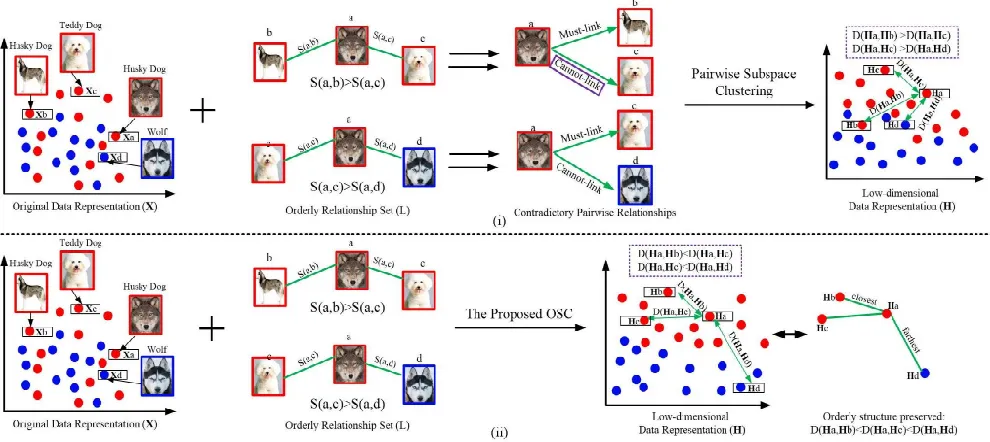
rela-Figure 1: The comparison of existing pairwise subspace clustering methods and the proposed OSC for finding representations in low-dimensional spaces. The original dataset contains images of two classes, where the dog images (e.g.,a,b andc) are in red and the wolves (e.g.,d) are in blue. In particular, bothaandbare Husky dogs andcis a Teddy dog. Existing pairwise approaches are infeasible to utilize orderly relationship as supervisions for semi-supervised learning, but OSC incorporates the orderly relationship effectively and enforces the learned representations to have the orderly structure which is faithful to the relationship.
tions could be utilized by OSC, but the pairwise approaches cannot incorporate the orderly relations effectively. We out-line these differences and OSC’s advantages in Figure 1. As shown in 1(i), given a set of orderly relationships such as ais closer to b than toc, i.e., S(a, b) > S(a, c), an intu-itive way to incorporate the relationship by existing pairwise approaches is to split the orderly relationship into two pair-wise relations: (1) a and b are must-link and (2) a andc
are cannot-link. However, this implies thataandcbelong to different classes, which is incorrect. And from the relation-shipS(a, c)> S(a, d), it can be derived thatais must-link tocand cannot-link tod, which is correct. However, while enforcing the representation of dataa, i.e.,Ha to be close
toHc and far away fromHd), the pairwise approaches are
not able to quantify the distance among their corresponding representations. As a result, it may end up with the relation D(Ha,Hc) > D(Ha,Hd), which is apparently
inconsis-tent with the true data relationships. This error may likely lead to a wrong clustering, e.g. it is notbbutdwhich is clus-tered into the “Dog”. In contrast, as shown in Figure 1(ii), OSC enforces representations to be faithful to the true data relationship, such as it learnsD(Ha,Hb) < D(Ha,Hc)
with S(a, b) > S(a, c). Moreover, from Figure 1(ii), we can easily deduce S(a, b) > S(a, c) > S(a, d). Accord-ingly,Hais enforced to be the closest toHband the furthest
fromHd, i.e.,D(Ha,Hb) < D(Ha,Hc) < D(Ha,Hd).
As a result, a more discriminative representation matrixH
is achieved with orderly structure preserved.
The main contribution of our work is that, to our best knowledge, OSC is the first approach to incorporate the
orderly relationship as a novel supervision into subspace clustering for semi-supervised learning. Due to the natural availability of the orderly relationship, OSC is practical for real applications. With the orderly relationship, OSC ranks the learned representations effectively according to the true structure of data so that more discriminative representations are obtained. In fact, this strategy is not limited to one spe-cific approach only but can also be easily adopted by sev-eral existing representation-based subspace clustering ap-proaches such as SSC and LRR. Extensive experiments on several benchmark datasets have demonstrated the effective-ness of OSC against state-of-the-arts, not only in terms of accuracy, but also the interpretation of orderly data struc-ture.
Related Work
Several representation-based subspace clustering methods have been proposed. To a large extent, unsupervised ap-proaches all tend to exploit intrinsic data structure by adding regularization terms on the representations under different assumptions. For example, the sparse subspace clustering (SSC) (Elhamifar and Vidal 2009) seeks the sparse solu-tion of data representasolu-tion, which tends to be block diag-onal. The low-rank representation (LRR has two versions: LRR1and LRR2,1) (Liu, Lin, and Yu 2010) aims to take the
also efficient due to its closed form solution. The correlation adaptive subspace segmentation (CASS)(Lu et al. 2013) si-multaneously performs automatic data selection and groups correlated data, which can adaptively balance SSC and LSR. Based on LSR, the smooth representation (SMR)(Hu et al. 2014) incorporates a weight matrix that measures the spa-tial closeness of data. Given a dataset with multiple types of features, (Cao et al. 2015) proposed a diverse multi-view subspace clustering (DiMSC) which learns a complemen-tary representation shared by multiple features. (Zhang et al. 2017) then proposed latent multi-view subspace clustering (LMSC) method, which clusters data points with latent rep-resentation and simultaneously explores underlying comple-mentary information from multiple views.
To seek for more effective representations, several semi-supervised approaches have been proposed by incorporat-ing pairwise information or labels as supervisions with graph-based regularization. In particular, a graph consists of “nodes” (data) and “edges” that indicate the relation-ships of data. If two data points are of must-link, a large positive weight is assigned to the edge. Otherwise, a non-positive weight is assigned. The graph is then incorporated into the objective function as a regularizer. CS-VFC (Zhou et al. 2014) incorporates such a graph into SSC to explore the unknown relationships among data, followed by adding the constraints directly to the affinity matrix. Since the block-diagonal structure is heavily desired for accurate sample clustering, (Feng et al. 2014) proposed a graph Laplacian constraint based SSC (BD-SSC) to construct exactly block-diagonal affinity matrices. NNLRR (Fang et al. 2015) em-ploys the graph to encode label information to seek low-rank and sparse representation simultaneously with nonneg-ativity constraints on the matrices. Later, LRRADP (Wang et al. 2018a) was then proposed by using adaptive distance penalty to construct an affinity graph, which enforces the representations of every two consecutive neighboring data to be similar. However, none of existing approaches can cap-ture the true data relationships, though the reflection of the true data structure is in essence for an effective representa-tion.
Orderly Subspace Clustering (OSC)
Preliminary
Given a set of data pointsX= [X1,X2, . . . ,Xn]∈Rm×n, where each data vectorXi(1≤i≤n)is am-dimensional
vector andnis the number of data. In order to cluster the data into their respective subspaces, we need to find effec-tive representations for constructing an affinity matrix. To achieve so, representation-based approaches assume that ev-ery data point in a union of subspaces can be represented as a linear combination of other data points, i.e.,X=XH+E, whereH = [H1,H2, . . . ,Hn] ∈ Rn×n is the data repre-sentation matrix andE ∈ Rm×n denotes errors. It can be
formulated as the following optimization problem to com-pute the optimal data representation matrixH∗:
min
H Θ(E) +αΩ(X,H),
s.t. X=XH+E,H∈ T, (1)
whereαis the tradeoff parameter,Θ(E)is the noise term. Ω(X,H)andT are the regularizer and constraint set onH, respectively. Under different assumptions, existing methods differ mainly in the choice of norms1for the noise term and
regularization onH.
As one of the most representative subspace clustering method, LSR (Lu et al. 2012) solves the following objective function:
min H kEk
2
F+αkHk
2
F, s.t.X=XH+E. (2)
Obviously, the representation learning process of LSR de-pends on the intrinsic data structure only. Since the orderly relationship reflects the true data relationships, which if in-corporated, is of much help for more accurate learning. In the following we present our OSC which embeds orderly re-lationships to achieve more discriminative representations.
OSC-model
We useS(a, b)> S(a, c)to denote an orderly relationship, i.e., the data a is closer/more similar to b than to c. The objective of OSC is to enforce the distances among repre-sentations of the data are in correspondence to the orderly relationship, i.e.,
S(a, b)> S(a, c)⇒D(Ha,Hb)< D(Ha,Hc), (3)
whereD denotes the distance measure. To achieve so, we minimize the following term:
I(S+(a, b))I(D(Ha,Hb)≥D(Ha,Hc))I(S−(a, c)).
(4) Here,S+(·)/S−(·)indicates a closer/less close relationship
between two data.I(·)is an indicator which equals to “1” if the condition in the parenthesis is satisfied and “0” oth-erwise. It is clear to see that givenS(a, b) > S(a, c), i.e., I(S+(a, b)) = I(S−(a, c)) = 1, minimizing (4) enforces D(Ha,Hb)< D(Ha,Hc).
UseLto represent a set of orderly relationships, then (4) could be extended for∀(a, b, c)∈Las follows,
X
(a,b,c)∈L
I(S+(a, b))I(D(Ha,Hb)≥D(Ha,Hc))I(S−(a, c)). (5)
Using Euclidean distance (Liu et al. 2018) for D, we can rewrite (5) as
X
(a,b,c)∈L
I(S+(a, b))I(kHa−Hbk22≥ kHa−Hck22)I(S−(a, c)).
(6) To ensure a distance betweenkHa −Hbk22 andkHa− Hck22, a tunable thresholdδ >0is incorporated to regulate
the distances in-between as X
(a,b,c)∈L
I(S+(a, b))I(kHa−Hbk22>(kHa−Hck22−δ))I(S−(a, c)).
(7) Because (7) is non-continuous, we use a ReLU loss function f(t) = max(0, t)and obtain our orderly structured term
X
(a,b,c)∈L
I(S+(a, b)) max(0, t)I(S−(a, c)), (8)
1
In this paper, Frobenius norm,L2 norm,L2,1 norm and nu-clear norm are represented byk · kF,k · k2,k · k2,1 andk · k∗,
wheret=kHa−Hbk22−(kHa−Hck22−δ).
By incorporating (8) into (2), we propose a simple yet effective objective function as follows:
F= min
H kX−XHk
2
F
| {z }
error
+αkHk2F
| {z }
smoothness
+β X
(a,b,c)∈L
I(S+(a, b)) max(0, t)I(S−(a, c))
| {z }
orderly structure
, (9)
whereβis the trade-off parameter of the orderly structured term. Note that, without orderly relationship, the objective function (9) becomes the same as that in LSR (Liu, Lin, and Yu 2010); with relationships, for eachS(a, b)> S(a, c), (9) penalizestto encouragekHa−Hbk22− kHa−Hck22→ −δ
fort >0or maintains the structure fort <0.
Remarks.It is worth pointing that the orderly structured term is not limited to LSR only. In this paper we base OSC on LSR simply because LSR not only achieves effective per-formance, but also has been proved efficient due to its closed form solution, which makes our approach more practical. In fact, any other representation-based subspace clustering ap-proach which satisfies (1) can also be extended to the semi-supervised setting with the orderly structure term. For exam-ple, LRR2,1 can be directly extended by incorporating the
term as
min
H kX−XHk2,1+αkHk∗
+β X
(a,b,c)∈L
I(S+(a, b)) max(0, t)I(S−(a, c)).
Such extension unifies the process of low rank representa-tion learning with the orderly structure preserving so that more accurate performances are expected, which would be our future work.
Optimizations
We rewrite the optimization problem (9) as
F= min
Hu,Ha,Hb,Hc
X
u /∈L
kXu−XHuk22+ X
a∈L
kXa−XHak22
+X
b∈L
kXb−XHbk22+ X
c∈L
kXc−XHck22+α X
u /∈L
kHuk22
+αX
a∈L
kHak22+α X
b∈L
kHbk22+α X
c∈L
kHck22
+β X
(a,b,c)∈L
I(S+(a, b)) max(0, t)I(S−(a, c)),
(10) whereXuindicates a data vector without prior information
andHu is the corresponding representation. Since (10) is
non-convex, it is non-trivial to find the global minimum. Here we divide (10) into several subproblems for alternately updating each subproblem with the others fixed.
The optimization of Hu-subproblem leads to the
stan-dard LSR formulation (Lu et al. 2012), so we obtain
Hu= (XTX+αI)−1XTXu, (11)
whereIis an identity matrix.
Ha-subproblem: UpdatingHa with other subproblems
fixed leads to
min Ha
F(Ha) =kXa−XHak22
+αkHak22+β X
(b,c)∈L
I(S+(a, b)) max(0, t)I(S−(a, c)).
(12) Since max(0, t) is non-continuously differentiable with respect to Ha, we relax the optimization by replacing
max(0, t)byI(t >0)tand solve the modified problem in-stead of directly optimizing (13). This modification leads to the minimization of the following function:
min Ha
F(Ha) =kXa−XHak22
+αkHak22+β X
(b,c)∈L
I(t >0)I(S+(a, b))tI(S−(a, c)).
(13) DifferentiatingF(Ha)with respect toHa and setting it to
zero, we get
XTXa−XTXHa+αHa
+β X
(b,c)∈L
I(t >0)I(S+(a, b))(Hc−Hb)I(S−(a, c) = 0. (14)
This is the fixed point equation, and we can get the closed form solution as
Ha= (XTX+αI)−1(XTXa
+β X
(b,c)∈L
I(t >0)I(S+(a, b))(Hb−Hc)I(S−(a, c)).
(15) Similarly, we obtain the closed solutions for Hb-subproblemandHc-subproblemas
Hb= (XTX+αI+β
X
(a,c)∈L
I(t >0)I(S+(a, b)II(S−(a, c)))−1
·(XTXb+β
X
(a,c)∈L
I(t >0)I(S+(a, b)HaI(S−(a, c))),
(16) and
Hc= (XTX+αI−β
X
(a,b)∈L
I(t >0)I(S+(a, b)II(S−(a, c)))−1
·(XTXc+β
X
(a,b)∈L
I(t >0)I(S+(a, b)HaI(S−(a, c))).
(17) Since the alternating minimization relies on the compar-ison between the initial values oftand 0, it is important to have a sensible initialization. Here we initialize the whole representations matrixHusing LSR, which is a special case of our method (whenβ= 0in (9)).
After obtaining representations of each vector, the repre-sentation matrix H∗ is formed. The affinity matrix is then constructed and NCuts (Shi and Malik 2000) is applied onto the affinity matrix to produce the final clustering results. The whole procedure of OSC is summarized in Algorithm 1.
Experiments
Table 1: Clustering accuracies (%) on Extended Yale B
Methods k-NN SSC LRR1 LRR2,1 LSR CASS SMR TSC CS-VFC SemiLSR OSC
5 subjects 71.56 92.19 81.88 86.56 92.19 94.03 85.31 89.69 88.81 92.31 94.06
10 subjects 49.59 63.97 60.56 65.00 73.59 81.88 72.50 62.19 74.34 75.24 87.19
30 subjects 52.59 50.19 58.23 61.24 58.38 N/A 56.94 56.20 63.57 62.65 66.67
38 subjects 47.53 45.89 55.11 57.39 57.73 N/A 56.88 54.18 54.35 58.21 62.80
Table 2: Clustering accuracies (%) on USPS
Methods k-NN SSC LRR1 LRR2,1 LSR1 LSR CASS SMR TSC CS-VFC SemiLSR OSC
10 subjects 77.70 73.72 74.40 74.40 72.40 72.20 82.40 84.20 73.10 84.57 85.52 88.00
Algorithm 1Solving OSC
Input: data matrixX, orderly relationship setL, number of subspacesp, parametersλ,βandδ.
Output: Clustering result. InitializeHby solving (2). repeat
fori= 1 :ndo
Obtain representations for eachXiby solving (11),
(15), (16) and (17), accordingly. end for
untilmax iteration times or convergence
Construct the affinity matrix by(|H∗|+|H∗T|)/2. Segment the data intopgroups by NCuts.
(Extended-Yale B, USPS), a document dataset (20news-groups) and a motion sequence (Hopkins 155).
Extended Yale Bis a face clustering dataset which con-tains 2414 frontal face images of 38 subjects, with approx-imately 64 images per subject taken under different illumi-nation conditions. We chose different numbers of subjects in the experiment, ranging from the first 5, 10, 30, to 38 (i.e., all of the subjects in the dataset).
USPScontains9298handwritten digit images (16×16 each). It consists of 10 classes corresponding to the 10 digits, 0∼9. We used the first100examples of each digit for this experiment.
20 newsgroupsis a collection of approximately 20,000 newsgroup documents, partitioned evenly across 20 differ-ent newsgroups. Following (Breitenbach and Grudic 2005), we used 3970 document vectors which belong to four topics in an 8014-dimensional space.
Hopkins 155 contains 155 motion sequences, each of which contains two or three motions (one motion corre-sponds to one subspace). As in (Hu et al. 2014), we used PCA to project the data into a12-dimensional subspace.
Experimental settings
We compared OSC with several unsupervised baselines:k -NN using heat kernel distance, SSC (Elhamifar and Vidal 2009), LRR (LRR1 and LRR2,1) (Liu et al. 2013), LSR
(Lu et al. 2012), CASS (Lu et al. 2013), SMR (Hu et al.
2014) and TSC (Heckel and B¨olcskei 2015). Since exist-ing semi-supervised approaches and OSC utilize different supervision information, it is practically infeasible to com-pare them. Nevertheless, to experimentally demonstrate that the orderly relationship is infeasible to be implemented by pairwise approaches (as in Figure 1), we split each orderly relation into a pair of must-link and cannot-link and ap-plied the pair onto an existed approach CS-VFC and a con-structed approach SemiLSR2. The parameters for each com-pared method were tuned to achieve the best performance for comparison. For OSC, we varied the regularization pa-rameters αandβ within [0.1, 0.2, 0.3, 0.4, 0.5] and [0.01, 0.02, 0.03, 0.04, 0.05], respectively, and δwas fixed to be 0.002 for all the experiments. To construct orderly rela-tions for OSC, we first randomly selected 10% data for each dataset, and then constructed 30 orderly relations for each selected data as in (Chang et al. 2014). Without losing gen-erality, the orderly relations were constructed in two days. For image and document datasets, we used the labels be-cause they can be directly used for constructing orderly rela-tionships, although the relationships can also be formed by observing similarities among images/documents. In partic-ular, one half of the orderly relationships were constructed with labels for data with the same label are more related than those with different ones. The other half were constructed from theq-nearest neighbouring graph since data are usu-ally more related to their nearest neighbours than those far away andqwas set as 5 according to (Gong et al. 2017). For the motion dataset, we chose the first 15 relations with each containing two frames from the same scene and one from another. Each of the second 15 relations is formed by choos-ing from a scene two neighbourchoos-ing frames and one farther away. To ensure a fair comparison, the affinity matrices of all approaches were conducted on the typical affinity mea-sures (Georghiades, Belhumeur, and Kriegman 2001) and NCuts (Shi and Malik 2000) was employed to produce the final clustering results. The clustering performance is evalu-ated by accuracy/error (Hu et al. 2014) and the best results
2SemiLSR is modified by incorporating pairwise information
onto LSR. Following (Liu et al. 2012), we have modifiedkHk2
F to
tr(HIHT)by settingIij= 1if data are of must-link, orIij= 0
Table 3: Clustering accuracies (%) on 20 Newsgroups
Methods k-NN SSC LRR1 LRR2,1 LSR CASS SMR TSC CS-VFC SemiLSR OSC
4 subjects 91.41 83.63 91.59 92.19 84.81 N/A 86.32 89.09 89.43 89.36 93.32
Table 4: Clustering errors (%) on Hopkins155
Methods k-NN SSC LRR1 LRR2,1 LSR CASS SMR TSC CS-VFC SemiLSR OSC
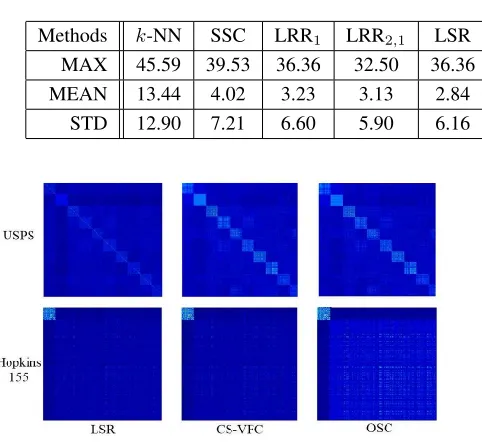
MAX 45.59 39.53 36.36 32.50 36.36 32.85 35.83 45.21 37.25 36.15 36.39
MEAN 13.44 4.02 3.23 3.13 2.84 2.42 2.27 12.04 3.24 2.25 1.31
STD 12.90 7.21 6.60 5.90 6.16 5.84 5.41 11.24 4.64 5.36 4.01
Figure 2: OSC achieves a clearer affinity matrix with more salient block diagonal than LSR and CS-VFC.
are highlighted inboldface. Since CASS requires a sig-nificant amount of time to process some large datasets, the corresponding results are not available but represented with N/A. All the experiments are done using Matlab 2017 in an Intel Core 2.50GHZ desktop.
Experimental results and analysis
Clustering results Tables 1 and 2 summarize the image clustering results on Extended Yale B and USPS, respec-tively. On both datasets, OSC not only outperforms LSR which proves the effectiveness of the proposed orderly struc-tured term, but also achieves higher accuracies than all com-pared methods consistently. Specifically, Table 1 shows that OSC achieves the highest clustering accuracy on all four clustering tasks. For example, OSC outperforms the second best results (SemiLSR) by1,75%and4.59%for the 5 and 38 subjects tasks, respectively. Besides, note that CS-VFC performs even worse than SSC in 5 subject tasks, which proves that orderly relationships cannot be effectively used by pairwise approaches. In Table 2, we can see that the clustering accuracies of the first four methods (k-NN, SSC, LRR, and LSR) and TSC are very close, fluctuating between 72.20% and 77.70%. The rest (CASS, SMR, CSVFC and SemiLSR) achieve also similar but better accuracies which vary slightly from 82.40% to 85.52%. Although these meth-ods perform well, OSC still gets the highest accuracy of 88.00%.
Table 3 shows the clustering accuracy on 20 Newsgroups
dataset. On this dataset, most approaches achieve promis-ing performance, but OSC still outperforms the rest signif-icantly. Table 4 tabulates the motion segmentation errors of ten methods on the Hopkins 155 database. It shows that OSC makes only1.31%segmentation error, while the second best is 2.25% by CS-VFC. Arguably, the improvement of OSC on this dataset is moderate. This is mainly because most se-quences are actually easy to segment. As a result, even with big improvements on some challenging sequences, the over-all improvement is limited, as the reported error is the mean of all 156 segmentation errors.
Affinity matrix analysis. To intuitively demonstrate the clustering results, we closely visualized the corresponding derived affinity matrix, as a clearer block diagonal structure of the affinity matrix leads to higher clustering performance. Figure 2 shows the comparison of OSC with LSR and CS-VFC on a challenging sequence of Hopkins 155 datasets, as well as USPS. Clearly, the results on both figures show that the affinity matrix obtained by OSC has much more salient block diagonal structure compared with those by other meth-ods, which undoubtedly will lead to more accurate results.
Orderly relationship analysis. To further validate the ef-fectiveness of the orderly relationships for the interpretation of data structure, we examinedHfor LSR and OSC in Fig-ure 3. Since the performance on each dataset has similar tendency, due to page restriction, we only show the exper-imental results on the first 5 clusters of Extended Yale B for the following analyses. For clearer visualization, we only demonstrate 3 groups of images and sample 10 (out of 64) images from each selected group as example. In Figure 3, the different groups are represented by different colors. Two examples of true relations among images, i.e., S(a, b) > S(a, c) and S(a, c) > S(a, d), were given by observing these images in terms of different subjects and expressions, respectively. All representations displayed after the dimen-sionalities of their features are reduced to 2-D by PCA. It can be seen that the original imageXa is closer toXd than to Xc, although the ground truth should beS(a, c)> S(a, d).
LSR however givesD(Ha,Hc) > D(Ha,Hd), which
ex-perimentally proves that LSR cannot maintain the orderly structure. Consequently, it leadsHato be close toHdwhich belongs to a different group. In contrast, OSC effectively enforces D(Ha,Hb) < D(Ha,Hc) < D(Ha,Hd)with
Figure 3: An example of the learned representations of LSR and OSC on the dataset Extended Yale B. LSR fails to learn orderly structure among representations, while OSC effectively cluster data into three groups with orderly structure preserved.
(a)
0 10 20 30 40
Percentage of selected data (%) 86
88 90 92 94 96
Clustering
Accuracy(%)
Extended Yale B
(b)
Figure 4: Clustering accuracy of OSCw.r.torderly relation-ships.
represent the faces of the same subject with the same expres-sion, which are definitely of the highest relativity. SinceHd
represents a face of a different subject, it is the least related toHa. Therefore, theHlearned through OSC demonstrates
a clearer structure of data.
0.1 0.2 0.3 0.4 0.5 Parameter
50 55 60 65 70 75 80 85 90 95 100
Clustering Accuracy(%)
Extended Yale B
(a)
0.01 0.02 0.03 0.04 0.05 Parameter
50 55 60 65 70 75 80 85 90 95 100
Clustering Accuracy(%)
Extended Yale B
(b)
Figure 5: Parameters analysis.
Since the number of orderly relationships may influ-ence the construction of the affinity matrix (and thus the clustering performance), we also analyzed this in Figure 4 from two aspects. We first selected 10% data from Ex-tended Yale B and varied the relations associated with
each selected data from 0 to 50 with 10 interval as in Figure 4(a). We then varied percentages of data within
{0%,1%,5%,10%,20%,50%} and fixed 30 orderly rela-tions for each selected data in Figure 4(b). Both figures show that the clustering accuracy generally increases with more supervisions. This further proves the effectiveness of OSC on incorporating the orderly relationships.
Parameters and convergence analysis. We tested the ef-fect of parameters αandβ of OSC with δ being fixed as 0.002. First, we fixedβ = 0.05to testαwith varying from 0.1to0.5with0.1interval, and then fixedα= 0.2to testβ varying from0.001to0.005. Figure 5 shows that the clus-tering accuracy is relatively stable whenαandβvary. This well demonstrates the robustness of OSC.
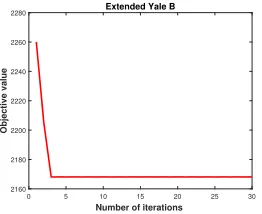
We also experimentally demonstrated the convergence of OSC in Figure 6, where the horizontal axis is the number of iterations and the vertical axis is the value of objective function. It can be seen that the objective function values are non-increasing and drop sharply within 5 iterations, which empirically validates its convergence.
0 5 10 15 20 25 30
Number of iterations
2160 2180 2200 2220 2240 2260 2280
Objective
value
Extended Yale B
Figure 6: Convergence curves.
Conclusion
rep-resentations truly reflect the data structure. As a regularizer, the proposed mechanism of orderly relation preserving can also be utilized in other subspace clustering methods. We have done experiments on several benchmark datasets and demonstrated that OSC can not only preserve the true data structure which beyond what existing methods can offer, but also achieve more accurate clustering against the state-of-the-arts. In the future, we will explore a more solid analysis in theory on the preservation of the orderly relationship.
Acknowledgements
This work was supported by JST CREST (No. JP-MJCR1304), JSPS KAKENHI (No. 18J12201) and National Natural Science Foundation of China (No. 61503281).
References
Amid, E., and Ukkonen, A. 2015. Multiview triplet embed-ding: Learning attributes in multiple maps. InInternational Conference on Machine Learning, 1472–1480.
Breitenbach, M., and Grudic, G. Z. 2005. Clustering through ranking on manifolds. InProceedings of the 22nd interna-tional conference on Machine learning, 73–80. ACM. Cao, X.; Zhang, C.; Fu, H.; Liu, S.; and Zhang, H. 2015. Diversity-induced multi-view subspace clustering. In Pro-ceedings of the IEEE conference on computer vision and pattern recognition, 586–594.
Chang, S.; Qi, G.-J.; Aggarwal, C. C.; Zhou, J.; Wang, M.; and Huang, T. S. 2014. Factorized similarity learning in networks. InData Mining (ICDM), 2014 IEEE International Conference on, 60–69. IEEE.
Elhamifar, E., and Vidal, R. 2009. Sparse subspace clus-tering. InComputer Vision and Pattern Recognition, 2009. CVPR 2009. IEEE Conference on, 2790–2797. IEEE. Fang, X.; Xu, Y.; Li, X.; Lai, Z.; and Wong, W. K. 2015. Ro-bust semi-supervised subspace clustering via non-negative low-rank representation.IEEE transactions on cybernetics. Feng, J.; Lin, Z.; Xu, H.; and Yan, S. 2014. Robust sub-space segmentation with block-diagonal prior. In Proceed-ings of the IEEE Conference on Computer Vision and Pat-tern Recognition, 3818–3825.
Georghiades, A. S.; Belhumeur, P. N.; and Kriegman, D. J. 2001. From few to many: Illumination cone models for face recognition under variable lighting and pose. Pattern Analysis and Machine Intelligence, IEEE Transactions on
23(6):643–660.
Gong, C.; Tao, D.; Liu, W.; Liu, L.; and Yang, J. 2017. La-bel propagation via teaching-to-learn and learning-to-teach.
IEEE transactions on neural networks and learning systems
28(6):1452–1465.
Heckel, R., and B¨olcskei, H. 2015. Robust subspace clus-tering via thresholding. IEEE Transactions on Information Theory61(11):6320–6342.
Hu, H.; Lin, Z.; Feng, J.; and Zhou, J. 2014. Smooth representation clustering. In Computer Vision and Pat-tern Recognition (CVPR), 2014 IEEE Conference on, 3834– 3841. IEEE.
Kendall, M. G. 1948. Rank correlation methods.
Liu, H.; Wu, Z.; Li, X.; Cai, D.; and Huang, T. S. 2012. Con-strained nonnegative matrix factorization for image repre-sentation. Pattern Analysis and Machine Intelligence, IEEE Transactions on34(7):1299–1311.
Liu, G.; Lin, Z.; Yan, S.; Sun, J.; Yu, Y.; and Ma, Y. 2013. Robust recovery of subspace structures by low-rank repre-sentation. IEEE Transactions on Pattern Analysis and Ma-chine Intelligence35(1):171–184.
Liu, H.; Ji, R.; Wu, Y.; and Liu, W. 2016. Towards optimal binary code learning via ordinal embedding. InAAAI, 1258– 1265.
Liu, W.; Xu, D.; Tsang, I.; and Zhang, W. 2018. Metric learning for multi-output tasks. IEEE Transactions on Pat-tern Analysis and Machine Intelligence.
Liu, G.; Lin, Z.; and Yu, Y. 2010. Robust subspace seg-mentation by low-rank representation. InProceedings of the 27th international conference on machine learning (ICML-10), 663–670.
Liu, W.; Tsang, I. W.; and M¨uller, K.-R. 2017. An easy-to-hard learning paradigm for multiple classes and multi-ple labels. The Journal of Machine Learning Research
18(1):3300–3337.
Lu, C.-Y.; Min, H.; Zhao, Z.-Q.; Zhu, L.; Huang, D.-S.; and Yan, S. 2012. Robust and efficient subspace segmenta-tion via least squares regression. InComputer Vision–ECCV 2012. Springer. 347–360.
Lu, C.; Feng, J.; Lin, Z.; and Yan, S. 2013. Correlation adaptive subspace segmentation by trace lasso. In Com-puter Vision (ICCV), 2013 IEEE International Conference on, 1345–1352. IEEE.
Rao, S.; Tron, R.; Vidal, R.; and Ma, Y. 2010. Motion seg-mentation in the presence of outlying, incomplete, or cor-rupted trajectories. Pattern Analysis and Machine Intelli-gence, IEEE Transactions on32(10):1832–1845.
Shi, J., and Malik, J. 2000. Normalized cuts and image segmentation. Pattern Analysis and Machine Intelligence, IEEE Transactions on22(8):888–905.
Song, D.; Meyer, D. A.; and Tao, D. 2015. Top-k link rec-ommendation in social networks. InData Mining (ICDM), 2015 IEEE International Conference on, 389–398. IEEE. Terada, Y., and Luxburg, U. 2014. Local ordinal embed-ding. In International Conference on Machine Learning, 847–855.
Wagstaff, K.; Cardie, C.; Rogers, S.; Schr¨odl, S.; et al. 2001. Constrained k-means clustering with background knowl-edge. InICML, volume 1, 577–584.
Wang, J.; Wang, X.; Tian, F.; Liu, C. H.; and Yu, H. 2017a. Constrained low-rank representation for robust subspace clustering. IEEE transactions on cybernetics47(12):4534– 4546.
Wang, S.; Tang, J.; Aggarwal, C.; Chang, Y.; and Liu, H. 2017b. Signed network embedding in social media. In
Wang, C.-P.; Zhang, J.-S.; Du, F.; and Shi, G. 2018a. Symmetric low-rank representation with adaptive distance penalty for semi-supervised learning. Neurocomputing. Wang, J.; Tian, F.; Liu, W.; Wang, X.; Zhang, W.; and Ya-manishi, K. 2018b. Ranking preserving nonnegative matrix factorization. 2776–2782.
Wu, F.; Hu, Y.; Gao, J.; Sun, Y.; and Yin, B. 2015. Ordered subspace clustering with block-diagonal priors.Cybernetics, IEEE Transactions on.
Zhang, C.; Hu, Q.; Fu, H.; Zhu, P.; and Cao, X. 2017. Latent multi-view subspace clustering. InProceedings of the IEEE Conference on Computer Vision and Pattern Recognition, 4279–4287.
Zhang, C.; Fu, H.; Hu, Q.; Cao, X.; Xie, Y.; Tao, D.; and Xu, D. 2018. Generalized latent multi-view subspace clus-tering. IEEE transactions on pattern analysis and machine intelligence.