The Thirty-Third AAAI Conference on Artificial Intelligence (AAAI-19)
Exploiting Local Feature Patterns for Unsupervised Domain Adaptation
Jun Wen,
1,2Risheng Liu,
3Nenggan Zheng,
1∗Qian Zheng,
2Zhefeng Gong,
4Junsong Yuan
5 1Qiushi Academy for Advanced Studies, Zhejiang University, Hangzhou, Zhejiang, China2College of Computer Science and Techology, Zhejiang University, Hangzhou, Zhejiang, China 3International School of Information Science & Engineering, Dalian University of Technology, Liaoning, China
4Department of Neurobiology, Zhejiang University School of Medicine, Hangzhou, Zhejiang, China 5State University of New York at Buffalo
{junwen, qianzheng, zfgong}@zju.edu.cn, [email protected], [email protected], [email protected]
Abstract
Unsupervised domain adaptation methods aim to alleviate performance degradation caused by domain-shift by learn-ing domain-invariant representations. Existlearn-ing deep domain adaptation methods focus on holistic feature alignment by matching source and target holistic feature distributions, without considering local features and their multi-mode statistics. We show that the learned local feature patterns are more generic and transferable and a further local feature dis-tribution matching enables fine-grained feature alignment. In this paper, we present a method for learning domain-invariant local feature patterns and jointly aligning holistic and local feature statistics. Comparisons to the state-of-the-art unsuper-vised domain adaptation methods on two popular benchmark datasets demonstrate the superiority of our approach and its effectiveness on alleviating negative transfer.
Introduction
Many machine learning algorithms assume that the train-ing and testtrain-ing data are drawn from the same feature space with the same distribution. However, this assumption rarely holds in practice as the data distribution is likely to change over time and space. Though the state-of-the-art deep con-volutional features show invariant to low-level variations to some degree, they are still susceptible to domain-shift, as we can not manually label sufficient training data that cover di-verse application domains (Csurka 2017; Zhou et al. 2018; Hong et al. 2018). The typical solution is to further fine-tune the learned deep models on task-specific datasets. How-ever, it is often prohibitively difficult and expensive to obtain enough labeled data to properly finetune the large-scale pa-rameters employed by deep networks. Instead of recollect-ing labeled data and retrainrecollect-ing the model for every possible new scenario, unsupervised domain adaptation methods at-tempt to alleviate the performance degradation by transfer-ring discriminative features from neighbotransfer-ring labeled source domains using only unlabeled target data (Ganin et al. 2016; Tzeng et al. 2017).
Unsupervised domain adaptation methods assume shared label space with different feature distributions across source
∗
Coresponding author.
Copyright c2019, Association for the Advancement of Artificial Intelligence (www.aaai.org). All rights reserved.
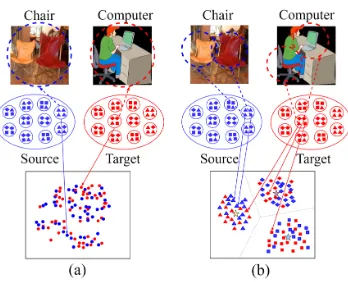
Figure 1: Comparisons of (a) holistic feature alignment and (b) local feature alignment. The learned local feature pattern “Chair” could not only be shared across domains but also between the category “Chair” and category “Computer”, as shown in (b).
and target domains. These methods usually bridge different domains by learning domain-invariant discriminative repre-sentations, and directly apply the classifier learned from only source labels to target domain (Ben-David et al. 2010). To reduce domain discrepancy, previous methods usually align source and target in a shared subspace (Gong et al. 2012; Fernando et al. 2013). Recently, deep neural networks have been exploited to map both domains into a domain-invariant feature space and learn more transferable representations (Zhou et al. 2014; Tzeng et al. 2017; Pei et al. 2018). This is generally achieved by optimizing the learned representations to minimize some measures of domain discrepancy such as maximum mean discrepancy (Long et al. 2015), reconstruc-tion loss (Ghifary et al. 2016), correlareconstruc-tion distance (Sun and Saenko 2016), or adversarial loss (Tzeng et al. 2017). Among them, the adversarial learning based deep domain adaptation methods have become increasingly prevalent and achieved the top performances.
more primitive and transferable local feature patterns. Com-paring to local feature patterns, holistic representations, usu-ally the final fully-connected layers of deep neural networks, are tailored to capture more current task related semantics and hence less transferable to novel domains (Yosinski et al. 2014), especially when source labels are scarce. In contrast, local feature patterns only focus on smaller parts of images that could be shared not only across different domains but also between multiple categories, as shown in Figure 1(b), thus are more generic and less susceptible to limited train-ing labels. Further, existtrain-ing domain adaptation methods fail to consider the complex multi-mode distributions of local features, which limits their capability to achieve fine-grained local feature alignment.
Motivated by the above limitations of existing domain adaptation methods, we propose to learn transferable lo-cal feature patterns for unsupervised domain adaptation and jointly align holistic features and local features for fine-grained alignment. The local feature space is firstly par-titioned into several well-separated cells with a cluster of generic local feature patterns. We then achieve feature align-ment by simultaneously enforcing both holistic distribution consistency over the aggregated local features and local fea-ture alignment within each separated local feafea-ture pattern cells, as shown in Figure1(b). The contributions of our work are as follows:
• Different from most existing domain adaptation methods which focus on aligning holistic features, we propose to exploit local features for unsupervised domain adaptation. We show that our learned local feature patterns are more generic and transferable.
• We align the residuals of local features regarding to the learned local feature patterns by minimizing an additional conditional domain adversarial loss. With joint holistic and local distribution matching, we enable fine-grained cross-domain feature alignment.
• Exhaustive experimental results on standard domain adaptation benchmarks demonstrate the promises of the proposed method by outperforming the state-of-the-art approaches. As a nontrivial byproduct, we provide com-prehensive evaluations of local feature patterns from dif-ferent levels for unsupervised domain adaptation.
Related Works
We first give a brief overview on existing domain adaptation methods. Then, we present related works on local feature aggregation.
Domain Adaptation methods seek to learn from neigh-bouring source domains discriminative representations that can be applied to target domains. This is usually achieved by mapping samples from both domains into a domain-invariant feature space to reduce domain discrepancy (Ben-David et al. 2010). Previous methods usually seek to align source and target feature through subspace learning (Gong et al. 2012; Fernando et al. 2013; Pan et al. 2011). Recently deep domain adaptation approaches become prevalent as deep networks can learn more transferable representations
(Bengio, Courville, and Vincent 2013; Yosinski et al. 2014). Different measures of domain discrepancy have been mini-mized to align source and target distributions. Several meth-ods propose to minimize the Maximum Mean Discrepancy (MMD) loss between source and target (Long et al. 2015). Ghifary et al. propose to reduce the discrepancy through the auto-encoder based reconstruction loss (Ghifary et al. 2016). Recently, the adversarial learning based methods are becoming popular (Ganin et al. 2016; Tzeng et al. 2017; Pei et al. 2018). These methods are closely related to the adversarial generative networks (GAN) (Goodfellow et al. 2014; Gulrajani et al. 2017). They aim to reduce domain dis-crepancy by optimizing the feature learning network with an adversarial objective produced by another discrimina-tor network which is trained to distinguish features of tar-get from features of source. All these methods only fo-cus on transferring holistic semantics, without considering the more generic local feature patterns and the multi-mode statistics of local features.
Feature AggregationOur work is also related to feature ag-gregation methods, such as vectors of locally aggregated de-scriptors (VLAD) (J´egou et al. 2010), bag of visual words (BoW) (Sivic and Zisserman 2003), and Fisher vectors (FV) (Perronnin and Dance 2007). Previously, these methods have usually been applied to aggregate hand-crafted keypoint de-scriptors, such as SIFT, as a post-processing step, and only recently have them been extended to encode deep convolu-tional features with end-to-end training (Arandjelovic et al. 2016). VLAD has been successfully applied to image re-trieval (Yue-Hei Ng, Yang, and Davis 2015), place recog-nition (Arandjelovic et al. 2016), action recogrecog-nition (Gird-har et al. 2017), etc. We build on the end-to-end trainable VLAD, and extend it to learn generic local feature patterns and facilitate local feature alignment for unsupervised do-main adaptation.
Method
In this section, we describe the proposed unsupervised do-main adaptation method. Given source dodo-main datasetDs= {(xsi, yis)}ns
i=1 of ns labeled examples and target domain
datasetDt=
xt j
nt
j=1ofntunlabeled samples. The source domain and target domain are sampled from joint distribu-tion P(Xs,Ys) andQ(Xt,Yt), respectively, andP 6= Q.
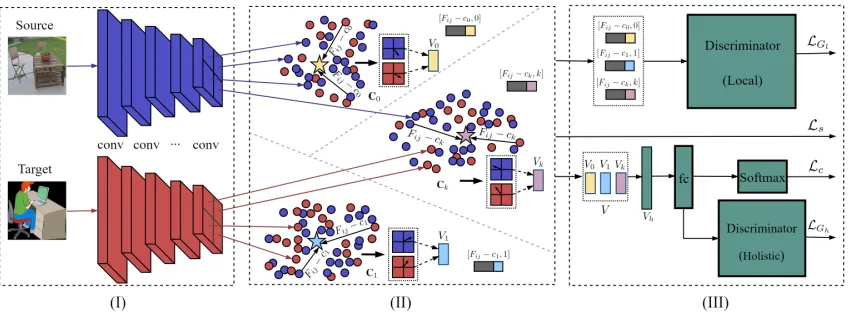
The goal of unsupervised domain adaptation is to learn dis-criminative features from source data and effectively transfer them from source to target to minimize target domain errors. There are two technical challenges to enabling success-ful domain adaptation: 1) promoting positive transfer of relevant discriminative features by enforcing cross-domain feature distribution consistency, and 2) reducing negative transfer of irrelevant features by preventing false across-domain feature alignment (Pan, Yang, and others 2010; Pei et al. 2018). Motivated by the two challenges, we pro-pose to simultaneously enhance positive transfer by learning generic local feature patterns and alleviate negative trans-fer by enforcing additional local feature alignment. As il-lustrated in Figure 2, our method consists of three parts:I)
Figure 2: Pipeline of the proposed method: (I) feature extractorG, (II) local feature patterns learning, and (III) feature alignment. We learn generic local feature patterns, and jointly align holistic features and local features.
feature alignment. We employ multiple convolutional layers as the feature extractor to transform source and target data into feature maps with each position in the map representing a local feature. In the following sections, we describe how to learn local feature patterns and achieve feature alignment.
Local Feature Patterns Learning
In this section, we learn a cluster of discriminative local fea-ture patterns to enable joint holistic and local feafea-ture align-ment. We employ the end-to-end trainable NetVLAD for lo-cal feature patterns learning and lolo-cal feature aggregation over the extracted convolutional feature maps (Arandjelovic et al. 2016). We first learn a initial cluster of local fea-ture patterns and then adapt them for cross-domain transfer. Given a collection of convolutional features from layerLl,
we performk-meansclustering to obtain the initialKlocal feature patterns,cl
1, ..., clK, represented by theKclustering
centers. For each image, a convolutional featureFijl at po-sition (i, j)of its feature map from layer Ll is assigned a
similarity vectorSijk, defined as:
Slij[k] =
e−α||Fijl−c l k||
2
Σk0e−α||F l ij−clk0||2
, (1)
which soft-assignsFl
ijto local feature patternclkwith weight
proportional to its distances to theklocal feature patterns in the feature space.Sl
ij[k] ranges between 0 and 1, with
the highestsimilarityvalue assigned to the closest local fea-ture pattern.αis a tunable hyper-parameter (positive con-stant) and controls the decay of the similarity responses to the magnitude of the distances. Note that forα→+∞,Fijl
is hard-assigned to the nearest local feature pattern. For the
dldimensional feature mapFlfromL
l, the NetVLAD
en-coding converts it into a singledl∗Kdimensional vector
Vl∈Rd l∗k
, describing the distribution of local features re-garding theKlocal feature patterns. Formally, the encoding of an image regarding layerLlis represented as:
Vl[d, k] =
Ml
X
i=1
Nl
X
j=1
Sijl[k](Fijl[d]−clk[d]), (2)
whereFl
ij[d]andclk[d]are thedth dimension of featureF l ij
and local feature patterncl
k, respectively.F l
ij[d]−clk[d]is the
residual of featureFijl to local feature patternclk;Ml×Nl
denotes the feature map size. The intuition is that residuals record the differences between the feature at each position and the typical local feature patterns. The residuals are ag-gregated inside each of the local feature pattern cell, and the similarity vector defined above determines the contribution of the residual of each feature to the total residuals. The out-put is a matrixV with thek-th columnV[·, k]representing the aggregated residuals inside thek-th local feature pattern cell. The columns of the matric are then stacked and nor-malized into adl∗Kdimensional aggregated descriptorV
h
which is fed into the classifier for classification and holistic alignment.
We encourage the learned local feature patterns to be well-separated and local features to distribute compactly around them through minimizing a sparse lossLsover the
information entropy of the similarity vectors:
Ls=− 1 Nl∗Ml
Ml
X
i=1 Nl
X
i=1 max(
K
X
k=1
Slij[k] logSijl[k], m). (3)
wheremis the information entropy threshold.Sis the simi-larity vector described in Equation 1, but here we use a much smaller decay weightαs. Through the sparse loss
minimiza-tion, we expect sparse soft-assignments of local features to the learned local feature patterns and less confusing bound-ary local features lying between different local feature pat-tern cells.
Feature Alignment
Adversarial Learning and Holistic Alignment We em-ploy the popular adversarial learning for distribution match-ing (Goodfellow et al. 2014; Gulrajani et al. 2017), as deep domain adversarial networks have achieved the top domain adaptation performances (Tzeng et al. 2017; Pei et al. 2018). The adversarial domain adaptation procedure is a two-player game, where the first player is the domain discriminatorDh
trained to distinguish source features from target features, while the second player, the feature extractorG, is trained to confuse the domain discriminator. By learning a best pos-sible discriminator, the feature extractor is expected to learn features that are best domain-invariant. We achieve holis-tic alignment by matching the neural activation distributions of the classification layer. To be noted, the classification layer directly receives the aggregated local features over the learned local feature patterns. Formally, holistic domain dis-criminator theDhand feature extractorGare trained to
min-imize lossLDh andLGh, respectively, and they are defined
as the following:
LDh =− 1
ns ns X
i=1
(log(Dh(G(xs))))
−1
nt nt X
i=1
(log(1−Dh(G(xt)))),
(4)
LGh =− 1
nt nt X
i=1
(log(Dh(G(xt)))), (5)
wherensandntare the number of training samples from
source and target, respectively.
Local Feature Alignment Existing adversarial domain adaptation methods only match the cross-domain holistic feature distributions and fail to consider the complex dis-tributions of local features. As a result, multi-mode local feature patterns may be poorly aligned. Hence, we pro-pose to further align the local features regarding the learned local feature patterns by minimizing an additional condi-tional domain adversarial loss (Mirza and Osindero 2014; Isola et al. 2017). For each convolutional featureFl
ij at
po-sition (i, j) from layer Ll, we hard-assign it to the
near-est local feature patternal
ij , andalij = arg maxk(Sijl [k]).
We align the residuals of local features to the assigned lo-cal feature patterns, and enforce that, within each lolo-cal fea-ture pattern cell, the residuals of local feafea-tures from both domains distribute similarly. We find aligning the residuals, other than the original convolutional features, enables easier optimization and fine-grained alignment. Formally, an addi-tional local feature discriminatorDl is trained to minimize
lossLDldefined as:
LDl=− 1 ns ns X n=1 1 Nl∗Ml
Ml X i=1 Nl X j=1
(log(Dl(Fijl −cl[alij], alij)))
−1 nt nt X n=1 1 Nl∗Ml
Ml X i=1 Nl X j=1
(log(1−Dl(Fijl −cl[alij], alij))),
(6)
whereFijl −cl[alij] donates the residual of feature Fijl to its assigned local feature patternalij. For local feature align-ment, the feature extractor networkGis trained to minimize lossLGldefined as:
LGl=− 1 nt nt X n=1 1 Nl∗Ml
Ml X i=1 Nl X j=1
(log(D(Fijl −cl[alij], alij))). (7)
To enable discriminative feature transferring, the feature extractorGis also trained to minimize the classification loss
Lcusing source labels, defined as:
Lc=−
1
ns ns X
i=1
yi·log ˆyi, (8)
whereyi is the true label of the source samplexi, andyˆiis
its predicted possibility.
Integrating all objectives together, the final loss for the feature extractorGto minimize is
L=Lc+λhLGh+λlLGl+λsLs, (9)
whereλh,λlandλsare hyper-parameter that trade-offs the
objectives in the unified optimization problem. By optimiz-ing the feature extractor network with the integrated loss, we aim to learn well-separated local feature patterns and si-multaneously transfer category-related holistic features and generic local feature patterns.
Implementation and Learning
Implementation Details We use the VGG16 network (Si-monyan and Zisserman 2014) as the backbone network and exploit the last convolutional layer, conv5 3, for local fea-ture patterns learning and local alignment. We share the pa-rameters of the source and target feature extractors. We ap-pend a single-layer classifier on the top of the aggregated local features. We keep the number of local feature patterns fixed to be 32. For local feature aggregation, we use a large
α = 5000.0 to encourage independent residual accumula-tion within each local feature pattern cell. We use a small similarity decayαs= 0.005and a small sparsity threshold
m= 0.02. Since the dimensionality of the aggregated local features are large,512∗32, we use a dropout of 0.5 over it to avoid over-fitting. For adversarial feature alignment, the holistic discriminatorDhconsists of 3 fully connected
lay-ers: two hidden layers with 768 and 1536 units, respectively, followed by the final discriminator output. We use larger 3-layer local adversarial discriminatorDlwith 2048 and 4096
units for the two hidden layers. We implement our model in Tensorflow and train it using Adam optimizer.
source classification loss combined with the sparsity loss. In the third step,domain adaptation, we simultaneously train the classifier, local feature patterns, and the last two convo-lutional layers with a learning rate of 0.0001 to minimize the final joint loss described in Equation 9. Only finetuning and adapting the last two convolutional layers of VGG16 help to prevent overfitting to small datasets, reduce GPU memory footprint, and enable faster training. We set hyper-parametersλh= 0.2,λl= 0.1andλs= 0.1.
Experiments
We now evaluate our method with the state-of-the-art do-main adaptation approaches on benchmark datasets. We experiment on the popular Office-31 dataset (Saenko et al. 2010) and the recently introduced Office-home dataset (Venkateswara et al. 2017).
Office-31(Saenko et al. 2010) This dataset is widely used for visual domain adaptation. It consists of 4,652 images and 31 categories collected from three different domains: Ama-zon (A), with 2817 images from amaAma-zon.com, Webcam (W) and DSLR (D), with 795 images and 498 images taken by web camera and digital SLR camera in different environ-mental settings, respectively. We evaluate all methods on the challenging settings ofA↔W andA↔D. TheW ↔D
performances are not reported as D and W are two similar domains and the domain shift is very small.
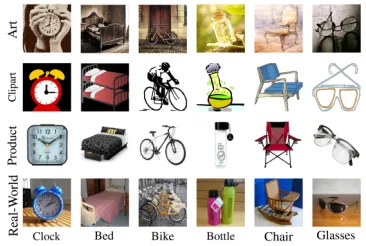
Office-home(Venkateswara et al. 2017) This is a very chal-lenging domain adaptation dataset, which comprises 15,588 images with 65 categories of everyday objects in office and home settings. Some example samples are shown in Figure 3. There are 4 significantly different domains: Art (Ar) with 2427 painting, sketches or artistic depiction images, Clipart (Cl) with 4365 images, Product (Pr) containing 4439 images and Real-World (Rw) with 4357 regularly captured images. We report performances of all 12 transfer tasks to enable thorough evaluations:Ar ↔ Cl,Ar ↔ P r,Ar ↔ Rw,
Cl↔P r,Cl↔Rw, andP r↔Rw.
Figure 3: Example images of theOffice-homedataset.
Compared Methods We perform comparative studies of our method against the state-of-the-art deep domain adapta-tion methods: Deep CORAL (D-CORAL) (Sun and Saenko 2016), Deep Adaptation Network (DAN) (Long et al. 2015), Domain Adversarial Neural Network (DANN) (Ganin et al. 2016), Adversarial Discriminative Domain Adaptation
(ADDA) (Tzeng et al. 2017), and Wasserstein Distance Guided Representation Learning (WD-GRL) (Shen et al. 2018). All these deep methods only align the holistic rep-resentations for domain adaptation. D-CORAL proposes to align the second-order statistics. DAN matches multi-layer deep features using multi-kernel MMD. DANN exploits ad-versarial learning for aligning deep features and enforces them indistinguishable for a additional domain discrimina-tor. ADDA is a generalized framework for adversarial deep domain adaptation and unties weight sharing across do-mains. WD-GRL employs the Wasserstein distance to guide the adversarial learning of domain-invariant features.
SetupWe follow standard evaluation protocols for unsuper-vised domain adaptation: using all labeled source data and all unlabeled target data. We report the results averaged from three random experiments. The VGG16 network is used as the backbone model and the convolutional layers are initial-ized with parameters pre-trained on ImageNet dataset. The fully connected layers of our model are randomly initialized, while for comparing models they are initialized with param-eters pre-trained on ImageNet dataset. To further explore the transferability of holistic features, we also report the perfor-mances of DAN and ADDA with fully-connected layers ran-domly initialized. In this case, to avoid overfitting, we use two smaller fully connected layers with 1024 and 128 hid-den units, respectively, as done in (Motiian et al. 2017), and we denote them as DAN(s) and ADDA(s), respectively. To verify the importance of local feature alignment, we report results of our method in two different settings: 1) only holis-tic features are aligned (λh = 0.2, λl = 0), denoted asOur (H); 2) holistic features and local features are jointly aligned (λh= 0.2, λl= 0.1), denoted asOur (H+L).
Table 1: Accuracy (%) on theOffice31dataset for unsuper-vised domain adaptation.
Method A→W A→D W→A D→A Avg
D-CORAL 69.23 68.52 59.53 60.53 64.45
DAN 70.35 69.56 61.38 60.92 65.55
WD-GRL 74.61 73.27 60.65 60.01 67.14
ADDA 75.24 73.64 60.34 60.75 67.49
DANN 74.03 73.52 62.23 61.73 67.88
ADDA(s) 64.89 64.84 48.66 50.07 57.12
DANN(s) 64.85 61.48 40.50 48.21 53.76
Ours(H) 82.63 75.02 63.47 64.16 71.32
Ours(H+L) 84.35 77.56 64.56 63.38 72.46
Results
simi-Table 2: Accuracy (%) on theOffice-homedataset for unsupervised domain adaptation.
Method Ar→Cl Ar→Pr Ar→Rw Cl→Ar Cl→Pr Cl→Rw Pr→Ar Pr→Cl Pr→Rw Rw→Ar Rw→Cl Rw→Pr Avg
D-CORAL 35.85 45.58 56.52 36.28 47.54 50.27 36.45 37.57 61.54 49.87 43.21 69.01 47.47
DAN 36.98 45.71 58.11 38.90 50.33 51.94 37.44 37.05 61.49 50.07 42.18 68.37 48.21
WD-GRL 36.37 44.54 58.12 37.65 51.54 52.46 36.73 37.98 63.08 50.04 44.49 70.15 48.60
ADDA 38.33 47.81 60.54 36.34 49.56 50.54 37.89 39.26 64.75 54.14 46.55 71.64 49.78
DANN 37.04 46.29 59.38 39.83 52.95 53.85 37.80 38.52 63.86 49.61 45.15 70.76 49.59
ADDA(s) 25.05 35.30 42.23 27.71 37.37 39.98 30.15 34.94 55.34 45.30 39.50 62.20 39.59
DANN(s) 23.16 33.75 41.91 25.96 38.72 37.73 29.20 35.00 50.80 42.02 38.19 61.03 38.12
Ours(H) 38.95 48.05 62.33 40.56 53.45 56.36 37.85 39.43 65.18 54.78 46.29 75.21 51.54
Ours(H+L) 41.53 53.66 64.90 41.53 54.57 57.66 38.87 40.08 65.97 55.13 47.18 76.02 53.10
lar holistic alignment. We observe that the improvements of our method are more obvious whenAacts as the source do-main. DomainAcomprises more training images with more diversities, and thus more generic local feature patterns can be learned, which effectively enhance positive feature trans-fer.
The performances of ADDA and DANN drop signif-icantly when the fully-connected layers are trained from scratch using the source labels, and the averaged perfor-mance gaps from the pretrained models are 10.37% and
14.12%, respectively. The performance drops are more dis-tinct whenDorW acts as the source domain, as these two domains have much less training images and the learned holistic representations severely overfit the source labels. The results verify the inferior transferability of holistic rep-resentations, especially when source labels are limited.
The performances of all methods on the Office-home
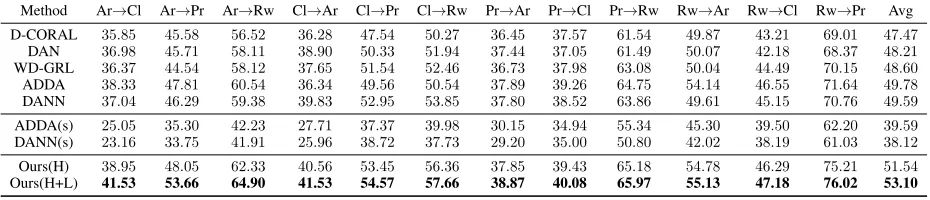
dataset are reported in Table 2. The proposed model Our (H+L)achieves consistent improvements over the compari-son methods. ForOffice-homedataset, the training images in each category show more diversities as verified by the lower in-domain classification accuracy described in its original paper (Venkateswara et al. 2017). The model Our (H+L)
shows consistent advantages over the model Our (H), and the advantages are manifested in settings when Art acts as the source domain. Adaptations from Art to other do-mains are more challenging as images fromArtshow more diversities within each category while having nearly half of the training samples of the other three domains. That means more complex local feature patterns with less refer-able points (holistic features) to be transferred from Art
source domain. In this case, enforcing additional local fea-ture alignment promotes positive transfer of relevant local features within each local feature pattern cell, and thus im-proves performances.
Negative transfer happens when features are falsely aligned and domain adaptation causes deteriorated perfor-mances. Existing holistic feature distribution matching eas-ily induce negative transfer when the distributions between source and target are inherently different. Consider the case when source domain is much smaller or larger than target. We aim to evaluate the robustness of domain adaptation methods against negative transfer in a more common sce-nario where source domain is much larger than target. In this case, there are many source points in the feature space (semantic features) that are irrelevant to the target domain.
We experiment with setting,31-25, on the four transfer tasks constructed from theOffice-31dataset, by removing the last 6 classes in alphabet order from the target domain. For ex-ample, we perform domain adaptation on transfer task A31-D25, where the source domainAhas 31 classes but the target domainWonly contains 25 classes. The results are reported in Table 3. As we can see, there are obvious negative transfer for top-performing domain adaptation methods DANN and ADDA. Both of them under-perform the finetuned VGG16 net on most of the transfer tasks and the averaged perfor-mance drops are2.59%and10.34%, respectively. Our do-main adaptation modelOur (H+L)andOur (H)both outper-form the unadapted modelOur(w/o DA). The significant im-provements bringed by our domain adaptation method prove the advantage of exploiting generic local feature patterns in combating negative transfer.
Table 3: Accuracy (%) on theOffice31dataset for unsuper-vised domain adaptation from 31 to 25 categories.
Method A→W A→D W→A D→A Avg
VGG16(FT) 63.33 65.92 58.68 57.83 61.44
ADDA 63.21 59.79 44.74 36.65 51.10
DANN 62.12 62.31 59.46 51.49 58.85
Our(w/o DA) 62.51 63.67 56.47 56.35 59.75
Ours(H) 74.85 68.77 63.88 62.82 67.58
Ours(H+L) 75.49 70.05 67.67 63.14 69.09
Ablation Study
Comparison of Layers We compare the performances of models trained and adapted from different convolutional lay-ers, and the results are shown in Table 4. As we can see, the performance trends are clear: higher layers achieve better performances and the best performance is achieved by layer
conv5 3. Lower layers are more generic, however, much less semantic features are captured if the higher layer features are abandoned.
(a) VGG16 finetuned (b) DANN (c) Our (unadapted) (d)Our (H+L)
Figure 4: The t-SNE visualizations of holistic representations learned by (a) Fine-tuned VGG16 net, (b) DANN, (c) Our un-adapted model, and (d) AdaptedOur (H+L)(blue:A, red:W).
(a) VGG16 (b) DANN (c)Our (H) (d)Our (H+L)
Figure 5: The t-SNE visualizations of local features,conv5 3, of (a) VGG16 net, (b) DANN, (c)Our (H), and (d)Our (H+L)
(blue:A, red:W).
Table 4: Accuracy (%) on theOffice31dataset with convo-lutional features from different layers.
Layers A→W A→D W→A D→A Avg
conv5 1 73.70 70.01 43.96 39.88 56.89
conv5 2 79.62 73.49 50.96 50.60 63.67
conv5 3 84.35 77.56 64.56 63.38 72.46
we need more powerful local discriminatorDlto distinguish
source from target. For example, for k = 64, the hidden units number of theDlare both 4096 for the two layers.
Table 5: Accuracy (%) on theOffice31dataset with varying size of local feature patterns.
Nunmber k=0 k=8 k=16 k=32 k=64
Accuracy 67.92 69.75 70.84 72.46 72.59
Alignment VisualizationWe visualize both the holistic rep-resentations and local features using t-SNE embedding with theA→W transfer task. In Figure 4, we visualize the net-work activations of the last fully-connected layer of fine-tuned VGG16 net, DANN, our unadapted model, and our adapted modelOur (H+L). For both the finetuned VGG16 and our unadapted model, target and source are poorly aligned. For DANN, as shown in Figure 4(b), source and tar-get representations are well aligned, but there are still many boundary confusing points lying between different category clusters. For our adapted modelOur (H+L), source and tar-get representations are much better aligned.
In Figure 5, we visualize the network activations of the last convolutional layer,conv5 3, to study the effects of lo-cal alignment. As shown in Figure 5 (a), source and target local features are poorly aligned for the VGG16 net. When
adapted with DANN andOur (H), local features are better aligned, though both of the two models only match holis-tic feature distributions. As our model encourages learning well-separated local feature patterns by minimizing an addi-tional sparsity loss, the local features learned by our model distribute in more compact clusters (best view the zoomed-in figure). When enforcing additional local alignment byOur (H+L), local feature patterns tend to be equally shared by source and target, and local features are better aligned within each local feature pattern cluster.
Conclusions
We have presented a novel and effective approach to ex-ploiting local features for unsupervised domain adaptation. Unlike existing deep domain adaptation methods that only transfer holistic representations, the proposed method learns domain-invariant local feature patterns, and simultaneously aligns holistic features and local features to enable fine-grained feature alignment. Experimental results verified the advantages of the proposed method over the state-of-the-art unsupervised domain adaptation approaches. We have ex-plored the performances of convolutional features from dif-ferent layers for domain adaptation with the VGG16 net and found that the last convolutional layer achieves the best per-formances. Further, we showed that the proposed method can effectively alleviate negative transfer.
Acknowledgments
References
Arandjelovic, R.; Gronat, P.; Torii, A.; Pajdla, T.; and Sivic, J. 2016. Netvlad: Cnn architecture for weakly supervised place recognition. InProceedings of the IEEE Conference on Computer Vision and Pattern Recognition, 5297–5307. Ben-David, S.; Blitzer, J.; Crammer, K.; Kulesza, A.; Pereira, F.; and Vaughan, J. W. 2010. A theory of learning from different domains.Machine learning79(1-2):151–175. Bengio, Y.; Courville, A.; and Vincent, P. 2013. Repre-sentation learning: A review and new perspectives. IEEE transactions on pattern analysis and machine intelligence
35(8):1798–1828.
Csurka, G. 2017. Domain adaptation for visual applications: A comprehensive survey. arXiv preprint arXiv:1702.05374. Fernando, B.; Habrard, A.; Sebban, M.; and Tuytelaars, T. 2013. Unsupervised visual domain adaptation using sub-space alignment. InProceedings of the IEEE international conference on computer vision, 2960–2967.
Ganin, Y.; Ustinova, E.; Ajakan, H.; Germain, P.; Larochelle, H.; Laviolette, F.; Marchand, M.; and Lempitsky, V. 2016. Domain-adversarial training of neural networks. The Jour-nal of Machine Learning Research17(1):2096–2030. Ghifary, M.; Kleijn, W. B.; Zhang, M.; Balduzzi, D.; and Li, W. 2016. Deep reconstruction-classification networks for unsupervised domain adaptation. InEuropean Conference on Computer Vision, 597–613. Springer.
Girdhar, R.; Ramanan, D.; Gupta, A.; Sivic, J.; and Russell, B. 2017. Actionvlad: Learning spatio-temporal aggregation for action classification. InCVPR, volume 2, 3.
Gong, B.; Shi, Y.; Sha, F.; and Grauman, K. 2012. Geodesic flow kernel for unsupervised domain adaptation. In Com-puter Vision and Pattern Recognition (CVPR), 2012 IEEE Conference on, 2066–2073. IEEE.
Goodfellow, I.; Pouget-Abadie, J.; Mirza, M.; Xu, B.; Warde-Farley, D.; Ozair, S.; Courville, A.; and Bengio, Y. 2014. Generative adversarial nets. InAdvances in neural information processing systems, 2672–2680.
Gulrajani, I.; Ahmed, F.; Arjovsky, M.; Dumoulin, V.; and Courville, A. C. 2017. Improved training of wasserstein gans. InAdvances in Neural Information Processing Sys-tems, 5767–5777.
Hong, W.; Wang, Z.; Yang, M.; and Yuan, J. 2018. Condi-tional generative adversarial network for structured domain adaptation. InProceedings of the IEEE Conference on Com-puter Vision and Pattern Recognition, 1335–1344.
Isola, P.; Zhu, J.-Y.; Zhou, T.; and Efros, A. A. 2017. Image-to-image translation with conditional adversarial networks. InProceedings of the IEEE Conference on Computer Vision and Pattern Recognition, 1125–1134.
J´egou, H.; Douze, M.; Schmid, C.; and P´erez, P. 2010. Ag-gregating local descriptors into a compact image representa-tion. InComputer Vision and Pattern Recognition (CVPR), 2010 IEEE Conference on, 3304–3311. IEEE.
Long, M.; Cao, Y.; Wang, J.; and Jordan, M. I. 2015. Learn-ing transferable features with deep adaptation networks.
arXiv preprint arXiv:1502.02791.
Mirza, M., and Osindero, S. 2014. Conditional generative adversarial nets. arXiv preprint arXiv:1411.1784.
Motiian, S.; Jones, Q.; Iranmanesh, S.; and Doretto, G. 2017. Few-shot adversarial domain adaptation. InAdvances in Neural Information Processing Systems, 6670–6680. Pan, S. J.; Tsang, I. W.; Kwok, J. T.; and Yang, Q. 2011. Domain adaptation via transfer component analysis. IEEE Transactions on Neural Networks22(2):199–210.
Pan, S. J.; Yang, Q.; et al. 2010. A survey on transfer learn-ing.IEEE Transactions on knowledge and data engineering
22(10):1345–1359.
Pei, Z.; Cao, Z.; Long, M.; and Wang, J. 2018. Multi-adversarial domain adaptation. InAAAI Conference on Ar-tificial Intelligence.
Perronnin, F., and Dance, C. 2007. Fisher kernels on vi-sual vocabularies for image categorization. In2007 IEEE conference on computer vision and pattern recognition, 1– 8. IEEE.
Saenko, K.; Kulis, B.; Fritz, M.; and Darrell, T. 2010. Adapt-ing visual category models to new domains. In European conference on computer vision, 213–226. Springer.
Shen, J.; Qu, Y.; Zhang, W.; and Yu, Y. 2018. Wasserstein distance guided representation learning for domain adapta-tion. InAAAI.
Simonyan, K., and Zisserman, A. 2014. Very deep convo-lutional networks for large-scale image recognition. arXiv preprint arXiv:1409.1556.
Sivic, J., and Zisserman, A. 2003. Video google: A text re-trieval approach to object matching in videos. Innull, 1470. IEEE.
Sun, B., and Saenko, K. 2016. Deep coral: Correlation align-ment for deep domain adaptation. InEuropean Conference on Computer Vision, 443–450. Springer.
Tzeng, E.; Hoffman, J.; Saenko, K.; and Darrell, T. 2017. Adversarial discriminative domain adaptation. InComputer Vision and Pattern Recognition (CVPR), volume 1, 4. Venkateswara, H.; Eusebio, J.; Chakraborty, S.; and Pan-chanathan, S. 2017. Deep hashing network for unsupervised domain adaptation. InProc. CVPR, 5018–5027.
Yosinski, J.; Clune, J.; Bengio, Y.; and Lipson, H. 2014. How transferable are features in deep neural networks? In
Advances in neural information processing systems, 3320– 3328.
Yue-Hei Ng, J.; Yang, F.; and Davis, L. S. 2015. Exploiting local features from deep networks for image retrieval. In
Proceedings of the IEEE conference on computer vision and pattern recognition workshops, 53–61.
Zhou, J. T.; Pan, S. J.; Tsang, I. W.; and Yan, Y. 2014. Hybrid heterogeneous transfer learning through deep learning. In
AAAI, 2213–2220.
Zhou, J. T.; Zhao, H.; Peng, X.; Fang, M.; Qin, Z.; and Goh, R. S. M. 2018. Transfer hashing: From shallow to deep.