Comparative analysis of techniques for diagnostics of
phase singularities
Felde Ch.V., Polyanski P.V. and Bogatyryova H.V.
Department of Correlation Optics, Chernivtsi National University, 58012 Chernivtsi, Ukraine, [email protected]
Received: 23.11.2007
Abstract
A comparative analysis of several techniques used for diagnostics of phase sin-gularities in the optical vortex beams and fields is performed. Both the advan-tages and shortcomings of implementation and application of those techniques are discussed.
Keywords: singular optics, wavefront dislocations, interference, diffraction, Young’s interference experiment
PACS: 42.15.Dp, 78.20.Fm, 65.57Fg UDC: 535.31
1. Introduction
One of the urgent problems of singular optics consists in development of special tech-niques for detection and diagnostics (i.e., determination of the magnitude and the sign of topological charge) of phase singularities in vortex-supporting beams and optical fields. Sometimes conventional interference techniques [1, 2] are not efficient enough or even inapplicable. The examples are studies of partially spatially coherent combined singular beams, which are inhomogeneous in polarization, or polychromatic beams. Indeed, appli-cation of interference techniques is impossible when diagnosing partially spatially coher-ent singular beams resulting from mixing of mutually incohercoher-ent Laguerre-Gaussian modes. This is because it would be impossible to form a reference wave coherent with all the constituting modes simultaneously. Application of the classical interference tech-niques for diagnostics of phase singularities in polychromatic fields becomes extraordi-nary complicated since a precise adjustment of optical arrangement is needed.
2. Analysis
2.1. Interference technique
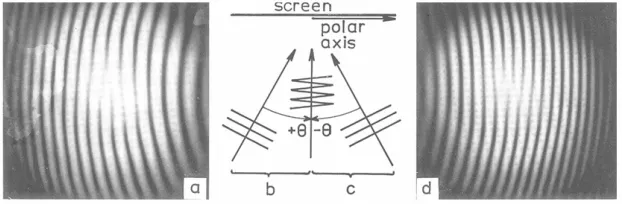
A conventional technique for diagnostics of phase singularities in the optical fields is an interference one [1, 3]. It presumes employing a reference beam mutually coherent with the singular beam and observation of on-axis or off-axis interference patterns. When ap-plying the interference technique to the analysis of “elementary”, deterministic optical vortices of the kind of Laguerre-Gaussian modes, one enforces interference of the beam bearing one or several phase singularities with a plane or spherical reference beam. In practice, it is convenient to use a spread Gaussian beam for this purpose. Both the off-axis and on-off-axis schemes are widely utilized. The fringes formed in such a manner can be straight, with typical “bifurcations”, or spiral. This depends on the inclination and curva-ture of wavefront of the reference beam [3], as shown in Fig. 1 and 2. Let us note that the number of dark fringes originating from the centre (for the off-axis interference scheme – Fig. 1) is equal to the module of topological charge, m, whereas the sign of the vortex (i.e., the sign of the topological charge) is determined by the direction of bifurcation of interference "forklets" (up or down), taking into account the propagation direction of the reference beam with respect to the interferogram axis.
If one implements the on-axis technique (see Fig. 2) for diagnostics of phase singu-larities, then the module and sign of the topological charge of the vortex beam are deter-mined from the number and direction of twirling of the "blades" with respect to the inter-ferogram axis. In this case one must account for the relation between the curvature radii of the reference beam and the beam under test [1, 3, 4]. It is clear that in the both cases interference test of the vortex beams and fields assumes a complicated and precisely ad-justed optical apparatus. So, according to the experimental estimations [4], the on-axis interference pattern is observed if the angle between the axes of the reference and singu-lar beams does not exceed 5·10-4 rad (i.e., about 1.5'') and the ratio of the curvature radii for those beams exceeds unity, S 1
ref R
R > .
Thus, the interference technique for the diagnostics of phase singularities provides
Fig. 2. On-axis interferogram for a single-charged optical vortex.
information on both the module and the sign of the topological charge of vortex beams. However, unambiguous results are obtained only if one has a priori data on the arrangement and parameters of the test beam and the reference beam. Besides, interpretation of the results obtained using the off-axis technique (e.g., the sign of the topological charge of the vortex) depends upon orientation of the corresponding pattern. For instance, rotation of the pattern shown in Fig. 1a or 1d by 180 deg would result in the vortex of opposite sign.
2.2. Dove-prism technique
This approach consists in interference of Laguerre-Gaussian mode with its mirror replica [5]. It is known [2] that the mirror reflection results in reversing sign of the topological charge. Therefore, when a vortex beam is divided into two partial beams and one addi-tional reflection is provided for one of them, then the two partial beams would exhibit the opposite signs of the topological charge. The Dove-prism technique is based on summa-tion and interference comparison of those modes. The idea of the technique is to compare the test beam with its mirrored replica (“auto-reference technique”). This means that the technique does not involve additional reference beams. As a consequence, the two partial beams are peer, and the information concerned with the sign of the topological charge of the initial vortex is lost.
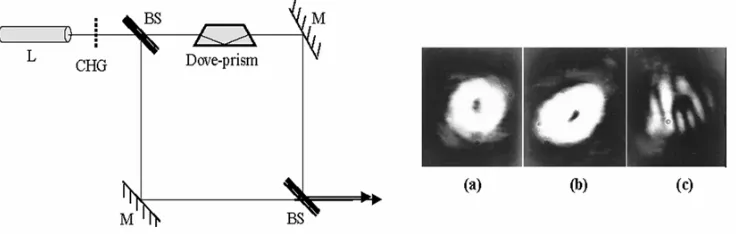
The relevant experimental arrangement is shown in Fig. 3. A Dove prism inserted into one arm of Mach-Zehnder interferometer inverts the input Laguerre-Gaussian beam, which interferes coaxially with the initial (doubly mirrored) beam at the interferometer output. This gives rise to interference pattern in the shape of fringes, with 2m+1 fork-lets in the centre. Notice that this technique allows deriving only the module of the topo-logical charge of the singularity under test, provided that the number of interference fringes originating from the centre of interference pattern is known. It is therefore
sible to use this technique for determination of sign of the mode charge. Furthermore, the technique is applicable to diagnostics of the isolated vortices alone but not for studying the phase singularities of speckle fields and partially coherent singular beams.
2.3. Diffraction technique
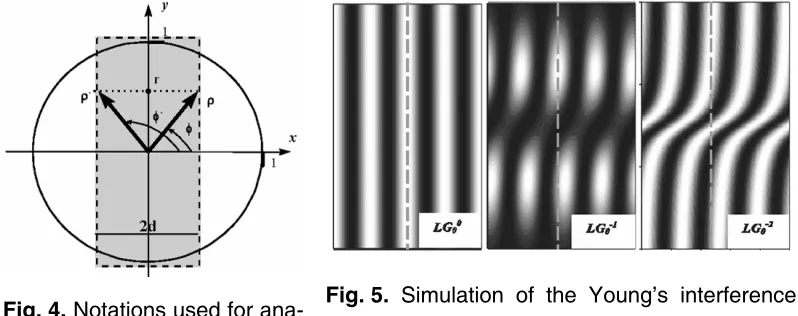
Another technique aimed at diagnostics of the optical vortices has been suggested in Ref. 6. It is based upon the “strip” Young’s interference experiment [6, 7]. The idea of ex-perimental investigation of the vortex optical beams can be elucidated using the notations of Fig. 4. An opaque strip is placed on the path of the beam under study, symmetrically to its centre, and the interference fringes arising in geometrical shadow of the strip are ex-amined. Following the Young-Rubinowicz model of the diffraction phenomena, we con-sider these interference fringes as a result of superposition of the edge diffraction waves, which are thought as being re-transmitted by the strip edges. Taking the stationary phase principle into account, we regard the fringes at any height r as being produced by the edge re-transmitters localized at this height alone.
Fig. 4. Notations used for ana-lysing the Young’s strip inter-ference experiment.
Fig. 5. Simulation of the Young’s interference fringes for the vortexless, singly-charged (m = –1) and the doubly-charged (m = –2) Laguerre-Gaussian modes.
( )
r,d =m[
±arctan( )
rd]
∆
ϕ
π
, (1)where d is the halfwidth of the diffraction strip.
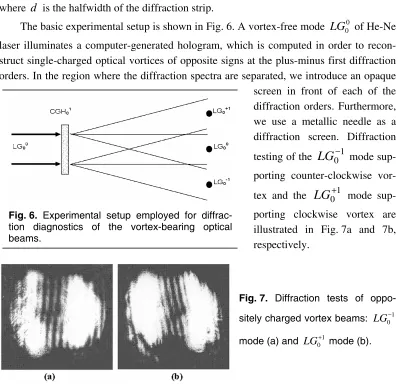
The basic experimental setup is shown in Fig. 6. A vortex-free mode 0 0
LG
of He-Ne laser illuminates a computer-generated hologram, which is computed in order to recon-struct single-charged optical vortices of opposite signs at the plus-minus first diffraction orders. In the region where the diffraction spectra are separated, we introduce an opaque screen in front of each of the diffraction orders. Furthermore, we use a metallic needle as a diffraction screen. Diffraction testing of theLG
0−1 mode sup-porting counter-clockwise vor-tex and theLG
0+1 mode sup-porting clockwise vortex are illustrated in Fig. 7a and 7b, respectively.Fig. 7. Diffraction tests of oppo-sitely charged vortex beams: 1 0 LG−
mode (a) and 1 0
LG+ mode (b).
As a conclusion, the diffraction technique for diagnostics of phase singularities pro-vides comprehensive information on the beam singularity, viz. the information on both the module parameters of the topological charge of the observed vortex and its sign. The mentioned quantities are derived respectively from the magnitude and the direction of the Young’s interference fringes in the geometrical shadow appearing behind the opaque strip. The technique requires neither additional reference beam nor complicated optical setup. The former fact makes the method convenient when diagnosing vortices in par-tially spapar-tially coherent [7–9] and polychromatic [10] beams, for which formation of co-herent reference waves is problematic or, sometimes, impossible. Contrary to the inter-ference cross-correlation techniques where one compares the phases of singular and ref-erence beams, the diffraction technique is in fact autocorrelation one. Namely, it in-volves comparison of the phases at different points of one singular beam. That is why
there is no need in any a priori information on the beam under study. In contrast to the interference technique, the results obtained with the diffraction technique (see Fig. 7) are unbiassed in a sense that they are invariant with respect to the orientation of the pattern. Really, the direction of bending of the Young’s interference fringes is always the same, thus enabling unambiguous determination of the sign of topological charge of the beam under test.
2.4. Wave-guide technique
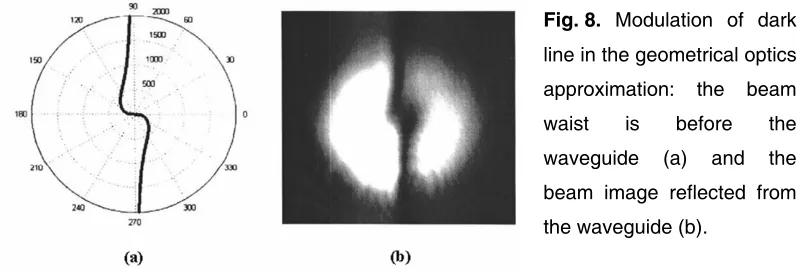
One more technique has been suggested recently for determining the structure of the op-tical vortices. It originates from the model of planar waveguide with a leaky mode [11]. Similarly to the Dove-prism and the diffraction techniques, here the reference beam is not used, although the principle of detection of the vortex is different. Multi-beam interfer-ence occurring in a planar waveguide results in high angular resolution, so that such an “interferometer” can be used for diagnostics of phase singularities.
A planar waveguide with a leaky mode is a set of two equal-sided glass prisms, with an immersion liquid between them. The refraction index of the immersion is less than that of the prisms. The surfaces of the prisms sandwiching the immersion in between are parallel. As a result, a narrow dark fringe appears in the cross-section of reflected beam, which is observed both in the near and far fields. This provides a possibility for observing a line of zero intensity across the beam that represents a non-localized (infinitely ex-tended) wave dislocation. Scanning the optical beam by such a fringe of zero intensity, one can determine the wave front structure of the beam under test, following from the fringe shape.
As seen from Fig. 8, the parameters (the module and sign) of the vortex beam in the presence of singularity are determined from typical bending of the fringe of zero inten-sity. Similarly to the diffraction technique, the pattern is invariant with respect to rotation by 180 deg. Therefore the direction of bending of the zero-intensity fringe is informative and the technique requires no a priori information.
Fig. 8. Modulation of dark line in the geometrical optics approximation: the beam waist is before the waveguide (a) and the beam image reflected from the waveguide (b).
realiza-tion of this approach is rather sophisticated. In order to provide multi-beam interference in a thin layer of immersion liquid (e.g., glycerin), one must use precise goniometric equipment. Besides, the test beam must have a diffraction-limited divergence. Moreover, one must take into account that a unique high resolution (6×10⁻⁵ for He-Ne laser) is
pre-dicted by the geometrical theory of the technique alone (for the case of infinitely narrow dark line). At the same time, within the wave optics approximation and even more so in the experiment, such the resolution cannot be achieved, whereas the infinitely narrow “black” line is surrounded by relatively broad area of non-zero, though very low, inten-sity (see Fig. 8b).
2.5. Chromascope technique
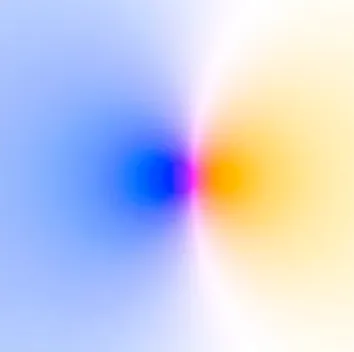
A quite novel technique for processing of phase singularities in the polychromatic speckle fields arises from a concept of chromascope [13, 14]. The latter is intended for explana-tion of a universal colour gamut seen by a human observer near an isolated zero, viz., within the area where the complex amplitude
ψ
( )
R,k varies linearly with the position R(over the spatial range considered) and the wavenumber
k
(over the visible range). In is remarkable that in this case “Approximately circular regions of colours, including intense blue, red and yellow, separated by a large white circle, merge into an unsaturated “asymp-totic white”… the region in the total gamut of possible colours that the universal pattern occupies is rather small; most notably, there is no green” (see Fig. 9). The concept of chromascope is implemented using the fol-lowing equation:) , , max(R G B B G R B G R CR =
, (2)
where we normalize the colours at each point (ξ,η) of the field, basing on the maximum intensity for any colour in the RGB scale. This increases the brightness for the points of low intensity, viz., in the vicinity of the amplitude zeroes. Therefore, if all of the three spectral components are of low inten-sity, then these areas processed by a chro-mascope appear "white" [15].
The technique considered above can be applied for detecting the vortices in the poly-chromatic fields from the universal gamut of colours. Nonetheless, it is inapplicable for determining the vortex parameters. Besides, we deal in fact with a software technique assigned just for the polychromatic fields, rather than a universal experimental technique.
3. Conclusions
In this work we have analysed a number of techniques for detection and diagnostics of phase singularities in optical beams and fields. We have argued the advantages and dis-advantages of these diagnostic techniques. It has been shown that some of the techniques (in particular, the Dove-prism and the chromascopic ones) are applicable for detecting the phase singularity alone, though they do not provide information on the parameters of that singularity.
The other kind of the techniques (i.e., the interference one) requires some a priori information on the curvature radius of the reference beam (the case of the on-axis tech-nique) or on the mutual orientation of the reference and singular beams (the off-axis technique). It is needed for determining correctly the sign of the topological charge of vortices. Having this information, one can obtain unambiguous and comprehensive re-sults of diagnostics. Such the techniques are the most popular among experimentalists elaborating completely spatially coherent monochromatic fields.
At the same time, the interference techniques become less convenient or even im-possible for the domain of partially spatially coherent and polychromatic fields. Some techniques (e.g., the waveguide one) require complicated and high-precision equipment, as well as fine adjustment of the optical apparatus. Practical resolution provided in frame of the technique mentioned above might be considerably less than that predicted by the geometrical optics. Nevertheless, this technique is unbiassed and enables unambiguous diagnostics of optical vortices without any a priori information on the beam parameters. Moreover, it can be applied to white-light vortices, too.
In our opinion, the most flexible technique for the diagnostics of phase singularities is the diffraction one. It is based on the Young’s model of the diffraction phenomena (the model of the edge diffraction wave) and the Young’s interference experiment in its initial form, with the opaque strip. This technique requires neither a priori information on the tested beam nor complicated optical equipment and. At the same time, it gives unambi-guous and comprehensive data on the parameters of singular beam, including the module and the sign of its topological charge. This technique has been successfully used in ex-perimental studies of phase singularities of completely coherent, partially spatially coher-ent, inhomogeneously polarized and polychromatic light beams.
References
1. Baranova N B, Zeldovich B Ya, Mamayev A V, Pilipetsky N F and Shkunov V V, 1981. Dislocation of the wavefront of a speckle-inhomogeneous field (theory and experiment). JETP. 33: 1789–1797.
2. Soskin M S and Vasnetsov M V, Singular Optics, in Progress in Optics 42 (E. Wolf, Ed.): 219–276 (2001).
3. Basistiy I V, Soskin M S and Vasnetsov M V, 1995. Optical wavefront dislocations and their properties. Opt. Comm. 119: 604–612.
helical wave fronts. Semicond. Phys., Quant. Electron & Optoelectr. 6 (2): 254–258. 5. Allen L, Padgett M J and Babiker M, The orbital angular momentum of light, in
Progress in Optics 40 (E. Wolf, Ed.): 291–371 (1999).
6. Bogatyryova G V, Felde Ch V and Polyanskii P V, 2003. Referenceless testing of vortex optical beams. Opt. Appl. 33: 695–708.
7. Bogatyryova G V, Felde Ch V, Polyanskii P V, Ponomarenko S A, Soskin M S and Wolf E, 2003. Partially coherent vortex beams with a separable phase. Opt. Lett. 28: 878–880.
8. Schouten H F, Gbur G and Wolf E, 2003. Phase singularities of the coherence func-tion in Young’s interference pattern. Opt. Lett. 28 (12): 968–970.
9. Gbur G and Visser T D, 2003. Coherence vortices in partially coherent beams. Opt. Commun. 222: 117–125.
10. Polyanskii P V, Optical correlation diagnostics of phase singularities in polychro-matic fields, Chapter 2 in Optical Correlation Applications and Techniques (O. An-gelsky, Ed.), SPIE Press A168, Bellingham (2007).
11. Marienko I G, Pas’ko V A, Slyusar V V, Soskin M S and Vasnetsov M V, 2002. Investigation of an optical vortex beam with a leaky planar waveguide. Opt. Com-mun. 213: 1–11.
12. Soskin M S, Polyanskii P V and Arkhelyuk O O, 2004. Computer-synthesized holo-gram-based rainbow optical vortices. New J. Phys. 6: 196.1–196.8.
13. Angelsky O V, Maksimyak A P, Maksimyak P P and Hanson S G, Interference di-agnostics of white-light vortices, Opt. Express, 13: 8179–8183 (2005).
14. Berry M V, Exploring the colours of dark light, New J. Phys., 4: 74.1–74.14 (2002). 15. Leach J and Padgett M J, 2003. Observation of chromatic effects near a white light