The Assignment of Grammatical Gender in German:
Testing Optimal Gender Assignment Theory
Emma Charlotte Corteen
Trinity Hall
September 2018
i
The Assignment of Grammatical Gender in German: Testing Optimal Gender Assignment Theory Emma Charlotte Corteen
Abstract
The assignment of grammatical gender in German is a notoriously problematic phenomenon due to the apparent opacity of the gender assignment system (e.g. Comrie 1999: 461). Various models of German gender assignment have been proposed (e.g. Spitz 1965, Köpcke 1982, Corbett 1991, Wegener 1995), but none of these is able to account for all of the German data.
This thesis investigates a relatively under-explored, recent approach to German gender assignment in the form of Optimal Gender Assignment Theory (OGAT), proposed by Rice (2006). Using the framework of Optimality Theory, OGAT claims that the form and meaning of a noun are of equal importance with respect to its gender. This is formally represented by the crucial equal ranking of all gender assignment constraints in a block of GENDER FEATURES, which is in turn ranked above a default markedness hierarchy *NEUTER »*FEMININE »*MASCULINE,which isbased on category size.
A key weakness of OGAT is that it does not specify what constitutes a valid GENDER FEATURES constraint. This means that, in theory, any constraint can be proposed ad hoc to ensure that an OGAT analysis yields the correct result. In order to prevent any constraints based on ‘postfactum rationalisations’
(Comrie 1999: 461) from being included in the investigation, the GENDER FEATURES constraints which have been proposed in the literature for German are assessed according to six criteria suggested by Enger (2009), which seek to determine whether there is independent evidence for a GENDER FEATURES constraint.
ii Declaration
iii Acknowledgements
Firstly, I would like to thank the Arts and Humanities Research Council for funding this project. I would also like to thank the Cambridge Trust and the Pigott Scholars Programme for their offers of funding,
and the Vice Chancellor for my Honorary Vice Chancellor’s Award.
My greatest thanks go to my supervisor, Dr Sheila Watts, for her continual support and guidance throughout this project. I am extremely grateful not only for her invaluable academic insight, but also for her never-ending patience, positivity and encouragement.
I am also grateful to all of the other members of the Department of German and Dutch and the Department of Theoretical and Applied Linguistics at Cambridge University who provided me with advice and support throughout my time at Cambridge. Particular thanks go to Dr Bert Vaux, Dr Napoleon Katsos, Dr David Willis, Dr Jim Blevins, Professor Sarah Colvin and Dr Simon Pickl.
I would also like to thank the Cambridge Statistics Clinic at the Centre for Mathematical Sciences for their assistance with my statistical queries.
My thanks also go to the many native German speakers who I consulted throughout the project, and particularly the 100 who took part in my experiment.
Additionally, I would like to thank members of staff at the Schools of Modern Languages and English Literature, Language and Linguistics at Newcastle University, where my studies of Linguistics began. In particular, I would like to thank Dr Carol Fehringer and Andrea Wilczynski for nurturing my interest in German linguistics and encouraging me to apply for postgraduate study.
iv
Contents
Chapter 1: Introduction ... 1
1.1 Grammatical gender in German ... 1
1.2 Gender assignment in German ... 2
1.3 Gender assignment principles ... 7
1.3.1 Morphological principles ... 7
1.3.1.1 Derivation via affixation ... 8
1.3.1.2 Implicit derivation ... 9
1.3.1.3 Conversion ... 9
1.3.1.4 Compounds ... 10
1.3.1.5 Reductions ... 10
1.3.1.6 Inflection ... 11
1.3.1.7 Evidence for morphological principles ... 14
1.3.2 Phonological principles ... 15
1.3.2.1 Word ending ... 15
1.3.2.2 Other phonological factors ... 16
1.3.2.3 Evidence for phonological principles ... 17
1.3.3 Semantic principles ... 18
1.3.3.1 The Natural Gender Principle (NGP) ... 18
1.3.3.2 Other semantic classes ... 19
1.3.3.3 Levels of abstraction ... 20
1.3.3.4 Evidence for semantic principles ... 22
1.4 Interaction of gender assignment principles ... 23
1.4.1 Semantics » form ... 24
1.4.2 Form » semantics ... 26
1.4.3 Morphology » semantics » phonology ... 27
1.4.4 Hierarchy of individual principles ... 28
1.4.5 Optimal Gender Assignment Theory (OGAT) ... 29
1.4.5.1 Theory outline ... 29
1.4.5.2 Strengths of OGAT ... 34
1.4.5.3 Weaknesses and aspects of OGAT for further investigation ... 37
1.4.5.4 Previous testing of OGAT ... 45
1.4.5.4.1 OGAT and German ... 45
1.4.5.4.2 OGAT and other languages ... 49
1.5 Summary and plan for investigation ... 52
Chapter 2: Evaluating GENDER FEATURES constraints ... 55
2.1 Introduction ... 55
2.2 The noun sample and the constraints... 56
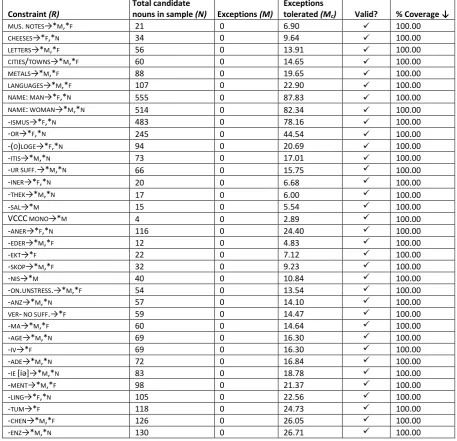
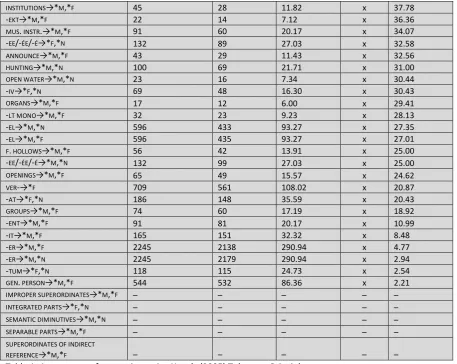
2.3 Criterion 1: Coverage of candidate nouns ... 60
2.4 Criterion 2: Typological parallels ... 70
2.5 Criterion 3: Parallels outside of gender assignment ... 78
v
2.7 Criterion 5: Accounting for exceptions ... 91
2.8 Criterion 6: Productivity ... 95
2.8.1 Neologisms ... 97
2.8.2 Historical gender changes ... 100
2.9 Refinement of constraint set ... 103
2.10 Summary of results ... 109
Chapter 3: Analysis – testing OGAT ... 113
3.1 Introduction and preliminary analysis ... 113
3.2 Constraint-related issues ... 118
3.2.1 Constraints with multiple versions ... 118
3.2.2 Constraints whose application is problematic ... 121
3.2.2.1 DEVERBAL STEM→*F,*N
... 121
3.2.2.2 SUPERORDINATES→*M,*F ... 129
3.2.2.3 DEVERBAL -T→*M,*N
... 135
3.2.2.4 -MA→*M,*F ... 137
3.3 Noun-related issues ... 138
3.3.1 Loanwords ... 138
3.3.1.1 Donor gender ... 140
3.3.1.2 Semantic equivalence ... 141
3.3.1.3 Homonymy/partial homonymy ... 147
3.3.1.4 Default gender ... 149
3.3.1.5 Summary ... 150
3.3.2 Nouns with multiple meanings or forms ... 150
3.3.2.1 Meaning variation ... 151
3.3.2.1.1 Multiple meanings vs. one meaning ... 151
3.3.2.1.2 Multiple meanings vs. one meaning in the sample ... 153
3.3.2.1.3 Polysemy vs. homonymy ... 153
3.3.2.1.4 Polysemy vs. homonymy in the sample ... 156
3.3.2.1.5 Approaches to polysemy ... 157
3.3.2.1.6 Polysemy in the sample ... 160
3.3.2.2 Form variation ... 162
3.3.3 Complex nouns and “strong rules” ... 163
3.3.3.1 Heads ... 164
3.3.3.1.1 Head identification ... 164
3.3.3.1.2 Head position ... 165
3.3.3.2 Multi-word units and OGAT ... 166
3.3.3.2.1 Compounds ... 166
3.3.3.2.2 Lexicalised phrases ... 167
3.3.3.2.3 Multi-word units and OGAT ... 168
3.3.3.3 Nouns derived via affixation and OGAT ... 169
3.3.4 Subset of 55 nouns ... 173
3.3.4.1 Placenames ... 173
vi
3.3.4.3 Plural terms ... 181
3.3.4.4 Regional terms ... 182
3.3.4.5 Archaic nouns ... 183
3.3.4.6 Homonyms ... 184
3.3.4.7 Adjectival nouns ... 185
3.3.4.8 Multiple-gender nouns ... 186
3.4 Remaining issues ... 191
3.4.1 New constraints ... 192
3.4.2 Other nouns in the sample ... 196
3.4.3 Testing alternative default hierarchies ... 198
3.5 Effectiveness of OGAT vs. OGAT II and exceptions ... 200
3.5.1 OGAT vs. OGAT II ... 200
3.5.2 Exceptions ... 201
3.5.3 OGAT II vs. other approaches ... 204
3.5.4 Economising the theory ... 205
3.6 Summary ... 207
Chapter 4: Testing the predictive power of OGAT II ... 209
4.1 Introduction ... 209
4.2 Experiment design ... 209
4.3 Method ... 213
4.4 Results ... 216
4.5 Discussion ... 219
4.6 Conclusions and implications of results ... 232
Chapter 5: Conclusions and directions for further work ... 241
Reference list ... 247
Appendices ... 273
Appendix A: The sample ... 273
Appendix B: The constraints ... 277
Appendix C: Sources for criterion 1 ... 303
Appendix D: Sources for criterion 4 ... 309
Appendix E: Summary of results from Chapter 2 ... 313
Appendix F: Summary of results from Chapter 3 ... 319
1 Chapter 1: Introduction
‘A person who has not studied German can form no idea of what a perplexing language it is […]. Every noun has a gender, and there is no sense or system in the distribution; so the gender of each must be learned separately and by heart. There is no other way. To do this one has to have a memory like a memorandum-book. In German, a young lady has no sex, while a turnip has. Think what overwrought reverence that shows for the turnip, and what callous disrespect for the girl.’
– Mark Twain, The Awful German Language (1879)
1.1 Grammatical gender in German
Gender is a grammatical feature present in around half of the world’s languages which separates nouns into classes (Corbett 2013, Audring 2016). In German, there are three grammatical genders: masculine, feminine and neuter. Almost all German nouns belong to one of these categories. For instance, Tisch ‘table’ is masculine, Lampe ‘lamp’ is feminine, and Fenster ‘window’ is neuter. In German, gender is said to be ‘covert’ because the gender of a noun is not marked on the noun (the “controller”) itself (Corbett 1991: 62). In accordance with Hockett’s (1958: 231) well-known definition of gender, ‘genders are classes of nouns reflected in the behaviour of associated words’, gender in German is visible only on agreeing elements (known as “targets”) such as determiners, attributive adjectives, relative pronouns and personal pronouns. For example, the masculine gender of Tisch is visible on the determiner in der Tisch ‘the.MASCtable’.
The gender of a German noun can, however, only be seen on agreeing targets when the noun is in the singular. In the plural, gender is said to be ‘neutralised’, since all targets are marked identically (e.g. Bauch 1971: 412, Weinrich 2007: 326, Kürschner & Nübling 2011: 363). Accordingly, the small subset of nouns which appear only in the plural and have no singular variant, known as pluralia tantum, are said to have no gender, e.g. Eltern ‘parents’, Ferien‘holidays’, Leute ‘people’ (e.g. Wegener 2000: 541, Nübling 2008: 289).
For all nouns with a singular form, however, i.e. most German nouns, gender is obligatory (e.g. MacKay 1999: 73, Hickey 2000: 639). The vast majority of German nouns belong unequivocally to just one gender. There are, however, two main categories of nouns for which this is not the case: “ multiple-gender” nouns and “hybrid” nouns.
2
vs. das Virus (scientific contexts) (e.g. Hickey 2000: 625, Duden Online-Wörterbuch 2018f). Many MGNs can also be found amongst relatively recent loanwords, e.g. der/das Laptop (e.g. Hoberg 2004: 79). MGNs constitute just 1.3% of nouns listed in the Duden dictionary (the standard reference work for German) (Duden Sprachwissen 2017).
“Hybrid” nouns, are nouns which ‘neither […] take the agreements of one consistent agreement pattern nor belong to two or more genders’ (Corbett 1991: 183). That is to say, while the hybrid noun itself is said to belong to just one gender, its targets may display agreement with more than one gender. In German, hybrid nouns are usually those which refer to people but whose grammatical gender does not match the conceptual gender of the referent, e.g. Mädchen ‘girl’. In line with Corbett’s (1979, 1991, 2006) Agreement Hierarchy, all attributive targets used in conjunction with
Mädchen agree with the noun’s grammatical gender (neuter), but anaphoric personal pronouns may agree with either the noun’s grammatical gender or the conceptual gender of the referent (feminine) (e.g. Batliner 1984: 850, Semplicini 2012: 141). It has been argued that the kind of agreement displayed by an anaphoric personal pronoun may be influenced by factors such as the distance between the controller noun and the personal pronoun (Köpcke, Panther & Zubin 2010) or, in the case of Mädchen specifically, the age of the referent in question (Braun & Haig 2010). Due to the presence of hybrid nouns in German, it is important to look at attributive targets only in order to reliably ascertain the grammatical gender of a noun.
1.2 Gender assignment in German
The question of what determines the grammatical gender of a noun is highly intriguing, and is one which is central to the present study. How is it that native speakers know which gender a particular noun should be? Why, for instance, is Schuh‘shoe’ masculine but Mütze ‘cap’ feminine? In some languages, the reasons for nouns being allotted to different genders is relatively transparent, e.g. Tamil (Corbett 1991: 9) and Russian (Rodina & Westergaard 2013: 95). German, however, is notorious for its seemingly opaque gender system (e.g. Salmons 1993: 187, Comrie 1999: 461, Hickey 2000: 628, Schmid 2002: 100), which has led various linguists to claim that German nouns are assigned genders completely arbitrarily.
The notion of the arbitrariness of the German gender system was widespread in the early 20th century.
3
declares that ‘in German, […] the gender of only a very small percentage of nouns can be predicted […], that is, the German gender system is largely arbitrary’.
According to this view, due to the perceived lack of regularity in gender assignment, speakers have no option but to simply memorise the gender of each noun. That is to say, gender must be stored for each noun in the lexicon and retrieved each time a noun is used (Corbett 1991: 7, van Berkum 1996: 33, Conzett 2006: 224).
However, over the past few decades, results from a number of in-depth analyses based on corpus data have revealed various patterns of correlation between the gender of a German noun and its semantic, morphological and phonological properties (e.g. Arndt 1970, Altmann & Raettig 1973, Zubin & Köpcke 1981, 1986, Köpcke 1982, Köpcke & Zubin 1983, 1984). These patterns will be outlined in Section 1.3. Studies have proposed that using the regularities observed, the gender of a large proportion of German nouns can be systematically predicted. For instance, Zubin & Köpcke (1981, 1986), Köpcke (1982), and Köpcke & Zubin (1983, 1984) estimate that the gender of around 90% of the 1466 monosyllables in the Duden can be accounted for using a combination of semantic, phonological and morphological principles.1 Such findings have led many linguists to conclude that gender assignment
in German is not arbitrary but rather a largely rule-governed process (e.g. Mills 1986, Wegener 1995, Eisenberg 1999, Schmid 2002).
Furthermore, similar estimates have been made for other languages whose gender classification has also previously been dismissed as arbitrary. For Dutch, for instance, Frieke (1988) demonstrates the ability of a set of gender assignment rules to account for the genders of around 80% of a corpus of 763 monosyllables. For Norwegian, Trosterud (2001) proposes a set of assignment rules which he claims cover around 94% of nouns, and for French, Tucker, Lambert & Rigault (1977) establish the ability of a set of phonological gender assignment rules to account for around 85% of a corpus of 31,619 nouns.2
On the basis of such data, Corbett (1994: 1350) argues that gender assignment is ‘essentially systematic’ in all languages. He reasons that, due to the high degree of regularity in gender assignment, native speakers do not have to rely on the memorisation of gender (i.e. lexical storage), but can instead compute the gender of the vast majority of nouns based on their semantic, morphological and phonological information, which is in any case available in the lexicon (Corbett 1991: 66ff.). That is to say, speakers possess a ‘gender assignment system’, specifically in the lexicon,
4
which enables them to derive the genders of most nouns based on their formal and sematic features (Corbett 1991: 7, 66). Speakers therefore must only store the genders of the small proportion of nouns whose gender is synchronically unpredictable (e.g. Mills 1986: 41,Hickey 2000: 644).
Furthermore, Corbett (1991: 7), alongside other linguists, argues in favour of the computation of gender on the basis that the alternative, namely storage, is problematic. He states that having to simply remember the gender of every single noun in the lexicon without taking advantage of any regularities would entail ‘a considerable feat of memory’. Zubin & Köpcke (1981: 447) and Corbett (1991: 7) reason that if the gender of every noun had to be memorised, then it would be expected that native speakers would make frequent gender errors (as with non-natives), which they do not. Moreover, it is argued that the memorisation of the genders of tens of thousands of nouns would present an ‘insurmountable task to the language learner’ (Zubin & Köpcke 1981: 447) and would place ‘extreme stress’ on a learner’s memory (Wegener 2000: 514).
However, van Berkum (1996: 31f.) states that this argument alone is not sufficient to dismiss the possibility of gender storage. He argues that, if native speakers are able to learn the ‘essentially
arbitrary’ form of each item in the lexicon, then it is not impossible that they would be able to do the same for gender. Van Berkum (1996: 32f.) claims that native speakers may well both have a system for deriving gender online and store gender too. He does not doubt that native speakers of Dutch are able to derive the neuter gender of meisje ‘girl’ from the fact that it is a diminutive, but maintains that this does not eliminate the possibility of storing the gender of this noun as well. Although systematicity in gender assignment would undeniably aid acquisition, van Berkum (1996: 32) argues that there is no a priori reason to assume that gender could not be learned without it.
As noted by e.g. Conzett (2006: 230), the perceived validity of this argument is highly dependent on one’s view of redundancy in the language faculty. To have a system of regularities but not always exploit them or not exploit them at all would be highly redundant and would violate the linguistic principles of economy and parsimony, as well as the more general principle of Occam’s razor. As Salmons (1994: 187) states, to say that German gender assignment is not rule based is to violate the claim that ‘language constitutes rule-governed behaviour’. However, the premise of this argument is not universally held, and, given the scale of the issue, its discussion is not within the scope of this project.
5
generally tend to agree on the gender that should be assigned to a loan, suggesting that this mechanism is part of the linguistic competence of all native speakers. This is corroborated by the results from a number of studies on loanwords in German, e.g. Arndt (1970), Carstensen (1980), Gregor (1983), Callies, Onsyko & Ogiermann (2012) etc.
Similarly, when presented with pseudo-nouns in an experimental setting, i.e. a scenario in which gender retrieval is simply not a possibility, speakers are able to assign genders to the pseudo-nouns (e.g. Köpcke & Zubin 1983: 167, Corbett 1991: 7). As with loans, speakers generally do this with a high degree of consistency, as is illustrated by e.g. Lang (1976), Carstensen (1980), Köpcke & Zubin (1983), Mills (1986), Wegener (1995, 2000), Schwichtenberg & Schiller (2004) and Hohlfeld (2006) for German; Mastropavlou & Tsimpli (2011) for Greek; Zekhnini & Hulstijn (1995) for Dutch; Tucker et al. (1968, 1977) and Karmiloff-Smith (1979) for French; and Sadek, Kiraithe & Villareal (1975) for Spanish. This suggests that native speakers have the ability to somehow “work out” the gender of a noun based on its features (Corbett 1991: 7).
This is generally perceived to be convincing supporting evidence for the presence of a mechanism in the language faculty that is able to assign gender (e.g. Conzett 2006: 236). However, van Berkum (1996: 31) highlights that, while it is possible that there is indeed a mechanism in the language faculty which is used to assign gender to “new” words (i.e. loans, pseudo-nouns, previously unheard native nouns), it is also possible that this mechanism is not always exploited or not exploited at all for assigning gender to known words, i.e. that gender is derived for new nouns but stored for existing nouns.
Again, the validity of this counter-proposal is similarly dependent on one’s view of redundancy in the language faculty. While it is possible that a native speaker possesses a mechanism that can assign gender to the vast majority of nouns but does not always exploit it unless the noun is new, it would be a highly redundant model of gender assignment. This is especially true because presumably the mechanism for assigning gender to new nouns would consist of generalisations which have been made based on existing nouns in the lexicon. Nevertheless, even if the system were redundant and the mechanism were not exploited for all nouns, it is still agreed that a mechanism for gender assignment exists, and it is this mechanism which is of interest.
6
from empirical testing in order to determine whether native speakers pick up on and make use of the regularities observed, a point also raised by Corbett (1991: 70) and Conzett (2006: 229).
Psycholinguistic experiments designed to test this very question, i.e. whether native speakers take advantage of gender assignment regularities or not, have produced very mixed results, most likely due to the wide variety of experimental methods used.
On the one hand, for example, results from experiments by a number of linguists on speakers who are anomic or in a “tip-of-the-tongue” state, show that the participants were able to correctly assign gender to nouns without being able to retrieve their word form, suggesting that gender can be assigned without knowledge of a noun’s phonological form. This was found for e.g. Italian by Badecker et al. (1995), Miozzo & Caramazza (1997), Caramazza & Miozzo (1997) and Vigliocco et al. (1997); for French by Henaff Gonon et al. (1989); and for Spanish by Avila et al. (2001). These linguists therefore conclude that formal features cannot influence gender assignment, arguing in favour of the gender storage model. However, Conzett (2006: 231ff.) highlights some potential methodological issues with a number of these studies, and, moreover, the results of these experiments are not incompatible with the idea that semantic features may have an effect on gender assignment.
On the other hand, results from a number of other psycholinguistic studies contradict the findings of these experiments. For instance, in their study on Italian native speakers, Caffarra et al. (2015) find ERP (event-related brain potential) data which demonstrates that the brain detects formal cues to gender during sentence processing in line with the gender computation model, i.e. that noun ending does have an effect on gender assignment in Italian. Additionally, results relating to error rates and reaction times from a number of experiments involving gender decision tasks provide evidence which supports the idea that native speakers make use of a noun’s formal features (specifically its ending) when assigning gender. This has been shown for French by e.g. Desrochers & Paivio (1990) and Taft & Meunier (1998); for Spanish by Hernandez et al. (2004) and Afonso et al. (2014); and for Italian by Padovani & Cacciari (2003) and De Martino et al. (2010).
Furthermore, van Berkum (1996: 93-187), in his study of Dutch gender, tests a specific model of gender storage, namely that proposed by Jescheniak & Levelt (1994), who state that gender is stored for all nouns and the retrieval of a noun’s gender from the lexicon is made faster by the gender of that noun having been retrieved recently before,3 and finds that his results contradict this hypothesis. While his
results do not necessarily disconfirm that gender is stored, they do rule out this particular model of storage (van Berkum 1996: 187).
7
A third option has also emerged from the psycholinguistic literature, namely that gender can be both stored and computed. Bates et al. (1995), for example, found that Italian native speakers were influenced by word-ending in a gender selection task but not in a noun repetition task. Consequently, they propose that the gender of a noun can be retrieved independently of its form but then can also be computed on the basis of its formal features as a “checking” mechanism when the task requires.
In their study of Hebrew, Gollan & Frost (2001) also find that computation as a method of “checking” occurs in specific tasks, such as when participants are presented with ungrammatical data. They state that the degree to which gender is computed is likely to be language specific, as there will be ‘differences in the availability and strength of […] mechanisms for deriving gender’ (Gollan & Frost 2001: 648).
It therefore seems that, in spite of the conflicting evidence, the computation of gender remains a plausible possibility. However, the degree to which it occurs in a language and the circumstances under which it occurs are matters for further psycholinguistic investigation.
Given that there is at least some psycholinguistic evidence to suggest that native speakers do exploit a mechanism for computing gender, it seems worth exploring what this mechanism consists of. The next section will focus on the case of German specifically, and the various morphological, phonological and semantic gender assignment principles that have been proposed in the literature. For each type of principle, evidence for their employment by native German speakers will be discussed.
1.3 Gender assignment principles
Among those who maintain that gender in German is largely computed rather than stored, it is widely agreed that the mechanism for assigning gender uses regularities relating to a noun’s form and
meaning (e.g. Zubin & Köpcke 1981, Köpcke 1982, Mills 1986, Corbett 1991, Wegener 1995, Köpcke & Zubin 1996, Hickey 2000, Hoberg 2004, Weinrich 2007). As a result of numerous studies on German gender, various morphological, phonological and semantic gender assignment principles have been formulated. In this section, a number of these principles will be discussed and evidence for their usage by native speakers will be presented.
1.3.1 Morphological principles
8 1.3.1.1 Derivation via affixation
The connection between a noun’s derivational morphological features and its gender is well established for German (e.g. Arndt 1970, Mills 1986: 30f., Köpcke & Zubin 1996: 28, Hickey 2000: 630, Hoberg 2004: 86-89, Weinrich 2007: 326f.). Perhaps the most widely cited gender assignment principles are those involving derivational affixes, which typically categorically determine a noun’s gender. For example, nouns with the suffixes -er (e.g. Lehrer)or -ling (e.g. Bratling)are masculine, nouns with the suffixes -in (e.g. Lehrerin), -schaft (e.g. Freundschaft) or -ung (e.g. Meinung) are feminine, and nouns with the suffixes -chen (e.g. Bäumchen) or -lein (e.g. Büchlein) are neuter(e.g. Altmann & Raettig 1973: 302, Flämig 1991: 453, Köpcke 1982: 71, Mills 1986: 30, Steinmetz & Rice 1989: 165, Köpcke & Zubin 1996: 476, Zifonun et al. 1997: 33, Hickey 2000: 630, 635, Hoberg 2004: 86f., Menzel 2004: 66, Thomoglou 2004: 41, Weinrich 2007: 326f., Duden Grammatik 2009: 164ff., Engel 2009: 280f., Eisenberg 2013: 133).
There are also, however, a small number of suffixes which are associated with two genders. For instance, nouns in -nis can be either neuter or feminine, e.g. das Ereignis, die Erlaubnis, and nouns in
-tum can be neuter or masculine, e.g. das Eigentum, der Reichtum (e.g. Steinmetz 1986: 200, 2006: 1424; Flämig 1991: 453; Zifonun et al. 1997: 33; Nelson 1998: 215; Hickey 2000: 629; Hoberg 2004: 87ff.; Menzel 2004: 66; Thomoglou 2004: 41, Duden Grammatik 2009: 166, Engel 2009: 279, 282; Eisenberg 2013: 133). Nevertheless, for both of these suffixes, their association with neuter is stronger. Estimates of the proportion of neuter nouns in -nis range from around 60% (Hoberg 2004: 89) to over 75% (Leiss 2005: 23), and for nouns in -tum, all but two (Reichtum and Irrtum) of the 118 nouns listed in the Duden are neuter. Moreover, it is claimed that both -nis and -tum are now only productive in the neuter (e.g. Hickey 2000: 629, Eisenberg 2013: 134).
Additionally, a gender assignment principle has been proposed which involves the derivational prefix
Ge-, stating that nouns with this feature are usually neuter, e.g. Gefühl, Gestein (e.g. Mills 1986: 30, Hickey 2000: 631, Menzel 2004: 66, Rice 2006: 1396, Steinmetz 2006: 1424). Unlike the majority of principles relating to suffixes, however, this principle is not categorical, but rather based on a tendency.
9
nouns with the “foreign” suffixes -ment (e.g. Fundament) or -ium (e.g. Studium) are neuter (e.g. Altmann & Raettig 1973: 302, Mills 1986: 30, Steinmetz 1986: 197, Flämig 1991: 453, Zifonun et al. 1997: 33, Kratochvilová 2000: 71, Hoberg 2004: 86f., Menzel 2004: 66, Thomoglou 2004: 41, Chan 2005: 52, Weinrich 2007: 326f., Duden Grammatik 2009: 164ff., Engel 2009: 279ff.).
The gender of nouns derived via affixation will be considered further in Section 3.3.3.3.
1.3.1.2 Implicit derivation
In contrast to nouns derived by means of affixation, also termed “explicit” derivation (e.g. Fleischer & Barz 1992: 46, Donalies 2002: 97f.), there are also nouns which are claimed to have been formed via derivation without the use of affixes, a process termed “implicit” derivation (e.g. Fleischer & Barz 1992: 51, Russ 1994: 195). Nouns which are most commonly categorised as products of implicit derivation are nominalised verb stems with an ablauted stem vowel, e.g. Gang, Flug, Zwang (e.g. Fleischer & Barz 1992: 41, 2012: 89; Eisenberg 1999: 281; Donalies 2002: 98, 135; Lohde 2006: 50f.). Such nouns are relevant to gender assignment, since it has been observed that they have a strong association with masculine (Flämig 1991: 453, Hickey 2000: 643f., Hoberg 2004: 90, Chan 2005: 55). Also sometimes categorised alongside these nouns are nominalised verb stems which have not undergone a stem vowel change, e.g. Bau, Lauf, Versuch (e.g. Russ 1994: 201). In terms of gender assignment, such a grouping is fitting, since it has been observed that these nouns are also typically masculine (e.g. Flämig 1991: 453, Hickey 2000: 643f., Hoberg 2004: 90, Chan 2005: 55). However, nominalised verb stems without ablaut are sometimes categorised as products not of implicit derivation but of conversion (e.g. Eisenberg 1999: 281, Hoberg 2004: 89), a process which will be discussed in the following section. Note that nouns of this type will be discussed in further detail in 3.2.2.1.
1.3.1.3 Conversion
Like implicit derivation, conversion is a word-formation process which does not involve (overt) affixation. It is usually seen either as being completely distinct from derivation, thought to consist of a simple change of syntactic category of a lexical item to form a new lexeme (e.g. Bauer 1983: 32, Plag 1999), or it is classified as a kind of derivation, often labelled “zero derivation”, and is thought to involve the affixation of a phonologically null, class-changing morpheme, or “zero affix”, to the base (e.g. Marchand 1969, Kiparsky 1982).
10
Steinmetz 1986: 198, Flämig 1991: 453, Russ 1994: 201, Hickey 2000: 630, Hoberg 2004: 90f., Menzel 2004: 63, Chan 2005: 55ff., Duden Grammatik 2009: 159, Engel 2009: 282, Eisenberg 2013: 134). These include nominalised infinitives (e.g. das Laufen), adjectives4 (e.g. das Schwarz), adverbs (e.g. das Hier
und Jetzt), pronouns (e.g. das Ich), conjunctions (e.g. das Wenn und Aber), prepositions (e.g. das Auf und Ab), interjections (e.g. das Hallo)and whole verb phrases (e.g. das Inkrafttreten).
1.3.1.4 Compounds
A further morphological process which is relevant to gender assignment in German is compounding. The gender of a German compound is in the majority of cases determined by its rightmost element (e.g. Eisenberg 1999: 218, Donalies 2002: 57, Neef 2009: 389, Fleischer & Barz 2012: 85). For instance,
Tierarzt is masculine because its rightmost element, Arzt, is masculine. As a result, a morphological gender assignment principle termed the Letzt-Glied-Prinzip or Last Member Principle (LMP) has been proposed, which states that, just as affixed nouns’ gender is determined by their final suffix, nominal compounds assume the gender of their final constituent noun or “last member” (Köpcke & Zubin 1983: 9, 1984: 44f., 1997: 28).
However, this principle does not appear to be categorical, since there seem to be a small number of exceptions, for instance, das Rückgrat (despite der Grat), die Wehmut (despite der Mut) and das schöne Ingolstadt (despite die Stadt) (Zubin & Köpcke 1984: 47, Durrell 2002: 10, Chan 2005: 50). The Last Member Principle will be discussed further in 3.3.3 and 3.3.4.
1.3.1.5 Reductions
An additional morphological gender assignment principle which has been proposed relates to nouns which have been formed by means of reduction. These include clippings (e.g. Uni < Universität), initialisms (e.g. SPD < Sozialdemokratische Partei Deutschlands), acronyms (e.g. FAZ < Frankfurter Allgemeine Zeitung),multi-segmental reductions (e.g. BAFög < Bundesausbildungsförderungsgesetz, KaDeWe < Kaufhaus des Westens), and blends (e.g. Kurlaub < Kur+Urlaub) (e.g. Wegera 1997: 50,
Donalies 2002: 144, Hoberg 2004: 91, Duden Grammatik 2009: 159).
On the basis of such nouns, a general gender assignment principle has been proposed, stating that the gender of a shortened form is determined by the gender of the corresponding full form (e.g. Wegera
4 This applies only to uninflected adjectives which are able to be used as predicates. Nominalised inflected
11
1997: 50, Hoberg 2004: 91, Chan 2005: 59). In cases where the corresponding full form consists of a single noun or compound, e.g. Universität or Bundesausbildungsförderungsgesetz, this is relatively straightforward. However, in cases where the corresponding full form is an NP – e.g.
Sozialdemokratische Partei Deutschlands, Kaufhaus des Westens, Frankfurter Allgemeine Zeitung – the principle must be modified to specify that the gender of the shortened form is determined by the head of the NP, which can appear phrase initially, medially or finally (e.g. Wegera 1997: 50, Hoberg 2004: 91, Chan 2005: 59). Such structures are discussed further in 3.3.3.
This gender assignment principle is generally considered to be categorical, however, a small number of apparent exceptions have been identified, e.g. das Foto < die Fotografie, das Kino < der Kinematograph (e.g. Heringer 1995: 214, Wegera 1997: 50, Hoberg 2004: 91, Duden Grammatik 2009: 160). Nevertheless, Heringer (1995: 214) argues that, synchronically, these nouns are unlikely to be analysed as shortened forms, since the corresponding full forms are seldom used.
1.3.1.6 Inflection
Finally, it has also been proposed that certain inflectional properties of a German noun may too influence the gender it is assigned. Zubin & Köpcke (1981: 443) and Köpcke (1982: 79f.), for instance, claim that native German speakers may use a noun’s plural inflection to determine its gender. They state that this is especially likely for nouns which occur frequently in the plural, such as Perlen ‘pearls’. Accordingly, they propose a number of gender assignment principles based on plural morphology, shown in (1).
(1) Nouns forming their plural with (UMLAUT) + -er = M/N UMLAUT + -e = M/F
–e = M/N
–(e)n = F
–s = M/N
12
Indeed, while it is widely accepted that there is certainly a correlation between inflectional morphology and gender in German (e.g. Salmons 1993: 414, Zifonun et al. 1997: 29f., Hickey 2000: 638, Weinrich 2007: 342, Thieroff & Vogel 2012: 40f. etc.), many linguists consider it more likely that inflectional class is determined by gender in German, rather than vice versa (e.g. Wurzel 1984, 1994; Salmons 1993: 420f.; Aronoff 1994: 74; Bittner 1994, 2000; Wegener 1995, 2000; Eisenberg 1999). Bittner (2000), for instance, provides a number of reasons why this is more likely to be the case. In terms of singular morphology, Bittner (2000: 6) argues that a relationship whereby gender determines inflection is evident in German since the correlation between gender and case marking is so strong. As shown below in (2), all feminines are always completely unmarked for case, masculines and neuters take -(e)s in the genitive singular and a small group of masculines take -(e)n in the oblique cases.
(2) Gender Nominative
Singular
Accusative Singular
Genitive Singular
Dative Singular
Feminine -ø -ø -ø -ø
Masculine, Neuter -ø -ø -(e)s -ø5
Masculine (weak) -ø -(e)n -(e)n6 -(e)n
Bittner (2000: 6) states that, given such a strong correlation, ‘gender is plainly the dominant criterion’ with regard to establishing case inflection on singular nouns, i.e. there is no factor other than gender that could so convincingly determine singular inflection. This view is also shared by linguists such as Neef (1998: 225f.) and Salmons (1993: 414), and, furthermore, by Köpcke (1982: 79f.), who although advocates the position that plural inflectional morphology can determine gender, claims that singular inflectional morphology does not affect gender assignment, since it is instead gender which determines singular inflection.
In terms of plural morphology, Bittner (2000: 8f.) argues that gender must determine inflection since the alternative is problematic. An analysis in which plural inflection determines gender relies on the premise that plural inflection is primarily determined by the phonological structure of a noun instead of its gender. However, there are three main problems with this view.
5 A small number of masculine and neuter nouns adopt the inflectional suffix -e in the dative singular. This is
generally seen as archaic and largely only persists in set phrases, such as im Sinne von ‘in the sense of’ and im Grunde genommen ‘basically’ (Duden Grammatik 2009: 206f.).
6 There are around twelve weak masculine nouns, all of which refer to inanimates, that bear the suffix -ns rather
13
Firstly, referring to the phonological structure of a noun alone is not sufficient to capture important generalisations about many plural formation tendencies; it is necessary to also refer to a noun’s gender in order to do this (Bittner 2000: 8). For instance, the rule “nouns ending in -el, -er, -en and -leinhave a zero plural” applies only to masculine and neuter nouns, and not to feminine nouns such
as Regel ‘rule’ or Feder ‘feather’, which take an -(e)n plural. Likewise, the rule “nouns ending in a consonant or diphthong take -e in the plural” also only applies to masculines and neuters. Feminines with this phonological structure take -(e)n in the plural, e.g. Zeit ‘time’, Frau ‘woman’. It is therefore necessary to refer to a noun’s gender when stating plural formation rules.
Secondly, Bittner (2000: 9) argues that expressing inflectional rules in terms of the phonological structure of a noun is inefficient. This is because many different phonological inputs yield same output, as shown in (3).
(3) Nouns ending in a stressed vowel (which are also feminine) form their plural in -(e)n a consonant
a diphthong a schwa -er -el
This rule could be simplified considerably if reformulated solely in terms of gender, i.e. by stating that the vast majority of feminine nouns take an -(e)n suffix in the plural, instead of listing all possible phonological configurations of these nouns. Such simplification appeals to the principles of economy and parsimony.
Thirdly, stating that gender determines singular inflection but that phonology determines plural inflection (as Köpcke 1982: 79f. does) is to say that singular and plural morphology constitute ‘two separate and entirely independent domains within the inflectional system’ (Bittner 2000: 6). Splitting
singular and plural morphology in this way ignores important generalisations about how nouns of the same gender inflect in both the singular and the plural. As shown in (4), feminine nouns on the one hand, and masculine and neuter nouns on the other, tend to inflect in the same way as each other in the singular and in the plural.7 Similarly, weak masculine nouns are set apart from other masculines in
both the singular (displaying suffix -(e)n in oblique cases) and in the plural (taking suffix -(e)n).
7 While not all nouns belong to these two classes, there is evidence to show that these paradigm types are both
14
(4) Gender Singular Plural
NOM ACC GEN DAT NOM.ACC.GEN DAT
Feminine -ø -ø -ø -ø -(e)n -(e)n
Masculine, Neuter -ø -ø -(e)s -ø -e -(e)n
In order to overcome the problems associated with a split system in which gender determines singular inflection and phonology determines plural inflection, Bittner (2000: 13ff.) proposes a unified account of inflection in which gender, specifically the feature [±FEM], determines both singular and plural inflection. In order to explain any exceptions to the paradigms in (4), Bittner (2000: 13ff.) formulates a small number of blocking rules which refer to more specific features such as the presence of certain derivational suffixes or certain phonological endings. Such an analysis is, as established above, both simpler and more efficient than the alternative.
In sum, a number of reasons have been presented which demonstrate that a relationship whereby gender is used to determine inflection is theoretically more favourable than the reverse scenario. Inflectional morphology is thus unlikely to form part of the German gender assignment system. This is in line with the majority of accounts of German gender assignment, which do not incorporate principles based on inflectional behaviour, e.g. Spitz (1965), Heringer (1995), Wegener (1995), Chan (2005) etc. Consequently, the idea that inflectional morphology plays a role in German gender assignment will not be pursued further in this study.
1.3.1.7 Evidence for morphological principles
As established above, various patterns of correlation between gender and morphological features have been identified. Furthermore, there is experimental evidence to suggest that native German speakers make use of these regularities when assigning gender to nouns.
Both Carstensen (1980) and Hohlfeld (2006), for instance, conducted experiments in which native German speakers were required to assign genders to pseudo-nouns, each of which possessed a native or loan derivational suffix. Results from both experiments showed that, in a significant majority of cases, the participants selected the gender that is predicted by the relevant morphological gender assignment principle, suggesting that native speakers make use of derivational affixes when assigning gender to nouns. Similar results have also been found in parallel experiments for Greek (e.g. Mastropavlou & Tsimpli 2011) and Dutch (e.g. Zekhnini & Hulstijn 1995).
pseudo-15
nouns with native suffixes, it was shown that the participants assigned gender to the nouns in accordance with the morphological principles established, producing statistically significant results. In summary, it can be concluded that morphological principles, which may relate to derivation, conversion or compounding but not to inflection, seem to form part of the German gender assignment system.
1.3.2 Phonological principles
It is widely held that the phonological shape of a German noun can also influence the gender it is assigned (e.g. Altmann & Raettig 1973, Köpcke 1982, Köpcke & Zubin 1983, Mills 1986, Corbett 1991, Wegener 1995, Hickey 2000). Various phonological features of nouns have been claimed to be relevant to gender assignment, resulting in the formation of numerous phonological gender assignment principles. As noted by e.g. Schmid (2002: 104), the majority of these principles are stochastic rather than deterministic in nature, i.e. are based on tendencies and not categorical rules.
1.3.2.1 Word ending
In an early study by Altmann & Raettig (1973), it was found that certain phonological endings of nouns have a statistically significant association or dissociation with certain genders. For example, it was found that nouns ending in -ich and nouns ending in -ang are strongly associated with masculine, and nouns ending in -b are strongly disassociated with feminine (Altmann & Raettig 1973: 302).
Since then, a variety of other principles relating to the phonological properties of the ending of a noun have been suggested. One such set of principles involve nouns with so-called “pseudo-suffixes”. Pseudo-suffixes are phonological endings which appear to be identical to a suffix, yet, synchronically at least, do not constitute morphemes (e.g. Eisenberg 1999: 203). Examples of pseudo-suffixes in German include -el in e.g. Himmel (as opposed to the suffix -el in e.g. Ärmel), -er in e.g. Hammer (as opposed to the suffix -er in e.g. Lehrer), -en in e.g. Boden (as opposed to the suffix -en in e.g.
Schwimmen), and -e in e.g. Biene (as opposed to the suffix -e in e.g. Höhe).
16
Other phonological gender assignment principles relating to the ending of a noun include, for example, Nelson’s (1998: 214f.) proposal that nouns ending in a stressed vowel followed by /m/ or /l/ are neuter, e.g. das Problem, das Profil. This principle illustrates the relevance of stress patterns to gender assignment, as highlighted by e.g. Nelson (1998) and Hohlfeld (2006). For instance, Nelson (1998: 217) makes a distinction between stressed final -on which is claimed to be associated with masculine, e.g.
der Balkon, and unstressed final -on which is claimed to be associated with neuter, e.g. das Stadion. He also distinguishes between stressed final -iv, which is claimed to be associated with neuter, e.g.
das Archiv, and unstressed final -iv, which is claimed to be associated with masculine e.g. der Imperativ.
1.3.2.2 Other phonological factors
It is not only word-final phonological features which are claimed to be relevant to gender assignment. In his study of the gender of monosyllables in German, Köpcke (1982) proposes a number of gender assignment principles relating to various phonological properties of monosyllabic nouns, i.e. not only their ending. Köpcke (1982) categorises his proposed principles into five main groups, each of which will be outlined below.
The first category of phonological gender assignment principles consists of those which relate to the properties of the onset of a monosyllable. These include the principle stating that monosyllables with the onset /kn/ are masculine, e.g. der Knopf, which, according to Köpcke (1982: 89), holds for 14 out of the 15 cases listed in the Duden, and the principle stating that monosyllables beginning with /ʃ/ followed by a consonant are also masculine, e.g. der Schrott, which is said to hold for 144 out of the 167 cases in the Duden (Köpcke 1982: 89f.).
The second category of principles involves the properties of the nucleus of a monosyllable. For instance, Köpcke (1982: 95) states that monosyllabic nouns whose nucleus consists of a long vowel are more likely to be masculine or neuter rather than feminine, e.g. das Ohr, der Tag.
The third category consists of principles relating to the coda. For example, Köpcke (1982: 98, 102) states that monosyllables ending in a consonant followed by /s/ have a tendency to be masculine, e.g.
der Lachs, and those ending in a non-sibilant fricative, i.e. /f/ or /x/, followed by /t/ have a tendency to be feminine, e.g. die Frucht (Köpcke 1982: 98).
17
monosyllables with a long, high vowel followed by /r/, e.g. Tür, are usually feminine (Köpcke 1982: 103).
The fifth category of phonological gender assignment principles are those based on the syllable structure of a monosyllabic noun. For instance, Köpcke (1982: 85) formulates a principle stating that nouns with the structure VCCC are either feminine or neuter, i.e. not masculine, e.g. die Angst. Additionally, he states that nouns with the structure CCVCC are masculine, e.g. der Brand, on the basis of the calculation that this is true for 111 out of the 148 cases listed in the Duden (Köpcke 1982: 84).
A final phonological gender assignment principle which is relevant to monosyllabic nouns is suggested by e.g. Wegener (1995: 87), who, based on the fact that 64% of the 1466 monosyllables investigated by Köpcke (1982) are masculine, proposes a general phonological gender assignment principle that monosyllables have a tendency to be masculine.
1.3.2.3 Evidence for phonological principles
As stated above, many of the phonological gender assignment principles that have been proposed are based on statistical tendencies. However, results from a number of studies indicate that such principles are also productive and psychologically real for native German speakers.
For instance, Köpcke & Zubin (1983) conducted an experiment in which participants had to assign genders to pseudo-nouns with specific phonological features. It was found that in most cases, the participants selected the gender predicted by the relevant phonological gender assignment principle. Mills (1986) and Wegener (1995) repeated this experiment with different participants and found largely similar results. These studies therefore suggest that native speakers make use of phonological principles when assigning gender to pseudo-nouns. Similar results have also been found in parallel studies for French (e.g. Tucker et al. 1968, 1977; Karmiloff-Smith 1979), Dutch (e.g. Zekhnini & Hulstijn 1995) and Spanish (e.g. Sadek et al. 1975).
Schiller et al. (2003) also conducted an experiment investigating the influence of phonological factors on gender assignment. In their experiment, native German speakers were required to specify the gender of various monomorphemic nouns, and their reaction times were measured. It was found that the participants’ reaction times were significantly faster for nouns with a phonological feature relevant to gender, suggesting that gender assignment is influenced by phonological features.
18
phonological principles, thereby indicating the early use of phonological regularities in the acquisition of gender. Mills (1986) also reports early use of phonological regularities by children to determine noun gender, and Wegener (2000: 533) confirms this in an experiment using monosyllabic and polysyllabic pseudo-nouns, in which children assigned gender to the nouns in accordance with a variety of phonological principles. Similar results have also been found for e.g. French (e.g. Karmiloff-Smith 1979) and Spanish (e.g. Sadek et al. 1975).
In summary, it can be concluded that phonological principles, which may relate to various phonological features of a noun, seem to form part of the German gender assignment system.
1.3.3 Semantic principles
Various gender assignment principles have been proposed in the literature which relate to the semantic features of a noun. A number of these will be outlined below.
1.3.3.1 The Natural Gender Principle (NGP)
One of the most oft-cited semantic principles for gender assignment is what is commonly referred to as the natürliche Geschlechtsprinzip ‘natural gender principle’ (NGP) (e.g. Mills 1986: 16; Wegener 1995: 71; Köpcke & Zubin 1996: 28, 1997: 479; Menzel 2004: 60f., Chan 2005: 41). The NGP states that a noun denoting an animate will be assigned the grammatical gender which corresponds to the “natural gender” of the referent. For animals, this is their biological sex, and for humans, this is their societal gender identity. Therefore, according to the NGP, nouns denoting men and male animals are masculine, e.g. der Mann ‘man’, der Hahn ‘rooster’, and nouns denoting women and female animals are feminine, e.g. die Frau ‘woman’, die Henne ‘hen’ (e.g. Zubin & Köpcke 1981: 445, Köpcke 1982: 75f., Mills 1986: 27, Flämig 1991: 451, Köpcke & Zubin 1996: 479-484, Hoberg 2004: 99f., Weinrich 2007: 331-336, Eisenberg 2013: 137).
Additionally, the NGP states that nouns denoting young humans and young animals are neuter, e.g.
das Kind ‘child’, das Küken ‘chick’ (e.g. Zubin & Köpcke 1981: 444f., Köpcke 1982: 77, Flämig 1991: 456, Eisenberg 1999: 156, Hickey 2000: 630, Hoberg 2004: 102, Chan 2005: 296, Weinrich 2007: 336). This is presumably because such animates are perceived in a sense as sexless and genderless due to their biological immaturity (see e.g. Köpcke & Zubin 1996: 483).
19
feminine nouns denoting pejorative terms for men‘who traditionally have been regarded in German culture as lacking central characteristics of culturally-defined masculinity’, such as die Tunte and die Schwuchtel ‘gayman [pej.]’ or die Memme ‘coward’(Zubin & Köpcke 1981: 445).
In terms of nouns referring to women, exceptions to the NGP generally constitute neuter nouns denoting either young women (as above), e.g. das Mädchen, das Gör, or pejorative terms for women based on factors such as their culturally-determined ‘sexual undesirability’ because of old age, e.g. das Weib, das Reff ‘old woman [pej.]’, or perceived behaviour, e.g. das Luder, das Mensch‘wanton woman [pej.]’ (Zubin & Köpcke 1981: 445, Köpcke & Zubin 1996: 483; Mills 1986: 16).
In terms of nouns referring to animals, there appear to be quite a number of nouns which are not assigned gender according to the NGP. This is because the NGP is largely limited to domestic animals, such as der Hengst ‘stallion’– die Stute‘mare’ –das Fohlen‘foal’ order Bulle/Stier‘bull’ –die Kuh ‘cow’ –das Kalb‘calf’ (e.g. Zubin & Köpcke 1981: 444, 1986: 154ff.; Köpcke 1982: 76f.), presumably because their sexed terms are traditionally of cultural importance (see e.g. Zubin & Köpcke 1986: 153). The grammatical gender of many nouns denoting animals, however, is not based on their biological sex. It is claimed, for instance, that terms for domestic animals which are unspecified for sex are usually neuter, e.g. das Rind ‘cow’, das Pferd ‘horse’, das Schwein ‘pig’ (Zubin & Köpcke 1981: 444; 1986: 153). Animals whose sex is simply not of cultural relevance, on the other hand, can be of any of the three genders, e.g. die Spinne ‘spider’, der Koala, das Krokodil ‘crocodile’. The grammatical gender of such nouns is claimed to sometimes be based on other semantic factors. Köpcke & Zubin (1996: 484), for example, claim that classes of animals which are larger and more human-like, such as mammals, have a tendency to be masculine, e.g. der Affe ‘monkey’, der Elephant, and classes of animals which are smaller and less human-like, such as insects, have a tendency to be feminine, e.g.
die Fliege ‘fly’, die Laus ‘louse’.
1.3.3.2 Other semantic classes
Other semantic principles for gender assignment relate to the association of certain semantic classes with particular genders. It is claimed that a noun has a tendency to be assigned a particular gender if it is a hyponym of a certain category. For example, masculine is generally assigned to currencies, e.g.
20
2004: 106, Menzel 2004: 63, Thomoglou 2004: 34, Chan 2005: 45, 94f., Engel 2009: 272, Weinrich 2007: 328, Duden Grammatik 2009: 158f., Eisenberg 2013: 138).
A principle termed the Leitwortprinzip (LWP) dictates that nouns in these semantic categories are assigned the same gender as that of their hypernym (Wegener 1995: 72). That is to say, metals, for example, are claimed to be assigned neuter because Metall is neuter, and dances assigned masculine due to the masculine gender of Tanz ‘dance’ (Wegener 1995: 72). However, as evident from the examples above, this principle does not seem to hold for many semantic classes. Obst ‘fruit’, for instance, is neuter, yet hyponyms of Obst are usually feminine, Baum ‘tree’ is masculine, yet hyponyms of Baum are usually feminine, and alkoholisches Getränk ‘alcoholic drink’ is neuter, yet hyponyms of this category are usually masculine. It thus seems that the gender associated with hyponyms of a particular semantic category is not linked to the gender of the category head.
What the LWP does appear to account for, however, is the fact that hyponyms of certain relatively narrow semantic categories do seem to be assigned the same gender as that of their hypernym, e.g.
der Wein > der Bordeaux, der Rioja; die Zigarette > die Lord, die Marlboro; das Hotel > das Hilton, das
Ritz. It seems, therefore, that the validity of the LWP could be dependent on the level of abstraction of the hypernym, which will be explained in detail below.
1.3.3.3 Levels of abstraction
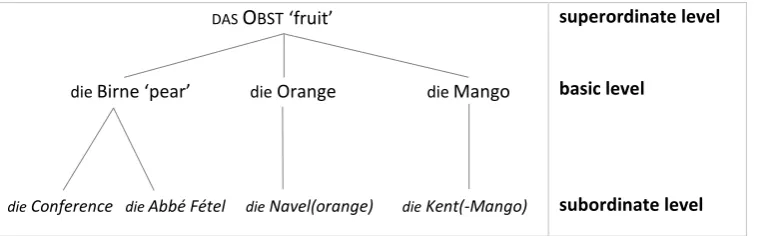
A final group of semantic gender assignment principles relate to the level of abstraction at which the referent of a noun is organised. It is claimed that concepts are organised at different levels of a hierarchical structure according to their degree of specificity (e.g. Rosch 1977). The three main levels are: superordinate > basic level > subordinate, whereby a superordinate term is the least specific and a subordinate term is the most specific. An example is given in Figure 1.
DASOBST‘fruit’
die Birne ‘pear’ die Orange die Mango
die Conference die Abbé Fétel die Navel(orange) die Kent(-Mango)
superordinate level
basic level
subordinate level
21
All levels of the hierarchy are said to be defined in terms of the basic level, i.e. superordinates are organised on the level of abstraction above the basic level, and subordinates on the level below the basic level. It is claimed that terms on the basic level can be determined via various experimental methods, since this is the level at which things are argued to be cognitively organised (e.g. Rosch et al. 1976, Rosch 1977). See Section 3.2.2.2 for a fuller discussion on this topic.
In terms of gender assignment, it is claimed that nouns on the superordinate level are usually neuter in German, e.g. das Obst ‘fruit’, das Tier ‘animal’, das Element (Zubin & Köpcke 1986; Mills 1986: 27; Steinmetz 1986: 192, 2006: 1424; Köpcke & Zubin 1997: 35-38, 2005: 152; Eisenberg 1999: 156; Rice 2006: 1398; Duden Grammatik 2009: 158).
Basic level terms, by contrast, can be of any gender. As mentioned above, basic level terms may be assigned a particular gender if they are hyponyms of a certain category, e.g. basic level hyponyms of
Obst are usually feminine. The gender they are assigned is not necessarily the same as that of their superordinate (contrary to the LWP).
Finally, subordinate terms are claimed to typically be of the same gender as their hypernymous basic level term (e.g. Köpcke & Zubin 2005a: 98, 2005b: 152). Often, in German, a subordinate has the same gender as its corresponding basic level term because it is a compound with the basic level term as its head, e.g. die Orange > die Navelorange, but this is not always the case. It is at this level of abstraction, then, that the LWP gains plausibility. This observation is in line with Thornton’s (2009) Basic Level Hyperonym Constraint, formulated on the basis of evidence from Italian and Hausa, which states that a hyponym can only inherit the gender of a hypernym if the hypernym is a basic level (and not superordinate) term.
Köpcke & Zubin (2005a: 111f.), however, highlight that not all subordinates inherit the gender of the hypernymous basic level term. For instance, they state that hyponyms of the neuter basic level term
Pferd ‘horse’ are usually masculine, e.g. der Holsteiner, der Braune, der Appaloosa, and hyponyms denoting car types are usually masculine despite the fact that the hypernymous basic level term could justifiably be das Auto and not der Wagen (see Köpcke & Zubin 2005a: 107, 112). The LWP is therefore unable to replace all semantic gender assignment principles at the subordinate level.
22
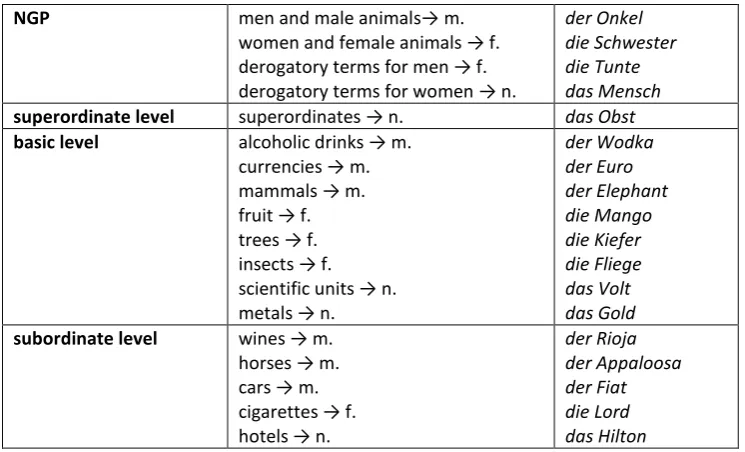
NGP men and male animals→ m.
women and female animals → f. derogatory terms for men → f. derogatory terms for women → n.
der Onkel die Schwester die Tunte das Mensch superordinate level superordinates → n. das Obst basic level alcoholic drinks → m.
currencies → m. mammals → m. fruit → f. trees → f. insects → f. scientific units → n. metals → n.
der Wodka der Euro der Elephant die Mango die Kiefer die Fliege das Volt das Gold subordinate level wines → m.
horses → m. cars → m. cigarettes → f. hotels → n.
der Rioja der Appaloosa der Fiat die Lord das Hilton Figure 2: Summary of semantic gender assignment principles
1.3.3.4 Evidence for semantic principles
Not only have various patterns of correlation been observed regarding a noun’s semantic features and its gender, but there is also experimental evidence which suggests that native speakers use semantic principles in order to assign gender to nouns.
Schiller et al. (2003), for instance, conducted a study in which they investigated the influence of semantic factors on gender assignment. In their experiment, native German speakers were required to specify the gender of various monomorphemic nouns, some of which had gender-relevant semantic features and some of which did not, and their reaction times and ERPs were measured. The ERP data and reaction times recorded demonstrate that participants were faster in selecting the gender of nouns which had a relevant semantic feature than for those which did not. Consequently, Schiller et al. (2003) conclude that native speakers are influenced by semantic factors when assigning gender. A further experiment investigating the use of semantic gender assignment principles by native German speakers was conducted by Schwichtenberg & Schiller (2004). Their participants were presented with a semantic category and two formally-similar pseudo-nouns of different genders, and were asked to select the noun that was more likely to belong to the category, e.g. type of fruit: der Jast or die Mauch?
The results showed that in a significant majority of cases, participants selected the pseudo-noun of the gender which is claimed to be associated with the semantic category. Accordingly, they conclude that semantic regularities are part of the German gender assignment system.
23
participants were presented with a definition for each pseudo-noun, and were again asked to assign genders to each. In many cases, the distribution of results obtained with and without the definition was significantly different, demonstrating that the semantic features of the pseudo-nouns affected the participants’ choice of gender.
Additionally, a number of studies on loanwords indicate that semantics is key to gender assignment. Mills (1986:50f.), for example, states that evidence from loans shows that semantic features influence gender assignment, given that various loanwords receive the gender that is predicted by proposed semantic principles. Carstensen (1980: 23) and Fischer (2005: 287ff.), too, illustrate the influence of a loan’s semantic features on its gender, both finding that gender variation among speakers occurs more when the meaning of a loan is unknown, and that gender selection is more likely to be unanimous when the meaning is known, thus showing that gender assignment is affected by knowledge of a loanword’s meaning.
Finally, Wegener (2000: 514f., 531f.) claims that evidence from child language acquisition demonstrates that the NGP influences gender assignment from an early age, reporting semantically-motivated gender errors even with high-frequency nouns, e.g. *dieFEM.SG MädchenNEUT ‘girl’ and *derMASC KindNEUT‘child’ (when referring to a boy). Wegener (2000: 514f.) claims that if gender were
simply memorised rather than derived, it would be expected that only low-frequency nouns would cause problems.
In summary, it has been shown that there are numerous morphological, phonological and semantic gender assignment principles which can be used to determine the gender of German nouns. Additionally, experimental evidence has been presented which suggests that native German speakers actually make use of these principles in their assignment of gender to nouns. In the next section, it will be considered how these various principles interact with each other.
1.4 Interaction of gender assignment principles
24
resolving conflicts between principles (e.g. Steinmetz 1985: 10, Menzel 2004: 69, Rice 2006). The main proposals for principle interaction that have been suggested will be discussed below.
1.4.1 Semantics » form
The first proposal to be discussed states that all gender assignment systems have a “semantic core” (Aksenov 1984: 17f., Corbett 1991: 307) or “semantic base” (Lang 1976). This means that, in all
languages, ‘the formal gender assignment rules [...] are dominated by the semantic gender assignment rules’ (Corbett & Fraser 2000: 321), i.e. when there is a conflict between gender assignment principles of different types, ‘the semantic rule takes precedence’ (Corbett 1991: 66).
However, Rice (2004: 1412) argues that this approach is ‘untenable’ for German, given the large number of counterexamples that exist. For instance, he cites the three nouns die Pflanze, die Waffe
and die Frucht, stating that their gender is determined by the dominance of the formal principles “nouns with a final schwa are feminine” (e.g. Altmann & Raettig 1973: 302, Mills 1986: 33, Steinmetz 1986: 192, Steinmetz & Rice 1989: 166, Wegener 1995, Köpcke & Zubin 1996: 476, Nelson 1998: 218, Hoberg 2004: 87, Rice 2006: 1396, Eisenberg 2013: 134) and “monosyllabic nouns ending in a non-sibilant fricative [f]/[x]/[ҫ] followed by [t] are feminine” (e.g. Zubin & Köpcke 1981: 440, 1984: 44, Köpcke 1982: 98, Mills 1986: 33, Köpcke & Zubin 1997, Hoberg 2004: 98, Menzel 2004: 68, Duden Grammatik 2009: 166, Eisenberg 2013: 135) over the semantic principle “nouns denoting a superordinate are neuter” (e.g. Zubin & Köpcke 1986, Mills 1986: 27, Steinmetz 1986: 192, 2006: 1424, Eisenberg 1999: 156, Rice 2006: 1398, Duden Grammatik 2009: 158).8
Other counterexamples include: die Gymnastik, whose gender is determined by the dominance of the formal principle “nouns in -ik are feminine” (e.g. Altmann & Raettig 1973: 302, Zifonun et al. 1997: 33, Nelson 1998: 218, Hoberg 2004: 87, Menzel 2004: 66, Thomoglou 2004: 41, Weinrich 2007: 327, Duden Grammtik 2009: 165, Engel 2009: 281) over the semantic principle “nouns denoting sports and games are neuter” (e.g. Mills 1986: 27, Köpcke & Zubin 1996: 480, Chan 2005: 96); der Wacholder, whose gender is determined by the dominance of “nouns with the pseudo-suffix -er are masculine” (e.g. Steinmetz 1986: 197, Wegener 1995, Hoberg 2004: 92, Eisenberg 2013: 135) over “nouns denoting trees are feminine” (e.g. Flämig 1991: 452, Hickey 2000: 629, Menzel 2004: 63, Thomoglou 2004: 34, Chan 2005: 95, Weinrich 2007: 328, Engel 2009: 272); and der Mohn, whose gender is determined by the dominance of “monosyllables with the structure CVC are not feminine” (Köpcke 1982: 85) and “monosyllables containing a long vowel and a consonant in the coda are not feminine”
8 Naturally, the validity of this criticism is highly dependent on the validity of these gender assignment principles,