Iranian Journal of Language Teaching Research 4(3), (Oct., 2016) 5-19 5
* Corresponding author: School of Education, University of Michigan, US Email address: [email protected]
Urmia University
This paper argues that understanding what is offered as professional development frames what matters in English language teaching in a national education system. Analyzing these offerings articulates the values and perceptions of the work environment in which teachers live professionally. The Learning4Teaching (L4T) project is a multi-country series of national studies that examine public-sector English language teachers’ experiences of professional development. The studies document 1) the learning opportunities provided in the national context, 2) how teachers view participating in these opportunities, and 3) what they believe they take from them. Drawing on data from the first phase of the study (#1 above), this paper examines the provision of professional development to ELT teachers in the ‘independent’ (public school) sector in Qatar between 2012 and 2015. Of the 150 events offered during this period, 50% concerned teaching methodology. The university/training center sector provided the bulk of professional development (79% of events). The professional development offerings presented teachers with a view of English language teaching as: highly focused on methodological expectations and skills; driven by a set of policy priorities around managing the learning environment, assessment, and standards; in which methodological knowledge and skills are seen as the currency of a teaching identity.
Keywords: foreign/second language motivation; changes in motivation; interest and involvement
© Urmia University Press
Received: 20 Aug. 2016 Revised version received: 7 Sep. 2016 Accepted: 10 Sep. 2016 Available online: 1 Oct. 2016
Who provides professional development? A study of
professional development in Qatar
1Donald Freeman
a, *, Dudley Reynolds
b, Will Toledo
a, Abdullah
Mohammad Hamdan Abu-Tineh
ca
University of Michigan, US
aCarnegie Mellon University, Qatar
aUniversity of Michigan, US
aQatar University, Qatar
A B S T R A C T
A R T I C L E H I S T O R Y
Content list available at www.urmia.ac.ir/ijltr
Iranian Journal
of
6 D. Freeman, D. Reynolds, W. Toledo & A. Abu-Tineh/Who provides professional …
Introduction
Rethinking ELT teachers’ experiences of professional development
Around the world, major resources are regularly devoted to professional development to improve classroom public-sector EFL teaching (e.g. Coleman, 2011). The impact is often questioned however, since the quality of classroom instruction remains uneven (Weddell, 2011). This lack of improvement is generally ascribed to teachers (e.g. Clark & Dede, 2009; Djukic, Fulmer, Adams, Lee, & Triola, 2012; Dimmock & Yong Tan, 2013); the common argument is that they do not take up the training they receive (Educational Development Corporation, 2011). However, this view is suspect for several reasons:
● If the lack of uptake from professional development were solely a matter of teacher
resistance, then we could expect to find robust counterexamples specifically designed to counter it – professional development or reform projects in which teachers are heavily invested and which are therefore successful (Kennedy, 2005). These counterexamples are difficult to find.
● Teacher resistance—if it exists as a major factor influencing uptake from professional
development – might result from a lack of relevance in what is offered. There is a general (what we call) ‘assumption of coherence’ that the professional development sponsored and provided by ministries and other national actors is consistently aligned with teachers’ needs on the one hand, and educational policy goals on the other.
● These arguments rely on a relatively small research base (Birman, Desimone, Porter, &
Garet, 2000; Desimone, Porter, Garet, Yoon, & Birman, 2002; Little, 1993).
● There have been very few studies that examine uptake from the perspective of the
teachers themselves (see TALIS 2009 for an exception).
Thus the challenge to the training and research communities is how to re-examine our assumptions and understanding of how professional development works across large-scale settings. This re-examination, we argue, must start with documenting teachers’ experiences of professional development: what they see as learning opportunities, how they view participating in these opportunities, and what they believe they take from them. These examinations of their experiences are critical in unpacking what teachers believe they learn from professional development, and how they use these ideas and skills in their classroom teaching.
The Learning4Teaching Project2
A transnational research initiative
This paper contributes to that rethinking by examining the provision of professional development in one national context—Qatar-- to one segment of the national teaching force – English language
teachers (ELT). The data are drawn from a larger, transnational research initiative that studies
public-sector English language teachers’ experiences of professional development. The
Learning4Teaching (L4T) project is a multi-country series of national studies that document
Iranian Journal of Language Teaching Research 4(3), (Oct., 2016) 5-19 7
The national studies follow a similar research design that is organized in three phases (see Table 1):
Table 1
Design of Learning4Teaching Project studies
PHASE I: ‘Inventory’ PHASE II: ‘Participation’ PHASE III: ‘Uptake’
A national inventory that catalogues professional development opportunities available to public-sector ELT teachers in the last three years
A web-based national survey that documents ELT teachers’ participation in these professional development opportunities
An on-line teaching log in which selected teachers from Phase II report on how they have used professional development ideas in their teaching.
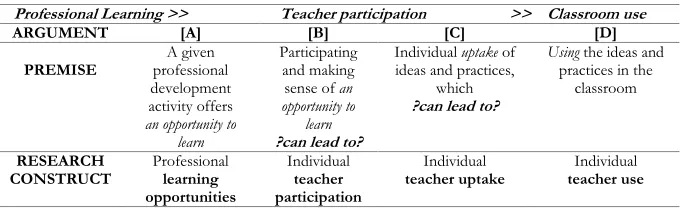
The project’s studies are based in a phenomenographic logic model, ‘making sense of professional learning’ (represented in Table 2 below). The logic model argues that teachers learn through professional development when there is a connection made between the learning opportunities that are available [A below], how teachers gain access and participate in them [B below]; what they ‘take’ from that involvement [C below], and how they use the knowledge and skills in their teaching [D below] (Blömeke, 2012; Richter, Kunter, Klusmann, Lüdtke, & Baumert, 2014).
Table 2
The L4T PROJECT LOGIC MODEL - Making Sense of Professional Learning
Professional Learning >> Teacher participation >> Classroom use
ARGUMENT [A] [B] [C] [D]
PREMISE professional A given
development activity offers an opportunity to
learn
Participating and making sense of an opportunity to learn ?can lead to?
Individual uptake of ideas and practices,
which ?can lead to?
Using the ideas and practices in the
classroom
RESEARCH
CONSTRUCT Professional learning
opportunities
Individual teacher participation
Individual
teacher uptake teacher use Individual
A typology of professional development provision in ELT
Teachers usually participate in a great deal of professional development throughout their careers (Little, 1993). Professional development opportunities are typically offered by a wide range of providers, including for- and non-profit organizations, local educational authorities, tertiary institutions, and governmental agencies. These opportunities to learn new skills and strategies, which it is usually assumed teachers will use in their own classrooms, are an important dimension
of the teaching profession (Garet, Porter, Desimone, Birman, & Yoon, 2001). While providers
8 D. Freeman, D. Reynolds, W. Toledo & A. Abu-Tineh/Who provides professional …
offerings can offer insight into the values, norms, and beliefs promoted by the professional development, and the potential meanings it generates for teachers.
In many countries, including Qatar, the country that is the focus of this study, professional development is a major responsibility of a national education ministry. With a single provider overseeing at the national level what is offered to teachers, one might assume that professional development would align with national policies on the one hand, and the prescribed classroom needs on the other. However, despite this ‘assumption of coherence’ (mentioned above), there are often what Avalos (2000, p. 463) called “centers of control”, with differing, sometimes competing visions and agendas. Across the three country studies, we have identified five broad sectors: 1) the national government; 2) local education authorities; 3) universities / training centers; 4) extra-governmental organizations3, which include national and international providers as well as quasi-diplomatic
organizations (such as the British Council), professional associations (like IATEFL, TESOL International Association, and/or their local affiliates), and testing organizations; and 5) ELT materials suppliers (such as publishers, technology providers etc.). As ‘centers of control’, providers in these different sectors may work in concert with one another; at other times one provider (e.g. the national government) may operate through others (e.g. local education authorities or universities); and at still other times they may operate independently of each other.
In the case of Qatar, we found three sectors offering professional development to public-sector ELT teachers: the national government, universities/training centers, and extra-governmental providers, which are in this case local branches of international organizations. As argued above, these organizations generally have policy rationales, which shape the topics, formats, and quantity of the professional development activities they offer. These rationales, which may or may not be communicated to participants, are in any case only part of the picture, however. Surfacing the meanings implicit in the ‘what’ and ‘how’ of this provision is an important part of better understanding how professional development may influence classroom practices, as well as the ways in which such national efforts align with teachers’ experiences.
The organization of the paper
This paper begins to surface these potential meanings by focusing on the providers’ perceptions of
professional development they offer. With fewer than 160,000 school-age children4, Qatar has a
highly centralized education system, which offers the opportunity to study how policies are carried through to implementation. To this end, the study examined the question: How do Qatari professional development providers perceive what public-sector English language teachers need to know? We were interested in their perspectives on what is needed, and therefore valued, in ELT classroom teaching, and how these perspectives are articulated through the events they offered. We begin with a brief discussion of the Qatari educational system as context for the study. We then outline the findings from the inventory phase, specifically how the providers organize the learning opportunities (see column A in Figure 1-- Logic Model). This discussion is organized to address the following points:
● What professional development opportunities are provided to public-sector ELT
teachers?
● Which organizations/sectors offer these opportunities?
● What topics are offered by which sectors?
Iranian Journal of Language Teaching Research 4(3), (Oct., 2016) 5-19 9
The Qatari educational system as context
Since the initiation of a series of educational reforms known as ‘Education for a New Era’ in 2004, the Qatari educational system has been in a period of more or less constant change. The 2004 reforms were originally intended to promote school-level autonomy, accountability mechanisms including standards-based assessments, a variety of type of schools, and school choice for parents (Zellman, Ryan., Karam, Constant, Salem, Gonzalez, Al-Obaidli, 2009, p. 5). As part of the reform, a new type of school modeled after U.S. charter schools and known locally as ‘independent schools’ was introduced. From 2004 when 12 independent schools were opened until fall 2010 when all existing schools were converted to the new model, the Ministry of Education (MOE) was responsible for schools following the pre-2004 model, while a second agency, the Supreme Education Council (SEC), assumed responsibility for the new schools. The two agencies were individually responsible for curriculum, assessment, and teacher professional development in their respective schools. There were major differences between the two systems, however. The Ministry-overseen schools continued to base their curricula on prescribed textbooks, and taught math and science in Arabic. The new ‘independent schools’ followed separate, newly developed curriculum standards and taught math and science in English.
In the fall 2010 all schools became independent schools and the MOE was absorbed into the SEC. Within the SEC, two offices shared responsibility for supporting teachers’ professional development: The Office of Professional Development and the Office of Curriculum Standards, with the former ostensibly providing logistical and technical support while the later provided curriculum specialists and materials. The transition of the MOE schools to Independent schools theoretically meant that all public-sector schools in Qatar would now teach math and science in English alongside the regular English (as a Foreign) language courses.
In spring 2012, which was also known as the “Arab spring,” concerns about poor student performance in math and science, as well as a perception that students were ‘losing’ their Arabic to English, prompted the SEC to announce that math and science would be again taught in Arabic beginning the following fall (2012). During the 2012-13 school year, a two-hour per week course on English vocabulary for math and science was included in the curriculum, but this was abandoned after one year because of widespread perceptions of its ineffectiveness. In spring 2016, as part of a reshuffling and consolidation of government ministries, the SEC was renamed the Ministry of Education and Higher Education.
The Qatari teaching workforce during this period could be characterized as transitory with many teachers coming from professions other than education. Approximately 25% of teachers in the government schools are Qatari citizens with the rest being primarily Arab expatriates (Romanowski, Cherif, Al Ammari, & Al Attiyah, 2013). The Qataris who are teaching are predominantly female. In boys schools almost all teachers are expatriates working on contracts.
The SEC’s Education in the State of Qatar: Annual Report for the Academic Year 2012-135 indicates that
10 D. Freeman, D. Reynolds, W. Toledo & A. Abu-Tineh/Who provides professional …
ELT professional development in Qatar—Who are the providers?
Returning to the analysis of provision, we have identified sixdifferent organizations that offered
professional development to public-sector ELT teachers between November 2012 and September 2015. These providers clustered into three sectors using the typology outlined in Section 3 above:
1) the national government (the Supreme Education Council); 2) universities/ training centers; and 3)
extra-governmental providers (such as embassies). Neither of the other two categories—local
educational authorities or educational materials suppliers-- are active professional development providers in Qatar. The former, because the small scale of the national educational system is not further subdivided; the latter, probably due to the relatively small market the Qatari school system represents.
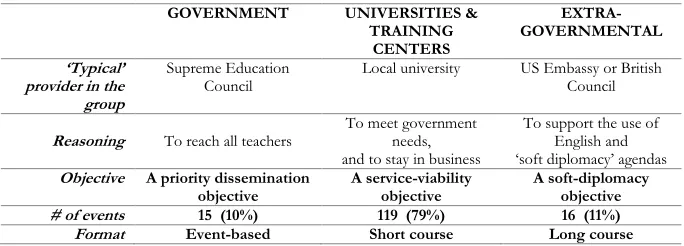
Table 3 below summarizes professional development provision according to these three categories:
Table 3
Who provides ELT professional development in Qatar (2012 - 2015)?
GOVERNMENT UNIVERSITIES &
TRAINING CENTERS
EXTRA-GOVERNMENTAL
‘Typical’ provider in the group
Supreme Education
Council Local university US Embassy or British Council
Reasoning To reach all teachers To meet government needs,
and to stay in business
To support the use of English and ‘soft diplomacy’ agendas Objective A priority dissemination
objective A service-viability objective A soft-diplomacy objective
# of events 15 (10%) 119 (79%) 16 (11%)
Format Event-based Short course Long course
During the period of the study, the majority of professional events (79%) were presented by universities and training centers, however most of these operated on a sort of ‘flow through’ basis in which the ministry nominated the topics and funded the offerings. The ministry itself only offered 10% of the events. The professional development provided by extra-governmental sources came from two groups: the British Council (11 events) and the US Embassy (4 events). Each of these three sectors seemed to have a distinct agenda. The ministry was responsible for reaching all ELT teachers in the public-sector schools with the curricula and assessment information they deemed necessary, in what we label a ‘priority dissemination’ approach. However, they operated largely through the universities, which designed and offered events. As alternative providers, universities were dependent on the government both for funding and for creating positive conditions for teachers to participate, which led to what we call a ‘service-viability’ approach. The extra-governmental providers operated outside this chain of directed delivery and service-viability, although they needed to get ministry agreement for teachers to participate. These two extra-governmental providers shared a ‘soft-diplomacy’ objective in that they hoped teachers would develop or deepen an affinity with their respective countries (the US and the UK) and cultures.
Iranian Journal of Language Teaching Research 4(3), (Oct., 2016) 5-19 11
government provision, which was largely single meetings, as event-based; while the universities tended to run short courses, perhaps reflecting the norm of their hosting institutions. The extra-governmental providers, on the other hand, tended to favor extended series of meetings or long
courses, often run over a school year
Professional Learning - What topics are offered?
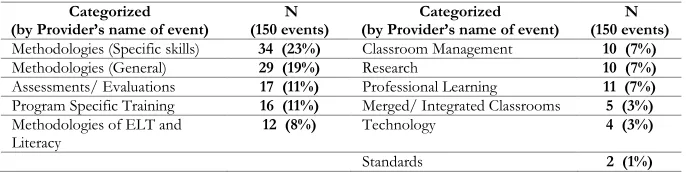
These data present an operational portrait of ELT professional development, which a closer analysis of the topics helps to fill out. Table 4, is based on a token-type analysis of the 150 events offered during this three-year period.
Table 4
Professional development by topic (2012 - 2015)? Categorized
(by Provider’s name of event) (150 events) N (by Provider’s name of event) Categorized (150 events) N Methodologies (Specific skills) 34 (23%) Classroom Management 10 (7%)
Methodologies (General) 29 (19%) Research 10 (7%)
Assessments/ Evaluations 17 (11%) Professional Learning 11 (7%) Program Specific Training 16 (11%) Merged/ Integrated Classrooms 5 (3%) Methodologies of ELT and
Literacy 12 (8%) Technology 4 (3%)
Standards 2 (1%)
Note: The two columns are for ease of display
It is not surprising perhaps that half of professional development events during this period (50%) concerned teaching methodologies of some sort: 23% focused on ELT skills (e.g. listening, speaking, etc.), 19% on general teaching methodologies (e.g. Multiple Intelligences in the Classroom), and 8% on ELT in relation to literacy (e.g. Creating a Balanced Literacy Program in Your Classroom). The less common professional development offerings, listed in the right column of Table 3, totaled just under a third (28%) of the offerings. These concerned more general topics of classroom teaching and education such as Classroom Management, which focused on preparing teachers to manage students’ behaviors and their classroom schedules, and Merged/ integrated classrooms, which prepared teachers with strategies to teach in ‘mixed ability’ classrooms.
Provision by topic
Comparing the topics offered by three sectors reveals differences in the views of professional learning they promoted, and the meanings teachers might make of what each sector offered. The
sequence of figures below (Figures 3 – 5) represents the distribution of topic by provider, and the
12 D. Freeman, D. Reynolds, W. Toledo & A. Abu-Tineh/Who provides professional …
Government providers
Figure 1. Professional Development Topics Offered by Government Providers
The professional development offered by government providers focused primarily on specific teaching methodologies related to English language and literacy (20%) and other specific skills areas (40%), which likely reflects the skills-based structure of the national curriculum standards used to guide English instruction. Unlike the other two groups of providers, both standards (13%) and
classroom management (13%) also featured prominently. Collectively, these offerings suggest that the
ministry’s dissemination priorities (see Table 2) were ensuring that teachers are prepared to teach according to national standards and to manage their classrooms.
Universities and Training Centers
University training centers were responsible for four-fifths of the professional development events during this time period (79%, see Table 3). As might be expected, their offerings varied considerably in keeping with the sector’s objective of service and viability. As reflected in Figure 2 approximately half (51%) concerned methodologies of some kind, of which the most focused on
general teaching methodologies (22%). Other topics included assessments (13%), for example Steps in Building Achievement Tests and Designing the Learning Outcomes, and professional learning (9%), for
Iranian Journal of Language Teaching Research 4(3), (Oct., 2016) 5-19 13
Figure 2. Professional Development Topics Offered by Universities and Training Centers
Extra-governmental providers
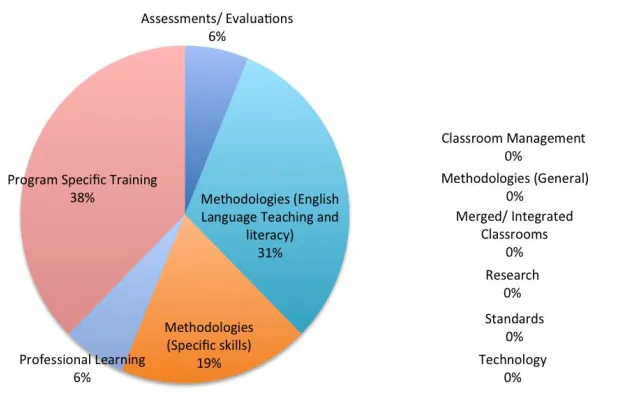
Figure 3 combines the two extra-governmental professional development providers, the British Council and the US Embassy. These providers focused primarily on specific teaching methodologies related to English language and literacy (31%) and other specific skills (19%). Reflecting their practices and traditions, these two providers used specific ELT methodology (50%) as a vehicle for engaging teachers. However, in contrast to the governmental sector, they did not offer anything related to
standards or classroom management, suggesting their soft-diplomacy objective of promoting English,
14 D. Freeman, D. Reynolds, W. Toledo & A. Abu-Tineh/Who provides professional …
Figure 3. Professional Development Topics Offered by Extra-governmental Providers
What professional development provision says about ‘what matters’ in ELT in Qatar
We began this paper with the argument that understanding of what providers offer as professional development helps to frame what matters in English language teaching in a national education system. Analyzing these offerings as opportunities to learn can articulate the values and perceptions of the work environment in which teachers live professionally. This phenomenological approach to teacher learning differs from the view of professional development as a behavioral intervention – that teachers are trained in certain practices (for example, literacy methods or using technology in particular ways), and then both the professional development, and their teaching, can be evaluated based on the fidelity of implementing those practices (e.g. Desimone, 2009). In documenting what is available as professional development in ELT in a national context at a point in time, phenomenological studies like this aim to understand how teachers make sense of what is expected of them. Close analysis of these professional development opportunities is an entry point in that process.
Summary interpretation
To summarize the interpretation of these analyses. In Qatar, professional development presents teachers with a view of English language teaching as:
Highly focused on methodological expectations and skills, which blend
ELT-specific and general teaching. All three sectors offered events in this topic area, which represented fully half of the total during the three-year period. Further, both the university/training center sector, with its emphasis on ‘short courses’, which provided the majority of events, and the two extra-governments providers, with their ‘long courses’, seem to underscore the importance of pedagogical expertise. It would seem almost inescapable then that ELT teachers would perceive the expectations of their work, and the knowledge and skills on which it is based, as primarily pedagogical. Methodology seems to be what providers wanted them to learn; this pedagogical expertise is seen to offer a connection to a globalized ELT profession.
Animated by a set of policy priorities around the managing learning environment,
Iranian Journal of Language Teaching Research 4(3), (Oct., 2016) 5-19 15
offerings combined to focus on these areas; perhaps more saliently however, they made up a quarter of government-provider professional development. There seems to be a split or bifurcated message to teachers here—that pedagogical expertise, developed and exercised individually, is centrally important to ELT, but that this expertise needs to integrate (or perhaps even compete with) how students are ‘managed’ in order to achieve declared learning outcomes. In other words, the socio-professional message seems to be: ‘Teach well, teach correctly, and teach according to governmental expectations.
Methodological knowledge and skills are the currency of a teaching identity. The
two summary points above suggest that the national ecology of professional development confronts public-sector English language teachers with the premise that knowing and using teaching methodologies appropriately, according to both governmental expectations and global ELT norms, are central to one’s functional identity as a teacher.
The analyses presented here do not include data of teachers’ perceptions from the national survey (see ‘Phase 2 in Table 1). However, they do provide insight into providers’ de facto views of what matters as important to—and for—ELT teachers in Qatar. Further, the organization of professional development provision suggests what the sectors believe or assume about how new skills and knowledge ‘enter’ schools.
The interplay of the government and university-training center sectors is a case-in-point, and particularly illustrative of how opportunities to learn communicate meaning and underlying agendas. The providers in the government sector structure their offerings in a few single-session events that focus on the skills and practices, which they have prioritized. The sector ‘outsources’ elaboration on the curriculum and practices of ‘good teaching’ to the university/training center providers, which can raise a question about how teachers perceive this distribution of professional development events and topics. The distribution could subtly position the government ministry as the authority on curricular and instructional matters, however it leaves pedagogical expertise—and indeed visions of what ‘good teaching’ is and how it is practiced-- outside the ministry’s purview. The long-term courses offered by the extra-governmental providers, which are more substantive, may further contribute to perceptions that expertise is located not only outside of the ministry but even outside of the country.
[
Implications beyond Qatar
These findings certainly suggest implications that go beyond the particular national context of Qatar. National environments do foster views of what matters for teachers to know and be able to do. The professional development offerings-- the topics, formats, and most critically who provides what-- all contribute to valuing and supporting some forms of teaching over others. This constellation can suggest views of what constitutes ‘good’ or ‘up-to-date’ teaching. In ELT, the process is made more complex by the involvement of two sectors that provide professional
development and that operate transnationally. ELT materials suppliers, with their commercial aims,
and extra-governmental organizations (like the British Council or the US Department of State), with their soft-diplomacy objectives, tend to promote transnational views of ‘good’ English language teaching, which co-exist and to some degree interact with the expectations of the national environment. All of which can make the position of the ELT teacher more complicated in trying to respond to the expectations raised by these different sectors of professional development. For example, the current emphasis in the extra-governmental sector on ‘continuing professional
development’, while it promotes the importance of life-long learning, can also suggest to teachers
16 D. Freeman, D. Reynolds, W. Toledo & A. Abu-Tineh/Who provides professional …
order to “improve … their agency and develop their organisation and their pupils” (Padwad &
Dixit, 2011, p. 7).
Structurally, it is clear that, while the government sector cannot—and probably should not attempt to—provide all the professional development offered in the national system, the ministry has a definite role in articulating consistent policy goals and standards. We have found in other national studies that, given the complexity of delivering classroom teaching, governmental policies seem to function best as a framework that guides the professional development in the national setting.
Insofar as the other sectors (local education authorities; universities / training centers;
extra-governmental organizations; and ELT materials suppliers) participate nationally, it can be
advantageous if they too operate within this framework. Working in this way can bring a certain
lived consistency for teachers who participate, and tends to make more real the ‘assumption of
coherence’ mentioned at the start of this paper.
[
Closing caveats
We conclude this paper with two caveats. This analysis is silent with respect to the argument at the beginning of the paper: that teachers are responsible for failing to implement what they have ‘learned’ in professional development in support of given reform plans. However, the data clearly do not support the ‘assumption of coherence’—that professional development policies, offerings, and implementation are well aligned – which anchors most government-led professional development. Within Qatar’s relatively small national educational system, there are distinct agendas for professional development, and only partial coordination of events. There are varying assumptions about how to provide professional development, whether as single, short-, or long-course ‘events’. Moreover, the government sector, which is arguably responsible for setting the agenda nationally, seems to be indirectly promoting questions about what matters in terms of pedagogical expertise.
The final caveat is with respect to future analyses. This paper has focused here on providers'
professional development offerings, and our interpretation of them, and therefore only accounts for what providers see teachers would (or should) learn from these events. Clearly, teachers' own views of professional development events, and what they believe they take from them, is equally significant to this analytic enterprise. The work of the Learning4Teaching project continues to examine data about this interplay between providers’ and teachers’ perceptions of professional development.
Which brings us back to the question of studying professional development at scale, a challenge
which, according to Cohen and Ball (2007, p. 35), is “… as much a qualitative as a quantitative
problem”. They continue:
[T]he very meaning of scale is distinctive, because its qualitative elements can be as important as, or more important than, quantitative elements. How deeply an innovation permeates practice may be as important to an assessment of its success at scale as how many sites adopt it, and innovations differ in how much is needed for them to deeply affect practice.” (p. 20).
Iranian Journal of Language Teaching Research 4(3), (Oct., 2016) 5-19 17
References
‘Above 30pc teachers not qualified’. (2011, September 4). The Peninsula. Doha, Qatar. Retrieved from http://www.thepeninsulaqatar.com/news/qatar/163929/above-30pc-teachers-not-qualified.
Avalos, B. (2000). Policies for teacher education in developing countries. International Journal of Educational Research, 33(5), 457-474.
Birman, B. F., Desimone, L., Porter, A. C., & Garet, M. S. (2000). Designing professional development that works. Educational Leadership, 57(8), 28-33.
Blömeke, S. (2012). Content, professional preparation, and teaching methods: How diverse is teacher education across countries? Comparative Education Review, 56(4), 684-714.
Clarke, J., & Dede, C. (2009). Design for scalability: A case study of the River City curriculum.
Journal of Science Education and Technology, 18 (4), 353-365.
Coleman, H (ed). Dreams and Realities: Developing Countries and the English Language. London: British
Council.
Cohen, D. K., & Ball, D. L. (2007). Educational innovation and the problem of scale. In Schneider, B. & McDonald, S. (Eds.), Scale- up in education (Vol. I, pp. 19-36). Lanham, MD: Rowman & Littlefield.
Desimone, L. (2009). Improving impact studies of teachers' professional development: Toward better conceptualizations and measures. Educational Researcher, 38(3), 181-199.
Desimone, L. M., Porter, A. C., Garet, M. S., Yoon, K. S., & Birman, B. F. (2002). Effects of professional development on teachers’ instruction: Results from a three-year longitudinal study. Educational Evaluation and Policy Analysis, 24(2), 81-112.
Dimmock, C., & Yong Tan, C. (2013). Educational leadership in Singapore: Tight coupling, sustainability, scalability, and succession. Journal of Educational Administration, 51 (3), 320-340.
Djukic, M., Fulmer, T., Adams, J. G., Lee, S., & Triola, M. M. (2012). NYU3T: teaching, technology, teamwork: a model for inter-professional education scalability and sustainability. Nursing Clinics of North America, 47 (3), 333-346.
Educational Development Center. (2011). Scaling innovation: A preliminary review of the literature. Newton MA: National Center for Scaling Up Effective Practice.
Freeman, D. (2016). Educating second language teachers: The same things done differently. Oxford: Oxford University Press.
18 D. Freeman, D. Reynolds, W. Toledo & A. Abu-Tineh/Who provides professional …
Kennedy, M. M. (2005). Inside teaching: How classroom life undermines reform. Cambridge MA: Harvard
University Press.
Knight, J. 2009. What can we do about teacher resistance? Phi Delta Kappan, 90(7) 508-513.
Little, J. W. (1993). Teachers’ professional development in a climate of educational reform. Educational Evaluation and Policy Analysis, 15(2), 129-151.
Padwad, A. & K. Dixit. (2011) Continuing Professional Development: An Annotated Bibliography. Spring Garden: British Council
Richter, D., Kunter, M., Klusmann, U., Lüdtke, O., & Baumert, J. (2014). Professional development across the teaching career. In S. Krolak-Schwerdt, S. Glock & M. Böhmer (Eds.), Teachers’ professional development (pp. 97-121): SensePublishers.
Romanowski, M. H., Cherif, M., Al Ammari, B., & Al Attiyah, A. (2013). Qatar’s educational reform: The experiences and perceptions of principals, teachers and parents. International Journal of Education, 5(3), 108–135.
Schneider, B. & McDonald, S. (Eds) (2007), Scale- up in education. Lanham, MD: Rowman & Littlefield.
Organization for Economic Cooperation and Development. (2009). First results from TALIS. Teaching and Learning International Survey, OECD. Paris: Author.
(doi.org/10.5296/ije.v5i3.3995}
Weddell, M. 2011. ‘More than just ‘technology’: English language teaching initiatives as complex educational changes.’ In H. Coleman (ed). Dreams and Realities: Developing Countries and the
English Language. London: British Council. Section 13.
Zellman, G. L., Ryan, G. W., Karam, R., Constant, L., Salem, H., Gonzalez, G., Al-Obaidli, K. (2009). Implementation of the K-12 education reform in Qatar’s schools. (No. RAND_MG880). Santa Monica, CA: RAND Corporation. Retrieved from www.rand.org/ pubs/ monographs /MG880/
Donald Freeman leads the Learning4Teaching Project and a professor, School of Education,
University of Michigan. He is author most recently of Educating second language teachers:
'The same things done differently' (Oxford University Press, 2016). His research focuses on
equity and access in ELT professional development.
Dudley Reynolds is President of the TESOL International Association and a Teaching Professor
of English at Carnegie Mellon University in Qatar where he teaches first-year writing. His research focuses on teacher development and second language literacy issues.
Will Toledo is a PhD candidate in Teaching and Teacher Education at the University of
Iranian Journal of Language Teaching Research 4(3), (Oct., 2016) 5-19 19
Abdullah Abu-Tineh is the Director of National Center for Educational Development (NCED)
and Associate Professor of Educational Leadership and Human Resource Development at College of Education-Qatar University.
1 This article was made possible by NPRP grant # 7-1393-5-209 from the Qatar National Research Fund (a member of Qatar Foundation). The statements made herein are solely the responsibility of the authors. 2 The Learning4Teaching Project has been a collaborative effort of faculty and students at the School of Foreign Languages, Anadolou University [Eskisehir Turkey], Carnegie Mellon University in Qatar, and Qatar University [Doha, Qatar], the Universidad Alberto Hurtado [Santiago Chile] and the University of Michigan School of Education [Ann Arbor MI USA].
3 The term ‘extra-governmental’ here is potentially confusing. We mean organizations that are not part of, or affiliated with, the national government or ministry of the country studied. For example, in offering ELT professional development in Qatar, the US Embassy would be considered an ‘extra-governmental’ provider.
4 UNESCO Qatar Education data-- www.uis.unesco.org/DataCentre/Pages/country-profile.aspx?code= QAT®ioncode=40525