Journal of Industrial Engineering and Management Studies
Vol. 4, No. 1, 2017, pp. 1-12
DOI: 10.22116/JIEMS.2017.51960
www.jiems.icms.ac.ir
Solving product mix problem in multiple constraints environment
using goal programming
Fahimeh Tanhaie1, Nasim Nahavandi1,*
Abstract
The theory of constraints is an approach to production planning and control that emphasizes on the constraints to increase throughput by effectively managing constraint resources. One application in theory of constraints is product mix decision. Product mix influences the performance measures in multi-product manufacturing system. This paper presents an alternative approach by using of goal programming to determine the product mix of the manufacturing system. The objective of paper is to provide a methodology in order to make product mix decision. Key point of the proposed methodology is considering decision maker idea to determine the weights of objective functions that are throughput and bottleneck exploitation. Therefore the weights of the objective functions are determined by the information get from decision maker. Through an example, inefficiency of theory of constraints in multiple bottleneck problems has been showed. Comparison of theory of constraints, linear programming and other methods to product mix problem has also discussed to show the advantages of the proposed method.
Keywords:Theory of constraints; Product mix; multiple constraints; bottleneck; goal programming.
Received: July 2017-28 Revised: September 2017-09 Accepted: October 2017-06
1. Introduction
Theory of constraints (TOC) is a production control methodology that improves the throughput of a system by effectively managing constraint resources. A constraint in a manufacturing firm shows that the system could not meet the demands of all the products. So, for exploitation of constraint the product mix should be determined to maximize product
throughput (Ray et al. 2010). Product mix influences the performance of production control
strategy in multi-product manufacturing systems (Onyeocha, 2015). TOC incorporates five
It was revealed that the TOC was inefficient in solving two types of problems. The first type includes problems concerning more than one bottleneck in which TOC could not reach the
feasible optimum solution (Plenert 1993). The second type includes problems associated with
increasing new product alternatives to an existing production line (Lee and Plenert 1993).
The present work explains an alternative approach by using the goal programming to determine the product mix of the manufacturing firm, and allows the decision maker to determine the importance of the throughput and bottleneck. The weights of the objective functions are determined by the information from decision maker. Defining and determining the importance of the throughput and bottleneck will improve the production process and help production line to gain competitive advantage. A common management task in all production lines is decision making, and some of the most important decisions made by business leaders are those that improve outcomes of the lines that are considered here.
The article first reviews the past research on the TOC product mix solution. Secondly it explains the proposed methodology and compares the solutions obtained with other methods. After that includes a numerical example using the proposed method and TOC. Finally, conclusions and the future research are drawn.
2. Literature review
The TOC is a management methodology developed by Goldratt in the mid-1980s. In the early
1990s, Goldratt (Goldratt 1990) improved TOC by an effective management philosophy based
on identifying the constraints to increase throughput. It was shown that a product-mix problem under TOC could be showed as a linear programming model. Methodologies to recognize a product mix that maximizes the product throughput have been identified in the literature. Integer linear programming (ILP) is often used to optimize the product-mix, but it needs a high level of expertise to formulate and also may take hours to solve it. Researchers showed that the TOC heuristic is simpler to use than the ILP.
Okutmu et al. carried out the TOC in a furniture firm which operates in the Mediterranean Region (Okutmu et al. 2016). They concluded that, there are capacity constraints in the firm and they could increase the profitability 42% after the elimination of this constraint. Luebbe and Finch compared the TOC and LP using the five-step improvement process in TOC (Luebbe and Finch 1992). They mentioned that TOC could optimize the product mix as integer linear programming (ILP). They revealed that TOC was not efficient in solving two types of problems. The first type includes problems associated with increasing new alternative products to an existing production line. The second type includes problems concerning multiple bottlenecks in which the TOC could not reach the optimum solution. They categorized the TOC as a manufacturing philosophy and LP as an optimization tool.
Some researchers identified conditions under which TOC could create a non-optimal
product-mix (Lee and Plenert 1993), or reach infeasible solution (Plenert 1993). In 1993 Lee and Plenert
showed examples of product- mix decision problem and concluded that TOC solution could not reach to the optimum solution and had the risk of being infeasible when multiple constraint resources in a manufacturing system exist. Tanhaie and Nahavandi improved TOC
approach to determined optimal product mix in two constraint resource environment (Tanhaei
and Nahavandi 2012). Linhares showed forms that TOC product mix method may fail, even in
the case of a single bottleneck (Linhares 2009).
Fredendall and Lea proposed the TOC product-mix heuristic to recognize the optimal product
Georgiadis and Politou proposed a dynamic time-buffer control mechanism in both internal and external shop environment to support the decision-making on time- buffer policies and
showed infeasibility of the TOC (Georgiadis and Politou 2013).
Much researcher worked on multiple constraint resources and while analyzing multiple constraint resources, researchers mostly considered the inefficiency of the TOC. Hsu and
Chungbpresented an algorithm (Hsu and Chung 1998), based on load calculation equations that
categorized non-critically constraint resources into three levels for solving the TOC product-mix problem when multiple constraint resources exist.
Balakrishnan and Cheng (Balakrishnan and Cheng 2000) used set of data given by Luebbe and
Finch (Luebbe and Finch 1992), and by modifying their example showed that some of the
conclusions were not extended. They concluded that the LP is superior to TOC when dealing with several constraints. Izmailov et al. used TOC for planning and project management in both one-project and multi-project structures where resources are being used in several projects simultaneously (Izmailov et al. 2016).
Finch and Luebbe’s response on Balakrishnan and Cheng and claimed that Balakrishnan and
Cheng did not compared LP with TOC (Finch and Luebbe 2000). They mentioned that
Balakrishnan and Cheng compared LP with one of many approaches sometimes incorporated in TOC. Badri and Aryanezhad focused on step four of the TOC and used the remained
capacity of nonconstraint to elevate the system’s constraint (Badri and Aryanezhad 2011).
Mishraa et al. developed a tabu search and simulated annealing (SA) hybrid approach and claimed that the performance of hybrid tabu-SA algorithm on a data set of product mix optimization problem is superior to tabu search, SA, TOC heuristic and revised-TOC approaches (Mishraa te al. 2005). Rabbani and Tanhaie developed production schedule by applying the first three steps in the TOC process and improved it (Rabbani and Tanhaie 2015).
Aguilar-Escobar analyzed the applicability of the TOC principles to the logistics of clinical
documents in a hospital (Aguilar-Escobar 2016). Bhattacharya and Vasant proposed
fuzzy-LP model to solve the multiple constraint resources, where traditional linear programming failed (Bhattacharya and Vasant 2007). Also Bhattacharya et al. presented an innovated fuzzy decision-making under TOC for the product-mix problem using a smooth logistic membership function (Bhattacharya et al. 2006). Hasuike and Ishii proposed three models to product mix problems including several randomness, fuzziness and flexibility that it may be applicable to some complicated problems (Hasuike and Ishii 2009).
Golmohammadi implemented TOC rules for job-shop systems to advance the state of research on constraint scheduling (Golmohammadi 2015). Ray et al. proposed an integrated model by combining Laplace criterion and TOC in a multiproduct constraint resource environment (Ray et al. 2008). Also Ray et al. compared three alternatives: TOC, ILP and their proposed approach (Ray et al. 2010). They considered an integrated heuristic model by using of analytic hierarchy process (AHP) in multiple resource environment. Their numerical result showed that the proposed approach is better than TOC and ILP.
After review of the literature on the TOC product-mix heuristic to identify optimal product mix, following results for TOC were determined:
2) The idea of decision makers in the product mix problem is not considered in the traditional TOC model. So considering decision makers idea in the model while performing product mix decisions is important.
The major contribution of this study is to propose a multiple objective mathematical model in multiple bottlenecks environment that considers the decision maker ideas. The product mix is determined based on the multiple objectives which are maximizing throughput and maximizing bottlenecks exploitation. The proposed method allows decision maker to determine the importance of objectives based on expensiveness of machines or operators or other considerations such as linear programming (LP).
LP tries to maximize the usage of all resources without considering to decision maker ideas. The proposed methodology regards this issue.
3. Proposed methodology
The product mix was determined based on multiple objectives which were maximizing throughput and maximizing bottlenecks exploitation. The proposed method allows decision maker to determine the importance of objectives based on expensiveness of machines or operators or other considerations such as linear programming (LP).
Decision maker idea was considered by constructing a comparison matrix and the importance of objective functions are determined through pair-wise comparison.
The following variable and parameters were used in proposed model:
symboles definition
xi total production of product i
{1,2,.., }
j m Resource index
{1,2,..,r}
k bottlenek index
r number of bottlenecks
i
R Raw material cost of product i
i
D Demand of product i
i
P Market price of product i
i i
PR throughput of product i
ij
t processing time of product i on resource j
i
CP capacity of resource j
,s {1,2,..,r}
s
G objective functions for maximizing bottleneck s exploitation
1
r
G objective function for maximizing throughput
, {1,2,..,r 1}
s
d s positive deviation from goal s
1
max( ) 1, 2,..r
n
s i is
i
G x t s
(1)1
1
max( (P R ))
n
r i i i
i
G x
(2)
S.t:
1
, 1, 2,..,
n
i ij j
i
x t CP j m
(3)0 xi Di (4)
Equation (3) restricts the total process time of all products at resource j not to exceed the capacity of resource j and Equation (4) determines the production number of product i not to exceed the demand of product i.
The model solved by using of goal programming and showed how deviation from goals could be minimized by placing the positive deviation directly in the objective function of the model. the importance of objective function was showed by Cs. Cs is the nonnegative constant representing the relative importance to be assigned to variable ds that was determined by decision maker as follwes:
The pair-wise comparison (apq) is made to each of the objective functions base on the
decision maker’s judgment. Comparison matrix is presented by r+1columns and r+1rows and shown in Table 1.
Table 1. Comparison matrix
Bottleneck 1 Bottleneck 2 Bottleneck r throughput Bottleneck 1 1 a12 a1r a1r+1
Bottleneck 2 a21 1
Bottleneck r ar1 1
Throughput ar+11 ar+1r 1
Normalize matrix by dividing each member in a column of the comparison by its column sum and shown in Equation (5) and Table 2.
1
1
1, 2,.., 1 1, 2,.., 1
pq
pq r
pq p
a
r p r q r
a
Table 2. Normalize comparison matrix
Bottleneck 1 Bottleneck 2 Bottleneck r Throughput Bottleneck 1 r11 r12 r1r r1r+1
Bottleneck 2 r21 r22
Bottleneck r rr1 rrr
Throughput rr+11 rr+1r+1
The Coefficients for defined variables (Cs s = 1,2….,r+1) are determined by averaging on
the normalized decision matrix rows as Equation (6) . 1
1
1, 2,.., 1 1
r
pq q s
r
C p r
r
(6)So final model is as follows:
1
1
min( )
r
s s
s
C d
(7)S.t:
1
1 1
(P R ) (P R )
n n
i i i r i i i
i i
x d D
(8)1
, , 1, 2,..,
n
i ij s s
i
x t d CP j s r
(9)1
n
i ij j
i
x t CP if r j m
(10)0 xi Di (11)
4. Example of product mix
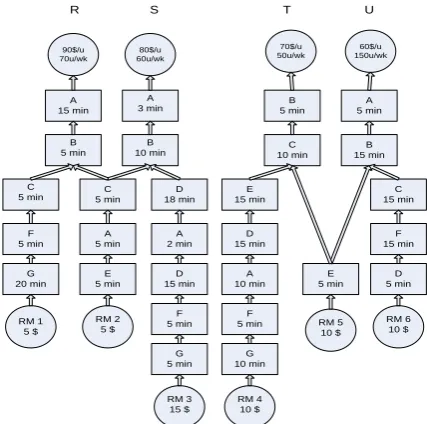
The problem shown in Figure 1 has been taken from Hsu and Chung (Hsu and Chung 1998). There are seven different resources, A, B, C, D, E, F, G. Each resource has a capacity of 2400 minutes. Four different types of products R, S, T and U, are produced.
90$/u 70u/wk A 3 min 80$/u 60u/wk A 15 min B 10 min B 5 min C 5 min C
5 min 18 minD
A 5 min F 5 min A 2 min E 5 min G 20 min D 15 min G 5 min F 5 min RM 1 5 $ RM 2 5 $ RM 3 15 $ 70$/u 50u/wk A 5 min 60$/u 150u/wk B 5 min B 15 min C 10 min E 15 min C 15 min D 15 min F 15 min E 5 min A 10 min D 5 min RM 5 10 $ RM 6 10 $ G 10 min F 5 min RM 4 10 $
R S T U
Figure 1. Example from Hsu and Chung
Table 3 shows the throughput and loads required for producing one unit of products R, S, T, U.
Table 3. Throughput and loads required for producing one unit of products cases
P ro du ct Wee kly dema nd T hro ug hp ut per unit Load requirements(min)
A B C D E F G
R 70 80 20 5 10 0 5 5 20
S 60 60 10 10 5 30 5 5 5
T 50 50 10 5 10 15 20 5 10
U 150 30 5 15 10 5 5 15 0
4.1.TOC approach solution
The TOC incorporates five general steps (Onwubolu and Mutingi 2001):
1) Identify the constraints.
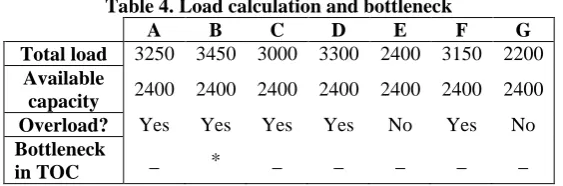
Table 4. Load calculation and bottleneck
A B C D E F G Total load 3250 3450 3000 3300 2400 3150 2200
Available
capacity 2400 2400 2400 2400 2400 2400 2400 Overload? Yes Yes Yes Yes No Yes No
Bottleneck
in TOC _ * _ _ _ _ _
2) Decide how to exploit the constraints.
In Table 5 throughput per constraint minute is calculated. 3) Subordinate everything else to the above decision. 4) Elevate the constraints.
In Table 5 throughput per constraint resource minute is calculated to determining the required number of products to be produced within the available capacity of each resource per week.
It is clear from TOC that the order of production is product R, T, S, U. So the product mix is 70 product R, 50 product T, 60 product S and 80 product U.
Table 5.TOC approach and product mix
Products R S T U Throughput per unit 80 60 50 30
Process time machine B 5 10 5 15
Throughput per constraint minute 16 6 10 2
order of Production 1 3 2 4
Produced units 70 60 50 80
Throughput 14,100
5) If in the previous steps, a constraint has been broken, go back to step 1.
Total load of each member for product mix given by TOC is shown in Table 6. It shows that the resource A and D are again overloaded and exceeds the available maximum capacity of 2400 minutes. Thus, it appears that TOC solution is infeasible when multiple constraint resources exist and so throughput is not acceptable.
Table 6.Load calculation for product mix given by TOC
A B C D E F G
Total load 2900 2400 2300 2950 2050 2100 2200 Available capacity 2400 2400 2400 2400 2400 2400 2400 Bottleneck after solving Yes No No Yes No No No
4.2.Proposed methodology solution
The previous example from Hsu and Chung was solved by proposed method to determine the effectiveness of the proposed methodology in multiple bottlenecks environment.
Table 4 shows that A, B, C, D and F are overloaded. So, bottlenecks are ={A, B, C, D, F } and proposed model has 6 objective functions, 5 of them for bottleneck exploitation and one for throughput.
At first, the importance of throughput and bottlenecks based on the decision maker’s judgment is determined.
C1 : 0.160, C2 : 0.242, C3 : 0.094, C4 : 0.147, C5 : 0.138, C6 : 0.214
It must be noted that maximum throughput of system is the goal of throughput and is calculated as follows:
70 * 80 + 60 * 60 + 50 * 50 + 150 * 30 = 16200
Finally the mathematical model after using of goal programming is as follows. Min 0.160d1 + 0.242d2 + 0.094d3 + 0.147d4 + 0.138d5+ 0.214d6
20R + 10S + 10T + 5U + d1 = 2400 (for bottleneck resource A) 5R + 10S + 5T + 15U + d2 = 2400 (for bottleneck resource B) 10R + 5S + 10T + 10U + d3 = 2400 (for bottleneck resource C) 0R + 30S + 15T + 5U + d4 = 2400 (for bottleneck resource D) 5R + 5S + 5T + 15U + d5 = 2400 (for bottleneck resource F) 80R + 60S + 50T + 30U + d6 =16200 (for throughput) 5R + 5S + 20T + 5U <= 2400 (for resource E)
20R + 5S + 10T + 0U <= 2400 (for resource G) 0<= R <= 70 (demand of product R)
0<= S <= 60 (demand of product S) 0<= T <= 50 (demand of product T) 0<= U <= 150 (demand of product U)
We use GAMS 24.1 to solve the problems, experiments have been performed on a PC with Intel (R) Core (TM) 2 Duo CPU T9550 @ 2.67GHz and 4GB of memory and compare the result of Proposed methodology with GA solution, TOC solution and LP solution. After running the model, Table 7 shows product mix and throughput of proposed methodology.
Table 7.Product mix and throughput of proposed methodology Products R S T U Produced units 50.6667 38.1667 50 101
Throughput 11873.333
Comparing the result with other models in Table 8 reveals that the proposed methodology is suitable in reaching at the optimal product-mix, maximizing throughput under situation that decision maker idea is important.
Table 8.Throughput comparison between models Problem GA solution(Coman
and Ronen 2000)
TOC solution
LP solution Proposed methodology Hsu and Chung
( 1998).
11860 14100
(infeasible)
11873.33 11873.33
The genetic algorithm (GA) model presented by Onwubolu and and Mutingi (Onwubolu and
Mutingi 2001) fails to maximize the throughput. The result of theory of constraint is infeasible. LP answer is optimal but it tries to maximize the usage of all resources, so does not regard the ideas of the decision maker. In thr proposed methodology, decision maker can decide about the importance of throughput and Bottleneck priority through considering them in to the decision matrix.
5. Sensitivity analysis
vary. In this section sensitivity analysis is done for coefficients value of objective function. Table 9 shows the result.
In the first scenario it can be seen that in decision maker idea all objectives are the same and have no superiority to each other. So coefficients of objective function are the same and the answer of the proposed methodology is optimal. In second and third scenario objectives have superiority to each other. In the second scenario the answer is optimal and in third scenario the answer is not optimal but considers the decision maker idea.
Scenario 3 in the proposed method solution is not optimal but considers the decision maker idea and LP solution does not consider decision maker idea because in LP solution utilization of bottleneck D is higher than of bottleneck C and F while in decision maker idea maximizing utilization of bottleneck C and F is more important than maximizing utilization of bottleneck D. Proposed method considers this issue. It is important that in all situations, proposed methodology considers decision maker idea.
Table 9.Sensitivity Analysis
rows Coefficients of objective function Throughput Bottlenecks Utilization
C1 C2 C3 C4 C5 C6 A B C D F
1
0.166 0.166 0.166 0.166 0.166 0.166 LP solution 11873.33 100% 100% 0.919% 100% 0.92%
Proposed method solution 11873.33 100% 100% 0.919% 100% 0.92%
2
0.160 0.242 0.094 0.147 0.138 0.214 LP solution 11873.33 100% 100% 0.919% 100% 0.92%
Proposed method solution 11873.33 100% 100% 0.919% 100% 0.92%
3
.08 0.05 0.416 0.027 0.277 0.138 LP solution 11873.33 100% 100% 0.919% 100% 0.92%
Proposed method solution 11318.182 100% 100% 100% 0.984% 100%
6. Conclusion
The present work explained a methodology using of goal programming and pair wise comparison to determine the product mix of the manufacturing system in multiple bottlenecks environment. The proposed methodology has multi objectives: maximizing throughput and the bottlenecks exploitation with considering the importance of throughput and bottleneck that is determined by the decision maker.
The present work showed the theory of constraints had shortcomings in handling multiple constraint resources. It could not reach an optimum solution in all cases and doesn’t consider decision maker idea. Due to the inefficiency of the available methods in considering the decision maker idea, a proposed methodology was developed. The main advantage of the method was considering the decision maker idea in the model. The optimal throughput for proposed methodology is found to be 11873.33. The value is identical to the optimal throughput found by Hsu and Chung, with this difference that proposed methodology considers the decision maker idea and the model presented by Hsu and Chung (1998) doesn’t consider the decision maker idea.
References
Aguilar-Escobar, V., Garrido-Vega, P. and González-Zamora, M., (2016). “Applying the theory of constraints to the logistics service of medical records of a hospital”, European Research on
Management and Business Economics, Vol. 22, No. 3, pp 139-146.
Badri, S. A. and Aryanezhad, M.B., (2011). “A Mathematical Method for Managing the System Constraint”, International Journal of Engineering (IJE) , Vol. 24, No. 1, pp 37-47.
Balakrishnan, J. and Cheng, C.H., (2000). “Theory of constraints and linear programming: A re-examination”, International Journal of Production Research , Vol. 38, No. 6, pp 1459–1463.
Bhattacharya, A. and Vasant, P., (2007). “Soft sensing of level of satisfaction in TOC product mix decision heuristic using robust fuzzy-LP”, European Journal of Operation Research , Vol. 177, 55– 60.
Bhattacharyal, A., vasant, P., Andreeski, C., Barsourn, N., kolemisevska, T., Dinibiitiin, A. T.,and Dirnirovski, G. M., (2006). “decision making in TOC product mix selection via fuzzy cost function optimizations”, Improving Stability in Developing Nations through Automation Prishtina, Kosovo.
Coman, A. and Ronen, B., (2000). “production outsourcing: a linear programming model for the theory of constraints”, International Journal of Production Research , Vol. 38, No. 7, pp 1631–1639.
Goldratt, E.M., (1990). “What is This Thing called Theory of Constraints”, North River Press, NewYork.
Golmohammadi, D., (2015). “A study of scheduling under the theory of constraints ”, International
Journal of Production Economics, Vol. 165, pp 38–50.
Finch, B.J. and Luebbe, R.L., (2000). “Response to Theory of constraints and linear programming: A re-examination”, International Journal of Production Research , Vol. 38, No. 6, pp 1465–1466.
Frendall, L. D. and Lea, B. R., (1990). “Improving the product mix heuristic in the theory of constraints”, International Journal of Production Research , Vol. 35, No. 6, pp 1535–1544.
Georgiadis, P., & Politou, A., (2013). “Dynamic Drum-Buffer-Rope approach for production planning and control in capacitated flow-shop manufacturing systems”, Computers & Industrial Engineering, ,
Vol. 65, No. 4, pp 689-703.
Hasuike, T. and Ishii, H., (2009). “product mix problems considering several probabilistic conditions and flexibility of constraints”, computers and industrial engineering , Vol. 56, pp 918-936.
Hsu, T. C. and Chung, S.-H., (1990). “The TOC-based algorithm for solving product mix problems”, Production Planning and Control t”, Vol. 9, 36–46.
Izmailova, A., Kornevaa, D. and .Kozhemiakinb, A., (2014). “Effective Project Management with Theory of Constraints”, Procedia - Social and Behavioral Sciences, Vol. 229, pp 96–103.
Luebbe, R. and Finch, B., (1992). “Theory of constraints and linear programming: A comparison”,
International Journal of Production Research, Vol. 30, No. 6, pp 471–1478.
Mishraa, N., Prakash, Tiwari, M.K., Shankar, R. and Chan, F.T.S., (2005). “Hybrid tabu-simulated annealing based approach to solve multi-constraint product mix decision problem”, Expert Systems
with Applications , Vol. 29, pp 446–454.
Okutmu ¸E ., Kahveci, A., Kartašova , J., (2016). “Using theory of constraints for reaching optimal product mix: An application in the furniture sector”, Intellectual Economics , pp 138–149.
Onwubolu, G.C. and Mutingi, M., (2001). “A genetic algorithm approach to the theory of constraints product mix problems”, Production Planning and Control , Vol. 12, No. 1, pp 21–27.
Onyeocha, C., (2015). “Effect of product mix on multi-product pull control Chukwunonyelum Emmanuel Onyeocha”, Simulation Modelling Practice and Theory, Vol. 2, pp16–35.
Plenert, G., (1990). “Optimizing theory of constraints when multiple constrained resources exist”,
European Journal of Operational Research, Vol. 70, pp 126–133.
Rabbani, M., & Tanhaie, F. , (2015). ” A Markov chain analysis of the effectiveness of drum-buffer-rope material flow management in job shop environment”,growing science , Vol. 6, No. 4, pp 457-468.
Ray, A., Sarkar, B. and Sanyal, S.K., (2008). “An improved theory of constraints”, International
journal of accounting and information management , Vol. 16, No. 2.
Ray, A., Sarkar, B. and Sanyal, S., (2010). “The TOC-Based Algorithm for Solving Multiple Constraint Resources”, International Jo IEEE Transactions on Engineering Management, Vol. 2.