Available Online at www.ijpret.com 921
INTERNATIONAL JOURNAL OF PURE AND
APPLIED RESEARCH IN ENGINEERING AND
TECHNOLOGY
A PATH FOR HORIZING YOUR INNOVATIVE WORK
FORMATION OF CLUSTERS AND SEARCHING USING SIDE INFORMATION MINING
POOJA AWANDKAR, PROF. AMIT PIMPALKAR Department of Computer science & Engineering, G.H.R.A.E.T, Nagpur University, India. Accepted Date: 05/03/2015; Published Date: 01/05/2015
Abstract: In the digital world there is tremendous growth of digital information. This information also contains side information with it. The side information is the auxiliary information which may also be useful. The side information is of the type such as citation from the scientific publications, the authorship, the co-authorship, etc. such types of side information contain tremendous amount of information for performing clustering process. In this paper we deal with a principled way of performing mining process with the use of side information from the different documents. We make use of the clustering algorithm for the formation of clusters. After mining text data we search the keywords based on the user behavior.
Keywords:Text mining, Side information, Mining.
Corresponding Author: MS. POOJA AWANDKAR
Access Online On:
www.ijpret.com
How to Cite This Article:
Pooja Awandkar, IJPRET, 2015; Volume 3 (9): 921-930
Available Online at www.ijpret.com 922 INTRODUCTION
The rapid increase of digital information in the digital world creates problems in extracting relevant information from those huge data. The large amount of work on the text clustering has been done in recent years [18] [23]. In many text documents along with the text data, side information is also present. This side information is nothing but the auxiliary information which is useful for the clustering process. Some of the examples of the side information are as follows:-
a. Many text documents have links among them. These links are useful and contains a large amount of useful information for mining purposes. Such type of side information may provide the correlations among the documents which is not easily accessible from raw content.
b. Documents may be linked with user-tags in many network and user-sharing applications. This may also be quite informative.
We are making use of the side information for clustering the data for doing effective text mining. The process of deriving high quality information from text is known as text data mining. While this side-information can sometimes prove useful in improving the quality for the clustering process, but when the side-information is noisy it can be a risky approach and the quality of the mining process can actually become worse. Therefore, we will proceed towards to use an approach which carefully finds the well-organized form of the clustering characteristics of side information with that of text content. The basic approach of the system is that it can form a clustering in which the text attributes along with the side-information provide similar hints about the character of the basic clusters, and at the same time fail to consider those features in which conflicting hints are provided. Also we will use an efficient searching method based on user behavior. With the help of the use of this user behavior search we will get the more relevant searching results and the desired output.
I. RELATED WORK
Available Online at www.ijpret.com 923
Fast and adaptive clustering of text streams were studied by S. Zhong [16]. They combine an effective online spherical k-means (OSKM) algorithm with an existing expandable clustering strategy. This was done to achieve fast and adaptive clustering of the text streams. However, all of these methods were designed for the instance of pure text data, and these methods do not work for cases in which text-data is merged with other forms of data.
Y. Gong, etal [19] proposed Matrix-factorization techniques for text clustering. This technique selects words from the document which are based on their application of the clustering process, and also uses an iterative EM method. This method is used in order to refine the clusters. One of the most popular techniques for text-clustering was introduced by D. Cutting, etal [21] the scatter-gather technique, which uses a fusion of agglomerative and partitional clustering. Scatter-gather technique is particularly helpful in situations where it is difficult or undesirable to specify query formally.
II. PROPOSED WORK
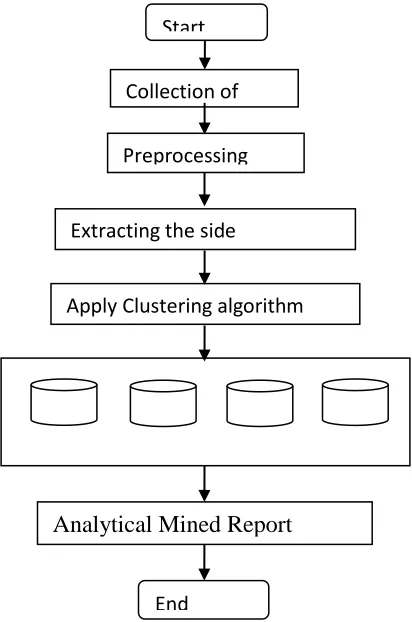
In the proposed work our objective will be firstly to collect information i.e. gathering the data set. After this extracting the keywords and the side information from those data sets will be our next objective. Once the keywords and the side information are extracted we will then perform the clustering using the COATES algorithm. Then the Text classification is carried out, means classifying the clustered text for generating the optimized result according to User Behavior (localization, personalization). Then the output will be shown in the form of graph. Graphical representation will show the relevant data mined from the particular page by removing the irrelevant information. Also the analytical mined reports will be generated. These reports will depend on the previous searching method and the method used in our proposed system.
a. Gathering data set
We will gather data set. From the large amount of data we will select our data set on which we will be working.
b. Extracting keywords and side-information
From the data set we will extract the keywords and the side-information.
Available Online at www.ijpret.com 924
Once we will extract the keywords and the side-information we will form the clusters based on the keywords and then on the side-information.
d. Outcome
We will show the graph that will show the relevant data mined from the particular page by removing the irrelevant information.
Our contribution in this proposed work is describe as follows,
Firstly we gathered large amount of data set from internet which includes the data on IPC Act of India and some generalized data. After this the preprocessing on data was done. Preprocessing is the very important thing since it may affect the result of clustering technique. Preprocessing includes the stop words removal techniques and the stemming technique. Once the preprocessing is done then the indexing of data has been started. Indexing is the process of maintaining the frequency of the particular keyword from the documents.
Stop Words: Stop words are the words which should be filtered out before or after the text processing. Stop words should be removed to support the phrase searching because they can cause problems while searching for phrases that include them. Some of the list of stop words includes, “is, the, at, which, on, are, but, onto, etc”. Such stop words are removed in the preprocessing step of our project.
Stemming: Stemming words are the derived words from their root words. Most of the times we come across words which have similar semantic interpretation and instead of those words their root words can be used for the information retrieval process. Stemming words includes, “Relating/Related/” can be replaced by their root word “Relate”. Such stemming words are replaced by their root words in our project.
Clustering Algorithms
Available Online at www.ijpret.com 925
In this paper we are using K-means clustering algorithm for the formation of clusters from the set of text documents. K-means clustering algorithm does the partition of n observations into k clusters in which each observation belongs to the cluster of the nearest mean.
K-means Algorithm
K-means clustering algorithm aims to do the partition of n observations into k sets {S1, S2,..…,Sk}
where k ≤ n from the given set of observations (x1, x2,…… xn). The steps followed by k-means
algorithm are as below:
i. The algorithm randomly selects k points as initial cluster centers.
ii. Each point from the dataset is assigned to the closest cluster based upon the Euclidean distance among each point and each cluster center.
iii. Each cluster center is then recomputed as the average of points in that cluster.
iv. Step ii and iii are repeated until the clusters are formed.
Once all the preprocessing is performed we then focus on the retrieval of side information from the documents. For this retrieval we maintain a particular threshold. The threshold is maintained by the gini index concept from [3]. Once the side information is retrieved from the documents then the process of formation of clusters started.
Clustering with Auxiliary information
For the clustering process we make use of clustering with auxiliary information method. We make the clustering process in two phases:
i. First phase: In the first phase the clustering is performed on the pure text data from the documents without making any use of the side information.
ii. Second phase: After the completion of the first phase the next phase started. In the second phase the reclustering is done with the help of text content as well as the side information.
Available Online at www.ijpret.com 926
Fig (1): System flow diagram
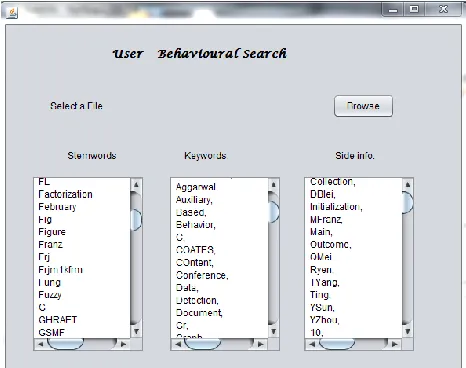
The implementation of project is carried out and we got some output. Fig (2) shows the output after the preprocessing is carried out i.e. it shows the result of separation of keywords and the side information from the documents. Fig (3) shows the output of the searching when the user searches particular keyword.
Start
Collection of data
Preprocessing
Apply Clustering algorithm
Analytical Mined Report
End Extracting the side information
Available Online at www.ijpret.com 927 Fig (2): Results after preprocessing
Fig (3): Output of Searching
IV. CONCLUSION
Available Online at www.ijpret.com 928 REFERENCES
1. Pooja Awandkar, Amit Pimpalkar, “Survey on User Behavioral Search using the Auxiliary Information Mining”, in International Journal Of Engineering And Computer Science ISSN:2319-7242 Volume 3, Issue 10 October, 2014 Page No. 9002-9006.
2. Pooja Awandkar, Amit Pimpalkar, “Extracting Side Information from Unstructured Data using Data Mining Technique”, in ABHIYANTRIKI An International Journal of Engineering & Technology (AIJET) eISSN: 2394-627X, Vol. 1, No. 2 (December, 2014) Page No. 51-56.
3. Philip S, C. C. Aggarwal, Yuchen Zhao, “On the Use of Side Information for Mining Text Data”, in IEEE Transactions on knowledge and data engineering, vol. 26, no. 6, June 2014.
4. Ting Yuan, Jian Cheng, Xi Zhang, Shuang Qiu, Hanqing Lu, “Recommendation by Mining Multiple User Behaviors with Group Sparsity”, in Proceedings of the Twenty-Eighth AAAI Conference on Artificial Intelligence, 2014.
5. Amit Pimpalkar “Review of Online Product using Rule Based and Fuzzy Logic with Smiley’s”, International Journal of Computing and Technology, Volume 1, Issue 1, February 2014.
6. Ryen W. White, Wei Chu, Xiaodong He, Ahmed Hassan1, Yang Song, Hongning Wang, “Enhancing Personalized Search by Mining and Modeling Task Behavior”,in Proceedings of ACM International World Wide Web Conference (WWW), 2013.
7. H. Wang and C. C. Aggarwal, Managing and Mining Graph Data. New York, USA: Springer, 2010.
8. D.Blei and J.Chang, “Relational topic models for document networks”, in Proceedings of AISTASIS, Clearwater, FL, USA, pp. 81–88, 2009.
9. Y.Sun, J.Han, Y.Yu, and J.Gao, “iTopicModel: Information network integrated topic modeling”, in Proceedings of ICDM Conference,Miami,FL,USA, pp. 493–502, 2009.
10.Y.Zhou, H.Cheng, and J.X.Yu, “Graph clustering based on structural/attribute similarities”, PVLDB, volume 2, no. 1, pp. 718–729,2009.
11.Q.Mei, D.Cai, D.Zhang, and C.X.Zhai, “Topic modeling with network regularization”, in Proceedings of WWW Conference, NewYork,USA, pp. 101–110, 2008.
Available Online at www.ijpret.com 929
13.J. Zhang, Q. He, K. Chang, and E. P. Lim, “Bursty feature representation for clustering text streams”, in Proceedings of SDM Conference, pp. 491–496, 2007.
14.P. S. Yu, and C. C. Aggarwal, “A framework for clustering massive text and categorical data streams”, in Proceedings of SIAM Conference Data Mining, pp. 477–481, 2006.
15.S. Siersdorfer, and R. Angelova, “A neighborhood-based approach for clustering of linked document collections”, in Proceedings of CIKM Conference, New York, USA, pp. 778–779, 2006.
16.S. Zhong, “Efficient streaming text clustering”, Neural Network., volume 18, no. 5–6, pp.790–798, 2005.
17.S. C. Gates, P. S.Yu, and C. C. Aggarwal, “On using partial supervision for text categorization”, IEEE Transaction Knowledge and Data Engineering, volume 16, no.2, pp. 245– 255, February 2004.
18.J. X. Yu, G. P. C. Fung, and H. Lu, “Classifying text streams in the presence of concept drifts”, in Proceedings of PAKDD Conference, Sydney, NSW, Australia, pp. 373–383, 2004.
19.Y. Gong , W. Xu, and X. Liu, “Document clustering based on nonnegative matrix factorization”, in Proceedings of ACM SIGIR Conference, New York, USA, pp. 267–273, 2003.
20.M.Franz, J.S.McCarley, T.Ward, and W.J.Zhu, “Unsupervised and supervised clustering for topic tracking”, in Proceedings of ACM SIGIR Conference, New York, USA, pp. 310–317, 2001.
21.D. Cutting, J. Pedersen, J. Tukey, and D. Karger, “Scatter/Gather: A cluster-based approach to browsing large document collections”, in Proceedings of ACM SIGIR Conference, New York, USA, pp. 318–329, 1992.
22.Ting Yuan, Jian Cheng, Xi Zhang, ShuangQiu, Hanqing Lu, “Recommendation by Mining Multiple User Behaviors with Group Sparsity”, in Proceedings of the Twenty-Eighth AAAI Conference on Artificial Intelligence, 2014.
23.Amit Pimpalkar “Review of Online Product using Rule Based and Fuzzy Logic with Smiley’s”, International Journal of Computing and Technology, Volume 1, Issue 1, February 2014.
Available Online at www.ijpret.com 930
25.H. Wang and C. C. Aggarwal, Managing and Mining Graph Data. New York, USA: Springer, 2010.
26.D.Blei and J.Chang, “Relational topic models for document networks”, in Proceedings of AISTASIS, Clearwater, FL, USA, pp. 81–88, 2009.
27.Y.Sun, J.Han, Y.Yu, and J.Gao, “iTopicModel: Information network integrated topic modeling”, in Proceedings of ICDM Conference,Miami,FL,USA, pp. 493–502, 2009.
28.Y.Zhou, H.Cheng, and J.X.Yu, “Graph clustering based on structural/attribute similarities”, PVLDB, volume 2, no. 1, pp. 718–729,2009.
29.Q.Mei, D.Cai, D.Zhang, and C.X.Zhai, “Topic modeling with network regularization”, in Proceedings of WWW Conference, NewYork,USA, pp. 101–110, 2008.
30.S. Basu and Banerjee, “Topic models over text streams: A study of batch and online unsupervised learning”, in Proceedings of SDM Conference, pp. 437–442, 2007.
31.J. Zhang, Q. He, K. Chang, and E. P. Lim, “Bursty feature representation for clustering text streams”, in Proceedings of SDM Conference, pp. 491–496, 2007.
32.P. S. Yu, and C. C. Aggarwal, “A framework for clustering massive text and categorical data streams”, in Proceedings of SIAM Conference Data Mining, pp. 477–481, 2006.
33.S. Siersdorfer, and R. Angelova, “A neighborhood-based approach for clustering of linked document collections”, in Proceedings of CIKM Conference, New York, USA, pp. 778–779, 2006.
34.S. Zhong, “Efficient streaming text clustering”, Neural Network., volume 18, no. 5–6, pp.790–798, 2005.
35.S. C. Gates, P. S.Yu, and C. C. Aggarwal, “On using partial supervision for text categorization”, IEEE Transaction Knowledge and Data Engineering, volume 16, no.2, pp. 245– 255, February 2004.