Using Social Marketing Principles to Understand an Extension
Audience’s Landscape Water Conservation Practices
Laura A. Warner William L. Schall University of Florida
A substantial amount of water is applied to Florida landscapes, and encouraging water conservation through irrigation practices has been identified as a priority programming area where there is great opportunity to positively affect the state’s water resources. Florida Extension addresses this priority area through
educational programming. Social marketing has been identified as a promising approach to changing behaviors that influence environmental issues, such as water-saving irrigation technologies and practices. This approach recognizes that there are barriers that prevent individuals from engaging in positive behavior changes. This study evaluated an irrigation seminar using a retrospective pretest-posttest design that incorporated elements of a social marketing intercept survey. Thirty-four attendees participated and primarily represented green industry professional and government sectors. Study objectives were to evaluate the workshop and describe the audience using social marketing principles for future program planning based on audience research. The
audience rated their descriptive norms, a strong predictor of behavioral change, lower than their injunctive norms, a less robust predictor. The majority planned to adopt at least one water-conservation best management practice as a result of the workshop. We make recommendations for applying social marketing
principles to Extension programming.
Keywords: behavior change, irrigation, water conservation, social marketing, normative beliefs, barriers
Introduction
Florida withdraws an incredible 6.341 billion gallons of fresh ground and surface water per day, with water directed to public consumption making up approximately 35% of this usage (U.S. Geological Service, 2013). In a typical central Florida landscape with homeowner-controlled irrigation, an average of 64% of residential water usage is applied in the landscape and often exceeds the amount needed by plants (Haley, Dukes, & Miller, 2007). This usage represents a substantial opportunity for conservation by residents, green industry professionals, and property managers throughout the state, as many have previously recognized.
Irrigation and Environmental Impact
Research indicates that a significant portion of Florida’s water usage is directed toward
landscape irrigation. Thus, landscape water conservation has been identified as a priority area. There are a number of means to conserve water in the landscape through appropriate landscape practices and irrigation technologies. These include smart irrigation controllers that use soil moisture sensors or evapotranspiration data (Dukes, 2012; Haley & Dukes, 2012), the reduction of turfgrass in the landscape, the use of plant material with low water requirements, and the use of rainfall-activated irrigation shutoff devices. Florida Extension professionals incorporate these practices and technologies into programming to encourage landscape water conservation.
Extension Education on Sustainable Landscaping Practices
Florida Extension seminars have successfully increased the use of appropriate irrigation practices (Israel, Easton, & Knox, 1999), and there is a substantial amount of training available for
homeowners on landscape water use and conservation (Shober, Denny, & Broschat, 2010). However, raising awareness of the relationship between landscape practices and environmental impact remains an area of educational need. Research has shown that the majority of
homeowners want to protect water quality but believe that their irrigation practices do not impact the environment (Blaine, Clayton, Robbins, & Grewal, 2012). Most green industry professionals have not had formal training in irrigation management (Shober et al., 2010). These indicators reveal the great need for education in this area.
Florida Extension regularly offers seminars about water-saving technologies and practices to address the overuse of water in the landscape. Local county Extension faculty members apply current research and customize these programs to meet the needs of local clients (Israel et al., 1999). In the program under study, Extension faculty from three adjacent counties collaborated on a seminar to meet the needs of mixed local clientele comprised of landscape professionals, local government staff, and homeowners. This study sought to explore audience characteristics using social marketing principles and to evaluate the 1-day program for audience behavioral intentions and increased awareness of water issues.
Measuring Impact of Extension Programs
serve Extension clients (Boone, Safrit, & Jones, 2002). Knowledge gain is frequently used as an evaluation measure, but this outcome cannot be assumed to generate behavior change (Frisk & Larson, 2011; Kollmuss & Agyeman, 2002). There is value in knowledge gain as an outcome; however, in the case of many environmental issues, such as water quality and human-impacted nonpoint source pollution, it is essential that behavior changes occur in order to improve the problem. Behavior change is highly valued as an outcome, and Extension professionals have been encouraged to incorporate this measure into their evaluation plans (Boone et al., 2002; Rennekamp & Engle, 2008). One approach to creating behavior change is social marketing. This approach to changing behaviors is relatively underused in Extension and “holds great promise for extending Extension’s outreach on old and new issues” (Skelly, 2005, Conclusion, para. 1).
Overview of Social Marketing
Social marketing is a distinct discipline that applies traditional marketing principles to create voluntary behavior change that benefits society (Kotler & Lee, 2008). A key distinction of social marketing is the focus on the benefit to society, whereas in traditional marketing, financial profit is the primary objective (Kotler & Lee, 2008). Social marketing incorporates (a) a research-based understanding of a targeted audience, (b) tailored message development research-based on a segmented group’s characteristics and needs, and (c) the use of strategies designed to remove or reduce an audience’s perceived barriers and enhance perceived benefits to change (Andreasen, 2006; Kotler & Lee, 2008; Lefebvre, 2011; McKenzie-Mohr, 2011). An audience’s perceived barriers to change contribute to their perceived cost of making practice changes. When applying the social marketing approach, Extension professionals work to reduce this perceived price (barrier) and to increase the value of adopting the behavior, similar to traditional marketing of commercial products (McKenzie-Mohr, Lee, Schultz, & Kotler, 2012). A number of social marketing models describe the process of this approach to change. A social marketing
campaign, as described by McKenzie-Mohr et al. (2012), incorporates the following major steps: (a) selecting behaviors to promote among a target audience, (b) identifying barriers and benefits to making the selected behavior changes, (c) developing strategies to reduce barriers and increase benefits to changing the behaviors, (d) pilot testing the strategy, and (e) implementing on a broad-scale implementation and evaluating.
Social Marketing Principles and Extension Programs
analysis allows Extension educators to use tools and strategies to encourage the adoption of practices that benefit the communities they serve.
Social marketing may be applied to programs as a strategy to influence behaviors for the good of the broader community (Andreasen, 1994). Many Extension professionals already use some social marketing principles, albeit unintentionally (Warner, 2014), and the tools of social
marketing can be used to impact the community in a positive way. Social marketing campaigns have been successfully used to encourage environmental behavior changes such as recycling, water conservation, and sustainable landscape management practices (McKenzie-Mohr, 2011; McKenzie-Mohr et al., 2012). Extension professionals working to promote a specific
behavior—the adoption of water-saving techniques and technologies—used this study to explore an audience’s social norms, perceived barriers and benefits to practice and technology adoption, and knowledge gain related to the objectives of the training. When viewing Extension
programming through the lens of social marketing, an understanding of clients’ behavioral intentions, norms, barriers, and benefits can allow an Extension professional to use strategies to increase the likelihood that individuals will adopt a behavior (McKenzie-Mohr, 2011).
Audience Characteristics and Behavior Change
While social marketing prescribes specific behavior change as a final outcome, the Theory of Planned Behavior (TPB) is an indicator of change prior to its occurrence. The TPB defines behavioral intention as a product of attitude, perceived behavioral control, and subjective norms. The TPB may be applied to behavioral outcomes of Extension programming. The intention to perform some behavior suggests the effort one is likely to put into practice change or behavior adoption. When a target audience’s intent to perform a behavior is understood, their future behaviors may also be understood, as “the stronger the intention to engage in a behavior, the more likely should be its performance” (Ajzen, 1991, p. 181). Therefore, educational professionals are able to project actual behavior when they measure audience intentions.
Barriers are the target audience’s concerns regarding a specific behavioral change; they include the reasons people feel they cannot make some practice change and the costs they perceive to be associated with the practice change (Kotler & Lee, 2008). Benefits are the things people
perceive they will gain if they make the specified behavior change; people factor in the likelihood they think they are to receive them (Kotler & Lee, 2008). An Extension faculty member using social marketing would approach behavior change by first identifying the audience’s perceived benefits and barriers, and then working to enhance the former and reduce the latter.
perceptions of whether the behavior ought to be done, and descriptive norms refer to behaviors in which those around an individual are engaged (McKenzie-Mohr, 2011). Research has
demonstrated a relationship between normative beliefs about a behavior with intentions to act (Ajzen, 1991; McKenzie-Mohr, 2011). Based on TPB, if a target audience believes that using water savings practices and techniques are both approved of (injunctive norm) and being done by others (descriptive norm), they are more likely to adopt the behavior (Ajzen, 1991; McKenzie-Mohr, 2011). Norms have been demonstrated to be good predictors for whether someone will make a particular behavior change (Ajzen, 1991; McKenzie-Mohr, 2011; Shaw, Radler,
Chenoweth, Heiberger, & Dearlove, 2011). In short, if individuals think that the people around them approve of and are engaging in some behavior, they are more likely to do so themselves. It is important to conduct thoughtful research on the target audience to understand the
characteristics that will support or discourage their adoption of some behavior change (McKenzie-Mohr, 2011). Barriers, benefits, normative beliefs, and behavioral intentions are some of the key indicators that can inform Extension professionals about their audiences and help them develop strategies that will effectively change behaviors.
Research Objectives
The objectives that guided this study were to
1. Describe an Extension audience using the social marketing concepts of intentions, barriers, benefits, and normative beliefs; and
2. Evaluate program outcomes through the use of a retrospective pretest-posttest.
Methods
Seminar Design
A one-day irrigation workshop was developed and held in Palm Beach County, Florida, to educate green industry professionals, municipal and county staff, property managers, and volunteers about irrigation best management practices. The objectives of this educational workshop were to raise awareness of the need to conserve water and preserve water quality and to encourage participants to adopt water-saving practices and technologies.
Study Design and Program Delivery
A research protocol for this study was submitted to the University of Florida’s Institutional Review Board. These documents described the voluntary study, explained how much time it would take to complete the instrument, and acknowledged known risks and benefits. Approval to conduct this research was received in September 2013 (Protocol #2013-U-0967).
This seminar was conducted in October 2013. At the conclusion of the program, the research protocol was explained, and participants were advised that involvement in the study was voluntary. Those who agreed to participate were asked to complete the survey instrument.
Sample Population
Sixty-nine individuals participated in this workshop, and 35 opted to complete the survey. We found 34 of the surveys to be usable, resulting in a 49.3% response rate.
Instrumentation
The survey instrument combined elements of a traditional retrospective pretest-posttest survey design and a community-based social marketing intercept survey design.
The first segment of the instrument was qualitative and incorporated an intercept survey. Intercept surveys are short surveys useful in identifying an audience’s perceived barriers and benefits with a limited time investment; they can be used when focus groups and more detailed surveys are not plausible (McKenzie-Mohr, 2011). Intercept surveys ask two questions: What makes it challenging or difficult for you to do this behavior? and What are the benefits to doing this behavior?, effectively identifying an audience’s barriers and benefits associated with a specific practice change (McKenzie-Mohr, 2011).
The third segment of the instrument incorporated elements of a retrospective pretest-posttest. A retrospective pretest-posttest instrument is administered one time following an intervention, such as a workshop (Nielsen, 2011). This instrument asks a respondent to refer to a specific point in time, such as before the workshop, and compare characteristics with their current state (Nielsen, 2011). This method of evaluation is beneficial as it is less time-consuming for both evaluators and program participants (Davis, 2003). Further, respondents are often better able to accurately gauge how their behavior has changed or their knowledge increased, after they have participated in a program (Davis, 2003). In other words, prior to an educational training, participants may not be clear on how much or little they know about the subject being taught. Participants were asked to rate their pre- and post-seminar knowledge on a 5-point Likert scale (from Very
unknowledgeable to Very knowledgeable). They were also asked to rate their awareness of the need to conserve water, the tools and resources that they can access to get help and information about using more efficient irrigation practices, and the techniques that can be used to improve irrigation efficiency on a 5-point Likert scale (from Very unaware to Very aware). We also asked participants if they were familiar with the water-saving technologies we presented prior to the program and if they planned to adopt new water-saving best practices as a result of the workshop.
A Cronbach’s alpha test for reliability resulted in a coefficient of .84 for the complete survey instrument, indicating that this tool had a satisfactory level of internal consistency (Fraenkel & Wallen, 2008). We also ran the Cronbach’s alpha test for reliability of the two individual quantitative parts of the instrument. This resulted in coefficients of .69 for the normative beliefs scale (second segment) and .81 for the retrospective pretest-posttest items (third segment). Given that the reliability coefficient for the second segment was approaching the .70 benchmark, and the reliability coefficients for the overall instrument and the third segment exceeded it, we determined that the instrument was suitable for this study (Fraenkel & Wallen, 2008).
Data Analysis
Data collected from this study were analyzed using Statistical Package for the Social Sciences (SPSS Version 20; SPSS, Chicago). Descriptive statistics, one-way analysis of variance (ANOVA), and paired t-tests were used to analyze the data.
To analyze data associated with Objective 1 (Describe an Extension audience through the use of social marketing concepts), we first calculated the frequencies of participants’ self-reported roles and descriptions. These frequencies were used to compute the mean score and standard
We used paired t-tests to measure Objective 2 (Determine program impact through the use of a retrospective pretest-posttest). For each of the items in the pretest-posttest, we computed the mean pretest score and compared it to the mean posttest score. We calculated effect size using Cohen’s d when t-tests produced significant results (Cohen, 1988). We report on effect size to allow the reader “to appreciate the magnitude or importance” (American Psychological
Association, 2010, p. 34) of the results. Effect size is a measure of practical significance, or “whether the result is useful in the real world” (Kirk, 1996, p. 746).
Results
Objective 1: Describe an Extension Audience Through the Use of Social Marketing Concepts
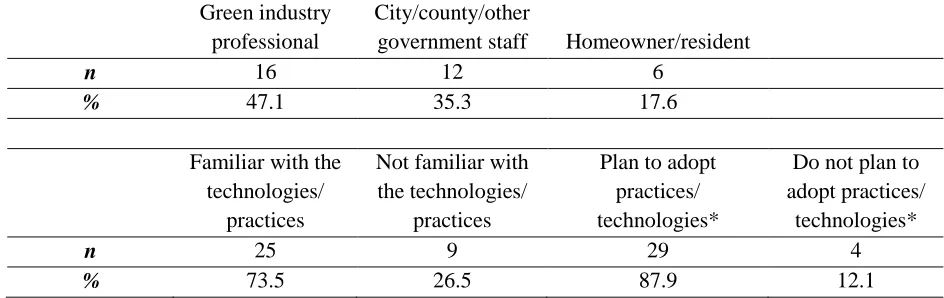
The majority of workshop attendees described themselves as either green industry professionals or local government staff, with less than one-fifth identifying as homeowners (Table 1). Nearly three-quarters of the sample had previously heard about the new technologies and practices presented, and nearly all indicated that they planned to adopt practices and technologies presented in the workshop.
Table 1. Distribution of Self-Reported Role and Description for Audience of a One-Day Irrigation Symposium
Green industry professional
City/county/other
government staff Homeowner/resident
n 16 12 6
% 47.1 35.3 17.6
Familiar with the technologies/
practices
Not familiar with the technologies/
practices
Plan to adopt practices/ technologies*
Do not plan to adopt practices/
technologies*
n 25 9 29 4
% 73.5 26.5 87.9 12.1
*Calculated based on n = 32 responses
Workshop attendees indicated that they viewed their role in both conserving water in the
landscape and persuading others to conserve water in the landscape (Table 2) as falling between Important (4) and Very important (5). We found no significant difference between participants’ self-described role at p = .05 (data not presented).
fell between Agree (4) and Strongly agree (5). Participants rated their descriptive norms (Many of my peers are adopting new water-saving technologies to conserve water in the landscape) lower than their injunctive norms (Table 2); this value fell between Neutral (3) and Agree (4).
Table 2. Summary of Evaluation of a Tri-County Irrigation Symposium
Variable M SD
How important is your role in:a
Conserving water in the landscape? 4.35 .85
Persuading others to conserve water in the landscape? 4.35 .92
Please indicate how much or how little you agree with the following statements:b
I believe I should conserve water in the landscape. 4.68 .54
The people who are most important to me believe I should
conserve water in the landscape. 4.24 .92
Many of my peers are adopting new water-saving technologies
to conserve water in the landscape. 3.74 .89
a 1 = Very unimportant; 2 = Unimportant; 3 = Neutral; 4 = Important; 5 = Very important.
b 1 = Stronglydisagree; 2 = Disagree; 3 = Neutral; 4 = Agree; 5 = Stronglyagree.
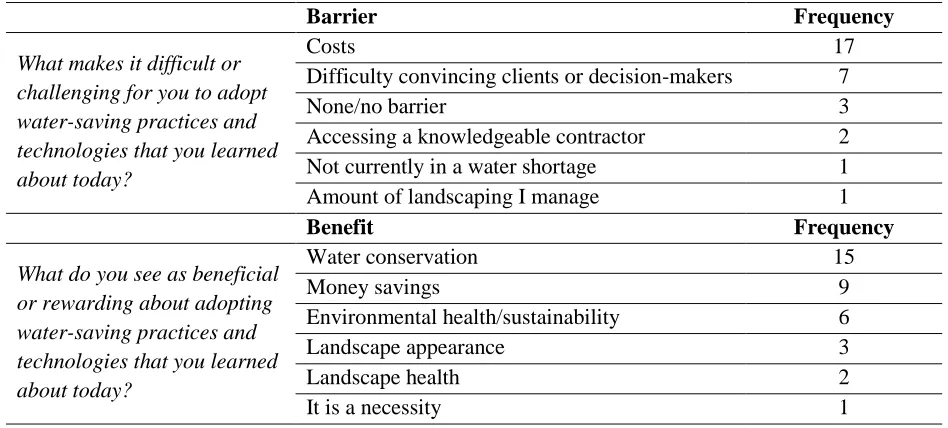
Participants provided a number of perceived barriers and benefits to adopting the practices and technologies presented in the workshop (Table 3). The most common barrier identified was the cost associated with adopting new technologies, followed by convincing clients to make changes and the politics associated with making changes. A few respondents indicated that there were no barriers to changing their practices. The most common benefits mentioned to adopting the practices and technologies presented in the workshop were water conservation, money savings, and environmental health.
Table 3. Summary of Barriers and Benefits Perceived by Participants in a Tri-County Irrigation Symposium
Barrier Frequency
What makes it difficult or challenging for you to adopt water-saving practices and technologies that you learned about today?
Costs 17
Difficulty convincing clients or decision-makers 7
None/no barrier 3
Accessing a knowledgeable contractor 2
Not currently in a water shortage 1
Amount of landscaping I manage 1
Benefit Frequency
What do you see as beneficial or rewarding about adopting water-saving practices and technologies that you learned about today?
Water conservation 15
Money savings 9
Environmental health/sustainability 6
Landscape appearance 3
Landscape health 2
Objective 2: Determine Program Impact Through the Use of a Retrospective Pretest-Posttest
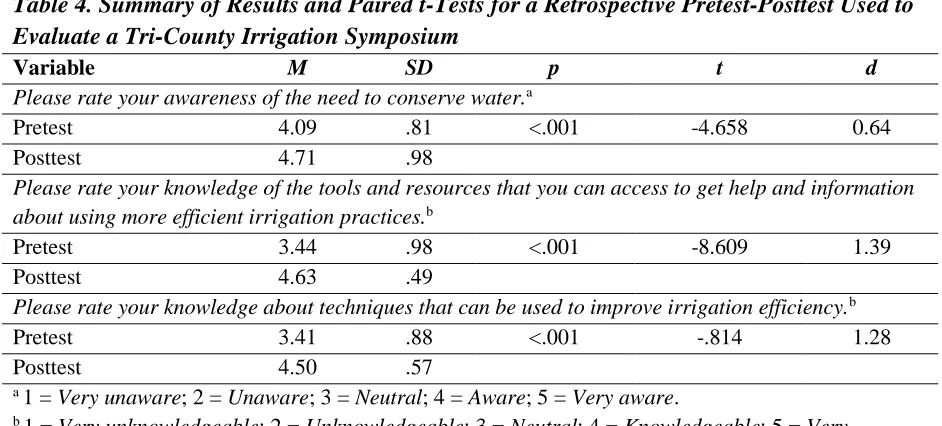
We measured a significant increase on each of the three items on the retrospective pretest-posttest (Table 4). Participants reported a substantial change in their understanding of the need to conserve water, their awareness of the knowledge and tools available to help improve
irrigation efficiency, and their understanding of the techniques that can be used to improve efficiency. The Cohen’s d measure of effect size for the awareness of the need to conserve water analysis was 0.64, which we interpreted as an indication of a medium magnitude of relationship (Cohen, 1988). The Cohen’s d measure of effect sizes for the knowledge and tools available to help improve irrigation efficiency and the knowledge of the techniques that can be used to improve efficiency were 1.39 and 1.28, respectively (Cohen, 1988). The effect sizes show that these increases have practical significance beyond statistical changes, and the results can be applied to real programming (Kirk, 1996).
A majority of respondents (73.5%; n = 25) indicated they were already familiar with the water-saving technologies and practices discussed in the workshop. The most common sources of this information were other professional organizations and our own university system through other workshops, newsletters, and media. A total of 85.3% (n = 29) of participants indicated they planned to adopt new water-saving technologies as a result of attending the workshop. When asked what technologies they planned to adopt, participants most frequently indicated they would make use of plants that require less water, install soil moisture sensors and smart irrigation controllers, and use more efficient irrigation heads.
Table 4. Summary of Results and Paired t-Tests for a Retrospective Pretest-Posttest Used to Evaluate a Tri-County Irrigation Symposium
Variable M SD p t d
Please rate your awareness of the need to conserve water.a
Pretest 4.09 .81 <.001 -4.658 0.64
Posttest 4.71 .98
Please rate your knowledge of the tools and resources that you can access to get help and information about using more efficient irrigation practices.b
Pretest 3.44 .98 <.001 -8.609 1.39
Posttest 4.63 .49
Please rate your knowledge about techniques that can be used to improve irrigation efficiency.b
Pretest 3.41 .88 <.001 -.814 1.28
Posttest 4.50 .57
a 1 = Veryunaware; 2 = Unaware; 3 = Neutral; 4 = Aware; 5 = Veryaware.
b 1 = Veryunknowledgeable; 2 = Unknowledgeable; 3 = Neutral; 4 = Knowledgeable; 5 = Very
Conclusions
Our team found the three-part instrument to be reliable and relatively easy to use. We liked the single administration of this tool as compared to a standard pretest-posttest design, and our audience appeared to like it as well. This Extension seminar was designed to address our local and widespread need to conserve water in the landscape, and we hoped to increase awareness of conservation issues and encourage irrigation practice changes. Given that the majority of the audience intended to make behavior changes, we determined that they may be likely to make changes (Ajzen, 1991). A follow-up evaluation should be conducted to measure actual change. We consider this program to be successful in that most participants indicated that they would adopt a new best management practice as a result of the program. We were not surprised that most of our audience had previously heard about the practices and technologies we presented, as water conservation is a widespread and public issue in our state.
Our audience’s familiarity with the issues could be further explained in that more knowledgeable clients may be prone to attend a program that covers issues they are already familiar with, and possibly be more likely to seek out opportunities to conserve and protect water. In other words, the individuals who are unaware of these issues and who potentially waste more water may be less likely to attend a program that encourages them to conserve. This reflects Rogers’ (2003) innovativeness-needs paradox in that those who need the benefits of an idea the most are the last to adopt it. Based on recommendations for addressing this paradox, we suggest that Extension professionals consider using a strategy that targets those who “would ordinarily be the last to adopt” (Rogers, 2003, p. 296). For example, in repeating this program, we would consider targeting those who are least aware of local water issues or least likely to conserve. One way to identify this target audience is through observation of current behaviors or water use records in a community.
Our audience reported their perceived role in conserving water and encouraging others to conserve water as fairly high. Participants’ injunctive normative beliefs toward irrigation conservation behavior were rated more highly than descriptive normative beliefs, meaning that our audience felt strongly that they should conserve water in the landscape but were not
convinced that their peers were doing so.
Implications and Recommendations
We suggest that others consider using evaluation tools similar to the one we used in this study. The retrospective pretest-posttest format saves time by allowing for the capture of outcomes of the program with a single instrument. The incorporation of the intercept survey to gauge audience barriers, benefits, and normative beliefs provides the practitioner with a better
understanding of the audience. These data are invaluable in assessing needs and planning future programs. While it “is tempting to skip barrier and benefit identification when you have limited time or financial resources […], failing to conduct [this] research dramatically reduces the likelihood that your program will be successful” (McKenzie-Mohr, 2011, p. 37). As the use of intercept surveys is recognized as a mechanism for understanding benefits and barriers of one’s audience with minimal time, and when more detailed survey research is not practical (McKenzie-Mohr, 2011), we suggest that other Extension professionals consider this efficient method for audience research. It is much preferred to conduct this research ahead of time in order to design sets of Extension activities that meet the needs of the clients and help them to overcome barriers to change.
The knowledge gained from this study will help to guide more in-depth target audience analysis in the future. The value of understanding an Extension audience’s real reasons for not adopting a particular behavior cannot be overemphasized; these barriers can inform how to most effectively connect with an audience segment and better meet their needs (Kotler & Lee, 2008). Social marketing incorporates the concept of audience segmentation, where audiences are divided in meaningful ways and targeted based on their unique characteristics and needs (Andreasen, 2006). Audience segmentation allows the Extension practitioner to deliver the most fitting messages based on characteristics of the audience.
A major challenge to encouraging sustainable behaviors is the very nature of many
We encourage other Extension educators working on water conservation and related initiatives to increase target audiences’ awareness of peers’ water-saving activities by using strategies to make norms noticeable (McKenzie-Mohr, 2011). Showcasing individuals and firms that use water-saving technologies and practices and publicly communicating about the people in the
community who are engaging in specific water-saving practices are two ways to use norms to encourage water conservation behaviors. Frequently, recognition programs, announcements, mass media, stickers, and signs are used to emphasize norms and communicate what others in the community are doing. Additional educational programming targeting key audiences could also be helpful in making conservational behaviors more visible.
We did not identify knowledge as a barrier to behavior change among audience members. With this in mind, a social marketing approach to creating behavior changes in landscape irrigation conservation dictates that an Extension program’s focus would concentrate on reducing the perceived barriers and emphasizing the benefits of these practice changes over providing knowledge alone (Kotler & Lee, 2008; McKenzie-Mohr, 2011). As financial costs of the behavior were identified as a major barrier, and financial savings identified as a major benefit, a strategic approach would emphasize the financial savings and deemphasize the costs to making the desired changes. Providing water-saving technologies to the audience at a reduced cost would help to decrease that particular barrier. That approach may not be feasible if funds are not available to purchase the items. In such a case, we recommend that educational programming be used to emphasize ways to reduce startup costs and achieve financial savings. One method to do this would be to provide data about the amount of time in which a system would pay for itself, which could help to enhance the perceived financial benefit. For example, when introducing new irrigation technologies, the audience may likely want to know the cost of installation and maintenance, but this information should be provided along with the estimated savings they could expect to see on their water or pump electricity bills. Likewise, since it is known that water savings is a major driver for irrigation behavior changes for this audience, it would be advantageous for Extension professionals to emphasize the amount of water each technology or practice could save.
specific messages for different groups (Kotler & Lee, 2008; McKenzie-Mohr, 2011). When these requirements are met, social marketing is a highly valuable means for creating behavior change that benefits the community.
We acknowledge a number of limitations to this study that are common to self-reported
evaluation methods used in Extension programming. This study used a convenience sample of individuals who participated in an Extension workshop and opted to complete the voluntary questionnaire. This could have resulted in a nonrepresentative sample, and there is a possible difference between the people who opted to participate and those who did not. Because of these limitations, generalizations of the results of this study to the nonrespondents and to other
Extension audiences should be made with caution. Further, potential biases may occur in social science research, especially when relying on self-reported measures (Podsakoff, MacKenzie, Lee, & Podsakoff, 2003), which is common in Extension evaluation. Consistency or social desirability biases may occur because individuals “have a desire to appear consistent and rational in their responses [… and] present themselves in a favorable light, regardless of their true
feelings about an issue” (Podsakoff et al., 2003, p. 881).
The data gleaned from this study indicate that the workshop was successful in that it increased the audience’s intention to make behavioral changes and raised their awareness and knowledge of water conservation behaviors and technologies. According to the TPB (Ajzen, 1991), it is likely that these intentions will lead to actual change. We recommend that long-term follow-up evaluation measures be conducted with these participants to measure actual behavior change and to determine if the audience needs additional information or assistance in overcoming barriers to adopting new practices. Through an investigation of social marketing principles, we explored and documented our audience’s behavioral intentions, normative beliefs, and perceived barriers and benefits to a specific behavior change. This new knowledge provided a better understanding of this audience. As normative beliefs, barriers, and benefits are proven predictors of behavior (Ajzen, 1991; Cialdini, 2003; McKenzie-Mohr, 2011), this information about a specific audience provides practical implications for future Extension programming in water conservation with this audience and similar groups. We recommend that others consider using audience analysis to identify benefits and barriers to behavioral change and use this research to inform and guide a social marketing approach that results in more effective Extension programs.
References
Ajzen, I. (1991). The theory of planned behavior. Organizational Behavior and Human Decision Processes, 50(2), 179–211. doi:10.1016/0749-5978(91)90020-T
Andreasen, A. R. (1994). Social marketing: Its definition and domain. Journal of Public Policy & Marketing, 13(1), 108–114. Retrieved from http://www.jstor.org/stable/30000176 Andreasen, A. R. (2006). Social marketing in the 21st century. Thousand Oaks, CA: Sage
Publications. doi:10.4135/9781483329192
Blaine, T. W., Clayton, S., Robbins, P., & Grewal, P. S. (2012). Homeowner attitudes and practices toward residential landscape management in Ohio, USA. Environmental Management, 50(2), 257–271. doi:10.1007/s00267-012-9874-x
Boone, E. J., Safrit, R. D., & Jones, J. (2002). Developing programs in adult education: A conceptual programming model (2nd ed.). Long Grove, IL: Waveland Press. Cialdini, R. B. (2003). Crafting normative messages to protect the environment. Current
Directions in Psychological Science, 12(4), 105–109. doi:10.1111/1467-8721.01242 Cohen. J. (1988). Statistical power analysis for the behavioral sciences. (2nd ed.). Hillsdale, NJ:
Lawrence Erlbaum.
Davis, G. A. (2003). Using a retrospective pre-post questionnaire to determine program impact. Journal of Extension, 41(4), Article 4TOT4. Retrieved from
www.joe.org/joe/2003august/tt4.php
Dukes, M. D. (2012). Water conservation potential of landscape irrigation smart controllers. Transactions of the ASABE, 55(2), 563–569.
Fraenkel, J. R., & Wallen, N. E. (2008). How to design and evaluate research in education (7th ed.). New York, NY: McGraw-Hill.
Frisk, E., & Larson, K. L. (2011). Educating for sustainability: Competencies & practices for transformative action. Journal of Sustainability Education, 2(1), 1–20. Retrieved from
http://www.jsedimensions.org/wordpress/content/educating-for-sustainability-competencies-practices-for-transformative-action_2011_03/
Glaser, B. G. (1965). The constant comparative method of qualitative analysis. Social Problems, 12(4), 436–445. Retrieved from www.jstor.org/stable/798843
Haley, M. B., & Dukes, M. D. (2012). Validation of landscape irrigation reduction with soil moisture sensor irrigation controllers. Journal of Irrigation and Drainage Engineering, 138(2), 135–144. doi:10.1061/(ASCE)IR.1943-4774.0000391
Haley, M. B., Dukes, M. D., & Miller, G. L. (2007). Residential irrigation water use in Central Florida. Journal of Irrigation and Drainage Engineering, 133(5), 427–434.
doi:10.1061/(ASCE)0733-9437(2007)133:5(427)
Israel, G. D., Easton, J. O., & Knox, G. W. (1999). Adoption of landscape management practices by Florida residents. HortTechnology, 9(2), 262–266. Retrieved from
http://horttech.ashspublications.org/content/9/2/262.full.pdf+html
Kalambokidis, L. (2004). Identifying the public value in Extension programs. Journal of Extension, 42(2), Article 2FEA1. Retrieved from www.joe.org/joe/2004april/a1.php Kirk, R. E. (1996). Practical significance: A concept whose time has come. Educational and
Kollmus, A., & Agyeman, J. (2002). Mind the gap: Why do people act environmentally and what are the barriers to pro-environmental behavior? Environmental Education Research, 8(3), 239–260. doi:10.1080/13504620220145401
Kotler, P., & Lee, N. R. (2008). Social marketing: Influencing behaviors for good (3rd ed.). Thousand Oaks, CA: Sage Publications.
Lamm, A. J., & Israel, G. D. (2013). A national examination of Extension professionals’ use of evaluation: Does intended use improve effort? Journal of Human Sciences and Extension, 1(1), 49–62. Retrieved from
http://media.wix.com/ugd//c8fe6e_5b9eec9ff883f1d0efcd9f0731f0c857.pdf
Lefebvre, R. C. (2011). An integrative model for social marketing. Journal of Social Marketing, 1(1), 54–72. doi:10.1108/20426761111104437
McKenzie-Mohr, D. (2011). Fostering sustainable behavior: An introduction to community-based social marketing (3rd ed.). Gabriola Island, British Columbia, Canada: New Society Publishers.
McKenzie-Mohr, D., Lee, N. R., Schultz, P. W., & Kotler, P. A. (2012). Social marketing to protect the environment: What works. Thousand Oaks, CA: Sage Publications.
Nielsen, R. B. (2011). A retrospective pretest-posttest evaluation of a one-time personal finance training. Journal of Extension, 49(1), Article 1FEA4. Retrieved from
www.joe.org/joe/2011february/a4.php
Podsakoff, P. M., MacKenzie, S. B., Lee, J.-Y., & Podsakoff, N. P. (2003). Common method biases in behavioral research: A critical review of the literature and recommended remedies. Journal of Applied Psychology, 88(5), 879–903. doi:10.1037/0021-9010.88.5.879
Rennekamp, R. A., & Engle, M. (2008). A case study in organizational change: Evaluation in Cooperative Extension. New Directions for Evaluation, 2008(120), 15–26.
doi:10.1002/ev.273
Rogers, E. M. (2003). Diffusion of innovations (5th ed.). New York, NY: Free Press.
Shaw, B. R., Radler, B. T., Chenoweth, R., Heiberger, P., & Dearlove, P. (2011). Predicting intent to install a rain garden to protect a local lake: An application of the theory of planned behavior. Journal of Extension, 49(4), Article 4FEA6. Retrieved from www.joe.org/joe/2011august/a6.php
Shober, A. L., Denny, G. C., & Broschat, T. K. (2010). Management of fertilizers and water for ornamental plants in urban landscapes: Current practices and impacts on water resources in Florida. HortTechnology, 20(1), 94–106. Retrieved from
http://horttech.ashspublications.org/content/20/1/94
Skelly, J. (2005). Social marketing: Meeting the outreach challenges of today. Journal of
Extension, 43(1), Article 1IAW1. Retrieved from www.joe.org/joe/2005february/iw1.php U.S. Geological Service. (2013). Water use data tables, 2010. Washington, DC: U.S. Geological
Warner, L. A. (2014). Enhancing the capacity to create behavior change: Extension key leaders’ opinions about social marketing and evaluation. Journal of Agricultural Education, 55(4), 176–190. doi:10.5032/jae.2014.04176
Laura Warner is an assistant professor of Extension education in the Department of Agricultural Education and Communication and the Center for Landscape Conservation and Ecology at the University of Florida. She focuses on strategies for encouraging behavior change through Extension programming.
William Schall is a commercial horticulture Extension agent for Palm Beach County Extension at the University of Florida. He focuses on best management practices education for the