Organized by C.O.E.T, Akola & IWWA, Amravati Center. Available Online at www.ijpret.com 15
INTERNATIONAL JOURNAL OF PURE AND
APPLIED RESEARCH IN ENGINEERING AND
TECHNOLOGY
A PATH FOR HORIZING YOUR INNOVATIVE WORK
SPECIAL ISSUE FOR
NATIONAL LEVEL CONFERENCE
"SUSTAINABLE TECHNOLOGIES IN
CIVIL ENGINEERING"
EFFECT OF SLOPING GROUND ON STEP -BACK AND SETBACK OF RC FRAMED
BUILDING
R. M. PHUKE1, P. N. DESHMUKH2
1. Civil Engineering Department, Faculty of Civil Engineering, College of Engineering & Technology Akola, Maharashtra
2. Civil Engineering Department, PG Student ME (Structural Engineering) Final year, College of Engineering & Technology Akola, Maharashtra
Accepted Date: 13/03/2015; Published Date: 01/04/2015
Abstract: The buildings situated on hill slopes in earthquake prone areas are generally irregular, torsionally coupled & hence, susceptible to serve damage when affected by earthquake ground motion. Such buildings have mass & stiffness varying along the vertical & horizontal planes, resulting the center of mass & center of rigidity do not coincide on various floors, hence they demand torsional analysis, in addition to lateral forces under the action of earthquakes. These unsymmetrical buildings require great attention in the analysis & design. Analysis of hill buildings is somewhat different than the buildings on leveled ground, since the column of hill building rests at different levels on the slope. The shorter column attracts more forces & undergoes damage, when subjected to earthquakes.
Keywords: Seismic Effect, Setback Building, Sloping Ground, Time Period.
Corresponding Author: MR. R. M. PHUKE
Co Author: MR. P. N. DESHMUKH
Access Online On:
www.ijpret.com
How to Cite This Article:
Organized by C.O.E.T, Akola & IWWA, Amravati Center. Available Online at www.ijpret.com 16
INTRODUCTION
The economic growth & rapid urbanization in hilly region has accelerated the real estate development. Due to this, population density in the hilly region has increased enormously. Therefore; there is popular & pressing demand for the construction of multi-storey buildings on hill slope in and around the cities. The adobe burnt brick, stone masonry & dressed stone masonry buildings are generally made over level ground in hilly regions. Since level land in hilly regions is very limited, there is a pressing demand to construct buildings on hill slope. Hence construction of multi-storey RC Frame buildings on hill slope is the only feasible choice to accommodate increasing demand of residential & commercial activities.
1. SINIFICANCE OF STUDY
It is observed from the past earthquakes, buildings in hilly regions have experienced high degree of demand leading to collapse though they have been designed for safety of the occupants against natural hazards. Hence, while adopting practice of multi-storey buildings in these hilly & seismically active areas, almost care should be taken, making these buildings earthquake resistant.
During past earthquakes, reinforced concrete (RC) frame buildings that have columns of different heights within one storey, suffered more damage in the shorter columns as compared to taller columns in the same storey. One example of buildings with short columns in buildings on a sloping ground can be seen in the figure (2.1) given
Organized by C.O.E.T, Akola & IWWA, Amravati Center. Available Online at www.ijpret.com 17
2. SCOPE OF STUDY
Three dimensional space frame analysis is carried out for three different configurations such as;
1. Step back Building
2. Step back-Setback Building
3. Setback Building
Dynamic response of these buildings, in terms of time period, base shear & top floor displacement is presented & compared within the considered configuration as well as with other configurations. At the end, a suitable configuration of building to be used in hilly area is suggested.
4. BUILDING CONFIGURATION
Three different configurations are considered,
1. Step back (Resting on sloping ground)
2. Step back-Setback (Resting on sloping ground)
3. Setback (Resting on plain ground)
The building shown in figure 4.1 having step back configuration is labeled STEP6.
Step back-Setback configuration of building is shown in fig 4.2, are designed as STPSET6. Setback building resting on plain ground & labeled SET6, as shown in fig 4.3.
Organized by C.O.E.T, Akola & IWWA, Amravati Center. Available Online at www.ijpret.com 18
Table 4.1 Properties of members of different configurations of building
Sr. No. Building Configuration Size of column Size of beam
1. Step back Buildings (STEP6) 400 x 400 mm 300 x 450 mm
2. Stepback & Setback Building (STEPSET6) 400 x 400 mm 300 x 450 mm
3. Setback Building (SET6) 400 x 400 mm 300 x 450 mm
5. METHOD OF ANALYSIS
The seismic analysis of all buildings are carried out by Seismic coefficient method by using
IS 1893(part I) -2002. The other parameters used in seismic analysis
a) Moderate seismic zone-III
b) Zone Factor = 0.16.
c) Importance Factor = 1
d) Response Reduction Factor = 5
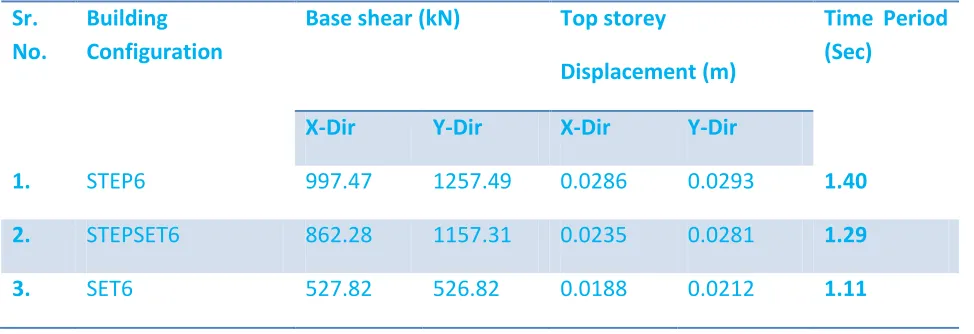
Analyses of results In all, thirty six buildings have been analyzed for seismic load. The seismic force was applied in X & Y direction independently.
Sr. No.
Building Configuration
Base shear (kN) Top storey
Displacement (m)
Time Period (Sec)
X-Dir Y-Dir X-Dir Y-Dir
1. STEP6 997.47 1257.49 0.0286 0.0293 1.40
2. STEPSET6 862.28 1157.31 0.0235 0.0281 1.29
Organized by C.O.E.T, Akola & IWWA, Amravati Center. Available Online at www.ijpret.com 19
Fig.5.1 Comparison of Base Shear in X & Y Direction
Fig.5.2 Comparison of Roof Displacement Fig.5.3 Comparison of Fundamental
in X & Y Direction Time period
6. CONCLUSIONS
Organized by C.O.E.T, Akola & IWWA, Amravati Center. Available Online at www.ijpret.com 20
1) The maximum base shear is induced in Step back-Setback building & least in Setback
building on leveled ground.
2) Top storey displacement of Step back building is quite high as compared to Step
back-Setback building resting on sloping ground.
3) Stepback-Setback building may be Favored on sloping group.
4) Fundamental time period is more in Step back-Setback building & least in Setback building
on leveled ground.
REFERENCES
1. D. K. Paul “Simplified seismic analysis of framed buildings on hill slopes Bulletin of Indian
Society of earthquake technology, Vol 30, no4,paper 335,Dec 1993, pp 113-124
2. Satish Kumar & D. K. Paul , Hill buildings configurations from seismic considerations, Journal
of Structural engineering, vol 26,no3, oct.1999, pp 179-185
3. Satish Annigeri, Ashok k Jain “Torsional Provisions for asymmetrical multi-storey buildings in
I. S. 1893,” International Journal of structures, vol14, no 2, paper no 139, Dec 94, pp 115- 142.
4. Satish kumar & D. K. Paul 3.D.Analysis of Irregular Buildings with Rigid Floor Diaphragms
Bulletin of Indian Society of earthquake technology, Vol 31, no4, paper no 335, Sept 1994, pp 141-154
5. Dr. S. R. Murthy & K. Latha Journal of Structural Engineering , Vol 37,No
4,Octomber-November 2010, pp256-262
6. BIS (2002). “IS 1893 (Part 1)-2002: Indian Standard Criteria for Earthquake Resistant Design
of Structures, Part 1 – General Provisions and Buildings (Fifth Revision)”, Bureau of Indian Standards, New Delhi
7. Paz, M., Structural Dynamics: theory and computation. Second edition, CBS publishers and
distributors pvt. ltd.