Organized by C.O.E.T, Akola, ISTE, New Delhi & IWWA. Available Online at www.ijpret.com471
INTERNATIONAL JOURNAL OF PURE AND
APPLIED RESEARCH IN ENGINEERING AND
TECHNOLOGY
A PATH FOR HORIZING YOUR INNOVATIVE WORK
A NEW MODEL TO ASSESS THE LEVEL OF IMPLEMENTATION OF
PRODUCTIVITY PRACTICES ON CONSTRUCTION PROJECTS
VIKRAM S. GOHATRE1, PROF A. B. RANIT2
1. Prof. Ram Meghe College of Engineering and Management, Badnera.
2. Prof. Ram Meghe College of Engineering and Management, Badnera.
Accepted Date: 07/09/2016; Published Date: 24/09/2016
Abstract: It is unfortunate that the productivity in the construction industry has lagged behind the manufacturing industry for the last several decades. The research presented in this thesis aims to improve productivity in the infrastructure sector of the construction industry by developing Best Productivity Practices Implementation Index (BPPII) for Construction projects. The BPPII Infrastructure is a check list of practices that are considered to have a positive influence on labour productivity at the project level for infrastructure projects. These practices have been identified through a literature review and consultation with industry experts, and have been anecdotally proven to positively affect productivity. These practices have been grouped together into a formalized set of BPPII’s categories, sections, and elements. Its planning and implementation levels have been defined. Each practice in the index has been assigned a relative weight based on its importance in affecting labor productivity. In total, there are 31 elements and 6 categories. The six categories of the BPPII Infrastructure are: (1) Materials Management; (2) Construction Machinery and Equipment Logistics; (3) Execution Approach; (4) Human Resources Management; (5) Construction Methods; and (6) Health and Safety. The PIL method is used to find maximum score of each category and each element. Further the category is ranked on the basis of the score obtained by the PIL. The category Execution Approach scores the highest in the entire category with the score of 146. Further the top 10 element are ranked according to their score.
Keywords: Labour productivity, Management practices, Implementation index, Labour issue.
Corresponding Author:MR. VIKRAM S. GOHATRE
Co Author: PROF A. B. RANIT
Access Online On:
www.ijpret.com
How to Cite This Article:
Vikram S. Gohatre, IJPRET, 2016; Volume 5 (2): 471-487 PAPER-QR CODE
SPECIAL ISSUE FOR
INTERNATIONAL CONFERENCE ON
“INNOVATIONS IN SCIENCE & TECHNOLOGY:
Organized by C.O.E.T, Akola, ISTE, New Delhi & IWWA. Available Online at www.ijpret.com472
INTRODUCTION
In a study undertaken by the Construction Industry Institute’s (USA) Improving productivity is a management issue, and the use of new technologies and techniques may be helpful. Analysis by the Construction Industry Institute’s (CII) Research Teams 240 and 252 of CII Benchmarking and Metrics (BM&M) data has clearly shown that productivity typically deviates 25% more or less from the norm on any particular project within a group with similar characteristics and environments.
Research team of CII developed a method, called the Best Productivity Practices Implementation Index for Industrial Projects (BPPII Industrial), that can be used by members of a construction project’s management team to assist in the planning and implementation of management practices that have the potential to improve construction productivity on industrial projects. The goal of the BPPII Industrial is to produce a comprehensive checklist in the form of audits to assess the implementation levels of essential practices needed to ensure high levels of productivity by the craft workers. The method also provides a scoring system to quantitatively evaluate a project team’s level of preparedness in addressing these issues. The practices included are those that are widely accepted throughout the construction industry
Industrial Projects is a tool designed to help project managers or superintendents plan productivity enhancing jobsite activities. The philosophy of the BPPII is that one can only improve what is measured. The BPPII–Industrial Projects measures the planning and implementation levels of practices that have the potential to improve construction productivity on industrial projects. These practices differ from the Construction Industry Institute (CII) Best Practices since the focus of BPPII is on practices that promote productivity improvement.
The BPPII enables managers to identify practices with low implementation levels on their projects. And it helps them carry out practices that, as noted above, positively affect productivity. The BPPII should be used at the beginning of the execution phase, to help project managers identify the productivity-improving practices to be implemented at the construction site. However, it can also be used at the end of the detailed scope phase to help prepare the project execution plan.
1.2Definition of Productivity in Construction Industry
Organized by C.O.E.T, Akola, ISTE, New Delhi & IWWA. Available Online at www.ijpret.com473 efficiency of production. Making a site more productive that means getting more output for less cost in less time. Productivity covers every activity that goes into completing the construction site works, from the planning stage to the final state. If the contractor can carry out these activities at lower cost in less time with fewer workers, or with less equipment then productivity will be improved. Productivity is generally defined as the ratio of outputs to inputs.
Productivity =
It is important to specify the inputs and outputs to be measured when calculating productivity because there are many inputs, such as labour, materials, equipment, tools, capital, and design.
1.3 Aim and Objectives
The main aim of this research is to develop a process for improving project labour productivity in the infrastructure construction sector. This aim would be achieved by developing the Best Productivity Practices Implementation Index (BPPII) for infrastructure projects. The following objectives are required to achieve the main research objective
1. To identify and define the categories and element of the BPPII for Infrastructure projects.
2. To find out the maximum score by PIL formula.
3. To rank the top ten elements in BPPII Infrastructure
These research objectives are achieved by identifying, mapping, and measuring processes or practices which are essential for improving construction productivity at the project level for the infrastructure construction sector and by collecting and analyzing data for validation.
II. METHODOLOGY
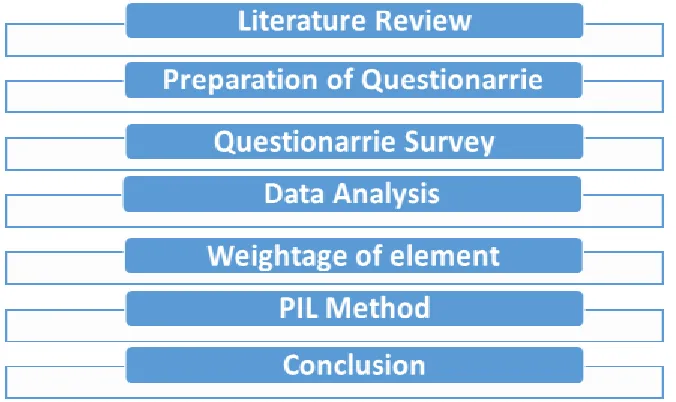
2.1 Process of Methodology
Organized by C.O.E.T, Akola, ISTE, New Delhi & IWWA. Available Online at www.ijpret.com474
Figure 2.1: Methodology Process
2.2 Categories and Elements of BPPII Infrastructure
Table 2.1 provides a complete list of elements and categories that constitute the Best Productivity Practices Implementation Index (BPPII) for Infrastructure projects. The BPPII Infrastructure consists of six categories and 31 elements as shown in Table 3.1. These categories and Elements are described in detail below
Table 2.1 BPPII industrial categories and elements
Sr. No Categories Elements
1 Materials
Management
Defining accurate materials specifications
Locating sources of materials for procurement
Preparing for material storage
Daily recording of using materials in the project
Controlling over-ordering and purchasing
Organized by C.O.E.T, Akola, ISTE, New Delhi & IWWA. Available Online at www.ijpret.com475
2 Construction
Machinery &
Equipment Logistics
Procurement Procedures & Plans for Construction Machinery
Construction Machinery and Equipment Maintenance
Site Tools and Equipment Management Strategy
On-site Tools Maintenance
3 Execution Approach Short interval planning
Well defined scope of work
Use of Software
Dedicated planner
Model requirements/3d visualization
Contracts & Agreements with Agencies
4 Human Resource
Management
Age factor
Average working hours/day
Site crowding factor enables labors to do work in uncomfortable manner.
Over time work will not give good productivity in an job
On time payment is done right at the time when the work is accomplished.
5 Construction
Methods
The construction team (including the owner, engineering and Procurement) was both integrated and aligned.
Drawings, site permits, and other required documents were Available before starting construction.
Organized by C.O.E.T, Akola, ISTE, New Delhi & IWWA. Available Online at www.ijpret.com476
Required construction and management personnel were available as needed before starting construction.
6 Environment, Safety,
and Health
Formal Health and Safety Policy
Climatic condition will affect your working performance
Site safety procedures were followed for the project.
Safety incentives were used on the project.
Accidents were formally investigated.
Contractor employees were randomly screened for alcohol and Drugs.
2.1.1 Category I - Materials Management
The first category in the index is materials management, and practices related to materials management are grouped in this category. Materials management is concerned with the availability of the right materials at the right time and at the right place in the construction process. Materials management has been identified as one of the most important factors affecting construction projects in several research efforts. Materials management has been identified as a best practice by CII. Effective materials management on a construction project has the ability to improve productivity and reduce crew idle time. Research found that inefficient materials management could be responsible for an increase in field labour hours of 50% or more.
2.2.2 Category II - Construction Machinery and Equipment Logistics
Organized by C.O.E.T, Akola, ISTE, New Delhi & IWWA. Available Online at www.ijpret.com477 productivity if they are not managed properly. They also reported that tools and equipment and trucks account for a major portion of the total waiting time. Research reported that construction machinery have high significance in factors related to working conditions.
2.2.3 Category III – Execution Approach
This category deals with issues which are required to be planned and settled so that the construction work can be properly executed and progresses without stopping. The practices in this category are related to planning, constructability reviews, utility alignments, acquisition strategies, and regulatory requirements. They reported that fixed price contracts have better productivity and that lowest bid contracts had a negative effect on productivity. They also mentioned that planning, scheduling, and availability of working drawings are critical for project productivity.
2.2.4 Category IV - Human Resources Management
As labour productivity involves humans, it is imperative that proper management of this resource is essential. Human Resources Management deals with the planning, training and development, organizational structure, and employment issues of people working in the company. Research identified lack of experienced design and project management personnel, restrictive union rules, and lack of management training for supervision and project management as the main factors affecting productivity.
2.2.5 Category V - Construction Methods
Construction methods used for the completion of a project play an important role in project success. This category groups together best practices related to site layout planning, scheduling controls, and design/construction planning and approach. Ineffective communications and inadequate planning and scheduling as major impediments in productivity improvement. Scheduling, overtime strategies, and task sequencing have greater impact on labour productivity
2.2.6 Category VI – Health and Safety
Organized by C.O.E.T, Akola, ISTE, New Delhi & IWWA. Available Online at www.ijpret.com478 developed practices such as Zero Accident Techniques that should be implemented to protect workers’ safety on a jobsite. The construction industry is one of the hazardous industries. The numbers of fatalities and injuries in the construction industry. His research found that accidents can be avoided by establishing procedures and regulations to enhance safety. Different job classifications have safety hazards related to them and usually the construction workers underestimate the hazards. The cost of accidents in construction accounts to approximately 6% of total building costs
2.3 Data Collection
The questionnaire was designed for collecting information related to the Best Productivity Practices Implementation Index for Construction projects. Questionnaire survey was carried out at different construction sites, such as government organization and private firm. 31 factors are classified under 6 categories are distributed to respondents. Total 31 respondents give their opinion out of 50 respondents.
2.4 Weightage of Element
The five-point scale ranged from 1 (not important) to 5 (extremely important) were adopted and transformed to relative importance indices. The value of ƩW is calculated by the sum of total 5 responses multiply by weightage given by the respondent. After that average has been calculated for getting PIL 5 score, where:
Ʃ w = sum of the weights assigned by the respondents.
2.5 Linear Interpolation by PIL
After assigning the maximum scores to each category, the next step is to assign the relative scores to each PIL of all the 31 elements in the BPPII Infrastructure. The elements that are not applicable to a construction project are given a score of 0. A level one of planning and implementation was given a score of 1 for all the elements. The scores of the PIL 2 to PIL 4 were determined based on linear interpolation between PIL 1 and PIL 5 using the following formulas:
PIL 2 Score = (PIL 5 Score -1)/4 +1
PIL 3 Score = (PIL 5 Score -1)/4 + PIL 2 Score
Organized by C.O.E.T, Akola, ISTE, New Delhi & IWWA. Available Online at www.ijpret.com479
2.6 Scoring of the BPPII Infrastructure
Each element of the BPPII is scored using a system that ranks the planning and implementation level (PIL). The PIL definitions are organized on a scale from 0 to 5. The guideline for each PIL is explained as below:
1. Planning and Implementation Level 0: The planning and implementation of the element is
not applicable.
2. Planning and Implementation Level 1: The planning and implementation of the element is
not addressed in any capacity on the project.
3. Planning and Implementation Level 2: The planning and implementation of the element is
addressed up to a certain extent, but in a below average manner.
4. Planning and Implementation Level 3: The element has average level of planning and
implementation.
5. Planning and Implementation Level 4: The planning and implementation of the element is
thorough, above average, but not perfect.
6. Planning and Implementation Level 5: The element has the highest possible planning and
implementation level, i.e. at most state of the art and technologically advanced level. It is expected that few projects would achieve this level.
III. RESULTS AND DISCUSSION
Organized by C.O.E.T, Akola, ISTE, New Delhi & IWWA. Available Online at www.ijpret.com480
Figure 3.1 Percentages of Respondents
Weightage are assign to the entire category like material management, Construction Machinery & Equipment Logistics, Execution Approach, Human Resource Management, Construction Methods and Environment, Safety, and Health. Further the average value is calculated for PIL 5; after analysis and assign to the respective element.
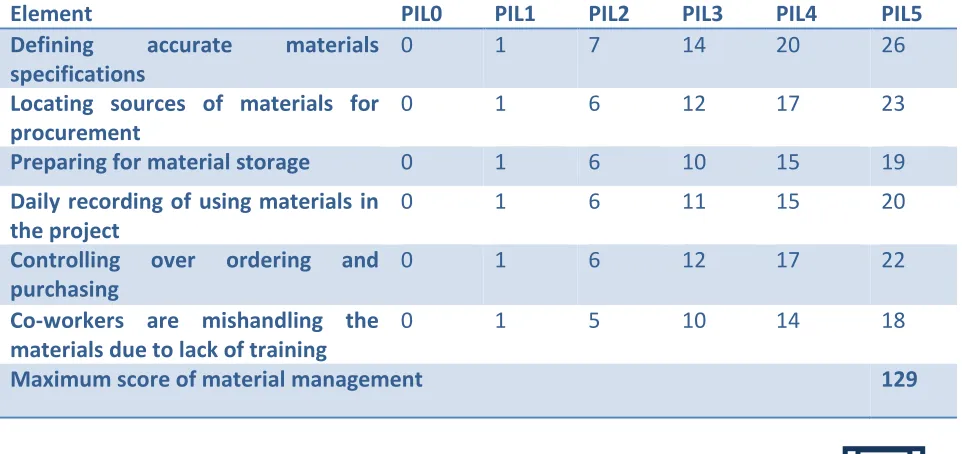
3.1 PIL Score for Material Management
Table 3.1 shows all of the elements that are N/A to a construction project, for whatever reason, are given a score of zero. A Level 1 of planning and implementation was given a score of 1 for all the elements. The maximum average value is calculated from ƩW for getting the value of PIL 5 i.e. In this case 26 is the maximum value for defining accurate materials specifications. After that PIL 2, PIL 3, PIL 4 is calculated from the given formula. The maximum score is obtained for the category of material management is as 129.
Table 3.1: PIL Score for Material Management
Element PIL0 PIL1 PIL2 PIL3 PIL4 PIL5
Defining accurate materials
specifications
0 1 7 14 20 26
Locating sources of materials for procurement
0 1 6 12 17 23
Preparing for material storage 0 1 6 10 15 19
Daily recording of using materials in the project
0 1 6 11 15 20
Controlling over ordering and
purchasing
0 1 6 12 17 22
Co-workers are mishandling the materials due to lack of training
0 1 5 10 14 18
Organized by C.O.E.T, Akola, ISTE, New Delhi & IWWA. Available Online at www.ijpret.com481 Fig 3.1 shows that the element defining accurate materials specifications has the highest score of 26. Locating sources of materials for procurement the score is 23. Preparing for material storage the score is 19. Daily recording of using materials in the project has a score of 20. Controlling over ordering and purchasing has a score of 22. Where Co-workers are mishandling the materials due to lack of training has the lowest score in the category that is 18.
Organized by C.O.E.T, Akola, ISTE, New Delhi & IWWA. Available Online at www.ijpret.com482 Using survey data from 31 completed forms, the average importance factor of each category, and element was calculated. Once the averages had been calculated, the maximum scores of the 31 elements and 6 categories were determined. This corresponded to a situation in which the planning and implementation level (PIL) of all elements was 5 (i.e., maximum) on a 1 to 5 scale. The research team defined that the maximum attainable BPPII Industrial score for a project was set to 656, representing the best level of practice planning and implementation (i.e., all elements have a PIL of 5). The lowest score (i.e., all elements have a PIL of 1 with no applicable elements) was set to zero.
Table: Maximum scores of the BPPII categories
Table: Ranking of Categories in BPPII Infrastructure
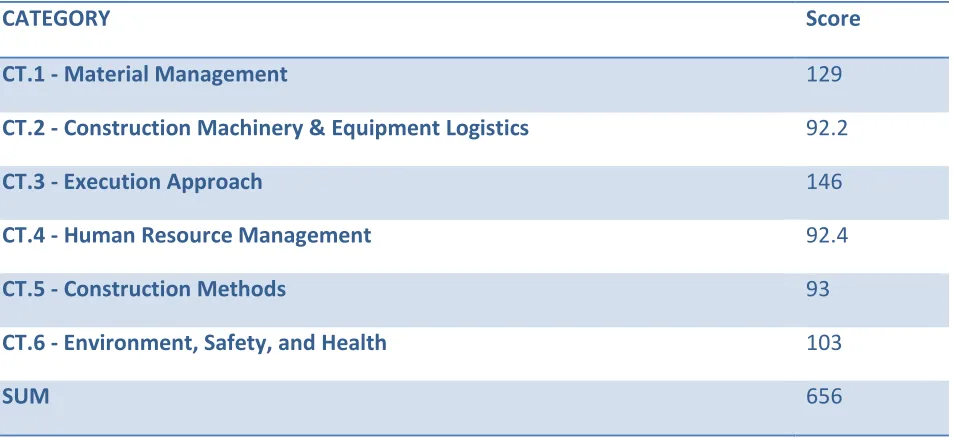
Table 4.9 shows the ranking of 6 categories in the BPPII infrastructure based on the score assigned to each of them.
Table 4.9: Ranking of Categories in BPPII Infrastructure
CATEGORY Score
CT.1 - Material Management 129
CT.2 - Construction Machinery & Equipment Logistics 92.2
CT.3 - Execution Approach 146
CT.4 - Human Resource Management 92.4
CT.5 - Construction Methods 93
CT.6 - Environment, Safety, and Health 103
Organized by C.O.E.T, Akola, ISTE, New Delhi & IWWA. Available Online at www.ijpret.com483
Rank CATEGORY
REALATIVE SCORE (%)
SCORE
1 CT.3- Execution Approach 22.31 146
2 CT.1- Material Management 19.63 129
3 CT.6- Environment, Safety, and Health 15.73 102
4 CT.5- Construction Methods 14.17 93
5 CT.4- Human Resource Management 14.08 92.4
6 CT.2- Construction Machinery & Equipment Logistics 14.05 92.2
SUM 100 656
Fig 4.8 shows the category of execution approach has the highest ranking followed by material management. The category of Environment, Safety, and Health has ranked on third place. The category of Construction Methods and Human Resource Management scored fourth and fifth place in the category. The category of Construction Machinery & Equipment Logistics has score the lowest rank.
4.7: Top Ranked Elements in the BPPII Infrastructure
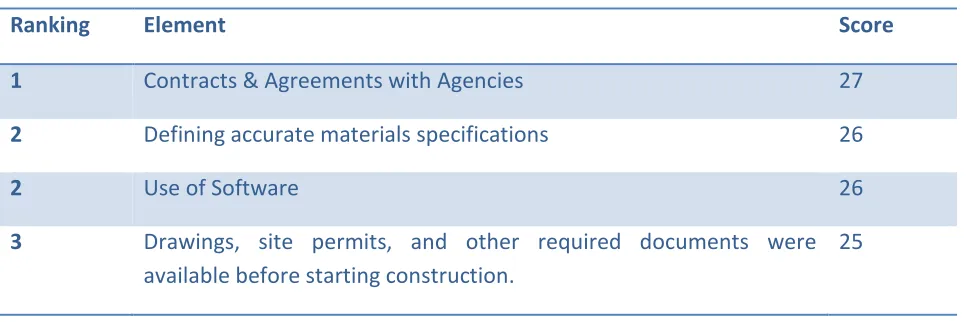
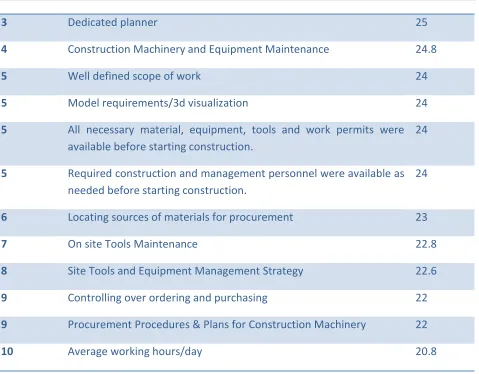
Table 4.10 provides the listing of top 10 ranking elements in the BPPII Infrastructure.
Table 4.10 : Top Ranked Elements in the BPPII Infrastructure
Ranking Element Score
1 Contracts & Agreements with Agencies 27
2 Defining accurate materials specifications 26
2 Use of Software 26
3 Drawings, site permits, and other required documents were
available before starting construction.
Organized by C.O.E.T, Akola, ISTE, New Delhi & IWWA. Available Online at www.ijpret.com484
3 Dedicated planner 25
4 Construction Machinery and Equipment Maintenance 24.8
5 Well defined scope of work 24
5 Model requirements/3d visualization 24
5 All necessary material, equipment, tools and work permits were
available before starting construction.
24
5 Required construction and management personnel were available as
needed before starting construction.
24
6 Locating sources of materials for procurement 23
7 On site Tools Maintenance 22.8
8 Site Tools and Equipment Management Strategy 22.6
9 Controlling over ordering and purchasing 22
9 Procurement Procedures & Plans for Construction Machinery 22
10 Average working hours/day 20.8
Organized by C.O.E.T, Akola, ISTE, New Delhi & IWWA. Available Online at www.ijpret.com485 for Construction Machinery both are simultaneously ranked on ninth position. Average working hours/day has been ranked on tenth position. There are 17 practices in the top 10 ranked and it makes almost 50% of the total index score. This shows the importance of these particular practices for the improvement of productivity on construction projects.
IV. CONCLUSIONS
Various different factors affect project performance whereas labour productivity is recognized as one of the most important factor in construction industry. So the objective behind this research was to address this critical aspect of project performance. The goal was to improve the effective planning and implementing of management practices that positively impact construction productivity. The main role of this paper is the development of a method called BPPII Industrial.
The BPPII Industrial includes 31 elements, also called best productivity practices, which were grouped in six categories: (1) Materials Management, (2) Construction Machinery & Equipment Logistics, (3) Equipment Logistics, (4) Human Resources Management, (5) Construction Methods, and (6) Environment, Health, and Safety. In developing the BPPII Industrial, relevant literature took into account. The PIL method is used to find maximum score of each category and each element. Further the category is ranked on the basis of the score obtained by the PIL. The category Execution Approach scores the highest in the entire category with the score of 146.
Further the top 10 element are ranked according to the score. The very first element is Contracts & Agreements with Agencies. As this practice should given a very high importance before starting of any construction project.
After those Defining accurate materials specifications and Use of Software get the second highest score. Mega project needs these types of practices to improve the lead time.
REFERENCES
1. (Hassan Nasir 2013) "Best Productivity Practices Implementation Index (BPPII) for Infrastructure Projects" Waterloo, Ontario, Canada, 2013.
Organized by C.O.E.T, Akola, ISTE, New Delhi & IWWA. Available Online at www.ijpret.com486 3. (Hassan Nasir et al. 2015) "An Integrated Productivity - Practices Implementation Index for Planning the Execution Of Infrastructure Project" Journal of Infrastructure systems ASCE, ISSN 1076-0342.
4. (Borcherding and Garner 1981) “Work force motivation and productivity on large jobs.” J. Constr. Div., 107(3), 443–453.
5. (Allmon et al. 2000) “U.S. construction labour productivity trends, 1970–1998.” J. Constr. Eng. Manage., 10.1061/(ASCE)0733-9364(2000)126:2(97), 97–104.
6. (Shan et al. 2011) “The impact of management practices on mechanical construction productivity.” Constr. Manage. Econ., 29(3), 305–316.
7. (Liberda et al. 2003) “Construction productivity improvement: A study of human, management and external issues.” Construction Research Congress, ASCE, Reston, VA, 1–8.
8. (Klanac and Nelson 2004) “Trends in construction lost productivity claims.” J. Prof. Issues Eng. Educ. Pract., 10.1061/(ASCE)1052-3928 (2004)130:3(226), 226–236.
9. (Dai et al. 2009) “Construction craft workers’ perceptions of the factors affecting their productivity.” J. Constr. Eng. Manage., 10.1061/(ASCE)0733-9364(2009)135:3(217), 217–226.
10. (William F. Maloney) "PRODUCTIVITY IMPROVEMENT: THE INFLUENCE OF LABOR" Journal of Construction Engineering and Management, Vol. 109, No. 3, September, 1983. ©ASCE, ISSN 0733-9364/83/0003-0321/$01.00. Paper No. 18214.
11. (Upul Ranasinghe1 et.al.) "Streamlining the Construction Productivity Improvement Process with the Proposed Role of a Construction Productivity Improvement" Journal of Construction Engineering and Management, Vol. 138, No. 6, June 1, 2012. ©ASCE, ISSN 0733-9364/2012/6-697–706.
12. (Eddy M. Rojas 2003) “Is construction labour productivity really declining?” J. Constr. Eng. Manage., 10.1061/(ASCE)0733- 9364(2003)129:1(41), 41–46.
13. (Jimmie Hinze and Gary Wilson 2000) “Moving toward a zero injury objective.” J. Constr. Eng. Manage., 10.1061/(ASCE)0733-9364(2000)126:5(399), 399–403.
Organized by C.O.E.T, Akola, ISTE, New Delhi & IWWA. Available Online at www.ijpret.com487 15. (Paul M. Goodrum et al.) “Long-term impact of equipment technology on labor productivity in the U.S. Construction Industry at the activity level.” J. Constr. Eng. Manage., 10.1061/(ASCE)0733-9364 (2004)130:1(124), 124–133.