Mr. Amit Chaudhary, Dept. of Pharmaceutics, School of Pharmacy, Bharat Institute of Technology,
By-Pass Road, Partapur, Meerut-250103, UP, India E. Mail ID: [email protected]
Mobile: 09897883487
Address for correspondence
Access this article online www.japer.in
Designing and Evaluation of Mucoadhesive Buccal Films of Propranolol
Hydrochloride
INTRODUCTION
The development of a novel delivery system for
existing drug molecules not only improves the
drug’s performance in terms of efficacy and
safety but also improves patient compliance and
overall therapeutic benefit to a significant
extent.[1]
A method of drug delivery in which a drug is
introduced to the body across a mucous
membrane which allows for the avoidance of the
gastrointestinal tract and first pass liver
metabolism and consequently allows the
therapeutic to directly enter into circulation. [2]
Among the various drug delivery systems, buccal
delivery system is found to be the most
promising because, buccal mucosa, itself,
provides a protective covering for the underlying
tissues, acting as a physical barriers against
toxins and micro-organisms. [3-4]
Extensive efforts have been focused on the
development of new drug delivery systems.
Mouth as a structural organ has a wide variety of
function and it act as an excellent site for the
absorption of drugs. Film type dosage form can
be used for transdermal and also for buccal (or)
sublingual use. [5] In the discipline of
cardiovascular therapy, the buccal drug delivery
system may prove valuable in administering
drugs to treat hypertension and peripheral
vascular diseases.
Propranolol hydrochloride is widely used β
blocker, in the treatment of Hypertension, Angina
pectoris and Cardiac arrthymia10. When
administered orally [6-7], frequent dosing is
needed due to short biological half-life (t1/2
-3-5hrs). Secondly drug undergoes high hepatic first
pass metabolism thus bioavailability is reduced
to 15-23 % only. It has also been reported to
cause gastrointestinal discomfort. Buccal route of
drug administration may be a promising
Original Article
Mucoadhesive buccal films of propranolol hydrochloride were prepared by solvent casting technique using hydroxypropyl methylcellulose (HPMC), hydroxy ethyl cellulose (HEC), sodium carboxymethyl cellulose (SCMC), polyvinyl pyrrolidone K-30 (PVP) and polyvinyl alcohol (PVA) in various proportions and combinations. Prepared films were evaluated for their weight, thickness uniformity, surface pH, swelling index, folding endurance,
in-vitro residence time, in-vitro release and drug content uniformity. Ex-vivo
permeation studies through the porcine buccal mucosa were performed on the selected formulations. Films exhibited sustained release over more than 6 h. The drug release from the films followed the zero order kinetics with matrix diffusion mechanism. From this study it is concluded that the films containing 20 mg propranolol hydrochloride in PVA: PVP (5 % w/v) in a 4:1 ratio (Formulation F16), showed moderate swelling, a convenient residence time and promising drug release.
Key words: Buccal Drug Delivery Systems, Buccal Films, Mucoadhesive
ABSTRACT
Amit Chaudhary*1, Upendra
Nagaich1, Bhavya Rastogi1
Department of Pharmaceutics, School of Pharmacy, Bharat Institute of Technology, Partapur-Bypass, Meerut.
approach to overcome the above problems. Thus
the present work deals with the formulation and
characterization of mucoadhesive buccal films of
propranolol hydrochloride using mucoadhesive
polymers. [8-9]
MATERIALS AND METHODS
Propranolol hydrochloride was obtained as a gift
sample from Sarabhai Chemicals, Vadodara
(Gujarat). Hydroxypropyl Methylcellulose
(HPMC) and Polyvinyl Pyrrolidone K-30 (PVP)
procured from Otto Kemi Ltd., Mumbai, Polyvinyl
Alcohol (PVA) and Sodium Carboxymethyl
Cellulose -1500-400cps (SCMC) procured from
Central Drug House, Mumbai. (HEC) Glycerol
was procured from E. Merck (P) Ltd. All other
reagents used were of analytical grade. The films
were prepared by Solvent Casting Method.
Preparation of mucoadhesive buccal films:
Buccal films of Propranolol Hydrochloride were
prepared by solvent casting technique employing
mercury as substrate9. Composition of various
formulations is mentioned in Table 1.
The mucoadhesive films were prepared using
anionic polymer Sodium carboxymethyl cellulose
and non-ionic polymers (PVA, HEC, HPMC)
polymers. PVP was added in the formulations for
improving film performance and release
characteristics.
The casting solutions were prepared by
dissolving appropriate polymers, plasticizer and
penetration enhancer in suitable solvents
(distilled water) using a magnetic stirrer. The
drug was added slowly to the solution and
dissolved by continuous stirring for 30 minutes.
The prepared solutions were left overnight at
room temperature to ensure clear bubble-free
solutions. Mercury was used as the substrate for
casting the films. The mercury plates were kept
on a platform with smooth horizontal surface.
About 5 ml of the casting solution was poured
within the glass bangles (5.8 cm diameter) placed
on mercury surface in a petridish and allow to
dry till a flexible film was formed. The dried films
were cut into films of 20 mm diameter, packed on
aluminium foil and stored over fused calcium
chloride in a dessicator at room temperature for
further use.
Evaluation of Mucoadhesive Buccal Films:
Film weight:
Three films of each formulation were taken and
weighed individually in digital balance (Fisher
Brand PS-200). The average weights were
calculated.
Film thickness:
Weight variation test was done by weighing five
films individually on a digital balance. The
average weight of the film was taken as the
weight.
Surface pH:
Three films of each formulation were left to swell
for 2 h on the surface of an agar plate. The
surface pH was measured by means of a pH
paper placed on the surface of the swollen patch.
A mean of three readings was recorded.
Swelling study:
After determination of the original film weight
and diameter, the samples were allowed to swell
on the surface of agar plate kept in an incubator
maintained at 37 oC. Increase in the weight or
diameter of the films (n = 3) was determined at
preset time intervals (1–5 h). The percent
swelling, %S, was calculated using the following
equation:
Amit Chaudhary, et al.: Designing and Evaluation of Mucoadhesive Buccal Films of Propranolol Hydrochloride
Percent Swelling (%S) = Xt – Xo / Xo × 100
Where Xt is the weight of the swollen film after
time t,
Xo is the initial film weight at zero time11.
In-vitro residence time:
The in vitro residence time was determined using
a IP disintegration apparatus. The disintegration
medium was composed of 800 ml pH 6.6
phosphate buffer (PB) maintained at 37 + 2oC.
The segment of porcine intestinal mucosa, 3 cm
length, were glued to the surface of a glass slab,
vertically attached to the apparatus. Three
mucoadhesive films of each formulations were
hydrated from one surface using pH 6.6 PB and
then the hydrated surface was brought into
contact with the mucosal membrane. The glass
slab was vertically fixed to the apparatus and
allowed to move up and down. The film was
completely immersed in the buffer solution at the
lowest point and was out at the highest point.
The time required for complete erosion or
detachment of the film from the mucosal surface
were recorded (n=3) as given in Table 2.
Folding endurance:
Three films of each formulation of size (2cm x
2cm) were cut by using sharp blade. Folding
Endurance was determined by repeatedly folding
a small strip of film at the same place till it broke.
The number of times, the film could be folded at
the same place without breaking gave the value
of folding endurance. The mean value of triplicate
and standard deviation were shown in Table 2.
Drug content uniformity:
The uniformity of drug content of the buccal film
was determined, based on dry weight of drugs
and polymers used by means of a UV
Spectrophotometer method. Three film units of
each formulation were taken in separate 100ml
volumetric flask, added 100ml of phosphate
buffer pH 6.6 and kept for 24 hour under
constant stirring. The solutions were filtered,
diluted suitably and absorbance read at 290 nm.
The average of three films was considered as the
drug content in one film unit. [10]
In-vitro release study:
The USP XXIV six station dissolution apparatus
type 1 (V Scientific Model No. DA-6DR) was used
throughout the study. One Film of each
formulation was fixed to the central shaft using a
cyanoacrylate adhesive. The dissolution medium
consisted of 900ml pH 6.6 PB. The release study
was performed at 37 ± 1°C with a rotation speed
of 100 RPM. The release study was carried out
for 6 h. After every one hour, 5ml samples were
withdrawn from each station, filtered, diluted
suitably and then analyzed
spectrophotometrically at 290 nm. The
Cumulative percent Propranolol Hydrochloride
were determined. [11]
Ex-vivo permeation studies:
The ex-vivo permeation studiesof mucoadhesive
buccal films of Propranolol hydrochloride
through excised porcine buccal mucosa was
performed using the modified K-C diffusion cell.
A 2.0 cm diameter film of each formulation under
study was placed in intimate contact with the
porcine buccal mucosa and the topside was
covered with aluminum foil as a backing
membrane. Teflon bead was placed in the
receptor compartment filled with 75 ml of pH 7.4
phosphate buffer. The cell contents were stirred
with a magnetic stirrer and temperature of 37+1
0C was maintained with the water jacket
throughout the experiment. The amount of drug
permeated into the receptor solution was
intervals for 10 hrs. The withdrawn volume was
replaced with an equal volume of fresh buffer
solution. The drug permeated was determined by
analyzing the samples at 290 nm.
RESULTS AND DISCUSSION
Mucoadhesive buccal films of Propranolol
Hydrochloride were prepared using
mucoadhesive polymers HPMC, HEC, SCMC, PVP
and PVA. The drug delivery system was designed
as a matrix.
The matrices of Propranolol Hydrochloride
showed satisfactory physicochemical as well as
bioadhesive performance of the formulated films.
The physicochemical characteristics are
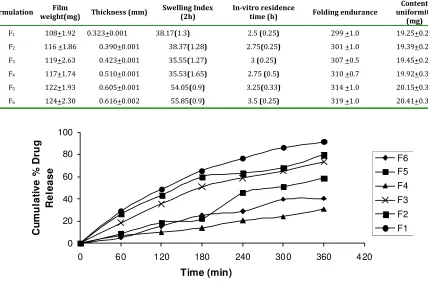
summarized in Table 2.
It was found that film thickness were in the range
of 0.323 ± 0.001 mm to 0.616 ± 0.002 mm and
the weight of the films varied between 108 ± 1.92
mg to 124± 2.30 mg. The surface pH of all
formulations was within 5-6 and hence no
mucosal irritation was expected.
The effect of Propranolol hydrochloride on the
swelling behaviour and the residence time of the
mucoadhesive polymers are observed as given in
Table 2.
The folding endurance was measured manually,
films were folded repeatedly till it broke, and it
was considered as the end point. And it varied
between 299 ± 1 and 319 ± 1.
Swelling index of the films was determined using
the weighing method. The samples were allowed
to swell on surface of agar plate. Increase in the
weight was determined at preset time. The
percent swelling was calculated. Observation of
the result shows that the addition of PVP
predominantly decreased the swelling
characteristics of the medicated films, except for
HEC and Sodium CMC. The water-soluble
hydrophilic additive dissolves rapidly
introducing porosity. The void volume is thus
expected to be occupied by the external solvent
diffusing into the film and thereby accelerating
the dissolution of the gel. A remarkable increase
in swelling properties was observed in the case
of Sodium CMC films.
The values of the in-vitro residence time are
reported in Table 2.All the films, except Sod. CMC
remained attached to the mucosal surface until
complete erosion, longer duration was recorded
for HEC. Upon addition of hydrophilic additive
PVP the early dislodgement of the films were
reported and it was more distinct with ionic
polymer Sodium CMC.
Drug content in formulations was uniform with a
range of 19.25 ± 0.25 mg to 20.41 ± 0.38 mg. On
the basis of drug content determination it was
considered that the drug was dispersed
uniformly throughout the film.
In-vitro release studies of various formulations
were performed in pH 6.4 phosphate buffer at
237 nm. Distinguishable difference was obtained
in the release pattern of Propranolol HCL films
containing PVA and SCMC. During dissolution
SCMC containing films swelled forming a gel
layer on the exposed film surfaces. The loosely
bound polymer molecules were easily eroded,
allowing the release of Propranolol
hydrochloride easily as compared to
PVA12,13,14. Both polymers exhibited high
swelling, the film weight of these polymers were
increased by 25 to 60 % from the initial weight
within 2 h (Table 2). Although the marked
increase in surface area during swelling can
promote drug release, the increase in diffusional
path length of the drug may paradoxically delay
the release. In addition, the thick gel layer formed
on the swollen film surface is capable of
preventing matrix disintegration and controlling
additional water penetration15. SCMC showed
high dissolution rate as compared to PVA. It was
found that the drug release from the prepared
films varied with respect to the proportion of
polymers. Increase in the polymer concentration
reduces the diffusion of drug from the matrix.
Out of the six formulations, the formulation F1
showed the good release pattern as compared to
others and optimum sustained release profile
was obtained in formulation F5. After 6 h the
release was found to be 91.45, 79.89, 73.65,
31.02, 58.76 and 40.45 %in formulation F1, F2, F3,
F4, F5 and F6 respectively (Fig. 1). Among the
SCMC films, F1 (SCMC 3%) showed the good
release. On the other hand, out of the PVA films,
release rate was found to be higher for film
containing1 % w/v PVP.
The plots of log cumulative percent drug retained
versus time were found to be linear to the
formulations (Fig.3). On the basis of plots it was
concluded that the release of Propranolol HCL
from the films have obeyed first order kinetics.
The correlation coefficient values were found to
be 0.9963, 0.9879, 0.9980, 0.9922, 0.9886,
-0.9875 for F1, F2, F3, F4, F5 and F6 respectively. It
shows that data are in good correlation. Negative
values of the correlation coefficient indicate
negative slope for the plot.
Mechanism of drug release pattern i.e. diffusion,
swelling or erosion was confirmed by Higuchi
plots. Fig. 2 shows the graphical representation
of cumulative percentage drug release versus
square root of time. The Higuchi’s Plots were
found to be linear with correlation coefficient
values of 0.9959, 0.9879, 0.9980, 0.9922, 0.9886,
0.9875 for F1, F2, F3, F4, F5 and F6 respectively. It
was concluded that the release of drug from the
films followed the diffusion controlled
mechanism in all the formulations.
It was also concluded that among the SCMC films
formulation F1 showed the promising release
pattern as compared to others. From the PVA
films formulation F5 showed moderate swelling, a
convenient residence time as well as adequate
drug release. On the basis of release pattern,
swelling and residence time F1 and F5
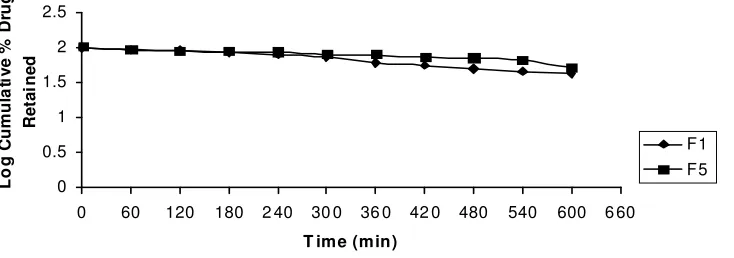
formulations were selected for ex-vivo study. In
Ex-vivo study, drug permeation through the
porcine buccal mucosa was observed for
formulation F1 and F5 (Fig.4). The drug
permeation was found to be 58.25 % and 49.01
% in F1 and F5 after 10 h.
The Higuchi’s Plots of F1 and F5 (Fig. 5) were
found to be almost linear with correlation
coefficient values of 0.9310 and 0.9748 of F1 and
F5 respectively. It was concluded that the drug
permeation followed the matrix diffusion
process.
The plots of log cumulative percent drug retained
as a function of time were found to be linear for
both the formulations (Fig.6). This linearity
indicates that the permeation of Propranolol HCL
from the films obeyed the first order kinetics. The
correlation coefficient values were found to be
-0.9877 and -0.9485. It shows that data are in
good correlation. Negative values of the
correlation coefficient indicate negative slope for
the plot.
However SCMC films (F1) showed good drug
release profile compared to the PVA films but
they exhibited poor residence time as they
dislodged early from the mucosal surface. It is
Propranolol Hydrochloride in PVA 10 % and PVP
1 % w/v (Formulation F5), showed moderate
swelling, a convenient residence time and
promising sustained drug release, thus can be
selected for the development of buccal film for
potential therapeutic uses.
Table 1: Composition of Mucoadhesive Buccal Films
Ingredients(%w/w) F1 F2 F3 F4 F5 F6
Propranolol hydrochloride 2 2 2 2 2 2
Sodium carboxymethyl
cellulose (1500-400cps) 3 3 3 - - -
Polyvinyl alcohol (Hot) - - - 10 10 10
Poly vinyl pyrrolidone K-30 0 1 5 0 1 5
Glycerol (% w/v) 5 5 5 5 5 5
Table 2: Physical Evaluation Of Mucoadhesive Buccal Films Of Propranolol Hydrochloride
Formulation Film
weight(mg) Thickness (mm)
Swelling Index (2h)
In-vitro residence
time (h) Folding endurance
Content uniformity
(mg)
F1 108+1.92 0.323+0.001 38.17(1.3) 2.5 (0.25) 299 +1.0 19.25+0.25
F2 116 +1.86 0.390+0.001 38.37(1.28) 2.75(0.25) 301 +1.0 19.39+0.27
F3 119+2.63 0.423+0.001 35.55(1.27) 3 (0.25) 307 +0.5 19.45+0.29
F4 117+1.74 0.510+0.001 35.53(1.65) 2.75 (0.5) 310 +0.7 19.92+0.30
F5 122+1.93 0.605+0.001 54.05(0.9) 3.25(0.33) 314 +1.0 20.15+0.35
F6 124+2.30 0.616+0.002 55.85(0.9) 3.5 (0.25) 319 +1.0 20.41+0.38
Fig. 1: Cumulative Percent Drug Release in pH 6.6
0 20 40 60 80 100
0 60 1 20 180 240 30 0 360 4 20
Time (min)
C
u
m
u
la
ti
v
e
%
D
ru
g
R
e
le
a
s
e
F6
F5
F4
F3
F2
F1
Fig. 1: Cumulative percent Drug Release in pH 6.6 Phosphate Buffer
0 20 40 60 80 100
0 2 4 6 8 10 12 14 16 18 20
Square Root of Time
C
u
m
u
la
ti
v
e
%
D
ru
g
R
e
le
a
s
e
F6
F5
F4
F3
F2
F1
Fig. 2: Higuchi Plot of Different Formulations
Fig. 3 : Log Cumulative Percent Drug Retained of Different
0 0.5 1 1.5 2 2.50 60 120 180 240 300 360 420
Time (min) L o g C u m u la ti v e % D ru g R e ta in e d F1 F2 F3 F4 F5 F6
Fig. 3: Log Cumulative percent drug retained of different Formulations
0 1 0 2 0 3 0 4 0 5 0 6 0 7 0
0 6 0 1 2 0 1 8 0 2 4 0 3 0 0 3 6 0 4 2 0 4 8 0 5 4 0 6 0 0 6 6 0
T im e ( m in )
C u m u la ti v e % D ru g R e le a s e F 1 F 5
Fig. 4: Ex-Vivo Permeation of Propranolol Hydrochloride in pH 7.4 Phosphate Buffer of selected Formulations 0 10 20 30 40 50 60 70
0 5 10 15 20 25 30
Square Root of T ime
C u m u la ti v e % D ru g P e rm e a te d F1 F5
Fig. 5: Higuchi Plot for the Ex-vivo studies of selected formulations
0 0.5 1 1.5 2 2.5
0 60 120 180 2 40 30 0 36 0 42 0 480 540 600 6 60
T ime (min)
L o g C u m u la ti v e % D ru g R e ta in e d F 1 F 5
REFERENCES
1. Ishida, M., Nambu, N., and Nagai, T., Chem. Pharm. Bull., 1982, 30:980-984.
2. Collins, A.E.M., Deasy, P.B., Mac Carthy, D.J., and Shanley, D.B., Int. J. Pharm., 1989, 51:103-114. 3. Elkayam, R., Friedman, M., Stabholz, A., Soskolne,
A.w., Sela, M.N., and Golub, L., J. Control. Rel., 1988, 7:231-236.
4. Samaranayake, L. and Ferguson, M., Adv. Drug Del. Rev., 1994, 13:161-179.
5. Nagai, T., J. Control. Rel., 1985, 2:121-134. 6. Nagai, T. and Machida, Y., Pharm. Int., 1985,
196-200.
7. Aditya, G. N., Chattopadhyay, R. N., Mandal,S., Roy, R. K, Lahiri, H. L.and Maitra, S. K., Indian. J. Pharm. Pharmacol., 1997, 29, 3-5, 325-26. 8. Tripathi, K. D., In; Essentials of Medical
Pharmacology, Jaypee Brothers Medical Publishers, New Delhi, 2001, 519-35
9. Devi, K. and Paranjothy, K. L. K., East. Pharm., 1998, 485, 98.
10.Tsutsumi, K., Tahayama, K., Machida, Y., Ebert, C.D., Nakatomi, I., Nagai, T., S.T.P. Pharm. Sci., 1994 4, 230–234.
11.Nafee, N. A., Ismail, F. A., Boraie, N. A. and Mortada, L. M., Int. J. Pharm., 2003, 264, 3. 12.Wan, L.S.C., Heng, P.W.S., Wong, L.F., Int. J. Pharm.
1995, 116, 168–195.
13.Samuelov, Y., Donbrow, M., Friedman, M., J. Pharm. Sci. , 1979, 68, 325–329.
14.Korsmeyer, R.W., Gurny, R.,Doelker, E., Buri, P., Peppas, N.A., Int. J. Pharm., 1983, 15, 25-35. 15.Rodriguez, C.F., Bruneau, N., Barra, J., Alfonso, D.,
Doelker, E., Hydrophilic Cellulose Derivatives as Drug Delivery Carriers: Influence of the Substitution Type on the Properties of Compressed Matrix Tablets. In: Wise, D.L. (Ed.), Handbook of Pharmaceutical Controlled Release Technology, vol. 1. Marcell Dekker, New York, USA, 2000, pp. 1–30.
Amit Chaudhary, Upendra Nagaich, Bhavya Rastogi; Designing and Evaluation of Mucoadhesive Buccal Films of Propranolol Hydrochloride; J. Adv. Pharm. Edu. & Res. 2012:; 4: 239-246