Dr. Rayidi Lavanya
Department of Pharmaceutical Analysis & Quality Assurance,
Bapatla College of Pharmacy, Bapatla Andhra Pradesh Email:[email protected]
Address for correspondence
Access this article online www.japer.in
Development and Validation of RP-HPLC method for the
estimation of Sitagliptin Phosphate in Bulk and its Tablet Dosage
Form
INTRODUCTION
Sitagliptin phosphate is an oral anti hyperglycemic of the dipeptidyl peptidase-4 (DPP-4) inhibitor class. This enzyme-inhibiting drug is used either alone or in combination with other oral anti hyperglycemic agents (such as metformin or a thiazolidinedione) for treatment of diabetes mellitus type 2. Sitagliptin works to competitively inhibit the enzyme DPP-4. This enzyme breaks down the incretins GLP-1 and GIP, gastrointestinal hormones released in response to a meal. By preventing GLP-1and GIP inactivation, they are able to increase the secretion of insulin and suppress the release of glucagon by the pancreas. This drives blood glucose levels towards normal.
Fig.1. Structure of Sitagliptin phosphate
7 - [(3R) – 3 – amino – 1 – oxo – 4 - (2, 4, 5- trifluorophenyl) butyl] 5, 6, 7, 8 tetrahydro – 3 -(trifluoromethyl)-1, 2, 4 – triazolo [4, 3-a]pyrazine phosphate (1:1) monohydrate.
Literature survey reveals the availability of various analytical methods for the analysis of sitagliptin in biological samples by RP-HPLC.[1,2] and few
Spectrophotometric methods are available for estimation of sitagliptin in bulk and pharmaceutical dosage form.[3-7] There is one RP-HPLC method is also
available for this sitagliptin formulation. [8] The
reported RP-HPLC method was not economical in terms of mobile phase composition, flow rates and less efficient. Hence there is a need to develop an RP-HPLC method for the estimation of sitagliptin in the tablet formulations. The aim of the present analytical research is to develop simple, precise, accurate, rapid and economical RP-HPLC method for the assay of sitagliptin phosphate in tablet formulation.
MATERIALS AND METHOD
Sitagliptin phosphate gift sample was provided by MSN labs, Hyderabad. A commercial Janumet tablets containing Sitagliptin phosphate 100 mg was purchased from local market, Hyderabad. All other chemicals used were of HPLC grade.
Selection of wavelength of detection
R R R
Research esearch esearch Articleesearch ArticleArticleArticle
A new simple and precise reverse phase high performance liquid chromatographic method has been developed and subsequently validated for the estimation of Sitagliptin phosphate monohydrate in bulk and its pharmaceutical dosage form. The chromatographic separation was performed by using mobile phase consisting of 0.01M KH2PO4: Methanol in the ratio of 50:50 % v/v and the pH 2.5 adjusted with 0.2% orthophosphoric acid. The column used was Zorbax Eclipse XDB C18 (150×4.6 mm, 5µ) with flow rate of 0.7 ml/min using PDA detection at 267 nm. The described method was found to be linear over the range of 5-30µg/ml and correlation coefficient was found to be 0.999. The assay of Sitagliptin was found to be 99.89 %. The results of the study showed that the proposed RP-HPLC method is simple, rapid, precise, reliable, accurate and economical which is useful for the routine determination of Sitagliptin phosphate in bulk and its pharmaceutical dosage form.
Keywords: Sitagliptin phosphate, method validation
ABSTRACT ABSTRACT ABSTRACT ABSTRACT R. Lavanya*, Md. Yunoos
Department of Pharmaceutical Analysis & Quality Assurance Bapatla College of Pharmacy, Bapatla Andhra Pradesh 522101
Sitagliptin standard solution of 100 ppm was scanned at 200-400 nm and UV Spectrum was recorded. By observing the spectrum of standard solution, λmax of 267 nm was taken for trails to develop the proposed method. UV-spectra of sitagliptin phosphate is shown in figure.2.
Instrumentation and Chromatographic Conditions
High performance liquid chromatography Agilent 1200 series equipped with PDA detector and Zorbax Eclipse XDB C18 (150 mm × 4.6 mm) containing 5 μm
particle size column was used. Mobile phase comprising of 0.01M Phosphate buffer: methanol in a ratio 50:50 % v/v at pH 2.5 adjusted with 0.2 %
orthophosphoric acid at a flow rate of 0.7 ml/min and the effluent was detected at 267 nm. The Column temperature was maintained at ambient and the volume of injection is 10 μL.
Preparation of buffer
Phosphate buffer was prepared by dissolving 0.68 gm of potassium dihydrogen orthophosphate in 500 mL of double distilled water. PH was adjusted to 2.5 with
0.2% ortho phosphoric acid and solution was filtered through 0.45 μ Millipore Nylon filter.
Mobile phase preparation
0.01M Phosphate buffer adjusted to PH 2.5: methanol
in a ratio 50:50 % v/v was taken, sonicated for 15 minutes and filtered through 0.45µ Millipore Nylon filter under Vacuum filtration. The prepared solution was used as Mobile phase.
Diluent Preparation
Diluent 1: Water Diluent 2: Mobile phase
Preparation of solutions
Standard stock solution:
10 mg of Sitagliptin was accurately weighed and dissolved in diluent1 in a 100 ml volumetric flask and the solution was made up to 100 mL with diluent 1to obtained concentration of 100 µg/ml.
Working Standard solution:
1mL of standard stock solution was pipetted into 10 mL volumetric flask and diluted up to the mark with
diluent 2 and filtered through 0.45μ Millipore Nylon filter to obtained concentration of 10 µg/ml.
Sample stock solution:
20 tablets were weighed and average weight of tablet was calculated. The tablets were crushed into a fine powder using mortar and pestle. 42 mg of tablet powder equivalent to 10 mg of Sitagliptin phosphate monohydrate was weighed accurately and transferred into a 100 mL clean and dry volumetric flask. Then 70 ml of diluent 1 was added, sonicated for 15 min. and then volume was made up to the mark with the diluent 1 to obtained concentration of 100 µg/ml. Further1 mL of above sample stock solution was pipetted into a 10 mL volumetric flask and diluted up to the mark with diluent 2, filtered through 0.45 μ Millipore Nylon filter to obtained final concentration of 10 µg/ml.
Method validation
The method was validated in terms of the following parameters; linearity, specificity, accuracy, precision, and system suitability parameters as per the ICH guidelines.
Specificity
To determine specificity, a volume of 10µl of working standard, sample and blank solution were injected separately and the chromatograms were recorded and are shown in fig. 3and 4.
Linearity
A series of working standard solutions of Sitagliptin phosphate monohydrate were prepared in the concentration range from 5 to 30(μg/mL) and injected into the chromatographic system. A calibration graph is plotted between concentration of Sitagliptin
phosphate monohydrate (μg/mL) and
chromatographic peak area (mV). The results are tabulated in Table no.1 and linearity graph was shown in Fig 5.
Accuracy studies
chromatographic system. From this % recovery was calculated. Results of the recovery studies are shown in Table no.2
Precision Studies
System precision:
The system precision was established by injecting six replicate injections of working standard solution into the chromatographic system and the results are shown in table no.3
Method precision:
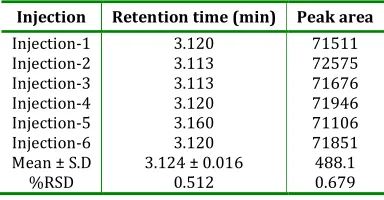
The method precision was established by injecting six freshly prepared sample solutions into the chromatographic and the results are shown in table no.4
Sensitivity
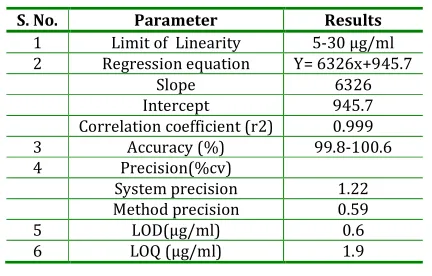
The sensitivity of Sitagliptin by the use of proposed method was estimated in terms of the limit of quantitation (LOQ) and the limit of detection (LOD). The LOQ and LOD were found to be 0.6 µg/ml and 1.9 µg/ml.
Results and Discussions
The proposed method was developed and validated as per the ICH guidelines. Linearity was observed over a concentration range of 5 to 30 μg/ml. System suitability parameters were satisfactory and the theoretical plates were obtained above 2000. Tailing factor was found below 2. %RSD also found below 2%. The assay of Sitagliptin was found to be 99.89% and the low % RSD value confirms the robustness of the method.
Table 1: Data of linearity study
Sl. No.
Concentration (µg/mL)
Peak
Area Statistical analysis
1 5 32500
Slope=6326
Intercept=945.7
Correlation
coefficient=
0.999
2 10 66306
3 15 99201
4 20 122467
5 25 156734
6 30 193693
Table: 2 Data of Accuracy (Recovery studies)
Sl. No.
Spiked level
Amount of drug from Formulation (μg/mL) Amount added (µg/ml) amount found (μg/mL) % Recovery Statistical Analysis Mean±
SD(n=3) %RSD
1 50% 10 5
15.10 100.7
100.6 ± 0.374 0.37
15.02 100.1
15.15 101.0
2 100% 10 10
19.91 99.5
99.84 ± 0.251 0.25
20.02 100.1
19.98 99.92
25.22 100.8
3 150% 10 15 25.34 101.3 100.4 ±0.923 0.97
24.78 99.14
Table 3: Data of system precision
Injection Retention time (min) Peak area
Injection-1 Injection-2 Injection-3 Injection-4 Injection-5 Injection-6 Mean ± S.D
%RSD 3.073 3.100 3.173 3.113 3.200 3.173 3.138 ± 0.045
1.43 66287 67736 66286 66262 67585 67591 66957 ± 681.3
1.01
Table 4: Data of method precision
Injection Retention time (min) Peak area
Injection-1 Injection-2 Injection-3 Injection-4 Injection-5 Injection-6 Mean ± S.D %RSD 3.120 3.113 3.113 3.120 3.160 3.120 3.124 ± 0.016
Fig.2: UV spectrum of sitagliptin phosphate in water (100 µg/ml)
Fig.3 Chromatogram of sitagliptin phosphate in standard solution
Fig.4: Chromatogram of sitagliptin phosphate in sample solution
Fig.5: Calibration curve of sitagliptin phosphate
Table 5: Summary of Validation Parameters
S. No. Parameter Results
1 Limit of Linearity 5-30 µg/ml
2 Regression equation Y= 6326x+945.7
Slope 6326
Intercept 945.7
Correlation coefficient (r2) 0.999
3 Accuracy (%) 99.8-100.6
4 Precision(%cv)
System precision 1.22
Method precision 0.59
5 LOD(µg/ml) 0.6
6 LOQ (µg/ml) 1.9
CONCLUSION
The proposed RP-HPLC method was found to be simple, accurate, precise, linear, robust and specific for quantitative estimation of Sitagliptin phosphate in bulk and its formulation. The proposed RP-HPLC method was cost effective and less time consuming. The values for system suitability parameters showed feasibility of this method for routine pharmaceutical application. Hence, the present RP-HPLC method is suitable for routine assay of Sitagliptin phosphate in bulk and tablet dosage form in the quality control laboratories.
ACKNOWLEDGMENTS
The author grateful to MSN Labs Ltd, Hyderabad for providing the gift sample.
REFERENCES
1. Anildubala et.al. RP-HPLC method for the estimation
of Sitagliptin Phosphate in human plasma by protein
precipitation technique. International journal of
pharmacy and pharmaceutical sciences. 2012; 4(2):
691- 694.
2. Tian Yan Zhou and Wei Lu RP-HPLC method for the Quantitative determination of sitagliptin in rat
plasma. Journal of Chinese Pharmaceutical Sciences.
2011; (20): 63-69.
3. Monila.N et.al. Spectrophotometric method for
determination of Sitagliptin Phosphate in bulk and
also in pharmaceutical formulations. Journal of
Pharmacy and Biological Sciences, 2012;1(6):37-40
4. Jeyabalan.G and Narendra Nyola spectrophotometric
and tablet dosage form. Journal of Pharmaceutical
Analysis Oct–Dec, 2012; 1(1): 19-23.
5. Rolim M.B et.alUV-spectrophotometric method for
the analysis and dissolution studies of sitagliptin
phosphate in tablets Latin American Journal of
Pharmacy, (2010); 29 (6): 962-967.
6. Parag Pathade et.al stability indicating UV
Spectrophotometric method has been developed for
quantitative determination of Sitagliptin Phosphate
in bulk and pharmaceutical formulations. Journal of
Pharmacy Research, 2011; 4(3): 871-873.
7. Tarkase K.N et.al UV spectrophotometric method
has been developed for Estimation of Sitagliptin
phosphate in tablet dosage form. Scholars Research
Library 2013; 5 (3):315- 318.
8. Deepthi.v a novel stability-indicating RP-HPLC
method for quantitative analysis of Sitagliptin in the
bulk drug and in its pharmaceutical dosage form.
International journal of pharmacy and
pharmaceutical sciences.2013; 5(1): 320-325.
How to cite this article: R. Lavanya*, Md. Yunoos; Development and Validation of RP-HPLC method for the estimation of Sitagliptin Phosphate in Bulk and its Tablet Dosage Form; J. Adv. Pharm. Edu. & Res. 2013: 3(4): 475-479.