Keith Brown and CorilU1e Boone are with the Non-Utility Generation Division at Ontario Hydro. The authors wish to thank the representatives from the other utilitiesinCanada for their time and contributions in presenting an up-to-date overview of the Canadian NUG market. This paper was originally presented at the McGraw Hill's Seventh Annual Cogeneration and Independent Power Market Conference held in New Orleans, Louisiana, March 22-24, 1992. Data on the status ofNUGin each province was updated in August, 1992.
Non-Utility Generation in
Canada
KEITH BROWN and CORINNE BOONE
Non-utility generation (NUG) is an important supply option for the majority of electric utilities. The need, and thus the market, for NUG is a function of many changing
parameters, such as economic conditions and
the expected contributions from other demand/supply options, e.g., DSM and utility-owned facilities. These parameters are dynamic - they can change drastically and quickly to alter potential NUG markets in either direction. This paper provides an up-to-date overview of NUG in Canada with a special focus on one utility, Ontario Hydro.
Canadian utility structure is different than that of the US. The major utilities in each province are public with the exception of Nova Scotia, Prince Edward Island, Alberta and Newfoundland. Each utility has the respon-sibility of providing the supply and distribution system for customers in their franchise area (generally the entire province). In Ontario, generation, bulk transmission, and
service to some large customers and
municipalities is handled by Ontario Hydro. Distribution to individual customers is largely the responsibility of over 300 municipal utilities.
There is no federal or provincial energy policy in Canada comparable to the Public Utilities Regulatory Policies Act (PURPA) passed in the US in 1978 to promote cogeneration and small power production. Furthermore, energy prices are generally low in Canada (avoided costs are similar to many states in the Central US). Due to the shear size of the supplied areas, there can be certain parts of a utility's system that have limited
transmission capacity to accept new
result, there are currently NUG activities in
ahnost every province in Canada.
About 20% of end use energy in Canada is electricity. The total electrical demand is about 475 TWh with almost 100,000 MW of installed capacity. While small by US standards (Canada has about 14% of the total US installed capacity), there are significant re-qillrements for future capacity from both utility and non-utility projects.
Non-utility generation has been presentin
Canada since the tum of the century. Past developments, typically at large industrial sites, were implemented based on customer economics (reduced requirements of supply from local utilities) and to meet the local ener-gy and/or waste disposal needs of the site. These generation facilities (referred to as load
displacement generation) were customer
driven for customer benefit. Additional electricity needs of the industrial site were supplied by the local electrical utility. Prior to the late 1980s, public power philosophy excluded NUG as a supply option by the Canadian utilities.
In addition to the existing stock of load displacement generation, a total of just over 2430 MW of NUG is now in-service, under construction, or approved in Canada. A sum-mary of the current in-service non-utility
generation in each province is shown in
Figure 1. New Requests For Proposals (RFPs)
have been issued, or are planned for issue, in
1992 in British Columbia, Alberta, and New-foundland. The combined capacity re-quirements for these new solicitations is just over 450 MW; they involve primarily
renewable resource generation.
Utilities in Saskatchewan, Manitoba, On-tario and Quebec are in the process of negotiating proposals with proponents from past solicitations and are not currently looking for additional NUG capacity. New Brunswick Power recently contracted 50 MW of generation from wood-waste from an RFP issued in 1991, and is currently negotiating with pulp and paper producers in the province for 50 MW production from biomass
cogeneration. Nova Scotia Power Inc. recently
awarded 14 contracts representing 68 MW in
response to its RFP issued in January 1991. There is currently no NUG activity in Prince Edward Island.
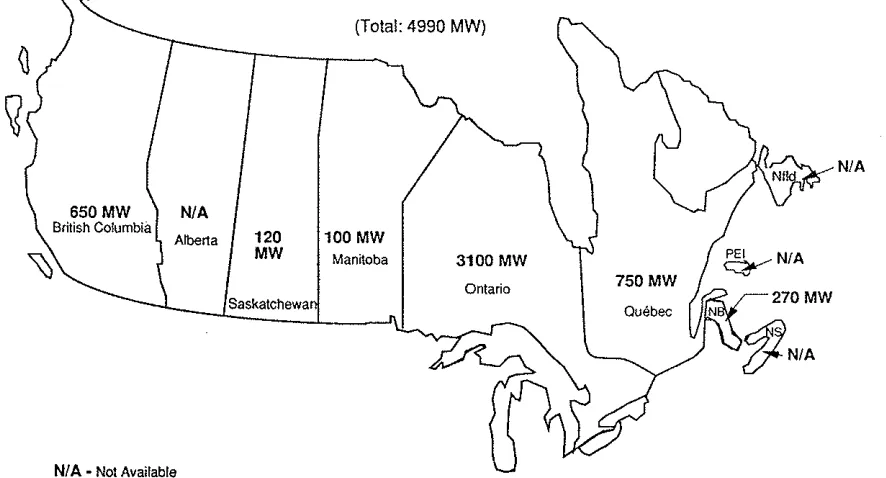
Several provinces have established year 2000 NUG targets. As shown in Figure 2, by the year 2000, 4990 MW of new capacity (in addition to the existing stock of load displacement generation) is expected in these provinces. Thisis an increase of 2560 MW over
the current in-service and contracted amolillt.
A detailed account of developments in the Ontario NUG industryisprovided below. This is followed by brief summaries of develop-ments in the remaining provinces of Canada.
1.
Ontario
(Peak Demand: 23.6 GW, Utility: Ontario Hydro)
1.1 Overview of Status
A total of 1167 MW of load displacement NUG was in operation prior to the utility becoming active in NUG solicitation. This represents ap-proximately 4% of the total installed capacity. The NUG Program was officially launched in 1985 to promote the development of additional NUG in the province. In 1988, a new or-ganizational unit known as the Non-Utility Generation Division was established dedicated to this goal. An additional 528 MW of purchase and new load displacement has been added since January 1989. Fourteen projects represen-ting 229 MW are under construction and seven additional projects totaling 806 MW have been approved.
In 1989, an open solicitation, RFP 1, was issued. At present, one project submitted as part of RFP 1 representing 66 MW is under construction, 526 MW from three proposals have received Corporate Approval, and a further 880 MW are still under negotiation
lillder a new NUG Program which commenced
February 7, 1992 (see section 1.4 below).
Unsolicited proposals totalling 845 MW (projects over 5 MW) are being considered.
Total of all Canada:2430MW
Manitoba 1422
Alberta
~~
0Brijish Columbia
'\J
260 1530:'
15 2250 = 0
0
Saskalchewa Ontario Quebec
o
PurchaseII
Load DisplacementExisting load displacement not included.
Figure 1: Non-Utility Generation in Canada - In~Service/UnderConstruction/Approved - As of August 1992 (MW)
N/A
~N/A
270MW
~N/A
Quebec
750MW Ontario
3100MW (Total:4990MW)
100MW
Manitoba
N/A
Alberta 120
MW
Saskatchewa
NIA • Not Available
650MW
British Columbia
280 MW have received Corporate Approval, while the remaining 565 MW are still under negotiation.
At the present time no proposals for projects over 5 MW are being accepted unless they are hydro-electric or use other renewable resources. In addition to the original load displacement, an overall target of 3100 MW of purchase and load displacement NUG has been set for the year 2000.
The amount of additional NUG Ontario Hydro expects to have in-service in the future has grown significantly over the last several
years. There are several reasons that account
for projections of accelerated growth, including the follOWing:
1) As with most utilities, Ontario Hydro has recognized that under today's economic
climate, focusing exclusively on large central
generation would entail a high level of risk to ratepayers from over or under building.
2) NUG can also bring environmental benefits through the development of renewable resour-ces such as hydro-electric generation and the more efficient use of non-renewable energy
sources through cogeneration.
As a result, Ontario Hydro is giving NUG a high priority and it forms a Significant part of Hydro's integrated plans. The NUG program gives NUG much greater emphasis now than it did in the past, especially where such
generation is produced from renewable or
waste resources, or at high efficiency. The current Ontario Hydro target is for 3100 MW of new NUG capacity by the year 2000, or about 10% of Ontario Hydro's existing installed capacity.
Ontario Hydro is in the midst of an En-vironmental Assessment Hearing reviewing the utility's 25 year Demand/Supply Plan issued in 1989 and updated in 1991. This review includes the expected contributions from non-utility generation.
1.2 Support to the Industry
Ontario Hydro has been working with the NUG industry since the early 1980s. Specific policies and programs have been developed to
support it. Implemented through the Non-Utility Generation Division, they include
power purchase rates, financial assistancel and technical assistance.
POWER PURCHASE RATES
Rates for projects over 5 MW are negotiated on a project-specific basis. Standard rates based on 100% of avoided cost are used for projects at or below 5 MW. All purchase rates are cur-rently based upon one fundamental guideline, rates or payments must not exceed Hydro's avoided cost. The avoided. cost calculation includes provisions for the application of cost
credits to NUGs for generation, transmissionl and distribution where applicable. Within this fundamental guideline, there is room for Hydro to be creative and flexible in developing rate schedules. Similar to other utilities, the rate schedules take into account time of day and season. For some of the larger projects,
minimum performance targets for capacity
payments are added.
For projects that use renewable resources for generation, a premium of 10% is added to the avoided cost. This includes:
(i)renewable resources such as water, wind, or solar;
(ii) waste-product fuels such as wood-waste or landfill gas; and
(iii) waste heat recovery (ie. OrganiC Rankine Cycle).
For cogeneration projects that meet a
minimum efficiency, an efficiency adder is
used to determine the purchase rate. For projects with an annual average heat rate of the fuel charged to power less than 6200 BTU/kWh, a 10% adder is used. A 9% adder to the avoided cost is used for all projects with a heat rate of between 6600 and 6200 BTU/kWh. Projects with heat rates greater than 6600 BTU/kWh will not be accepted under Hydro's
current guidelines.
FINANCIAL ASSISTANCE
qualifying projects. These are:
(i) Advanced Payment - Higher payments early in the project and less later. This option can be offered to all types of projects;
(il) Guaranteed Payment - To assist in
ob-taining lower cost financing, a minllnum
payment each month can be established, regardless of production. Primarily designed for small hydro-electric projects whose weather dependent production complicates
financing;
(iii) Performance Payments - Provides a series of payments to load displacement projects when they meet predetermined levels of production;
(iv) Interest Rate Buy-Downs - Provides payments to project financiers to lower the developer's lending costs;
(v) Low Interest Loans - The utility Can provide low interest loans directly to the project; and
(vi) Natural Gas Procurement - Many of the above five options can also be used to
pur-chase natural gas reserves! where necessary for gas contracting, for a cogeneration project.
TECHNICAL ASSISTANCE
Staff in Ontario Hydro's NUG Division have built up a significant amount of technical ex-pertise over many years in the business.
Several services are available to assist
developers from the idea stage to project development. These include:
(i) Project Design Assistance - Ontario Hydro can provide advice early in the project which can assist in determining the size of a project in
view of transmission and other factors, on rate
selection appropriate to the project's financing situation, and in designing the electrical
con-nection package; and
(il) Pre-Feasibility Studies - Ontario Hydro can perform a pre-feasibility study for the developer based on known project information to determine if a more detailed study is war-ranted.
1.3 Current NUG Projects
Existing NUG facilities in Ontario are dispersed throughout the transmission net-work and are predominantly based on renewable fuels and cogeneration. Cogeneration, as shown in Table 1, accounts for about 43% of the currently installed capacity in the province.
In addition to above in-service facilities, 229 MW of NUG is presently under construc-tion and a further 806 MW has Corporate Ap-proval to proceed. These projects are primarily cogeneration. Once all of these projects are in-service the total NUG program in Ontario, excluding the older load displacement projects, will be 1563 MW by the year 1996.
1.4 Changing Electricity Needs - A New Program
Non-utility generation is an important option to meet future supply requirements. Ontario Hydro increased its forecast of non-utility generation from 300 MW in 1987 to 3100 MW in 1991. However, like many areas in Canada and the US, a number of factors have con-verged to limit future expansion of the NUG market. The most important are the current economic downturn and the anticipated suc-cess of Hydro's demand management and NUG programs.
In Ontario, the anticipated demand for electricity by the year 2000 has decreased by almost 5% or about 1500 MW relative to earlier planning forecasts. The demand for power, which had averaged about 5% growth over the latter half of the 80s, is now expected to grow at 2.2% in the 90s. This is the lowest growth in electricity demand in Ontario Hydro's history.
Ontario Hydro has aggressively promoted energy efficiency and has targeted 5200 MW of savings, up 1500 MW from the estimate made in 1989. Combined with the decrease in demand, the need for new generating supply in the 90's has been reduced by about 3000 MW creating a surplus situation of about 4500 MW in the year 2000.
Table 1: Total In-Service NUG Capacity in On-tario as of August 1992 (MW)
New Load
Purchase Displacement Total
Hydro-Electric 73 52 125
Cogenerahon1 167 62 229
Wood-Waste2 140
0 140
Other 34 0 34
Total 414 114 528
Notes:
1/ Various fuels are used including wood waste, black liquor, and natural gas.
2/ Includes natural gas generation at some sites.
market. Providing NUG capacity well before it is needed would lead to hardship for rate payers in the province. As a result, Hydro has tailored short-term NUG development to ad-dress system requirements and minimize im-pacts of rate increases to customers. This means a slowdown in the rate of acquiring additional NUG towards the 3100 MW target for the year 2000. Significant increases in pur-chases beyond the year 2000 NUG target are not anticipated at this time.
This change occurred during a period of
active NUG development. By the end of 1991, Ontario Hydro's NUG Program had over 1400
MW either in-servicel under constructionl or had received corporate approval. In addition, Hydro was negotiating 13 proposals represen-ting a further 1625MWof possible capacity. If all the projects under negotiation were to proceed as proposed, a total of over 3000 MW would be achieved by the year 1996. A further 40 unsolicited proposals representing 3000 MW were received in late 1991, but were not
given status to negotiate. This amount of new generation would create a surplus of
generation and force Ontario Hydro to have idle capacity for the remainder of the 1990s. If this happened, it may have brought about increases in electricity rates of as much as 6% starting in 1994.
While Ontario Hydro remains conunitted to NUG as a manageable resource for meeting future electricity needs, an adjustment in the
NUG program was called for. Those projects that are important to the economy of the province, such as load displacement (self generation), should continue. Itis also impor-tant that projects that have environmental benefits such as hydro-electric and other renewable resource based projects, continue to be developed. These categories of NUG development cannot be turned on and off as
easily as cogeneration projects. Furthermore, if
the demand for electricity grows much faster than anticipated, the flexibility of NUG will make it an important short lead time supply option. These reasons make it important for Ontario Hydro to maintain its relationship with the NUG industry. Subject to these considerations, changes in the NUG program were made.
On February 7, 1992, Ontario Hydro an-nounced that it will be more selective in accep-ting NUG proposals. As already noted, this new approach maintains consideration of projects that were advanced in negotiation (13 projects, 1625 MW) but recognizes that the future pace of NUG acquisitions has to be adjusted to minimize rate impacts and follow load growth. The new NUG Program is as follows:
1) All projects that have corporate approval will proceed.
2) Negotiations with the proponents of the 13 projects with status to negotiate have been re-opened to attempt to decrease the rate impact given the decreased need for future capacity.
The re-negotiations will focus on delaying
continue to be accepted. This sector is not ex-pected to make a large contribution over the next eight years and already has a difficult formal process in place to get site development approvals. Ontario Hydro does not want to add additional requirements to this process. 5) Proposals submitted that did not have status to negotiate were terminated. These represented about 40 projects totaling 3000 MW.
6) No new proposals for projects of over 5 MW will be accepted for consideration, other than hydro-electric and other fully renewable based projects, until the need for further capacity is identified.
This new program is good news for renewable-based and load displacement projects. On the other hand, the reduced need for new capacity has all but eliminated the requirement for large NUG capacity in Ontario at this time. In the eyes of a developer, Ontario has gone from being a free and open market for large NUG capacity to being a limited and competitive environment very quickly.
Ontario Hydro remains committed to NUG as a viable option. The long-term outlook calls for 4200 MW of NUG by the year 2014. Ac-tivities are continuing to develop, such as additional policies and programs, demonstration of alternative technologies, and upgrading transmission to ensure that the NUG option is viable in the future. Ontario Hydro will continue to review all aspects of its NUG program to ensure it is addressing
cur-rent circumstances.
2. British Columbia
(Total Demand: 9.4 GW, Utility: B.e. Hydro)
At the present time, there exists 350 MW of committed NUG in Be. The first RFP in BC was for projects over 5 MW and was issued in 1988. Three contracts for 210 MW were contracted under this RFP with expected in-service dates of 1993-1994. In 1989, another RFP was issued. This one was restricted to projects less than 5 MW. A total of nine projects representing 50 MW were selected.
A second RFP for projects of less than 5 MW is being considered. A total of 650 MW of NUG is expected to be under contract by the year 2000.
3. Alberta
(Peak Demand: 6.0 GW, Utilities: TransAlta, Alberta Power, Edmonton Power, and Medicine Hat)
There is almost 750 MW of existing load displacement generation tluoughout Alberta. In addition, there is about 22 MW of
small-scale purchase generation connected under
Alberta's Small Power Research & Develop-ment Program. A further 49 MW of small hydro, 51 MW of biomass and waste, and al-most 22 MW of wind generation has also been allocated under the program initiated in 1988 by the provincial government. The program has been fully allocated.
TransAlta Utilities, based in Calgary, are in the process of issuing an open competitive solicitation for 100-200 MW. Contracts are ex-pected to be signed by the end of 1993 with a 1996-97 in-service date. These dates may change depending upon expected demand for generation within Alberta.
The Alberta Department of Energy is cur-rently studying cogeneration potential in the province' to determine the potential contribution from this technology.
4. Saskatchewan
(Peak Demand: 2.4 GW, Utility: Sask Power)
There is 63 MW of existing load displacement cogeneration in Saskatchewan. No generation under contract with the utility is in-service. A contract has been approved for a 15 MW peat facility expected to come on-line in July, 1994.
Table 2: Summary of NUGs in Canada - August 1992 (MW)
Province Existing In-Service Under Totals Under Forecast
LD" Canst. & Negotiation to 2000
Approved
-L.D. Pur L.D. Pur L.D Pur Total L.D. Pur Total LD& Pur
_ . _ - - - . _ - - - -
-British Columbia 90 260 90 260 350 650
Alberta 750 22 131 153 153 N/A
Saskatchewan 63 15 15 15 3 3 120
Manitoba 11 0 100 100 100
Ontario 1167 114 414 27 1008 141 1422 1563 10 1435 1445 3100
Quebec 20 205 225 225 1490 1490 750
New Brunswick 163 6 50 56 56 50 50 270
Nova Scotia 80 68 68 68 N/A
Prince EdwardIs. 0 0 N/A
Newfoundland 195 0 N/A
2429 114 462 117 1737 231 2199 2430 110 2978 3088 4990
PUR=Purchase; LD=Load Displacement
*Old load displacement (that installed before 1989J- where recorded, is not included in totals
service during fall1994.
Sask Power has recently gone through a public hearings process (before the Electrical Energy Options Review Panel) to seek public input regarding the future path of electrical energy options in Saskatchewan. Several recommendations have been handed down by the Panel including those dealing with non-utility generation. The non-utilityiscurrently in the process of revising its NUG policy to be in place by the end of1992.
5. Manitoba
(Peak Demand: 3.6 GW, Utility: Manitoba Hydro)
There is approximately 11 MWof customer self generation in Manitoba, but no purchase situations currently exist.
Manitoba's DSM target of 100 MW (which includes load displacement generation) for 2001 was recently raised to 285 MW. There have been no specific planning targets for non-utility generation; however, the non-utility issued a
RFP for100MW of NUG to go in-service prior to 1998. The RFP closed December 31, 1991, and Manitoba Hydro is currently negotiating with proponents.
6. Quebec
(Peak Demand: 27.5 GW, Utility: Hydro-Quebec)
There is considerable load displacement NUG in the province. Currently, there is in service a total of 20 MW of purchase-type generation, utilizing MSW, wood waste, cogeneration, and small hydro (less than 25 MW).
cogeneration was selected for further
negotiation, for a total of 1695 MW under negotiation from both phases. The utility has signed contracts for approximately 205 MW of NUG from the RFP. Negotiations are con-tinuing with the remaining 1490 MW of proposals received in response to the RFP.
Hydro-Quebec is still accepting projects of less than 10 MW utilizing renewable energy options. These are mainly hydroelectric projects, forest biomass incinerators, mWlicipal
or industrial waste incinerators/ or
wind-powered projects. The total amount of power represented by the new projects selected for negotiation must not exceed 100 MW. The utility is also accepting NUG proposals for negotiation located on the isolated systems (Northern Quebec, Lower North Shore, Mag-dalen Island). These will be based on specific needs of the isolated systems and the specific avoided costs on those systems.
The utility has just increased its forecast of non-utility generation from 390 MW to 750 MW by the year 1996. Hydro-Quebec is in the midst of a public consultation process to deter-mine the future direction of energy policy and
further activities are pending this review.
7.
New Brunswick
(Peak Demand: 2.5 GW, Utility: New Brunswick Electric Power Commission)
There are just over 160 MW of NUG in the
province from oit wood waste, and small
hydro. A further 50 MW of wood waste has just recently been contracted in response to an RFP in 1991. This capacity is expected to be on-line by 1996. The utility expects that a further 50 MW of capacity may be required over the 1996-2000 time frame. It is presently negotiating with pulp and paper producers within the province to meet the anticipated capacity requirements through biomass
cogeneration.
The utility expects a total of approximately 270 MW of NUG capacity to be in-service by the year 2000. New Brunswick Power is in the process of developing a Non-Utility
Generation Policy.
8. Nova Scotia
(Peak Demand: 1.9 GW, Utility: Nova Scotia Power Corporation)
Approximately 80 MW of the existing load displacement generation is privately owned based on wood waste and mainly located within paper mills within the province.
A RFP for 50 MW of new capacity to be in-service by the end of 1996 was issued in January, 1991. In August, 1991, 15 projects representing 62 MW were selected for
negotiation. Contracts were signed in JlUle/
1992, for 14 projects representing 68 MW. No further capacity is expected from NUGs until after the year 2000. Nova Scotia Power official-ly privatized on August 10, 1992.
9. Prince Edward Island
(Peak Demand: 0.1 GW, Utility: Maritime Electric Company)
No NUG is in-service to date except for a wind generation test facility. Potential for NUG is currently limited to wind and one cogeneration facility.
10. Newfoundland
(Peak Demand: 1.5 GW, Utilities: New-foundland and Labrador Hydro, New-foundland Power& Light)
A total of 195 MW of load displacement NUG is in operation that has been in-service for many years. No additional NUG is cur-rently in operation or committed. New-foundland and Labrador Hydro has recently waived its franchise rights to small hydro sites on the island portion of the province. This will enable development of privately-owned small hydro sites so long as government regulations are met. Interest has been shown in MSW, peat, small hydro, and some cogeneration.
is-sued recently. The deadline for preliminary submissions is August 26, 1992, and the dead-line for submission of proposals has been set at July 28,1993. The utility anticipates 1996-1997 in-service dates for selected projects. The utility has no firm plans to develop non-utility
generation as ,part of its generation mix, other
than from small hydro.
Summary
NUG is established in Canada. A total of 2430
MW of generation is on-line, under
construc-tion, or approved. Those provinces forecasting NUG contributions expect 4990 MW by the year 2000. This represents an increase of 2560 MW over the current installed and contract
amounts for those provinces. However the market for NUG will vary with economic con-ditions. At the present time the conditions are such that less, not more, NUG is required in Canada.