This is an open access journal, and articles are distributed under the terms of the Creative Commons Attribution-Non Commercial-ShareAlike 4.0 License, which allows others to remix, tweak, and build upon the work non-commercially, as long as appropriate credit is given and the new creations are licensed under the identical terms.
Cost-effectiveness analysis of psychotropic therapy in
adolescent patients with intellectual disability in Mental
Hospital of West Java Provincial State 2015-2017
Ice L. Nur
1,2*, Neily Zakiyah
1, Lina Budiyanti
2, Auliya A. Suwantika
1,31Department of Pharmacology and Clinical Pharmacy, Faculty of Pharmacy, Universitas Padjadjaran, Jln. Bandung Sumedang, KM. 21, Jatinangor, Sumedang, Indonesia. 2Departement of Children and Adolescent, Mental Hospital of West Java Provincial State. 3 Center of Excellence in Higher Education for Pharmaceutical Care Innovation,
Universitas Padjadjaran, Indonesia.
Correspondence: Ice L. Nur, Department of Pharmacology and Clinical Pharmacy, Faculty of Pharmacy, Universitas Padjadjaran, Jln. Bandung Sumedang KM. 21, Jatinangor 45363, E-mail: [email protected]
ABSTRACT
This research was aimed to analyse the cost-effectiveness analysis (CEA) of psychotropic therapy for adolescents with intellectual disability in Mental Hospital of West Java Provincial State from 2015 – 2017, and additionally, identify the most significant parameters affecting the cost-effectiveness each year. The participants were adolescent patients, aged between 12-18 years-old, with intellectual disability. Healthcare provider perspective was used, considering direct medical cost i.e cost of medical records, drugs, hospitalization, therapy and medical treatments, nurses, and lab fees. The effectiveness was estimated based on the incremental rate of one unit of Global Assessment of Functioning (GAF) value. In this CEA, the average effectiveness ratio (ACER), incremental cost-effectiveness ratio (ICER) and univariate sensitivity analysis were assessed. The results showed that psychotropic therapy in 2015 was the most cost-effective alternative with the lowest ACER, Rp248.596 for increase of each unit GAF value compared to 2016 (Rp1.013.728) and 2017 (Rp1.316.044). ICER estimation was only assessed in 2015 and 2016, due to lower cost and effectiveness compared to 2015, it was estimated Rp14.671 for one unit of GAF. Psychotropic therapy in 2017 was a dominated alternative since it had the highest cost with the lowest effectiveness. Univariate sensitivity analysis showed that hospitalization cost was the most significant parameter that affected cost-effectiveness in each year. The hospitalization cost was daily room rate multiplied with length of stay.
Keywords:
adolescent, cost-effectiveness analysis, global assessment of functioning, intellectual disability, psychotropic.
Introduction
Intellectual disability is a disorder that occurs in a development period, approximately before 18 years old, that includes the limitations of intellectual functions such as reasoning, problem solving, planning, abstract thinking, academic learning, judgment, and learning experience and adaptive functions,
including conceptual, social, and practical abilities [1, 2].
A recent meta-analysis showed that the overall prevalence of
intellectual disability is estimated to be 1% (i.e 1,64 % in
low-income countries, 1,59% in middle-low-income countries and
0,92% in high-income countries) [3]. A person with intellectual
disability easily suffers from psychological disorders such as
schizophrenia, bipolar, and anxiety [4]. Moreover, challenging
behavioural changes like aggression and self-injury are more likely to occur and exacerbate by co-morbid psychopathology
[5].
Around 58% of patients with intellectual disability get at least one psychotropic drug, either to treat general mental disorders or to manage challenging behavioural disorders such as aggressiveness and irritability. Atypical antipsychotics are the most commonly used drugs (39%), followed by antidepressants (23%), mood stabilizers (19%), anxiolytics (16%) and typical
antipsychotics (6%) [6]. Children and adolescent patients with
Access this article online
Website: www.japer.in E-ISSN: 2249-3379
How to cite this article: Ice L. Nur, Neily Zakiyah, Lina Budiyanti, Auliya
A. Suwantika. Cost-effectiveness analysis of psychotropic therapy in adolescent patients with intellectual disability in Mental Hospital of West Java Provincial State 2015-2017. J Adv Pharm Edu Res 2019;9(1):57-63.
intellectual disability receive psychotropic therapy (29.4%), consisting of 15.3% antipsychotics (especially risperidone) and
14.8% psychostimulant (especially methylphenidate) [7].
Psychotropic pharmacotherapy for intellectual disability cases has been proven effective, yet studies on pharmacoeconomics aspects have remained limited. Psychotropic pharmacotherapy has been used in 89-90% patients with intellectual disability that showed aggressive behaviours. Around 41-45% patients received more than one psychotropic drug therapy (poly pharmacy). Psychotropic therapy showed significant results in
lowering aggressive behaviours and self-harm behaviours [8].
Based on an overview of 8 out of 12 studies on psychotropic effectiveness for intellectual disability patients, it was found that psychotropic treatment significantly reduced the frequency of
challenging behaviour compared with placebo [9].Instruments
have been needed to assess the effectiveness of therapy, and the effectiveness of therapy in patients with intellectual disability can be seen from the parameters of clinical symptom improvement and improvement of psychosocial function by
using Global Assessment of Functioning (GAF) [10-12].
The economic cost related to mental disorders such as intellectual disability has been mostly reflected in direct expenditures for the treatment by individuals, corporations,
and governments [13].The cost for mental disorder has been the
largest in healthcare system, with 25,8% consisting of 10,6% for psychiatric, 9% for intellectual disability, and 6,2% for
dementia [14]. The lack of research on the economic aspects of
intellectual disability cases has become an obstacle in policy making and technical decisions for intellectual disability patients
[15].
Psychotropic is a pharmacotherapy mostly used for adolescent patients with intellectual disability in Mental Hospital of West Java Provincial State, Indonesia. As far as this study was concerned, pharmacoeconomics research especially on cost-effectiveness analysis (CEA) has never been carried out in this particular population, thus the research on CEA in recent years has been considered important.
The aim of this research was to analyse the most cost-effective alternative for psychotropic therapy for adolescent patients (12-18 years old) in 2015, 2016, and 2017, and to estimate the most significant parameters for the cost-effectiveness.
Materials and Methods
This study was a combination of retrospective and prospective non-experimental study in adolescent patients with intellectual disability who were hospitalized in Mental Hospital of West Java Provincial State during 2015 until 2017. The sample population was represented by total sampling with inclusion criteria as follows: 1) 12-18 years old, 2) diagnosed with mental retardation (defined as intellectual disability last terminology)
according to the international classification of diseases 10th
(ICD-10) criteria, in Axis II of diagnostic and statistical manual
of mental disorders 4th (DSM-IV-TR) system, 3) received
psychotropic drugs therapy and 4). hospitalized in 2015, 2016, or 2017. Meanwhile, the exclusion criteria were patients with physical illnesses in critical conditions, and required to be referred to another hospital, or the GAF value was not completed (only one GAF value either at the beginning of treatment or only at the end of the treatment).
Tabulation of the data related to the patients’ characteristics were also done to assess the number of intellectual disability cases in 12-18 years old adolescent patients based on their gender.
Cost-effectiveness analysis guideline
The guideline for conducting cost-effectiveness analysis issued
by Indonesia Ministry of Health was applied for the analysis [16,
17].The alternatives of psychotropic therapy in 2015, 2016 and
2017 were identified as alternative A, B, and C; respectively.
Cost and perspective
Healthcare provider perspective was used for the CEA,
considering direct medical cost i.e the cost of medical record,
hospitalization, therapy and medical treatment, nursing, and also lab fees.
The parameter cost of medical record, hospitalization, medical treatment and therapy, nursing, and also lab fees were referred to local government fare for Mental Hospital of West Java Provincial State. The medicine cost was the overall psychotropic drugs with the amount of fare referred to the hospital regulation. The costs in 2015 and 2016 were adjusted to the price value in 2017, considering inflation rate referred to
Bank Indonesia [18] and World Bank [19] based on consumer price
index of 1,074932407 (in 2015) and 1,038272727 (in 2016). In this case, the inflation rate according to Bank Indonesia was equivalent to the inflation rate from World Bank for Indonesia.
Efectiveness
The effectiveness was measured as GAF value which was assessed by the doctor in charge and documented in the medical record. GAF was chosen because it has been used widely to assess the psychiatric disorders diversity through psychological assessment, social function and occupation. This instrument was
translated into various languages, and used in many studies [20, 21]
and available on Axis V of DSM-IV-TR [22]. The DSM-IV-TR
was used in Mental Hospital of West Java Provincial State diagnosed system.
Average cost-effectiveness ratio
The ACER calculation was estimated to assess the ratio of the average cost per unit effectiveness (per 1 unit of GAF value) in each year. The average cost-effectiveness ratio in each year was calculated by using the following equation:
𝐴𝐴𝐴𝐴𝐴𝐴𝐴𝐴=𝑇𝑇ℎ𝑒𝑒𝑎𝑎𝑎𝑎𝑒𝑒𝑟𝑟𝑎𝑎𝑟𝑟𝑒𝑒𝐺𝐺𝐴𝐴𝐺𝐺𝑎𝑎𝑎𝑎𝑣𝑣𝑣𝑣𝑒𝑒𝑐𝑐𝑐𝑐𝑐𝑐𝑐𝑐𝑝𝑝𝑝𝑝𝑐𝑐𝑟𝑟𝑒𝑒𝑎𝑎𝑐𝑐𝑒𝑒𝑐𝑐𝑜𝑜𝑒𝑒𝑎𝑎𝑐𝑐ℎ𝑣𝑣𝑝𝑝𝑝𝑝𝑐𝑐𝑝𝑝𝑎𝑎𝑐𝑐𝑝𝑝𝑒𝑒𝑝𝑝𝑐𝑐
Incremental cost effectiveness ratio
The incremental cost effectiveness ratio was estimated to assess the additional cost needed (or saving) per GAF value unit if one alternative would be changed to other alternatives.
𝐼𝐼𝐴𝐴𝐴𝐴𝐴𝐴=Average cost alternative A 𝐺𝐺𝐴𝐴𝐺𝐺 𝑎𝑎𝑣𝑣𝑐𝑐𝑒𝑒𝑟𝑟𝑝𝑝𝑎𝑎𝑐𝑐𝑝𝑝𝑎𝑎𝑒𝑒 𝐴𝐴 −− Average cost alternative B 𝐺𝐺𝐴𝐴𝐺𝐺 𝑎𝑎𝑣𝑣𝑐𝑐𝑒𝑒𝑟𝑟𝑝𝑝𝑎𝑎𝑐𝑐𝑝𝑝𝑎𝑎𝑒𝑒 𝐵𝐵
(2) The average cost here was the average cost per patient, and GAF was the deviation of the average GAF value of final treatment, and the average of GAF value of the first treatment.
Sensitivity analysis
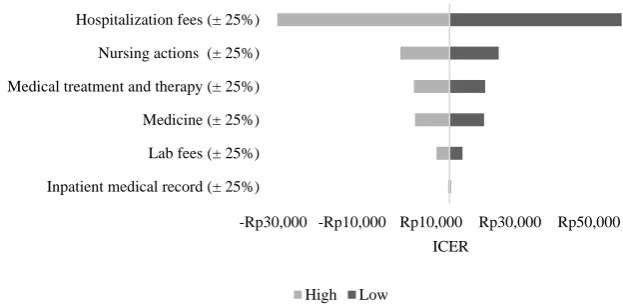
Univariate sensitivity analysis was carried out to assess the most significant parameters that potentially affected the cost-effectiveness. The estimation was done by calculating the value of a parameter (the average cost of each parameter was increased by 25% and decreased by 25%) by keeping the other parameters in the fixed value. The sensitivity analysis results were displayed in a tornado diagram. The most influential parameter change to ACER or ICER (the largest range) was the parameter that gave the most significant effect on the cost-effectiveness.
Results
This research was conducted on the population which met the inclusion criteria in 2015 (n=19), 2016 (n=54) and 2017 (n=76). Several patient data were excluded due to incomplete GAF value, thus the number of samples for CEA in 2015 was
(n=15), in 2016 was (n=42), and in 2017 was (n=64). In the population of the adolescents with intellectual disability in Mental Hospital of West Java Provincial State during 2015 until 2017, the intellectual disability cases were mostly found in male
adolescent patients (i.e. 66,7%, 73,8% and 84,4%;
respectively). The data of the sample characteristics based on the gender has been presented in Table 1.
The average costs of direct medical cost and GAF effectiveness during 2015 until 2017 have been provided in Table 2. The average cost-effectiveness ratio resulting from three participating years (2015, 2016 and 2017) showed that the
ACER was becoming greater over the years, i.e. Rp. 248,596,
Rp. 1,013,728 and Rp. 1.316.044, for 2015, 2016 and 2017; respectively. This indicated that the required costs for each unit of GAF value in 2016 and 2017 were more expensive than 2015. Thus, the alternative of psychotropic therapy in 2015 was considered to be the most cost-effective option.
The ICER calculation was estimated in 2015 and 2016. The alternative therapy in 2015 had high effectiveness value (GAF value= 20,5) but had higher cost than in 2016, otherwise, 2016 had lower cost than 2015, and also had lower effectiveness value (GAF value= 4,8). The incremental cost effectiveness ratio between 2015 and 2016 was Rp. 14671. The average cost-effectiveness ratio in 2015-2017 and the incremental cost effectiveness ratio in 2015-2016 have been provided in Table 3. Univariate sensitivity analysis results of ACER and ICER suggested that the hospitalization fee was the parameter that had a significant impact on overall cost effectiveness in all three participating years (2015, 2016 and 2017). The ICER tornado diagrams of 2015 and 2016 have been presented in Figures 1 and 2; respectively.
Table 1. Characteristics Data of the population based on gender 2015-2017
Gender/year 2015 2016 2017
n 15 100% 42 100% 64 100%
Male 10 66,7% 31 73,8% 54 84,4%
Female 5 33,3% 11 26,2% 10 15,6%
Note: n = the number of adolescent patients with intellectual disability
Table 2. Data of Cost and Effectiveness in 2015-2017
Year Sample LOS Average
(day)
Initial GAF Average
Final GAF Average
∆
GAF
Cost Average (Rp) *
Total of Cost Average MR
Fees
Hospitalization Fees
Medical Treatment & Therapy
Nursing
Actions Lab Fees Medicine
2015 15 20 42,7 63,2 20,5 21.499 2.576.255 566.848 1.207.579 159.807 564.237 5.096.224 2016 42 21 49,7 54,5 4,8 20.765 2.738.939 566.922 782.165 207.778 549.325 4.865.895 2017 64 23 44,8 49,3 4,5 20.000 3.283.594 845.469 1.000.039 193.516 579.579 5.922.196 Note : LOS; length of stay, GAF; Global Assessment of Functioning, MR; medical record.
* The cost value in 2015 and 2016 is adjusted to the value in 2017 (present value) by considering inflation level referred to Bank Indonesia and World Bank based on consumer price index which was 1,074932407(in 2015) and 1,038272727 (in 2016).
Table 3. Average cost-effectiveness ratio and Incremental cost-effectiveness ratio of therapy alternative in 2015-2017 Psychotropic Therapy Alternative Therapy Incremental of GAF Effectiveness (E) The Average Cost/patient (C) ACER=C/E ICER= ∆C/∆E
2015 A 20,5 Rp5.096.224 Rp248.596
2016 B 4,8 Rp4.865.895 Rp1.013.728 Rp14.671
Note: GAF; Global Assessment of Functioning, E; Effectiveness, C; Cost, ACER; Average cost-effectiveness ratio, ICER; Incremental cost-effectiveness ratio, ∆C;
cost differentiation, ∆E; effectiveness differentiation
Figure 1.Tornado diagram of Incremental cost-effectiveness ratio based on the calculation of univariate sensitivity analysis in 2015
Figure 2.Tornado diagram of Incremental cost-effectiveness ratio based on the calculation of univariate sensitivity analysis in 2016
Discussion
This research was the first CEA on psychotropic therapy conducted in hospitalized adolescent patients with intellectual disability specifically in Indonesia. The target population of this current research was adolescents, aged 12-18 years old, who were hospitalized in Mental Hospital of West Java Provincial State during 2015 until 2017. The age group of 12-18 years-old
was corresponded to the development phase [23], and also based
on the regulation in Mental Hospital of West Java Provincial State as patients whose age were above 18 years old were hospitalized in adult rooms.
Intellectual disability cases were more commonly found in men than in women. This research results were similar to previous researches that intellectual disability cases were commonly found in men, based on two surveys conducted in the United
States i.e. 2011-2012 National Survey of Children's Health
(NSCH) and 2011-2013 National Health Interview Survey (NHIS), the prevalence of intellectual disability in children aged 2-17 years old was estimated to be 12. 2 (95% CI: 10, 7-13,9) per 1000 in NSCH, and 12.1 (95% CI: 10,8-13,7) per 1000 in
NHIS. In both samples, the prevalence of intellectual disability was higher among male than female patients, and the prevalence of intellectual disability was higher in older children (above 10
years old) than in younger children (below 10 years old) [24].
The study conducted in Finland showed that the prevalence of intellectual disability increased from 0,20% in the first year of life to 0,74% at the age of 10 years old (male: 0.90% and female: 0.58%). For boys, it then decreased to 0.71% at the age of 11 years old, while both sexes experienced a steady increase up to 40 years old (male: 0.84% and female: 0.73%), followed by a sharp increase to the maximum prevalence at the age of 50 (male: 1.19% at the age of 48, and female: 1.05% at
the age of 50) [25].In a recent study in Finland, the data of
children and adolescents who were born in 1996-2007 were collected based on Care Register for Health Care (CRHC), and it was identified that there were 7975 people diagnosed with intellectual disability at least once, of which 4826 (61%) were
males.The cumulative prevalence of the intellectual disability
reached to 1.19% at the age of 17.5 years old among those who
-Rp30,000 -Rp10,000 Rp10,000 Rp30,000 Rp50,000 Inpatient medical record (± 25%)
Lab fees (± 25%) Medicine (± 25%) Medical treatment and therapy (± 25%) Nursing actions (± 25%) Hospitalization fees (± 25%)
ICER
High Low
-Rp30,000 -Rp10,000 Rp10,000 Rp30,000 Rp50,000
Inpatient medical record (± 25%) Lab fees (± 25%) Medicine (± 25%) Medical treatment and therapy (± 25%) Nursing actions (± 25%) Hospitalization fees (± 25%)
ICER
were born in 1996, while those who were born in 1999 achieved a cumulative prevalence of 1.21% at the age of 14.5 years old [26].
The study conducted in West Australia showed that from
721.645 children who were born from 1st of January 1983 to
31st of December 2010, 10.631 children were identified to have
intellectual disability in 2010 with the proportion of 64.95% males and 35.05% females [27].
The cost-effectiveness of psychotropic therapies in 2015, 2016 and 2017 in adolescent patients with intellectual disability was obtained from the ACER estimations. Psychotropic therapy in 2015 (A) was shown to have the lowest ACER value of Rp. 248.596, so that the alternative therapy in 2015 was the most cost effective alternative therapy compared to 2016 and 2017 as seen from the average cost required for a unit of GAF value. The alternative therapy in 2017 had the highest ACER value, meaning that this alternative was the least cost-effective option. In this research, it was found that the alternative psychotropic therapy A (psychotropic therapy in 2015) and B (psychotropic therapy in 2016) were dominant as compared to the alternative therapy C (psychotropic therapy in 2017) due to their lower cost and higher effectiveness. The calculation of ICER was done to determine the deviation in the costs that needed to be added or could be saved when it was necessary to choose alternative A or B. Psychotropic therapy in 2017 was being dominated (not recommended) because it had the lowest effectiveness value and it required the most expensive cost.
From the univariate sensitivity analysis, it was also obtained that hospitalization fee was the most affecting parameter to ACER and ICER in all the years of analysis (2015-2017). This might be due to the uncertainty on the parameters in the estimation of hospitalization fees. The hospitalization fees were related to the daily room rate and the length of stay; and the greater the room rate and the longer the length of stay, the greater the cost of hospitalization would be.
The direct cost of inpatient medical treatment for the period of 2015-2017 referred to the same referral which was the Regulation of West Java Provincial Government. The hospitalization fee of psychiatric inpatient was distinguished based on the type of room and the treatment class, the intensive mental room, the intermediate mental room I, II and III class, and the quiet mental room I, II, III class. This differentiation might affect the uncertainty of hospitalization fees.
In addition, the uncertainty of hospitalization fee parameters could also be affected by the length of stay. Some factors that might affect the length of stay included the severity of intellectual disability and clinical conditions or clinical focus (axis I), general medical conditions (axis III), psychosocial and environmental problems (axis IV) and the global function of the patients’ diversity, the patients’ response to the treatment, the drugs’ side effects, families’ attention to the patients’ recovery process, and others. In this study, the average length of stay increased from 2015 to 2017; 20 days, 21 days and 23 days; respectively. These things also allowed hospitalization fees
become the most influential parameter affecting ICER and ACER results.
Some studies assessing the length of stay in patients with intellectual disability indicated that the length of stay has been one of the important parameters that needs attention. Studies that have been conducted in patients with intellectual disability who were hospitalized in generic care (general psychiatric care) compared to the treatment in specialist units (especially for patients with intellectual disability) showed that patients with intellectual disability and mental disorders hospitalized in the specialist care unit showed a significant improvement in a number of outcome measures including overall function level, psychiatric symptoms, severity of mental disorders and behavioral impairments, but the length of stay was longer. Although this study was not designed to include economic evaluation, the length of stay was considered as an important parameter in hospitalization [28].
Another study comparing the length of stay between psychiatric patients with developmental disabilities such as down syndrome, autism and intellectual disability (n = 294) with psychiatric patients without developmental disability (n=287) showed that psychiatric patients with developmental disabilities experienced longer length of stay [29].
Other studies conducted on adolescent patients with mental disorders (age 6-17 years) with intellectual disability (n=38) and no intellectual disability (n=113) showed that both groups had clinical improvement after the treatment, and patients with intellectual disability were mostly boys, and had a longer length of stay [30].
This study provided cost-effectiveness overview of psychotropic in all the years of analysis (2015-2017), and showed evidence that hospitalization fee (daily room rate multiplied with length of stay) was the most affecting parameter on cost-effectiveness psychotropic therapy in adolescent patients with intellectual disability in Mental Hospital of West Java Provincial State. These evidences were expected to be useful in policy-making, especially for inpatient services of adolescents with intellectual disability in that hospital.
The limitation of this study included: 1) Psychotropic drugs were not classified based on their active substances or therapeutic classes such as antipsychotic, antidepressant,
anxiolytic etc, 2) The clinical disorders on Axis I were not
identified, 3) The severity of intellectual disability was not classified, 5) The effectiveness was measured by only one
indicator i.e. GAF and 6) The number of population was
adjusted life year/ QALY) has been important in adolescent patients with intellectual disability.
Conclusions
The alternative of psychotropic therapy in 2015 was the most cost-effective alternative for adolescent patients with intellectual disability in Mental Hospital of West Java Provincial
State with the lowest cost effectiveness ratio (ACER) i.e. Rp.
248,596 for every single GAF unit. ICER calculations were assessed in 2015 and 2016 data, because 2016 had a lower cost value and lower effectiveness compared to 2015, which was Rp. 14.671 for one unit GAF value. The most influencing factor on the cost effectiveness of psychotropic therapy in intellectual disability patients in Mental Hospital of West Java Provincial State during 2015 until 2017 was the hospitalization fees.
Acknowledgements
The authors would like to express their thanks to the management of Mental Hospital of West Java Provincial State and Regional Personnel Board of West Java Provincial State. This article’s publication was supported by the United States Agency for International Development (USAID) through the Sustainable Higher Education Research Alliance (SHERA) Program for Universitas Indonesia’s Scientific Modeling, Application, Research and Training for City-centered Innovation and Technology (SMART CITY) Project, Grant #AID-497-A-1600004, Sub Grant #IIE-00000078-UI-1.
References
1. American Psychiatric Association.(2013). Diagnostic and
statistical manual of mental disorders (DSM-5®):
American Psychiatric Pub. View Article Google Scholar.
2. Schalock, R. L., Borthwick-Duffy, S. A., Bradley, V. J.,
Buntinx, W. H., Coulter, D. L., Craig, E. M., ... & Shogren, K. A. (2010). Intellectual disability: Definition,
classification, and systems of supports. American Association
on Intellectual and Developmental Disabilities. (11th ed.). Washington DC.
3. Maulik, P. K., Mascarenhas, M. N., Mathers, C. D.,
Dua, T., & Saxena, S. (2011). Prevalence of intellectual disability: a meta-analysis of population-based studies.
Research in developmental disabilities, 32(2), 419-436.
4. LoVullo, S. V., & Matson, J. L. (2009). Comorbid
psychopathology in adults with autism spectrum disorders
and intellectual disabilities. Research in Developmental
Disabilities, 30(6), 1288-1296.
5. Embregts, P. J., Didden, R., Schreuder, N., Huitink, C.,
& Van Nieuwenhuijzen, M. (2009). Aggressive behavior in individuals with moderate to borderline intellectual disabilities who live in a residential facility: An evaluation
of functional variables. Research in developmental disabilities,
30(4), 682-688.
6. Tsiouris, J. A., Kim, S. Y., Brown, W. T., Pettinger, J.,
& Cohen, I. L. (2013). Prevalence of psychotropic drug use in adults with intellectual disability: positive and
negative findings from a large scale study. Journal of autism
and developmental disorders, 43(3), 719-731.
7. Scheifes, A., de Jong, D., Stolker, J. J., Nijman, H. L.,
Egberts, T. C., & Heerdink, E. R. (2013). Prevalence and characteristics of psychotropic drug use in institutionalized children and adolescents with mild intellectual disability. Research in developmental disabilities,
34(10), 3159-3167.
8. Deb, S., Unwin, G., & Deb, T. (2015). Characteristics
and the trajectory of psychotropic medication use in general and antipsychotics in particular among adults with an intellectual disability who exhibit aggressive behaviour.
Journal of Intellectual Disability Research, 59(1), 11-25.
9. Matson, J. L., & Neal, D. (2009). Psychotropic
medication use for challenging behaviors in persons with
intellectual disabilities: An overview. Research in
developmental disabilities, 30(3), 572-586.
10. Moos, R. H., Nichol, A. C., & Moos, B. S. (2002).
Global Assessment of Functioning ratings and the allocation and outcomes of mental health services.
Psychiatric Services, 53(6), 730-737.
11. Söderberg, P., Tungström, S., & Armelius, B. Å. (2005).
Special section on the GAF: reliability of Global Assessment of Functioning ratings made by clinical psychiatric staff. Psychiatric Services, 56(4), 434-438.
12. Lunsky, Y., White, S. E., Palucka, A. M., Weiss, J.,
Bockus, S., & Gofine, T. (2010). Clinical outcomes of a specialised inpatient unit for adults with mild to severe
intellectual disability and mental illness. Journal of
Intellectual Disability Research, 54(1), 60-69.
13. Shaughnessy, T. M., Parker, F. R., Hollenshead, J. H.,
Clottey, E. N., & Rubin, H. W. (2017). Contemporary Data and Trends in the Economic Costs of Mental Disabilities. Behavioral sciences & the law, 35(2), 162-177.
14. Polder, J. J., Meerding, W. J., Bonneux, L., & Van Der
Maas, P. J. (2002). Healthcare costs of intellectual disability in the Netherlands: a cost‐of‐illness perspective.
Journal of Intellectual Disability Research, 46(2), 168-178.
15. Romeo, R., & Molosankwe, I. (2010). Economic
evidence in intellectual disabilities: a review. Current
opinion in psychiatry, 23(5), 427-431.
16. Ministry of Health, RI. (2013). Guidelines for the
application of pharmacoeconomic studies. Directorate General of Pharmacy and Medical Devices, Jakarta.
17. Ministry of Health, RI. (2016). Technical guidelines for
pharmacoeconomic analysis in health facilities. Directorate General of Pharmacy and Medical Devices, Jakarta.
18. Central Bank of Republik Indonesia. Inflation Report
measurement.[homepage on the Internet]. copyright © 2013 Bank Indonesia all rights reserved [cited 2017
Desember 22]. Available at: http://www.bi.go.id/en/moneter/inflasi/data/Default.
aspx.
19. The world Bank. Inflation consumer prices annual (%),
consumer price index, selected countries and economies, Indonesia.[homepage on the Internet]. © 2017 The World Bank Group, All Rights Reserved. [cited 2017 Desember 22]. Available from https://data.worldbank.org/indicator/FP.CPI.TOTL.Z G?end=2016&locations=ID&start=2015&view=chart&y ear_high_desc=true.
20. Salvi, G., Leese, M., & Slade, M. (2005). Routine use of
mental health outcome assessments: choosing the measure. The British Journal of Psychiatry, 186(2), 146-152.
21. Vatnaland, T., Vatnaland, J., Friis, S., & Opjordsmoen,
S. (2007). Are GAF scores reliable in routine clinical use?. Acta Psychiatrica Scandinavica, 115(4), 326-330.
22. American Psychiatric Association. (2000). DSM-IV-TR:
Diagnostic and statistical manual of mental disorders, text
revision. Washington, DC: American Psychiatric Association,
75, 78-85.
23. Havighurst, R. (1972). Developmental tasks and
education (3rd Edit.) New York: David McKay Co.
24. Maenner, M. J., Blumberg, S. J., Kogan, M. D.,
Christensen, D., Yeargin-Allsopp, M., & Schieve, L. A. (2016). Prevalence of cerebral palsy and intellectual disability among children identified in two US National
Surveys, 2011–2013. Annals of epidemiology, 26(3),
222-226.
25. Westerinen, H., Kaski, M., Virta, L. J., Almqvist, F., &
Iivanainen, M. (2014). Age‐specific prevalence of
intellectual disability in Finland at the beginning of new
millennium–multiple register method. Journal of
Intellectual Disability Research, 58(3), 285-295.
26. Westerinen, H., Kaski, M., Virta, L. J., Kautiainen, H.,
Pitkälä, K. H., & Iivanainen, M. (2017). The nationwide
register‐based prevalence of intellectual disability during
childhood and adolescence. Journal of Intellectual Disability
Research, 61(8), 802-809.
27. Bourke, J., de Klerk, N., Smith, T., & Leonard, H.
(2016). Population-based prevalence of intellectual disability and autism spectrum disorders in Western
Australia: a comparison with previous estimates. Medicine,
95(21): e3737.
28. Xenitidis, K., Gratsa, A., Bouras, N., Hammond, R.,
Ditchfield, H., Holt, G., ... & Brooks, D. (2004). Psychiatric inpatient care for adults with intellectual
disabilities: generic or specialist units?. Journal of
Intellectual Disability Research, 48(1), 11-18.
29. Saeed, H., Ouellette-Kuntz, H., Stuart, H., & Burge, P.
(2003). Length of stay for psychiatric inpatient services: a comparison of admissions of people with and without
developmental disabilities. The journal of behavioral health
services & research, 30(4), 406-417.
30. Chaplin, R., Roach, S., Johnson, H., & Thompson, P.
(2015). Inpatient children and adolescent mental health services (CAMHS): Outcomes of young people with and
without intellectual disability. Journal of Intellectual