This is an open access journal, and articles are distributed under the terms of the Creative Commons Attribution-Non Commercial-ShareAlike 4.0 License, which allows others to remix, tweak, and build upon the work non-commercially, as long as appropriate credit is given and the new creations are licensed under the identical terms.
© 2018 Journal of Advanced Pharmacy Education & Research | Published by SPER Publication
9
Toll like receptor 7 & 8 gene variations and sustained virological
response in Hepatitis C Virus Patients treated with interferon
Embaby, M.
1*, Shaker, O.
2, Abd El Aziz, G.
1, Rashad, A.
2, Yousri, A.
31Medical Biochemistry Department, Faculty of Medicine, Beni Suef University, 2Medical Biochemistry and Molecular Biology Department, Faculty of Medicine, Cairo
University, 3Tropical Medicine, Cairo University, Egypt.
Correspondence: Marwa Embaby, Medical Biochemistry Department, Faculty of Medicine, Beni Suef University, Egypt. E_mail: [email protected]
ABSTRACT
Objective: Hepatitis C virus (HCV) infection is an important etiology of chronic liver diseases. Polymorphisms in the toll like receptor 7 & 8 genes are important in predicting the suitability of HCV infection and response to interferon treatment. This study aimed to detect the effect of single nucleotide polymorphisms on both TLR-7(rs179009) and TLR8 (rs3764879) genes in HCV infected patients with interferon therapy. Methods: The study included 190 chronic hepatitis C patients with interferon therapy and 60 healthy subjects. HCV quantitation by real time PCR, DNA extraction from whole blood for detection of SNP of TLR7&8 by polymerase chain reaction (PCR) and all allelic discrimination (AD) of the TLR-7 and TLR-8 SNPs were performed. Results: Concerning, TLR7, there was a higher significant difference between HCV patients and control females as regards GG, and G allele, p= (0.030 and 0.001), and there was a lower significant difference between responders and non-responder females considering GG, AG and G allele, p= (0.006, 0.007 and 0.012). There were no significant differences in males. Concerning TLR8, higher significant differences were found between HCV and control group considering C allele (p= 0.006) in females. The reverse was found in responders and non-responders, and there was a lower significant difference between both groups of males regarding GC and C allele p= (0.002 and 0.019). No difference was found in females. Conclusion: The variations in TLR7 and TLR8 genes impair immune responses during HCV infection, and affect responding to interferon treatment, implying a gender-specific effect of this X-chromosomal variation.
Keywords:
Hepatitis C virus, toll-like receptor 7&8, genetic polymorphism
Introduction
The fast recognition of virus-specific ‘danger signals’ and the activation of both innate and adaptive immunity are needed for successful host defense against viral pathogens. Hepatitis C virus (HCV), a single-stranded (ss) RNA virus, infects more than 170 million people worldwide [1].There have been various outcomes of HCV infection, and lots of factors like genetic ones which involve innate immunity may have effects on the susceptibility to the disease and its progression after infection [2].Along with viral factors, factors like age, gender and alcohol consumption which are known as host factors affect the consequences of HCV-infection. The automatic outcomes of HCV-infection, the
development of chronic diseases, and the response to therapy are all affected by genetic factors. There are a lot of genetic risk factors related to the development of diseases which have been characterized by many studies [3].
The gene of TLR7 and TLR8 which is located on the X chromosome, existing in the endosomal compartment’s membranes, identifies non-self nucleic acids (such as viral ssRNA) and eventually triggers downstream signals in order to make inflammatory cytokines and type I interferon [4].
Studies have shown that the immune response against HCV can be triggered by activating TLR7 both in vitro and in vivo. A HCV-specific immune response can be induced by SM360320, which is a synthetic ligand of TLR7, and subsequently the levels of HCV mRNA and NS5A protein expression can be reduced. Although ligands of other TLRs have been very ineffective, IFN induction, or an IFN-independent mechanism can cause this occurrence [5].
Additionally, during chronic HCV infection, TLR7 is activated to appear on monocytes [6].Even though, the exact mechanisms of TLR7 and HCV infection interaction have not been explained, clinical studies have indicated that isatoribine, which is a TLR7 Access this article online
Website: www.japer.in E-ISSN: 2249-3379
How to cite this article:Embaby, M., Shaker, O., Abd El Aziz, G., Rashad,
A., Yousri, A.Toll like receptor 7 & 8 gene variations and sustained virological response in Hepatitis C Virus Patients treated with interferon. J Adv Pharm Edu Res 2018;8(3):9-15.
agonist, increases the antiviral effect through reducing viral-loads in IFN-resistant patients during Phase I and II studies [7].
In viral pathogenesis, TLR8-mediated innate immune responses might be very important. The antiviral effect of TLR8 in response to ligand stimulation have been shown by a lot of clinical studies [8]. The ssRNA genome of HCV is a well-known natural ligand for TLR8 activation. It has been reported that HCV core protein negatively regulates the dendritic cell-induced T helper type 1 response [9]. Thus, the influence of HCV core protein stimulation on cells containing the TLR8 variants has been investigated to elucidate TLR8’s role in the immune response against HCV infection, and find out the mechanism of the interaction between variant TLR8 proteins and HCV core protein and impaired inflammatory responses [10].
The genetic variants of TLRs and downstream signaling molecules can influence the ability of the host to respond properly to TLR ligands can be affected by the genetic variants of TLRs and downstream signaling molecules, and as a result, the vulnerability of the patients suffering from infectious diseases can be changed [11]. Yet, the functional roles of genetic TLR7&8 polymorphisms and the mechanisms responsible for the variation in their function during activation have been rarely studied [12]. Therefore, the aim of several studies was to understand the genetic mechanism underlying host pathogen-recognition receptors by investigating the functional differences and signal transduction that occur after the ligand-induced stimulation of TLR7&8 [13].
Therefore, the aim of the current study was to detect the effect of single nucleotide polymorphisms (SNPs) in both TLR-7(rs179009) and TLR8 (rs3764879) genes in HCV infected patients who are under treatment with interferon plus ribavirin (responders and non-responders) and to compare the results with healthy subjects (controls).
Materials and Methods
The study was conducted on 190 HCV chronically infected Egyptian patients (46 females and 144 males). All of them attended the liver unit of Tropical Medicine Department, at Kasr El-Aini Hospital, Cairo University Outpatient’s Clinic to receive combined treatment of Interferon and Ribavirin during the period from 2002 to 2008. The histological findings in liver biopsy specimens and/or serum biochemical tests and peripheral blood cell counts were used to diagnose the chronic hepatitis. A written informed consent was taken from patients participating in the study in accordance with the ethical guidelines of the Declaration of Helsinki. As well, 60 (18 females and 42 males) with matching age and sex to the patients were included in the study as healthy controls.
The chronically infected HCV patients aged between 18 to 60 years old, had serological, virological and histological diagnosis of chronic HCV, elevated ALT level above the upper limit of normal range within 6 months, and had not been previously treated with interferon based therapy. The exclusion criteria were: Decompensated liver disease, hemoglobin <13 g/dl for
men and <12 g/dl for women, white blood cell count of <3,000/mm3, neutrophil count of <1500/mm3, or platelet count of < 100,000/mm3, patients with hepatitis B surface antigen (HBsAg) seropositivity or infected with the human immunodeficiency virus (HIV), active schistosomiasis, serum creatinine above upper limit of normal, poorly controlled diabetes mellitus, hypertension, or psychiatric diseases, presence of ANA titre (antinuclear antibodies) > 1/160, and TSH out of normal range (0.5-5 million units/l).
Each patient received subcutaneous injection of pegylated (Peg)-IFN-α2b, at 1.5μg/kg body weight once a week, combined with daily oral administration of ribavirin at a dosage which was determined based on the patient’s body weight (600 mg for <60 kg, 800 mg for 60–80 kg, 1000 mg for >80 kg). Sustained virological response (SVR), defined as HCV RNA-negative six months after cessation of therapy was considered for ensuring Successful treatment.
The patients were divided into two groups based on their response to the treatment: The first group was called responders which included 118 patients who initially responded to treatment with normalization of aminotransferases (ALT and AST) levels and clearance of the virus denoted by negative HCV-RNA by PCR after 6 months of receiving treatment and those completed the treatment for another 6 months and remained negative after completion of the treatment course, and, the second group which was called Non-Responders (72 patients) who received treatment for 6 months and failed to clear the virus and gave positive HCV-RNA by PCR.Liver biopsies, both were assessed by a single expert pathologist and scored using the Ishak et al. (1995) system in separate reports for grading and staging [14]. The score for staging ranged from 0 (no fibrosis) to 6
(cirrhosis).
Analytic procedure
Sterile EDTA and centrifuge tubes were used to collect venous blood samples from the patients and controls. The centrifuge tube was placed at 37°c for 15 minutes then centrifuged at 3,000 rpm for 10 minutes at room temperature; The serum was separated and used for investigating biochemical characterization of HCV specific antibody titers by ELISA and enzymatic evaluation of ALT, AST, bilirubin, albumin, and complete blood picture. These tests were done at weeks 1, 2, 4 and monthly thereafter during treatment to detect the development of any adverse side effects of the drugs which necessitated dose modification, or temporary or permanent stoppage of the treatment. Markers of Hepatitis virus: HBsAg, HBc, Anti-HCV were assessed by routine methods using commercially available assays. Viral RNA was extracted using viral RNA extraction kit (Qiagen) and stored at -80 °C. HCV-RNA titer was measured before and after the treatment by Real time PCR. Thyroid function tests (T3, T4 and TSH) were done (using Immulite) to all the patients before receiving the treatment. Autoantibodies (ANA, Anti-DNA) were done using Immunoflurescence kits.
Genomic DNA was extracted from peripheral blood mononuclear cells in the collected EDTA blood using the QIAamp DNA minikit (Qiagen, USA) for genotyping of the two SNPs. A polymerase chain reaction (PCR) was performed in a final volume of 50µL. In which, there were 25 ul TaqMan master mix, 200 ng genomic DNA template, 2.5 ul Primer probe mix and RNAase free water. The PCR mixture was amplified by the real time PCR Qiaplex Q (Qiagene, USA). The cycling condition was initial denaturation at 94°C for 10 min., followed by 40 cycles of: denaturation at 92°C for 30 sec, annealing at 60°C for 90 sec, extension at 72ºC for 1 min, and final extension cycle of 72ºC for 7 min. Primers and probes included: TLR-7 (rs179009) Cat. # 4351379 and TLR-8 (rs3764879) (Cat. # 4351379 which were supplied by Aapplied Bio Biosystems, Foster City, CA). All Allelic discrimination (AD) of the TLR-7 and TLR-8 SNPs were performed by the commercially available TaqMan genotyping assay for each sample in an AD assay, and a unique pair of fluorescent dye detectors was used, for example, two TaqMan® probes that targeted a SNP site. One fluorescent dye detector was a perfect match for the wild type (allele 1), and the other fluorescent dye detector was a perfect match for the polymorphism (allele 2).
Statistical Methods:
Data were coded and entered using the statistical package SPSS version 21. The mean and standard deviation for quantitative variables and frequencies (number of cases) and relative frequencies (percentages) for categorical variables were calculated. Chi-square tests were used to compare genotype and allele frequencies of the patients and the control groups, and also the responders and non-responders. When the expected frequency was less than 5, the exact test was used instead. Odds’ ratio (OR) with 95% confidence intervals was calculated. The patients were analyzed based on the carriage of the rare allele, either homozygous or heterozygous. The common homozygous genotype was considered the reference. Multivariate binary logistic regression was done to detect independent predictors of response to treatment. The common homozygous genotype was considered the reference. The nonparametric Mann–Whitney U test was used to compare numeric variables between the cases and the control and between responders and non-responders. P value <0.05 was taken as statistically significant.
Results
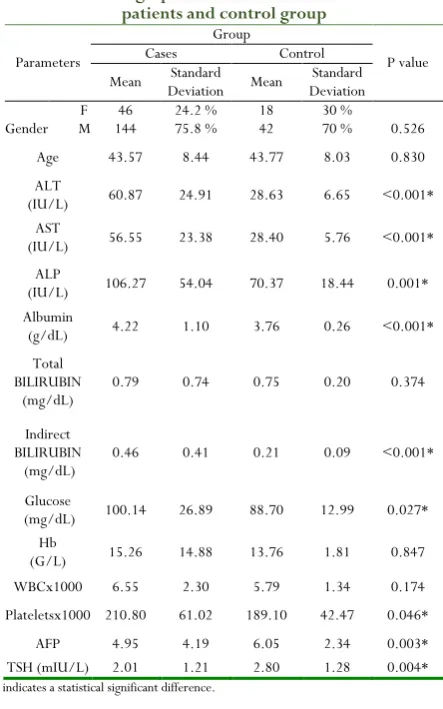
The patients were 144 men and 46 women with their mean age between 43.57±8.44 years. All were genotype 4a, and were treated with PEG-IFNα 2b 1.5 µg/kg weekly and ribavirin (800-1000 mg/day) for 24 weeks. There was statistical significant difference between HCV and control group as regards the mean values of (AST, ALT, ALP, ALB, TSH, platlets count, AFP, glucose and indirect bilirubin. No significant differences were observed as regards, (total bilirubin, Hb and WBCs. Also, no significant difference was observed concerning age and sex (Table 1).
Considering the genotypes and alleles frequencies of TLR gene in female patients and controls (Table 2), TLR 7(rs179009) genotype showed that there was a higher statistically significant difference between HCV female patients and control as regards GG genotype (mutant) and G allele (p value = 0.030 and 0.001 respectively, while lower difference was found regarding AA genotype (wild) (p value = 0.013). On the other hand, considering TLR8 (rs3764879), a higher significant difference was found between both groups regarding C allele (mutant) (P= 0.006).
Table 1: Demographic and biochemical data in HCV patients and control group
Parameters
Group
P value Cases Control
Mean Deviation Standard Mean Deviation Standard
Gender F M 144 46 24.2 % 75.8 % 18 42 30 % 70 % 0.526 Age 43.57 8.44 43.77 8.03 0.830 ALT
(IU/L) 60.87 24.91 28.63 6.65 <0.001* AST
(IU/L) 56.55 23.38 28.40 5.76 <0.001* ALP
(IU/L) 106.27 54.04 70.37 18.44 0.001* Albumin
(g/dL) 4.22 1.10 3.76 0.26 <0.001* Total
BILIRUBIN
(mg/dL) 0.79 0.74 0.75 0.20 0.374
Indirect BILIRUBIN
(mg/dL) 0.46 0.41 0.21 0.09 <0.001* Glucose
(mg/dL) 100.14 26.89 88.70 12.99 0.027* Hb
(G/L) 15.26 14.88 13.76 1.81 0.847 WBCx1000 6.55 2.30 5.79 1.34 0.174 Plateletsx1000 210.80 61.02 189.10 42.47 0.046*
AFP 4.95 4.19 6.05 2.34 0.003* TSH (mIU/L) 2.01 1.21 2.80 1.28 0.004*
* indicates a statistical significant difference.
Table 2: Genotypes and alleles frequency of TLR7 (rs179009) andTLR8 (rs3764879) polymorphism for HCV chronic infection and control
group in females
FEMALES
Group Cases
(46) Control (18) VALUE P (95%CI) OR Count % Count %
TLR7 (rs179009)
GG 20 43. 5% 0 0% 0.030* 0. ---
AG 18 39. 1% 6 33. 3% 1.000 (0.255- 1.286 6.492)
AA 8 17. 4% 12 66. 7% 0.013* (0.018- 0.105 0.609)
Allele G 58 63 % 6 16. 7% 0.001* (2.153-8.529 33.788) Allele A 34 37 % 30 83. 3%
TLR8
(rs3764879) CC 10 21.
7% 0%
GG 26 56. 5% 18 100. 0% 0.030 ---
Allele C 30 32. 6% 0 0% 0.006* ---
Allele G 62 67. 4% 36 100 %
* indicate a statistical significant difference
Considering the genotypes and alleles frequencies of TLR gene in male patients and control (Table 3), in both TLR 7(rs179009) andTLR8 (rs3764879), no statistical significant differences were found between both groups.
Table 3: Genotypes and alleles frequency of TLR7 (rs179009) andTLR8 (rs3764879) polymorphism for HCV
chronic infection and control group in males
MALES
Group
Cases (144) Control (42) VALUE P (95%CI) OR Count % Count %
TLR7 (rs179009)
GG 2 1.4% 0 0.0% 1.000 ---
AG 38 26.4% 10 23.8% 0.812 (0.370-1.147 3.561)
AA 104 72.2% 32 76.2% 0.718 (0.263-0.813 2.512)
Allele
G 42 14.6% 10 12% 0.660 1.263 (0.446-3.583) Allele
A 246 85.4% 74 88%
TLR8 (rs3764879)
CC 2 1.4% 0 0.0% 1.000 ---
GC 38 26.4% 12 28.6% 0.843 (0.304-0.896 2.654)
GG 104 72.2% 30 71.4% 0.943 (0.354-1.040 3.057)
Allele
C 42 14.6% 12 14.3% 0.962 1.024 (0.384-2.730) Allele
G 246 85.4% 72 85.7%
Regarding the response to treatment after 24 weeks, the patients were classified into two groups: Responders, including 59 patients and Non-responders, including 36 patients in which the mean values of ALT, AST, alkaline phosphatase, prothrombin time, and HCV-RNA were significantly lower in the responders comparing to the non-responders (P < 0.0001 for all of them), however, no significant difference in the mean values of direct and total bilirubin, albumin, and α-fetoprotein was observed between them.
As shown in (Table 4), concerningTLR7 (rs179009), there was a lower statistically significant difference between the responder and non-responder female HCV patients regarding GG genotype and G allele (p value = 0.006, 0.012), respectively, while a higher significant difference was found considering AG genotype (p=0.007). On the other hand, concerning TLR8 (rs3764879), no statistically significant difference was found between both groups as regards genotype and alleles.
Table 4: Prevalence of SNPs in TLR7 (rs179009) and TLR8 (rs3764879) between responders and non-responders to interferon therapy of chronic hepatitis C female patients
FEMALES
SVR Responder
(30)
Non- Responder
(16)
P VALU
E
OR (95%CI) Count % Count %
TLR7 (rs179009)
GG 6 20.0% 14 87.5% 0.006* (0.003-0.036 0.413) AG 18 60.0% 0 0.0% 0.007* ---
AA 6 20.0% 2 12.5% 1.000 (0.151-1.750 20.231)
Allele
G 30 50% 28 87.5% 0.012* 0.143 (0.028-0.740) Allele
A 30 50% 4 12.5%
TLR8 (rs3764879)
CC 8 26.7% 2 12.5% 0.621 (0.234-2.545 27.709)
GC 8 26.7% 2 12.5% 0.621 (0.234-2.545 27.709)
GG 14 46.7% 12 75.0% 0.379 (0.044-0.292 1.940)
Allele
C 24 40% 6 18.75% 0.143 2.889 (0.676-12.345) Allele
G 36 60% 26 81.25%
Table 5: Prevalence of SNPs in TLR7 (rs179009) and TLR8 (rs3764879) between responders and non-responders to interferon therapy of chronic hepatitis C male patients
MALES Responder SVR VALUE P (95%CI) OR (88) Non-Responder (56)
Count % Count %
TLR7 (rs179009)
GG 0 0.0% 2 3.6% 0.389 ---
AG 22 25.0% 16 28.6% 0.737 (0.287-0.833 2.422)
AA 66 75.0% 38 67.9% 0.509 (0.499-1.421 4.046) Allele
G 22 12.5% 20 17.9% 0.375 0.657 (0.259-1.667) Allele
A 154 87.5% 92 82.1%
TLR8 (rs3764879)
CC 2 2.3% 0 0.0% 1.000 -----
GC 12 13.6% 26 46.4% 0.002* (0.058-0.182 0.568)
GG 74 84.1% 30 53.6% 0.005 (1.529-4.581 13.726) Allele
C 16 9.1% 26 23.2% 0.019* 0.331 (0.127-0.860) Allele
G 160 91% 86 76.8%
p= (0.002, 0.019) respectively, while in TLR7 (rs179009), no difference was found between both groups (Table 5).
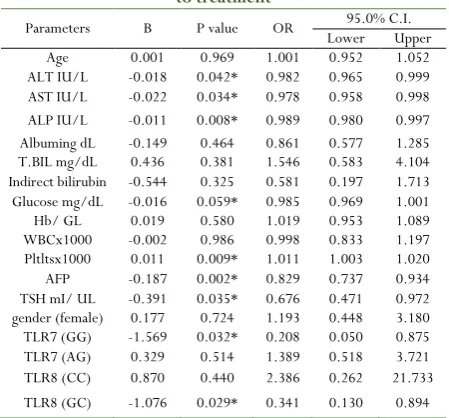
Logistic regression analyses were performed to show the factors that could affect and predict the response of chronic hepatitis C patients to interferon treatment. ALT (B= - 0.018, p= 0.042), AST (B = - 0.22, p= 0.034), ALP (B= - 0.011, p= 0.008), PLT (B= 0.11, p= 0.009), AFP (B= 0.187, p= 0.002), TSH (B= -3.91, p= 0.035), TLR7 (GG) (B= -1.569-, p= 0.032) and TLR8 CG (B= -1.076, P= 0.029) were found to be significant predictors for response as shown in Table (6).
Table 6: Univariate logistic regression to detect response to treatment
Parameters B P value OR Lower 95.0% C.I.Upper Age 0.001 0.969 1.001 0.952 1.052 ALT IU/L -0.018 0.042* 0.982 0.965 0.999 AST IU/L -0.022 0.034* 0.978 0.958 0.998 ALP IU/L -0.011 0.008* 0.989 0.980 0.997 Albuming dL -0.149 0.464 0.861 0.577 1.285 T.BIL mg/dL 0.436 0.381 1.546 0.583 4.104 Indirect bilirubin -0.544 0.325 0.581 0.197 1.713 Glucose mg/dL -0.016 0.059* 0.985 0.969 1.001 Hb/ GL 0.019 0.580 1.019 0.953 1.089 WBCx1000 -0.002 0.986 0.998 0.833 1.197 Pltltsx1000 0.011 0.009* 1.011 1.003 1.020 AFP -0.187 0.002* 0.829 0.737 0.934 TSH mI/ UL -0.391 0.035* 0.676 0.471 0.972 gender (female) 0.177 0.724 1.193 0.448 3.180 TLR7 (GG) -1.569 0.032* 0.208 0.050 0.875 TLR7 (AG) 0.329 0.514 1.389 0.518 3.721 TLR8 (CC) 0.870 0.440 2.386 0.262 21.733 TLR8 (GC) -1.076 0.029* 0.341 0.130 0.894
P-value is significant if < 0.05; Odds ratio = P/ (1-P). P is the probability that the event y occurs; C.I: Confidence interval (it is an interval in which a true population parameters fall).
Discussion
The role of TLR7 and TLR8 in the immune response against HCV has been recently reported to be associated with treatment response in HCV infected individuals, they have a potential to better identify patients with HCV infection who are likely to benefit from PEG-IFN/ribavirin therapy, and they may reveal mechanisms associated with viral clearance and immunity [12]. This study revealed that the end of treatment virological response (ETVR) to interferon was 118 responders and 72 non-responders which is comparable to the result of Tanaka et al. (2009) who searched for host genes associated with response to PEG-IFN-a plus ribavirin (RBV) treatment in 172 Japanese individuals (50 non-responder vs. 122 with VR) [15].Suppiah et al. (2009)showed different results, they studied genetic variants associated with SVR to PEG-IFN-a⁄RBV therapy in 293 Australians of northern European ancestry infected with HCV genotype 1 (162 non-responders vs. 131 with VR) [16].
The results of the current study indicated a single nucleotide polymorphism in TLR7 (rs179009) with different genotypes, AA (wild type), AG (heterozygote) and GG (mutant). Also it has detected another polymorphism in TLR8 (rs3764879) with different forms, GG (wild type), GC (heterozygote) and CC (mutant type) in both HCV patients and healthy subjects. As
TLR7 gene is located on the X-chromosome, the effect of TLR7 SNP on HCV chronic infection in each sex separately was analyzed, and the results reveled that in females there was a higher statistically significant difference between HCV patients and control group considering GG and G alleles with P value = 0.030 and 0.001, OR --- & 8.529 of (95% CI=2.153-33.78) respectively, while a lower significant difference was found regarding AA genotype, p value = (0.013).
These results are in harmony with Ming et al. (2014) who discovered that the frequency of TLR7 rs179009 GG was found significantly higher among female HCV infected subjects than the uninfected female subjects (OR = 2.42, 95% CI = 1.24–4.71, P = 0.01), However, no significant association was observed between both male groups (all P> 0.05) [17]. Furthermore, it has been indicated that the rs179009 G allele may play a risk factor for the susceptibility to HCV infection among Chinese females. Also, Wei et al. (2014) demonstrated that rs179009 G/A was a risk factor for HCV susceptibility in Chinese female Han population [18]. In contrast to this finding, Wang et al. (2011) found that, the frequency of TLR7 IVS2-151G (rs179009) was significantly higher in male chronic HCV infection patients than control subjects (24.1% versus 14.4%; p= 0.028), with odds ratio (OR) of 1.89 (95%CI = 1.06 to 3.33) [19]. Although, there were no relations found between chronic HCV infection and TLR7 polymorphisms among females.
Also, in the present study, the effect of TLR7 SNP on prediction of SVR to interferon therapy in females was assessed, there was found a statistically significant difference between responders and non-responders as regard GG and AG genotype and G allele with P value = 0.006, 0.007 and 0.012, OR 2.545 of (95%CI= 0.234-27.709), 2.545 of (95%CI= 0.234-27.709) and 2.889 of (0.676-12.345), respectively.
The underlying mechanism of the effect of TLR7 SNP (rs197009) in suitability to chronic HCV infection and response to treatment was explained by Cheng et al. (2007) who detected that the polymorphism, TLR7 IVS2-151G>A, changed the -151 nucleotide of the second intervening sequence from G to A and affected its function. Several results have suggested that TLR7 variants have functional relevance in the setting of HCV-infection by conferring susceptibility to infection. The TLR7 variants resulted in reduced IFN-a release. Accordingly, this could be responsible for a lower level of immune activation and explain the higher susceptibility to chronic HCV chronic infection among males with these mutations [20].
increased IFN-a response and the protection from HCV infection, and the effects to course of treatment [22].
Considering TLR8 (rs3764879) SNP, in the current study, no statistically significant difference was found between HCV patients and controls in genotype and alleles, but analyzing each sex separately, a higher significant difference was found between both groups in C allele (p= 0.006), among female subjects in both groups, and no difference was found in males.
The obtained results were different from Wang et al. (2011) who showed that the TLR8-129C (rs3764879) also had a significantly higher frequency in male chronic HCV infected patients than controls (17.6% versus 6.8%; p = 0.004); OR= 2.91 (95% CI = 1.38 to 6.13). However, no associations were found between chronic HCV infection and TLR7 and TLR8 polymorphisms among females. In addition, their results suggested that the TLR8 (-129G.C) polymorphisms also altered these gene expressions when quantified by mRNA.
The effects of variations in TLR8 (SNP at rs3764879) in both sexes to treatment in HCV patients were compared between responders’ non-responders, and a statistically significant difference was found between the male patients in both groups considering GC and GG genotype with P value = 0.002 and 0.005, OR 0. .896 of (95% CI=0.304-2.654) and % CI= 1.040 of (1.040 (0.304-3.057), respectively, also a significant difference was found in C alleles, p value = 0.019. No significant difference was found in females. Thomas et al. (2007) suggested that the variations in the TLR8 gene may modulate immune responses during HCV infection [23]. However, the mechanisms by which TLR8 polymorphisms affect HCV infection have not been fully understood.
Other researches explained the results of the present study by SNPs, resulting in a Met/Val change at the start codon for TLR8 and a (G/C) SNP at position -129 in the TLR8 promoter region which were shown to be in linkage. The TLR8 -129 G/C linkage with the TLR8 A1G polymorphism altered the start ATG of TLR8 into a GTG triplet. A methionine at position 4 could be used as a substitutional start codon, which leads to a truncated TLR8 (1038 aa vs. 1041 aa) with a shorter signal peptide. This mutation may cause a faster decay of TLR8 mRNA or may influence the functions of proteins [13].
In the current study, the univariate logistic regression was used for detection of factors that can predict the response to combined PEG-IFN alpha-2b and ribavirin therapy in hepatitis C patients. Univariate logistic regression analysis identified the following predictors of response: T.bil (r= 0.5; p= 0.0001), D.bil (r= -0.4; p= 0.0001), ALK (r= -0.2; p= 0.03), ALB (r= 0.3 p= 0.002), AFP (r= -0.2; p= 0.05), PT (r= -0.4; p= 0.0001), fibrosis (r= -0.3; p= 0.0001) and SNP at (rs12979860) (r= -0.4 p=0.0001). However, by multivariate logistic regression, it was found that only T bil (p= 0.002) and PT (p =0.01) were the most significant predictors of response.
Sarwar and Tarique (2010) identified three variables, platelet count <180 x 10 /L, serum albumin less than 4 grams/dl and the duration between diagnosis and treatment of hepatitis C more than 11 months to be associated with non-response to
interferon therapy in chronic hepatitis C [24]. Furthermore, Gad et al. (2008) reported that among genotype 4 chronic hepatitis C patients, severe steatosis, treatment with standard interferon and a high serum AFP level were all negatively associated with SVR [25]. This finding was in accordance with Al Ashagar et al. (2009)
who found that, high serum albumin, and low alpha fetoprotein were associated with high SVR [26]. At the same time, their study demonstrated that lower baseline serum AST is an independent predictor of SVR to PEG-INF and Rbv in patients with chronic HCV-4. They believed that these lower AST levels reflected less severe histological parameters in the sustained responders.
Conclusion
TLR7 SNP at (rs179009) and TLR8 SNP at (rs3764879) have been significantly associated with suitability to HCV infection and SVR to interferon treatment for patients with chronic HCV infection genotype 4. These polymorphisms have been gender dependent. These have allowed a better understanding of disease pathogenesis, and guiding an improved patient-selection process for eligibility of antiviral therapy.
List of abbreviations:
HCV: Hepatitis C virus; TLR: Toll like receptors; SNP: Single nucleotide polymorphism; PCR: Polymerase chain reaction; AD: Allelic discriminations; Ss RNA: Single stranded RNA; Peg INF: Pegylated Interferone; HbsAg: Hepatitis B surface antigen; HIV: Human immune deficiency virus; ANA: Anti-nuclear antibody; SVR: Sustained virological response; ALT: Alanine transaminase; AST: Aspartate transaminase; ALB: Albumin; ALP: Alkaline phosphatase: AFP: Alpha fito protein; PLT: Platlets; PT: Prothrombin time; Total BIL: Total bilirubin; ELISA :Enzyme- Linked-Immunosorbent Assay; EDETA: Ethelene diamine tetra acetic acid; TSH:Thyroid stimulating hormones.
Acknowledgments:
The authors would like to thank all staff members of the Medical Biochemistry and Molecular Biology Department, Cairo University for their help and support and the Department of Gastroenterology at Kasr El-Aini hospital for contributing to the data collection and health examinations.
References
1. Morgan RL, Baack B, Smith BD, Yartel A, Pitasi M, Falck-Ytter Y 2013. Eradication of hepatitis C virus infection and the development of hepatocellular carcinoma: a meta-analysis of observational studies. Ann Intern Med., 158: 329–37.
3. Powell EE, Edwards-Smith CJ, Hay JL 2003. Host genetic factors influence disease progression in chronic hepatitis C. Hepatology, 31(4): 828–833.
4. Sarvestani ST, Williams BR, Gantier MP 2012. Human Toll-like receptor 8 can be cool too: implications for foreign RNA sensing. J Interferon Cytokine Res., 32: 350– 61.
5. Lee J, Wu CC, Lee KJ, Chuang TH, Katakura K, Liu YT, Chan M, Tawatao R, Chung M, Shen C 2006. Activation of anti-hepatitis C virus responses via Toll-like receptor 7. Proc. Natl. Acad. Sci. U.S.A., 103: 1828–1833.
6. Dolganiuc A, Garcia C, Kodys K, Szabo G 2006. Distinct Toll-like receptor expression in monocytes and T cells in chronic HCV infection. World J. Gastroenterol., 12: XX-XX.
7. Horsmans Y, Berg T, Desager JP. Isatoribine 2005. An agonist of TLR7, reduces plasma virus concentration in chronic hepatitis C infection. Hepatology, 42(3): 724–731. 8. Campbell GR and Spector SA 2012. Toll-like receptor 8 ligands activate a vitamin D mediated autophagic response that inhibits human immunodeficiency virus type 1. PLoS Pathog., 8: e1003017
9. Nian H, Geng WQ, Cui HL 2012. R-848 triggers the expression of TLR7/8 and suppresses HIV replication in monocytes. BMC Infect Dis., 12: 5.
10. Waggoner SN, Hall CH, Hahn YS 2007. HCV core protein interaction with gC1q receptor inhibits Th1 differentiation of CD4+ T cells vi suppression of dendritic cell IL-12 production. J Leukoc Biol., 82:1407–19.
11. Netea MG, Wijmenga CO, Neill LA 2012. Genetic variation in Toll-like receptors and disease susceptibility. Nat Immunol., 13:535-42.
12. Cheng PL, Eng HL, Chou MH, You HL, Lin TM 2007. Genetic polymorphisms of viral infection-associated Toll-like receptors in Chinese population. Transl. Res., 150: 311–318.
13. Oh DY, Taube S, Hamouda O, Kucherer C, Poggensee G. A 2008. Functional toll-like receptor 8 variant is associated with HIV disease restriction. J Infect Dis., 198: 701–709. 14. Ishak K, Baptista A, Bianchi L 1995. Histological grading
and staging of chronic hepatitis. J Hepatol., 22: 696-699. 15. Tanaka Y, Nishida N, Sugiyama M, Kurosaki M, Matsuura
K, Sakamoto N 2009. Genome-wide association of host gene with response to pegylated interferon-alpha and ribavirin therapy for chronic Hepatitis C. Nat. Genet., 41: 1105-9.
16. Suppiah V, Moldovan M, Ahlenstiel G, Berg T, Weltman M, Abate ML 2009. Genetic variations affecting the
response to chronic hepatitis C interferon-alpha and ribavirin therapy. Nat. Genet., 41: 1100 - 4.
17. Ming Yue, Chun-fang GaoJia-ji, Wang Chang-jun, Wang Le, Feng, Jie, Wang Rong-bin, Yu Zhi-hang, Peng Xing-xin, Xue Li, Cai Nai-jun, Fan Yun, Zhang, Xiao-zhao, Deng 2014. Toll-like receptor 7 variations are associated with the susceptibility to HCV Infection. Genetics and Evolution, 27: 264–270.
18. Wei XS, Wei CD, Tong YQ, Zhu CL, Zhang PA 2014. Single nucleotide polymorphisms of Toll-like receptor 7 and Toll-like receptor 9 in hepatitis C virus infection patients from Central China. Yonsei Medical Journal, 55: 428–434.
19. Wang CH, Eng HL, Lin KH, Chang CH, Hsieh CA 2011. TLR7 and TLR8 Gene Variations and Susceptibility to Hepatitis C Virus Infection. PloSONE, 6(10): e26235. 20. Libri NA, Barker SJ, Rosenberg WM, Semper AE 2009. A
class C CpG toll-likereceptor 9 agonist successfully induces robust interferon-alpha production by plasmacytoid dendritic cells from patients chronically infected with hepatitis C. J Viral Hepat., 16: 315–324.
21. Fish EN 2008. The X-files in immunity: sex-based differences predispose immune responses. Nat. Rev. Immunol., 8: 737–744.
22. Seillet C, Laffont S, Trémollières F, Rouquié N, Ribot C, Arnal JF, Douin-Echinard V, Gourdy P, Guéry JC 2012. The TLR-mediated response of plasmacytoid dendritic cells is positively regulated by estradiol in vivo throughcell-intrinsic estrogen receptor a signaling. Blood, 119: 454– 464.
23. Thomas A, Laxton C, Rodman J, Myangar N, Horscroft N, Parkinson T. Investigating Toll-like receptor agonists for potential to treat hepatitis C virus infection 2007. Antimicrob. Agents Chemother., 51: 2969–78.
24. Sarwar, Tarique. Treatment failure in chronic hepatitis C 2010. Predictors other than viral kinetics. Rawal Medical Journal, 35: 217-220.
25. Gad RR, Males S El, Makhzandy H, Showman S, Hassan A, Atallah N 2008. Predictors of sustained virological response in patients infected with hepatitis C virus genotype4. Liver International, 28: 1112-1119.