Turkish Journal of Fisheries and Aquatic Sciences 17: 911-919 (2017)
www.trjfas.org ISSN 1303-2712 DOI: 10.4194/1303-2712-v17_5_07
RESEARCH PAPER
© Published by Central Fisheries Research Institute (CFRI) Trabzon, Turkey in cooperation with Japan International Cooperation Agency (JICA), Japan
Nitrogen, Phosphorus and N: P Ratio in Macroalgae of Two Lagoon
Systems of NW Mexico
Introduction
Nitrogen and phosphorus (N and P) enrichment of coastal water is mainly due to human activities and it accelerates the cultural eutrophication processes. Its consequences are increased frequency and duration of algal blooms, which are mainly due to opportunistic and fast-growing species. This has several detrimental effects, such as biodiversity losses and alteration of the trophic structure of aquatic ecosystems (Selman et al., 2008; Thornber et al., 2008; Teichberg et al., 2010).
The N: P ratio is an important additional factor because, while increases in N and P availability favor algal growth and bloom development (Granéli et al., 2008), if either nutrient becomes limiting for the dominant species, others may outcompete the remaining and become the next dominant species (Krause-Jensen et al., 2007; Teichberg et al., 2008). This ability is mostly related to algal morphology, because the surface to biomass ratio is an important factor for nutrient absorption and growth (Fong et al., 2001; Lilliesköld-Sjöö and Mörk, 2009).
The eastern coast of the Gulf of California is highly impacted by human activities, urban development and in particular by primary activities such as shrimp farms, animal husbandry and agriculture (Lluch-Cota et al., 2007). Up to 40% of
Mexican agricultural products are grown on the fertile Pacific Coastal Plain of the states of Sonora, Sinaloa and Nayarit, and the intense use of fertilizers is the main origin of the annual mean input to the Gulf of >78x103 t of N and >38x103 t of P (Miranda et al.,
2009). Some of the 40 lagoons found along this coastline, including those of this study, receive various types and volumes of effluents. These cause different degrees of impact and are the most probable origin of the various micro and macroalgal blooms detected along the Gulf of California coasts (Ochoa et al., 2002; Piñón-Gimate et al., 2008, 2009).
In this study we determined the biomass of the dominant algal species of Urías lagoon (UR) and of the Altata-Ensenada del Pabellón lagoon system (AEP), their N and P contents and the respective N: P ratios. UR receives mainly urban wastewaters while the main N and P sources of AEP are agricultural effluents. The underlying assumption of this work was that, independently from the species analyzed, the N and P contents of algal tissues reflect the difference in nutrient availability and ratios caused by these different sources of human impact.
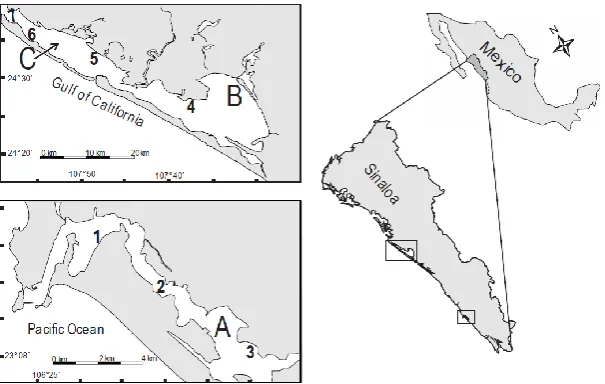
UR is located in mainland NW Mexico, close to the area where the Gulf of California and the Eastern Pacific Ocean abut (23° 10'- 23° 13' N, 106° 20'-106° 25 W). Its connection with the open sea is through a permanent mouth, its surface area is 1800 ha and its
María Julia Ochoa-Izaguirre
1, Domenico Voltolina
2,*, Griselda Victorino-Sánchez
11 Facultad de Ciencias del Mar. Universidad Autónoma de Sinaloa. Paseo Claussen s/n. CP 82000, Mazatlán, Sinaloa,
México.
2Centro de Investigaciones Biológicas del Noroeste. Laboratorio UAS-CIBNOR, Mazatlán, Sinaloa, México.
* Corresponding Author: Tel.: +52.669 9828656; E-mail: [email protected]
Received 14 October 2016 Accepted 13 February 2017
Abstract
In this work we aimed to determine if different sources of anthropogenic impact of different water bodies may affect the nitrogen (N) and phosphorus (P) contents of macroalgae biomass. To this end, samples of water and macroalgae were collected every second month in Urías lagoon (UR) and in Altata-Ensenada del Pabellón (AL and EP) lagoonal system of NW Mexico. The order of concentrations of dissolved N was UR> EP>AL (P<0.001), that of reactive P was EP>UR>AL (P <
0.001). The N content of the macroalgal biomass of the three lagoons was not significantly different, but the P content was significantly (P <0.001) lower in UR than in EP and AL. The N: P ratios in algal biomass seemed to indicate that N was below optimum values for growth in AL and EP, while P was below optimum in UR. However, the algae N and P contents were consistently high in the three lagoons, indicating adequate concentrations of external nutrients for optimum growth.
length is 18 km along two main axes, the first normal and the second parallel to the coastline. Extensive mangrove developments are present in the inner parts of the system (Figure 1). Mean yearly temperature and rainfall of the area are 24.7 °C and 882 mm, respectively. Freshwater influx is limited to discharges of urban and industrial wastewaters and to surface runoff during the rainy season. For this reason, salinity is highly variable, both locally and seasonally, ranging from <10 to >45 (Ochoa-Izaguirre et al., 2002).
Activities around UR are fish and shellfish processing and other food-related industries, while agriculture and aquaculture are carried out in a reduced scale and have a low impact. The calculated amounts of N it receives yearly range from 692 to 711 Mg (0.384-0.395 Mg ha-1, 29% from atmospheric
deposition, 28% from treated or untreated urban wastewater generated by close to 400,000 inhabitants, 15% from agriculture and the remaining 28% from industrial and other human activities) (Ochoa-Izaguirre and Soto-Jiménez, 2013).
Total annual P inputs have been calculated as 79.2 Mg (0.044 Mg ha-1), mostly from municipal
(57.7%) and industrial (27.8%) wastewaters. The contribution of aquaculture amounts to 14.5%, and agriculture was not considered a significant source of P for Urías lagoon (Del Río-Chuljak, 2003).
AEP is a complex lagoonal system located in the central part of Sinaloa State. It extends almost parallel to the coast for about 55 km, from 24° 18' to 24° 40' N and between 107° 27' and 108° 00' W, covering an area of 23,474 ha. Its two main subsystems are Altata Bay (AL) to the NW and Ensenada del Pabellón (EP) to the SE, it communicates with the open sea through one mouth common to both subsystems, and a secondary one exclusive to AL (Figure 1). The Culiacán River flows directly into EP, which for this reason is considered a brackish water environment, hydrographically separated from the more saline AL
(Carbajal and Núñez-Riboni, 2002).
Average depths are 5 m in AL and 1.5 m in EP. Mean air temperatures range from 20 to 32 °C, the rainy season lasts from July to October with a mean annual rainfall of 699 mm, while evaporation is 2,130 mm (De la Lanza-Espino et al., 2011). Mangrove forests cover 100 km2 and several inner canals and
lagoons, such as Chiricahueto, Caimanero, Bataoto and Esterón, are connected to this complex system.
AEP receives the effluents of two of the most important agricultural districts of NW Mexico, Culiacán Valley (236,229 ha) and Navolato (160,237 ha), of 7,750 ha of shrimp farms and of part of the urban and industrial wastewaters generated by more than one million local inhabitants (INEGI, 2007). Total estimated annual N inputs are 59,355 Mg (2.52 Mg ha-1), those of P are 7,110 Mg (0.30 Mg ha-1).
Agriculture is by far the main source of N (62.35%), followed by atmospheric deposition (21.06%), animal husbandry (12.8%), urban wastewaters (2.35%) and shrimp culture (1.44%). Agriculture and atmospheric depositions are also the main P sources (70.32 and 17.58%, respectively), urban wastewaters represent 6.75%, followed in this case by shrimp farms and animal husbandry, with 4.08 and 1.27% respectively (Páez-Osuna et al., 2007).
Materials and Methods
Field Activities
Macroalgae were collected every two months from February 1998 to January 1999 at three sampling sites in UR (E1 to E3), and from February 2006 to January 2007 at one sampling site in EP (E4) and three in AL (E5 to E7) (Figure 1). Collections at each sampling site were performed along two transects normal to the coastline, close to 100 m from each other and of varying length, depending on location and tide. Algae were obtained from six
sampling points spaced at equal distance from the coastline along each transect. At each of these points, a 0.5x0.5 m (0.25 m2) quadrat was thrown six times at
random within a 5 m radius. All algae within the quadrat were collected and stored in a common polystyrene ice box, giving a 72–subsamples composite sample (6 quadrats x 6 sampling points x 2 transects) for each sampling site.
Temperature and salinity were measured in situ with a mercury thermometer and a field refractometer and surface water samples were collected, stored in polyethylene bottles and taken to the laboratory for dissolved reactive phosphate (RP) and total inorganic nitrogen (DIN) determination with the respective techniques described by Strickland and Parsons (1972).
In the laboratory, macroalgae were washed free of organic and inorganic debris, rinsed with tap water and dried to constant weight in a convection oven at 60 °C (close to 3 d), after taxonomic determination using algal morphological characteristics (Dawson, 1956, 1961; Mendoza-González et al., 1994). Weight was determined in a digital balance (±0.05 g). Subsamples of the dominant species were freeze-dried and used for total N and P determination after
persulfate-sulphuric acid digestion (American Public Health Association, 1998), using the semimicro Kjeldhal (Bremner, 1965) and the Murphy and Riley (1962) colorimetric methods, respectively.
Data Analysis
The mean values of all variables determined at each lagoon were compared using one-way analysis of variance for repeated observations (RO-ANOVA). In all cases, tests were performed after R1 rank transformation (Conover and Iman, 1981) and the different means were separated with Holm-Sidak multiple comparison tests. The relationship between dissolved N and P concentrations and algal biomass, and between dissolved nutrients and their contents in algal tissues were determined with non-parametric Spearman's correlation tests (Zar, 1996).
Results
Hydrology and Nutrients
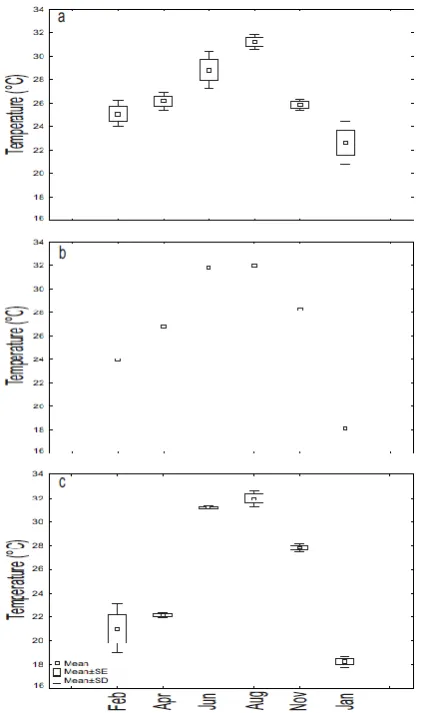
Mean surface temperatures ranged from 18.1 to 32 ± 0.7 °C, recorded in EP during January, 2007 and
in AL during August, 2006, respectively (Figure 2). Although the initial (February, April, 2006) mean values in AL were close to 3.5-4 °C lower than those recorded in same months in EP, the mean annual temperatures calculated for each station of the three lagoons were not significantly different (RO-ANOVA), and ranged between 25.1 ± 5.9 (station 1, AL) and 27.2 ± 3.0 °C (Station 2, UR).
Salinities showed low seasonal variability in UR and AL (34-35 in most months) and showed similar trends, while in EP they ranged from 25 to 35. The mean salinities of the stations of UR (35.3 ± 3.7 to 37.0 ± 2.6) and AL (33.6 ± 1.1 to 37.1 ±7.5) were not significantly different, but all were significantly higher (RO-ANOVA, P<0.05) than the mean value of EP (30.0 ± 4.2) (Figure 3).
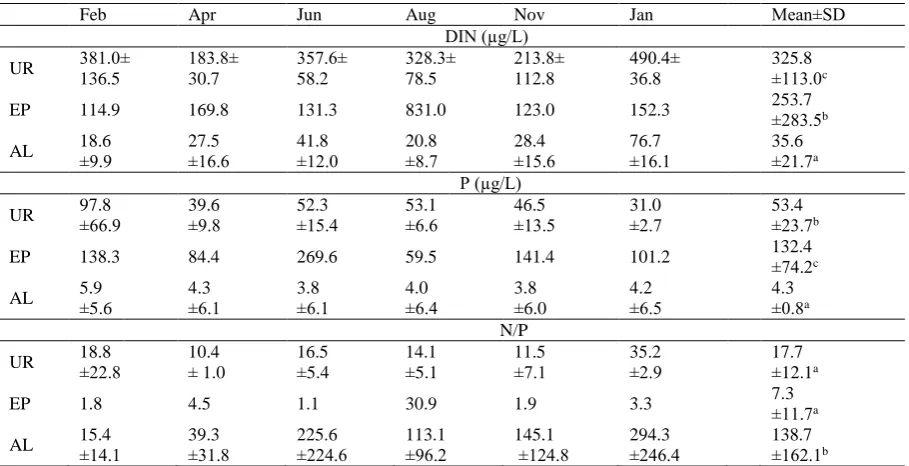
DIN ranged from 183.8 to 490.4 µg L-1 (April
1998 and January 1999) in UR and between 114.9 and 831 µg L-1 in EP (February and August 2006). The
mean DIN and RP concentrations of the three systems were significantly different (P<0.05). For both, the lowest values were determined in AL, while the highest DIN was found in UR and the highest RP was that of EP (P<0.001) The mean annual N:P ratio of
AL was significantly (P<0.05) higher than the values of UR and EP (Table 1).
Macroalgal Biomass
The total number of species identified was 79 (45 in UR, 34 in AEP and 25 common to both systems). Most species were represented by one or few specimens and low biomass, while the bulk was due to Gracilaria vermiculophylla (Florideophyceae, Rhodophyta) and Ulva expansa (Ulvophyceae, Chlorophyta) in UR and by Caulerpa sertularioides (Ulvophyceae, Chlorophyta) and G. vermiculophylla in AL and EP (Ochoa-Izaguirre et al., 2002; Victorino-Ochoa, 2007). Biomass values ranged within two orders of magnitude, from close to 9 to almost 140 g m-2 in UR (in June and November 1998,
respectively). In EP biomass varied only fourfold (10.4 to 37.4 g m-2), but the representative species
were absent at the sampling station from August to November 2006, whereas in AL values varied within a range similar to that detected in UR, with the lowest value in June and the highest in November, 2006, respectively (Table 2). There were no significant
differences between the mean macroalgal biomass of the three lagoons (P>0.05).
Most of the correlations calculated between algal biomass and environmental variables registered in the three systems were not significant (n=6, ρ from -0.002 to 0.145, P>0.2-0.3 in all cases), with the notable exception of the negative correlation between DIN and algal biomass in UR (P= 0.022).
Nitrogen, Phosphorus and N: P Ratio in Macroalgal Biomass
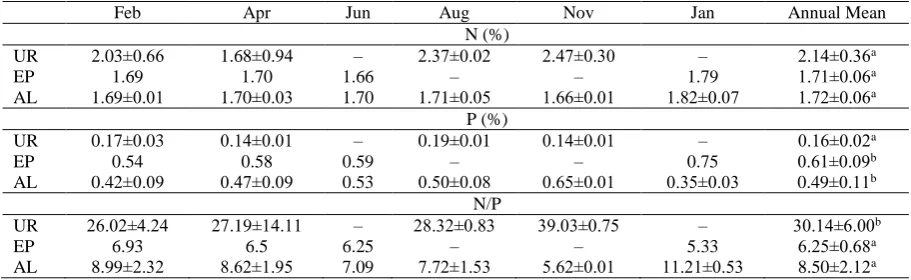
The mean N content of the biomass of the dominant species (G. vermiculophylla and U. expansa in UR and C. sertularioides and G. vermiculophylla in AL and EP) ranged from 1.66 to 2.47%. Both values were determined in EP and AL in June and November 1998 and UR in November 1998, respectively, and there were no significant differences (RO-ANOVA, P>0.05) between the mean annual values of the three lagoons (Table 3).
As to P contents, all values determined in the algal biomass of UR were lower than those of EP and AL. Therefore, the annual means of AL and EP were significantly higher than that of UR (RO-ANOVA,
P<0.05). The fairly high N content of the algal biomass of UR, coupled with the significantly lower P, gave the significantly (P<0.05) highest mean annual N:P ratio, whereas the lowest N:P ratio was that determined in the algal samples of EP (Table 3).
Discussion
Hydrology and Nutrients
The first half of 1998 was characterized by an El Niño event, which changed to a La Niña situation in the second part of that year. Both events were associated with strong temperature anomalies. The conditions in 2006 were "normal" until September, when temperature anomalies revealed a weak El Niño event (NOAA, 2015). These different situations were not reflected by the temperature values recorded for the three lagoons, in view of the similar trends and lack of significant differences between temperature cycles.
Both UR and AL may be considered anti-estuarine water bodies, given the almost complete lack of freshwater inputs. EP receives the drains of the extensive irrigation system of the surrounding Table 1. Concentrations of total dissolved inorganic nitrogen (DIN), reactive phosphate (P) and N:P ratios of the surface water of the stations of Urías lagoon (1998-99), Ensenada del Pabellón and Altata lagoon(2006-07) used for macroalgae collection
Feb Apr Jun Aug Nov Jan Mean±SD
DIN (µg/L)
UR 381.0± 136.5
183.8± 30.7
357.6± 58.2
328.3± 78.5
213.8± 112.8
490.4± 36.8
325.8 ±113.0c
EP 114.9 169.8 131.3 831.0 123.0 152.3 253.7 ±283.5b
AL 18.6 ±9.9 27.5 ±16.6 41.8 ±12.0 20.8 ±8.7 28.4 ±15.6 76.7 ±16.1 35.6±21.7a
P (µg/L)
UR 97.8 ±66.9 39.6 ±9.8 52.3 ±15.4 53.1 ±6.6 46.5 ±13.5 31.0 ±2.7 53.4 ±23.7b
EP 138.3 84.4 269.6 59.5 141.4 101.2 132.4 ±74.2c
AL 5.9 ±5.6 4.3 ±6.1 3.8 ±6.1 4.0 ±6.4 3.8 ±6.0 4.2 ±6.5 4.3 ±0.8a
N/P
UR 18.8 ±22.8 10.4 ± 1.0 16.5 ±5.4 14.1 ±5.1 11.5 ±7.1 35.2 ±2.9 17.7 ±12.1a
EP 1.8 4.5 1.1 30.9 1.9 3.3 7.3±11.7a
AL 15.4 ±14.1 39.3 ±31.8 225.6 ±224.6 113.1 ±96.2 145.1 ±124.8
294.3
±246.4 138.7 ±162.1b
Different superscripts indicate significant differences between mean values of each lagoon (One way ANOVAs on R1 rank-transformed data and Holm-Sidak tests, α=0.05, a<b<c).
Table 2. Mean values (±SD) of macroalgal biomass (g/m2, d.w.) in UR (1998-1999), and EP and AL (2006-2007)
Feb Apr Jun Aug Nov Jan Mean
UR 36.3±23.5 55.0±56.3 8.97±2.4 72.1±29.3 138.7±100.3 31.4±35.9 57.1±45.4a
EP 33.68±65.7 29.7±45.5 37.4±54.8 ‒ ‒ 10.4±9.3 27.8±12.0a
AL 55.8±53.9 33.8±29.5 23.1±25.5 67.3±74.0 75.7±15.4 36.0±33.5 48.6±20.8a
agricultural areas and the inflow of the Culiacán River (Ayala-Castañares et al., 1994; Carbajal and Nuñez-Riboni, 2002), which explains its low mean annual salinity value.
These systems receive high volumes of different types of nutrient-rich wastewater. Most of those draining into AEP come from agricultural fields or from agriculture-related activities, while those of UR are urban wastewaters or originate from shrimp farms and fish and shrimp processing plants. In the latter case, the N and P concentrations give a mean annual N:P ratio which coincides with that calculated for the known inputs (692 to 711 Mg N, 79.2 Mg P, N:P ratio 19.3-19.9: Del Río-Chuljak, 2003; Ochoa-Izaguirre and Soto-Jiménez, 2013). Since the estimated average N:P ratio of the municipal wastewater of Mazatlán is close to 9-9.5 (Alonso-Rodríguez et al., 2000), the high mean N:P ratio of UR surface waters indicates a high P content of the industrial wastewaters and shrimp farm effluents draining into UR.
The difference in the mean annual N and P concentrations of AL and EP coincides with the indications by De la Lanza-Espino and Flores-Verdugo (1998) and Flores-Flores-Verdugo and De la Lanza-Espino (2000). It is explained by the high volumes of agricultural effluents which flow into EP (De la Lanza-Espino et al., 2011), which has a longer water and suspended solids residence time than AL (Carbajal and Nuñez-Riboni, 2002). In particular, the excess dissolved P in comparison to total DIN has been mentioned by several authors as the result of the high amounts of P draining into this system from fertilized fields and sugarcane-processing plants (Soto-Jiménez et al., 2003; González-Farías et al., 2006; De la Lanza-Espino et al., 2011).
Macroalgal Biomass
U. expansa and G. vermiculophylla made up most of the biomass in UR. In AL and EP most of the
biomass was G. vermiculophylla and C.
sertularioides, This coincides with the characteristics of these highly adaptive, bloom-forming algal species (Cohen and Fong 2004; Thornber et al., 2008; Jorgensen et al., 2010; Teichberg et al., 2010). These may persist as dominant even in periodically or occasionally nutrient-poor environments, because of their capability of N storage (Naldi and Wheeler, 2002) and of organic nitrogen utilization in N-poor environments (Tyler and McGlathery, 2006).
Algal biomass frequently shows marked seasonal variations, which are mainly due to the seasonal variability in biomass of the dominant species (Turna et al., 2002; Bosc et al., 2004). In this study biomass varied irregularly and, in view of the lack of significant correlations between temperature or salinity data and the abundance of macroalgal biomass, there was no statistical evidence of a relation with a season-related factor.
Nutrient inputs to the three systems are practically continuous, since they are generated by the urban population and the food-processing industries in the case of UR. In the case of AEP, the favourable climatic conditions and the high technification of local agriculture allow continuous production in the irrigated fields of that region. Thus, continuous nutrient availability explains the lack of significant direct correlations between N or P concentrations and algal biomass. The negative relation between biomass and DIN might be due to light limitation of growth generated by harmful algal blooms and respective high turbidities, which are frequent in Mazatlán Bay during winter and early spring months (Cortés-Altamirano and Núñez-Pasten, 1992).
N, P and N: P in Algae Biomass
The N and P contents of algal tissues and their atomic ratio may be used as indicators of the availability of these nutrients in an ecosystem (Fong et al., 1994; Kim et al., 2013). In particular, high N:P ratios may be taken as indicative of low P availability, Table 3. Total N and P content (% of dry macroalgae biomass) and N/P ratios determined every second month in UR (1998-1999), EP and AL (2006-2007). Feb to Jan: Values are mean ± standard error when biomass allowed more than one determination. Annual means ± standard deviation
Feb Apr Jun Aug Nov Jan Annual Mean
N (%)
UR 2.03±0.66 1.68±0.94 ‒ 2.37±0.02 2.47±0.30 ‒ 2.14±0.36a
EP 1.69 1.70 1.66 – ‒ 1.79 1.71±0.06a
AL 1.69±0.01 1.70±0.03 1.70 1.71±0.05 1.66±0.01 1.82±0.07 1.72±0.06a
P (%)
UR 0.17±0.03 0.14±0.01 – 0.19±0.01 0.14±0.01 – 0.16±0.02a
EP 0.54 0.58 0.59 ‒ – 0.75 0.61±0.09b
AL 0.42±0.09 0.47±0.09 0.53 0.50±0.08 0.65±0.01 0.35±0.03 0.49±0.11b
N/P
UR 26.02±4.24 27.19±14.11 ‒ 28.32±0.83 39.03±0.75 – 30.14±6.00b
EP 6.93 6.5 6.25 ‒ – 5.33 6.25±0.68a
AL 8.99±2.32 8.62±1.95 7.09 7.72±1.53 5.62±0.01 11.21±0.53 8.50±2.12a
insufficient to maintain internal concentrations stable during active growth, whereas low values (<16 in the case of Ulva fenestrata: Björnsäter and Wheeler, 1990) could indicate N-limited growth.
According to these relations between N:P values and algal growth, the N:P ratios determined in UR would indicate P-limited algal biomass, whereas N would be limiting algal growth in AL and EP. However, even in AL the concentrations of both dissolved nutrients are sufficiently high that the assumption of nutrient-limited algal growth does not seem justified. This is consistent with the relatively high contents of N and P in the algal tissues determined in the three systems, which may be used as an additional criterion for the determination of nutrient-limited growth.
The internal N concentration necessary to maintain maximum growth (critical concentration) is a species-specific trait (Pedersen and Borum 1996). It may vary between 1.1 and 3.1% d.w., similar to the range mentioned by Fujita et al. (1989), who found values ranging from 0.89 to 3.0% depending on algal species and N source. Values within this range (2.17 to 2.45%) were determined in different situations for Ulva spp. by Pedersen and Borum (1997) and Villares and Carballeira (2003), respectively.
All values determined in this study lie within these ranges, indicating that the internal N pool is adequate to maintain maximum macroalgal growth, especially considering that in all situations P is available in amounts amply sufficient to rule out its role as a colimiting factor (Bracken et al., 2015).
Information on critical P concentration for macroalgae is limited. Villares and Carballeira (2003) determined a value (0.08%) which is similar to the 0.13% calculated by Gerloff and Krombholz (1966) for a variety of aquatic plants. However, it is lower than the range of 0.2-0.25% within which lie the critical P concentrations of most algae (Lyngby, 1990; Lyngby et al., 1999), The lower limit of this range is higher than the mean internal P concentrations determined in UR, but is consistently lower than those of AL and EP.
This is in agreement with the indications of the N:P values determined in the three system. It shows luxury P uptake and storage in algal tissues in AEP, where the local P budget indicates continuous P accumulation in the sediment and its mobilization to the water column, with consequent high P availability for biological processes (De la Lanza-Espino and Flores-Verdugo, 1998). In UR, the high N content and low internal P reserves are consistent with the indication of a lower external P availability than in AEP, causing a limitation of macroalgae growth.
Acknowledgements
Field work supported through projects FOMIX SIN-2005-COI-13 and UAS-PI-PROFAPI-06-101. Manuel Murillo helped with field work.
References
Alonso-Rodríguez, R., Páez-Osuna, F., & Cortés-Altamirano, R. (2000). Trophic conditions and stoichiometric nutrient balance in subtropical waters influenced by municipal sewage effluents in Mazatlán Bay (SE Gulf of California). Marine Pollution Bulletin, 40, 331-339.
https://dx.doi.org/10.1016/S0025-326X(99)00225-8. American Public Health Association. (1998). Standard
methods for the examination of water and wastewater. 20th Ed. Washington, DC: American Public Health Association, American Water Works Association, Water Environment Federation.
Ayala-Castañares, A., Gutiérrez-Estrada, M., Galaviz-Solis, A., & Malpica-Cruz, V.M. (1994). Geología marina del sistema lagunar Altata-Pabellones, Sinaloa, México. Anales del Instituto de Ciencias del Mar y Limnología. Universidad Nacional Autónoma de México, 21, 129-147.
Björnsäter, B. R., & Wheeler. P. A. 1990. Effect of nitrogen and phosphorus supply on growth and tissue composition of Ulva fenestrata and Enteromorpha intestinalis (Ulvales, Chlorophyta). Journal of Phycology, 26, 603-611.
https://dx.doi.org/10.1111/j.0022-3646.1990.00603.x.
Bosc, E., Bricaud, A., & Antoine, D. 2004. Seasonal and interannual variability in algal biomass and primary production in the Mediterranean Sea, as derived from 4 years of SeaWiFS observations. Global Biogeochemical Cycles, 18, GB1005.
https://dx.doi.org/10.1029/2003GB002034.
Bracken, M. E. S., Hillebrand, H., Borer, E. T., Seabloom, E. W., Cebrian, J., McCleland, E. E., … & Smith, J. T. 2015. Signatures of nutrient limitation and co-limitation: responses of autotroph internal nutrient concentrations to nitrogen and phosphorus additions.
Oikos, 124, 113-121.
https://dx.doi.org/10.1111/oik.01215.
Bremner, J. M. (1965). Organic forms of nitrogen. In C.A. Black (Ed.), Methods of soil analysis. Part 2. Agron. Monogr. 9. (pp. 1238-1255). Madison, WI: American Society of Agronomy.
Carbajal, N., & Núñez-Riboni, I. D. (2002). Dispersión de contaminantes pasivos en el complejo lagunar de Altata-Ensenada del Pabellón, Sinaloa. Reportes del Instituto. Potosino de Ciencia y Tecnología,1, 23-38. Cohen, R.A., & Fong, P. (2004). Nitrogen uptake and assimilation in Enteromorpha intestinalis (L.) Link (Chlorophyta) using 15N to determine preference
during simultaneous pulses of nitrate and ammonium.
Journal of Experimental Marine Biology and Ecology, 309, 60-67.
https://dx.doi.org/10.1016/j.jembe.2004.03.009. Conover, W.J., & Iman, R.L. (1981). Rank transformations
as a bridge between parametric and nonparametric statistics. American Statistician, 35, 124-133. https://dx.doi.org/ 00031305.1981.10479327. Cortés-Altamirano, R., & Núñez-Pasten A. (1992). Twelve
years (1979- 1990) of red tide records in Mazatlán Bay, Sinaloa, Mexico. Anales del Instituto de Ciencias del Mar y Limnología. Universidad Nacional Autónoma de México 19, 113-121.
Dawson, E. Y. (1956). How to know the seaweeds. Dubuque, IA: W.M.C. Brown Co.
Part 4. Gigartinales. Pacific. Naturalist, 2, 191-343. De la Lanza-Espino, G., & Flores-Verdugo, F. J. (1998).
Nutrient fluxes in sediment (NH4+ and PO4-3) in a
N.W. coastal lagoon of Mexico associated with an agroindustrial basin. Water, Air & Soil Pollution, 107, 105-120.
https://dx.doi.org/10.1023/A:1004913711608. De la Lanza-Espino, G., Flores-Verdugo, F. J.,
Hernández-Pulido, S., & Penié-Rodríguez, I. (2011). Concentration of nutrients and C:N:P ratios in surface sediments of a tropical coastal lagoon complex affected by agricultural runoff. Universidad y Ciencia, 27, 145-155.
Del Rio-Chuljak, A. (2003). Concentración y aporte de
nutrientes en el Estero de Urías (puerto de Mazatlán): tiempo de residencia y variabilidad estacional. B. Sc. Thesis. Mazatlán: Universidad Autónoma de Sinaloa, Facultad de Ciencias del Mar.
Flores-Verdugo, F. J. & De la Lanza-Espino, G. (2000). Budget calculations (Bahía de Altata-Ensenada del Pabellón). Retrieved from LOICZ-Biogeochemical modeling node website:
http://nest.su.se/mnode/mexicanlagoons/epbud.htm Fong, P., Donohoe, R. M., & Zedler, J. B. (1994). Nutrient
concentration in the tissue of the macroalgae
Enteromorpha as a function of nutrient history: an experimental evaluation using field microcosms.
Marine Ecology Progress Series, 106, 273-281. https://dx.doi.org/10.3354/meps106273
Fong, P., Kamer, K., Boyer, K. E., & Boyle, K. A. 2001. Nutrient content of macroalgae with differing morphologies may indicate sources of nutrients to tropical marine systems. Marine Ecology Progress Series, 220, 137-152.
https://dx.doi.org/10.3354/meps220137.
Fujita, R. M., Wheeler, P. A., & Edwards, R. L. (1989). Assessment of macroalgal nitrogen limitation in a seasonal upwelling region. Marine Ecology Progress Series, 53, 293-303.
Gerloff, G. C., & Krombholz, P. H. (1966). Tissue analysis as a measure of nutrient availability for the growth of angiosperm aquatic plants. Limnology and Oceanography, 11, 529-537.
https://dx.doi.org/10.431,9/lo.1966.11.4.0529. González-Farías, F. A., Hernández-Garza, M. R., &
Díaz-González, G. (2006). Organic carbon and pesticide pollution in a tropical coastal lagoon-estuarine system in Northwest Mexico. International Journal of
Environment and Pollution, 26, 234-252.
https://dx.doi.org/10.1504/IJEP.2006.009109. Granéli, E., Weberg, S., & Salomon, P. S. 2008. Harmful
algal blooms of allelopathic microalgal species: The role of eutrophication. Harmful Algae, 8, 94-102. https://dx.doi.org/10.1016/j.hal.2008.08.011.
INEGI. (2007). Censo agrícola, ganadero y forestal.
Sinaloa. Retrieved from Instituto Nacional de Estadística, Geografía e Informática website: http://www3.inegi.org.mx/sistemas/tabuladosbasicos/ default.aspx?c=17177&s=est
Jorgensen, P., Ibarra-Obando, S.E., & Carriquiry, J.D. (2010). Management of natural Ulva spp. blooms in San Quintin Bay, Baja California: Is it justified? Journal of Applied. Phycology, 22, 49-558. https://dx.doi.org/10.1007/s10811-009-9491-0. Kim, S., Park, S. R., Kang, Y. H., Kim, G. Y., Lee, K. S.,
Lee, H. J., Won, N .I., & Kil, H. J. (2013). Usefulness of tissue nitrogen content a nd macroalgal community
structure as indicators of water eutrophication.
Journal of Applied. Phycology, 26, 1149-1158. https://dx.doi.org/10.1007/s10811-013-0194-1. Krause-Jensen, D., Middelboe, A. L., Carstensen, J., &
Dahl, K. (2007). Spatial patterns of macroalgal abundance in relation to eutrophication. Marine Biology, 152, 25-36.
https://dx.doi.org/10.1007/s00227-007-0676-2.
Lilliesköld-Sjöö, G., & Mörk, E. (2009). Tissue nutrient content in Ulva spp. (Chlorophyceae) as bioindicator for nutrient loading along the coast of East Africa.
Open Environmental &. Biological Monitoring Journal, 2, 11-17. https://dx.doi.org/ 1875-0400/09. Lluch-Cota, S. E., Aragón-Noriega, E. A.,
Arreguín-Sánchez, F., Aurioles-Gamboa, D., Bautista-Romero, J. J., Brusca, R. C., & Sierra-Beltrán, A. P. (2007). The Gulf of California: Review of ecosystem status and sustainability challenges. Progress in Oceanography, 73, 1-26.
https://dx.doi.org/10.1016/j.pocean.2007.01.013. Lyngby, J. E. (1990). Monitoring of nutrient availability and
limitation using the marine macroalga Ceramium rubrum (Huds.). Aquatic Botany, 38, 153-161. https://dx.doi.org/10.1016/0304-3770(90)90002-3. Lyngby, J. E., Mortensen, R. S., & Ahrensberg, N. (1999).
Bioassessment techniques for monitoring of eutrophication and nutrient limitation in coastal ecosystems. Marine Pollution Bulletin, 39, 212-223. https://dx.doi.org/10.1016/S0025-326X(99)00025-9. Mendoza-González, A. C., Mateo-Cid, L. E., &
Huerta-Múzquiz, L. (1994. Algas marinas bentónicas de Mazatlán, Sinaloa, México. Acta Botanica Mexicana,
27, 99-115.
Miranda, A., Voltolina, D., Frías-Espericueta, M. G., Izaguirre-Fierro, G., and Rivas-Vega, M. E. (2009). Budget and discharges of nutrients to the Gulf of California of a semi-intensive shrimp farm (NW Mexico). Hidrobiológica, 19, 43-48.
Murphy, J., and Riley, J. P. (1962). A modified single solution method for the determination of phosphate in natural waters. Analytica Chimica Acta, 27, 31-36. https://dx.doi.org/10.1016/S0003-2670(00)88444-5. Naldi, M., and Wheeler, P. (2002). 15N measurements of
ammonium and nitrate uptake by Ulva fenestrata
(Chlorophyta) and Gracilaria pacifica (Rhodophyta): comparison of net nutrient disappearance, release of ammonium and nitrate, and 15N accumulation in algal
tissue. Journal of Phycology, 38, 135-144. https://dx.doi.org/10.1046/j.1529-8817.2002.01070.x. NOAA. (2015). Cold and warm episodes by season.
Retrieved at website:
prehttp://www.cpc.noaa.gov/products/analysis_monit oring/ensostuff/ensoyears.shtml
Ochoa, J .L., Hernández-Becerril, D. U., Lluch-Cota, S., Arredondo-Vega, B. O., Nuñez-Vázquez, E., Heredia-Tapia, A., ... & Alonso-Rodríguez, R. (2002). Marine biotoxins and harmful algal blooms in Mexico's Pacific littoral. In: Taylor, F. J. R., & Trainer, V. L.
(Eds.). Harmful algal blooms in the PICES region of
the North Pacific. (pp.119-128). Sidney, BC. North Pacific Marine Science Organization (PICES) Scientific Report 23,
Ochoa-Izaguirre, M. J., & Soto-Jiménez, M. F. 2013. Evaluation of nitrogen sources in the Urías lagoon system, Gulf of California, based on stable isotopes in macroalgae. Ciencias Marinas, 39, 413-430. https://dx.doi.org/10.7773/cm.v39i4.2285.
Páez-Osuna, F., Ramírez-Reséndiz, G., Ruiz-Fernández, A. C., and Soto-Jiménez, M. F. ( 2007). La contaminación por nitrógeno y fósforo en Sinaloa: flujos, fuentes, efectos y opciones de manejo. México D.F., Instituto de Ciencias del Mar y Limnología, Universidad Nacional Autónoma de México. Pedersen, F. M,. & Borum, J. (1996). Nutrient control of
algal growth in estuarine waters. Nutrient limitation and the importance of nitrogen requirements and nitrogen storage among phytoplankton and species of macroalgae. Marine Ecology Progress Series, 142, 261-272. https://dx.doi.org/10.3354/meps142261. Pedersen, F. M., and Borum, J. (1997). Nutrient control of
estuarine macroalgae: growth strategy and the balance between nitrogen requirements and uptake. Marine Ecology Progress Series, 161, 155-163.
https://dx.doi.org/10.3354/meps161155
Piñón-Gimate, A., Serviere-Zaragoza, E., Ochoa-Izaguirre, M. J., & Páez-Osuna, F. (2008). Species composition and seasonal changes in macroalgal blooms in lagoons along the southeastern Gulf of California. Botanica Marina, 51, 112-123.
https://dx.doi.org/10.1515/BOT.2008.013.
Piñón-Gimate, A., Soto-Jiménez, M. F., Ochoa-Izaguirre, M. J., García-Pagés, E., & Páez-Osuna, F. (2009). Macroalgae blooms and δ15N in subtropical coastal
lagoons from the Southeastern Gulf of California: discrimination between agricultural, shrimp farm and sewage effluents. Marine Pollution Bulletin, 58, 1144-1151.
https://dx.doi.org/10.1016/j.marpolbul.2009.04.004. Selman, M., Greenhalgh, S., Diaz, R., & Sugg, Z. (2008).
Eutrophication and hypoxia in coastal areas: a global assessment of the state of knowledge. Retrieved from World Resources Institute website: http://pdf.wri.org/eutrophication_and_hypoxia_in_coa stal_areas.pdf.
Soto-Jiménez, M. F., Páez-Osuna, F., & Bojórquez-Leyva, H. (2003). Nutrient cycling at the sediment-water interface and sediments at Chiricahueto marsh: a
subtropical ecosystem associated with agricultural land uses. Water Research, 37, 719-728. https://dx.doi.org/10.1016/S 0043-1354(02)00380-9. Strickland, J. D. H., & Parsons, T. R. 1972. A practical
handbook of seawater analysis. Bulletin of the Fisheries Research Board of Canada, 167, 1-311. Teichberg, M., Fox, S. E., Aguila, C., Olsen, Y. S., &
Valiela, I. (2008). Macroalgal response to experimental nutrient enrichment in shallow coastal waters: growth, internal nutrient pools, and isotopic signatures. Marine Ecology Progress Series, 368, 117-126. https://dx.doi.org/10.3354/meps07564.
Teichberg, M., Fox, S. E., Olsen, Y. S., Valiela, I., Martinetto, P., Iribarne, O., & Tagliapietra, D. (2010). Eutrophication and macroalgal blooms in temperate and tropical coastal: Nutrient enrichment experiments with Ulva spp. Global Change Biology, 16, 2624-2637. https://dx.doi.org/10.1111/j.1365-2486
Thornber, C. S., Di Milla, P., Nixon, S. W., & McKinney, R. A. 2008. Natural and anthropogenic nitrogen uptake by bloom-forming macroalgae. Marine Pollution Bulletin, 56, 261-269.
https://dx.doi.org/10.1016/j.marpolbul.2007.10.031. Turna, I. I., Ertan, O. O., Cormaci, M., & Furnari, G.
(2002). Seasonal variations in the biomass of macro-algal communities from the Gulf of Antalya (north-eastern Mediterranean). Turkish. Journal of Botany, 26, 19-29.
Tyler A. C., & McGlathery, K. J. (2006). Uptake and release of nitrogen by the macroalgae Gracilaria vermiculophylla (Rhodophyta). Journal of Phycology, 42, 515-525.
https://dx.doi.org/10.1111/j.1529-8817.2006.00224.x Victorino-Ochoa, G. (2007). Biomasa y contenido de
nitrógeno y fósforo de las macroalgas del sistema lagunar Altata-Ensenada del Pabellón, Sinaloa, México. B. Sc. Thesis. Mazatlán: Universidad Autónoma de Sinaloa, Facultad de Ciencias del Mar. Villares, R., & Carballeira, A. (2003). Seasonal variation in
the concentrations of nutrients in two macroalgae and nutrients levels in sediments in the Rías Baixas (NW Spain). Estuarine Coastal and Shelf Science, 58, 887-900. https://dx.doi.org/10.1016/j.ecss.2003.07.004. Zar, J. H. (1996). Biostatistical analysis. Englewood Cliffs,