Kajetan Juszczak
1, 2, Marek Wyczółkowski
2, Piotr J. Thor
1The Participation of Afferent C Fibers
in Micturition Reflex Regulation
Udział aferentnych włókien nerwowych grupy C
w regulacji procesu mikcji
1 Department of Pathophysiology, Jagiellonian University, Medical College, Cracow, Poland 2 Department of Urology, Rydygier Memorial Hospital, Cracow, Poland
Abstract
Background. The most important afferents for micturition are myelinated Aδ fibers and unmyelinated C fibers, which are believed to be insensitive in naive conditions. Afferent C fiber activation, especially the fibers with positive expression of vanilloid receptors, leads to micturition. Previous studies suggested that different types of unmyelinated afferent C fibers, such as the capsaicin-sensitive and capsaicin-resistant, mediate the voiding reflex in an overactive bladder. Surprisingly, these fibers also seem to play an important role in micturition in the naive condition.
Objectives. Considering the polymodal features of bladder afferent C fibers, the authors explored the urodynamic effect of primary afferent neurons modulation by capsaicin (CAP) and lidocaine (LDK) on detrusor activity in normal model rats.
Material and Methods. Experiments were performed on 24 female rats. The animals were randomly divided into three groups: control (group 1, n = 12), healthy rats with CAP instillation (group 2, n = 6), and healthy rats with LDK instillation (group 3, n = 6). Cystometry was performed 1 h after the surgical procedure in all groups. Modulation of afferent C fiber activity was performed with intravesical instillation of 1 mM capsaicin and 2% lidocaine. The surgical procedures and urodynamic studies were performed under urethane anesthesia. The mea-surements in each animal represent the average of five bladder micturition cycles after obtaining repetitive voiding. Recorded were basal, threshold, and micturition voiding pressures, intercontraction interval, compliance, func-tional bladder capacity, motility index, and detrusor index.
Results. Capsaicin produced complete inhibition of detrusor contractility, preventing proper voiding function of the bladder. Complete disorganization of the micturition cycles was observed. In the storage phase of the micturi-tion cycles, increased spontaneous detrusor overactivity, evaluated as phasic detrusor contracmicturi-tions of low amplitude with accompanying increased intravesical pressure, was observed. In the voiding phase there was no proper detru-sor contractility (MVP – generation of maximal voiding pressure). As a consequence of the lack of periodically gen-erated MVP and incomplete bladder empting, constant urine retention occurred. When a critically full bladder was achieved (maximal cystometric capacity), a constant dripping flow of urine through the urethra was recorded. In contrast, lidocaine had no influence on micturition cycles. Compared with the control group, significant increases in intercontraction interval, compliance, functional bladder capacity, and detrusor index were observed.
Conclusions. These results indicate that the modulation of bladder C fiber activity by capsaicin and lidocaine influence the proper micturition cycle in normal rats. These observations confirm the hypothesis that bladder affer-ent C fibers play a key role in micturition not only in the case of bladder overactivity, but also in naive conditions (Adv Clin Exp Med 2010, 19, 1, 13–19).
Key words: C fibers, bladder, capsaicin, lidocaine, rats.
Streszczenie
Wprowadzenie. Odruch mikcji jest indukowany z sygnałów pochodzących z włókien A delta, gdyż większość włókien dośrodkowych grupy C w warunkach prawidłowych jest nieaktywna. Wyniki badań wskazują na udział włókien C, mających na swoich zakończeniach receptory waniloidowe, w procesie mikcji nie tylko w stanach pato-logicznych (np. nadaktywny pęcherz moczowy), ale również w warunkach prawidłowych.
Cel pracy.Ocena udziału aferentnych włókien nerwowych grupy C w regulacji procesu mikcji u osób zdrowych.
Adv Clin Exp Med 2010, 19, 1, 13–19 ISSN 1230-025X
ORIgINAL PAPERS
The most important afferents for the mictu-rition are myelinated Aδ fibers and unmyelinat-ed C fibers, which are believunmyelinat-ed to be insensitive in naive conditions [1]. Afferent C fibers respond to mechanical, thermal, and chemical stimuli [2, 3]. Their stimulation, especially the fibers with positive expression of vanilloid receptors TRPV1 (transient receptor potential ion channel of vanil-loid type 1), whose natural ligand is capsaicin, leads to micturition activation. These alterna-tive C fibers mediate the spinal reflex, play a key role in the pathogenesis of bladder overactivity development, and increase the severity of symp-toms of overactive bladder (OAB), also in patients who sustained spinal cord injury [4]. The pivotal background for OAB development is C fibers sen-sitization (increased sensitivity to various stimuli acting on the urotelium) and local effector func-tion of afferent C fiber endings, leading to neu-rogenic inflammation. Previous studies have sug-gested that different types of unmyelinated affer-ent C fibers, such as the capsaicin-sensitive and capsaicin-resistant, mediate the voiding reflex in OAB [5]. Surprisingly, based on a study by Birder et al. [6], the afferent C fibers with TRPV1 recep-tors seem to play an important role in micturi-tion in the naive condimicturi-tion. He observed that in TRPV1-knockout mice, intense generation of non-voiding contractions of the bladder’s detru-sor occurred.
Considering the polymodal features of blad-der afferent C fibers, the present study explored the urodynamic effect of primary afferent neuron modulation by capsaicin and lidocaine on detru-sor activity in normal model rats.
Material and Methods
Animals
The experiments were performed on 24 adult female Wistar rats (weight: 200–275 g). The rats were housed in individual cages. The animal room was maintained at a constant temperature of 23°C, humidity, and a 12:12 h light-dark cycle. They were fed animal food (Labofeed; Kcynia, Poland) with no restraint on water. The study was approved by the Animals Ethics Committee of Jagiellonian University (Krakow, Poland).
Modulation of Afferent
C Fiber Activity
The drugs capsaicin (Sigma-Aldrich, germany) and 2% lidocaine (Polfa, Warsaw, Poland) were used. Capsaicin (final concentration: 1 mM) was dissolved in a special solution composed of 0.9% saline (80% of the total volume), absolute ethanol (10%), and Tween 80 (Sigma-Aldrich, germany) (10%). Under urethane anesthesia, the bladder was catheterized through the urethra and emp-tied. A volume of 0.3 ml of 1 mM capsaicin or 2% lidocaine was injected through the catheter (groups 2 and 3) at a rate of 0.15 ml/min. The capsaicin or lidocaine was left in contact with the mucosa for 15 and 30 minutes, respectively. The bladder was emptied again and flushed using 0.5 ml of 0.9% saline at a rate of 0.15 ml/min. [7].
Anaesthesia
All the surgical procedures and urodynamic studies were performed under anesthesia with
Materiał i metody. Badanie przeprowadzono na 24 szczurach płci żeńskiej, które przydzielono do 3 grup: I – kon-trolna (n = 12), II – osobniki zdrowe, którym dopęcherzowo podano 1 mM CAP (n = 6), III – osobniki zdro-we z dopęcherzową podażą 2% LDK (n = 6). Zabiegi chirurgiczne i badanie urodynamiczne wykonano w znieczu-leniu ogólnym z użyciem uretanu. Cystometrię wykonano po upływie 1 godz. od zakończenia zabiegu chirurgicz-nego. Analizie poddano 5 kolejnych cykli mikcyjnych, po uzyskaniu stabilności zapisu, oceniając: śródpęcherzowe ciśnienie bazalne, progowe i szczytowe, okresy międzymikcyjne, podatność, czynnościową pojemność pęcherza oraz indeks motoryczny i aktywność wypieracza.
Wyniki. Kapsaicyna prowadzi do całkowitej dezorganizacji cyklu mikcyjnego. W fazie wypełniania i magazyno-wania moczu stwierdzono zwiększoną spontaniczną aktywność mięśnia wypieracza, zarejestrowaną jako skurcze fazowe o niskiej amplitudzie z towarzyszącym zwiększonym ciśnieniem śródpęcherzowym. W fazie opróżniania nie obserwowano prawidłowej aktywności skurczowej wypieracza (MVP – generacji śródpęcherzowego ciśnienia szczytowego). Na skutek braku okresowo generowanych MVP przez wypieracz i w następstwie niemożności całko-witego opróżnienia pęcherza obserwowano stale utrzymującą się retencję moczu, a w chwili uzyskania krytycznego wypełnienia rejestrowano stały, kroplowy wyciek moczu przez cewkę moczową. Odmiennie, lidokaina nie zaburza-ła cyklu mikcyjnego. W porównaniu z osobnikami zdrowymi obserwowano wzrost wartości okresów międzyskur-czowych, podatności ścian, czynnościowej pojemności pęcherza i wskaźnika aktywności wypieracza.
Wnioski. Wpływ modulacji aktywności włókien typu C przez kapsaicynę i lidokainę u osobników zdrowych na prawidłowy przebieg procesu mikcji jest dowodem, iż aferentne włókna grupy C są istotne w regulacji procesu mikcji w warunkach fizjologicznych (Adv Clin Exp Med 2010, 19, 1, 13–19).
intraperitoneal injection of 1.2 g/kg urethane (Sigma-Aldrich, St. Louis, USA) [8], in the case of capsaicin instillation with 0.4 g/kg.
Surgical Procedure
Bladder catheter implantation: under ure-thane anesthesia, the abdomen was opened through a midline incision and the bladder end of a polyethylene catheter (OD: 0.97 mm, ID: 0.58 mm; BALT, Poland) was passed through a 1-mm incision at the apex of the bladder dome and secured in place by a 4–0 silk ligature, as previ-ously described [8].
Urodynamic Studies
Cystometry was performed under urethane anesthesia after a 1-h recovery period from the surgical procedure. Room temperature saline solution was infused at a rate of 0.046 ml/min continuously into the bladder. The free end of the implanted catheter was connected via a T stop-cock to a pressure transducer (UFI, MorroBay, CA, USA) and injection pump (Unipan340A, Poland). Cystometry was recorded using ML110- -BridgeAmp (ADInstruments, Australia) hardware and PowerLab/8SP (ADInstruments, Castle Hill, Australia) software, as previously described [9].
Study Protocol
All the animals were randomly divided into three groups: a control group (group 1, n = 12), healthy rats with capsaicin instillation (group 2, n = 6), and healthy rats with lidocaine instillation (group 3, n = 6). The surgical procedure was per-formed after 24 h in the capsaicin instillation in group 2 and after 30 min in the lidocaine instil-lation in group 3. Cystometry was performed 1 h after the surgical procedure in all groups. The mea-surements in each animal represent the average of five bladder micturition cycles after obtaining repetitive voiding. The following cystometrogram (CMg) parameters were recorded: basal pressure
(BP, cmH2O), threshold pressure (PT, cmH2O),
micturition voiding pressure (MVP, cmH2O),
intercontraction interval (ICI, min), compliance
(ml/cmH2O), and functional bladder capacity (fBC,
ml). Moreover, the motility index (MI, cmH2O ×
s/min) in 10-min intervals was calculated. The MI is defined as the enclosed area between the sampled data and their minimum on the selected interval. Because there were no proper micturition cycles in group 2, bladder activity was estimated using only the motility index. In addition, the detrusor
index (DI, cmH2O/ml), depicted as the quotient of
the sum of amplitudes of all detrusor contractions during the filling phase and the functional bladder capacity, was analyzed [10].
Statistical Analysis
The results are expressed as means and
stan-dard deviations (± SD). The Kruskal-Wallis test
was used to compare groups and post hoc mul-tiple comparison tests for statistically significant results. Statistical significance was set at p ≤ 0.05 for all tests.
Results
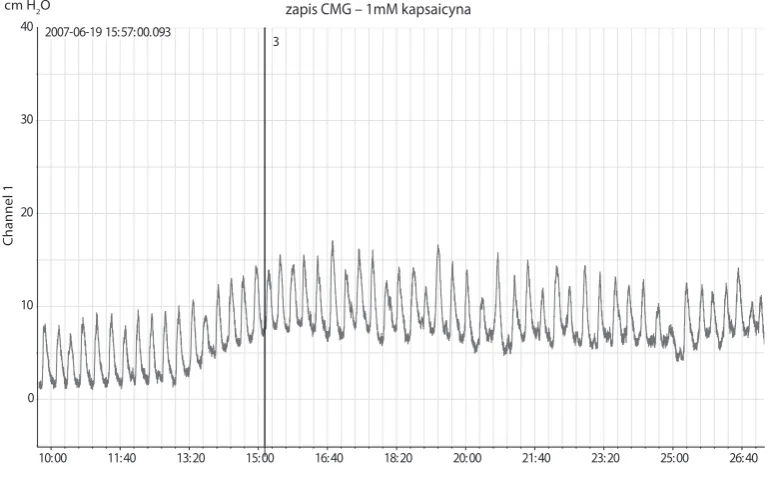
Intravesical instillation of 1 mM capsaicin produced complete inhibition of detrusor con-tractility, preventing proper voiding function of the bladder. On the basis of the performed CMgs, complete disorganization of micturition cycles was observed (Fig. 1, 2). In the storage phase of the micturition cycles, increased spontaneous detrusor overactivity, evaluated as phasic detrusor contractions of low amplitude with accompany-ing increased intravesical pressure, was observed. In the voiding phase there was no proper detrusor contractility (generation of maximal voiding pres-sure, MVP). As a consequence of the lack of peri-odically generated MVP and incomplete bladder empting, constant urine retention occurred. In the case of critical bladder filling achievement (maxi-mal cystometric capacity), a constant dripping flow of urine through the urethra was recorded. Because there were no proper micturition cycles, bladder activity was estimated using only the motility index (Tab. 1).
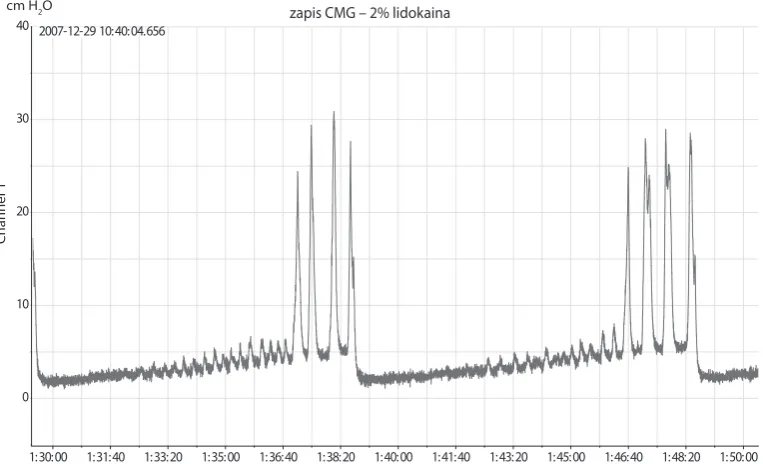
In contrast, intravesical instillation of 2% lido-caine had no influence on micturition cycles (Fig. 1, 3). Compared with the control group, signifi-cantly increased intercontraction interval (47.2%), compliance (79.7%), functional bladder capacity (47%), and detrusor index (49.8%) were observed. The basal, threshold, and maximal voiding pres-sures were not significantly changed. There were also no significant changes in the motility index after capsaicin or lidocaine intravesical instillation compared with the control group (Tab. 1).
Discussion
Fig. 1. Cystometrogram of healthy rats (group 1). The figure shows a 15-minute interval (horizontal axis). The vertical axis is the intravesical pressure (range: 0–40 cm H2O)
Ryc. 1. Zapis cystometryczny zdrowego szczura (grupa 1). Zapis obejmuje okres 15 min (oś X). Oś Y obejmuje zakres ciśnień śródpęcherzowych od 0 do 40 cm H2O
zapis CMG – badanie kontrolne
Channel 1
0 10 20 30 40
35:00 36:40 38:20 40:00 41:40 43:20 45:00 46:40 48:20 50:00 51:40
2007-03-17 10:31:05.453 cm H2O
Fig. 2. Cystometrogram after intravesical instillation of capsaicin in healthy rats (group 2). The figure
shows a 15-minute interval (horizontal axis). The vertical axis is the intravesical pressure (range: 0–40 cm H2O) Ryc. 2. Zapis cystometryczny po podaniu dopęcherzowo kapsaicyny u zdrowego szczura (grupa 2). Zapis obejmuje okres 15 min (oś X). Oś Y obejmuje zakres ciśnień śródpęcherzowych od 0 do 40 cm H2O
zapis CMG – 1mM kapsaicyna
Channel
1
0 10 20 30 40
10:00 11:40 13:20 15:00 16:40 18:20 20:00 21:40 23:20 25:00 26:40
2007-06-19 15:57:00.093 3
cm H2O
physiological conditions because there was no response to mechanical stimuli [4]. Surprisingly, Birder et al. observed significant differences in voiding behavior and cystometrogram traces of TRPV1-knockout mice compared with healthy mice. His finding indicates that TRPV1 bladder
This experiment reveals that the modulation of bladder C fiber activity by neurotoxin or capsai-cin leads to a disorganization of micturition cycles in healthy rats. This observation is close to that reported by Komiyama et al. [7], who obtained inhibition of rhythmic bladder contractions after capsaicin and resiniferotoxin instillation in nor-mal and chronic spinal cord-injured rats.
Studies revealed that with stimulation of TRPV1 by vanilloids or other agents (bradykinin, protons), vanilloid-sensitive nerve terminals may release neuropeptides such as substance P (SP),
calcitonin gene-related peptide (CgRP), and inter-leukins, generating responses in blood vessels, mast cells, and lymphocytes causing neurogenic inflam-mation and subsequently leading to overactivity of the bladder [4, 13]. Capsaicin, an agonist of TRPV1 receptors, initially stimulates and then subsequently desensitizes, temporarily, the afferent C fibers, caus-ing incomplete suppression of bladder over-activity, which confirms the presence of capsaicin-resistant C-fiber afferents [14]. Intravesical instillation of capsaicin in OAB patients causes pain and discom-fort. Furthermore, local intravesical anesthesia of
Fig. 3. Cystometrogram after intravesical instillation of lidocaine in healthy rats (group 3). The figure shows a 15-min-ute interval (horizontal axis). The vertical axis is the intravesical pressure (range: 0–40 cm H2O)
Ryc. 3. Zapis cystometryczny po podaniu dopęcherzowo lidokainy u zdrowego szczura (grupa 3). Zapis obejmuje okres 15 minut (oś X). Oś Y obejmuje zakres ciśnień śródpęcherzowych od 0 do 40 cm H2O
zapis CMG – 2% lidokaina
Channel
1
0 10 20 30 40
1:30:00 1:31:40 1:33:20 1:35:00 1:36:40 1:38:20 1:40:00 1:41:40 1:43:20 1:45:00 1:46:40 1:48:20 1:50:00
2007-12-29 10:40:04.656 cm H2O
Table 1. Cystometrogram parameters in normal rates and after intravesical instillation of capsaicin or lidocaine Tabela 1. Parametry cystometryczne u osobników zdrowych oraz po podaniu dopęcherzowo kapsaicyny i lidokainy
group 1 – control
(grupa 1 – kontrolna) + capsaicingroup 2 – control (grupa 2 – kontrolna + kapsaicyna)
group 3 – control + lidocaine
(grupa 3 – kontrolna + lidokaina)
p value
BP [cm H2O]
PT [cm H2O]
MVP [cm H2O]
ICI [min]
Compliance [ml/cm H2O]
fBC [ml]
DI/DOI [cm H2O/ml]
MI [cm H2O × s/min]
1.40 ± 0.60 5.68 ± 1.22 27.41 ± 4.86 5.278 ± 1.549 0.059 ± 0.019 0.243 ± 0.071 121.92 ± 32.98 185.64 ± 45.95
– – – – – – –
203.75 ± 54.10
1.70 ± 0.58 5.33 ± 0.88 27.33 ± 0.70 7.770 ± 1.308 0.106 ± 0.029 0.357 ± 0.060 182.62 ± 38.75 209.98 ± 42.86
ns. ns. ns. 0.003* < 0.001* 0.004* 0.003* test K-W p = 0.543
the bladder with lidocaine, before capsaicin admin-istration, has been used to reduce the acute effects of capsaicin [15].
In contrast to intravesical instillation of cap-saicin, lidocaine has no impact on the disorganiza-tion of micturidisorganiza-tion cycles in healthy rats. The high-er value of the detrusor ovhigh-er-activity index is the result of intense detrusor contractile activity (the ability to generate detrusor contractions of higher amplitude at the end part of the storage phase). It seems that there are two underlying mechanisms responsible for the increase in the detrusor index in response to lidocaine. First, there is no over-stimulation of the detrusor muscle in response to neuropeptide release by C fibers as on stimu-lation of capsaicin, causing partial exhaustion of the detrusor. Secondarily, after lidocaine adminis-tration, the desensitization phase of C fibers does not occur, which does not lead to impairment of the modulating activity of the non-adrenergic non-cholinergic (NANC) autonomic nervous system on the activity of bladder efferent nerves. Local anesthetics such as lidocaine decrease the likelihood of neural depolarization by binding to
voltage-gated sodium membrane channels, lead-ing to blocklead-ing the admission of sodium ions into the neurons. However, recently discovered TRPA1 receptors (transient receptor potential ion channel of ankyrin type A1) on bladder afferent C fibers also probably contribute to micturition. Du et al. [16] determined that an agonist of TRPA1 leads to bladder over-activity in rats. TRPA1 is co-expressed with TRPV1 in sensory neurons within the lower urinary tract [13]. A study by Leffler et al. showed that lidocaine activates and sensitizes TRPV1 and TRPA1 and causes strong acute desensitization of TRPV1 in rodent sensory neurons [17]. This might suggest that local anesthetics such as lidocaine can also act directly on bladder afferent C fibers and modulate micturition cycles.
The authors concluded that these results indi-cate that the modulation of bladder C fiber activ-ity by capsaicin and lidocaine influence the proper micturition cycle in normal rats. These observa-tions confirm the hypothesis that bladder affer-ent C fibers play a key role in micturition not only in the case of bladder overactivity, but also in naive conditions.
References
[1] Chancellor MB: New frontiers in the treatment of overactive bladder and incontinence. Rev Urol 2002, 4, 4, S50–S56.
[2] Habler HJ, Janig W, Koltzenburg M: Activation of unmyelinated afferent fibres by mechanical stimuli and inflam-mation of the urinary bladder in the cats. J Physiol 1990, 425, 545–562.
[3] Fall M, Lindstrom S, Mazieres L: A bladder-to-bladder cooling reflex in the cats. J Physiol 1990, 427, 281–300. [4] De Ridder D, Baert L: Vanilloids and the overactive bladder. BJU Int 2000, 86, 172–180.
[5] Magii CA, Conte B: Effect of urethane anesthesia on the micturition reflex in capsaicin treated rats. J Auton Nerv Syst 1990, 30(3), 247–251.
[6] Birder LA, Nakamura Y, Kiss S, Nealen ML, Barrick S, Kanai AJ, Wang E, Ruiz G, De Groat WC, Apodaca G, Watkins S, Caterina MJ: Altered urinary bladder function in mice lacking the vanilloid receptor TRPV1. Nat Neurosci 2002, 5, 856–860.
[7] Komiyama I, Igawa Y, Ishizuka O, Nishizawa O, Andersson KE: Effect of intravesical capsaicin and resinifera-toxin on distension-induced bladder contraction in conscious rats with and without chronic spinal cord inju-ry. J Urol 1999, 161, 314–319.
[8] Dinis P, Churrua A, Avelino A, Cruz F: Intravesical resiniferatoxin decreases spinal c-fos expression and increases bladder volume to reflex micturition in rats with chronic inflamed urinary bladders. BJU Int 2004, 94, 1, 153–157. [9] Chopra B, Barrick SR, Meyers S, Beckel JM, Zeidel ML, Ford APDW, de Groat WC, Birder LA: Expression and
function of bradykinin B1 and B2 receptors in normal and inflamed rat urinary bladder urothelium. J Physiol 2005, 562, 3, 859–871.
[10] JuszczakK, Królczyk G, Filipek M, Dobrowolski ZF, Thor PJ: Animal models of overactive bladder: cyclophos-phamide (CYP)-induced cystitis in rats. Folia Med Cracov 2007, XLVIII (1–4), 113–123.
[11] Fowler CJ: Bladder afferents and their role in the overactive bladder. Urology 2002, 59, 5, 37–42.
[12] Chuang, YC: Analysis of the afferent limb of the vesicovascular reflex using neurotoxins, resiniferatoxin and cap-saicin. Am J Physiol 2001, 281, R1302–R1310.
[13] Geppetti P, Nassini R, Materazzi S, Benemei S: The concept of neurogenic inflammation. BJU Int 2008, 101, 3, 2–6.
[14] Andersson KE: New pharmacological targets for the treatment of the overactive bladder: An update. Urology 2004, 63, 32–41.
[15] Chandiramani VA, Peterson T, Duthie GS, Fowler CJ: Urodynamic changes during therapeutic intravesical instillations of capsaicin. Br J Urol 1996, 77, 792.
[16] Du S, Araki I, Yoshiyama M, Nomura T, Takeda M: Transient Receptor Potential Channel A1 Involved in Sensory Transduction of Rat Urinary Bladder Through C-Fiber Pathway. Urology 2007, 70, 826–831.
Address for correspondence:
Kajetan Juszczak
Department of Pathophysiology Medical College, Jagiellonian University Czysta 18
31-121 Cracow Poland
Tel.: +48 12 63 33 947
E-mail: [email protected]
Conflict of interest: None declared