Performance Analysis During Transmission In WSN
with Distributed Energy Efficient Clustering by
Modified Threshold Protocol
Er. Ankush Sharma
Research Scholar, Deptt. Of Electronics and Comm. ASRA College of Engineering & Technology Bhwanigarh (India).
Prof. Vikas Goyal
Professor, Deptt. Of Electronics and comm. ASRA College of Engineering & Technology Bhwanigarh (India).
Date of publication (dd/mm/yyyy): 07/01/2017
Abstract - The principle objective of present research is to build the vitality productivity of Wireless Sensor Network (WSN). Wireless Sensor Network (WSN) comprises of few to a few hundred or even thousand hubs, and every hub is associated with one to a few sensors. . In the present research multilevel grouping is utilized by utilizing DEEC-MT convention. In DEEC-MT three level of hubs is characterized which is more qualified for characterizing heterogeneous environment when contrasted with two level of hubs characterized in the BCDEEC convention. The new sorts of hubs which are included DEEC-MT are called" Super Nodes" which are having vitality more noteworthy than all the two nodes. The primary reason for present research is increment the lifetime of system that could be accomplished through the determination of an appropriate bunch heads.
Keywords – WSN, DEEC-MT, BCDEEC, Super Nodes, Bunch Head, Hubs.
1.
I
NTRODUCTIONThe wireless sensing technologies offer vast opportunities for research and development. The wireless Sensor Network's (WSN) are most significant technologies in 21st century. WSN's can operate in broad range of environment and thus can be used for various applications. A WSN consists of small devices called sensor nodes which are deployed on a geographical space for monitoring physical quantity like temperature, humidity, vibrations. A WSN system incorporates a gateway that provides wireless connectivity back to the wired world and distributed nodes. A sensing node contains three of basic units: a sensor unit for aggregate data from the surrounding environment, a measuring unit for data processing and storing a wireless communication unit for transmission of data. The WSN requires power sources while in a sensing node to perform the task. The power source is a battery with limited energy backup, therefore make it impossible to recharge or to replace the battery because node may be deployed in unpractical environment, therefore the sensor network must have enough lifetime to fulfill the requirements of the application. This basic communication design for the wireless sensor network's (WSN) is shown by figure 1 The sensing nodes connect with sink via multiple hoping. The sink communicates to user with the help of internet or satellite networks. This chapter presents the results obtained for the DEEC protocol, BCDEEC and DEEC-MT protocol. All the protocol is simulated in MATLAB.
Figure.1 Architecture of WSN
There is one Cluster Head (CH) in every group. In the present research multilevel grouping is utilized by utilizing DEEC-MT convention. In DEEC-MT three level of hubs is characterized which is more qualified for characterizing heterogeneous environment when contrasted with two level of hubs characterized in the BCDEEC convention. The new sorts of hubs which are included DEEC-MT are called" Super Nodes" which are having vitality more noteworthy than all the two nodes (advanced hubs and ordinary hubs). It must be noticed that the aggregate vitality of system is kept same as that of DEEC convention.
Figure.2 Clustering in WSN
2.
P
ROBLEMF
ORMULATIONThere are some design issue of clustering protocols that must be treated in order to design an efficient clustering\routing protocol. That is detailed below:
A.
Fault Tolerance:
In wireless sensor networks' (WSN's) some sensor node may fail due to lack of power or environmental interferences. The failure of sensor nodes should not affect the performance and functionality of WSN, the ability to sustain this nude failure without any interruption is called fault tolerance.
B.
Operating Environment:
Since wireless sensor network's (WSN's) are set in different operating environment like in bottom of ocean, in a home or in a building . Attached to a fast moving vehicle, therefore the lifetime and stability could be different for different environments.
C.
Power Consumption:
In wireless sensor network's (WSN's), the transmission energy consumption required by multi-hop routing protocol should be less. The lesser energy consumption gives more life time of sensor nodes and therefore it increases the lifetime of WSN's
D.
Data Aggregation:
Data aggregation is compilation of data from different sources by computation. In wireless sensor networks, sensor nodes generates significant amount of data. Therefore, similar packets from multiple nodes could be aggregated so that number of transmissions is reduced and energy efficiency is increased.
E.
Quality of Service:
Quality of service required by the application could be the length of time, energy efficiency, the data reliably collaborative processing and location awareness. All these factors affect the selection of routing protocols for a particular application.
F.
Data Latency and Overhead:
The data latency caused by data aggregation and multi-hop relays by some routing protocols creates excessive overheads to implements their algorithms, which is not suitable for some application.
G.
Node Deployment:
Node deployment affects the performance of the routing protocol and the dependent application. The deployment is of two types: deterministic or self –concerned.
3.
M
ETHODOLOGYThe results obtained for the DEEC protocol, BCDEEC and DEEC-MT protocol. All the protocol is simulated in
MATLAB.
A.
Implementation of DEEC-MT Protocol
The DEEC (distributed energy clustering) protocol with modified threshold (DEEC-MT) protocol is proposed in which the number of rounds as well as stability of network is increased as compared to DEEC protocol. The ideas behind DEEC-MT protocol are given below:
Figure.3 Block Diagram of DEEC-MT Algorithm
B.
Multilevel Clustering:
In DEEC-MT the multilevel clustering is occupied in which three types of nodes is assign which is better for describing heterogeneous environment against two types or nodes defined in the BCDEEC protocol. The new types of nodes which are added in DEEC-MT are called ”Super nodes” those contains energy more energy than two nodes.
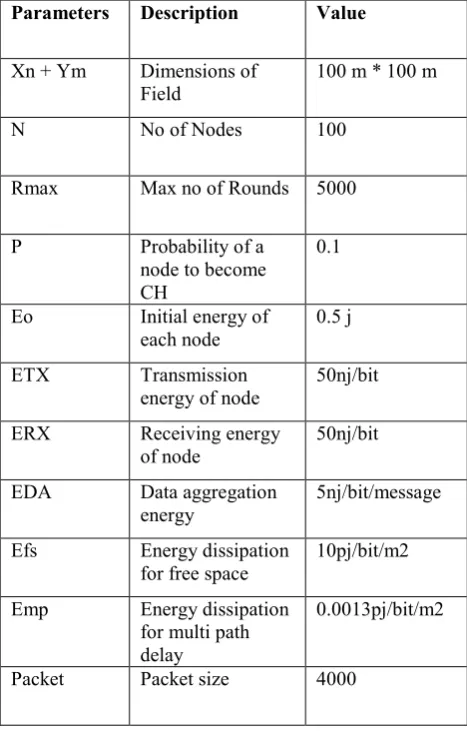
Table No.1 Initial parameter for implementing DEEC Protocol
Parameters Description Value
Xn + Ym Dimensions of
Field 100 m * 100 m
N No of Nodes 100
Rmax Max no of Rounds 5000
P Probability of a
node to become CH
0.1
Eo Initial energy of
each node 0.5 j
ETX Transmission
energy of node 50nj/bit
ERX Receiving energy
of node 50nj/bit
EDA Data aggregation
energy 5nj/bit/message
Efs Energy dissipation
for free space 10pj/bit/m2
Emp Energy dissipation
for multi path delay
0.0013pj/bit/m2
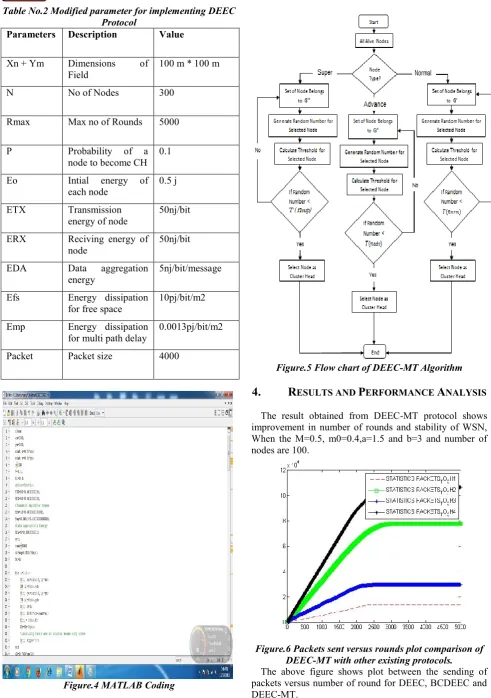
Table No.2 Modified parameter for implementing DEEC Protocol
Parameters Description Value
Xn + Ym Dimensions of
Field 100 m * 100 m
N No of Nodes 300
Rmax Max no of Rounds 5000
P Probability of a
node to become CH 0.1
Eo Intial energy of
each node
0.5 j
ETX Transmission
energy of node
50nj/bit
ERX Reciving energy of
node
50nj/bit
EDA Data aggregation
energy
5nj/bit/message
Efs Energy dissipation
for free space 10pj/bit/m2
Emp Energy dissipation
for multi path delay 0.0013pj/bit/m2
Packet Packet size 4000
Figure.4 MATLAB Coding
Figure.5 Flow chart of DEEC-MT Algorithm
4.
R
ESULTS ANDP
ERFORMANCEA
NALYSISThe result obtained from DEEC-MT protocol shows improvement in number of rounds and stability of WSN, When the M=0.5, m0=0.4,a=1.5 and b=3 and number of nodes are 100.
Figure.6 Packets sent versus rounds plot comparison of DEEC-MT with other existing protocols.
Figure.7 Cluster Heads versus rounds plot comparison of DEEC-MT with other existing protocols. The above figure shows plots between the number of cluster heads versus number of rounds for DEEC, BCDEEC and DEEC-MT.
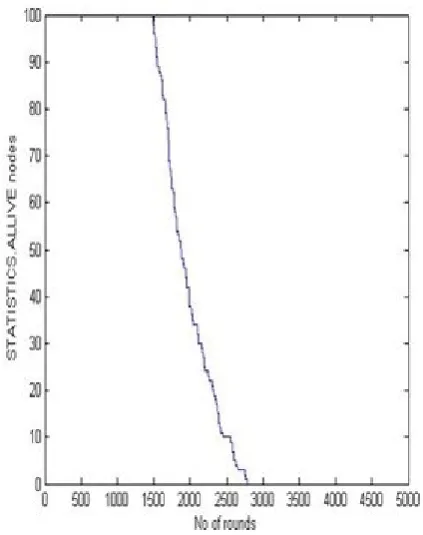
Figure.8 Alive nodes versus rounds plot comparison of DEEC-MT with other existing protocols.
Figure Show that the DEEC-MT protocol rounds stable then existing DEEC protocol as well as life time of network is also more round than that of DEEC protocol. The BCDEEC protocol has however extends the network lifetime but in terms of stability the DEEC-MT more rounds stable than BCDEEC protocol.
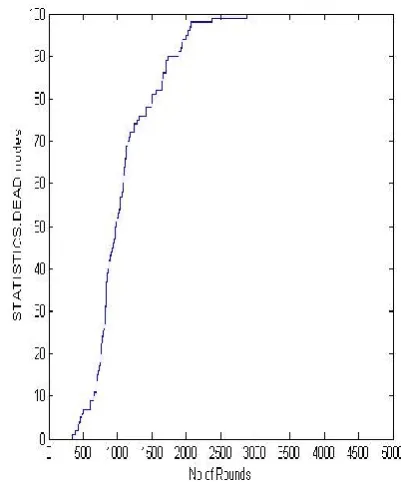
F
igure.9 Dead nodes versus rounds plot comparison of DEEC with other existing protocols.In Figure the Dead nodes correspond to number of rounds is shown and here again the DEEC-MT perform better than other protocols. Table shows comparison of existing DEEC and BCDEEC protocols with the DEEC-MT protocols. It can be seen from the comparison that DEEC-MT performed better than other existing protocol in most of aspects.
The result obtained from DEEC-MT protocol shows improvement in number of rounds and stability of WSN, When the M=0.5, m0=0.4,a=1.5 and b=3 and number of nodes are 300.
Figure.10 Packets sent versus rounds plot comparison of DEEC-MT with other existing protocols.
Figure.11 Cluster Heads versus rounds plot comparison of DEEC-MT with other existing protocols. The above figure shows plot between the number of cluster heads versus number of rounds for DEEC, BCDEEC and DEEC-MT.
Figure.12 Alive nodes VS rounds plot comparison of DEEC-MT with DEEC and BCDEEC
The BCDEEC protocol has however extends the network lifetime but in terms of stability the DEEC-MT is more round stable than BCDEEC protocol.
Figure.13 Dead nodes versus rounds plot comparison of DEEC with other existing protocols.
In figure the Dead nodes correspond to number of rounds is shown and here again the DEEC-MT perform better than other protocols even for 300 nodes.
Table No.3 Comparison of existing protocol with the DEEC-MT protocol using 100 nodes
Parameter DEEC BC
DEEC DEEC-MT
Number of rounds till first node dead i.e. stability period of the network.
516 647 700
Number of rounds till network survived (LND)
1400 2150 4800
Number of rounds till rate of packet sends to BS is stable.
_ _ 5000
Table No.4 Comparison of existing protocol with the DEEC-MT protocol using 300 nodes
Parameter DEEC BC
DEEC DEEC-MT
Number of rounds till first node dead i.e. stability period of the network.
290 317 444
Number of rounds till network survived (LND)
2750 3700 4700
Number of rounds till rate of packet sends to BS is stable.
5.
C
ONCLUSIONIn summary, it presented the results of the existing DEEC protocol, existing BCDEEC protocol, and DEEC-MT protocol. All the algorithms are implemented in MATLAB and a comparison of existing protocol with enhanced protocol is also done here. From results and comparison it is proved and verified that DEEC-MT raise the lifetime of WSN when it campared with existing DEEC protocol as well as BCDEEC protocol.
R
EFERENCES[1] Ebin Deni Raj “An Efficient Cluster Head Selection Algorithm for Wireless Sensor Networks –Edrleach”. IOSR Journal of
Computer Engineering (IOSRJCE) ISSN: 2278-0661 Volume 2, Issue 2 ,PP 39-44, (2012).
[2] K. Padmanabhan and Dr. P. Kamalakkannan “Energy Efficient Adaptive Protocol for Clustered Wireless Sensor Networks” IJCSI International Journal of Computer Science Issues, Vol. 8, Issue 5,ISSN: 1694-0814, (2011).
[3] Poonam Tyagi, Ravinder Prakash Gupta and Rakesh Kumar Gill “ Comparative Analysis of Cluster Based Routing Protocols used in Heterogeneous Wireless Sensor Network” International Journal of Soft Computing and Engineering (IJSCE), Vol. 1, Issue 5, ISSN: 2231-2307, (2011).
[4] Srikanth, B. ; Harish, M. ; Bhattacharjee, R."An energy efficient hybrid MAC protocol for WSNcontaining mobile nodes” Information, Communications and Signal Processing (ICICS) , P1age(s): 1 – 5, (2011)
[5] Harneet Kour and Ajay K. Sharma ,”Hybrid Energy Efficient Distributed Protocol for Heterogeneous Wireless Sensor Network” International Journal of Computer Applications (0975 – 8887) Volume 4 – No.6, (2010).
[6] A. B. M. Alim Al Islam, Chowdhury Sayeed Hyder, Humayun Kabir, Mahmuda Naznin “Stable Sensor Network (SSN): A Dynamic Clustering Technique for Maximizing Stability in Wireless Sensor Networks” Wireless Sensor Network,538-554, (2010).
[7] Deng Zhixiang, ; Qi Bensheng, "Three-layered
routing protocol for WSN based on LEACH algorithm” Wireless, Mobile and Sensor Networks,(CCWMSN07). IET Conference ,Page(s): 72 - 75 , (2007).
[8] Q. Li, Z. Qingxin and W. Mingwen “Distributed Energy Efficient Clustering Protocol (DEEC) protocol” (2006) [9] Ossama Younis and Sonia Fahmy “Distributed Clustering in
Ad-hoc Sensor Networks: A Hybrid, Energy-Efficient Approach.” In Proceedings of IEEE INFOCOM, Hong Kong, an extended version appeared in IEEE (2004).
[10] S. Lindsey and C. Raghavendra “PEGASIS: Power-Efficient Gathering in Sensor Information Systems.” IEEE Aerospace Conference Proceedings, Vol. 3, 9-16 pp. 1125-1130, (2002) [11] Jennifer Yick, Biswanath Mukherjee and Dipak Ghosal,
“Wireless sensor network survey”, Computer Networks 52, 2292-2330, 2008
[12] Vivek Katiyar, Narottam Chand, and Naveen Chauhan, “Recent advances and future trends in Wireless Sensor Networks”, International Journal of Applied Engineering Research, Volume 1, no 3, 2010
[13] Sanjay Waware, Dr Nisha Sarwade, and Pallavi Gangurde, “A Review of Power efficient routing protocols in Wireless Sensor Networks”, IJERA ,ISSN:2248-9622, vol. 2, pp. 1096-1102, Issue Mar-Apr 2012
[14] Jalil Jabari lotf, Mehran Hosseinzadeh, and Rasim M. Alguliev, “Hierarchical routing in wireless sensor networks: a survey”, 2nd International Conference on Computer Engineering and Technology, Vol 3, 2010
[15] Wendi B. Heinzelman, Anantha P. Chandrakasan, and Hari Balakrishnan, “An Application-Specific Protocol Architecture for Wireless Micro sensor Networks”, IEEE transactions on Wireless Communications, Vol. 1, no. 4, October 2002
[16] S. Lindsey and C. Raghavendra, “PEGASIS: Power-Efficient Gathering in Sensor Information Systems,” in proc. IEEE Aerospace Conf., vol.3, pp.1125-1130, 2002.
[17] W. Heinzelman, A. Chandrakasan, and H. Bal Krishnan(2000), “Energy-efficient Communication Protocol for Wireless Micro Sensor Networks,” Proc. of the 33rd Annual Hawaii International Conf. on System Science, Vol. 8, pp. 3005–3014, Hawaii, USA, January 04-07, 2000
A
UTHORS’
P
ROFILEEr. Ankush Sharma is pursuing M.Tech. from Asra Institute of Engg. And Tech. Bhawanigarh, Punjab (affiliated to I.K.G Punjab Technical University, Jalandher) in Electronics and Communication Engineering. His areas of interest are Control Systems, Electronic Devices and Circuits and Wireless Communication. He completed his B.Tech from Baba Hira Singh Bhathal Inst. Of Engineering and Technology, Lehragaga, Punjab (affiliated to I.K.G Punjab Technical University, Jalandher) in Electronics and Telecommunication Engineering with first class in the year 2012.
During his career he had done his industrial training at IDEA Pvt. Ltd. and Telecoma Technologies. He had done his major work on project on RF Accident in the respective branch for consecutive four years during his batch.
Contact No : 9815030331, 9356499000 Email Id.: [email protected]
Prof. Vikas Goyal is pursuing Phd at Desh Bhagat University, Mandi Gobindgarh, Punjab. He obtained his M.Tech degree from Sri Sukhmani Institute Of Engineering and Technology, Dera Bassi, Punjab (affiliated to I.K.G Punjab Technical University, Jalandher) in 2010 and B.Tech Degree from COET, Jalgaon, Maharashtra in 1997. He is working as a Professor and Head of the Department in the Department of Electronics and Communication in Asra inst. Of Engg. And Technology, Bhawanigarh. (Affiliated to I.K.G Punjab Technical University, Jalandher). His research interests include Wireless communication, FPGA implementation, and Microcontroller and Embedded systems design.