Copyright © 2014 IJECCE, All right reserved
Middleware-based Dynamic Traffic Information
Collection System
Lei Wu, Licai Yang
School of Control Science and Engineering, Shandong University, Jinan 250061, China
Abstract–According to traffic information of multi-source heterogeneity and complexity of information processing, hence, the architecture of the dynamic traffic information collection system based on middleware is proposed, which enhances the system stability, generality, and efficiency depending on the high integration and scalability of middleware. This middleware-based system unifies and encodes the data from all sorts of detectors, and integrates the multi-mode transmission, data preprocessing, and data fusion. Compared with the traditional traffic information collection system, the proposed system overcomes the data loss, data noise, and especially the data multiple source, decreases the data redundancy, and ensures the data accuracy with better security and expandability.
Keywords – Middleware, Traffic Information Platform, Information Collection, Intelligent Transportation System.
I. I
NTRODUCTIONAlong with the economical development and the urbanized advancement, the vehicle quantity increased sharply, thus has brought about a series of traffic problems such as traffic congestions, environmental pollution, and the increased traffic accidents, and simultaneously created huge energy waste and economic loss. The traffic conditions became the bottleneck of economy restriction and the social sustainable development.
With the advanced information technology applied unceasingly in the transportation profession, the informatization becomes one of the important solutions of transportation problems. The integration of advanced technologies such as computer, information, communication, sensor, electronic, and artificial intelligence, forms a comprehensive, real-time, accurate, and efficient dynamic traffic information system. This system can adjust the time and spatial distribution of traffic flow effectively, advance the road network traffic capacity, realize the information resource sharing, enhance the transportation efficiency, and improve urban environment [1]. In recent years, Public Security Ministry has implemented the national public security traffic control information system construction on a national scale, such as the vehicle and the driver query system, the road traffic accident information system, the imported vehicle verification system, and the motor vehicle registration management information system [2-5]. When these systems gather and compile the transportation information, the main consideration is related to traffic management system and serve for them, yet is shared or full used by the other government administrative departments or the social public. This kind of barriers between different management departments causes the “isolated island” problem in traffic information systems,
which makes the information disperses and the equipment independence with the low use ratio. This phenomenon becomes the important restraints to the development of Intelligence Transportation System (ITS).
Following the further development of concomitance transportation intellectualization, the independent traffic control system already can not meet the needs of the flourished transportation. Instead, resource sharing among all sorts of ITS subsystems appears more urgent[6, 7]. Establishing dynamic traffic information platform by using advanced information technology realizes the integration, sharing and cooperation of all the transportation data and resources in a wide range [8, 9]. The dynamic traffic information platform can also combine the resources of each system organically, so as to perform its biggest potency and form a new integrated intelligent transportation system to solve the above problems. For the coexistence of all kinds of traffic information detectors with multiple communication modes and the multi-source heterogeneous characteristic of collected information and the information processing complexity [2], an intelligent dynamic traffic information system based on middleware is proposed to simplify the traffic information system structure and uniform the traffic information communication protocol in order to information later processing and comprehensive utilization. This system overcomes the data missing, the data noise, and especially the multiple source heterogeneous which affect the entire transportation information system, reduced the data redundancy, guaranteed the data accuracy, and enhanced the data transmission reliability.
II. M
IDDLEWARE-B
ASEDS
YSTEMA
RCHITECTUREHowever, due to combined effects of external factors such as the GPS positioning signal resistance of urban expressway and other high-rise buildings and internal factors such as no complex algorithm provided in car-carried terminals, the collected data by the floating cars is generally quite low [11].
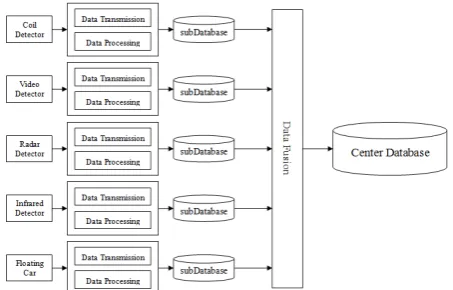
As each kind of transportation information detector has the good and bad points respectively, the collected transportation parameter type and form as well as the data format are possibly various. Hence, the traffic data has the characteristics such as polyphyly, isomerism, hierarchy, imperfection and inconsistency, and it also has the time and spatial characteristic. Data processing techniques like information fusion can enhance the traffic information reliability and accuracy, and it is also able to transform the imprecise, incomplete, inconsistent and the unreliable traffic information to uniform explanation and description to the goal or the phenomenon. The traditional dynamic traffic information collection system [12, 13] is shown in Fig. 1.
Fig.1. logical construction of traditional dynamic traffic information collection system
Considering many kinds of correspondence pattern coexistence, many kinds of transportation information check-out facilities which provides the multiple source isomerism transportation information origin and the complex processing transportation information of the road traffic information gathering system, for the simplification of the transportation information gathering system structure, to regulate transportation information data format, this article proposed one middleware based on dynamic transportation information gathering system construction, as shown in Fig. 2, this construction will use the middleware technology which from different transportation information check-out facility data, to carry on the unification establishment, and through the data pretreatment and the data fusion, overcame the factors such as data missing, data noise, multiple source isomerism which created the bad effects to the entire platform, reduced the data redundancy, guaranteed the data accuracy, enhanced the data transmission reliability.
Fig. 2 shows the logic skeleton based on the middleware dynamic transportation information gathering system be divided into three levels, Traffic information collection equipment layer (Detecting layer), information gathering and the processing layer (Middleware layer), the
transportation data warehouse layer. Each layer is clearly distinct, easy to develop and realize.
Fig.2. middleware information gathering system based on logic construction
Before producing the middleware, the application software aim to adapt the different hardware system, the different operating system, the different network protocol and the different database, it can only face the unusual bottomed things, which causes the application procedure complex and changeable [14]. To refine, abstract, increase one possible the multiplying part on the operating system to the general character question faced by the application software for the different application software to use, this technical thought finally constituted the middleware [15].
On the one hand, the middleware must reply different environment, to carry on the transfer in view of the different environment; On the other hand, the middleware must provide the unification connection to the upper formation, and guarantee to provide the same behavior service in the different environment for the upper formation. The middleware has shielded the first floor operating system complexity, reduced the complexity of the programming, makes the procedure development personnel to concentrate the attention on the service level, not need to duplicate for the procedure on the different system software transplant works, so greatly reduced software development cycle [16].To be specific, the middleware is located between the system software and an application software kind of general service, these services has the standard procedure connection and the agreement, in view of the different operating system and the software and hardware platform, they may have conforms to the connection and protocol specifications many kinds of realizations. The middleware is side link which is between the customer side and the service, and needs to carry on the re-development the middle products.
III. I
NFORMATIONG
ATHERINGM
IDDLEWARECopyright © 2014 IJECCE, All right reserved pattern or the network correspondence pattern for the
transmission of the transportation information; Using CORBA middleware technology in the interface definition language IDL customized to match the different traffic information detection equipment of port information collection, identification and specification of data from different inspection equipment, the implementation of road traffic flow, vehicle speed and road share real-time dynamic traffic information collection; All data which gathered should be carried on the pretreatment, and uses the path match algorithm based on the network analysis situs relations carries on the match of the map of the fluctuation vehicle; Using the immunity cluster neural network, to carry on fusion coexisting to enter the database after pretreat the multiple source isomerism real-time dynamic transportation data.
A. Data transmission
At present the urban road transportation information monitor mainstream equipment may select and match the Ethernet correspondence connection, the partial transportation information monitor equipment also provides the RS232/422/485 serial communication connection. These transportation information check-out facility general build in the road section or the four corners respectively, with the transportation information center between correspondence basis network construction situation, may use each different mailing address, such as serial port correspondence and network correspondence. The stationary vehicles detector less distance to the nearest station is a few hundred meters, more than thousands of meters, if use equipment to provide communication interface for data transmission directly, it obviously can't satisfy the requirement of the data transmission distance. Traditional traffic information detection system commonly used detector is connected to the Modem (Modem) to access the public telephone network (PSTN), to monitor end connected to the Modem, through multi-channel serial port card data into the communication server. This is a kind of serial communication mode.
Along with the computer network technology development, transmission plan based on the Internet network obtained the massive applications, at present commonly used has two ways: One kind is the serial port server and the short distance data light end machine way, another kind is the Ethernet light end machine entire network transmission mode. Regardless of the serial port server or the network light end transmission mode, all of them turn towards the manipuility direction to develop, the equipment selected may integrate the unification in the network management scope, which needs that front end this request network light end machine and the serial port server must have the network management function. Moreover, the wireless GPRS transmission also is one of the important mailing addresses of transportation intelligence transmission. The GPRS modem transmission plan building is convenient, specially suits the situation which the original data transmission network is unable to use in the transportation system transformation project. With the GPRS network unceasing consummation and the fees dropping gradually, its application scope will also
obtain the further expansion.
The serial port server, the network light end machine and wireless GPRS ,these three kind of plans ,are all based on the IP address network mailing address. Fluctuation vehicle transportation information gathering mainly uses the wireless GPRS transmission plan, is also one kind of network mailing address based on the IP address.
B. Data recognition and standard
In order to enable the data acquisition middleware to have a better versatility, data formats from different traffic information detection equipment prepared uniformly by the IDL interface definition language, make the collection port to match with various transportations information check-out facility, which has realized many kinds of check-out facility superiority supplementary and data format standardized processing, simplified the database with each kind of check-out facility connection, and realized conveniently regarding the road traffic current capacity, moreover, the vehicles speed as well as the path percentage of real-time dynamic road traffic information high grade gathering and so on, simultaneously also guaranteed the transportation information which provided to the different type transportation information check-out facility or the system new increase check-out facility to be able to gather smoothly and to transmit Transportation information database. It simplifies the procedure realization code, and causes the module to be more centralized completes the integrated function through integrates these connections in the IDL document.
In the connection realization of the integrated IDL document, the interface to data formats from different traffic information detection equipment made the following unified definition: The definition event structure describing including the event serial number and the event; Check-out facility type including coil detector, microwave detector, video frequency detector and fluctuation vehicle check-out facility; The check-out facility uses external communication agreement including RS-232/422/485, 802.1, GPRS and Ethernet; The check-out facility basic information includes: Brand, manufacturer, equipment model, equipment type, equipment serial number and communication protocol; Current capacity type includes forward current capacity and reverse current capacity; Speed type including forward speed and reverse speed; Percentage of type including forward percentage and reverse percentage; The check-out facility condition including successful, invalid, completes with uncompleted; Check-out facility gathering parameter including current capacity information, speed information and percentage of information; Check-out facility work including work name and work description.
Based on the above unified data format which has custom-made, at first, all the collected data attributes and so on data origin, type which gathers carries on the recognition, and performs standard processing to these data form, makes its form unitizing, for subsequent processing data fusion, storage and use.
C. Data processing
Handling of data preprocessing methods including outliers and loss of data processing. For abnormal values of the processing methods the error data processing, threshold value method to identify bad data, namely, depending on the type of data set threshold, the corresponding data of traffic or share collected for testing equipment according to the statistical data of traffic parameters, such as compared to set upper and lower threshold, if the flow or share the traffic parameters, such as not in the scope stipulated in the upper and lower threshold, is thought to be wrong data, carries on the repair. Concrete repair process are described below: 1) According to the municipal transportation which follows 7 day work diurnal period characteristic, establishes day transportation parameter and so on the time interval current capacity or percentage of threshold value upper limits and the threshold value lower limit respectively
t
q
t q
t q
t
Tmaxk max k 7 , k 2*7 , , k 8*7
(1)
t
q
t q
t q
t
Tmink min k 7 , k 2*7 , , k 8*7
(2)
Where qk7*i
t , i1,2,,8 is in previous 8 weeks the identical working day this time interval transportation data.2) Judge data whether the data gathered falls in the above threshold value scope this time, if not in, then transfers to the step (3) pair of unusual data carries on patching. (3)Repairs the current time the transportation data is:
4
1 * 7 4 1 i
i k
k t q t
q (3)
The data loss also gives the data the further use to bring the adverse effect. The methods of the loss data recognition are a data definition Cheng time data which obtains in a fixed time compartment. For example, we stipulated the time-gap of the data gathering is 5 minutes, then in obtains 8:00 to 8:05 this time section in the data regards as 8:00 data, then carries on the scanning to the data time section, if have not obtained the data in some time section, then regard the data as the loss this time interval, use the similar processing way of the repair in the unusual data to this time interval transportation data in this situation , its formula is as follows.
4
1 * 7 4 1 i
i k k
t q t
q (4)
Considering the traffic data with cyclical repetition characteristics, therefore, whether the abnormal data or missing data processing reference data with the characteristics of most similar days, namely different traffic data of the same day the same time in the week as a repairing according to the data, so as to ensure the validity of the obtained data.
Regarding dynamic transportation information which comes from the fluctuation vehicle system, first needs to carry on map match processing, plans the GPS receive vehicles localization information in the map coordinate system, the definite vehicles initial point path ID number, then according to the outset path ID number, determines this path the outset node serial number, the termination node serial number, as well as on this path various nodes space coordinates data and the attribute data; Calculates the GPS localization information (X, Y) to arrive on this path the recent spot, the vehicles namely locates in should light, when computation uses the judgment criterion is:
2 2
min
(
X
X
i)
(
Y
Y
i)
(5) Where (X, Y) is the GPS localization information, (Xi, Yi) for the path in fiducial mark.D. Data fusion
The dynamic transportation information gathering system is one kind of typical multi-sensor systems; the transportation information has the multiple source isomerism basic characteristic. The information fusion is one of transportation information gathering system core technologies, comes from many kinds of or many sensor multiple source isomerism transportation data through the fusion, may obtain a more accurate transportation to flow the condition information, thus reduces the fault which possibly appears in the information processing, and provides the reliable foundation for the transportation information processing use.
The traditional traffic information fusion generally adopt the method of weighted summation, namely from the traffic information acquisition device parameters measured value weighted summation as the parameter of the fusion results, the fusion method is simple, but the weight of the uncertainty make the accuracy of the data after fusion low, the consistency and integrity of information is difficult to meet the basic requirements of high performance information collection system. Considering radial basis function (RBF) neural network good nonlinear mapping ability, and possesses the advantages of simple structure and fast in operation, especially compared to a traditional traffic information fusion method has higher data precision and adaptability, can better guarantee the data consistency and integrity of information, using the radial basis function (RBF) neural network based on immune clustering as an essential tool of traffic information fusion, and the corresponding integration model called immune clustering neural network.
Copyright © 2014 IJECCE, All right reserved based on the artificial immunization to determine radial
direction primary function neural network implicit strata central point, avoided the network training easy falling into the partial extreme value question, thus obtained the good data fusion effect.
IV. M
IDDLEWARE-B
ASEDG
ATHERINGS
YSTEMR
EALIZATIONAccording to Jinan road traffic resources and Jinan intelligent transportation development plan, we demonstratively established the dynamic traffic information collection system based on middleware. This system mainly includes:
1), serial port correspondence real-time gathering: Real-time gathering toroidal coil, microwave and video frequency detector dynamic transportation information. 2), network correspondence real-time gathering: Real-time gathering toroidal coil, microwave, video frequency detector and fluctuation vehicle dynamic transportation information.
3), information online pretreatment: Realization gathering information online clean, repair exceptionally and loss data.
4), information online data fusion: After realization pretreatment dynamic information online data fusion, and stores the database promptly.
5), road section information management: The realization transportation check-out facility information increases, the revision and the deletion.
6), user management: Realizes the manager account and average consumer's debarkation and the jurisdiction management.
Fig.3. Dynamic Traffic Information Collection System based on Middleware
Based on middleware dynamic transportation information gathering system as shown in Fig. 3, enters this system after the debarkation, the system can carry on functions automatically data acquisition, data pretreatment, data fusion, data storage in the backstage and so on. In addition, the system has also had functions
and so on data inquiry, path information management, the convenient user to fuses after the data as well as the urban road information which because the later period transforms changes carries on the management and the operation.
V. C
ONCLUSIONTraffic information acquisition is the precondition of data processing and comprehensive utilization, based on traffic information platform, the optimization of urban road traffic management and control of the basis and core is to obtain and comprehensive utilization of all kinds of road traffic information, particularly with regard to road traffic flow, vehicle speed and road share dynamic traffic information. The information mainly through various kinds of fixed type of traffic information collection equipment (such as coil detector, microwave radar detector, video detector, etc.) and the floating car mobile acquisition device.
Each kind of transportation information check-out facility has the good and bad points respectively, the examined transportation parameter type and the form as well as the data format are possibly various, and caused the transportation data to have the polyphyletism, isomerism, multi-level, the imperfection and the nonuniformity, and had the time and the spatial characteristic, used information fusion and other data processing technologies to be able to enhance the reliability and the accuracy of the transportation information, transform the inaccuracy, incomplete, inconsistent and the unreliable transportation information to the goal or the phenomenon uniform explanation and the description. Traditional dynamic transportation information gathering system is shown in Fig. 1.
A
CKNOWLEDGMENTThe work is supported by the Shandong Province Natural Science Foundation (No.ZR2010FM036) and Graduate Autonomous Innovation Foundation of Shandong University (yzc10127).
R
EFERENCES[1] Ziliaskopoulos A K, Waller S T. An Internet-based geographic information system that integrates data, models and users for transportation application [J].Transpor -tation Research Part C, 2000, (8):427-444.
[2] Yali Chi, Liping Bao. Study on the Integrity of Isomerism Database in Vehicle Management Information System[J]. Journal of Academy of Military Transportation, 2009, 11(2): 13-16. [3] Meiling Huang, Wei Tan, Li’an Lin, Baichuan Lu. Design and
Development of Urban Traffic Information Release System [J]. Journal of Chongqing Jiaotong University(Natural Sciences), 2010, 29(4): 616-619.
[4] Chaohui Gao, Ning Zhang. Expressway Networking Toll Data Transmission System Based on Middle Ware [J]. Highway, 2006, (8): 132-135.
[5] Xinyong Zhao. Integrated Technical Application in Traffic Administration Information System [J]. Journal of Transportation Systems Engineering and Information Technology, 2009, 9(1): 133-138.
[6] Qixin Shi, Weizhong Zheng. Architecture Analysis of Common Information Platform for Intelligent Transportation Systems (ITS) and Its Construction Means[J]. Journal of Transportation Systems Engineering and Information Technology , 2003, 1(1): 41-47.
[7] Jianmin Xu, Yucong Hu, Huiling Zhong. Research on the Systematic Frame and Operation Rules of ITS Mutual Information Platform[J]. Journal of South China University of Technology (Natural Science Edition), 2002, 30(11): 55-60. [8] Jianmin Xu, Zi Zhang. Research on the interconnection of
inter-city common information platforms[J]. Comprehensive Transportation, 2003, (5): 53-55.
[9] Zhendong Xie, Wei Zhang, Jianmin Xu. Architecture Design of Common Information Platform[J]. Radio Engineering of China, 2002, 32(8): 63-64.
[10] Jianhu Zheng, Minghua Wang. Comparative Analysis of Collection Technologies for Dynamic Traffic Information[J]. Transport Standardization, 2009, (04):42-47.
[11] Zhonghua Liang, Li Wang, Xingle Feng, Mengwei Zhao. Applications of GPS Transportation Information Resources Integration and Value Chain [J]. Computer and Communications, 2010, 4(28): 122-125.
[12] Xiaoliang Pi. Analysis of Data Collection and Processing Technology and Design of Its System Frame[J]. Journal of Highway and Transportation Research and Development, 2008, 25(7): 136-140.
[13] Yongjun Cao, Lili Li, Zhenlin Lv, Yunxia Zhang. Multi-Source Traffic Information Collection, Processing and Publishing System [J]. Automation & Information Engineering, 2011, 1: 22-26.
[14] Lihua Song, Haitao Wang. Present Status of Middleware Technology and Its Development [J]. Data Communications, 2005, (01): 51-54.
[15] Jing Li. Applications in Middleware Technology [EB/OL]. http://media.ccidnet.com/media /ccu/504/02501.htm, 2002-03-25. [16] Tingdong Deng, Linfu Sun, Sen Han. Research and Application
of Middleware Technology for Collaborative System Manufacturing Industries Chain [J]. Microcomputer Information, 2009, 25(18): 208-210.
A
UTHOR’
SP
ROFILELei Wu
received the B.E degree from Shandong University of Technology in 2008. He is currently enrolled for joint courses for master and doctor degrees in School of Control Science and Engineering, Shandong University. His research interests include intelligent transportation system and cooperative vehicle infrastructure system. Email: [email protected]