R E S E A R C H
Open Access
Diagnosing EFL learners
’
writing ability: a
diagnostic classification modeling analysis
Farshad Effatpanah, Purya Baghaei
*and Ali Akbar Boori
* Correspondence:pbaghaei@ mshdiau.ac.ir
English Department, Mashhad Branch, Islamic Azad University, Mashhad, Iran
Abstract
Cognitive diagnostic models (CDMs) have recently received a surge of interest in the field of second language assessment due to their promise for providing fine-grained information about strengths and weaknesses of test takers. For the same reason, the present study used the additive CDM (ACDM) as a compensatory and additive model to diagnose Iranian English as a foreign language (EFL) university students’L2 writing ability. To this end, the performance of 500 university students on a writing task was marked by four EFL teachers using the Empirically derived Descriptor-based
Diagnostic (EDD) checklist. Teachers, as content experts, also specified the
relationships among the checklist items and five writing sub-skills. The initial Q-matrix was empirically refined and validated by the GDINA package. Then, the resultant ratings were analyzed by the ACDM in the CDM package. The estimation of the skill profiles of the test takers showed that vocabulary use and content fulfillment are the most difficult attributes for the students. Finally, the study found that the skills diagnosis approach can provide informative and valid information about the learning status of students.
Keywords:Cognitive Diagnostic Assessment (CDA), ACDM, Q-matrix, L2 Writing
Sub-skills
Introduction
Written language is only one of the fundamental ways of communication and linguistic expression which allows individuals from different cultures and backgrounds to partici-pate in various aspects of today’s global community. Given the rapid advances in tech-nology and communication throughout the world, the ability to write a second or foreign language has become a crucial skill more than ever. Learning to write well is thus a need for all students in academic and second/foreign language programs to not only generate new information but also transfer their knowledge (Weigle, Boldt, & Val-secchi,2003).
Many researchers have argued that writing is a highly complex and multidimensional process with many underlying cognitive components which play vital roles in commu-nicating, thinking, planning, and learning (Dunsmuir & Clifford, 2003; Williams & Larkin, 2013). To write effectively, writers are expected to have a mastery on a set of lower-level (namely, spelling, punctuation, sentence construction) and higher-level writing skills (namely, textual coherence, logical development of relevant arguments)
(McCutchen, 2011; Wilson, Olinghouse, McCoach, Santangelo, & Andrada, 2016).
Difficulty in each of these micro-skills can impede the development of L2 writing. Therefore, it is essential to accurately respond to students’specific writing skills where lack of mastery or faulty strategy is indicated. If difficult and problematic areas of writ-ing are identified, students can receive sufficient and immediate feedback on their per-formance. As a result, they can adopt some strategies to eliminate or remedy their weaknesses during their learning process.
Along the same lines, the last few decades have witnessed a growing interest in the role of feedback on L2 writing. Feedback conventionally refers to“information provided by an agent (e.g., teacher, peer, book, parent, self, experience) regarding aspects of one’s performance or understanding” (Hattie & Timperley, 2007, p. 81). Many researchers have accentuated that effective feedback should close the gap between the actual level and desired level of performance (Kumar & Stracke, 2011; Ramaprasad, 1983; Sadler,
1989). Appropriate feedback has been also shown to have a major role in motivating
students, encouraging self-regulated learning, and improving subsequent learning and teaching (Black & Wiliam, 1998; Hyland, 2013; Kuo, Chen, Yang, & Mok,2016;
Zim-merman, 2000). Consequently, there has been a proliferation of research on the effect
of various types of feedback on the performance of students; including corrective (Bitchener,2008; Bitchener & Knoch,2008), peer (Yu & Hu,2017), oral (Erlam, Ellis, & Batstone, 2013), coded (Buckingham & Aktuğ-Ekinci, 2017; Sampson, 2012), content (Ashwell, 2000), form-focused (Truscott, 1996), teacher (Yang, Badger, & Yu, 2006),
and computer-mediated (Shintani,2016). Such large number of studies on feedback
re-flects this fact that student development as writers entails a supportive environment in which they receive valuable feedback (Blikstad-Balas, Roe, & Klette, 2018; Ferris,2003). However, the current practices of providing feedback fail to identify the exact nature of
students’ problems. What is needed are approaches to assessment which are able to
provide diagnostic and fine-grained information about the strengths and weaknesses of students in various targeted language domains (Llosa, Beck, & Zhao,2011).
Diagnostic assessment, as an alternative approach to the existing methods of feed-back, has recently received more attention among educational experts because of its capability in providing diagnostic information about students’strengths and weaknesses (Lee & Sawaki, 2009a). Information obtained from diagnostic tests can be useful for identifying areas where students need more assistance and designing appropriate mate-rials for further learning or instruction (ALTE, 1998). According to Nation and
Macal-ister (2010), diagnostic assessment is of paramount importance in needs analysis both
prior and during a course. The findings of diagnostic assessments specifically pin down what goes into a course to be in accordance with students’needs. Particularly,
diagnos-tic tests can be considered as needs assessment to identify students’gaps, causes of
problems, priorities, and possible solutions. It is thus evident that diagnostic tests are in line with assessment for learning (AFL) or formative assessment. In other words, such tests are able to integrate assessment with instruction and curriculum which re-sults in enhancing learning (Pellegrino & Chudowsky,2003).
In addition to developing tests that are suitable for diagnostic purposes, there is an-other trend in developing and conducting diagnostic assessment which allows experts to model statistically the test takers’cognitive operations. This approach is known as Cognitive Diagnostic Assessment (CDA) which is able to yield more fine-grained
educational measurement that can provide informative and detailed information about the learning status of students on a set of multiple fine-grained (sub)skills (Rupp, Tem-plin, & Henson, 2010). Unlike traditional psychometric frameworks, such as classical test theory (CTT) and item response theory (IRT), which provide single overall scores along a proficiency continuum, CDA offers categorical mastery/non-mastery diagnostic
information about strengths and weaknesses of the examinee’s skills. Because CDA is
basically diagnostic, complex statistical models, known as cognitive diagnostic models (CDMs), are used to measure to what extent students have mastered a set of sub-skills required for successful performance on a test (de la Torre & Minchen,2014).
Technically speaking, CDMs decompose tasks into multiple strategies, processes, and knowledge that a student must possess in order to respond correctly to a given test item or task (Birenbaum, Kelly, & Tatsuoka,1993). This characteristic allows CDMs to generate“multidimensional diagnostic profiles based on statistically-driven multivariate classifications” (Kunina-Habenicht, Rupp, & Wilhelm,2009, p. 64) of students accord-ing to the degree mastery on each of the requisite traits. Such information can maximize opportunities to learn by giving diagnostic feedback to all stakeholders and ultimately enhance language learning and teaching.
Cognitive diagnostic models have primarily been used to serve two main purposes: (a) to classify examinees into similar skill mastery profiles on the basis of their observed response patterns and (b) to identify whether there is a compensatory or non-compensatory interaction between the postulated attributes underlying a given skill (Ravand & Robitzsch, 2018). A wide array of CDMs with different theories or assump-tions about the way of interaction between attributes (see Ravand & Baghaei,2019, for a review) have been proposed. Most of these models have been applied in language as-sessment contexts and demonstrated to be useful for providing diagnostic feedback in
service of instruction and learning (Nichols, 1994). The models include rule space
methodology (RSM) (Tatsuoka, 1983, 1995), the attribute hierarchy method (AHM)
(Leighton, Gierl, & Hunka, 2004), the higher-order DINA model (HO-DINA) (; de la
Torre & Douglas,2004), the multi-strategy DINA (MS-DINA) (de la Torre & Douglas,
2008), the DINO and NIDO models (Templin & Henson, 2006), the full
non-compensatory reparameterized unifed model (full NC-RUM)/fusion model (Hartz,
2002; Roussos et al., 2007), the compensatory RUM (C-RUM) (de la Torre, 2011),
GDINA (de la Torre,2011), the general diagnostic model (GDM) (von Davier,2008; Xu
& von Davier, 2008), the log-linear cognitive diagnosis model (LCDM) (Henson, Tem-plin, & Willse,2008), and the additive CDM (de la Torre,2011).
Despite the increasing interest for diagnostic purposes and potential of CDMs in provid-ing detailed information about test takers’strengths and weaknesses, too little research has been devoted to L2 writing ability in a foreign/second language-learning context (Knoch,
for EFL writing, submitted) who found that the ACDM fits better than other CDM models for EFL writing performance. In this regard, the current study aims to investigate strengths and weaknesses of Iranian EFL students in L2 writing ability.
Review of the literature
Cognitive diagnostic models
Cognitive diagnostic models (CDMs) are discrete and multidimensional latent variable models developed mainly for diagnosing students’mastery profiles on a set of skills or attributes based on their observed item response patterns. According to Rupp and
Templin (2008), CDMs are “probabilistic, confirmatory multidimensional
latent-variable models with a simple or complex loading structure. They are suitable for mod-elling observable categorical response variables and contain unobservable (i.e., latent) categorical predictor variables. The predictor variables are combined in compensatory and non-compensatory ways to generate latent classes”(p. 226).
Similar to item response theory models, CDMs are probabilistic models. They model the likelihood of executing a correct response with regard to a number of latent traits. In unidimensional item response theory models, the probability of producing a correct answer relies on a single latent trait,θ, in such a way that those examinees with higher ability have a higher probability of success. On the contrary, CDMs express a given stu-dent’s performance level in terms of the probability of mastery of each attribute separ-ately, or the probability of belonging to each latent class with a particular skill-mastery profile (Lee & Sawaki,2009a).
CDMs are also inherently confirmatory. Like confirmatory factor analysis, latent traits in CDMs are defined a priori through an incidence matrix called Q-matrix (Tatsuoka,
1983), which is considered as the loading structure of CDMs. It specifies a substantive hypothesis about the underlying response processes of students. The Q-matrix indi-cates the association between each item (rows) and its target cognitive sub-skills (col-umns) through a pattern of “1 s” and “0 s”. If an item requires sub-skill k, qik =1; otherwise, qik =0. Additionally, Rupp and Templin (2008) state that another manifest-ation of confirmatory nature of CDMs is the priori specificmanifest-ation of the way different at-tributes interact in the response process, that is, whether there exists a compensatory (disjunctive) or non-compensatory (conjunctive) relationship among the required attributes.
Furthermore, CDMs belong to multidimensional item response theory models. CDMs contain multiple latent traits inasmuch as the successful performance on an item (or a task) requires mastery of numerous sub-skills. Because each item is related to multiple attributes, CDMs have a complex loading structure. However, compared to multidi-mensional IRT and factor analysis (FA) in which latent traits are continuous, CDMs possess discrete or categorical latent variables.
compensatory models, all the attributes are required to get an item right, that is, non-mastery of one attribute cannot be compensated for by the non-mastery of other attributes. More recently, additive CDMs have been proposed as a new category of CDMs which assume that presence of any one of the attributes increases the probability of a correct response independent of the presence or absence of other attributes (Ma, de la Torre, & Sorrel,2018).
Another categorization of CDMs is specific vs. general. Specific CDMs are models which allow for only one type of relationship in the same test: conjunctive, disjunctive, and additive. On the other hand, general CDMs allow each item to select its own model that best fits it rather than imposing a specific model to all the items. de la Torre
(2011) showed that several specific CDMs can be derived from general models if
appro-priate constraints are applied in the parameterization of general models. For instance, the generalized deterministic inputs, noisy“and”gate (GDINA) (de la Torre,2011), as a general model, can be turned into DINA, DINO, ACDM, NC-RUM, and C-RUM by changing the link function intologandlogitand setting the interaction effects to zero.
ACDM model
Additive CDM (ACDM; de la Torre, 2011) is a compensatory cognitive diagnostic
model. It is similar to the generalized deterministic inputs, noisy “and” gate
(GDINA) (de la Torre, 2011), as a general model, which allows both compensatory
and non-compensatory relationships between attributes within the same test. The modeling approach adopted by the GDINA is similar to analysis of variance
(ANOVA) (Ravand, 2015). In this saturated model, all possible interaction and
main effects are used. If some main or interaction effects are removed, several spe-cific CDMs can be derived from the GDINA model. For instance, by setting all interaction effects to zero, the GDINA model turns into the ACDM. The difference between the two models is that the GDINA model has a multiplicative impact, but the ACDM has an additive impact on the probability of a correct response (de la
Torre, 2011). Also, unlike the GDINA model which partitions test takers into (2kjÞ,
the ACDM has Kjþ1 parameters for item j. The ACDM postulates that (1) the
probability of success increases by mastering each of the required attributes and lack of one attribute can be made up for by the presence of other attributes; and (2) the contribution of each attribute is independent from the other attributes. The item response function (IRF) for the ACDM is:
P ɑlj ¼δj0þ
Xkj
k¼1δjkalk
where P (ɑlj) is the probability of success, kis the number of attributes required for
item j,δj0is the intercept which represents the probability of a correct response when none of the required skills is present, andδjkis the main effect due to attributeαk/.
Previous applications of CDMs
CDMs are largely used in two ways: (a) to develop “true diagnostic tests” (Ravand
& Baghaei, 2019, p. 4) for the purpose of providing fine-grained information about
latent traits. It might be somewhat odd to say that although diagnostic tests are so compelling, very few true diagnostic tests have been designed (e.g., DIALANG by
Alderson, 2005; Alderson & Huhta, 2005; DELNA (www.delna. auckland.ac.nz/uoa);
and DELTA by Urmston, Raquel, & Tsang, 2013; Ranjbaran & Alavi, 2017) due to
the difficult and time-consuming process of test construction (Alderson, 2005).
Conversely, most applications of CDMs in educational measurement in general and second/foreign language testing in particular are cases of retrofitting to existing achievement or proficiency tests. Many researchers noted that this practice of CDMs application may raise various problems concerning the validity of any infer-ences about the test takers’ skill competencies (DiBello, Roussos, & Stout, 2007; Jang, 2009). Nevertheless, Lee and Sawaki (2009a) argued that “retrofitting efforts could serve as an important step in advancing diagnostic language assessment re-search... it is worth examining the extent to which useful diagnostic information could be extracted from existing assessments before delving into an expensive,
time-consuming process of designing a new cognitive diagnostic test” (p. 174).
In addition, the results derived from retrofitting assessments can be useful for univer-sities and non-tertiary education institutions. A single score from standardized lan-guage tests such as IELTS and test of English as a foreign lanlan-guage (TOEFL) indicates only whether or not an applicant has a sufficient command of English to satisfy the re-quirements of academic studies in that language. Nonetheless, fine-grained diagnostic
information about students’ ability can provide further information for stakeholders
and university admission offices. According to Cumming (2015), “The coordinator or
faculty advisor for an academic program at that same university, however, should ex-pect more detailed information than a single score from a language test, relevant to the expectations of that academic program. Can a student applicant read, write, and inter-act orally in a certain language with sufficient proficiency to complete course assign-ments effectively, conduct required research tasks successfully, and perhaps work as teaching or research assistant? To make such decisions requires diagnostic information from a language assessment”(p. 414).
Considering the advantages of retrospective CDMs, these models have been ap-plied in different studies on different language skills (Aryadoust, 2018; Buck et al.,
1998; Buck & Tatsuoka, 1998; Buck, Tatsuoka, & Kostin, 1997; Chen & Chen,
2016; Jang, 2009; Kasai, 1997; Kim, 2014; Lee & Sawaki, 2009b; Li, 2011; Li & Suen, 2013; Ranjbaran & Alavi, 2017; Sawaki, Kim, & Gentile, 2009; Scott, 1998;
Sheehan, 1997; von Davier, 2008). Compared to reading and listening, too little
studies employed CDMs for the productive skills, e.g., writing and speaking. The reason for this lies in the limited number of writing items and inadequacy of exist-ing ratexist-ing scales for providexist-ing detailed information about the strengths and
weak-nesses of students (Kim, 2011). Alderson (2005) suggests that there should be a
difference between diagnostic tests of writing and other tests of writing (e.g., place-ment or proficiency). Of course, he accentuated the use of indirect tests instead of performance tests in assessing writing. He argued that "in the case of diagnostic tests, which seek to identify relevant components of writing ability, and assess
writers’ strengths and weaknesses in terms of such components, the justification
for indirect tests of writing is more compelling’ (pp. 155–156). However, indirect
of their invalid measures of the multi-faceted nature of writing (Weigle, 2002).
Knoch (2011, p. 82) also maintained that “rating scales developed for purposes
other than diagnostic testing are not appropriate for diagnostic purposes.” In light
of this call, several studies have attempted to develop diagnostic checklist to iden-tify the problematic areas of writers (Banerjee & Wall, 2006; Kim, 2011; Struthers,
Lapadat, & MacMillan, 2013). In their study, Banerjee and Wall (2006) developed
and tailored a new instrument assessment for different skills of English. Struthers et al. (2013) also designed a checklist, containing 13 items, to assess only cohesion
in the writing of children in grades 4–7. In another study, Kim (2011) developed
an Empirically derived Descriptor-based Diagnostic (EDD) checklist, which contains 35 descriptors measuring five sub-skills of academic writing in English. She then applied the reduced reparameterized unified model (RRUM) to study the extent to which information obtained from CDMs are accurate, discriminant, and reliable.
Recently, Xie (2016) examined the validity of the EDD checklist for formative
as-sessment. Like Kim, she used the RRUM to assess first-year undergraduates in Hong Kong and evaluated the usefulness of the checklist for diagnosing academic writing in English. As it is apparent, the number of CDM studies on L2 writing is still scant and more research is required to apply different CDMs in order to de-termine which model can better reflect the underlying L2 writing attributes.
The present study investigated the extent to which the diagnostic information of the EDD checklist, which was estimated using the ACDM model, was accurate for specify-ing Iranian EFL university students’L2 writing ability. To accomplish this purpose, the following research questions are posed:
1. Does the ACDM model produce reliable and useful diagnostic information about Iranian EFL university students in terms of mastery/non-mastery of the L2 writing attributes?
2. What are the strengths and weaknesses of Iranian EFL students’L2 writing ability? 3. To what extent is the final Q-matrix valid for diagnosing the students’L2 writing
ability?
Methodology
Participants
1 to 2 years to more than 10 years. Similarly, they reported their frequency of use of English from cannot say to almost every day.
Moreover, four raters were recruited to mark the essays. The sample of raters included one female and three male raters between the ages of 28 to 39 years old (M = 31.75; SD = 4.99). They were all non-native speakers of English, knowing Persian as their first lan-guage and English as their foreign lanlan-guage. Each rater was provided with an as-sessment package containing 125 essays along with marking guidelines to score
them based on the EDD checklist (Kim, 2011).
Instruments
There were two measures employed in this study. One was a writing prompt, and the other was a diagnostic checklist for rating the essays (Additional file1).
Writing sample
The students were asked to complete a writing task. The task consisted of two sec-tions. The first part included demographic information of participants such as name (optional), age, gender, major, educational level, length of time learning Eng-lish, and frequency of use of English. The second part comprised a writing task. The respondents were asked to write at least a 350-word descriptive essay in class within an hour in response to the following prompt:
How to be a first-year college student? Write about the experience you have had. Make a guide for students who might be in a similar situation.
Describehow to make new friends, how to escape homesickness, how to be successful in studying, etc.
The Empirically derived Descriptor-based Diagnostic (EDD) checklist
The essays were marked using a diagnostic assessment scale called the Empirically
de-rived Descriptor-based Diagnostic (EDD) checklist (Kim, 2011; see appendix)
accom-panied by detailed guidelines. It was developed for scoring and describing the writing of non-native English-speaking students in an academic context. The EDD checklist consists of 35 dichotomous (Yes, No) descriptors assessing five writing attributes. The sub-skills are content fulfilment (CON), organizational effectiveness (ORG), grammat-ical knowledge (GRM), vocabulary use (VOC), and mechanics (MCH). The five sub-skills were defined as (1) a student’s ability to address a given question by presenting unity and relevance of supporting sentences, information, and examples (CON); (2) a student’s ability to develop and organize ideas and supporting sentences cohesively and coherently within and between paragraphs (ORG); (3) a student’s ability to demonstrate syntactic complexity and variety accurately (GRM); (4) a student’s ability to use a wide range of lexical items accurately and appropriately (VOC); and (5) a student’s ability to follow the conventions of English writing such as margins and indentation, punctu-ation, and spelling and capitalization.
Procedure
universities across the country to allow us to give the test to their students. Only 21 universities consented to be involved in the study. From each university, two or three intact classes at different levels (junior and senior B.A. and M.A.) were selected. In total, 500 English students participated in this study who were taught by 32 teachers. Some teachers taught two classes. The students were asked to write at least a 350-word descriptive essay in class in response to the prompt. They were encouraged to rely on themselves and do not use any dictionaries, books, and internet during the writing to give the researchers and their teachers the opportunity to diagnose their strengths and weaknesses in L2 writing. They were reassured that their information would remain confidential and anonymous. Then, four raters were recruited to rate these papers on the basis of the EDD checklist (Kim,2011). Reliability coefficients of the checklist were estimated using Cronbach alpha and a value of 0.89 was obtained which is acceptable. This value indicates that there is a high internal consistency for overall ratings of the checklist items.
Rater training
Rater variability is a serious source of construct-irrelevant variance, which may threaten construct validity (Barrett, 2001; Lumley & McNamara, 1995; Weigle, 1999). Rater training is an effective way for reducing such variations. It has been shown that training
can maximize the self-consistency of individual raters (Eckes, 2011; McIntyre, 1993;
Weigle, 1998) and allows raters to interact, ask questions, review different dimensions of writing prompt and scoring rubrics, and get feedback on their scoring. Hence, a two and a half-hour session was held to introduce raters with the purpose of the study, writing attributes, Q-matrix construction, and the EDD checklist, as the rating scale. Then, all the raters received the 35-item checklist and a matrix form to specify their idea about each item and its associated attributes. All the descriptors and their attribute associations were discussed one by one. A master form was collectively prepared to
combine all the raters’ideas into a comprehensive matrix. Next, following the
sugges-tion of Weigle (2007), raters were asked to try out the rating scale on a set of essays to compare their answers with each other. Each rater scored three essays. It helped us to discuss different points where less agreement was achieved.
Q-matrix validation
Correct identification of attributes underlying performance and their associations with test items improve the quality of a cognitive diagnostic assessment. If a Q-matrix is misspecified, diagnostic information may result in invalid inferences (Rupp & Templin,
2008). In the present study, raters, along with the authors, were considered as content experts to collectively indicate the major attributes required to perform correctly on each item. The raters were trained how to code the attributes measured by each item. On the basis of the consensus among the experts on the item–sub-skill associations, an
initial Q-matrix was developed. The initial Q-matrix included 48 “1 s” which was less
denser than the final Q-matrix (50“1 s”) from Kim (2011). The manipulated parameters related to 7 items (2, 3, 11, 12, 14, 31, 35). For example, item 3 was associated with CON, ORG, and GRM in the present study while it was specified to be related to
In the second step, the Q-matrix was empirically revised and validated by the
proced-ure suggested by de la Torre and Chiu (2016) using “G-DIINA” package (Ma et al.,
2018). In the first run of the analysis, some suggestions for the Q-matrix revision were provided. For example, it was suggested that ORG is not involved for Descriptor 7 (The supporting ideas and examples in this essay are appropriate and logical). In this case, only CON remains for the item. Accepting that statistical analysis should not be considered as the mere driving force for Q-matrix revision, the experts inspected the content of the descriptor and agreed that ORG is a requisite attribute for the item, so we kept it in the Q-matrix. Also, for Descriptors 1 and 10, it was suggested that ORG and GRM are respectively involved for the items; hence, we added them to the Q-matrix. However, for Descriptors 3, 12, and 18, the suggestions were to respectively re-move ORG, CON, and GRM from the Q-matrix. After several rounds of revisions and
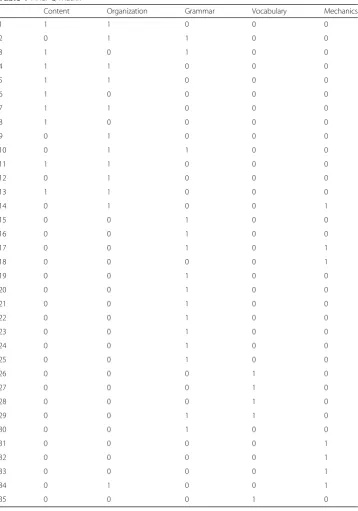
rerunning the GDINA package, the final Q-matrix presented in Table1was developed.
Of the total descriptors, nine of them were affiliated with CON, 12 items with ORG, 15
with GRM, five with VOC, and seven with MCH. In Table 1, 1 s indicate that the
suc-cessful performance of students on each item depends on the mastery of the attributes whereas 0 s indicate that the item does not require the attributes. For example, if a test taker wants to perform successfully on item 2 (the essay is written clearly enough to be read without having to guess what the writer is trying to say), he/she should have the mastery of ORG and GRM. In this item, content (CON), vocabulary (VOC), and me-chanics (MCH) are not necessary.
Results
Inter-rater reliability
As a preliminary check, the degree of inter-rater reliability was investigated using Pearson correlation coefficients. Each rater randomly received 37 scripts from the other raters to score for the second round. Totally, 147 out of 500 papers were remarked. The correlation coefficient between the total scores of the remarked papers from the two ratings was 0.82 (n= 147,p < 0.001) which shows a satisfactory agreement
in the two ratings. In addition, a paired-samples t-test was conducted to compare the
means of the sample in the two ratings. The results showed that there was not a statisti-cally significant difference between the two means of raw scores across the two different ratings (df= 146,p= 0.06,t= 1.87, mean difference = 0.63).
Model fit
As a fundamental step in any statistical modeling, estimated parameters in CDMs are interpretable to what extent the model fits the data. Data were analyzed using the CDM package version 6.1-10 (Robitzsch, Kiefer, George, & Uenlue,2018) in the R
stat-istical software (R core Team, 2013). The CDM package employs marginal maximum
the best fit in terms of absolute and relative fit indices compared to other CDMs for L2 writing ability.
As can be seen from Table 2, there is a nonsignificant value for MX2 (p> 0), that is, the value of 31.2 indicates good fit. It must be noted that there is not a clear cut-off score or criterion for fit indices in CDMs. However, as a rule of thumb, the closer the value to zero, the better the model fits. Considering this, the value of 0.058 shows a relative good fit of the model to the data in terms of the MADcor (DiBello et al., 2007;
Roussos et al., 2007). As to the MADRES, the value of 1.27 indicates a relatively poor
Table 1Final Q-matrix
Content Organization Grammar Vocabulary Mechanics
1 1 1 0 0 0
2 0 1 1 0 0
3 1 0 1 0 0
4 1 1 0 0 0
5 1 1 0 0 0
6 1 0 0 0 0
7 1 1 0 0 0
8 1 0 0 0 0
9 0 1 0 0 0
10 0 1 1 0 0
11 1 1 0 0 0
12 0 1 0 0 0
13 1 1 0 0 0
14 0 1 0 0 1
15 0 0 1 0 0
16 0 0 1 0 0
17 0 0 1 0 1
18 0 0 0 0 1
19 0 0 1 0 0
20 0 0 1 0 0
21 0 0 1 0 0
22 0 0 1 0 0
23 0 0 1 0 0
24 0 0 1 0 0
25 0 0 1 0 0
26 0 0 0 1 0
27 0 0 0 1 0
28 0 0 0 1 0
29 0 0 1 1 0
30 0 0 1 0 0
31 0 0 0 0 1
32 0 0 0 0 1
33 0 0 0 0 1
34 0 1 0 0 1
fit of the model to the data. For MADQ3 and SRMSR, the values of 0.056 and 0.074 can be considered as good fit of the model. In terms of RMSEA, following Maydeu-Olivares and Joe (2014), the value of 0.083 is satisfactory. Overall, there are convincing evidence for supporting the fit of the ACDM model to the data. The large values of fit
indices in this study could be due to the small sample size (N = 500) and the large
number of test items (J = 35) (Kang, Yang, & Zeng, 2018; Kunina-Habenicht et al.,
2009; Lei & Li,2016; Lin & Weng,2014).
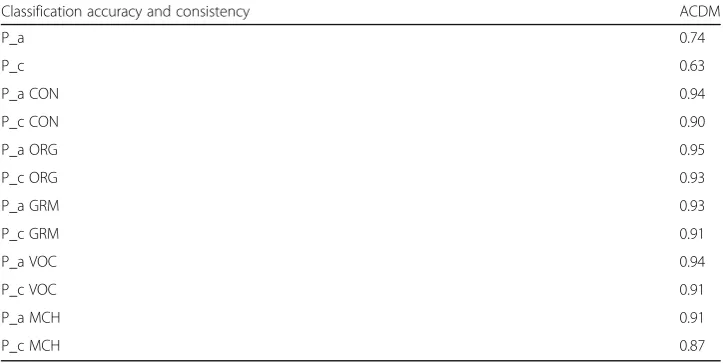
In addition to checking the absolute fit of the model to the data, the fit of the ACDM was testified by estimating classification consistency Pc and classification accuracyPa.
As demonstrated in Table 3, the classification accuracy (Pa) and consistency (Pc) for the whole latent class pattern is 0.74 and 0.63, respectively, indicating that the test pos-sesses a 74% probability of accurately classifying a randomly selected respondent into his/her correct latent class from a single-test administration. It also has a 63% probabil-ity of classifying a randomly selected respondent consistently on two administrations of the test. The other rows of the table show the consistency and accuracy of classifying examinees according to the mastery or non-mastery of each attribute. Similar to absolute fit statistics, there is not a definite criterion forPɑandPcvalues. In the light of the results
obtained by Cui, Gierl, and Chang (2012), Wang, Song, Chen, Meng, and Ding (2015),
and Johnson and Sinharay (2018), the values of accuracy and consistency are fairly high
and acceptable in the current study. These moderate values ofPɑandPc at the
whole-pattern can be due to the presence of moderate correlations among the attributes (Cui et al.,2012).
Table 2ACDM fit statistics
Fit index Estimate
MX2 31.2
MADcor 0.058
MADRESIDCOV 1.27
MADQ3 0.056
SRMSR 0.074
RMSEA 0.083
Table 3Classification consistencyPcand accuracyPa
Classification accuracy and consistency ACDM
P_a 0.74
P_c 0.63
P_a CON 0.94
P_c CON 0.90
P_a ORG 0.95
P_c ORG 0.93
P_a GRM 0.93
P_c GRM 0.91
P_a VOC 0.94
P_c VOC 0.91
P_a MCH 0.91
ACDM analysis
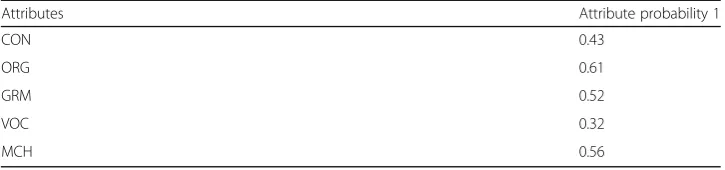
As the first analysis of the ACDM model, the attributes mastery status of the whole group show that (Table 4), of the five sub-skills, the most difficult attributes to master were VOC and CON with probabilities of 32% and 43%, respectively, indicating that only 32% of students have mastered vocabulary use and 43% have mastered content ful-fillment. However, ORG and MCH were identified as the easiest attributes with 61% and 56% probability, respectively followed by GRM with 52%. It suggests that 61% of the students mastered organizational effectiveness, 56% mastered mechanics, and only 52% had a mastery of grammatical knowledge.
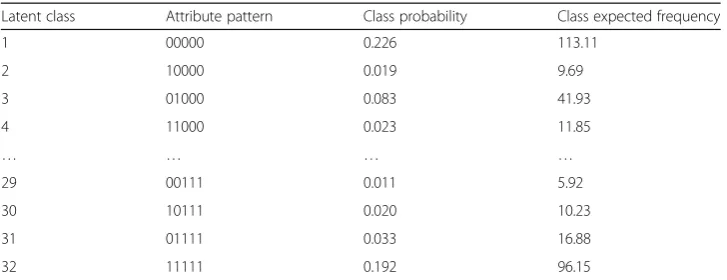
As noted earlier, CDMs classify examinees into different latent classes according to the total number of attributes, e.g., 2k. In the present study, there are 32 possible latent classes (five sub-skills with 25= 32 latent classes) with respect to the Q-matrix configur-ation. To save space, data for only the first and last four latent classes are presented in the first column of Table5. The second column shows the possible attribute pattern or profile for all the 32 latent classes.
As can be seen from the third column of the table, the attribute profile α1= [00000] had the highest class probability. It indicates that 22% of students, containing about 113 respondents (as shown in the last column), were classified as belonging to this la-tent class; therefore, these students are expected to have mastered none of the
attri-butes. Skill profile of α32= [11111] was the second most populated latent class with
19% probability, indicating that approximately 96 students belonged to this class who were expected to have mastered all of the attributes. The remaining profiles relate to students who mastered one of the attributes to four of the attributes.
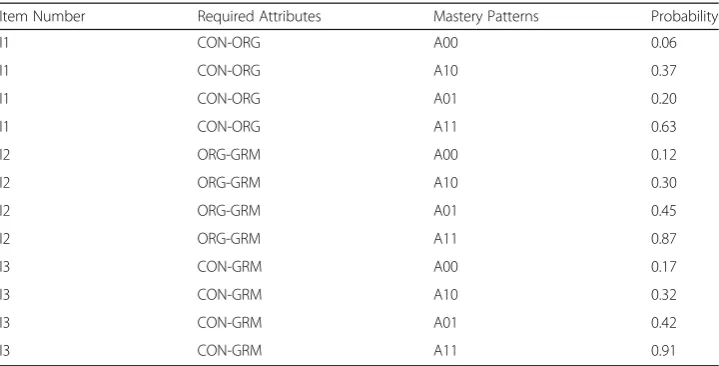
Table 6 shows, for space considerations, the ACDM parameters for only the first
three items or descriptors of the checklist. The first column gives the item number, the second column shows the requisite attributes for each item, the third column displays the attribute mastery patterns, and the last column represents the probability of a suc-cessful performance on each item with respect to the mastery of the required attributes by any given test item. As an illustration, successful performance on item 1 requires the presence of CON and ORG. Those students who have mastered none of the re-quired attributes have only 6% probability of guessing to get the item right (e.g., item intercept). However, those students who have mastered CON have 37% chance to re-spond correctly to the item. Therefore, masters of CON had 0.06 + 0.37 = 0.43 prob-ability of success (not slipping) on the item. Similarly, for those who have mastered ORG, there is 20% probability to give a correct response to the item. Thus, those who have mastered ORG have 0.06 + 0.20 = 0.26 probability of success (not slipping) on the item. It can be inferred that the CON discriminates more among masters and non-masters compared to ORG. In fact, mastery of CON increments the probability of a
Table 4Attribute difficulty
Attributes Attribute probability 1
CON 0.43
ORG 0.61
GRM 0.52
VOC 0.32
successful performance on the given item. By mastering the two attributes, the prob-ability of getting the item right increases to 63% (0.06 + 0.37 + 0.20). This shows the nature of the ACDM as an additive model in which each attribute additively contrib-utes to the increase in the probability of a correct response.
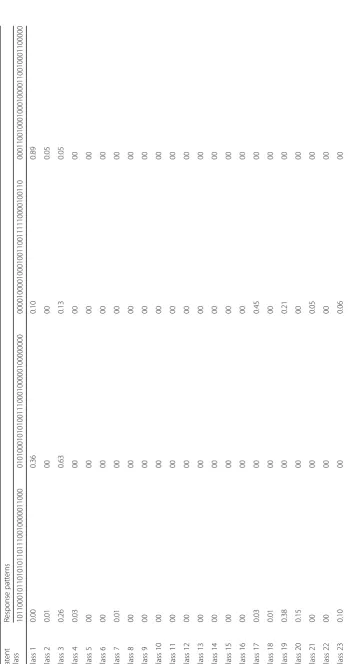
Table 7 demonstrates the probabilities (posterior probability) that each student
belonged to each of the 32 latent classes. For space considerations, the class probability for the first four students in the data are presented. The first column gives the latent
classes (25= 32) and the second column represents response patterns of the four
stu-dents. As an illustration, there are 38% and 26% probabilities for student number 1 to belong to latent classes 19 and 3, respectively. By checking the latent classes 20 and 19, it reveals that he/she has 38% chance to have mastered ORG and MCH and 26% chance for mastering only ORG. For student number 4, as another example, there is 89% probability of belonging to latent class 1, indicating that he/she has mastered none of the attributes by checking the latent class.
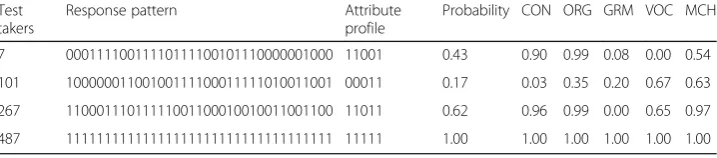
Table8further provides the mastery probability of each student on any of the requis-ite attributes for a given test requis-item or task. Due to the space limitation, the attribute mastery probability of only four randomly selected students are presented. The first column shows the student ID, followed by response pattern, attribute profile, the prob-ability of belonging to this profile, and the attribute mastery probabilities. For instance, the probabilities that student 267 with the skill profile of [11011] has mastered the at-tributes CON to MCH are 0.96, 0.99, 0.00, 0.65, and .097, respectively. Put differently, there is a probability of 96% that he/she has mastered CON and 0% probability for mastering GRM. On the other hand, student number 101 with the profile mastery [00011] has a probability of mastery of 3%, 35%, 20%, 67%, and 63%, indicating that he/ she has mastered VOC and MCH, but not CON, ORG, and GRM. The values above 0.50 show a high confidence for the mastery status of different sub-skills for each stu-dent (Hu, Miller, Huggins-Manley, & Chen,2016).
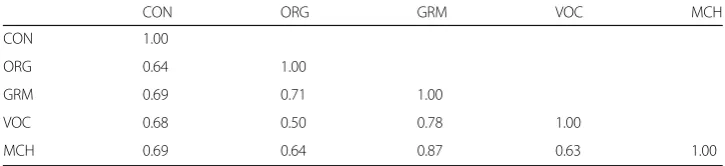
Finally, an inspection of the tetrachoric correlation among the attributes revealed that there exist a moderate to strong correlations between the sub-skills. Overall, the values larger than 0.70 are considered as strong, 0.50 and 0.70 as moderate, and less than 0.50 as weak. Empirical studies showed that 0.50 is a logical value for correlation among at-tributes (e.g., Henson, Templin, & Douglas,2007; Kunina-Habenicht, Rupp, & Wilhelm,
2012). As demonstrated in Table9, there was a strong correlation coefficients between GRM and MCH (0.87) followed by GRM and VOC (0.78). It suggests that if a student
Table 5Class probabilities
Latent class Attribute pattern Class probability Class expected frequency
1 00000 0.226 113.11
2 10000 0.019 9.69
3 01000 0.083 41.93
4 11000 0.023 11.85
… … … …
29 00111 0.011 5.92
30 10111 0.020 10.23
31 01111 0.033 16.88
performed well on GRM, he/she was likely to perform well on MCH and VOC as well, and vice versa. In fact, cognitive operations required to perform successfully on a test item or task were similar to each other. On the contrary, there existed a moderate cor-relation between VOC and ORG (0.50), and VOC and MCH (0.63); indicating that a good performance on VOC was not necessarily associated with a good performance on ORG and MCH.
Discussion
This study set out to examine the utility of the ACDM, as a compensatory model, in generating reliable and useful diagnostic information about strengths and
weak-nesses of Iranian EFL university students’ L2 writing ability. As a fundamental step
in CDMs, an initial Q-matrix was designed based on the consensus among the raters, as content experts, on the association between the checklist items and the five writing sub-skills. The Q-matrix was then empirically validated through the
procedure suggested by de la Torre and Chiu (2016) in GDINA package. In the
next step, the data were subjected to the ACDM model for checking fit of the data to the model. The results of absolute fit statistics yielded adequate evidence sup-porting the fit of the ACDM model to the data based on almost all the criteria. Then, the fit of the ACDM was further supported by checking the classification consistency and accuracy and tetrachoric correlations among the attributes. The
analysis of the attribute-level and profile-level Pc and Pɑ indices indicated
accept-able values for pattern-level and high values for sub-skill–level. In addition, the
writing sub-skills generally produced moderate to high correlations with each other which could be considered as a sort of evidence for claiming that there exists a compensatory relationship among the L2 writing attributes. This finding is in line with the previous study conducted by authors (A comparison of different cognitive diagnostic model for EFL writing, submitted) who found that compensatory models outperform non-compensatory models in explaining L2 writing ability.
The results of the study also showed that the CDM-based checklist approach is very useful in both identifying the major patterns of skill mastery of Iranian EFL students in L2 writing ability and providing finer-grained information about their learning status.
Table 6ACDM parameters
Item Number Required Attributes Mastery Patterns Probability
I1 CON-ORG A00 0.06
I1 CON-ORG A10 0.37
I1 CON-ORG A01 0.20
I1 CON-ORG A11 0.63
I2 ORG-GRM A00 0.12
I2 ORG-GRM A10 0.30
I2 ORG-GRM A01 0.45
I2 ORG-GRM A11 0.87
I3 CON-GRM A00 0.17
I3 CON-GRM A10 0.32
I3 CON-GRM A01 0.42
As the results of the study showed, the two “flat” skill-mastery profiles, namely “ non-master of all attributes” α1= [00000] and “master of all attributes” α32= [11111], were the most prevalent skill profiles. This is in contrast to the previous applications of CDMs to L2 writing by Kim (2011) and Xie (2016) who reported a small portion of test takers fell into the flat categories. They noted that generating various types of skill-mastery profiles is an indication of the model’s high discriminant function. However, it should be noted that they reported a weak to moderate correlation among the writing attributes which affect the classification of examinees. The existence of flat skills profile can be due to the unidimensionality of the measured scale and the high correlations be-tween the attributes (Lee & Sawaki, 2009a; Rupp et al.,2010). Lee and Sawaki (2009a)
rightly noted that“…a CDA analysis may classify most of the examinees into flat
pro-files. This makes additional scores reported redundant, suggesting that reporting separ-ate attribute scores provides little additional information over and above what a total score or overall proficiency score can offer. This can happen, for example, when a CDA is applied to a non-diagnostic test that was designed to be an essentially psychometric-ally unidimensional test for a target population (e.g., Luecht, Gierl, Tan, & Huff, 2006). When this happens, one can say that the utility of profile scoring is questionable from the psychometric point of view. This is a likely scenario in a domain such as language assessment where constructs are often found to be highly correlated among them-selves”(p. 185).
As stated above, moderate to high correlations between the writing attributes were observed in the current study which can be considered as the reason for classifying most students into the flat profiles.
Furthermore, the results of the study showed that VOC and CON were the most dif-ficult attributes among the five sub-skills of writing, followed by GRM, MCH, and ORG. This finding is in agreement with studies of Kim (2011) and Xie (2016), but com-pared with them, the students in the present study appeared to have a worse domin-ance on different attributes of L2 writing, with a higher mastery rates for GRM, MCH, and ORG (52%, 56%, and 61%, respectively) and a lower mastery rates for VOC and CON (43% and 32%, respectively). This finding substantiates English as a second lan-guage (ESL)/EFL writing research indicating that content and vocabulary are the most important attributes in the process of producing a high-level essay (Cheng, Klinger, & Zheng, 2007; Milanovic, Saville, & Shuhong,1996; Schoonen, Snellings, Stevenson, &
van Gelderen, 2009). According to Wilson et al. (2016), mechanics and grammar are
low-level writing skills and vocabulary, organization, and content are higher-level writ-ing skills. Therefore, it is evident that since vocabulary and content are higher-level skills, they require more cognitively advanced operations and therefore are difficult to master.
Table 8Skill-mastery probabilities
Test takers
Response pattern Attribute
profile
Probability CON ORG GRM VOC MCH
7 00011110011110111100101110000001000 11001 0.43 0.90 0.99 0.08 0.00 0.54
101 10000001100100111100011111010011001 00011 0.17 0.03 0.35 0.20 0.67 0.63
267 11000111011111001100010010011001100 11011 0.62 0.96 0.99 0.00 0.65 0.97
Conclusion
The present study investigated strengths and weaknesses of Iranian EFL university stu-dents in writing to determine their learning status. The findings indicated that most of the students are not able to produce a well-structured essay with respect to the inter-ested attributes, especially in terms of vocabulary and content. One solution for this problem can be the use of diagnostic assessment in writing classes to monitor the per-formance of students over time (e.g., during a term or course). Writing classes would be more effective to students if a theory-based assessment is employed, as opposed to conventional method of providing feedback to students. This endeavor helps both teachers to have a better understanding of their students’weaknesses and strengths and students to receive short- and long-term feedback (Kim,2011).
The previous studies on applications of CDMs on L2 writing by Kim (2011) and Xie
(2016) suggested the use of the EDD checklist for different academic tasks or writing
genres. By taking this recommendation into account, a descriptive essay was used in the current study. The obtained information verified the validity and accuracy of the checklist for applying to descriptive essays. As one of the anonymous reviewers noted, it would be interesting for future research to examine what form the EDD checklist would take if cognitive diagnostic tasks or a comparison of different academic tasks were used.
As in any research endeavor, the limitations of the present study should be acknowl-edged, and the conclusions drawn should be viewed within the constraints imposed on the study. This study was limited in that it applied a CDA approach to a non-diagnostic test which is problematic in terms of the validity of inferences about the test takers’skill-mastery profiles (DiBello et al.,2007; Jang, 2009). One urgent area for fur-ther investigation is designing a true diagnostic test (Ravand & Baghaei, 2019) accord-ing to a CDA framework. However, as noted earlier, retrofittaccord-ing can be advantageous by determining the diagnostic capacity of existing achievement and proficiency tests before developing true diagnostic tests which need a big budget and a lot of time (Lee &
Sawaki, 2009a). Overall, what is important is that cognitive diagnostic assessment has
shown its potential in providing diagnostic information about the learning status of stu-dents. Consequently, more attention should be paid to designing and developing educa-tional assessments in second/ foreign language contexts that are based on a CDM framework. Such an endeavor necessitates the cooperation of various experts from dif-ferent fields of study (e.g., subject matter, measurement, pedagogy).
Additional file
Additional file 1:The EDD Checklist, adapted from Kim,2011. (DOCX 18 kb)
Table 9Tetrachoric correlations between the sub-skills
CON ORG GRM VOC MCH
CON 1.00
ORG 0.64 1.00
GRM 0.69 0.71 1.00
VOC 0.68 0.50 0.78 1.00
Abbreviations
ACDM:Additive CDM; CDA: Cognitive diagnostic assessment; CDMs: Cognitive diagnostic models; CON: Content fulfillment; CTT: Classical test theory; EDD checklist: The Empirically derived Descriptor-based Diagnostic checklist; EFL: English as a foreign language; ESL: English as a second language; G-DINA: Generalized deterministic inputs, noisy
“and”gate; GRM: Grammatical knowledge; IELTS: The International English Language Testing System; IRT: Item
response theory; MCH: Mechanics; ORG: Organizational effectiveness; TOEFL: Test of English as a foreign language; VOC: Vocabulary use
Acknowledgements
We thank all the students and teachers who helped us in collecting the data.
Authors’contributions
FE collected and analyzed the data. PB supervised data analysis and provided the codes. AB read the manuscript and provided feedback. All authors wrote parts of the manuscript and revised it.
Funding
We received no funding for this research from any funding agencies.
Availability of data and materials
The datasets used and/or analyzed during the current study are available from the corresponding author on reasonable request.
Competing interests
The authors declare that they have no competing interests.
Received: 10 May 2019 Accepted: 26 June 2019
References
Alderson, J. C. (2005).Diagnosing foreign language proficiency: The interface between learning and assessment. A & C Black.
Alderson, J. C., & Huhta, A. (2005). The development of a suite of computer-based diagnostic tests based on the Common
European Framework.Language Testing, 22(3), 301–320.https://doi.org/10.1191/0265532205lt310oa.
ALTE. (1998).Multilingual glossary of language testing terms(p. 1998). Cambridge: Cambridge University Press.
Aryadoust, V. (2018). A cognitive diagnostic assessment study of the listening test of the Singapore–Cambridge general
certificate of education O-level: Application of DINA, DINO, G-DINA, HO-DINA, and RRUM.International Journal of
Listening, 1–24.https://doi.org/10.1080/10904018.2018.1500915.
Ashwell, T. (2000). Patterns of teacher response to student writing in a multiple-draft composition classroom: Is content
feedback followed by form feedback the best method?Journal of Second Language Writing, 9(3), 227–257.https://doi.
org/10.1016/S1060-3743(00)00027-8.
Banerjee, J., & Wall, D. (2006). Assessing and reporting performances on pre-sessional EAP courses: Developing a final
assessment checklist and investigating its validity.Journal of English for Academic Purposes, 5(1), 50–69.https://doi.org/1
0.1016/j.jeap.2005.11.003.
Barrett, S. (2001). The impact of training on rater variability.International Education Journal, 2(1), 49–58 Retrieved fromhttp://
iej.cjb.net.
Birenbaum, M., Kelly, A. E., & Tatsuoka, K. K. (1993). Diagnosing knowledge states in Algebra using the rule-space model.
Journal for Research in Mathematics Education, 24(5), 442–459.https://doi.org/10.2307/749153.
Bitchener, J. (2008). Evidence in support of written corrective feedback.Journal of Second Language Writing, 17(2), 102–118.
https://doi.org/10.1016/j.jslw.2007.11.004.
Bitchener, J., & Knoch, U. (2008). The value of written corrective feedback for migrant and international students.Language
Teaching Research, 12(3), 409–431.https://doi.org/10.1177/1362168808089924.
Black, P., & Wiliam, D. (1998). Assessment and classroom learning.Assessment in Education: Principles, Policy & Practice, 5(1), 7–
74.https://doi.org/10.1080/0969595980050102.
Blikstad-Balas, M., Roe, A., & Klette, K. (2018). Opportunities to write: An exploration of student writing during language arts
lessons in Norwegian lower secondary classrooms.Written Communication, 35(2), 119–154.https://doi.org/10.1177/0741
088317751123.
Buck, G., & Tatsuoka, K. (1998). Application of the rule-space procedure to language testing: Examining attributes of a free
response listening test.Language Testing, 15(2), 119–157.https://doi.org/10.1177/026553229801500201.
Buck, G., Tatsuoka, K., & Kostin, I. (1997). The subskills of reading: Rule-space analysis of a multiple-choice test of second
language reading comprehension.Language Learning, 47(3), 423–466.https://doi.org/10.1111/0023-8333.00016.
Buck, G., VanEssen, T., Tatsuoka, K., Kostin, I., Lutz, D., & Phelps, M. (1998). Development, selection and validation of a set of
cognitive and linguistic attributes for the SAT I verbal: Analogy section. ETS Research Report Series, 1998: i-25.https://doi.
org/10.1002/j.2333-8504.1998.tb01768.x.
Buckingham, L., & Aktuğ-Ekinci, D. (2017). Interpreting coded feedback on writing: Turkish EFL students’approaches to
revision.Journal of English for Academic Purposes, 26, 1–16.https://doi.org/10.1016/j.jeap.2017.01.001.
Chen, H., & Chen, J. (2016). Retrofitting non-cognitive-diagnostic reading assessment under the generalized DINA model
framework.Language Assessment Quarterly, 13(3), 218–230.https://doi.org/10.1080/15434303.2016.1210610.
Cheng, L., Klinger, D., & Zheng, Y. (2007). The challenges of the Ontario Secondary School Literacy Test for second language
students.Language Testing, 24, 185–208.https://doi.org/10.1177/0265532207076363.
Cui, Y., Gierl, M. J., & Chang, H.-H. (2012). Estimating classification consistency and accuracy for cognitive diagnostic
Cumming, A. (2015). Design in four diagnostic language assessments.Language Testing, 32(3), 407–416.https://doi.org/10.11
77/0265532214559115.
de la Torre, J. (2011). The generalized DINA model framework.Psychometrika, 76(2), 179–199.https://doi.org/10.1007/s11336-011-9207-7.
de la Torre, J., & Chiu, C.-Y. (2016). A general method of empirical Q-matrix validation.Psychometrika, 81(2), 253–273.https://
doi.org/10.1007/s11336-015-9467-8.
de la Torre, J., & Douglas, J. A. (2004). Higher-order latent trait models for cognitive diagnosis.Psychometrika, 69(3), 333–353.
https://doi.org/10.1007/bf02295640.
de la Torre, J., & Douglas, J. A. (2008). Model evaluation and multiple strategies in cognitive diagnosis: An analysis of fraction
subtraction data.Psychometrika, 73(4), 595.https://doi.org/10.1007/s11336-008-9063-2.
de la Torre, J., & Minchen, N. (2014). Cognitively diagnostic assessments and the cognitive diagnosis model framework.
Psicología Educativa, 20(2), 89–97.https://doi.org/10.1016/j.pse.2014.11.001.
DiBello, L. V., Roussos, L. A., & Stout, W. (2007). A review of cognitively diagnostic assessment and a summary of psychometric
models. In C. R. Rao & S. Sinharay (Eds.),Handbook of statistics(Vol. 26, pp. 979–1030). Elsevier.
Dunsmuir, S., & Clifford, V. (2003). Children’s writing and the use of information and communications technology.Educational
Psychology in Practice, 19(3), 170–187.https://doi.org/10.1080/0266736032000109447.
Eckes, T. (2011).Introduction to many-facet Rasch measurement. Peter Lang.
Erlam, R., Ellis, R., & Batstone, R. (2013). Oral corrective feedback on L2 writing: Two approaches compared.System, 41(2), 257–
268.https://doi.org/10.1016/j.system.2013.03.004.
Ferris, D. R. (2003).Response to student writing: Implications for second language students. Mahwah: Lawrence Erlbaum
Associates.
George, A. C., Robitzsch, A., Kiefer, T., Uenlue, A., & Grosz, J. (2016). The R package CDM for cognitive diagnosis models.
Journal of Statistical Software, 74(2), 1–24.
Hartz, S. M. (2002).A Bayesian framework for the unified model for assessing cognitive abilities: Blending theory with practicality
(Unpublished doctoral dissertation). University of Illinois at Urbana-Champaign, Urbana-Champaign, IL.
Hattie, J., & Timperley, H. (2007). The power of feedback.Review of Educational Research, 77(1), 81–112.https://doi.org/10.31
02/003465430298487.
Henson, R., Templin, J. L., & Douglas, J. 2007. Using efficient model based sum-scores for conducting skills diagnoses.Journal
of Educational Measurement, 44(4), 361–376. Retrieved fromhttp://www.jstor.org/stable/20461869.
Henson, R. A., Templin, J. L., & Willse, J. T. (2008). Defining a family of cognitive diagnosis models using log-linear models with
latent variables.Psychometrika, 74(2), 191.https://doi.org/10.1007/s11336-008-9089-5.
Hu, J., Miller, M. D., Huggins-Manley, A. C., & Chen, Y.-H. (2016). Evaluation of model fit in cognitive diagnosis models.
International Journal of Testing, 16(2), 119–141.https://doi.org/10.1080/15305058.2015.1133627.
Hyland, K. (2013). Faculty feedback: Perceptions and practices in L2 disciplinary writing.Journal of Second Language Writing,
22(3), 240–253.https://doi.org/10.1016/j.jslw.2013.03.003.
Jang, E. E. (2009). Cognitive diagnostic assessment of L2 reading comprehension ability: Validity arguments for fusion model
application to LanguEdge assessment.Language Testing, 26(1), 031–073.https://doi.org/10.1177/0265532208097336.
Johnson, M. S., & Sinharay, S. (2018). Measures of agreement to assess attribute-level classification accuracy and consistency for
cognitive diagnostic assessments.Journal of Educational Measurement, 55(4), 635–664.https://doi.org/10.1111/jedm.12196.
Kang, C., Yang, Y., & Zeng, P. (2018). Q-Matrix refinement based on item fit statistic RMSEA.Applied Psychological
Measurement.https://doi.org/10.1177/0146621618813104.
Kasai, M. (1997).Application of the rule space model to the reading comprehension section of the test of English as a foreign
language (TOEFL) (Unpublished doctoral dissertation). University of Illinois at Urbana Champaign.
Kim, A. Y. (2014). Exploring ways to provide diagnostic feedback with an ESL placement test: Cognitive diagnostic assessment
of L2 reading ability.Language Testing, 32(2), 227–258.https://doi.org/10.1177/0265532214558457.
Kim, Y.-H. (2011). Diagnosing EAP writing ability using the reduced reparameterized unified model.Language Testing, 28(4),
509–541.https://doi.org/10.1177/0265532211400860.
Knoch, U. (2011). Rating scales for diagnostic assessment of writing: What should they look like and where should the criteria
come from?Assessing Writing, 16(2), 81–96.https://doi.org/10.1016/j.asw.2011.02.003.
Kumar, V., & Stracke, E. (2011). Examiners’reports on theses: Feedback or assessment?Journal of English for Academic
Purposes, 10(4), 211–222.https://doi.org/10.1016/j.jeap.2011.06.001.
Kunina-Habenicht, O., Rupp, A. A., & Wilhelm, O. (2009). A practical illustration of multidimensional diagnostic skills profiling:
Comparing results from confirmatory factor analysis and diagnostic classification models.Studies in Educational
Evaluation, 35(2), 64–70.https://doi.org/10.1016/j.stueduc.2009.10.003.
Kunina-Habenicht, O., Rupp, A. A., & Wilhelm, O. (2012). The impact of model misspecification on parameter estimation and
item-fit assessment in log-linear diagnostic classification models.Journal of Educational Measurement, 49(1), 59–81.
https://doi.org/10.1111/j.1745-3984.2011.00160.x.
Kuo, B.-C., Chen, C.-H., Yang, C.-W., & Mok, M. M. C. (2016). Cognitive diagnostic models for tests with multiple-choice and
constructed-response items.Educational Psychology, 36(6), 1115–1133.https://doi.org/10.1080/01443410.2016.1166176.
Lee, Y.-W., & Sawaki, Y. (2009a). Cognitive diagnosis approaches to language assessment: An overview.Language Assessment
Quarterly, 6(3), 172–189.https://doi.org/10.1080/15434300902985108.
Lee, Y.-W., & Sawaki, Y. (2009b). Application of three cognitive diagnosis models to ESL reading and listening assessments.
Language Assessment Quarterly, 6(3), 239–263.https://doi.org/10.1080/15434300903079562.
Lei, P.-W., & Li, H. (2016). Performance of fit indices in choosing correct cognitive diagnostic models and Q-matrices.Applied
Psychological Measurement, 40(6), 405–417.https://doi.org/10.1177/0146621616647954.
Leighton, J. P., Gierl, M. J., & Hunka, S. M. (2004). The attribute hierarchy method for cognitive assessment: A variation on
Tatsuoka's rule-space approach.Journal of Educational Measurement, 41(3), 205–237 Retrieved fromhttp://www.jstor.org/
stable/1435314.
Li, H. (2011).Evaluating language group differences in the subskills of reading using a cognitive diagnostic modeling and
differential skill functioning approach (Doctoral dissertation). State College: Pennsylvania State University.
Li, H., & Suen, H. K. (2013). Detecting native language group differences at the subskills level of reading: A differential skill
Lin, T.-Y., & Weng, L.-J. (2014). Graphical extension of sample size planning with AIPE on RMSEA using R.Structural Equation Modeling: A Multidisciplinary Journal, 21(3), 482–490.https://doi.org/10.1080/10705511.2014.915380.
Llosa, L., Beck, S. W., & Zhao, C. G. (2011). An investigation of academic writing in secondary schools to inform the
development of diagnostic classroom assessments.Assessing Writing, 16(4), 256–273.https://doi.org/10.1016/j.asw.2
011.07.001.
Luecht, R.M., Gierl, M.J., Tan, X., & Huff, K. (2006).Scalability and the development of useful diagnostic scales. Paper presented at
the annual meeting of the NationalCouncil on Measurement in Education, San Francisco.
Lumley, T., & McNamara, T. F. (1995). Rater characteristics and rater bias: Implications for training.Language Testing, 12(1), 54–
71.https://doi.org/10.1177/026553229501200104.
Ma, W., de la Torre, J., & Sorrel, M. (2018). The Generalized DINA Model Framework (R package version 2.0.8). Retrieved from
https://cran.rproject.org/web/packages/GDINA
Maydeu-Olivares, A., & Joe, H. (2014). Assessing approximate fit in categorical data analysis.Multivariate Behavioral Research,
49(4), 305–328.https://doi.org/10.1080/00273171.2014.911075.
McCutchen, D. (2011). From novice to expert: Language and memory processes in the development of writing skill.Journal
of Writing Research, 3(1), 51–68.https://doi.org/10.17239/jowr-2011.03.01.3.
McIntyre, P. N. (1993).The importance and effectiveness of moderation training on the reliability of teachers’assessments of ESL
writing samples (Unpublished master’s thesis). Australia: University of Melbourne.
Milanovic, M., Saville, N., & Shuhong, S. (1996). A study of the decision making behavior of composition markers. In M. M. N.
Saville (Ed.),Studies in language testing 3: Performance testing, cognition and assessment(pp. 92–111). Cambridge
University Press: Cambridge.
Nation, I. S. P., & Macalister, J. (2010).Language curriculum design. Taylor & Francis.
Nichols, P. D. (1994). A framework for developing cognitively diagnostic assessments.Review of Educational Research, 64(4),
575–603.https://doi.org/10.3102/00346543064004575.
Pellegrino, J. W., & Chudowsky, N. (2003). FOCUS ARTICLE: The foundations of assessment.Measurement: Interdisciplinary
Research and Perspectives, 1(2), 103–148.https://doi.org/10.1207/S15366359MEA0102_01.
R Core Team (2013).R: A language and environment for statistical computing. Vienna: R Foundation for Statistical Computing.
Retrieved fromhttp://www.R-project.org/.
Ramaprasad, A. (1983). On the definition of feedback.Behavioral Science, 28(1), 4–13.https://doi.org/10.1002/bs.3830280103.
Ranjbaran, F., & Alavi, S. M. (2017). Developing a reading comprehension test for cognitive diagnostic assessment: A RUM
analysis.Studies in Educational Evaluation, 55, 167–179.https://doi.org/10.1016/j.stueduc.2017.10.007.
Ravand, H. (2015). Application of a cognitive diagnostic model to a high-stakes reading comprehension test.Journal of
Psychoeducational Assessment, 34(8), 782–799.https://doi.org/10.1177/0734282915623053.
Ravand, H., & Baghaei, P. (2019). Diagnostic classification models: Recent developments, practical issues, and prospects.
International Journal of Testing.https://doi.org/10.1080/15305058.2019.1588278.
Ravand, H., & Robitzsch, A. (2018). Cognitive diagnostic model of best choice: A study of reading comprehension.Educational
Psychology, 38(10), 1255–1277.https://doi.org/10.1080/01443410.2018.1489524.
Robitzsch, A., Kiefer, T., George, A. C., & Uenlue, C. (2018). CDM: Cognitive diagnosis modeling (Rpackage version 6.1-10).
Retrieved fromhttps://cran.rproject.org/web/packages/CDM/index.html
Roussos, L. A., DiBello, L. V., Stout, W., Hartz, S. M., Henson, R. A., & Templin, J. L. (2007). The fusion model skills diagnosis
system. In J. Leighton & M. Gierl (Eds.),Cognitive diagnostic assessment for education: Theory and applications(pp. 275–
318). Cambridge: Cambridge University Press.
Rupp, A. A., Templin, J., & Henson, R. A. (2010).Diagnostic measurement: Theory, methods, and applications. New York: Guilford Press.
Rupp, A. A., & Templin, J. L. (2008). Unique characteristics of diagnostic classification models: A comprehensive review of the
current state-of-the-art.Measurement: Interdisciplinary Research and Perspectives, 6(4), 219–262.https://doi.org/10.1
080/15366360802490866.
Sadler, D. R. (1989). Formative assessment and the design of instructional systems.Instructional Science, 18(2), 119–144.
https://doi.org/10.1007/bf00117714.
Sampson, A. (2012). Coded and uncoded error feedback: Effects on error frequencies in adult Colombian EFL learners’
writing.System, 40(4), 494–504.https://doi.org/10.1016/j.system.2012.10.001.
Sawaki, Y., Kim, H.-J., & Gentile, C. (2009). Q-Matrix construction: Defining the link between constructs and test items in
large-scale reading and listening comprehension assessments.Language Assessment Quarterly, 6(3), 190–209.https://doi.org/1
0.1080/15434300902801917.
Schoonen, R., Snellings, P., Stevenson, M., & van Gelderen, V. (2009). Towards a blueprint of the foreign language writer: The
linguistic and cognitive demands of foreign language writing. In R. M. Manchón (Ed.),Writing in foreign language:
Contexts learning, teaching, and research: Multilingual Matters.
Scott, H. S. (1998).Cognitive diagnostic perspectives of a second language reading test (Unpublished doctoral dissertation).
Urbana: University of Illinois, Urbana-Champaign.
Sheehan, K. M. (1997). A tree-based approach to proficiency scaling and diagnostic assessment.Journal of Educational
Measurement, 34(4), 333–352 Retrieved fromhttp://www.jstor.org/stable/1435113.
Shintani, N. (2016). The effects of computer-mediated synchronous and asynchronous direct corrective feedback on writing: a
case study.Computer Assisted Language Learning, 29(3), 517–538.https://doi.org/10.1080/09588221.2014.993400.
Struthers, L., Lapadat, J. C., & MacMillan, P. D. (2013). Assessing cohesion in children’s writing: Development of a checklist.
Assessing Writing, 18(3), 187–201.https://doi.org/10.1016/j.asw.2013.05.001.
Tatsuoka, K. K. (1983). Rule space: An approach for dealing with misconceptions based on item response theory.Journal of
Educational Measurement, 20(4), 345–354 Retrieved fromhttp://www.jstor.org/stable/1434951.
Tatsuoka, K. K. (1995). Architecture of knowledge structures and cognitive diagnosis: A statistical pattern recognition and
classification approach. In Cognitively diagnostic assessment(pp. 327–359). Hillsdale: Lawrence Erlbaum Associates, Inc..
Templin, J. L., & Henson, R. A. (2006). Measurement of psychological disorders using cognitive diagnosis models.Psychological
Methods, 11(3), 287–305.https://doi.org/10.1037/1082-989X.11.3.287.
Truscott, J. (1996). The case against grammar correction in L2 writing classes.Language Learning, 46(2), 327–369.https://doi.
Urmston, A., Raquel, M., & Tsang, C. (2013). Diagnostic testing of Hong Kong tertiary students’English language proficiency:
The development and validation of DELTA.Hong Kong Journal of Applied Linguistics, 14(2), 60–82 URL:http://hdl.handle.
net/10397/62844.
von Davier, M. (2008). A general diagnostic model applied to language testing data.British Journal of Mathematical and
Statistical Psychology, 61(2), 287–307.https://doi.org/10.1348/000711007x193957.
Wang, W., Song, L., Chen, P., Meng, Y., & Ding, S. (2015). Attribute-level and pattern-level classification consistency and
accuracy indices for cognitive diagnostic assessment.Journal of Educational Measurement, 52(4), 457–476.https://doi.
org/10.1111/jedm.12096.
Weigle, S. C. (1998). Using FACETS to model rater training effects.Language Testing, 15(2), 263–287.https://doi.org/10.1177/
026553229801500205.
Weigle, S. C. (1999). Investigating rater/prompt interactions in writing assessment: Quantitative and qualitative approaches.
Assessing Writing, 6(2), 145–178.https://doi.org/10.1016/S1075-2935(00)00010-6.
Weigle, S. C. (2002).Assessing writing. Cambridge: Cambridge University Press.
Weigle, S. C. (2007). Teaching writing teachers about assessment.Journal of Second Language Writing, 16(3), 194–209.https://
doi.org/10.1016/j.jslw.2007.0r7.004.
Weigle, S. C., Boldt, H., & Valsecchi, M. I. (2003). Effects of task and rater background on the evaluation of ESL student writing:
A pilot study.TESOL Quarterly, 37(2), 345–354.https://doi.org/10.2307/3588510.
Williams, G. J., & Larkin, R. F. (2013). Narrative writing, reading and cognitive processes in middle childhood: What are the
links?Learning and Individual Differences, 28, 142–150.https://doi.org/10.1016/j.lindif.2012.08.003.
Wilson, J., Olinghouse, N. G., McCoach, D. B., Santangelo, T., & Andrada, G. N. (2016). Comparing the accuracy of different
scoring methods for identifying sixth graders at risk of failing a state writing assessment.Assessing Writing, 27, 11–23.
https://doi.org/10.1016/j.asw.2015.06.003.
Xie, Q. (2016). Diagnosing university students’academic writing in English: Is cognitive diagnostic modelling the way
forward?Educational Psychology, 37(1), 26–47.https://doi.org/10.1080/01443410.2016.1202900.
Xu, X., & von Davier, M. (2008). Fitting the structured general diagnostic model to NAEP data.ETS Research Report Series, i–18.
https://doi.org/10.1002/j.2333-8504.2008.tb02113.x.
Yang, M., Badger, R., & Yu, Z. (2006). A comparative study of peer and teacher feedback in a Chinese EFL writing class.Journal
of Second Language Writing, 15(3), 179–200.https://doi.org/10.1016/j.jslw.2006.09.004.
Yu, S., & Hu, G. (2017). Understanding university students’peer feedback practices in EFL writing: Insights from a case study.
Assessing Writing, 33, 25–35.https://doi.org/10.1016/j.asw.2017.03.004.
Zimmerman, B. J. (2000). Attaining self-regulation: A social cognitive perspective. In M. Boekaerts, P. R. Pintrich, & M. Zeidner
(Eds.),Handbook of self-regulation(pp. 13–39). San Diego: Academic Press.
Publisher’s Note