Dacar Cas/Somali Red Aloe: a new species of
Aloe
(Asphodelaceae) from Somaliland
Mary E. Barkworth1,2, Ahmed Ibrahim Awale1,3,4, Faisal Jama Gelle1
1 Biodiversity Museum, University of Hargeisa, Hargeisa, Somaliland 2 Biology Department, Utah State University, 5305 Old Main Hill, Logan Utah, 84322, USA 3 Candlelight for Environment, Education, and Health, Hargeisa, Somaliland 4 Faculty of Environmental Science, College of Applied and Natural Science, University of Hargeisa, Hargeisa, Somaliland
Corresponding author:Mary E. Barkworth ([email protected])
Academic editor:L. Peruzzi | Received 6 July 2018 | Accepted 15 January 2019 | Published 8 February 2019 Citation: Barkworth ME, Awale AI, Gelle FJ (2019) Dacar Cas/Somali Red Aloe: a new species of Aloe (Asphodelaceae) from Somaliland. PhytoKeys 117: 85–97. https://doi.org/10.3897/phytokeys.117.28226
Abstract
A new species of Aloe (Asphodelaceae) is described from Somaliland. It differs from other species in form-ing large clumps and in havform-ing sap that is initially yellow but quickly turns bright red and then dark red or reddish-brown, paniculate red-flowered inflorescences and uniformly coloured leaves with red teeth. Its recognition raises the number of species known from the combined area of Somaliland and Somalia s.s. from 31 to 36. A map portraying species density of Aloe by country, as that genus is now interpreted, shows that Aloe has its highest density on islands in the Indian Ocean but that, within Africa, the greatest density is in countries along the eastern highlands. The data also reinforce the importance of field botanists in determining a country’s known plant diversity.
Keywords
Asparagales, species density, Africa
Introduction
The genus Aloe L. (Asphodelaceae) includes over 600 species, all native to Africa, islands in the western Indian Ocean or the Arabian Peninsula (Newton 2004; Carter et al. 2011; Klopper and Smith 2013). Its members are succulent plants with densely packed, spirally arranged leaves. They vary from stemless to having horizontal or vertical stems. The inflo-rescences vary from racemes to panicles with branches bearing spirally arranged pedicel-late flowers that vary from being well-spaced to densely packed and distally concentrated.
http://phytokeys.pensoft.net
Copyright Mary E. Barkworth et al. This is an open access article distributed under the terms of the Creative Commons Attribution License (CC BY 4.0), which permits unrestricted use, distribution, and reproduction in any medium, provided the original author and source are credited.
easy visualisation of the distribution of the species richness by country.
Somaliland, which declared its independence from Somalia s.l. in 1991, lies along the south side of the Gulf of Aden. Its flora is treated in the "Flora of Somalia" (Thulin 1993, 1995, 1999, 2006) which was begun in 1988 (Thulin 1993, preface), before the breakdown of the central Somali government. In volume 4 of the "Flora of Somalia", Lavranos (1995) recognised 31 species of Aloe, all of them collected before 1990. In 1988, the unrest that eventually led to the breakdown of the central Somali govern-ment made botanical exploration challenging but, after its unilateral declaration of independence, Somaliland achieved a degree of peace and stability that, among other things, encouraged renewed exploration of its flora and fauna. This resulted in the addition of three previously undescribed species of Aloe to the country’s flora [A.
or-landi Lavranos (Orlando 2003), A. rubrodonta T.A.McCoy & Lavranos and A. kahinii
T.A.McCoy & Lavranos (McCoy and Lavranos 2007)] which were included in the appendices of the final two volumes of the flora to be published (Thulin 1999, 2006). A fourth species, A. nugalensis Thulin, was described later (Thulin 2012) based on plants grown from seeds collected in 1985. In this paper, we describe a fifth species, so far known only from Somaliland, locally known as “Dacar Cas” or “Red Aloe” but which we refer to, in English, as the Somali Red Aloe to distinguish it from the species currently associated with the English name “Red Aloe”, A. cameronii Hemsl. We also re-examined the distribution of Aloe, being interested in the extent to which recent discoveries have modified the information provided by Newton (2004).
Materials and methods
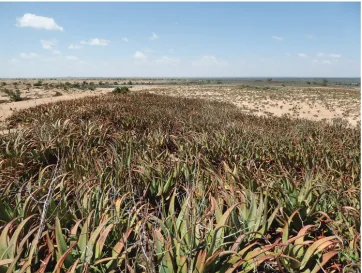
Figure 1.Aloe sanguinalis at Alala Adka showing the largest clump in October 2016.
In October 2016, Awale and Barkworth visited the Alala Adka site to take photo-graphs and make measurements. The location is a treeless plain in the Oogo ecological zone (Ibrahim 2010), dominated by shrubs and showing signs of overgrazing (Fig. 1). Unfortunately, no flowers were present. Despite this, they attempted to determine the scientific name of the plants using "Flora of Somalia" (Lavranos 1995; Thulin 1999, 2006) but none of the descriptions fitted, nor did those of other publications consulted, such as Ruch et al. (2013). They sent images of the plants to Mats Thulin, the late John Lavranos and Tom McCoy, three individuals highly respected for their knowledge of the region’s flora, Lavranos and McCoy being the second and third most prolific describers of Aloe species (Klopper and Smith 2013). All stated that the images sent were not of a species with which they were familiar and advised returning when the plants were in flower, partly to enable preparation of a complete description, but also to investigate the possibility that the plants were hybrids.
In January 2018, Awale discovered another population growing near Lafarug (La-faruug), in Sahil (Saaxil) Region, alongside the road to Hiin-Weyne village. Later that month, Barkworth and Awale revisited the location to learn more about the plants there and to make measurements. Lafarug is in the subcoastal area below the Golis es-carpment and has sandy soil with semi-desert vegetation that includes Vachellia tortilis
(Forssk.) Galasso & Banfi, Dobera glabra (Forssk.) Poir., Salvadora persica L., Indigofera
sparteola Chiov. and Commiphora Jacq. (Fig. 3A). There were no flowering
inflores-cences in January but some old ones were collected and examined for seeds. Awale revisited the site in June 2018, at which time the plants were in flower (Fig. 3B), and again in August 2018. During the August trip, he collected seeds.
Most capsules collected in January at Alala Adka had no seeds; none had more than 3. Capsules collected from the Lafarug population in August 2018 had several seeds. A total of about 50 seeds from the Lafarug area were planted in a pot and kept moist. By November 2018, 12 had germinated and one had developed three leaves (Fig. 4).
Based on the comments by Thulin, Lavranos and McCoy and the apparent func-tionality of the anthers and styles, we proposed recognising the Somali Red Aloe as a new species in July but, at the urging of the reviewers, Barkworth reviewed all the Aloe
ing features of Aloes are poorly preserved in herbarium specimens, we also reviewed the species descriptions for specimens that could not, based on the herbarium specimens seen, readily be distinguished from the Somali Red Aloe. These studies supported our earlier conclusion that the Somali Red Aloe should be described as a new species. In preparing the description, we have used terminology that is consistent with Klopper et al. (2013) but avoided use of the term “raceme” because of inconsistencies in how it is used [compare, for example, Klopper et al. 2013 with Harris and Harris (2001) and Beentje (2016)].
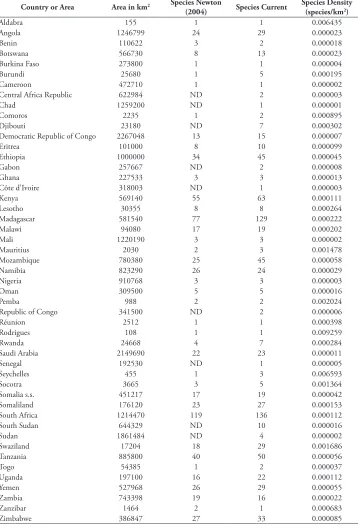
To examine current knowledge about the distribution of species richness in Aloe, we updated Newton’s table with data from multiple sources [(Reynolds 1954; Klopper et al. 2012; Ruch et al. 2013; Rakotoarisoa et al. 2014; Klopper 2015; Rakotoarisoa and Grace 2017; Cole and Forrest 2017; Aloes of the World (2018)] and calculated the number of species per km2. In doing so, we used the current interpretation of Aloe
which excludes Aloidendron (A. Berger) Klopper & Gideon F. Sm., Aloiampelos Klop-per & Gideon F. Sm. and other small genera previously included in it.
Taxonomic treatment
Aloe sanguinalis Awale & Barkworth, sp. nov. urn:lsid:ipni.org:names:60478025-2
Figures 1–4
Type. SOMALILAND. Marodi Jeh (Maroodi Jeex), Hargeysa, Alala Adka, 15–20 km west of the town of Da’ar Buduk (Dacar Budhuq). Elevation 950 m, 9.8705N, 44.3761E (WGS84), 24 May 2017, Mary E. Barkworth S17.001, Ahmed Ibrahim
Awale, Garrett Billings and Helen Pickering (holotype: HARG).
Diagnosis.Aloe sanguinalis differs from other species of Aloe in its combination of sap that is initially yellow but quickly turns bright red, drying to dark red or brownish-red, strong clump-forming habit, red teeth and paniculate inflorescence of well-spaced glabrous, red flowers.
Figure 3.Aloe sanguinalis at Lafarug. A One of the larger clumps, with Awale, in January 2018 B Inflo-rescence of Aloe sanguinalis at Lafarug, June 2018.
red, glabrous; outer perianth lobes 10–15 mm long, slightly recurved distally, with nar-row, hyaline, minutely erose margins; stamens 6, the anthers versatile, ca. 2 mm long, extending about 1 mm beyond the perianth at anthesis but the perianth extending 3–5 mm beyond the anthers as the style matures; ovary superior, with many ovules, stigma exserted 5–9 mm beyond the perianth at maturity. Capsules 15–20(–25 mm) long, 13–20 in diameter, ovoid, woody; seeds winged, 5–11 mm across (including the papery wing), triangular-pyramidal, outer surfaces ca. 1 mm across.
Distinguishing features.Aloe sanguinalis caught Awale’s attention by the large size of its clumps but its most distinctive feature appears to be the colour of its sap (Fig. 2) which is yellow, quickly turning bright red, then drying dark red or brownish-red. The difficulty is that none of the descriptions in the "Flora of Somalia" refer to sap colour. Carter et al. (2011) mention sap features, usually colour, but for only 186 of the 517 species treated. In most species, the colour is described as some variant of yellow, but A. rabaiensis Rendle has sap described as “yellow, drying red” and A. volkensii, sap described as “yellow, drying dark reddish”. Aloe rabaiensis is a shrubby aloe which differs from A. sanguinalis in having flowers in “sub-capitate to capitate” clusters (Carter et al. 2011, p. 633). It extends from Tanzania to southern Somalia s.s. Aloe volkensii Engl. is a tree aloe described as having densely flowered, “subcapitate to cylindrical-conical” flower clusters. It is known from south-eastern Kenya and north-eastern Tanzania (Carter et al. 2011, p. 691).
There were 16 other species described as having sap that dries purplish or reddish-brown. Of them, none is known from Somaliland, but A. gillettii S. Carter grows in Puntland, Somalia “on limestone with Juniperus in open Commiphora bushland” (Lavranos 1995, p. 40), a different habitat from that of A. sanguinalis. Aloe gillettii also differs from A. sanguinalis in having “dark grey-green leaves with very numerous white spots” and “white, cartilaginous teeth to 1 mm long” (loc. sic). The other species would also be ruled out by the description given.
Distribution.Aloe sanguinalis is currently known from only two locations, the type locality near Alala Adka and a more northern locality at 9.9840N, 44.8195E near the village of Lafarug. Larajasse (1897, p. 25), a Catholic missionary based in Berbera from 1888–1903, stated that “da’ar” refers to bile or an “aloe about three feet high, red and orange varieties, broad spiked fleshy leaves, spreading out from the ground; is a favorite food of elephants.” It seems probable, considering the species known from the area, that he was referring to A. sanguinalis. Elephants have not been seen in Somaliland since 1958.
Habitat and ecology. The two known locations of Aloe sanguinalis are open plains with sandy soils in which, among other species, Salvadora persica and Indigofera sparte-ola grow. The Alala Adka location is treeless but there are scattered Vachellia tortilis
trees at the Lafarug site.
Phenology. Flowering time in Aloe sanguinalis is probably determined by the tim-ing of the sprtim-ing rains which fall between late March and early June. The optimum time for seed collection has not been determined, but it is likely to be July to September.
At both Alala Adka and Lafarug, there are multiple clumps of Aloe sanguinalis. There were some markings on the leaves suggesting that insects might be piercing their surface but otherwise, the plants seemed undamaged. All the plants appeared to be growing on slight mounds in the sandy soil, probably because they protect the soil from being blown away. Offsets from both sites have been planted successfully in Hargeisa.
The largest clumps of Aloe sanguinalis were those at the first site, Alala Adka, the largest being about 40 m long and 10 m wide. We estimated that it was composed of about 2500 stems. The clumps at Lafarug were considerably smaller, none that we saw being more than 5 m long in its longest dimension. We do not know what proportion of the vertical stems within a clump represents new individuals rather than established off-sets. It seems probable, given the obstacles drought and grazing present to seedlings, that most growth is vegetative. Time constraints precluded a detailed survey of the two sites.
The biggest threat to the species may be the increasing frequency of drought which makes establishment of new plants, whether from seed or offsets, difficult. We saw no seedlings at either location but did not conduct a deliberate search for them within the clumps nor underneath other shrubby vegetation, the locations where they are most likely to become established. Because so little is known about the distribution, phenol-ogy, pollination, seed set and reproductive success of Aloe sanguinalis, we recommend it be regarded as “data deficient”.
Herbarium studies
available on line. In future, we encourage individuals collecting aloes to supplement their specimens with images of the living plants, a suggestion that digital technology has made feasible, and that herbaria mobilise their specimen records using software (for example, Symbiota 2018) that can accommodate multiple images per specimen.
Distribution of species density
Updated information on the number of Aloe species present in different countries (Table 1) shows 96 more records than in Newton (2004). although the numbers for a few countries have decreased, probably because of the exclusion of Aloidendron,
Aloiampelos and a few other small genera. The overall increase reflects both recognition
of new species and the discovery of known species in additional countries. The highest species densities (Table 1, Fig. 5) are on ocean islands and in countries that are so small that, even if only 1 species is present, the species density is high. Within Africa, the
Comoros 2235 1 2 0.000895
Djibouti 23180 ND 7 0.000302
Democratic Republic of Congo 2267048 13 15 0.000007
Eritrea 101000 8 10 0.000099
Ethiopia 1000000 34 45 0.000045
Gabon 257667 ND 2 0.000008
Ghana 227533 3 3 0.000013
Côte d’Ivoire 318003 ND 1 0.000003
Kenya 569140 55 63 0.000111
Lesotho 30355 8 8 0.000264
Madagascar 581540 77 129 0.000222
Malawi 94080 17 19 0.000202
Mali 1220190 3 3 0.000002
Mauritius 2030 2 3 0.001478
Mozambique 780380 25 45 0.000058
Namibia 823290 26 24 0.000029
Nigeria 910768 3 3 0.000003
Oman 309500 5 5 0.000016
Pemba 988 2 2 0.002024
Republic of Congo 341500 ND 2 0.000006
Réunion 2512 1 1 0.000398
Rodrigues 108 1 1 0.009259
Rwanda 24668 4 7 0.000284
Saudi Arabia 2149690 22 23 0.000011
Senegal 192530 ND 1 0.000005
Seychelles 455 1 3 0.006593
Socotra 3665 3 5 0.001364
Somalia s.s. 451217 17 19 0.000042
Somaliland 176120 23 27 0.000153
South Africa 1214470 119 136 0.000112
South Sudan 644329 ND 10 0.000016
Sudan 1861484 ND 4 0.000002
Swaziland 17204 18 29 0.001686
Tanzania 885800 40 50 0.000056
Togo 54385 1 2 0.000037
Uganda 197100 16 22 0.000112
Yemen 527968 26 29 0.000055
Zambia 743398 19 16 0.000022
Zanzibar 1464 2 1 0.000683
highest species densities belong to countries of the eastern highlands and coast. The general distribution of species richness is similar to that in Grace et al. (2015), in which the information is related to the genus’ phylogenetic history.
Table 1 and the citations used to update it demonstrate that aloes are more likely to be discovered in countries where they are the focus of field botanists fascinated by the genus. This point was brought out even more clearly by Crouch et al. (2013) in their analysis of species discovery, collecting effort and collectors in southern Africa. They conclude that “Further new descriptions are likely to flow from active fieldwork in rugged environments.” (Crouch et al. 2013 p. 195). We agree concerning the higher probability of making new discoveries in rugged environments but, as this paper and that describing A. orlandi (Lavranos 2006) demonstrate, there are still discoveries to be made in easily accessible habitats. To facilitate research on Somali-land’s species, the University of Hargeisa and Somaliland Biodiversity Foundation have established an ex situ conservation site in front of the university’s Biodiversity Museum. Those interested in collecting aloes and other species in Somaliland should contact the Ministry of Environment and Rural Development to obtain a collecting permit before applying for a visa and well in advance of their planned visit.
Acknowledgements
We are grateful to the University of Hargeisa for encouraging and providing space and infrastructure support for the Biodiversity Museum. We also thank Tom McCoy, Mats Thulin and the late John Lavranos for responding to our early enquiries about the Somali Red Aloe, Helen Pickering for sharing information concerning Sudan and South Sudan, Garrett Billings for preparing the map and the library of Utah State University for having purchased Aloes: the definitive guide. In addition, we thank the herbaria and staff of the Missouri Botanical Garden and National Museums Kenya for enabling us to examine the wide range of Aloe species in their collections and the Royal Botanic Gardens Kew for making so many images available online. We are also greatly appreciative of Ronell Klop-per’s willingness to share her knowledge of the genus and data from the Aloe database with us. Her assistance enabled us to add more countries to Table 1 and be more consist-ent in the interpretation of Aloe adopted. The manuscript has also benefited significantly from the comments of the two reviewers assigned to the paper. We thank them for their efforts. Reviewing herbarium specimens was both time consuming and expensive because it required travel to distant herbaria, but it improved our understanding of the genus.
References
de Larajasse E (1897) Somali-English and English-Somali Dictionary. Kegan Paul, Trench, Trübner & Co., Ltd. London. https://archive.org/details/cu31924026888820
Grace OM, Bueri S, Symonds MRE, Forest F, van Wyck AE, Smith GF, Klopper RR, Bjora CS, Neale S, Demissew S, Simmonds MSJ, Rønsted N (2015) Evolutionary history and leaf succulence as explanations for medicinal use in aloes and the global popularity of Aoe vera. BMC Evolutionary Biology 15(1): 29. https://doi.org/10.1186/s12862-015-0291-7 Harris JG, Harris MW (2001) Plant Identification Terminology: An Illustrated Glossary.
Spring Lake Publishing, Payson.
Ibrahim MOS (2010) Current status of forests and woodlands in Somaliland. Somali Ecological Society. http://somaliecologicalsociety.org/SESSomalilandFactFindingMiisionReport.pdf Kew (2018) Kew Herbarium Catalogue. http://apps.kew.org/herbcat/navigator.do?_ga=1.135
195249.1500266071.1474618021
Klopper RR (2015) Contributions to the systematics of the genus Aloe L. (Asphodelaceae: Aloo-ideae) in southern Africa. Unpublished PhD Thesis, University of Pretoria, Pretoria, 841 pp. Klopper RR, Smith GF (2013) Aloes of the world: Where, when and who? Aloe 50: 44–52. Klopper RR, Lane SS, Msekandiana-Mkwapatira G, Smith GF (2012) The genus Aloe L. in
Malawi. Bradleya 30: 65–92. https://doi.org/10.25223/brad.n30.2012.a10
Klopper RR, Smith GF, Crouch N, Grace OM (2013) Aloes of the world: Background and progress. Scripta Botanica Belgica 50: 332–336.
Lavranos JJ (1995) Aloe. In: Thulin M (Ed.) Flora of Somalia 4. Trustees of the Royal Botanic Gardens, Kew. Richmond, 35–42.
Lavranos JJ (2006) Aloe orlandi, a surprising discovery from the Horn of Afri-ca. Cactus and Succulent Journal 78(2): 62–65. https://doi.org/10.2985/0007-9367(2006)78[62:AOASDF]2.0.CO;2
McCoy T, Lavranos JJ (2007) Aloe rubrodonta and Aloe kahinii, Two Notable New Spe-cies from Somaliland. Hazeltonia 13: 29–33. https://doi.org/10.2985/1070-0048(2007)13[29:ARAAKA]2.0.CO;2
Newton LF (2004) Aloes in habitat. In: Reynolds T (Ed.) Aloes: the genus Aloe. Medicinal and Aromatic Plants – Industrial Profiles 38. CRC Press, Boca Raton, 1–14.
Rakotoarisoa SE, Grace OM (2017) Aloe belitsakensis (Asphodelaceae): A new species from north-western Madagascar. Phytotaxa 328(3): 276–282. https://doi.org/10.11646/phyto-taxa.328.3.6
Rakotoarisoa SE, Klopper RR, Smith GF (2014) A preliminary assessment of the conser-vation status of the genus Aloe L. in Madagascar. Bradleya 32(32): 81–91. https://doi. org/10.25223/brad.n32.2014.a1
Reynolds GW (1954) Notes on the Aloes of Southern Ethiopia and Somalia. Journal of the East Africa Natural History Society 22: 102–104. https://www.biodiversitylibrary.org/content/ part/EANHS/XXII_No.3_95__102_1954_Reynolds.pdf
Ruch N, McCoy T, Grace OM (2013) The genus Aloe L. (Xanthorrhoeaceae) in Djibouti. Bradleya 31(31): 15–24. https://doi.org/10.25223/brad.n31.2013.a4
Sebsebe D, Nordal I (2010) Aloes and Lilies of Ethiopia and Eritrea. Shama Books. Addis Adaba, Ethiopia. https://nhm2.uio.no/botanisk/nbf/temp/Sebsebe%20et%20Nordal%20 2010%20Lilies%20-%20SCREEN%2020091220.pdf
Symbiota (2018) The Symbiota Virtual Flora/Fauna project. https://github.com/Symbiota/Symbiota Thiers B (2018) Index herbariorum: a global directory of public herbaria and associated staff.
New York Botanical Garden’s Virtual Herbarium. http:///swetgum.nybg.org/ih/
Thulin M (1993) Flora of Somalia volume 1. Trustees of the Royal Botanic Gardens, Kew. Richmond.
Thulin M (1995) Flora of Somalia volume 4. Trustees of the Royal Botanic Gardens, Kew. Richmond.
Thulin M (1999) Flora of Somalia volume 2. Trustees of the Royal Botanic Gardens, Kew. Richmond.
Thulin M (2006) Flora of Somalia volume 3. Trustees of the Royal Botanic Gardens, Kew. Richmond.