Research on mutualisms between native and non-native
partners can contribute critical ecological insights
Clare E. Aslan1, Benjamin A. Sikes2, Keryn B. Gedan3
1 Landscape Conservation Initiative, Northern Arizona University 2 Department of Ecology and Evolutionary Biology and Kansas Biological Survey, University of Kansas, Lawrence, KS 66047 3 Department of Biology, University of Maryland, College Park
Corresponding author:Clare E. Aslan ([email protected])
Academic editor:M.van Kleunen | Received 26 October 2014 | Accepted 11 June 2015 | Published 23 July 2015
http://zoobank.org/3AEFBD58-99C1-4C89-BB42-A608A300211D
Citation: Aslan CE, Sikes BA, Gedan KB (2015) Research on mutualisms between native and non-native partners can contribute critical ecological insights. NeoBiota 26: 39–54. doi: 10.3897/neobiota.26.8837
Abstract
Mutualisms are important structuring forces in ecological communities, influencing ecosystem functions, diversity, and evolutionary trajectories. New interactions, particularly between native and non-native spe-cies, are globally increasing in biotic communities as species introductions accelerate. Positive interactions such as novel mutualisms can affect the fitness of organisms in invaded communities. Non-natives can augment native mutualism networks, replace extinct native partners, or disrupt native mutualisms. Be-cause they are actively forming or newly formed, novel mutualisms offer a unique opportunity to examine in real time the factors governing early mutualism formation and stability, including frequency-dependent processes and those relying on specific traits or functions. These central ecological questions have been in-ferred from long-formed mutualisms, but novel mutualisms may allow a glimpse of successes and failures in ecological time with insights into the relative importance of these factors as ecological systems shift. To this end, this commentary addresses how novel mutualisms inform our understanding of mutualism formation, stability, the importance of functional traits, and niche vs. neutral processes, using examples across multiple systems. Novel mutualism research thus far has been largely limited in both questions and ecosystems, but if more broadly applied could benefit both theoretical and applied ecology.
Keywords
Positive interactions, marine, belowground, biological invasions, non-native species, novel mutualisms
Copyright Clare E. Aslan et al. This is an open access article distributed under the terms of the Creative Commons Attribution License (CC BY 4.0), which permits unrestricted use, distribution, and reproduction in any medium, provided the original author and source are credited.
Introduction
Mutualisms as important structuring forces
Mutualisms are thought to be ubiquitous across habitat types (Bronstein et al. 2004), driving trait evolution and structuring ecological communities (Bruno et al. 2003; Bronstein et al. 2006). Participating species offer and receive currencies such as pro-tection, nutrients, or transportation. Individual species often interact with multiple partners, creating complex mutualistic networks that can confer resilience to species losses through partner redundancy (Aizen et al. 2012). Mutualisms are now recognized as fundamental to ecological complexity and stability (Montoya et al. 2006).
Ecologically and evolutionarily, mutualisms have shaped many biological invasions and vice versa (recently reviewed by Traveset and Richardson 2014). The importance of mutualisms in facilitating invasion and the potential for mutualism evolution to change as a result of biological invasions are critical areas of study (Kiers et al. 2010; Traveset and Richardson 2014). However, the formation of “novel mutualisms” between native and non-native species also serves as a remarkable opportunity to study the processes govern-ing mutualism formation, failure, and fitness implications. As they become established in ecological communities, non-native species may enter mutualistic networks, potentially altering community dynamics and ecosystem functions (Traveset and Richardson 2014). Fundamental research in ecology has centered on the role of mutualisms in emergent eco-system properties—that is, how mutualism formation, structure, and stability may have generated the species combinations and interactions observed in ecosystems today. Since this research concentrates on past processes, it is largely inferential, attempting to recon-struct likely pathways and thereby better understand ecosystem function. Two key areas of study include: 1) mutualism formation and stability in the context of partner cheating, opportunism, and partner extinction (Bronstein et al. 2006); and 2) how species’ traits and functions may or may not have predisposed them to participating in mutualisms (e.g., Janzen 1985). This latter line of inquiry examines, in essence, which comes first: participation in mutualisms or the traits that predispose participation, attempting to sort neutral opportunism from niche processes. Novel mutualisms provide an opportunity to examine these critical ecological questions from the opposite end of the process timeline: researchers can examine mutualisms as they form or fail, including the importance of functional traits, niche and neutral processes, and their stability over ecological time.
A useful definition
Scientific literature uses a variety of definitions for the term “mutualism.” The simplest, conventional definition for mutualism is any interaction between two species that re-sults in fitness benefits for both species (notated as “+/+”) (Bronstein 1994b). This contrasts with antagonistic relationships in which one species benefits and the other is harmed (predation, parasitism, competition: “+/-”) and commensal relationships in which one species benefits while the other is unaffected (“+/0”) (Bronstein 1994b). Examples throughout this commentary reflect this definition of mutualism, although we acknowledge that interactions that encompass facilitation or other indirect benefits may represent nascent points from which more traditional mutualisms may arise.
Box 1. Glossary of terms describing interspecific interactions.
Mutualism: an interaction wherein both sides derive fitness benefits and the interaction occurs at the individual level (“+/+”).
Facilitation: an interaction wherein at least one species derives a fitness benefit and the other side is not detrimentally affected.
Obligate: an interaction necessary for survival of one or both of the species involved. (Antonym: Facultative)
Specific: an interaction in which a species has only a single partner or very small number of partners. (Antonym: General)
Diffuse: an interaction involving many species or a network. (Antonym: Pairwise)
Novel mutualisms as examples of early mutualism formation
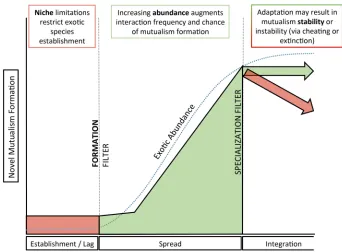
Basic evolutionary and ecological research focused on emergent ecosystem properties has explored the factors driving mutualism formation. Benefits of mutualisms can be contextual (Bronstein 2001; Hay et al. 2004), leading to questions about the circum-stances and strength of selection required for mutualisms to form (Sachs et al 2004; Foster and Wenseleers 2006) and persist. Species that form novel mutualisms must either be 1) initially capable of surviving and reproducing without mutualism (faculta-tive) or 2) interactors that can form new, necessary mutualisms with little regard for partner identity (generalist) (Brodie et al. 2014). Species requiring mutualism to sur-vive or reproduce may fail to recruit in a new ecosystem early in the invasion process, before novel relationships can develop (Fig. 1; Theoharides and Dukes 2007; Richard-son and Pyšek 2012). Consistently, most examples of novel mutualisms are both facul-tative and generalist (Traveset and Richardson 2014). This parallels our contemporary understanding of most native-native mutualisms (Blüthgen et al. 2007).
Thus, novel mutualisms appear to recapitulate a general mutualism tendency to be facultative, particularly early in the mutualism formation process. Known faculta-tive novel mutualisms include most novel seed dispersal relationships (e.g., Lenda et al. 2012), ant-plant and ant-insect mutualisms (Ness and Bronstein 2004), and a single example of a novel cleaning relationship: ectoparasite removal from non-native cows,
plants appear to be self-compatible or able to reproduce vegetatively, making animal-mediated pollination facultative in these cases (Burns et al. 2011). There are, however, exceptions: several aggressive invasive plants, such as purple loosestrife (Lythrum sali-caria), Amur honeysuckle (Lonicera maackii), and multiflora rose (Rosa multiflora), dif-fer from this pattern and demonstrate a stronger dependence on pollinators, partnering with generalist species during establishment (e.g., Jesse et al. 2006). Belowground, for-mation of novel associations between plants and soil microbes still occur readily (Trave-set and Richardson 2014), despite the reduction of benefits in some cases. For example, non-native and native legumes in a Mediterranean shrubland formed partnerships with non-native rhizobia, despite the fact that benefits for native plants from the association were far below those typical of native rhizobial associations (Rodríguez-Echeverría et. al. 2012). Similarly, the evolution of reduced mycorrhizal dependency of non-native plants
is evident from field data drawn from different populations of the same plant (Seifert et al. 2009). A notable exception is ectomycorrhizal (EcM) plants invading ecosystems in the Southern hemisphere that rely on mycorrhizas to establish and spread (Richardson et al. 2000). The complementary dependence of non-native soil biota on native host mutualisms is poorly studied. Most soil mutualists (e.g. mycorrhizal fungi, rhizobia, etc.) must form associations to complete their life cycle, although benefits from novel associations for the few EcM species studied may be reduced (Vellinga et al. 2009).
To our knowledge, there are only two documented examples of novel mutualisms in marine systems. One such novel marine mutualism is also facultative. The native sediment dwelling polychaete Diopatra cuprea in the mid-Atlantic U.S. incorporates the invasive red alga Gracilaria vermiculophylla into its decorated tube caps (Thomsen and McGlathery 2005). The non-native alga is also found unattached, but the stable attach-ment point of Diopatra tube caps increases its longevity and growth rate (Thomsen et al. 2009) and biomass (Byers et al. 2012). Although the nature of the reciprocal benefits of
G. vermiculophylla to D. cuprea have not been investigated, D. cuprea generally receives shelter and food from the algae it hosts and favors attaching G. vermiculophylla over other native algal species (Thomsen and McGlathery 2005). The other, newly-discovered marine novel mutualism involves a non-native zooxanthella that partners with corals in the Caribbean, with mixed fitness implications: the novel partnership results in increased heat tolerance but reduced calcification for the native partners (Pettay et al. 2015).
Does the lack of other marine examples of novel mutualisms arise from a dearth of research or from a true lack of novel mutualism formation? The few other relevant research attempts in marine systems have failed to detect novel mutualisms. For exam-ple, an unusual zooxanthella found in a native Hawaiian coral, once considered a novel mutualism, is instead of cryptogenic origin (LaJeunesse et al. 2008). A search for novel coral-endosymbiont mutualisms in Jamaica was fruitless, despite a high probability of detection due to both the long-term establishment of an Indo-Pacific non-native coral and its common acquisition of endosymbionts by horizontal transfer in its native range (LaJeunesse et al. 2005). Observations of the invasive lionfish, Pterois volitans, loiter-ing at reef cleanloiter-ing stations throughout its invaded range in the Caribbean appear to be the behavior of a sit-and-wait predator (Côté and Maljkovic 2010) rather than the formation of a novel mutualism. In spite of these notable absences, however, a consid-erable increase in marine novel mutualism research is needed before it will be possible to conclude that the formation of novel marine mutualisms is rare and to consider the implications of such rarity for marine mutualism formation. Observation of this research gap may in itself increase awareness and detection.
Informing our understanding of mutualism stability using novel mutualisms
predominates, mutualisms can become parasitic, with only one partner benefiting (Bron-stein 1994a). Mutualism networks containing “cheating” partners, however, may occur only when beneficial partners are also present (Weyl et al 2010). Species that are general-ist, partnering with many mutualistic partners, are likely to obtain mutualistic currencies from some partners, and thus to continue to participate in mutualisms even in the pres-ence of cheaters. Mutualism stability is also a consideration when mutualisms become more specialized or obligate over time and partners are at risk of extinction (Thébault and Fontaine 2010). Once again, mutualism stability may be enhanced by generalist partnerships, wherein each species has multiple partners so loss of a specific partner car-ries reduced impact. Mutualism specialization can evolve when fitness enhancements offset the enhanced probability of mutualism disruption (Schemske and Horvitz 1984). As early stage mutualisms, novel mutualists may derive lower levels of benefit on a per-mutualistic-interaction basis, but could be more stable than native mutualisms that have formed over a longer timeframe and more commonly exhibit specialization and cheating.
Since generality logically confers increased stability and reduces dependence on cheating or at-risk partners, it is unsurprising that mutualism network literature has demonstrated that generality is extremely common (e.g., Bascompte and Jordano 2014). Certain non-native mutualists appear to take this generality to an extreme, acting as “super-generalists” in novel mutualism networks (Olesen et al. 2002). Stud-ies focused on individual specStud-ies and their interactions have similarly detected high generality in novel mutualisms. For example, non-native ants that have been reported to partner with native plant species are generalists interacting with a wide variety of species across a global range (Ness and Bronstein 2004). Tending mutualisms between introduced ant species and native aphids are often similarly diffuse, with each ant spe-cies interacting with a number of aphid spespe-cies (Ness and Bronstein 2004). Non-na-tive species acting opportunistically can be generalist mutualists under some contexts and cheaters under others; the non-native Japanese white-eye (Zosterops japonicus), for example, nectar-robs some endemic Hawaiian plant flowers but pollinates others (Aslan et al. 2014). Recent evidence that Douglas fir (Pseudotsuga menziesii) invading New Zealand can readily form mutualisms with a diversity of native ectomycorrhizal fungi (Moeller et al. 2015) runs counter to other ectomycorrhizal invasive plants in the Southern hemisphere whose associations appear restricted to cosmopolitan or co-invading fungi (Nuñez et al. 2009; Dickie et al. 2010; Bogar et al. 2015). While no research has explored the network impact or stability of these interactions, we can logi-cally predict that diverse associations may enhance stability.
Using novel mutualisms to improve our understanding of the impor-tance of functional traits in community composition
exam-ple, pollination syndromes and functional groups of effective partners can generally be defined by flower morphology, color, and reward type of a plant species (Fenster et al. 2004). Additionally, mutualisms appear to underlie the evolution of remarkable traits (Bronstein et al. 2006) such as unique morphologies and behaviors, effectively expand-ing the trait-space of a community. New understandexpand-ing of major ecological processes, such as community assembly and environmental gradient effects, has come from tak-ing a trait-based approach (McGill et al. 2006; Kraft and Ackerly 2014). Examintak-ing novel mutualisms through this lens has the potential to be especially revealing about the role of positive biotic interactions in community assembly (Sargent and Ackerly 2008), but this type of approach has thus far primarily investigated the prevalence of negative biotic interactions like interspecific competition and natural enemies.
How then, do newly arriving non-native species fit into an existing landscape of functional traits and functional group partnerships within a community? Trait-based methods can distinguish environmental filtering and community-level niche partitioning (Kraft et al. 2008). Under environmental filtering, trait-space should be constrained within a locale relative to that of the regional species pool, whereas com-munity level niche partitioning occurs when traits are more evenly spaced than would be expected by chance due to interspecific competition (Kraft et al. 2006). If assembly rules are general, non-native species should, in the aggregate, pack accordingly into an environmentally constrained trait-space and/or exhibit divergent traits that may per-mit the filling of empty niches. Studies provide support for these processes (Ordonez et al. 2010; Tecco et al. 2010). In agreement with niche partitioning, species may be more likely to be invasive if they are functionally distinct from the native community and thus able to occupy vacant niches or possess novel weapons (Callaway et al. 2004). On the other hand, sheer propagule pressure (the abundance of the non-native species) has also been shown to underlie invasiveness (Lockwood et al. 2005).
and Rejmánek 2010). Most invasive plants also readily form belowground symbioses, despite the fact that not providing resources to soil biota should give invaders a distinct advantage (e.g. Brassica spp., Traveset and Richardson 2014). Interestingly, reduced mycorrhizal dependency of Hypericum perforatum in its invaded range is strongly corre-lated to specific changes in root architecture (Seifert et al. 2009). However, it is unclear whether other functional traits generally predispose non-native species to novel below-ground mutualisms. Novel mutualisms offer the opportunity to describe the nature of the community filter at the front end of the mutualism formation process (Fig. 1).
The role of neutral and niche processes in novel mutualisms
As incipient partnerships, novel mutualisms also offer a unique opportunity to assess the relative importance of interaction frequency as driven by abundance, a neutral process, with that of adaptive traits that provide specific mutualistic benefits defined by the niches of their potential partners (Kaiser-Bunbury et al. 2014). This comparison is particularly valuable given the rapid increase in abundance of non-native species that become invasive, and the relative importance of these two mechanisms may be dictated by the particular stage of spread of a non-native species (Fig. 1).
in dependence on an unreliable partner, a process typical of an evolutionary dead-end (Schlaepfer et al. 2002).
The relative importance of neutral vs. niche processes may also be explored through mutualistic network models. For example, asymmetric specialization or nestedness is a pervasive feature of known mutualistic networks (Vázquez and Aizen 2004; Bas-compte and Jordano 2014; but see Blüthgen 2010) in which the abundant, generalist species in one trophic group (e.g., plants) preferentially interact with many rare, spe-cialist species in the other trophic group (e.g., pollinators) and vice versa. “Forbidden links” in mutualistic networks result from niche differences, when species do not over-lap in space or time (e.g., a plant flowers and senesces before an insect emerges, sensu
Bascompte and Jordano 2014). Non-native species, particularly after establishment, may be present across more seasons and in more locations than natives, reducing the occurrence of “forbidden links” in the community. For example, Calotropis procera
flowers and fruits continuously in invaded Brazilian shrublands compared with a 2-6 month window in its native range, potentially bridging the phenological gap between native species that often flower in either the dry or wet season (Sousa Sobrinho et al. 2013). Similarly, the non-native tree Ligustrum lucidum presents food at a different season than its co-occurring native fleshy-fruited trees in Argentinian dry forests, pro-viding frugivores with a fruit resource in an otherwise resource-poor season (Ferreras et al. 2008). Thus, non-native species that become abundant may serve as constant and abundant partners for native mutualists, bridging modules in mutualistic networks that are separated by space or time (Olesen et al. 2007). The inclusion of abundant non-natives into native mutualism networks does appear to shift the behavior or traits of native mutualists (Olesen et al. 2002; Aizen et al 2008; Kaiser-Bunbury et al 2011). Clearly, the relative importance of niche and neutral processes in mutualisms is a topic that requires greater investigation, and novel mutualisms present such an opportunity.
Tackling new questions and new systems with novel mutualism research
has included examples of generalizable concepts developed in marine systems (e.g., key-stone species, Paine 1969; trophic cascade research, Strong 1992). If a true dearth of novel ecosystems in marine systems exists, the development of theory surrounding their absence may help us to better understand fundamental differences among systems.
A diversity of modern research challenges may benefit from a better understand-ing of mutualism formation and stability and of the roles of functional traits and niche and neutral processes in emergent ecosystem properties. As one example, we can focus on microbial mutualisms, increasingly being recognized as critical players in a wide diversity of previously-unknown contexts (Redford et al. 2012; Sikes et al. 2012). Ecological research on gut and cutaneous microbial mutualisms in animals is still in its infancy, particularly compared to that of endophytic plant mutualists (McFall-Ngai 2008). Mutualisms with microorganisms include diffuse (e.g., lichens; O’Brien et al. 2005), generalist (e.g., some gut bacteria; Montalto et al. 2009), and specialized (e.g., endophytes; Arnold and Lutzoni 2007) partnerships. Most animal-microbial symbioses are thought to be obligate mutualisms (e.g., some Wolbachia-host relationships; Kozek and Rao 2007), but microbial invasions are likely rampant and may follow similar rules as invasions by macrobiota (Litchman 2010). Understanding these invasions is more than academic; novel microbial mutualisms may play an in-creasingly important role in conservation. For example, the emerging fungal pathogen
Batrachochytrium dendrobatidis is causing global declines in amphibian populations, stimulating conservation research into the potential for inoculation of healthy amphib-ians with protective skin microbiota in order to reduce susceptibility to the pathogen
Table 1. Examples of questions in ecology and evolutionary biology that could be addressed with novel mutualisms as focal systems.
Research questions Basic ecology
• Do novel mutualisms promote stability, resilience, and diversity in ecological communities, as native-native mutualisms appear to do?
• Do mutualistic networks containing non-native species demonstrate the same architectural traits or level of stability as native networks?
• Do novel mutualisms result from availability of open ecological niches?
• Might specialization, at the level of the non-native or native interactors, dictate whether novel mutualisms can form?
• When non-natives establish in interaction networks, to what degree and in what ways are they redundant with native participants?
• Are some types of interaction networks more easily invaded?
• Are invaded networks more or less resilient to future extinctions than non-invaded networks?
Evolutionary biology
• What can the formation of novel mutualisms—where coevolutionary history is lacking—tell us about mutualism evolution?
(Daskin and Alford 2012). Given the enormous diversity of microorganisms, research in this field holds much promise (McFall-Ngai 2008) and provides a potential proving ground for many of the predictions of this Commentary.
Conclusion
Biological invasions will continue to foment novel mutualisms in every system, with unforeseen consequences for native communities. These organisms provide unprec-edented opportunity to observe the early stages of interaction development, and to directly observe processes that can be addressed only inferentially using traditional study systems and species. We suggest that novel mutualisms represent an excellent test arena for current understanding of mutualism formation, mutualism stability, func-tional traits, and niche vs. neutral processes. Novel mutualisms lend themselves to an expanded set of questions and research systems. Expansion and deepening of novel mutualism research can create synergy between invasion biology, basic ecology, and evolutionary biology, to the mutual benefit of all three.
Acknowledgments
The development of this manuscript benefitted greatly from discussions with many of the SCB Smith Fellows, from logistical support from S. Foster and M. Dombeck, and from conversations with J. DeBose, J. Stachowicz, and E. Sotka. We thank M. Rejmánek and N. Blüthgen for several helpful comments on early drafts, and several anonymous reviewers for encouraging us to seek novel approaches with this manu-script. The research was supported by David H. Smith Conservation Research Fellow-ships to CA, BS, and KG.
References
Aizen MA, Morales CL, Morales JM (2008) Invasive mutualists erode native pollination webs. PLoS Biology 6: e31. doi: 10.1371/journal.pbio.0060031
Aizen MA, Sabatino M, Tylianakis JM (2012) Specialization and rarity predict nonrandom loss of interactions from mutualist networks. Science 335: 1486–1489. doi: 10.1126/sci-ence.1215320
Arnold AE, Lutzoni F (2007) Diversity and host range of foliar fungal endophytes: are tropical leaves biodiversity hotspots? Ecology 88: 541–549. doi: 10.1890/05-1459
Aslan CE, Zavaleta ES, Tershy B, Croll D, Robichaux RH (2014) Imperfect replacement of native species by non-native species as pollinators of endemic Hawaiian plants. Conservation Biology 28: 478–488. doi: 10.1111/cobi.12193
Bascompte J, Jordano P (2014) Mutualistic networks. Princeton University Press, Princeton, NJ. Blüthgen N (2010) Why network analysis is often disconnected from community ecology: a
critique and an ecologist's guide. Basic and Applied Ecology 11: 185–195. doi: 10.1016/j. baae.2010.01.001
Blüthgen N, Menzel F, Hovestadt T, Fiala B, Blüthgen N (2007) Specialization, constraints, and conflicting interests in mutualistic networks. Current Biology 17: 341–346. doi: 10.1016/j.cub.2006.12.039
Bogar LM, Dickie IA, Kennedy PG (2015) Testing the co-invasion hypothesis: ectomycorrhizal fungal communities on Alnus glutinosa and Salix fragilis in New Zealand. Diversity and Distributions 21: 268–278. doi: 10.1111/ddi.12304
Bradshaw CJA, White WW (2006) Rapid development of cleaning behavior by Torresian crows
Corvus orru on non-native banteng Bos javanicus in northern Australia. Journal of Avian Biology 37: 409–411. doi: 10.1111/j.2006.0908-8857.03595.x
Brodie JF, Aslan CE, Rogers HS, Redford KH, Maron JL, Bronstein JL, Groves CR (2014) Secondary extinctions of biodiversity. Trends in Ecology and Evolution 29: 664–672. doi: 10.1016/j.tree.2014.09.012
Bronstein JL (1994a) Conditional outcomes in mutualistic interactions. Trends in Ecology and Evolution 9: 214–217. doi: 10.1016/0169-5347(94)90246-1
Bronstein JL (1994b) Our current understanding of mutualisms. Quarterly Review of Biology 69: 31–51. doi: 10.1086/418432
Bronstein JL (2001) The exploitation of mutualisms. Ecology Letters 4: 277–287. doi: 10.1046/j.1461-0248.2001.00218.x
Bronstein JL (2009) The evolution of facilitation and mutualism. Journal of Ecology 97: 1160–1170. doi: 10.1111/j.1365-2745.2009.01566.x
Bronstein JL, Alarcón R, Geber M (2006) The evolution of plant-insect mutualisms. New Phytologist 172: 412–428. doi: 10.1111/j.1469-8137.2006.01864.x
Bronstein JL, Dieckmann U, Ferrière R (2004) Evolutionary conservation biology. Cambridge University Press, Cambridge, UK.
Bruno JF, Stachowicz JJ, Bertness MD (2003) Inclusion of facilitation into ecological theory. Trends in Ecology and Evolution 18: 119–125. doi: 10.1016/S0169-5347(02)00045-9 Burns JH, Ashman T-L, Steets JA, Harmon-Threatt AN, Knight TM (2011) A phylogenetically
controlled analysis of the roles of reproductive traits in plant invasions. Oecologia 166: 1009–1017. doi: 10.1007/s00442-011-1929-9
Byers JE, Gribben PE, Yeager C, Sotka EE (2012) Impacts of an abundant introduced ecosystem engineer within mudflats of the southeastern US coast. Biological Invasions 14: 2587–2600. doi: 10.1007/s10530-012-0254-5
Callaway RM, Ridenour WM (2004) Novel weapons: invasive success and the evolution of increased competitive ability. Frontiers in Ecology and the Environment 2: 436–443. doi: 10.1890/1540-9295(2004)002[0436:NWISAT]2.0.CO;2
Daskin JH, Alford RA (2012) Context-dependent symbioses and their potential role in wildlife diseases. Proceedings of the Royal Society B Biological Sciences 279: 1457–1465. doi: 10.1098/rspb.2011.2276
Dickie IA, Bolstridge N, Cooper JA, Peltzer DA (2010) Co-invasion by Pinus and its mycorrhizal fungi. New Phytologist 187: 475–484. doi: 10.1111/j.1469-8137.2010.03277.x
Fenster CB, Armbruster WS, Wilson P, Dudash MR, Thomson JD (2004) Pollination syndromes and floral specialization. Annual Review of Ecology, Evolution, and Systematics 35: 375–403. doi: 10.1146/annurev.ecolsys.34.011802.132347
Ferreras AE, Torres C, Galetto L (2008) Fruit removal of an invasive exotic species (Ligustrum lucidum) in a fragmented landscape. Journal of Arid Environments 72: 1573–1580. doi: 10.1016/j.jaridenv.2008.03.015
Ferriere R, Bronstein JL, Rinaldi S, Law R, Gauduchon M (2002) Cheating and the evolu-tionary stability of mutualisms. Proceedings of the Royal Society B 269: 773–780. doi: 10.1098/rspb.2001.1900
Foster JT, Robinson SK (2007) Introduced birds and the fate of Hawaiian rainforests. Conser-vation Biology 21: 1248–1257. doi: 10.1111/j.1523-1739.2007.00781.x
Foster KR, Wenseleers T (2006) A general model for the evolution of mutualisms. Journal of Evolutionary Biology 19: 1283–1293. doi: 10.1111/j.1420-9101.2005.01073.x
Hay ME, Parker JD, Burkepile DE, Caudill CC, Wilson AE, Hallinan ZP, et al. (2004) Mu-tualisms and aquatic community structure: The enemy of my enemy is my friend. Annual Review of Ecology, Evolution, and Systematics 35: 175–197. doi: 10.1146/annurev.ecol-sys.34.011802.132357
Janzen DH (1985) The natural history of mutualisms. In: Boucher DH (Ed.) The biology of mutualism: ecology and evolution. Oxford University Press, Oxford, 40–99.
Jesse LC, Moloney KA, Obrycki JJ (2006) Insect pollinators of the invasive plant, Rosa multiflora
(Rosaceae), in Iowa, USA. Weed Biology and Management 6: 235–240. doi: 10.1111/j.1445-6664.2006.00221.x
Kaiser-Bunbury CN, Vázquez DP, Stang M, Ghazoul J (2014) Determinants of the microstructure of plant-pollinator networks. Ecology 95: 3314–3324. doi: 10.1890/14-0024.1
Kaiser‐Bunbury CN, Valentin T, Mougal J, Matatiken D, Ghazoul J (2011) The tolerance of island plant-pollinator networks to alien plants. Journal of Ecology 99: 202–213. doi: 10.1111/j.1365-2745.2010.01732.x
Kiers ET, Palmer TM, Ives AR, Bruno JF, Bronstein JL (2010) Mutualisms in a changing world: an evolutionary perspective. Ecology Letters 13: 1459–1474. doi: 10.1111/j.1461-0248.2010.01538.x
Klironomos JN (2003) Variation in plant response to native and exotic arbuscular mycorrhizal fungi. Ecology 84: 2292–2301. doi: 10.1890/02-0413
Kozek WJ, Rao RU (2007) The discovery of Wolbachia in arthropods and nematodes--A historical perspective. Issues in Infectious Diseases 5: 1–14. doi: 10.1159/000104228
Kraft NJB, Ackerly DD (2014) Assembly of plant communities. In: Monson RK (Ed.) Ecol-ogy and the environment, the plant sciences. Springer Science, New York, 66–85. doi: 10.1007/978-1-4614-7501-9_1
Lekberg Y, Gibbons SM, Rosendahl S, Ramsey PW (2013) Severe plant invasions can in-crease mycorrhizal fungal abundance and diversity. The ISME Journal 7: 1424–1433. doi: 10.1038/ismej.2013.41
LaJeunesse TC, Lee S, Bush S, Bruno JF (2005) Persistence of non-Caribbean algal symbionts in Indo-Pacific mushroom corals released to Jamaica 35 years ago. Coral Reefs 24: 157–159. doi: 10.1007/s00338-004-0436-4
LaJeunesse TC, Loh W, Trench RK (2008) Do introduced endosymbiotic dinoflagellates "take" to new hosts? Biological Invasions 11: 995–1003. doi: 10.1007/s10530-008-9311-5 Lenda M, Skórka P, Knops JMH, Morón D, Tworek S, Woyciechowski M (2012) Plant
estab-lishment and invasions: an increase in a seed disperser combined with land abandonment causes an invasion of the non-native walnut in Europe. Proceedings of the Royal Society B-Biological Sciences 279: 1491–1497. doi: 10.1098/rspb.2011.2153
Litchman E (2010) Invisible invaders: non-pathogenic invasive microbes in aquatic and terres-trial ecosystems. Ecology Letters 13: 1560–1572. doi: 10.1111/j.1461-0248.2010.01544.x Lockwood JL, Cassey P, Blackburn T (2005) The role of propagule pressure in explaining species
invasions. Trends in Ecology and Evolution 20: 223–228. doi: 10.1016/j.tree.2005.02.004 McFall-Ngai M (2008) Are biologists in 'future shock'? Symbiosis integrates biology across
domains. National Review of Microbiology 6: 789–792. doi: 10.1038/nrmicro1982 McGill BJ, Enquist BJ, Weiger E, Westoby M (2006) Rebuilding community ecology
from frunctional traits. Trends in Ecology and Evolution 21: 178–185. doi: 10.1016/j. tree.2006.02.002
McIver J, Thorp R, Erickson K (2009) Pollinators of the invasive plant, yellow starthistle ( Centau-rea solstitialis), in north-eastern Oregon, USA. Weed Biology and Management 9: 137–145. doi: 10.1111/j.1445-6664.2009.00331.x
Moeller HV, Dickie IA, Peltzer D, Fukami T (2015) Mycorrhizal co-invasion and novel interac-tions depend on neighborhood context. Ecology. doi: 10.1890/14-2361.1
Montalto M, D'Onofrio F, Gallo A, Cazzato A, Gasbarrini G (2009) Intestinal microbiota and its functions. Digestive Liver Diseases S 3: 30–34. doi: 10.1016/S1594-5804(09)60016-4 Montoya JM, Pimm SL, Solé RV (2006) Ecological networks and their fragility. Nature 442:
259–264. doi: 10.1038/nature04927
Ness JH (2003) Contrasting exotic Solenopsis invicta and native Forelius pruinosus ants as mutualists with Catalpa bignonioides, a native plant. Ecological Entomology 28: 247–251. doi: 10.1046/j.1365-2311.2003.00500.x
Ness JH, Bronstein JL (2004) The effects of invasive ants on prospective ant mutualists. Biological Invasions 6: 445–461. doi: 10.1023/B:BINV.0000041556.88920.dd
Nu-ez MA, Horton TR, Simberloff D (2009) Lack of belowground mutualisms hinders Pinaceae invasions. Ecology 90: 2352–2359. doi: 10.1890/08-2139.1
O'Brien HE, Miadlikowska J, Lutzoni F (2005) Assessing host specialization in symbiotic cyano-bacteria associated with four closely related species of the lichen fungus Peltigera. Eruopean Journal of Phycology 40: 363–378. doi: 10.1080/09670260500342647
Olesen JM, Bascompte J, Dupont YL, Jordano P (2007) The modularity of mutualistic net-works. Proceedings of the National Academy of Sciences 104: 19891–19896. doi: 10.1073/ pnas.0706375104
Ordonez A, Wright IJ, Olff H (2010) Functional differences between native and alien spe-cies: a global-scale comparison. Functional Ecology 24: 1353–1361. doi: 10.1111/j.1365-2435.2010.01739.x
Paine RT (1969) The pisaster-tegula interaction: Prey patches, predator food preference, and intertidal community structure. Ecology 60: 950–961. doi: 10.2307/1936888
Pettay DT, Wham DC, Smith RT, Iglesias-Prieto R, LaJeunesse TC (2015) Microbial invasion of the Caribbean by an Indo-Pacific coral zooxanthella. Proceedings of the National Acad-emy of Sciences 112: 7513–7518. doi: 10.1073/pnas.1502283112
Redford KH, Segre JA, Salafsky N, Martinez del Rio C, McAloose D (2012) Conserva-tion and the microbiome. ConservaConserva-tion Biology 26: 195–197. doi: 10.1111/j.1523-1739.2012.01829.x
Richardson DM, Allsopp N, D'Antonio CM, Milton SJ, Rejmánek M (2000) Plant invasions--the role of mutualisms. Biology Review 75: 65–93. doi: 10.1017/S0006323199005435 Richardson D, Pyšek P (2012) Naturalization of introduced plants: ecological drivers
of biogeographical patterns. New Phytologist 196: 383–396. doi: 10.1111/j.1469-8137.2012.04292.x
Rodríguez-Echeverría S, Fajardo S, Ruiz-Díez B, Fernández-Pascual M (2012) Differential ef-fectiveness of novel and old legume-rhizobia mutualisms: implications for invasion by ex-otic legumes. Oecologia 170: 253–261. doi: 10.1007/s00442-012-2299-7
Sachs JL, Mueller UG, Wilcox TP, Bull JJ (2004) The evolution of cooperation. Quarterly Review of Biology 79: 135–160. doi: 10.1086/383541
Sargent RD, Ackerly DD (2008) Plant-pollinator interactions and the assembly of plant com-munities. Trends in Ecology and Evolution 23: 123–130. doi: 10.1016/j.tree.2007.11.003 Sargent RD, Kembel SW, Emery NC, Forrestel EJ, Ackerly DD (2011) Effects of local com-munity phylogenetic structure on pollen limitation in an obligately insect-pollinated plant. American Journal of Botany 98: 283–289. doi: 10.3732/ajb.1000329
Schemske DW, Horvitz CC (1984) Variation among floral visitors in pollination ability: a precondition for mutualism specialization. Science 225: 519–521. doi: 10.1126/sci-ence.225.4661.519
Schlaepfer MA, Runge MC, Sherman PW (2002) Ecological and evolutionary traps. Trends in Ecology and Evolutionary Biology 17: 474–480. doi: 10.1016/S0169-5347(02)02580-6 Seifert EK, Bever JD, Maron JL (2009) Evidence for the evolution of reduced mycorrhizal
dependence during plant invasion. Ecology 90: 1055–1062. doi: 10.1890/08-0419.1 Sikes BA (2012) Internalizing conservation through our own microbes. Conservation Biology
26: 198. doi: 10.1111/j.1523-1739.2012.01834.x
Sousa Sobrinho M, Machado Tabatinga G, Machado IC, Lopes AV (2013) Reproductive phe-nological pattern of Calotropis procera (Apocynaceae), an invasive species in Brazil: annual in native areas; continuous in invaded areas of caatinga. Acta Brasilia Botanica 27: 456–459. doi: 10.1590/S0102-33062013000200018
Strong DR (1992) Are trophic cascades all wet? Differentiation and donor-control in speciose ecosystems. Ecology 73: 747–754. doi: 10.2307/1940154
Tecco PA, Diaz S, Cabido M, Urcelay C (2010) Functional traits of alien plants across contrast-ing climatic and land-use regimes: do aliens join the locals or try harder than them? Journal of Ecology 98: 17–27. doi: 10.1111/j.1365-2745.2009.01592.x
Thébault E, Fontaine C (2010) Stability of ecological communities and the architecture of mutualistic and trophic networks. Science 329: 853–856. doi: 10.1126/science.1188321 Theoharides K, Dukes JS (2007) Plant invasion across space and time: factors affecting
nonin-digenous species success during four stages of invasion. New Phytologist 176: 256–273. doi: 10.1111/j.1469-8137.2007.02207.x
Thomsen MS, McGlathery K (2005) Facilitation of macroalgae by the sedimentary tube-forming polychaete Diopatra cuprea. Estuarine, Coastal, and Shelf Science 62: 63–73. doi: 10.1016/j.ecss.2004.08.007
Thomsen MS, McGlathery K, Schwarzschild A, Silliman BR (2009) Distribution and ecological role of the non-native macroalga Gracilaria vermiculophylla in Virginia salt marshes. Biological Invasions 11: 2303–2316. doi: 10.1007/s10530-008-9417-9
Traveset A, Richardson DM (2006) Biological invasions as disruptors of plant reproductive mu-tualisms. Trends in Ecology and Evolution 21: 208–216. doi: 10.1016/j.tree.2006.01.006 Traveset A, Richardson DM (2014) Mutualistic interactions and biological invasions. Annual
Review of Ecology, Evolution, and Systematics 45: 89–113. doi: 10.1146/annurev-ecol-sys-120213-091857
Vázquez DP, Aizen MA (2004) Asymmetric specialization: a pervasive feature of plant-pollinator interactions. Ecology 85: 1251–1257. doi: 10.1890/03-3112
Vellinga EC, Wolfe BE, Pringle A (2009) Global patterns of ectomycorrhizal introductions. New Phytologist 181: 960–973. doi: 10.1111/j.1469-8137.2008.02728.x