Isotrema sanyaense, a new species of Aristolochiaceae from Hainan, China 85
Isotrema sanyaense
, a new species of Aristolochiaceae
from Hainan, China
Rongtao Li1, Zhiwei Wang2, Jun Wang3, Xinxin Zhu3, Han Xu4
1 Hainan Branch of the Institute of Medicinal Plant Development, Chinese Academy of Medical Sciences & Peking Union Medical College, Haikou, Hainan, 570100, China 2 College of Pharmacy, Guizhou University of Traditional Chinese Medicine, Guiyang, Guizhou, 550002, China 3 College of Life Sciences, Xinyang Nor-mal University, Xinyang, Henan, 464000, China 4 Research Institute of Tropical Forestry, Chinese Academy of Forestry, Longdong, Guangzhou 510520, China
Corresponding author:Zhiwei Wang ([email protected])
Academic editor:Leandro Giacomin | Received 2 April 2019 | Accepted 24 July 2019 | Published 12 August 2019
Citation: Li R, Wang Z, Wang J, Zhu X, Xu H (2019) Isotrema sanyaense, a new species of Aristolochiaceae from Hainan, China. PhytoKeys 128: 85–96. https://doi.org/10.3897/phytokeys.128.35042
Abstract
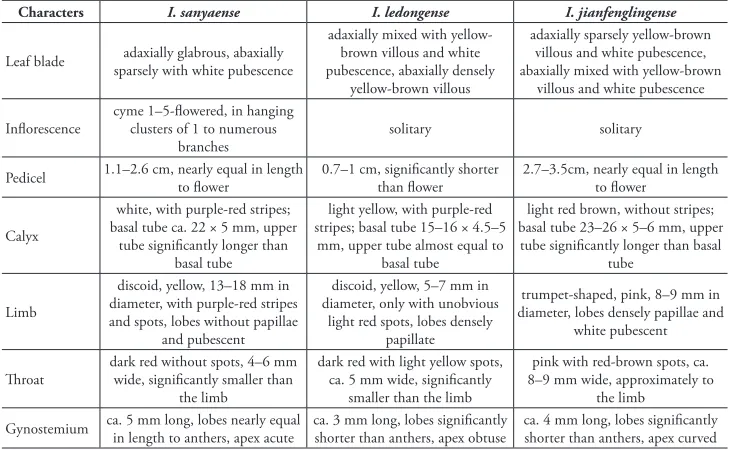
Isotrema sanyaense R.T.Li, X.X.Zhu & Z.W.Wang, sp. nov., a new species from Hainan island, China, is described and illustrated here. It is morphologically most similar to I. ledongense (Han Xu, Y.D.Li & H.J.Yang) X.X.Zhu, S.Liao & J.S.Ma and I. jianfenglingense (Han Xu, Y.D.Li & H.Q.Chen) X.X.Zhu, S.Liao & J.S.Ma in the shape of leaf, flower, and the yellow to brown villous indumentum of the pedi-cel, ovary and calyx. However, I. sanyaense can be easily distinguished from the latter two species by its 1–5-flowered cymes, in hanging clusters of 1 to numerous branches, upper calyx tube obviously longer than basal calyx tube, calyx limb discoid, yellow inside, with purple-red stripes and spots, about 13– 18 mm in diameter, glabrous, and a throat dark red without spots, 4–6 mm wide.
Keywords
Aristolochia, Aristolochia subgenus Siphisia, Asia, morphology, taxonomy
Introduction
Isotrema Raf. (Aristolochiaceae), previously treated as a subgenus of Aristolochia L., was recently reinstated as an independent genus based on molecular and morphological evidence (Zhu et al. 2019). It differs from other genera of Aristolochiaceae by a com-bination of characters: calyx strongly curved, gynostemium 3-lobed, anthers paired on the outer surface of each gynostemium segment, and capsule dehiscing basipetally
PhytoKeys 128: 85–96 (2019) doi: 10.3897/phytokeys.128.35042 http://phytokeys.pensoft.net
Copyright Rongtao Li et al. This is an open access article distributed under the terms of the Creative Commons Attribution License (CC BY 4.0), which permits unrestricted use, distribution, and reproduction in any medium, provided the original author and source are credited.
RESEARCH ARTICLE
Launched to accelerate biodiversity research
(Do et al. 2015a, Zhu et al. 2019). Currently, Isotrema comprises 99 species and one subspecies, mainly distributed in East and South Asia, with some species scattered in North and Central America (Zhou et al. 2019, Zhu et al. 2019). China accommodates 59 species and one subspecies, of which 47 species and one subspecies are endemic to the country (Hwang et al. 2003, Zhou et al. 2019, Zhu et al. 2019).
During our field investigations to South Hainan Province, China, in 2017 and 2018, an unknown species of Aristolochiaceae was discovered. The horseshoe-shaped calyx tube, 3-lobed calyx limb and gynostemium, anthers adnate in pairs opposite the gynostemium lobes, and capsule dehiscing basipetally indicate it to be a member of Isotrema. After comparing with other species of the genus, we confirmed that the unidentified species from Hainan island represents a new taxon, so here, we describe and illustrate it.
Material and methods
Measurements and assessments of morphological data of the species described here were based on living plants obtained in the wild. Flowering and fruiting branches were pressed to specimens and deposited in the CSH and KUN herbaria (herbarium acro-nyms follow Thiers 2019). The comparison among similar species was based on exten-sive revision of specimens (including types) of Isotrema in A, BM, BR, CDBI, CSFI, CSH, E, EMA, GXMI, HAST, HENU, HHBG, HIB, HITBC, HNWP, IBK, IBSC, K, KUN, KYO, L, LBG, LE, NAS, NTUF, P, PE, PEM, SM, SNU, SYS, TAI, TI, W, WCU, WU, WUK, XYTC and YUKU herbaria, as well as related literature (Cheng et al. 1988, Ma 1989a, 1989b, Hwang et al. 2003, Ohi-Toma et al. 2006, Xu et al. 2011, Do et al. 2015a, 2015b, Ohi-Toma and Murata 2016, Zhu et al. 2016, 2017a, 2017b, 2018, Gong et al. 2018, Yang et al. 2018).
Taxonomy
Isotrema sanyaense R.T.Li, X.X.Zhu & Z.W.Wang, sp. nov.
urn:lsid:ipni.org:names:77200836-1
Figs 1–3
Isotrema sanyaense, a new species of Aristolochiaceae from Hainan, China 87
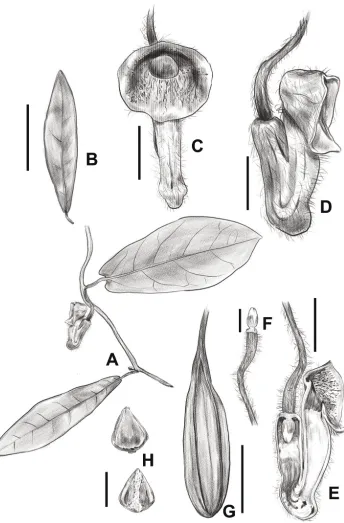
Figure 2. Isotrema sanyaense R.T.Li, X.X.Zhu & Z.W.Wang, sp. nov. A habit B leaves (adaxially and abaxially) C inflorescence D flower (lateral view) E opened flower (showing the inside structure) F anthers and gynostemium G fruit H seeds. Scale bars: 1 cm (B, C); 2 cm (D, E, G); 5 mm (F, H).
Type. CHINA. Hainan: Sanya City, Haitang District, Haitangwan Town, 18°17'22"N, 109°39'45"E, 332m a.s.l., 28 October 2017 (fl), X.X.Zhu & R.T.Li ZXX17105 (holotype: CSH-0146607!; isotype: CSH!, KUN!).
Isotrema sanyaense, a new species of Aristolochiaceae from Hainan, China 89
throat dark red, 4–6 mm wide. Anthers 6, oblong, ca. 2.2 mm long, adnate in 3 pairs to base of gynostemium, opposite to lobes, dehiscence longitudinal. Gynostemium ca. 5 mm long, 3-lobed, apex acute; ovary inferior, 6-loculed, abaxially densely villous, with yellow to brown trichomes; ovules numerous; placentation axillary. Capsule oblong-ellipsoid, ca. 5 × 2 cm, dehiscing basipetally. Seeds triangular-ovate, 4–5 × 3–4 mm.
Phenology. Flowering specimens have been collected in October and in fruiting specimens in May.
Etymology. The specific epithet is derived from the type locality, Sanya City, in Hainan island, China. The Chinese name is given as “三亚关木通”.
Distribution and habitat.Isotrema sanyaense is currently known from Haitang-wan Town, Haitang District, Sanya City, Hainan Province, China. It grows in low-land dry forests dominated by families including Euphorbiaceae, Fagaceae, Lauraceae, Myrtaceae, Arecaceae and Rubiaceae at elevations between 332–400 m.
Conservation status. Isotrema sanyaense is only known from two populations in Sanya City, Hainan island, China, with fewer than 30 individuals seen at each site. Therefore, the new species is assigned a preliminary status of Vulnerable (VU D2) according to IUCN Red List Criteria (IUCN 2012), indicating a population with a very restricted area of occupancy (typically less than 20 km2) or number of locations
(typically five or fewer).
Isotrema sanyaense, a new species of Aristolochiaceae from Hainan, China 91
Table 1. Morphological comparison of key characters among Isotrema sanyaense, I. ledongense and I. jianfenglingense.
Characters I. sanyaense I. ledongense I. jianfenglingense
Leaf blade sparsely with white pubescenceadaxially glabrous, abaxially
adaxially mixed with yellow-brown villous and white pubescence, abaxially densely
yellow-brown villous
adaxially sparsely yellow-brown villous and white pubescence, abaxially mixed with yellow-brown
villous and white pubescence
Inflorescence cyme 1–5-flowered, in hanging clusters of 1 to numerous
branches solitary solitary
Pedicel 1.1–2.6 cm, nearly equal in length to flower 0.7–1 cm, significantly shorter than flower 2.7–3.5cm, nearly equal in length to flower
Calyx
white, with purple-red stripes; basal tube ca. 22 × 5 mm, upper
tube significantly longer than basal tube
light yellow, with purple-red stripes; basal tube 15–16 × 4.5–5
mm, upper tube almost equal to basal tube
light red brown, without stripes; basal tube 23–26 × 5–6 mm, upper tube significantly longer than basal
tube
Limb
discoid, yellow, 13–18 mm in diameter, with purple-red stripes and spots, lobes without papillae
and pubescent
discoid, yellow, 5–7 mm in diameter, only with unobvious
light red spots, lobes densely papillate
trumpet-shaped, pink, 8–9 mm in diameter, lobes densely papillae and
white pubescent
Throat dark red without spots, 4–6 mm wide, significantly smaller than the limb
dark red with light yellow spots, ca. 5 mm wide, significantly
smaller than the limb
pink with red-brown spots, ca. 8–9 mm wide, approximately to
the limb
Gynostemium ca. 5 mm long, lobes nearly equal in length to anthers, apex acute ca. 3 mm long, lobes significantly shorter than anthers, apex obtuse ca. 4 mm long, lobes significantly shorter than anthers, apex curved
Discussion
Phuphathanaphong 2009, Liu and Deng 2009, Xu et al. 2011, Yao 2012, Huang et al. 2013, 2015, Wu et al. 2013, 2015, Do et al. 2014, 2015a, 2015b, 2015c, 2015d, 2017, 2019, Huong et al. 2014, Lu and Wang 2014, Ohi-Toma et al. 2014, Raviku-mar et al. 2014, Zhu et al. 2015, 2016, 2017a, 2017b, 2018, Gong et al. 2018, Yang et al. 2018, Zhou et al. 2019), we predict that more and more new species of Isotrema
will be found after extensive investigations and studies.
Key to Isotrema sanyaense and closely related species (including all species of Aris-tolochia and Isotrema in Hainan island, China)
1 Calyx tube rectilinear or slightly curved; with short stipe connected to ovary; limb ligulate; gynostemium 6-lobed; anthers 6, opposite to lobes of gynostemium; capsule dehiscing acropetally ...2 – Calyx tube horseshoe-shaped at middle; without short stipe connected to ovary;
limb discoid or obliquely trumpet-shaped; gynostemium 3-lobed; anthers 6, ad-nate in pairs opposite the gynostemium lobes; capsule dehiscing basipetally ...3 2 Leaf blade polymorphic, ovate or ovate-deltate to sagittate, usually deeply 3-lobed,
smaller, 2.5–5.5 × 2–6 cm; seeds ovoid, 2.5 × 2 mm; flowering from October to November ...A. polymorpha
– Leaf blade ovate-cordate or oblong-ovate, entire, larger, 8–24 × 4–22 cm; seeds triangular to subcordiform, ca. 8 × 8 mm. flowering from May to August ... ...A. tagala
3 Calyx limb trumpet-shaped, throat as long to the calyx limb ...4 – Calyx limb discoid, bell-shaped, throat significantly shorter than the calyx limb ...5 4 Throat yellow without spot; leaf blades ovate to ovate-lanceolate, lateral veins 5 to
7 pairs ...I. hainanense
– Throat pink with red-brown spots; leaf blades lanceolate to elliptic-lanceolate, lateral veins 16 to 18 pairs ...I. jianfenglingense
5 Calyx limb discoid; width of throat > 10 mm; leaf blades polymorphic, broad-ly oblong-oblanceolate, linear, or oblong, widest at upper half, often shallowbroad-ly 2–3-lobed ...I. howii
– Calyx limb bell-shaped or discoid; width of throat ≤ 6mm; leaf blades uniform, widest at middle or lower half, not lobed ...6 6 Calyx limb bell-shaped, inner surface purple black ...I. fulvicomum
– Calyx limb discoid, inner surface yellow, sometimes with red stripes and spots ....7 7 Upper calyx tube almost equal to basal calyx tube; calyx limb 5–7 mm in diam-eter, only with unobvious light red spots; gynostemium lobes significantly shorter than anthers, with obtuse apices ...I. ledongense
Isotrema sanyaense, a new species of Aristolochiaceae from Hainan, China 93
Acknowledgements
The authors are very grateful to Ms. Shizhen Qiao for the illustration of the new spe-cies. This study was jointly supported by the National Natural Science Foundation of China (grant nos. 31760053 and 31600161), the Natural Science Foundation of Edu-cation Department of Guizhou Province (QianJiaoHe KY Zi [2018]089), the Founda-tion of Guizhou AdministraFounda-tion of TradiFounda-tional Chinese Medicine (QZYY–2018–097), the Doctoral Research Project of Guiyang College of Traditional Chinese Medicine “Research on Polygonati Rhizoma and its adulterants”, the Education Department of Guizhou Province (KY[2017]018), the Foundation of the Science and Technol-ogy Department of Guizhou Province ([2019]5658) and the First-class Construction Disciplines Sub Project in Guizhou Province (Science of Chinese materia medica; GNYL[2017]008 Hao–7).
References
Cheng CY, Yang CS, Hwang SM (1988) Aristolochia Linnaeus. In: Kiu HS, Ling YR (Eds) Flora Reipublicae Popularis Sinicae. Science Press, Beijing, 199–245.
Do TV, Nghiem TD, Wanke S, Neinhuis C (2014) Aristolochia quangbinhensis (Aristolochiace-ae), a new species from Central Vietnam. PhytoKeys 33: 51–59. https://doi.org/10.3897/ phytokeys.33.6094
Do TV, Luu TH, Wanke S, Neinhuis C (2015a) Three new species and three new records of Aristolochia subgenus Siphisia from Vietnam including a key to the Asian species. System-atic Botany 40(3): 671–691. https://doi.org/10.1600/036364415X689140
Do TV, Neinhuis C, Wanke S (2015b) A new species of Aristolochia subgenus Siphisia (Aris-tolochiaceae) from central Vietnam. Phytotaxa 220(1): 69–76. https://doi.org/10.11646/ phytotaxa.220.1.6
Do TV, Nguyen DQ, Nguyen TQT, Wanke S, Neinhuis C (2015c) Aristolochia cochinchin-ensis (Aristolochiaceae), a new species from southern Vietnam. Annales Botanici Fennici 52(3–4): 268–273. https://doi.org/10.5735/085.052.0321
Do TV, Wanke S, Neinhuis C, Pooma R (2015d) Aristolochia phuphathanaphongiana sp. nov. from southwestern Thailand. Nordic Journal of Botany 33(5): 567–571. https://doi. org/10.1111/njb.00889
González F, Poncy O (1999) A new species of Aristolochia (Aristolochiaceae) from Thailand. Brittonia 51(4): 452–456. https://doi.org/10.2307/2666529
Hansen B, Phuphathanaphong L (2009) Two new species of Aristolochia (Aristolochi-aceae) from Thailand. Nordic Journal of Botany 19(5): 575–579. https://doi. org/10.1111/j.1756-1051.1999.tb01141.x
Huang YS, Peng RC, Tan WN, Wei GF, Liu Y (2013) Aristolochia mulunensis (Aristolochi-aceae), a new species from Guangxi, China. Annales Botanici Fennici 50(3): 175–178. https://doi.org/10.5735/085.050.0308
Huang YS, Peng YD, Huang BY, Lv HZ, Lin CR (2015) Aristolochia gongchengensis (Aris-tolochiaceae), a new species from the limestone areas in Guangxi, China. Annales Botanici Fennici 52: 396–400. https://doi.org/10.5735/085.052.0522
Huong NTT, Hai DV, Quang BH, Cuong NT, Khang NS, Vu DQ, Ma JS (2014) Aristolochia xuanlienensis, a new species of Aristolochiaceae from Vietnam. Phytotaxa 188(3): 176– 180. https://doi.org/10.11646/phytotaxa.188.3.7
Hwang SM, Kelly LM, Gilbert MG (2003) Aristolochia Linnaeus. In: Wu ZY, Raven PH, Hong DY (Eds) Flora of China, Vol. 5. Science Press, Beijing & Missouri Botanical Garden Press, St. Louis, 258–269.
IUCN (2012) IUCN Red List Categories and Criteria, Version 3.1 (2nd edn). Gland and
Cam-bridge, 32 pp.
Liu ZW, Deng YF (2009) Aristolochia wuana, a new name in Chinese Aristolochia (Aristolochi-aceae). Novon 19(3): 370–371. https://doi.org/10.3417/2007151
Lu CT, Wang JC (2014) Aristolochia yujungiana (Aristolochiaceae): A new species from Taiwan. Taiwan Linye Kexue 29: 291–299.
Ma JS (1989a) A revision of Aristolochia Linn. from E. & S. Asia. Zhiwu Fenlei Xuebao 27: 321–364.
Ma JS (1989b) A revision of Aristolochia from Yunnan. Yunnan Zhi Wu Yan Jiu 11: 321–323. Ohi–Toma T, Murata J (2016) Nomenclature of Isotrema, Siphisia, and Endodeca, and their
related infrageneric taxa of Aristolochia (Aristolochiaceae). Taxon 65(1): 152–157. https:// doi.org/10.12705/651.11
Ohi–Toma T, Sugawara T, Murata H, Wanke S, Neinhuis C, Murata J (2006) Molecular phy-logeny of Aristolochia sensu lato (Aristolochiaceae) based on sequences of rbcL, matK, and phyA genes, with special reference to differentiation of chromosome numbers. Systematic Botany 31(3): 481–492. https://doi.org/10.1600/036364406778388656
Ohi-Toma T, Watanabe-Toma K, Murata H, Murata J (2014) Morphological variations of Aristolochia kaempferi and A. tanzawana (Aristolochiaceae) in Japan. Shokubutsu Kenkyu Zasshi 89: 152–163.
Phuphathanaphong L (2006) New taxa of Aristolochia (Aristolochiaceae) from Thailand. Thai Forest Bulletin (Botany) 34: 179–194.
Ravikumar K, Tiwari U, Balachandran N (2014) Aristolochia gurinderii (Aristolochiaceae): A new species from Great Nicobar Island, India. Phytotaxa 172: 117–122. https://doi. org/10.11646/phytotaxa.172.2.7
Isotrema sanyaense, a new species of Aristolochiaceae from Hainan, China 95
Wu L, Xu WB, Wei GF, Liu Y (2013) Aristolochia huanjiangensis (Aristolochiaceae) a new species from Guangxi, China. Annales Botanici Fennici 50(6): 413–416. https://doi. org/10.5735/085.050.0608
Wu L, Xu WB, Huang YS, Liu Y (2015) Aristolochia longlinensis (Aristolochiaceae), a new species from Western Guangxi, China. Novon 23(4): 490–493. https://doi.org/10.3417/2011105 Xu H, Li YD, Yang HJ, Chen HQ (2011) Two new species of Aristolochia (Aristolochiaceae)
from Hainan Island, China. Novon 21(2): 285–289. https://doi.org/10.3417/2009116 Yang B, Ding HB, Zhou SS, Zhu XX, Li R, Mya BM, Tan YH (2018) Aristolochia
sinoburman-ica (Aristolochiaceae), a new species from north Myanmar. PhytoKeys 94: 13–22. https:// doi.org/10.3897/phytokeys.94.21557
Yao TL (2012) Aristolochia vallisicola (Aristolochiaceae), a new species from Peninsular Malay-sia. PhytoKeys 14(0): 15–22. https://doi.org/10.3897/phytokeys.14.3354
Zhou XX, Jiang GB, Zhu XX, Liu ZY, Huang Y, Wang GT, Wang RJ (2019) Isotrema plagiosto-mum (Aristolochiaceae), a new species from Guangdong, South China. Phytotaxa 405(4): 221–225. https://doi.org/10.11646/phytotaxa.405.4.7
Zhu XX, Zhang L, Hua ZX, Chen GF, Liao S, Ma JS (2015) Aristolochia weixiensis, a new species of Aristolochiaceae from Yunnan, China. Phytotaxa 230(1): 54–60. https://doi. org/10.11646/phytotaxa.230.1.4
Zhu XX, Liao S, Zhang L, Wang ZH, Du C, Ma JS (2016) The taxonomic revision of Asian Aristolochia (Aristolochiaceae) I: Confirmation and illustration of A. austroszechuanica, A. faucimaculata and A. yunnanensis var. meionantha from China. Phytotaxa 261(2): 137– 146. https://doi.org/10.11646/phytotaxa.261.2.3
Zhu XX, Liao S, Sun ZP, Zhen AG, Ma JS (2017a) The taxonomic revision of Asian Aristolochia (Aristolochiaceae) II: Identities of Aristolochia austroyunnanensis and A. dabieshanensis, and A. hyperxantha–a new species from Zhejiang, China. Phytotaxa 313(1): 61–76. https://doi. org/10.11646/phytotaxa.313.1.4
Zhu XX, Liao S, Ma ZX, Xu B, Wang ZH, Wang Y, Ma JS (2017b) The taxonomic revision of Asian Aristolochia (Aristolochiaceae) III: Two new taxa of Aristolochia and morphological revision for the flower character of A. obliqua from Yunnan, China. Phytotaxa 332(3): 269–279. https://doi.org/10.11646/phytotaxa.332.3.3
Zhu XX, Liao S, Liu JN, Zhang C, Ma JS (2018) The taxonomic revision of Asian Aristolochia (Aris-tolochiaceae) IV: Lectotypification of A. caulialata, with a new species from Yunnan, China – A. pseudocaulialata. Phytotaxa 364(1): 49–60. https://doi.org/10.11646/phytotaxa.364.1.2 Zhu XX, Li XQ, Liao S, Du C, Wang Y, Wang ZH, Yan J, Zuo YJ, Ma JS (2019) Reinstatement

![Figure 3. Holotype of Isotrema sanyaense R.T.Li, X.X.Zhu & Z.W.Wang, sp. nov. [CSH-0146607]!.](https://thumb-us.123doks.com/thumbv2/123dok_us/868176.2080729/5.468.53.415.57.592/figure-holotype-isotrema-sanyaense-zhu-wang-nov-csh.webp)