Open Access
Research
Unpacking analyses relying on area-based data: are the assumptions
supportable?
John Glover*
1, Diana Rosman
2and Sarah Tennant
1Address: 1Public Health Information Development Unit, The University of Adelaide, South Australia, Australia and 2Health Information Centre, Department of Health, Royal Street, East Perth, Western Australia, Australia
Email: John Glover* - [email protected]; Diana Rosman - [email protected]; Sarah Tennant - [email protected]
* Corresponding author
Abstract
Background: In the absence in the major Australian administrative health record collections of a direct measure of the socioeconomic status of the individual about whom the event is recorded, analysis of the association between the health status, use of health services and socioeconomic status of the population relies an area-based measure of socioeconomic status.
This paper explores the reliability of the area of address (at the levels typically available in administrative data collections) as a proxy measure for socioeconomic disadvantage. The Western Australian Data Linkage System was used to show the extent to which hospital inpatient separation rates for residents of Perth vary by socioeconomic status of area of residence, when calculated at various levels of aggregation of area, from smallest (Census Collection District) to largest (postcode areas and Statistical Local Areas). Results are also provided of the reliability, over time, of the address as a measure of socioeconomic status.
Results: There is a strong association between the socioeconomic status of the usual address of hospital inpatients at the smallest level in Perth, and weaker associations when the data are aggregated to larger areas. The analysis also shows that a higher proportion of people from the most disadvantaged areas are admitted to hospital than from the most well-off areas (13% more), and that these areas have more separations overall (47% more), as a result of larger numbers of multiple admissions.
Of people admitted to hospital more than once in a five year period, four out of five had not moved address by the time of their second episode. Of those who moved, the most movement was within, or between, areas of similar socioeconomic status, with people from the most well off areas being the least likely to have moved.
Conclusion: Postcode level and SLA level data provide a reliable, although understated, indication of socioeconomic disadvantage of area. The majority of Perth residents admitted to hospital in Western Australia had the same address when admitted again within five years. Of those who moved address, the majority had moved within, or between, areas of similar socioeconomic status.
Access to data about individuals from the Western Australian Data Linkage System shows that more people from disadvantaged areas are admitted to a hospital, and that they have more episodes of hospitalisation. Were data to be available across Australia on a similar basis, it would be possible to undertake research of greater policy-relevance than is currently possible with the existing separations-based national database.
Published: 09 December 2004
International Journal of Health Geographics 2004, 3:30 doi:10.1186/1476-072X-3-30
Received: 07 October 2004 Accepted: 09 December 2004
This article is available from: http://www.ij-healthgeographics.com/content/3/1/30 © 2004 Glover et al; licensee BioMed Central Ltd.
Background
The majority of work in Australia describing the associa-tion between the health status, use of health services and socioeconomic status of the population uses an area-based measure of socioeconomic status. It is necessary to use a proxy measure (the socioeconomic status of the pop-ulation in the area) because there is no direct measure in the major administrative health record collections of the socioeconomic status of the individual about whom the event is recorded.
However, the application of an area-based measure requires a number of assumptions, including that people who move do so between, or within, geographic areas of similar socioeconomic status; and that the (often large) areas used in these analyses provide a reliable indication of the socioeconomic status and health service utilisation of the individuals in the area about whom the event is recorded. Area level socioeconomic status can also be con-sidered as an independent predictor. For example, an individual with low socioeconomic status in an area of higher socioeconomic status is more likely to have better health outcomes than their counterpart in an area of lower socioeconomic status [1,2]. This aspect is not addressed in this paper.
In relation to this latter point, Hyndman et al [3] found that "Misclassification of individuals to SES groups based on the basis of postcode caused an underestimation of the true relationship between SES and health-related meas-ures. A reduction of this misclassification by using smaller spatial areas, such as CD or census enumeration districts, will provide improved validity in estimating the true rela-tionship." A reduction in strength of correlation with increasing size of area is consistent with the results of this paper. In a study of hospitalisations in Michigan, USA, Hofer et al [4] found that 'the impact of socioeconomic characteristics on hospitalization rates is consistent when measured by individual or community-level measures'. This is an encouraging finding for those limited to using area-based data.
Another limitation of the majority of Australian health-related datasets is that they record events (eg., hospital inpatient separations, services by general medical practi-tioners), rather than individuals.
The analysis in this report uses the Western Australian Data Linkage System to explore the reliability of area data as a proxy for socioeconomic disadvantage when analysed for the relatively large geographic units often used in health-related research: it also addresses the limitations of using data about events, rather than individuals. It does this by examining the extent to which hospital inpatient separation rates vary, both overall and by socioeconomic
status of area of residence, when calculated at various lev-els of aggregation, from Census Collection District (CD) – the smallest area level for which a measure of socioeco-nomic status is available – to the larger units of postcode and Statistical Local Area (SLA). Methods applied include the calculation of correlation coefficients and examina-tion of hospital separaexamina-tion rates by quintile of socioeco-nomic disadvantage of area, separately for events and individuals.
The report also examines the reliability of the socioeco-nomic status of the address over time, by examining the extent of change in socioeconomic status of area of resi-dence for individuals with repeat hospital episodes over a five year period.
The analysis shows that aggregating data to larger area reduces the gap between the index scores for the most dis-advantaged and least disdis-advantaged areas, with the great-est impact on the scores for the most disadvantaged areas. This results in an understatement of the extent of disad-vantage in the most disaddisad-vantaged areas, as well as an understatement in inequality between the most well off and the poorest areas.
Results
IndividualsOver the five years from 1994 to 1998, a total of 358 948 residents of Perth were admitted to a hospital in Western Australia on one or more occasion, an average of 71 750 individuals admitted per annum. Just over half (53.6%) the individuals admitted were females; 46.4% were males. The rate of individuals admitted was 16.4% higher for females (247.6 separations per 1000 population) than for males, (212.7 separations per 1000 population) (Table 1). As can be seen in Figure 1, the rates of males and females admitted vary notably by age. For females, the highest rate is in the 30 to 34 year age group (with a fur-ther three of the five highest female rates between ages 20 and 39 years), with the second highest rate in the 80 years and over age group. The highest male rate, in the 80 years and over age group, is substantially above the next highest male rates, in the 50 to 69 year age groups.
in 1995: thus the greater number with two or more admis-sions in 1994.
Just over half (54.6%) those admitted to hospital had one admission over this period, and more than one third (36.0%) had between two and four admissions, together comprising 90.6% of those admitted (Table 3).
Females accounted for just over half (53.6%) of those admitted once, compared with 59.7% of those admitted more than once. For males, the proportions were 46.4% and 40.3%, respectively.
Separations
There were 1 665 308 separations of Perth residents from Western Australian hospitals, an average of 2.53 separa-tions per person admitted over the five years from 1994 to
Table 1: Perth residents admitted to hospital, by age and sex, at first admission, 1994–98
Rate per 1000
Age Males Females Persons
0–4 185.3 147.2 166.8 5–9 207.1 168.4 188.3 10–14 163.5 135.5 149.9 15–19 201.0 244.4 222.4 20–24 204.3 288.2 245.6 25–29 207.8 315.7 261.4 30–34 212.9 328.1 270.9 35–39 214.3 282.5 248.8 40–44 213.4 250.4 232.3 45–49 214.3 242.4 228.2 50–54 243.6 270.2 256.5 55–59 242.6 254.7 248.6 60–64 252.7 257.5 255.2 65–69 240.5 241.4 241.0 70–74 232.2 237.9 235.3 75–79 237.5 254.8 247.6 80+ 291.7 283.5 286.2
Total 212.7 247.6 230.3
Table 2: Perth residents admitted to hospital, by number of admissions and year of separation, 1994–98
Year Individuals
One admission
Two or more admissions
Total
1994 71 566 118 039 189 605 1995 68 400 75 830 144 230 1996 68 989 52 577 121 566 1997 71 917 34 497 106 414 1998 77 896 17 862 95 758
Total 358 768 298 805 657 573
Table 3: Residents of Perth admitted to hospital, 1994–1998, by number of admissions per person
Admissions per person Number Per cent
1 358 769 54.6
2–4 236 611 36.0
5–9 46 377 7.1
10+ 15 821 2.4
Total 657 578 100.0
Perth residents admitted to hospital, by age and sex at first admission, 1994–98
Figure 1
1998. Over half (55.1%) of the separations were of females and 44.9% were of males.
Figure 2 shows the profiles of males and females, by age, for both individuals admitted (as in Figure 1) and separa-tions. For males, the proportion of individuals admitted is highest at ages 20 to 49 years, dropping away at younger and older ages, with the latter exhibiting a particularly marked drop. Total separations for males are generally highest at older ages (the highest at ages 70 to 74 years), reflecting the higher number of separations per person. The notable exception is the high proportion of separa-tions in the 0 to 4 year age group. The profile of the pro-portion of females admitted is similar to that for males, although it is somewhat distended at ages 20 to 39 years. The proportion of separations of females at ages 25 to 54 years closely follows that for females (individuals) admitted.
The main differences in the profiles of male and female separations are evident at the youngest ages (higher portions of males), from ages 20 to 44 years (higher pro-portions of females) and from 50 to 79 years (higher proportions of males). The ages at which the highest rates of admissions of individuals and of multiple admissions (the gap between the separations and admitted profiles) occur are clearly visible in the chart.
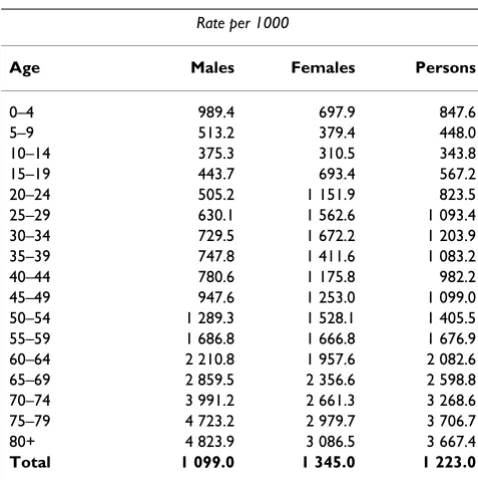
Unlike the rates for individuals admitted (Table 1, above), the highest rates for separations of both males and females occur in the oldest age groups (Table 4). The five highest rates for both males and females are in the age groups 60 to 64 years and over, with male rates higher (and often substantially so) than female rates. Also of note is the high rate of separations for females at ages 30 to 34 years (1,672.2 admissions per 1000 population): this is the sixth highest rate for females, and is more than twice the rate for males at the same age (729.5 separations per 1000 population).
Discussion
Effect of aggregation of areas on disadvantage scores
As noted, the majority of the analysis by socioeconomic status undertaken in the health sector in Australia is area based, and uses the postcode or SLA as the unit of analysis. This raises the question of the extent to which area based analyses at the postcode or SLA level provide a reliable indication of the socioeconomic status and health service utilisation of the individuals admitted. This report
Perth residents admitted to hospital and total separations, by age and sex, 1994–98
Figure 2
Perth residents admitted to hospital and total sepa-rations, by age and sex, 1994–98. Perth population is at 30 June 1996. Per cent shown is of males and females sepa-rately, not for persons.
Table 4: Separations of Perth residents, by age and sex, 1994–98
Rate per 1000
Age Males Females Persons
0–4 989.4 697.9 847.6 5–9 513.2 379.4 448.0 10–14 375.3 310.5 343.8 15–19 443.7 693.4 567.2 20–24 505.2 1 151.9 823.5 25–29 630.1 1 562.6 1 093.4 30–34 729.5 1 672.2 1 203.9 35–39 747.8 1 411.6 1 083.2 40–44 780.6 1 175.8 982.2 45–49 947.6 1 253.0 1 099.0 50–54 1 289.3 1 528.1 1 405.5 55–59 1 686.8 1 666.8 1 676.9 60–64 2 210.8 1 957.6 2 082.6 65–69 2 859.5 2 356.6 2 598.8 70–74 3 991.2 2 661.3 3 268.6 75–79 4 723.2 2 979.7 3 706.7 80+ 4 823.9 3 086.5 3 667.4
explores the reliability of postcode or SLA level data by examining the extent to which rates of individuals admit-ted and separations vary when calculaadmit-ted at various levels of aggregation (CD, postcode and SLA). Ideally, the com-parison would be between the socioeconomic status of individuals and of areas; however, the smallest area level for which a measure of socioeconomic status is available is the CD.
Variation in the minimum and maximum Index of Rela-tive Socio-economic Disadvantage (IRSD) scores when calculated at the CD, postcode and SLA level is striking and clearly shows the value of the smaller unit in area based analyses (Table 5). The range at the CD level is from a minimum index score of 532 to a maximum index score of 1221, a differential of 2.3 times. When individuals and separations are analysed by postcode, the range in the IRSD scores is narrower, from 863 to 1168 (a differential of 1.4). At the SLA level it is slightly lower again (a differ-ential of 1.3). The effect of aggregation to the larger areas is most noticeable in the minimum IRSD score, increasing the minimum score by 70.5% from the CD level to the SLA level. At the other end of the scale, the maximum score varies little, dropping by 4.0%. That is, the greatest loss in specificity in the IRSD score is in the most disad-vantaged areas.
Thus, the use of larger area aggregates reduces the gap between the index scores for the most disadvantaged and least disadvantaged areas (thus lessening the extent of ine-quality between these areas), with the greatest impact on
the scores for the most disadvantaged areas (thus under-stating the extent of inequality in these areas). Notably, the difference between the maximum and minimum scores, and the absolute level of the scores, is much less marked between the postcode and SLA.
There was a strong association between the IRSD scores for CDs and those for postcode of usual address at the first admission (a Spearman correlation coefficient of 0.74). The correlations were between CDs grouped to quintiles and postcodes grouped to quintiles, ranked by the IRSD, and not between individual CDs and postcodes. A weaker association was found between the quintiles for CDs and those for SLAs (0.64 for people with one separation and 0.63 for people with more than one separation) (Table 6). There was little difference in correlation coefficients for those who had moved address. Similar Spearman correla-tion coefficients were calculated for raw IRSD scores.
Effect of aggregation of areas on separation rates
Data at the CD level for the five years from 1994 to 1998 show a variation in rates of individuals admitted from 51 442 admissions per 100 000 population in the most advantaged areas to 58 130 admissions per 100 000 population in the most disadvantaged areas (Table 7). This is a differential of 13%. The differential in separation rates is substantially higher, at 47%, reflecting multiple admissions.
When data are aggregated to postcode area or SLA, the dif-ferentials in separation rates between Quintile 5 and
Table 5: Range of IRSD scores for area of address of individuals and separations
Variable Median for individuals Minimum Maximum Ratio: Maximum/minimum for separations
Collection District (1) 1012 532 1221 2.30
Postcode (2) 1015 863 1168 1.35
Statistical Local Area (3) 1017 907 1174 1.29
Ratio of IRSD scores in area (3) to area (1) 1.00 1.70 0.96 ..
Table 6: Spearman correlation coefficients between IRSD of address for individuals (at first discharge) and area level
Variable Area level of first discharge
CD Postcode SLA
Individuals:
one separation 1.00 0.74 0.64
Quintile 1 areas are smaller (differentials of 1.23 and 1.20, respectively) than at the CD level (a differential of 1.47) (Table 7). In the case of postcodes, this is largely because of the lower separation rate in Quintile 5 areas (likely to be a result of the process of aggregating CDs), whereas for SLAs it is a combination of a lower separation rate in Quintile 5 areas and a higher rate in Quintile 1 areas (likely to be a result of the aggregation process, exac-erbated by the variable size of SLAs – see section titled 'Methods, Area' under 'Methods.' The differential in rates
of individuals admitted is the same for data at the SLA and CD level, but higher for postcode areas. These results again reflect the difficulty inherent in producing groups of approximately equal populations.
While just over half (54.6%) those admitted to hospital had one separation over this period, the proportion varied from 56.3% in Quintile 1 to 51.9% in Quintile 5 (Table 8). This is as expected, with people from the most disadvantaged areas representing a smaller proportion of
Table 7: Residents of Perth admitted to hospital, 1994–1998, by socioeconomic disadvantage of area for selected area levels
Quintile Individuals admitted Separations
CD Postcode SLA CD Postcode SLA
Number
Q1: Least disadvantaged 126 615 123 380 138 127 294 130 303 131 340 294 Q2 130 907 123 465 114 244 294 307 326 652 279 537 Q3 133 073 126 770 142 107 316 066 328 999 363 908 Q4 124 279 128 863 123 199 327 228 328 630 313 879 Q5: Most disadvantaged 142 704 155 100 139 901 433 577 377 896 367 690
Total 657 578 657 578 657 578 1 665 308 1 665 308 1 665 308
Rate (per 100 000 population)
Q1: Least disadvantaged 51 442 48 247 51 950 119 813 120 567 127 986 Q2 53 343 48 239 52 235 120 582 129 945 127 810 Q3 53 889 48 789 52 656 127 995 126 618 134 841 Q4 50 919 51 263 52 564 133 342 128 400 133 920 Q5: Most disadvantaged 58 130 61 691 58 491 176 157 147 734 153 728
Total 53 547 53 547 53 547 135 607 135 607 135 607
Rate ratio: Ratio of rate in Q5 rate in Q1 1.13*** 1.28*** 1.13*** 1.47*** 1.23*** 1.20***
The extent of any inequality is shown by the rate ratio, which expresses the ratio of the rate in Quintile 5 to the rate in Quintile 1; rate ratios indicating differing significantly from 1.0 are shown with * p < 0.05; ** p < 0.01; *** p < 0.001.
Table 8: Number of separations per individual, by socioeconomic disadvantage of area, Perth residents, 1994–1998
Separations per person Quintile 1 Quintile 2 Quintile 3 Quintile 4 Quintile 5 Total
Number
1 69 485 69 118 69 960 69 709 80 497 358 769
2–4 43 274 43 776 45 566 46 747 57 244 236 607
5–9 7 907 7 902 8 449 9 220 12 899 46 377
10+ 2 714 2 668 2 793 3 187 4 459 15 821
Total 123 380 123 465 126 770 128 863 155 100 657 578
Per cent
1 56.3 56.0 55.2 54.1 51.9 54.6
2–4 35.1 35.5 35.9 36.3 36.9 36.0
5–9 6.4 6.4 6.7 7.2 8.3 7.1
10+ 2.2 2.2 2.2 2.5 2.9 2.4
those with one separation and a larger proportion with more than one separation.
There is a substantial difference in the proportion of the population in Quintiles 5 and 1 having two or more sep-arations (a difference of 38.8%, from a rate of 30 389 separations per 100 000 persons in Quintile 5 to 21 897 separations per 100 000 persons in Quintile 1): the differ-ential for people having one separation is lower, although still notable at 16.1% (a rate of 32 790 separations per 100 000 persons in Quintile 5 and 28 231 separations per 100 000 persons in Quintile 1) (Table 9).
The average number of admissions per person for people admitted to hospital on more than one occasion over the five years to 1998 was 4.4; this varied from 4.2 separations per person admitted in the least disadvantaged areas to 4.7 in the most disadvantaged areas.
Reliability over time of address as a proxy for socioeconomic status
Studies using the address of usual residence as a proxy for socioeconomic status require two important assumptions. They are that:
• people who move do so within, or between, areas of similar socioeconomic status; and that
• the areas used in an area based analysis (which can vary in size and are quite often large) provide a reliable indica-tion as to the socioeconomic status and use of health serv-ices of the individuals in the area.
Data from the 1996 Census show that 53.5% of Perth's population at the 1996 Census reported that they had a different address to that at the previous Census, five years earlier [5]. Data were not available to compare the IRSD
of the first and last SLA of address of the Perth population who moved. However, almost one quarter (24.0%) of Perth residents who moved between the 1991 and 1996 Censuses moved to an address within the same SLA. That is, some 59.3% of the population were in the same SLA after five years (either moved within the SLA, or did not move). This is an encouraging statistic for area based analyses.
Similarly, almost four out of five people admitted to hos-pital more than once in a five year period had not moved (out of the CD of their address at the first separation) by the time of their second separation. For example, of the 298 809 people admitted to a Perth hospital more than once over the five year period 1994 to 1998, over three quarters (78.6%, 64 075 people) had the same address at the time of the second separation. People were recorded as having 'moved' if the CD of their address changed between the first and last separation over the period from 1994 to 1998. Movement to a different address within a CD was not included.
The following table illustrates, for people with multiple admissions, the extent of movement by socioeconomic status. For this part of the analysis, the CD of first and last separation have been allocated to quintiles of socioeconomic disadvantage of area, to provide a compar-ison of the extent of movement between different levels of socioeconomic status. The construction of the quintiles is described in the section titled 'Methods, Measurement of socioeconomic status' under 'Methods.'
Table 10 shows, for people who moved to an address in another CD, that:
• people from the most well off areas are less likely to have moved to areas of greatly different socioeconomic status
Table 9: Separations per individual, by socioeconomic disadvantage of area, Perth residents, 1994–1998
Separations per person Quintile 1 Quintile 2 Quintile 3 Quintile 4 Quintile 5 Total Ratio of rates in Q5/Q1
Per cent
1 19.4 19.3 19.5 19.4 22.4 100.0 ..
2+ 18.0 18.2 19.0 19.8 25.0 100.0 ..
Total 18.8 18.8 19.3 19.6 23.6 100.0 ..
Rate per 100 000 population
1 28 231 28 165 28 331 28 561 32 790 29 215 1.16*** 2+ 21 897 22 146 23 006 24 236 30 389 24 332 1.39***
Total 50 128 50 311 51 337 52 797 63 180 53 547 1.26***
Average admissions per person with two or more admissions
Number 4.2 4.1 4.3 4.4 4.7 4.4 1.12***
(ie, changed quintiles) than are those from the most dis-advantaged areas – 40.2% of people in the most advan-taged areas (Quintile 1) remained there, despite moving from the CD of their first separation. The proportion in the most disadvantaged (Quintile 5) areas was a lower 30.5%;
• while there is movement right across the socioeconomic profile, most movement is between adjacent quintiles. For example, of the 18 875 people who lived in the most dis-advantaged areas at their first separation (and moved before a subsequent admission), 71.2% had moved to a CD in the same or next ranked quintile (Quintiles 5 or 4), with just 4.6% moving to the most advantaged areas. Sim-ilarly, of the 9 537 people in the most well off areas at their first separation, 63.0% had moved to a CD in the same or next ranked quintile (Quintiles 1 or 2), with a similarly low proportion (4.7%) moving to the most dis-advantaged areas;
• the most substantial movement between quintiles was of people moving from an address rated as Quintile 5 to one rated as Quintile 4 (40.7%); this was marginally higher than the proportions moving within Quintiles 4 or 1 (40.3% and 40.2%, respectively).
There is a strong association between the quintile of soci-oeconomic disadvantage of area at the first and the last discharge when analysed by CD (a correlation coefficient of 0.88) or SLA (a correlation coefficient of 0.89) of usual address (Table 11). This supports the earlier finding that people admitted to hospital who had moved between epi-sodes, moved to or within areas of similar socioeconomic status. The weaker correlations between CD and SLA (see table) highlight the loss in specificity of the index score when aggregated to the (larger) SLA level.
Conclusions
The analysis shows that, for Perth residents admitted to hospital, the use of larger area aggregates reduces the gap between the index scores for the most disadvantaged and least disadvantaged areas, thus understating the extent of inequality between these areas. The greatest impact of aggregation of areas is on the scores for the most disad-vantaged areas. This results in an understatement of the extent of disadvantage in the most disadvantaged areas, as well as an understatement in the extent of inequality between the most well off and the poorest areas.
Further, the analysis shows that a more people from the most disadvantaged areas are admitted to hospital than
Table 10: Residents of Perth admitted to hospital more than once, 1994–1998, who changed address, by socioeconomic disadvantage of area
CD of first separation CD of last separation (%) Total
Quintile 1 Quintile 2 Quintile 3 Quintile 4 Quintile 5 Total Number
Quintile 1 40.2 22.8 16.4 15.9 4.7 100.0 9 537 Quintile 2 21.5 24.4 22.9 23.6 7.5 100.0 10 551 Quintile 3 12.7 20.3 24.1 32.5 10.5 100.0 11 730 Quintile 4 7.8 14.6 22.0 40.3 15.3 100.0 13 298 Quintile 5 4.6 9.2 15.0 40.7 30.5 100.0 18 875
Total 14.8 16.9 19.6 32.6 16.0 100.0 63,991
Table 11: Correlation coefficients between quintile of socioeconomic disadvantage of area of address of first and last separation, 1994– 98
Area of address CD of SLA of
first separation last separation first separation last separation
CD of first separation 1.00 0.88 0.66 0.60
CD of last separation 0.88 1.00 0.60 0.65
SLA of first separation 0.66 0.60 1.00 0.89
SLA of last separation 0.60 0.65 0.89 1.00
from the most well-off areas (13% more), and that these people have more separations overall (47% more), as a result of larger numbers of multiple admissions.
As regards the extent of movement, four out of five people admitted to hospital more than once in a five year period had not moved (out of the CD of their address at the first separation) by the time of their second separation. In addition:
• people from the most well off areas are less likely to have moved to areas of greatly different socioeconomic status than are those from the most disadvantaged areas;
• while there is movement right across the socioeconomic profile, most movement out of a quintile is to areas in adjacent quintiles; and
• the most substantial movement between quintiles was of people moving from an address rated as Quintile 5 to an address rated as Quintile 4, although this was only marginally higher than the proportions moving within Quintiles 4 or 1.
In summary, postcode level and SLA level data provide a reliable indication of socioeconomic disadvantage of area, when compared with CD-level data. That is, the asso-ciation between rates of total separations and individuals admitted and socioeconomic disadvantage of area evident at the smallest area level (CD) is also evident in the higher level area aggregates of postcode and SLA.
It is reasonable to assume that similar relationships exist in other Australian cities, as well as in other health-related activity (eg. visits to general medical practitioners). Given the widespread use in Australia of area based anal-yses at the postcode and SLA level, and the limitations of CDs an area level for the analysis of most health datasets, it is important to know that such analyses provide a relia-ble indication of the direction and underlying strength of the influence of socioeconomic factors in hospital admis-sions rates.
This is not to imply that the postcode or SLA are the ideal areal unit for analysis, nor that data for Collection District would be. The ideal population size for area-level analysis is likely to vary dependent on the number of cases in the dataset under analysis. For datasets with a large number of cases per capita (eg. services by general medical practition-ers) the number will be smaller than those with a small number of cases per capita (eg. deaths), even with aggre-gation of data over a number of years. May SLAs have much larger populations than are necessary to produce reliable results; and the populations of most CDs are too
small (see Table 12). HealthWIZ [6], the National Social Health Database, comprising among the most widely available small area datasets in Australia, seeks to provide health service use and health status data for areas with populations of approximately 10 000. This is a useful benchmark.
It is also clear that data as to socioeconomic position at the smallest area level possible or, more importantly, of individuals, would also be of value. Were data to be avail-able across Australia on a similar basis to that from the Western Australian Data Linkage System, it would be pos-sible to undertake research of greater policy-relevance than is currently possible with the existing separations-based national database. Such moves are under consider-ation in several Australian States.
Further, linking data (eg, using probabilistic linkage) for individuals in the Western Australian Data Linkage System to the Australian Bureau of Statistics Population Census has the potential to add considerable value to such analyses. For example, it would be possible to examine an individual's characteristics of education, occupation, labour force status, housing tenure etc., and to more directly examine the relationships between the number of individuals admitted and total separations and these important socioeconomic variables. Linkage to death reg-istration data would also be valuable in understanding more about outcomes related to socioeconomic status. This latter example is a possibility under recently announced plans for the ABS to test the linking of 2006 Census of Housing and Population data to other datasets, such as deaths registrations, held under their Act. This is similar to the approach elsewhere, including New Zealand [7]. It is to be hoped that such arrangements can be put in place in Australia in the near future.
Methods
TerminologyThe report addresses differences in the number of individ-uals admitted and the number of separations they incurred. These are described as 'individuals', or
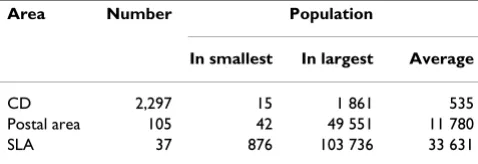
individu-Table 12: Number of areas and average population for CDs, postcodes and SLAs in Perth, 1996
Area Number Population
In smallest In largest Average
als admitted' and separations (the total number of separa-tions, where an individual may have had one or more episodes of hospitalisation over the period of the analy-sis). 'Separation' is the term describing a completed hos-pital episode: it is defined in the section titled 'Glossary, Separation' under 'Glossary.'
Data sources
Details of all separations to public and private hospitals in Western Australia for the five years from 1994 to 1998 were extracted from the Western Australian Hospital Mor-bidity Database (HMDS). Any separation records thought to belong to the same person had previously been linked together within the Data Linkage System, permitting anal-yses to be performed for both separations and individual persons. The population used in calculating rates is the 1996 Census population.
The analysis has been limited to separations of residents of Perth, but includes separations occurring at any public acute or private hospitals in Western Australia.
Area
Areas used in the analysis are the Census Collection Dis-trict (CD), postcode and Statistical Local Area (SLA). See Glossary for definitions of CD, postal area and SLA.
The HMDS includes address details for each separation from a hospital in Western Australia since 1993. These addresses have been linked to a Western Australian street address database to assign northing and easting points (geo-codes). These points were then assigned to the appropriate 1991 or 1996 CD using the ABS CData96 mapping tool. The postcode and SLA of the address were then determined by allocation of CDs to postcode or SLA. The boundaries for CDs and SLAs are consistent. How-ever, boundaries for CDs and postcodes are not, so CDs were allocated to postcodes on a 'best fit' basis (see Glossary).
Consequently, comparisons can be made between results for CDs and postcode areas, CDs and SLAs and postcode areas and SLAs. This is particularly important, as much of the area analysis undertaken in the health sector in Aus-tralia uses the postcode or the SLA, as a majority of data are only available at these area levels, and it is widely accepted that the larger the area, the less homogenous the population is likely to be.
There were 2 297 CDs in Perth at the 1996 Census, with 105 postcodes and 37 SLAs. The average population size at each of these area levels is shown in Table 12; these data emphasise the variation in size of the areas at each area level.
Measurement of socioeconomic status
In the absence of any direct measure of socioeconomic status in the hospital inpatient data, the socioeconomic status of the area of the address of the individual admitted is used as a proxy measure. The Index of Relative Socio-Economic Disadvantage (IRSD) is the measure used to provide the socioeconomic status of the area of the address. The IRSD is one of five Socio-Economic Indexes for Areas (SEIFA) produced by the Australian Bureau of Statistics (ABS) from data collected at the 1996 Population Census. It is calculated at the CD level and can be produced for other area levels. The postcode and SLA level index scores in this report are the population weighted average of the IRSD scores for the CDs in the postcode or SLA. This calculation is undertaken for all CDs in the postcode or SLA, not just those for which hos-pital episodes were recorded.
Each area level (CD, postcode or SLA) was allocated to one of five groups (quintiles). For example, for SLAs, Quintile 1 comprises the SLAs with the highest IRSD scores (most advantaged areas), and Quintile 5 comprises the SLAs with the lowest IRSD score (most disadvantaged areas): each quintile comprises approximately 20% of the Perth population. This process does not provide an exact allocation of population, so the resultant populations are only 'approximately' equal, and the larger the areal units being allocated, the less likely they are to be equal. As shown in Table 13, when areas were ranked by their IRSD score at the CD level and then grouped to produce quintiles, the resultant populations were relatively close to the ideal population in each quintile of 245 607 (one fifth of 1 288 036). The quintiles based on postcode areas had rather 'lumpier' populations (greater variation around the one fifth figure of 254 859 per quintile – and a higher total of 1 274 297, due to boundary differences between CDs and postcodes. The quintiles based on SLAs were the most variable. For example, the SLA of Wanneroo – South West (with a population of 103 176) had a score marginally below the cut-off score between Quintile 1 and Quintile 2. However, the inclusion of Wanneroo – South West in Quintile 2 resulted in
popula-Table 13: Population of quintiles at various area levels, 1996
Quintile CD Postcode SLA
1 246 131 255 726 265 883 2 245 406 255 942 218 713 3 246 937 259 835 269 879 4 244 072 251 378 234 378 5 245 490 251 416 239 183
tions in Quintile 1 and 2 of 161 707 and 321 889, respec-tively. Moving Wanneroo – South West to Quintile 1 left a population of 218 713 in Quintile 2 and increased that in Quintile 1 to 265 883. While these populations are sub-stantially different from the ideal population, they are the best that can be achieved.
Analysis
Three (different) IRSD scores were added to each hospital separation record, based on the CD, postcode or SLA that had been previously assigned to the address on that record. It should be noted that these IRSD scores were actually the average score for the particular CD, postcode or SLA as calculated from 1996 Census data. Quintile ranks for each aggregation level were also applied using population weighting as described above.
For analyses involving multiple admissions, the IRSD value used was that for the first separation in the five-year period. These 'first' separations were isolated using the internal links between separation records for the same person and the separation date. Of course, many of these 'first' separations could have been preceded by separa-tions occurring before 1994.
Rates are crude rates, per 100 000 population. Ideally the data would have been standardised (by the indirect method). However, access to the source data were limited and to requested tables, and standardisation was not an option.
As the data were from a complete enumeration (all admis-sions to hospital), confidence intervals were only calcu-lated for measures of difference (in this case, rate ratios).
The Spearman Rank Correlation has been used in the analysis to indicate the degree of correlation between pairs of variables.
Glossary
CDThe Collection District (CD) is the smallest area level in the Australian Bureau of Statistics' statistical geography and is primarily an area used in the five yearly population census.
Index of Relative Socio-Economic Disadvantage
The Index of Relative Socio-Economic Disadvantage (IRSD) is one of five Socio-Economic Indexes for Areas produced by the Australian Bureau of Statistics at recent population censuses. Produced using Principal Compo-nents Analysis, it summarises information available from variables related to education, occupation, income, family structure, race (the proportion of Indigenous people), eth-nicity (poor proficiency in use of the English language)
and housing. The variables are expressed as percentages of the relevant population. The IRSD is available at the Census Collection District level and was then be calcu-lated for postcodes and SLAs by weighting the CD level scores by their population. The IRSD is calculated to show the relativity of areas to the Australian average for the par-ticular set of variables which comprise it; this average score is set at 1000. Scores below 1000 indicate areas with relative disadvantaged populations under this measure, and scores above 1000 indicate areas with relatively advantaged populations. The IRSD scores at the Census Collection District (CD) level have been grouped to postal area, an area developed by ABS for the presentation of population counts and other Census data from the five-yearly population censuses to approximate postcode areas, as the ABS does not collect the postcode at the Census.
Separation
The term describing a completed hospital episode is a 'separation'. At the time of admission to hospital, the age, sex, address of usual residence and other personal details of the patient are recorded. At the end of the episode, at the time of separation from hospital, details of the epi-sode itself are recorded, including the date, time and method of separation (discharge, death or transfer of a patient to another care setting eg. hospital, nursing home). Consequently, hospital inpatient data collections are based on separations.
Postal area
The postal area is an area developed by ABS for the pres-entation of population counts and other Census data from the five-yearly population censuses. It approximates postcode areas, as the ABS does not collect the Australia Post postcode at the Census. Postal areas comprise Census Collection Districts (CDs) grouped to approximate code areas. Where a CD does not fit entirely within a post-code area, it is allocated to the postpost-code area into which the population largely falls. Where a CD covers more than one postcode area, the total CD population is allocated to one postcode.
The IRSD scores at the Census Collection District (CD) level have been allocated to postal areas as described in the section titled 'Methods, Index of Relative Socio-Eco-nomic Disadvantage' under 'Methods.'. Similarly, the postal area of each separation was approximated from the CD of the address.
The term postcode, rather than postal area, is used in the text, for ease of reading.
Postcode
Publish with BioMed Central and every scientist can read your work free of charge
"BioMed Central will be the most significant development for disseminating the results of biomedical researc h in our lifetime."
Sir Paul Nurse, Cancer Research UK
Your research papers will be:
available free of charge to the entire biomedical community
peer reviewed and published immediately upon acceptance
cited in PubMed and archived on PubMed Central
yours — you keep the copyright
Submit your manuscript here:
http://www.biomedcentral.com/info/publishing_adv.asp
BioMedcentral Quintile of socioeconomic disadvantage of area
See section titled 'Methods, Measurement of socioeco-nomic status' under 'Methods.'
SLA
An SLA in Perth is generally equivalent to a local govern-ment area, with additional codes allocated to local gov-ernment areas split for statistical purposes (mainly local government areas with large populations, split to form SLAs with smaller populations).
Acknowledgements
The hospital inpatient data on which this analysis was based were drawn from the Western Australian Data Linkage System. The Western Austral-ian Data Linkage System was established in 1995 with three year funding from the Western Australian Lotteries Commission. The system is now jointly funded, managed and staffed by the Department of Health (WA), the University of WA; the Institute for Child Health Research and Curtin Uni-versity of Technology.
Its aim is to link unit records from core Department of Health data collec-tions and other relevant data colleccollec-tions, for the purpose of providing linked data to support health planning, purchasing, evaluation and research.
The data extraction and analysis for this report was undertaken by Diana Rosman, Manager, Data Linkage Unit, Health Information Centre, Depart-ment of Health (Western Australia).
References
1. Joshi H, Wiggins R, Bartley M, Mitchell R, Gleave S, Lynch K: Putting health inequalities on the map: does where you live matter, and why? In In Understanding health inequalities Edited by: Graham H. Buckingham: Open University Press; 2001:143-155.
2. Cesaroni G, Farchi S, Davoli M, Perucci CA: Individual and area-based indicators of socioeconomic status and childhood asthma.European Respiratory Journal 2003, 22(4):619-24.
3. Hyndman JC, Holman CD, Hockey RL, Donovan RJ, Corti B, Rivera J:
Misclassification of social disadvantage based on geographic areas: comparison of postcode and collector's district analyses.Int J Epidemiol 1995, 24:165-176.
4. Hofer TP, Wolfe RA, Tedeschi PJ, McMahon LF, Griffith JR: Use of community versus individual socioeconomic data in predict-ing variation in hospital use. Health Serv Res 1998, 33(2 Pt 1):243-59.
5. Australian Bureau of Statistics: 1996 Census Basic Community Profile. In Table B01 Selected Characteristics ABS Canberra; 1998. 6. HealthWIZ [http://www.prometheus.com.au/html_control/
index_frame.htm]
7. New Zealand Census-Mortality Study [http://