International Doctorate School in Information & Communication Technologies
DIT - University of Trento
Using Formal Methods for Building more
Reliable and Secure e-voting Systems
Komminist S. Weldemariam
Advisor:
Adolfo Villafiorita (Ph.D)
Center for Information Technology (FBK-Irst)
It would not have been possible to write this doctoral dissertation without the help and support of the kind people around me, to only some of whom it is possible to give particular mention here.
Above all, I am heartily thankful to my supervisor, Adolfo Villafiorita. His encouragement, supervision and support from the preliminary to the conclud-ing level enabled me to develop an understandconclud-ing of the subject. I also would like to say sincere thanks to Prof. Richard A. Kemmerer for hosting me at the University of California Santa Barbara and for his consistent follow-up and enormous feedback.
I offer my regards and blessings to all of those who supported me in any respect during the completion of this dissertation. Particularly I would like to thank Birhanu M. Eshete at the Fondazin Bruno Kessler for the tireless efforts in reading and revising the English of my manuscript, as well as providing valuable comments. I am also grateful to all ICT4G and software engineering groups at the Fondazione Bruno Kessler for their continued moral support. Above all, thank you Chiara Di Francescomarino and Andrea Mattioli for all your kind help since the day I knew you.
Deploying a system in a safe and secure manner requires ensuring the
tech-nical and procedural levels of assurance also with respect to social and
regu-latory frameworks. This is because threats and attacks may not only derive
from pitfalls in complex security critical system, but also from ill-designed
procedures. However, existing methodologies are not mature enough to
em-brace procedural implications and the need for multidisciplinary approach
on the safe and secure operation of system. This is particularly common
in electronic voting (e-voting) systems.
This dissertation focuses along two lines. First, we propose an approach
to guarantee a reasonable security to the overall systems by performing
for-mal procedural security analysis. We apply existing techniques and define
novel methodologies and approaches for the analysis and verification of
procedural rich systems. This includes not only the definition of adequate
modeling convention, but also the definition of general techniques for the
injection of attacks, and for the transformation of process models into
rep-resentations that can be given as input to model checkers. With this it
is possible to understand and highlight how the switch to the new
tech-nological solution changes security, with the ultimate goal of defining the
procedures regulating system and system processes that ensure a sufficient
level of security for the system as well as for its procedures.
We then investigate the usage of formal methods to study and analyze
the strength and weaknesses of currently deployed (e-voting) system in
order to build the next generation (e-voting) systems. More specifically, we
show how formal verification techniques can be used to model and reason
about the security of an existing e-voting system. To do that, we reuse
the methodology propose for procedural security analysis. The practical
particular. With this it can be possible to build more secure, reliable, and
trustworthy e-voting system.
Keywords
procedural security, security assessment, electronic voting, formal
List of Tables v
List of Figures vii
1 Introduction 1
1.1 Motivation and Problem Statement . . . 1
1.2 Aims and Approach . . . 5
1.3 Main Contributions . . . 7
1.4 Organization . . . 11
2 State of the Art 13 2.1 BPR Context . . . 13
2.2 Security Analysis . . . 20
2.2.1 Graph-Based Approach . . . 20
2.2.2 Model-Based Approach . . . 22
2.3 Elections and Electronic Voting . . . 29
2.3.1 Elections and Technology . . . 29
2.3.2 Trends in the Development of e-voting system . . . 32
2.3.3 The ProVotE e-voting system . . . 41
3 Tool Supported Methodology for BPR 47 3.1 Challenges and Requirements of BPR in PA . . . 47
3.2 Representing Laws in XML . . . 55
3.3 Process Modeling Methodology . . . 57
3.3.1 Defining Business Models Formally . . . 57
3.3.2 The Modeling Methodology . . . 64
3.4 A Tool for Supporting the Methodology . . . 75
3.4.1 Intermediate Representations . . . 76
3.4.2 VLPM Usage Scenario . . . 78
3.4.3 Examples . . . 82
3.5 Summary . . . 87
4 Procedural Security Analysis 89 4.1 Why Procedural Security? . . . 89
4.2 Conceptual Framework . . . 95
4.2.1 Framework to Understand an Asset . . . 96
4.2.2 Asset Threats and Attacks . . . 99
4.3 A Methodology for Procedural Security . . . 109
4.3.1 Formal Model of Asset-flows . . . 109
4.3.2 Model Extension . . . 117
4.3.3 Encoding the Assets-flow models in NuSMV . . . . 118
4.3.4 Property Capturing and Model Checking . . . 127
4.4 A Case Study . . . 129
4.5 Summary . . . 139
5 Formal Analysis by Reverse Synthesis 143 5.1 Introduction . . . 144
5.2 The ES&S Electronic Voting Systems . . . 146
5.2.1 The System Components and Voting Process . . . . 146
5.2.2 Informal Description of Critical Requirements . . . 150
5.4 Overview of the ASTRAL language . . . 161
5.5 Formal Analysis of an e-voting System . . . 162
5.5.1 Specification of the ES&S Voting Process . . . 164
5.5.2 Critical Security Requirements . . . 183
5.5.3 Formal Verification and Results . . . 190
5.6 Extending the System Specification by Modeling Attack Sce-narios . . . 193
5.6.1 Attack Specifications . . . 195
5.7 Summary . . . 200
6 Conclusion 203 6.1 Summary and Discussion . . . 203
6.2 Future Work . . . 207
Bibliography 211
A Sample Attack Specifications 237
4.1 Accessary information as predicates. . . 122
4.2 Example 1: A counterexample showing the alternation of
election software at poll station. . . 137
4.3 Example 2: Denial of service attack counterexample. . . . 139
5.1 Number of proof obligations and number of proved critical
properties. . . 193
5.2 Number of reproved proof obligations after extending the
2.1 Three research areas. . . 14
2.2 Typical Scenario of formal verification in business process
models. . . 17
2.3 Elections in Italy and the ProVotE system architecture. The
dotted lines represent the different phases of the voting
pro-cess: namely, pre-electoral, electoral, and post-electoral. The
boxes in bold lines represent the organizations responsible
for the process. And, the rounded rectangles represent
func-tions performed during an election. . . 43
2.4 The ProVotE Development Process. The figure is an
activ-ity diagram in which activities are in rounded rectangles,
whose notation are slightly adapted to make it more
read-able. The meaning of creation (“C”), reading (“R”), and
inclusion (“inc”), respectively, are that an activity creates
an artifact, it reads it, or that an artifact is contained in
an-other artifact. The empty arrowhead indicates refinement,
so that, for instance, the “Machine Life-cycle” refines the
“Voting Activities”. . . 44
3.1 Law elements class diagram. . . 56
sub-processes using UML. . . 70
3.4 Some RACIV relationships among processes and actors. . . 72
3.5 Activity diagram example. . . 73
3.6 Example of an article and its defined processes. . . 75
3.7 The internal representation of our modeling elements. . . . 76
3.8 Relationships among the modeling elements. . . 77
3.9 VLPM usage scenario, i.e., Law modeling process handled
by the VLPM tool. . . 79
3.10 Storage of Law Data. . . 80
3.11 Relationships among processes. . . 83
3.12 A simplified use case diagram for the voting process with its
direct subprocesses. . . 83
3.13 Example of the split function applied to Article 15, Comma 1. 86
4.1 A reference scenario for procedural security analysis . . . . 92
4.2 A class diagram depicting the characteristics of an asset. . 97
4.3 The Delete threat Action and an Example. . . 105
4.4 The Read Threat-action. The state of the input asset does
not change, i.e., si. . . 106
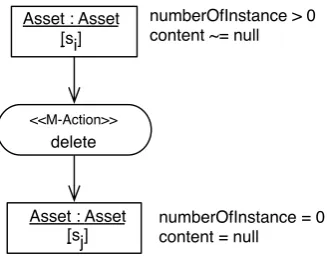
4.5 The Update Threat-asction. . . 106
4.6 The Create Threat-action. . . 107
4.7 A simple copy threat action. It is composed by two threat
actions: read and create. . . 108
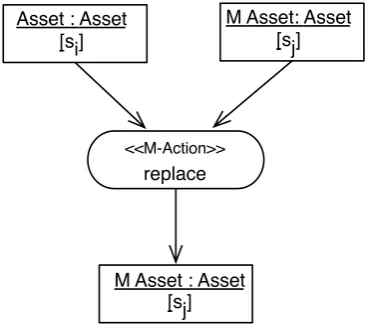
4.8 Replace threat action. It is composed by two threat actions:
delete and write. Note that the composition detail is not
shown in the diagram. . . 109
4.9 The process of formal procedural security. . . 110
4.12 An example of asset flows. . . 130
4.13 An example of extended model for Figure 4.12, where the introduction of the attacks are colored. It shows delete and replace threat-actions change the flow of the procedure un-der evaluation. . . 131
4.14 A simple example of state transition model for content fea-ture of electionSW. . . 133
4.15 An extension of Figure 4.14 due to the injection of threat-actions. . . 135
5.1 Main Components of the ES&S voting machine. . . 148
5.2 Changing an Unattentive Voter’s Vote. . . 156
5.3 Canceling a Vote by Faking a Fleeing Voter. . . 158
5.4 The approach of Formal Specification and Verification by Reverse Synthesis. . . 160
5.5 A simplified view of ES&S voting system . . . 165
Introduction
1.1
Motivation and Problem Statement
As our society is getting more dependent on (computer) system, security is
becoming one of the important constraints in system development.
How-ever, security is a complex non-functional requirement whose
implementa-tion requires intervenimplementa-tion over the entire parts of a system at all levels of
detail. It is widely reported that all systems and system processes making
use of Information and Communication Technology (ICT) are exposed to
security threats in one way or another (Avizienis et al. 2004, Myagmar
et al. 2005). The security threats are meant to compromise or invalidate
the confidentiality, integrity, and availability of the systems and system
processes.
A secure and reliable system, if it exists, must satisfy its critical
re-quirements. In order to assess and certify whether a given system meets
such requirements, a security analysis or assessment is conducted. To carry
out the assessment in a systematic way, usually a methodology is devised
by attaching context information to the system under analysis. Five
con-structs are pivotal to define a methodology for security assessment of a
system: asset, threat, vulnerability, attack, and risk (Bishop 2002, Rogers
Anasset is defined as something that has a value to the relevant organi-zations or business firms. A vulnerability is a weakness in the architecture, design or implementation of a system. A threat is a potential for violation of security, which exists when there is a circumstance, capability, action,
or event that could breach security and cause harm. An attack can be
identified as the entire process allowing a threat agent to exploit a system
by the use of one or more vulnerabilities. A risk may be defined as the
probability that a damaging incident is happening (when a threat occurs
because of a vulnerability), times the potential damage. The first step in
security analysis of a system is, therefore, to define the threat model using
these key constructs. The threat model for a system describes the goals an
attacker might have, the types of attackers that might attempt to attack
the system, and the capabilities available to each type of attacker (Jones
and Ashenden 2005, Vraalsen et al. 2005, Vetterling et al. 2006).
Electronic voting (e-voting) systems are increasingly replacing the
tra-ditional paper-based voting systems, by making the voting process more
convenient and may therefore lead to improved turnout (Gritzalis 2003,
Mercuri and Camp 2004, Sastry et al. 2006, Anane et al. 2007, Bishop and
Wagner 2007). Electronic recording and counting of votes could be faster,
more accurate, and less labor intensive. However, they are fundamentally
used in environmental conditions that are quite peculiar, if not unique. In
fact, they are probably the only complex safety and security critical
sys-tems for which all these conditions are met: they run in an environment
with limited control; they are operated by people with the most diverse
training and experience; they have to be accurate, while, at the same time,
have stringent requirements related to what they can trace, to protect
secrecy and anonymity. Logistics and support, due to the geographical
distribution and time constraints of elections, add further complexity.
without an observable cost (e.g., risks) one of which is opening security
vulnerabilities for attackers (Mercuri 2001, Prosser et al. 2004, Bishop and
Wagner 2007, Rivest and Wack 2006, Gardner et al. 2007). In that
re-spect, recently we have seen that several currently deployed e-voting
sys-tems (mostly, the direct recording electronics (DRE) voting syssys-tems as
used in U.S.) share critical failures in their design and implementation,
which render their technical and procedural controls insufficient to
guar-antee trustworthy voting (Lambrinoudakis et al. 2003, Kohno et al. 2004,
Bryans et al. 2006, Gardner et al. 2007, Balzarotti et al. 2008). Moreover,
elections are trust situations in which the trust properties reflected both on
individual and system level, independently of the voluntary, organizational
(or the government itself) or stringent nature of the procedure. Trust in
elections could, in principle, be established, if and only if, citizens convince
about security with respect to the system and its procedures are respected
and followed correctly. The lack of trust can also render even most secure
and most reliable systems completely useless (Oostveen and den Besselaar
2004, Antoniou et al. 2007).
The introduction of a new technology and the transition to a new form
of systems changes risks and attacks that can compromise or invalidate
the security goals. Therefore, the development and verification of fair and
secure e-voting systems (in general, any system) should not only take into
account their inherent features (e.g., what kind of protection they offer to
tampering with), but also how they fit into the environment in which they
are used, namely in elections. This leads to a demand for good security risk
analysis methods, which must handle detailed analysis of technical aspects
as well as more high-level procedure or organizational level analysis.
The research question we investigate in this dissertation is the following:
Typically, there are a number of established approaches to tackle the
above stated problem by modeling, specifying, and verifying a system
sat-isfies a set of properties (Fredriksen et al. 2002, Avizienis et al. 2004, Xu
and Nygard 2005, Myagmar et al. 2005, Wimmel 2005). The integrity and
assurance of a complex and safety-critical system’s correct behavior with
respect to modeling and specification can be achieved, if good engineering
practices are appropriately devised and used. With respect to this, the
us-age of formal methods has been shown to improve the security and quality
of complex systems (Kemmerer 1990, Hall 1990, Lowry and Dvorak 1998,
Heitmeyer et al. 2008). These approaches allow designers to prove, test,
or otherwise examine interesting properties of a complex process whose
behavior is specified abstractly, and then interactively refine the
behav-ioral specification to be as close to an implementation as appropriate for
a given assurance level. Unfortunately, their usage in voting in general
and in the development of e-voting solutions, in particular, is very limited
and unsatisfactory. For that matter, we are only aware of the following
works (Kremer and Ryan 2005, Campanelli et al. 2008, Delaune et al.
2009, Sturton et al. 2009, Delaune et al. 2009). These works demonstrate
the feasibility of applying formal methods for verifying voting machine
logics.
Finally, there are also some more reasons why the existing approaches
do not perform well in procedural rich scenario. If a methodology exists,
it is difficult to formally represent and analyze some peculiarities, namely
in elections. Among these peculiarities we mention the following. Mobility of assets, assets and sensible data related to an election are handled (and may be altered) by different actors (e.g., technicians, poll officers, electoral
officers) with different responsibilities over time and in different locations.
to the period in which the attack is performed (e.g., tampering with an
e-voting machine after the election does not have much of an effect). Number of instances, various electoral assets need to be replicated for running an election. The effects of an attack may not only propagate to copies, if the
master is compromised, but may also have a different impact, depending
on the number of instances that are affected by the attack (e.g., breaking
one e-voting machine may not have a tangible effect on an election).
1.2
Aims and Approach
In this dissertation we show that it is feasible to improve a system with
acceptable security level through the use of interdisciplinary approaches of
proper engineering practices. The central concept is to intermingle different
techniques for the development of a system. In particular, we have two
main aims in this work.
The first one is aimed at providing a technique that allows to
under-stand how the switch to a new technological solution changes security, with
the ultimate goal of defining the processes regulating e-voting system that
ensure a sufficient level of security for the system as well as for its
proce-dures. Along this line, an important goal is to provide a tool supported
methodology within a general-purpose tool, to reduce the necessary effort
and experience for the security-related activities and to increase the level
of confidence in the development process. Such confidence could have been
unthinkable had not we used formal methods. The applicability of the
developed approach should also be demonstrated for various case studies
of practical relevance. In this research, the approach we propose focuses
on the definition of methodologies and techniques to model and formally
verify business processes.
modeling convention, but also the definition of general techniques for the
injection of attacks, and for the transformation of business processes into
representations that can be given as input to model checkers. For this
purpose, we describe a methodology related to the security assessment of
the procedures. The underlying approach that we follow lies on the
in-tersection of three areas, namely BPR, security, and formal methods. The
center of the approach is a security-enriched model of the procedure, where
security requirements to be checked are included in the form of logic. We
explain our concept using the flows of assets and processes that we
rec-ognize as workflow activities, using executable specifications. More
specif-ically, starting from the process model, first we provide formal model of
the procedures in terms of transitions system. We elaborate threat-actions
using UML diagrams and extend the model by injecting the threat-actions
at each possible execution step. The resulting model is then encoded using
the NuSMV (Cimatti et al. 2002) input language, and using the NuSMV
model checker to help us analyze the effects of attacks on the execution
of the procedures. The use of a general-purpose tool makes it possible to
communicate and share models among participating parties. As this is an
integrated part of the overall system to-be developed and to build on
ex-isting tool support and experience on the part of the lawmakers, business
analysts, and software engineers.
In contrary, the second aim at investigating on the systematic
applica-tion of formal methods for reverse synthesis of an existing e-voting system
by modeling and verifying its underlying behaviors, then also enriched with
attacks, against critical security requirements. The ultimate goal is that of
specifying generic requirements for the next generation of e-voting systems.
In this research, the approach we follow focuses on the usage of formal
methods to study and analyze the strength and weaknesses of currently
systems. We refer to this activity as reverse synthesis. More specifically, we
show how formal verification techniques can be used to model and reason
about the security of an e-voting system.
Of central importance in our approach is formulating each individual
component of the voting system for one of currently deployed e-voting
sys-tems named Election Syssys-tems & Software (ES&S) e-voting system (Inc.
ES&S 2007) as process instance in ASTRAL declarative language (Kolano
et al. 1999), along the behavioral specifications of each instances. We
specify and analyze critical security requirements about each individual
component and the system as whole. We then extend the original formal
specification by augmenting a set of transition specifications that represent
known attacks, that are needed to model the specific scenarios presented
in (McDaniel et al. 2007). Thereafter, we attempt to analyze the extended
model against the same set of critical security requirements as the original
specification should respect. We use the ASTRAL Software Development
Environment (SDE) to process the specification and to automatically
gen-erate proof obligations for the PVS analysis tool (Owre et al. 1993, SRI).
1.3
Main Contributions
The main contributions of this dissertation are summarized as
methodolog-ical contributions for both the modeling and analysis of (system) processes
and security assessment techniques, and practical contributions on the
us-age of the methodologies for the development and assessment of real world
e-voting systems.
Methodology for Procedural Security Analysis
Risks and attacks not only depend upon the security levels the new
regulating the way in which the systems are operated. Therefore,
intro-ducing technical security mechanisms —such as (Adida 2006, Sastry et al.
2006, Yee 2007, Santin et al. 2008), to secure systems and system processes
is not sufficient in the situation where the usage of the system is (totally)
influenced by legal framework. For this reason, it is necessary to revisit the
way in which the development process are carried on, as well as the goals of
security and security threats are specified, modeled, and analyzed. To fill
this gap, we introduce what we call procedural security analysis. Since
as-set mobility, state, evolution, and the context in which asas-set instances are
used in electoral system are an inherent challenge, we introduce a generic
assets-centered methodology for procedural security analysis.
Interestingly, the methodology we devised allows for systematic analysis
of procedural security based on explicit reasoning on asset flows. That
is, by building models to describe the nominal procedures under analysis
and injecting possible threat-actions by assuming that any combination
of threats can be possible in all steps into such models. We also outline
encoding strategies using NuSMV input language —that it is amenable for
formal analysis allowing to reason on different properties of the procedure
on the extended model.
The benefits that the proposed methodology brings are twofold. First
all of, it helps identifying the security boundaries, that is, the conditions
under which procedures can be carried out securely. More specifically,
us-ing the NuSMV model checkus-ing facility, it is possible to understand what
are the hypotheses and conditions under which a given security goal is
achieved or breached. Secondly, it helps devising a set of requirement to
be applied both at the organizational level and on the (software) systems
used to make systems and system processes secure. This can be achieved
by analyzing the generated counterexamples by the NuSMV analysis tool,
procedures so that security breaches are taken care of. Our work takes
step forward the motivations for procedural security discussed in (Xenakis
and Macintosh 2004a, 2005a). Additionally, we believe that, such results
are foundations to familiarize actors (election officials or polling officers)
with the possible procedural threats and attacks that can happen
dur-ing elections, or otherwise anytime durdur-ing the electoral phases, and thus
complement works like (Volkamer and McGaley 2007, Volkamer 2009).
Formal Methods by Reverse Synthesis
We show how formal methods can be effectively applied for the specification
and verification of an e-voting machine, using the connection of ASTRAL
SDE and the PVS analysis tool.
The two main lessons drawn from this work are:
1. Formal methods help get a better understanding of the security
“bound-aries” of e-voting systems. In the case of the ES&S, for instance, various security requirements could not be proved without making
as-sumptions about the procedures and about the environment. Notice
that we expect this result to equally apply to other e-voting systems.
Formalizing such hypotheses helps to delineate the necessary
condi-tions for the secure use of systems.
2. Open specifications play a pivotal role for the development of more secure e-voting systems. The formal specification of the ES&S, for
instance, required the collection of information from different sources,
such as configuration instructions, the user’s manual, and videos. The
adoption of an open-standardized specification could help simplify,
ex-tend, and generalize the results we have found to other systems. Based
then be used as a basis for the specification and design of a new
gen-eration of an e-voting system.
Additionally, this work makes the following specific contributions: First,
this work advances the current usage scenario of formal techniques in
e-voting systems in which procedures and environmental factors also play
vital role for a correct execution of the system. Secondly, this work is
the first attempt adding on top of a system level testing and analysis of
e-voting systems, e.g., (Kohno et al. 2004, Sastry 2007, Ansari et al. 2008,
Balzarotti et al. 2008) in which complex low level engineering techniques
have been utilized for analyzing and verifying e-voting machines; all these
provide only (a relatively) low level of assurance.
Tool Supported Methodology for BPR
We elaborate a generic tool-supported methodology for BPR in public
ad-ministration for the construction of process models from domain experts
or from the laws that describe the procedures. The methodology was
orig-inally proposed in (Mattioli 2006). We extended by refining, structuring,
and adding some definitions and formalizations for some concepts. Using
the methodology, it is straightforward to obtain an unambiguous,
stan-dard, general, and objective process models about the procedures and laws
under analysis. The methodology also allows to link the laws and
mod-els in order to increase the traceability between them. Traceability helps
law makers elaborate models in collaboration with software developers or
process engineers, and understand the impact of law or process changes as
a result of interventions due to people, processes, and some kinds of
tech-nologies. When a change is made to the law, being able to identify which
processes are defined (or regulated) by the modified part of the law allows
then possible to determine what processes “interact” with the processes
af-fected by the change in the law. The modification can then be propagated
to all the relevant processes and makes the model up to date. On the other
hand, the reengineering of processes may result in a need to modify some
parts of the law. Maintaining law-model traceability allows to
automati-cally identify which parts of the law should be amended by tracing back
to the parts of the law that originally defined the modified processes.
Evaluation using Case Studies
The methodologies along with the supportive tool have been applied in
two Italian territories that have autonomy over local elections and have
experimented a transition to e-voting. Specifically, for the modeling of the
electoral law and procedures in the Province of Trento and the laws for
the introduction of an e-voting system for a local poll in two municipalities
of the Autonomous Region of Friuli Venezia Giulia. Within the project
we have analyzed the existing laws and procedures, defined the procedures
and developed the (e-voting) system that has been used in local elections
—mainly for experimental purpose. The results of the modeling and
analy-sis led to enrich and improve the business process models by re-organizing
voting processes that define the to-be system description for ProVotE
e-voting system, and consequently for the development of the system itself,
by helping eliciting, structuring, as well as maintaining requirements for
the ProVotE e-voting system —see also in (Villafiorita et al. 2009b,a,
Kom-minist Weldemariam and Mattioli 2009). Furthermore, the ES&S e-voting
system is used to demonstrate our reverse synthesis approach.
1.4
Organization
• Chapter 2 discusses an overview over the current state of research in
the following areas: BPR, security and risk analysis, formal methods,
and elections and trends in e-voting systems.
• Chapter 3 discusses a generic methodology and supportive tool for
BPR in public administration for the construction of (business)
pro-cess models.
• Chapter 4 presents the procedural security analysis and a methodology
for the modeling, encoding, and analysis through case studies.
• Chapter 5 presents the reverse synthesis approach of an e-voting
sys-tem using ASTRAL language and PVS analysis tool.
• Finally, Chapter 6 draws some lessons learned during our research
State of the Art
The ideas in this dissertation are built upon existing works in the business
process modeling, security, and formal methods fields (see Figure 2.1). We
apply known principles and original ideas to a new and socially important
problem domain —namely, elections. In this chapter, we discuss current
trends in these fields and how they can be adopted for the development
of safe and secure e-voting system. Thus, first we review business process
modeling and analysis approaches. Second, we discuss security analysis
approaches. Finally, we overview elections and e-voting, and the current
trends on the usage and application of these fields for the development of
e-voting systems. Moreover, we provide an overview of an e-voting system
named ProVotE.
2.1
BPR Context
Business process is a set of logically related tasks performed to achieve
a defined business outcome. A process is a structured, measured set of
activities designed to produce a specified output for a particular customer
or market. It implies a strong emphasis on how work is done within an
organization. The model describing how the processes interact is called
Security
Formal Methods
BPR
(e-)voting
Figure 2.1: Three research areas.
Reengineering (or Redesign) (BPR) is the analysis and design of workflows and processes within and between organizations (Davenport 1993, Daven-port and Short 1990, Malhotra 1998, William J. Kettinger 1997).
BPR helps an organization to better achieve its strategic goals by acting
on three dimensions: people (and their skills), technology, and processes.
We distinguish two kinds of process models: business architecture (as-is)
and software delivery (to-be). At a very high level and with several
sim-plifications, BPR consists of the following steps, along the line of (Wastell
et al. 1994, Valiris and Glykas 1999, Gordijn et al. 2000): modeling the
current processes (the as-is), defining goals of the re-engineering activity
(e.g., increase efficiency, reduce costs, introduce a new function), devising
new processes (the to-be), and actuate them.
Both the as-is and to-be can be represented in some textual or
graphi-cal representations. In the implementation, the as-is situation (e.g., actual
skills, processes, and systems) is the starting point that might limit the
scope of intervention. Notice that based on the requirements of the
made, as well as their interaction patterns. This is the architecture of the
new process. Furthermore, systems and applications have to be designed
enabling the new process to function according to its detailed design. Both
the technology architecture and the applications have to be actually
con-structed and tested. Finally, when we look at process re-engineering in
addition to the constraints, we need to take into account also the law that
regulates the goals, missions, and often, also the way in which work has to
be organized.
Several strategies have been proposed in the literature to understand,
model, and analyze business process models. Three aspects are central
in these approaches. The first is tools used for creating (business)
pro-cess models. Second, notations used to represent the modeling elements
and concepts. Third, techniques used for formally specifying and verifying
how such models respect the intended goals. For instance, various works
in the past have been proposed for modeling business processes. These
approaches span from workflow nets to event-based process chains, from
flow-charts diagrams to UML Activity diagrams (ADs) and Business
Pro-cess Execution Languages for Web Service (BPEL4WS)(Juric 2006) and
several other works such as (Jintae Lee 1993, Lehman, M. M. 1997, Hlupic
2003). In particular, (Dumas and Hofstede 2001a,b, Castela et al. 2001,
Eshuis 2002, Russell et al. 2006, Schattkowsky and Forster 2007) widely
discussed the usage of UML ADs for modeling business processes as well
as workflow modeling and specifications.
Similarly, a number of approaches focused on specifying and verifying
business process models. These include automata, process algebra, and
Petri Nets. Each equips with manual and/or automated analysis
tech-niques. Automata based approaches are common, which comprise of a
set of states, actions, transitions between states, and an initial state.
SPIN/Promela1 (Mauw et al. 1998) for instance, are derived from automata
to express system behavior in terms of transition systems. Figure 2.2 shows
a typical scenario of formal methods in business process modeling.
Petri Net (Peterson 1977) is widely applied for modeling workflow
spec-ifications. It allows identifying several basic aspects of concurrent
sys-tems/processes simply, mathematically and conceptually. For this
rea-son, it often become a topic in business process modeling for capturing
process control flows and a topic in web service process composition for
BPEL4WS (Wohed et al. 2003). In BPEL4WS, moreover, Petri Net is
specially applicable for detecting the dead path of business process models
whose preconditions are not satisfied. The application of process algebra
for process modeling is demonstrated in (Salaun et al. 2004, Salomie et al.
2007, Zhan-Haomin et al. 2008). Salaun et al. (2004) particularly discussed
the usage of process algebra to describe, compose, and verify interaction of
web services when they are composed together. General requirements for
the formalization of workflow models using process algebra can be found
in (Hofstede and Orlowska 1999). Other works also focused on integrating
formal methods —e.g., using π-calculus (Puhlmann and Weske 2005, Ma
et al. 2008) and SPIN (Holzmann 2003), with business process modeling
aimed at specifying, simulating, and verifying one’s business process
mod-els are designed. The results of the verification can be analyzed to improve
the models, thereby improving the actual business process. These
tech-niques can detect and correct errors of the models as early as possible and
in any case before implementation.
A formal model for business process modeling and design is discussed
in (Koubarakis and Plexousakis 1999, 2000), with emphasis on
represent-ing knowledge about organizations and their business processes formally,
inspired by the work presented in (Loucopoulos and Kavakli 1995). Their
㪧㫉㫆㪺㪼㫊㫊㩷㪤㫆㪻㪼㫃㫊
㪯㪤㪣㩷㪽㫆㫉㫄㪸㫋㫊
㪤㫆㪻㪼㫃㩷㪚㪿㪼㪺㫂㫀㫅㪾
㪫㫆㫆㫃㫊
㪚㫆㫅㫍㪼㫉㫋
㪭㪼㫉㫀㪽㫐
Fig. 1.
Verification of business process models with automata
Petri Net.
Petri Net is a framework to model concurrent systems. Petri Net
can identify many basic aspects of concurrent systems simply, mathematically
and conceptually. Therefore, many theories of concurrent systems derive from
Petri Net. Moreover, because Petri Net has easily understandable and graphical
notation, it has been widely applied.
Petri Net often become a topic in BPM and is related to capturing process
control flows [50]. Petri Net can specially detect the dead path of business process
models whose preconditions are not satisfied. The paper [9] shows how to
cor-respond all BPMN diagrams constructs into labeled Petri Net. This output
can subsequently be used to verify BPEL processes by the open source tools
BPEL2PNML and WofBPEL [41].
In the reference [36], the authors define the semantics of relation BPEL and
OWL-S [51] in terms of first-order logic. Based on this semantics they formalize
business processes in Petri Net, complete with an operational semantics. They
also develop a tool to describe and automatically verify composition of business
processes.
In the reference [17], the authors apply a Petri-net-based algebra to modeling
business processes, based on control flows.
The paper [52] proposes a Petri-net-based design and verification tool for web
service composition. The tool can visualize, create, and verify business processes.
The authors are now improving the graphical user interface which can be used
to aid the business process modeling and to edit Petri Net and BPEL in a lump.
The paper [53] introduce a Petri-net-based architectural description language,
named WS-Net, in which web-service-oriented systems can be modeled, and
presents a simple example. To handle real applications and to detect errors in
business processes, the authors are currently developing an automatic translation
tool from WSDL to WS-Net.
The paper [18] proposes a formal Petri Net semantics for BPEL which
as-sures exception handling and compensations. Moreover, the authors present the
parser which can automatically convert business process diagrams into Petri
Net. Consequently, the semantics enabled many Petri Net verification tools to
automatically analyze business processes.
In the reference[45], the authors propose a framework which can translate Orc
into colored Petri Net. Colored Petri Net has been proposed to model large scale
(Business) Process Model
(e.g., UML, BEPL, PNet, ...) Intermediate representation(e.g., SMV, Promela, ...)
Analysis Tools (e.g., NuSMV, SPIN, ...)
Translator Analysis
Figure 2.2: Typical Scenario of formal verification in business process models.
formalization is based on the use of situation calculus (Levesque et al. 1998)
and the concurrent logic programming language ConGolog (Giacomo et al.
2000) for representing knowledge about organizations and their processes.
More specifically, their approach allows to develop the so-called enterprise
model. It comprises five interconnected sub-models to formally describe
different aspects of an organization. The core elements that constitute
the enterprise model include actors with their roles, goals, process
(distin-guished between primitive and complex actions), enterprise entities, and
constraints. A goal-oriented methodology for business process design is
also outlined for developing a new business process. The ConGolog formal
specification is developed as a set of sub-models to capture the new process
from various viewpoints. Formal verification can be carried-out to check,
for instance, whether each role responsibility is fulfilled and each constraint
is maintained by the ConGolog procedures defined for each individual role.
The usage of model checking for verifying functional requirements on
workflow specifications is discussed in (Eshuis 2002, 2006). To specify
work-flows, the author used UML ADs by defining a formal semantic for them in
order to meet the semantics of the target specification language that is
suit-able for formal analysis. Two kinds of semantics are specifically introduced
for the ADs, namely a requirements-level and an implementation-level
se-mantic (Ch. 2 and 3 Eshuis 2002). A number of translation rules have been
defined to convert AD nodes (such as activities, objects, data and control
flows) into NuSMV input language semantics, such that functional
require-ments about the business process models can be model checked. To support
their approach, the authors present a tool in (Eshuis and Wieringa 2004),
so that the models specified in the ADs are translated into the NuSMV
input language for model checking.
An approach for the specification and verification of artifact behaviors in
business process models is presented in (Bhattacharya et al. 2007, Gerede
and Su 2007, Gerede et al. 2007). The center of the approach is the
artifact-centric operational modeling for constructing models with an appropriate
formalism. The three key constructs of the approach are business artifacts,
business work descriptions —describe the workflow activities on an artifact
by which a business role adds measurable business value to this artifact,
and repositories. These constructs define the operational modes of the
modeling, where each of the construct is represented formally. Differently
from the verification goal discussed in (Koubarakis and Plexousakis 2000),
which focuses on the use of formal methods for verifying properties about
only processes in business process of an enterprise, with this approach the
verification goal is checking whether models satisfy certain artifact
prop-erties. Examples of properties they claim to verify are reachability and
arrival of artifacts into a repository in bounded domains. The authors also
presented a logic language based on CTL named Artifact Behavior
Speci-fication Language (ABSL). ABSL allows to specify the lifecycle properties
of artifacts, where the lifecycle of an artifact type specifies the possible
sequencing of services that can be applied to an artifact of this type as it
undergoes through the business process. Yet, the same concept like above
cited with some extensions enabling to automatically construct business
processes is presented in (Deutsch et al. 2009, Fritz et al. 2009).
how to perform automated analysis or verification nor hinted the
integra-tion of their approach with existing formal methods’ tools. Mostly their
focus is in constructing business process models with correct creation and
termination of artifacts during their lifecycle, as opposed to the paradigm
of organizing and modeling workflow or business processes around
rela-tively flat process-centric models. Additionally, they hardly speak about
security analysis.
We have discussed various works demonstrating their usage scenarios
insofar as they can used for modeling, specifying, and analyzing business
processes and workflows. Unfortunately, the attempt to model laws and
procedures, as well as to perform formal analysis in favor of the public
administration (PA) is not satisfactory. The advantages and difficulties
related to the (re-)engineering of PA can be found in (Wastell et al. 1994,
Alpar and Olbrich 2005).
In recent years, however, a number of governments have been adopted
such techniques to support their PAs. Works like (Willcocks et al. 1997,
Thaens et al. 1997, Greco et al. 2005, Lenz and Reichert 2005)
particu-larly have been discussed BPR support for public healthcare services by
identifying different levels of process support and by distinguishing among
generic process patterns. The use of BPR for better government has also
been discussed earlier by the U.S. federal government and the U.S.
Depart-ment of Defense and its use in taxation in (Review 1993). The importance
of modeling in the legal framework and documenting the knowledge about
the legal constraints within the process model itself is stated in (Alpar and
Olbrich 2005).
In particular, in (Olbrich and Simon 2008), the authors discussed an
ap-proach based on event-driven process chains and suggested how to translate
law paragraphs into process models using the Semantic Process Language
legally regulated process. The interesting aspect of this work is not only
the consideration of the given law when developing business process
mod-els, but also the explicit derivation of a process structure which is
implic-itly specified within the paragraphs themselves using the SPL. The SPL
enabled them to articulate language structures into executable workflow
models, using Petri Nets. The presented approach could provide means
for verifying whether process-like behavior fulfills the selected paragraphs
formally.
2.2
Security Analysis
As defined by ISO/IEC 15408 (Common Criteria 2007), threats to security
(or security threats) are potential attacks that misuse or breach the security
goals. Security threats exist when there is an opportunity, capability,
ac-tion, or event that could violate security. Security threat modeling (simply
threat modeling) and analysis are (semi)formal mechanisms for identifying,
documenting, and assessing the risks caused by security threats. In the
lit-erature, there are several approaches and techniques to perform security
analysis. These include, but are not limited to graph-based, model-based,
formal methods, and a combination of one or more of these techniques.
What is common to all, however, is that they include five key constructs
(assets, threats, attacks, vulnerabilities, and risks), during their modeling
and analysis approaches. In the following, we discuss some of existing
works in security analysis relevant to this work.
2.2.1 Graph-Based Approach
In the graph-based approach, the description of an attack is provided in
the form of graphs that describe the logical sequences and requirements
used representation for attack modeling and analysis using graph-based
approach is attack tree, a term coined by Schneier (Schneier 1999, 2004).
Attack tree is a well-structured methodology for analyzing the security of
systems, subsystems, and system processes —and, it is used to capture
the sequence of attack actions and their interdependencies among them.
It provides a way to think about security, to capture and reuse knowledge
about security, and to respond to changes in security.
Quoting from (Schneier 1999):
“Security is not a product, it is a process, and attack trees form the basis of understanding that process.”
In the attack tree, all the top-level nodes represent the ultimate goal of
the attack and each lower-level nodes represents the actual executable
at-tack action. Atat-tack trees focus on generic description and sequences of
attacks following the AND/OR logical rules. However, a larger number of
attacks can carried out both through the exploitation of the knowledge of
the system and multi-action coordination (Steffan and Schumacher 2002).
(Braynov and Jadiwala 2003) proposed a formal model of attack trees in
terms of actions in order to understand, represent, and analyze such
coordi-nations. The model accounts for synergy and coordination among
attack-ers, by allowing specifying concerns like the actor in charge of performing
the action, the list of action preconditions, other concurrent actions, and
one or more action postconditions.
An approach to automatically generate and analyze attack graphs
us-ing formal techniques is discussed in (Sheyner et al. 2002, Sheyner 2004).
Their aim was that of examining, and eventually discovering design
er-rors using model checking technique (specifically, by using the SMV model
checking facilities) for the verification of a finite system model against a
Masera (2006) introduced a multidimensional view of attack trees
allow-ing to attach context information to the boundary knowledge (knowledge
about the system, such as the weaknesses of the target system, security
properties of the system, and potential threats) on each attack tree.
Specif-ically, the approach distinguishes each node of the attack tree among three
main categories: operations (which represent any step operation made by
the attacker to perform the attack), vulnerabilities (which describe a
vul-nerability required to realize the attack), and assertions (which represent
assumptions, results, or requirements that characterize the attack process).
The approach could allow to use attack patterns during the assessment
pro-cess while context information is appropriate. Though yet to investigate
in practice, this approach could work best with the methodology presented
in (Daley et al. 2002).
The use of goal-orientation has been well acknowledged in (early)
re-quirement engineering for eliciting, specifying, analyzing, and
document-ing (software) system requirements (Dardenne et al. 1993, van Lamsweerde
2001). The approach is also widely adopted for security domain (van
Lam-sweerde 2004, Elahi and Yu 2007, Yu et al. 2008). The overall idea of
goal-oriented security specific modeling and analysis is to use the notion
of “goal” to represent the sequence of actions of an adversary where the
sequence ordering can be specified appropriately. In this way, it is
possi-ble to reason on the possibilities of goals satisfiability or deniability. High
level goal (i.e., from attacker’s viewpoint) is said to be satisfied when all
the subgoals have been fulfilled.
2.2.2 Model-Based Approach
In the based approach, a combination of a system or process
model-ing language and traditional security or risk analysis methods are
integra-tion between security analysis and development process, by constructing
models for the system and security threats. The approach, on one hand,
helps detecting or identifying early security problems. On the other hand,
it provides a systematic way to wave security into the development process.
Notice that we are not saying that all model-based approaches are
appli-cable for development process. To make our discussion more clear, thus,
we distinguish model-based approaches into two categories: one focuses on
security or risk analysis and/or documentation, whereas the other gives
more emphasis on security-centric development process.
With respect to the first category, there are a number of specific as
well as general approaches. The Common Criteria, CORAS, Risk Analysis
and Management Methodology (CRAMM), and Information Security
(IN-FOSCE) Assessment Methodology (IAM) are among the most widely used
ones. With respect to the second category, we mention security specific
development process, and extensions and applications of UML for security.
The Common Criteria, ISO/IEC 15408
Since 1990, work has been going on to align and develop existing national
and international schemes in one, commonly accepted framework for
as-sessing IT security. The Common Criteria (CC) (Common Criteria 2007)
represents the outcome of this work. It is an international standard for
as-sessing and validating the security of information systems. The purpose of
CC is to allow i) users to specify their security requirements, ii) developer
to specify the security attributes of their products, and iii) evaluators to
determine if products actually meet their intended behaviors. In addition,
it presents requirements for the IT systems of a product or system under
specific categories of functional requirements (related to the product) and
of assurance requirements (related to the development process). The CC
Eval-uation Assurance Levels (EAL) through the association of various features
with appropriate assessment methodologies, and provides a structure set
for the generation of protection profile (PP)2 for the target of evaluation.
In CC, the (security aware) development begins by providing a brief
description about the target of evaluation and its boundaries. This can
be specified either by developers or security analysts. The assets of the
target system, the potential threats, the organization security policy, and
assumptions and constraints over the operating environment of the target
of evaluation are then provided. All these are included in a well-structured
form within security target document. The process then describes the
countermeasures (in the form of security objectives), and demonstrates
that these countermeasures are sufficient to defeat specified threats. The
assurance requirements can be used as a means to build confidentiality
on the system, because they contain measures to be undertaken during
development in order to keep the risk of security threats unlikely. They
are necessary for guaranteeing the confidence that the target of evaluation
meets its security objectives.
Unfortunately, CC does not say much about methodologies and
proce-dures for specific uses. Moreover, CC leaves too much room for ambiguity
and it is difficult to find the right meaning of the security requirements
(Mellado et al. 2007). To close this gap, some approaches have been
pro-posed in the past aimed at supporting the CC both methodologically and
procedurally. For instance, a process-based framework that describes how
to wave CC requirements into the development process at different level
of details is discussed in (Vetterling et al. 2002). The authors in (Mellado
et al. 2007) proposed CC based security engineering process with main
fo-cus on the early aspects of development, to understand and later to derive
2A document typically created by users or community that identifies security functional requirements
security requirements.
The use of formal methods, with the goal of achieving a high level of
as-surance earlier mentioned by (Dominique Bolignano 1999). Namely, formal
methods are to be used at every stage of the development process
(func-tional, internal, and interface specifications, plus high-level and low-level
design). At the EAL5 level, which is the first level for which formal
meth-ods can be used, a formal model of the security policy has to be provided
so as to verify the consistency of the policy. At EAL7 a formal description
of security functions is required. Thus, the use of formal methods should
be considered in many cases as the best way to meet the semiformal
re-quirement that are found at lower levels (Bialas 2006, 2007). In line with
this, some attempts have been made in the usage and application of formal
methods for CC based development aimed at narrowing some of the
men-tioned gaps see, e.g. (Morimoto et al. 2006, Horie et al. 2006) (Junkil Park
2007, Morimoto et al. 2007, Heitmeyer 2009).
The CORAS framework
The CORAS methodology —first introduced in (Fredriksen et al. 2002),
and extended and applied to various applications in (Vraalsen et al. 2005,
Vetterling et al. 2006, Hogganvik 2007)— is a combination of UML
mod-eling and structured brainstorming techniques such as HazOp (Hazards
and Operability Analysis), FTA (Fault Tree Analysis), and FMEA
(Fail-ure Mode Effects Analysis)3. The methodology presents descriptions of the
target system, its context, and all relevant security features in an easily
accessible format. It has three different structures: i) The CORAS risk
modeling language, which includes both textual and graphical syntax as
well as the semantics of the methodological elements such as the concept
of actor, asset, threat agent, threat scenario, and risk; ii) The CORAS
method, which specifies a step-by-step description of the security analysis
process; and, iii) Tool support, a visual tool (named CORAS) for
docu-menting, maintaining, and reporting the assessment results.
The distinct angle of the CORAS approach is that of its emphasis on
security and risk assessment tightly integrated in the UML and RM-ODP4.
In particular, the issue of maintenance and reuse of assessment results
is novel and makes the approach attractive. As said before, the CC is
generic and does not provide methodology for security assessment. By
contrast, the CORAS is devoted to methodology for security assessment.
Both the CC and CORAS place emphasis on (semi-)formal specification.
However, contrary to the CC, CORAS addresses and develops concrete
specification technology addressing security assessment. The CC provides
a common set of requirements for the security functions of IT systems, as
well as a common set of requirements for assurance measures applied to
the IT functions of IT products and systems during a security evaluation.
CORAS, instead provides specific methodology for one particular kind of
assurance measure, that is, security risk assessment.
Furthermore, the important features from the CRAMM 5 approach are
incorporated in CORAS methodology, e.g., assets identification and
valu-ation. Contrary to CRAMM, however, CORAS provides analysis process
in which modeling is tightly integrated with the process, not only to
doc-ument the target system, but also to describe its context and possible
threats. Moreover, CORAS employs modeling to document the
assess-ment results from risk analysis and the assumptions on which these results
depend. Although the CORAS approach provides the mentioned benefits
(e.g., a risk document in the form of risk profile at the end of the
methodol-ogy), it does not care much about the usage and automation of systematic
4Reference Model for Open Distributed Processing http://www.rm-odp.net/
threat actions and their coordination like (Braynov and Jadiwala 2003).
The NSA INFOSEC Assessment Methodology (IAM)
The National Security Agency (NSA) Information Security (INFOSCE)
Assessment Methodology (IAM) is a detailed and “systematic” method for
examining security vulnerabilities from an organization viewpoint as
op-posed to only a technical viewpoint (Rogers et al. 2004). It is not a risk
assessment methodology; instead it focuses on vulnerabilities and impact of
the information system. The security assessment process using IAM
com-prises of three mandatory phases, and each individual phase has specific
objective and output. These phases are pre-assessment, on-site activities,
and post-assessment. Within the pre-assessment, there are various
activ-ities related to refining organization objectives, understanding criticality
of organization information, identifying the system to be assessed and its
boundary, etc. By the end of the first phase, an assessment document is
produced. In the second phase of the IAM assessment (i.e., the on-site
activities), the classical interviewing process from security viewpoint with
customers is conducted. The third phase is devoted to the pre-assessment
activity, which is nothing but writing the final document of the assessment.
The methodology is accompanied by templates, which are designed by the
experiences of the NSA security team.
Needless to say that, the IAM does not specify any technique for
iden-tifying the vulnerabilities even for those specific vulnerabilities that are
from the perspective of organizational concern. Differently from CORAS
methodology, the IAM needs experts to perform the assessment
includ-ing for the on-site activities. In CORAS, this can be done usinclud-ing
easy-to-understand visual modeling language by both domain and non-domain
Security Centric Development process
In (Wimmel 2005, Jan J¨urjens 2006), security specific development
pro-cess (security engineering) is presented. That is, the approach attempted
to intermingle techniques to ensure secure development of a system. In
(Wimmel 2005), in particular, the author defined a model-based
develop-ment process for security engineering, with a central idea of transforming
security-enriched model to a threat scenario by adding an intruder with
appropriate capabilities and applying formal methods for security
verifica-tion and testing on the resulting threat scenario. For creating the
security-enriched model about a system of interest, the author extended and used
the AutoFocus/Quest tool6 —a a general-purpose tool and specification
language designed for the development of distributed and embedded
sys-tems. The formal verification of security requirements is performed on the
generated threat scenario using NuSMV model checker, after the threat
scenario being transformed automatically into the NuSMV input language.
UMLsec (J¨urjens 2002) is an extension of UML notations for a secure
system development, by providing means to specifying security
require-ments. The underlying basis is an abstract state machine model that
for-malizes a subset of the UML elements and extends with UMLsec specific
stereotypes. The purpose is to be able to formally verify software
specifi-cations, reduce the number of security risks, thereby making it available to
developers who may not be specialized in security. SecureUML
(Lodderst-edt et al. 2002, Basin et al. 2003) is another extension of UML, that defines
a vocabulary for annotating UML-based models with information relevant
to access control. It is based on extended reference model for Role-Based
Access Control (RBAC) (Osborn 1997), with additional support for
speci-fying authorization constraints. It combines system modeling and system
security in a detailed level with more emphasis on RBAC. The approach
is based on first specifying system models and its security requirements
and then use tools to generate the system architecture from such
specifi-cations, thereby supporting their integration into a model-based software
development process. RBAC is also targeted in (Ray et al. 2004) where the
authors model the concept as reusable UML templates. More specifically,
by proposing a class diagram template for RBAC and use object diagram
templates to specify RBAC constraints.
2.3
Elections and Electronic Voting
It is important to review elections and electronic elections in order to
pro-vide some perspectives on the issues and processes involved. However, we
will not review the election principles (such as universal, equal, free, secret,
direct, trusted) and the majority of technologies used for elections but the
DRE technology. These concerns are thoroughly reviewed, investigated,
and presented in (Mercuri 2001, Mitrou et al. 2003, Sastry 2007, McGaley
2008, Volkamer 2009).
2.3.1 Elections and Technology
Voters in democracies around the world currently cast their vote in one of
a variety of ways. Hence, elections differ quite a bit from nation to nation,
not only with respect to the technology chosen to determine the elected
candidates (e.g., proportional, majoritarian), but also for the procedures,
the way in which votes can be cast, the organizations involved, etc. Looking
at Europe, for instance, voting ranges from cases such as that of Estonia,
in which voters can cast their vote by mail, through the internet, or by
going to the polling station, to that of countries, such as Italy, in which
specific polling station to cast their vote. The technologies being in use
currently span from plain paper ballots to punch cards and from optical
scan to paperless technologies. Each of the technology has its own pros
and cons7.
Electronic voting systems are complex distributed systems, whose
com-ponents range from general purpose PCs to optical scanners and touch
screen devices, each running some combination of COTS components,
pro-prietary firmware, or full-fledged operating systems. The DRE voting
ma-chines are examples of e-voting systems. They are physically hardened,
preventing access to the typical PC connectors, e.g., USB ports. The
de-sign of these machines is de-significantly different, but they can be grouped
into three basic types —mostly on the basis of their interface evolution
(Coleman et al. 2000).
The first design essentially mimics the interface of a lever machine. In
a sense that, the entire displayed ballot is visible at once on the screen.
As opposed to the lever machine in which a voter moves levers to make
choices, with this kind of design the voter navigates from one screen to the
next by pushing a button available on the screen, which in turn triggers
an underlying electronic microswitch and turning on a small light next to
the choice. In the second design, a ballot page is displayed on a screen,
and the voter uses mechanical devices such as arrow keys and buttons to
make choices on a page and to navigate among pages. The third type is
similar to the second except that it has a touchscreen display, where the
voter makes a choice by touching the name of the candidate on the DRE
screen and casts the ballot by pressing a separate button.
What is common to all is that, after the ballot is cast the votes are
di-rectly stored internally. Moreover, most of the third type of DREs print a
7Comparison of Draft Voting Technology Standards Documents:
http://votingintegrity.org/
paper ballot with the voter’s choices listed. The voter could then verify that
the ballot accurately reflected her/his choices as made on the DRE screen.
This is usually referred as Voter Verified Paper Audit Trail (VVPAT) (or
Real Time Audit Log (RTAL)). Thus, the type of DRE equipped with
printed audit trails is often called DRE-VVPAT/RTAL. VVPAT was
orig-inally suggested by Mercuri (2001). In U.S., these machines are built by
private companies, according to various state-specific standards.
DREs are particularly interesting because they simplify a number of
complex operational problems (Gritzalis 2003). Many of the reasons for the
increased adoption of DRE machines include accessibility and prevention
of voter mistakes —e.g., preventing of overvotes and feedback on
under-votes before the voter confirms to the final vote; audio interfaces to let the
visually impaired vote without assistance; the ballot management is vastly
simplified using some kinds of memory cards instead of paper; moreover,
DRE machines can save the costs associated with producing and securing
paper ballots (Evans and Paul 2004).
As the DRE technology (e-voting technology, in general) evolves,
how-ever, many open questions emerge. One of these questions is how to ensure
the security of the entire voting chain. Quoting from (Mitrou et al. 2003)
“Security primarily refers to the (technically guaranteed) respect
for secrecy and freedom, but in reality it covers the entire range of functions and election components such as registration, eligi-bility and authentication. The ballot being transmitted to the vote counting equipment must be an accurate and non-modifiable copy
of the voter’s real choice, with no possibility of modification any-where in the transmission path, in any of the intervening networks and devices.”
gap —that is, between hardware and software, the sociotechnical gap — that is, between social and computer policies, and the social gap —that is, between social policies and human behavior, as noted prior by Mercuri
(2001). This underlines the fact that e-voting systems are not just to ensure
low